In Feburary 2018, the temperature in the Arctic region went up considerably, prompting the usual caterwauling from climate alarmists worldwide. It looked like this at Vox, they saw red, and the caption is theirs:

The temperature plot from the Danish Meteorological Institute showing the spiking temperatures about 80°North:

Source: http://ocean.dmi.dk/arctic/meant80n.uk.php
Predictably, excitable pundits went nuts over this, adding to the “climate change” conversation. For example, Zack Labe at Vox went with this language:

I particularly enjoyed this bit of alarmism int he caption for the first graphic above:
“The Arctic was 5.1 degrees Celsius warmer than normal on February 27, following several days of unusually hot weather.”
Well it was more like 10 degrees Celsius, if you look at the DMI temperature graph, but what really grabbed me was the “hot weather” definition. The DMI graph is in Kelvins, and if you convert that peak temp of ~ 245K to Celsius, you get: -28.15°C or -18.67°F. I challenge any sensible person to call that “hot weather”.
But more importantly, there’s this claim by Zack Labe:
We’ve seen an unprecedented pattern of high temperatures in the Arctic in recent years
Um, no. Once again, these climate noisemakers don’t pay attention to climate and weather history, probably because it ruins their narrative, like this graph does:

We have only a short record of the Arctic temperature, going back to 1958, just 60 years. Yet somehow, back in 1972 and 1976, when CO2 was at approximately 315-320 PPM, virtually the same event happened in the Arctic. Twice.

So much for “unprecedented”. And what about those claims that we need to get back to 350 PPM, the “safe level” of CO2 in our atmosphere, the number that 350.org was founded on.
Dr. James Hansen, the top climate scientist in the US has just announced his retirement from NASA. He’s been one of the best advocates a planet could ask for — he even gave us our name when he wrote that 350 parts per million is the safe level of CO2 in the atmosphere.
How could such tragic “unprecedented” temperature events in the Arctic happen at 315 to 320 PPM? Inquiring minds want to know.
Could it just be that it’s just weather, and CO2 has nothing to do with it? Nah, there’s no grant money in that.
But wait, there’s more.
Alarmists like to point to the recent low sea ice years of 2007 and 2012 and being “proof” of carbon dioxide’s effect on the north polar region. They see it as a consequence of “polar amplification“.
Yet, the temperature spikes for those years don’t seem to be inline with that narrative, and aren’t nearly as large:


Source: http://ocean.dmi.dk/arctic/meant80n.uk.php
Note that during the summer melt season, when those “historic unprecedented low sea ice” conditions occurred in 2007 and 2012, but the summer melt seasons had near normal temperature, the mean temperature was near climatic normal (the green line) both times.
What I do see though, is that during the springs of 2007 and 2012, there was a lot of fluctuations in temperature that were above the climatic norm. This suggests, like we saw in February 2018, that weather events changed the temperature, perhaps setting the stage for more flushing of ice out of the Fram strait.
Arctic sea ice occupies an ocean basin mostly enclosed by land. Because there is no landmass at the North Pole, sea ice extends all the way to the pole, making the ice subject to the most extreme oscillations between wintertime darkness and summertime sunlight.
…
During the “positive” phase of the Arctic Oscillation, winds intensify, which increases the size of leads in the ice pack. The thin, young ice that forms in these leads is more likely to melt in the summer. The strong winds also tend to flush ice out of the Arctic through the Fram Strait. During “negative” phases of the oscillation, winds are weaker. Multiyear ice is less likely to be swept out of the Arctic basin into the warmer waters of the Atlantic. Source: NASA
Nature surely is inconvenient when she doesn’t conform to alarmist expectations, isn’t she?
Anthony, I am surprised to see that your fact-checkers have not already alerted you about the incorrect figures in your article “The DMI graph is in Kelvins, and if you convert that peak temp of ~ 245K to Celsius, you get: -28.15°C or -18.67°F.” below the Vox screengrab. I think you intended to write 265 K, converting to -8 deg C & 18 deg F (approximately)
And again simply falls into.the range of previously ohserved natural variability. i.e.
Urban-Heat-Island effect overprinting of natural variability = Myth of human-induced climate-change.
Anthony,
“…alarmism int he caption…” Needs to be fixed.
Look at this new post at Dr Spencer’s page. …http://www.drroyspencer.com/2018/04/midwests-april-chill-most-unusual-on-earth/#comments
I have a hard time understanding why this inflow of warm air has anything to do with heating of the region?
How is it measured-at stations or from satellites?
How many stations are there and have all the same spike?
It was only a momentary heating ( 4 days total) , after which all of that heat was lost to space. The cold immediately returned with a vengeance afterwards. Many locations around the NH have since stayed well below average. The satellites observed the entire episode.
The summer temps can never rise much above freezing so the end bit about the temps being near normal is a red herring. It’s a physical limitation that sea water won’t get colder than -2C and the solar energy goes into melting the ice, not warming the surface in the summer. It’s predictably 0C during the summer (fresh water ice) with no variation and that’s very clear from graph. Even the most extreme warming scenario will not have the north pole surface above 0C ever.
“Unprecedented” is the most overused descriptor used when wanting attention. Don’t make a drinking game using the word when watching the next Olympics unless you want alcohol poisoning.
So, yet another lie from the political left. Surprising? Hardly.
Dumb alarmists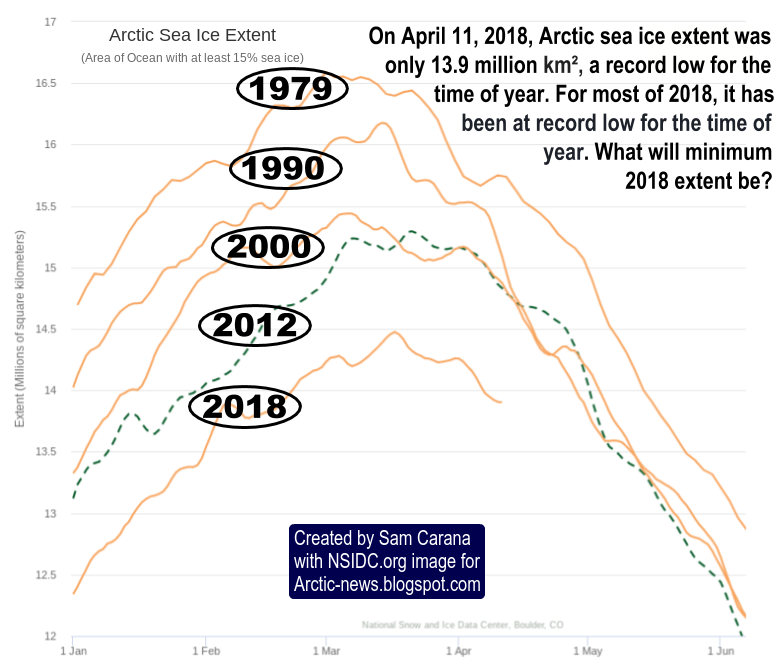
Anthony, I see someone did try to get the DMI’s Arctic Temperature graph on the Sea Ice Page to update after I mentioned the problem a few weeks ago, but now it’s stuck at about Day 55 or so and still isn’t updating on a daily basis. Since it’s the basis of the discussion here today I thought I’d mention it again.
It’s a worthwhile exercise to click the DMI link below the graph in the article and then click through all the years from 1958 to 2018. Unquestionably, the 1960’s experienced far colder winters in the arctic than recently with winter months consistently falling below the 1958-2010 average line. Then for about 30 years, up to 2000, it’s hard to detect any consistent trend away from the average. After 2000, more and more years see winter temps above the average with the last few years being especially warm. 2016 was noteworthy.
The summer months are constrained by the melting ice and summer temps track quite close to the average for the entire six-decade time frame.
P.S. For the conspiracy-minded, the 2002 graph shows overlapping of blue and red lines when I believe the measurement system was transitioned to a new methodology, right before things really started to warm up. Personally, I doubt there has been any tinkering but thought it was worth noting.
With the exception that the Arctic Sea is still covered with ice every winter, and the temps are still FAR BELOW freezing, whats your point? Sea ice freezes and melts, over and over and over and over. That is what it does and humans are not effecting it at all. Unless you want to count all the Russian, Norwegian, Canadian and Chinese icerbreakers churning their way through it, when it finally gets thin enough in that window of a few months each year. My favorite in recent years was the Russian CNG tanker which had to be abandoned and left to breakup when it got caught in the sea ice in August. Bet that effected the sea ice coverage for about 10 minutes as the wreckage burned while being consumed by that helpless sea ice.
Rod, I think you are right on. It’s the less cold winters that are creating less mass of ice; since in the summer roughly the same mass of ice melts, the net mass change is negative because of winter, not summer.
You can’t deal with Apparatchiks and their minions from the press. Just ignore them.
A very important point to consider in regard to Arctic temperatures is that there has been a dearth of drifting buoy observations in the Arctic this winter, especially those with reports being relayed in the global synoptic data network in near real-time. This winter there were no synoptic reporting buoys within 7 degrees of the North Pole and the closest air temperature measurement location was actually the land station at Kap Morris Jesup (04301) at the northern tip of Greenland, about 6.5 degrees south of the North Pole (or about 450 miles). All inferences of temperature near the North Pole this winter have been derived from weather models like GFS and ECMWF, which are better than nothing, but no match for having reliable measurements.
I found additional buoy reports that were not in the synoptic reporting network available in near-real-time here (and historical data too), but none with air temperature close to the North Pole:
http://iabp.apl.washington.edu/maps_daily_table.html
I don’t know if data from any of these additional buoys are later ingested into the Reanalyses for the GFS and ECMWF. However, I found that some of the few Arctic buoy reports in the synoptic network were incorrectly reporting the hull temperature as air temperature. Most buoys have both air and hull temperatures when they are first deployed, but over time one or both sensors fail. When the buoys are trapped in ice, the hull temperature is often much higher than the air temperature when both are available. The hull temperature yields water temperature when no ice is present, or ice temperature when the hull is trapped in ice.
An additional problem in cold climates is that rime icing can encapsulate air temperature sensors in ice, making them tiny igloos that are insulated from colder air outside the ice covering. This problem causes sensors to read too high when outside air is very cold and too low when outside air temperatures go above freezing initially and until the ice melts. Effectively, getting accurate air temperature measurements in the Arctic is a difficult challenge, but you’d think with all the fuss about a recently warming Arctic there would be more and better measurements and not fewer and lower quality measurements.