Guest Post by Willis Eschenbach
Reflecting upon my previous post, Where The Temperature Rules The Sun, I realized that while it was valid, it was just about temperature controlling downwelling solar energy via cloud variations. However, it didn’t cover total energy input to the surface. The total energy absorbed by the surface is the sum of the net solar energy (surface downwelling solar minus surface reflections) plus the downwelling longwave infrared, or DWIR. This is the total energy that is absorbed by and actually heats the surface.
According to the CERES satellite data, globally, the solar energy absorbed by the surface averages 162 W/m2. The downwelling longwave averages 345 W/m2. Conveniently, this means that on average the earth’s surface absorbs about a half a kilowatt per square meter on an ongoing basis. (And no, I have no interest in debating whether downwelling longwave radiation actually exists. It’s been measured by scientists around the world for decades, so get over it, Sky Dragons. Debate it somewhere else, please, this is not the thread for that.)
Let me note in passing that a doubling of CO2, which will increase the DWIR by something on the order of 3.7 W/m2, and which it is claimed would lead to Thermageddon, would be less than a 1% change in total downwelling radiation at the surface … which would easily be offset by a small change in total cloud cover. But I digress.
Here is the correlation between temperature and total surface absorption.

Figure 1. Correlation of total surface absorption with temperature.
Note the similarity to the previous graph showing just the correlation between surface temperature and downwelling solar energy at the surface.
Now, to explain how this can happen I need to take another digression. I was attracted to the study of the climate, not by questions about why the temperature was changing so much, but by why it was changing so little. As a man with some experience of heat engines and governors, I found it amazing that the temperature of such a possibly unstable system could only have changed by ± 0.3°C over the entire 20th century. Why should such a world, with clouds appearing and disappearing, with huge volcanoes popping off every few decades, with winds going up and down, with storms and hurricanes appearing and vanishing, why would it be so stable in the long-term? So I started looking for some long-term kind of feedbacks that could explain it.
I was living in Fiji at the time. After literally months of fruitless searching and thinking about long-term slow feedbacks, one day I thought “Hang on. I’m looking at the wrong end of the time spectrum.” What I realized was that if there was something that kept the daily temperatures from going outside a certain range, that would, in turn, keep the weekly, monthly, annual, decadal, centennial, and millennial temperatures from going outside that same range.
And because I was living in Fiji, the answer was right above me. The daily tropical weather typically looks like this: clear at dawn, clouding up with thermally-driven cumulus clouds in the late morning, perhaps thunderstorms in the afternoon if the day is warm enough, clearing some time after dark. Lather, rinse, repeat, as they say.
I also realized that there were two variables in that scheme—the time of onset of the cumulus clouds and the thunderstorms, and the amount of each of them. I hypothesized that these factors were what controlled the tropical temperature. Since then I have amassed a lot of evidence that my hypothesis is correct, including this post and its predecessor.
There are some important things to note about this process. First, the time of the emergence of the cumulus fields and the thunderstorms is NOT dependent on total forcing. Instead, they are responding to surface temperature. When the surface is cool at dawn, clouds form later, and more sunlight comes in, warming the surface. When the surface is warmer, clouds form earlier, throttling the energy input to the system, and cooling the system back down.
As a result, the system is not affected by small changes in insolation. For example, if a volcanic eruption reduces the amount of sunshine making it through the stratosphere, the tropics cool. And when they cool, clouds form later, letting in more sunlight, and rebalancing the system.
Next, the response is based, not on average temperatures, but instantaneous temperature. As such, it is obscured by monthly or yearly temperature averages.
Finally, the response is immediate. There is no lag of days, weeks, or months. As soon as the temperature crosses some given threshold, clouds form immediately, cooling the surface. This effect is so powerful that although the morning sun is growing stronger and stronger, when the clouds kick in, the temperature can actually drop. Here’s a graph of the long-term average daily swings of a number of TAO buoys spread across the Pacific. Here are the locations of the buoys. I’ve used those on the equator because they have the most data. The TAO buoy data is available here. 
Figure 2. Locations of the TAO buoys
These readings were taken by the automated buoys every ten minutes.

Figure 3. Daily average temperatures, equatorial TAO buoys.
In the cooler areas at the bottom of the graph, the onset of the morning cumulus field merely slows the daily warming. But in the warmer areas, when the clouds appear, the temperature actually drops. The differences can be seen clearly when they are expressed as anomalies about their individual average values, viz:

Figure 4. Daily temperature anomaly variations, equatorial TAO buoys.
Note that this “overshoot”, the ability to drive the temperature below the local initiation temperature threshold, is critical to controlling a lagged system such as the climate. It is also present in thunderstorms. They generate their own fuel once they are started, allowing them to cool the surface below the initiation temperature threshold.
Next, I divided the days into those which were warmer than usual from midnight to 5 AM, and compared them with the days which were cooler than usual during that same time span. Here’s the result:

Figure 5. Averages of warm and cool days, one of the warmest TAO buoys
This shows the temperature control in action at one of the warmest TAO buoys. On days which start out warmer than normal, the clouds and thunderstorms form earlier and more strongly. By evening the temperatures cool towards the average value. The opposite happens when the temperature from midnight to 5 AM are cooler than usual—cumulus form later and more scattered, thunderstorms may not form at all. And as a result, the surface warms towards normal.
With that understanding, we can take another look at the graphic in Figure 1, which I reproduce here:

Consider that this is a long-term average. This means, for example, that temperatures in the green and light yellow areas immediately outside the gray lines are not really slightly correlated with the total downwelling radiation.
Instead, it means that the number of days during which they are negatively correlated is slightly less than the number of days when they are positively correlated. However, this average conceals an important fact—the negative and positive correlations are not randomly distributed.
Instead, emergent phenomena like cumulus fields and thunderstorms occur earlier and more strongly exactly when and where the surface is hot. So those areas around the gray outlines of negative correlation are doing the same thing as the areas within the gray outlines—cooling down the hottest days and warming up the coolest days. The only difference is that the warm days are less frequent than inside the gray outlines. This puts limits on how much analysis we can do using averages, as I highlighted in “The Details Are In The Devil“.
In conclusion, let me say that the emergence of the tropical cumulus fields and associated thunderstorms are not the only temperature-linked phenomena which participate in global temperature regulation. Other phenomena include dust devils, squall lines, the Atlantic Multidecadal Oscillation, the El Nino-La Nina pump, cyclones, and the Pacific Decadal Oscillation. Likely more as well …
Me, I’m sitting on a hill in the Solomon Islands on what is scheduled to be my last day here … you’re welcome to read about it, along with the story of the Crocodile and Tufala Panadol over at my blog, Skating Under The Ice.
Best of life to all,
w.
My Strong Advice: When you comment, please QUOTE THE EXACT WORDS YOU ARE DISCUSSING so that we can all understand your thoughts and objections. Be forewarned that I’m likely to ignore your claims, hold you up to ridicule, and generally rubbish your name if you don’t have the polite kindness to quote someone’s words. I’m fed up with people saying things like “I disagree strongly with what you said”, when it is not clear who “you” is and it is totally unknown which of their statements the commenter disagrees with. If you wish to refute someone’s ideas, you need to QUOTE THEIR WORDS, and the TELL US WHAT IS WRONG WiTH THEM. Anything else is handwaving and with be referred to as such.
FURTHER READING:
Albedic Meanderings 2015-06-03
I’ve been considering the nature of the relationship between the albedo and temperature. I have hypothesized elsewhere that variations in tropical cloud albedo are one of the main mechanisms that maintain the global surface temperature within a fairly narrow range (e.g. within ± 0.3°C during the entire 20th Century). To…
An Inherently Stable System 2015-06-04
At the end of my last post, I said that the climate seems to be an inherently stable system. The graphic below shows ~2,000 climate simulations run by climateprediction.net. Unlike the other modelers, whose failures end up on the cutting room floor, they’ve shown all of the runs ……
The Tao That Can Be Spoken … 2011-08-14
As I mentioned in an earlier post, I’ve started to look at the data from the TAO/TRITON buoy array in the Pacific Ocean. These are an array of moored buoys which collect hourly information on a variety of environmental variables. The results are quite interesting, because they relate directly to…
TAO/TRITON TAKE TWO 2011-08-25
I wrote before of my investigations into the surface air temperature records of the TAO/TRITON buoys in the Pacific Ocean. To refresh your memory, here are the locations of the TAO/TRITON buoys. Figure 1. Locations of the TAO/TRITON buoys (pink squares). Each buoy is equipped with a sensor array measuring…
Cloud Radiation Forcing in the TAO Dataset 2011-09-15
This is the third in a series ( Part 1, Part 2 ) of occasional posts regarding my somewhat peripatetic analysis of the data from the TAO moored buoys in the Western Pacific. I’m doing construction work these days, and so in between pounding nails into the frame of a building I continue to…
TAO Buoys Go Hot And Cold 2015-06-16
I got to thinking about how I could gain more understanding of the daily air temperature cycles in the tropics. I decided to look at what happens when the early morning (midnight to 5:00 AM) of a given day is cooler than usual, versus what happens when the early morning…
ptolemy2
December 22, 2017 at 11:54 am: Now you’re talking! This suggests changes in ocean energy net absorbance such as we have been looking for since Bob Tisdale elucudated the Enso discharge-recharge actions. Weaker Ninas may mean less input, vice-versa Nini Modoki less output, but it remains debatable, all of it…..
The daily morning evaporation and night condensation cycles may be a huge and continuous mover of energy to where it can be radiated out, past the lower atmospheric soup.
error – Nina Modoki, not ninny (Freudian?)
“When you comment, please QUOTE THE EXACT WORDS YOU ARE DISCUSSING so that we can all understand your thoughts and objections.”
OK: “I’m sitting on a hill in the Solomon Islands”
I strongly object to the fact that you’re there and I’m here freezing my butt off.
Merry Christmas.
Interesting and enjoyable discussion. Drier Texas barrier islands, which heat up fast, produce such clouds in the summer, but rarely produce rain. Maybe larger topography at work moving moisture to Louisiana where it is not needed. The waters are saltier, and have to wonder how much gets in the clouds. Harvey produced some rust problems, not altogether unusual in area even with normal winds.
However, it’s Texas, probably adiabatic advectory. Merry Christmas!
(And no, I have no interest in debating whether downwelling longwave radiation actually exists. It’s been measured by scientists around the world for decades, so get over it, Sky Dragons. Debate it somewhere else, please, this is not the thread for that.)
345 W/m2 would make a nice input 24/7/ 365 for solar panels facing straight up. It is easy to make a panel which absorbs infra-red. Funny how no one does this…
Michael Moon December 22, 2017 at 3:50 pm
Michael, sadly, you couldn’t be more wrong. Nobody knows how to make a “solar panel” that absorbs thermal, aka “far”, aka “longwave” infrared. This is for a simple reason. Thermal infrared does NOT have enough energy to kick any known electron out of its orbit, which is a requirement for a photo-electric device.
Don’t quit your day job …
w.
PS—This is why I discourage such discussions. They tend to attract people like yourself who are absolutely positively sure enough of their position to make sarcastic remarks like “Funny how no one does this …”
In fact what is funny is you foolishly and yet so earnestly claiming it can be done. I say again, this is not the thread for that subject.
Any known electron out of its orbit.
No one has researched such a semi-conductor, because there is no energy source there. The Sun is over 5500 K. The sky is about 220-230 K. Kind of thing that makes you go, Hmmm…
Passive solar energy technology is also practiced widely.
Quote “Thermal infrared does NOT have enough energy to kick any known electron out of its orbit”.
Or to do any other kind of “Work” at the surface of the Earth for that matter, and LWIR from a cold object does not make warmer objects warmer either.
They can lead to a warmer object ending up warmer, but only if the 2 objects reach Eqilibrium and the Colder object has replaced an even colder object which would have meant an even lower Equilibrium.
At no time does the Warmer object’s temperature exceed it’s starting temperature.
During the Day/Night cycle at best it can only slow the cooling of the warmer object, God forbid that the Earth’s Surface and CO2 at -20C to -180C ever reach Equilibrium, we would not find it very comfortable.
Michael Moon December 22, 2017 at 4:30 pm
Any known electron out of its orbit.
No one has researched such a semi-conductor, because there is no energy source there.
There’s plenty of energy there, ~300W/m^2, the problem is it’s packaged in photons which individually don’t possess sufficient energy to ‘kick out’ an electron. It was the discovery of this phenomenon which led to the development of quantum mechanics, it’s called the photoelectric effect, i.e. Einstein’s 1905 paper which won him the Nobel Prize.
Exactly and as you say, they would work 24hours a day, 365days a year.
Willis says “Nobody knows how to make a “solar panel” that absorbs thermal, aka “far”, aka “longwave” infrared.” It’s because you can’t transfer energy from the cold atmosphere to the warm surface of the earth.
Phillip, you can transfer it OK, as I am sure the some photons reach the Earth from CO2, it just does absolutely no “work” whatsoever, especailly that of warming a warmer object.
It is however very good at Cooling Objects as in a Solar oven tuning in to a Night time Fridge, but Mr Eshenbach doesn’t believe that it has anything to do with “Downwelling Radiation”.
I am still not sure how a Warm object knows to send so many extra photons to a cold object when it is placed near it and make itself colder, when it carries on sending the normal number of photons to all the ambient objecst around it.
Is cold a Hot Photon Magnet?
My silly experiments do one thing.
They confirm EXACTLY what the Equations say will happen confiming the Second Law.
Energy is transferred and absorbed, but only the cooler object warms.
If all energy thermalises why do none, not one single experiment demonstrate any for the hot object, not even a little bit.
But they demonstrate cooling of the hot object and thermalising of the cold object.
You just can’t see it can you?
Take 2 objects at the same temperature of 62C (335K) as in my experiment, according to the first equations for output that is 10.05W/m2, a small amount, but detectable by your skin for each one.
That energy output when placed very close together does nothing to raise either objects temperature.
Plug the values in to the second equation and it says 0, yes zero transfer exactly as I found.
But change the second item to ambient at 20C and the transfer is 8.8W/m2 and cooling increases dramatically for the hotter one.
So what happened in the first case to the 10.5W/m2 going from object 1 to object 2 and the same energy going from object 2 to object 1.
Why didn’t their temperatures change, according to you those photons must be absorbed and the temperature increased?
You see everybody agrees and that includes Mr Eschenbach that they do not get hotter, it just slows the rate of cooling.
So where are the 21W/m2 of energy?
It appears I posted in the wrong place.
So here goes again.
If all energy thermalises why do none, not one single experiment demonstrate any for the hot object, not even a little bit.
But they demonstrate cooling of the hot object and thermalising of the cold object.
You just can’t see it can you?
Take 2 objects at the same temperature of 62C (335K) as in my experiment, according to the first equations for output that is 10.05W/m2, a small amount, but detectable by your skin for each one.
That energy output when placed very close together does nothing to raise either objects temperature.
Plug the values in to the second equation and it says 0, yes zero transfer exactly as I found.
But change the second item to ambient at 20C and the transfer is 8.8W/m2 and cooling increases dramatically for the hotter one.
So what happened in the first case to the 10.5W/m2 going from object 1 to object 2 and the same energy going from object 2 to object 1.
Why didn’t their temperatures change, according to you those photons must be absorbed and the temperature increased?
You see everybody agrees and that includes Mr Eschenbach that they do not get hotter, it just slows the rate of cooling.
So where are the 21W/m2 of energy?
Michael, as Mr Eshenbach says, no one knows how to make an Infra Red Panel.
But isn’t it surprising that all those Watts/M2, even more than the Sun’s also can’t warm water in Solar Heating Panels to keep it hot all night.
In fact a Night Radiator Panel is used to Cool Water.
For those of you who think that cold things can’t warm hotter things, i would ask that you lay off the snark long enough to really think long and hard about what your position is and how shallow your statements appear.
You are flat out wrong! You make intemperate comments flowing from word salads of incomplete, seriously over simplified and imprecise language.
I am in a warm house right now, being heated by the cold air outside. Impossible? Well millions of warm homes are heated by winter air and they heat summer air from their cold air conditioning too. It’s called a heat pump.
The magic is very simple. The cold thing and the hot thing are in a system that is NOT ISOLATED. External work is being provided which pumps cold joules into my warm house.
The earth-atmosphere is a system that is NOT ISOLATED. Work is being applied to it constantly. In such a system cold can provide energy to warm all day long.
If you can’t get past that, then you have no business diving into quantum mechanics, or snark for that matter.
Switch off the Electricity completely and see how much warmer your house gets due to Cooler things, work is being done you do not get something for nothing.
You seem to have a major problem accepting Reality, in fact after our last discussions I am not sure why I bother except you are getting at people for having opposing views just like last time
Why the hell don’t you actually try the Experiments for yourself instead of using words like snark.
It will cost you about £35 for a decent Temperature Measuring Device with Probes and many hours of devising objects, waiting and measuring.
Come back with your results as I have done on 3 seperate Threads now.
This is what I have tested
2 cooling objects of the same Temeperature.
2 cooling objects one hotter then the other where both are above ambient Temperature ie one replacing ambient.
2 cooling objects one hot (above ambient) one cold (below ambient).
1 heated object at Equlibrium with ambient & 1 cooling above ambient ie one replacing ambient.
1 heated object at Equlibrium with ambient & 1 cooling below ambient.
both items heated and above ambient, but one cooler than the other ie one replacing ambient.
None of them made the hotter object any hotter by even 0.1C.
The only way that any of these can warm the hotter object is if they heat the air between them thus changing the ambient experienced by the hotter object which is not by Direct Radiation.
I have tested it and does not happen if the air between them is stirred by a low level fan.
So the only thing that happens is the hotter object can cool more slowly and END UP at a higher Equilibrium Temeperature.
If you should find something that works (Please do not go down the light bulb in a box bullshit) let us all know so that we can confirm it and then we can accept what you are saying.
Otherwise stop with the superioriority attitude and stupid analogies.
A.C. you say….
“Switch off the Electricity completely and see how much warmer your house gets due to Cooler things, work is being done you do not get something for nothing”
But that is exactly the point you are always missing. The electricity is the work that pumps the cool things energy into the warm thing. It is not a stupid analogy.
It is exactly what is happening on earth. The sun is providing the work to allow the cool thing to heat the warm thing.
Doing a radiation experiment between two beer cans in air with a fan blowing is not an experiment. It’s a waste of beer.
Not trying to convince you, by the way. Just hoping that your ramblings don’t drag in any innocents who come here to learn.
I have just re-read your last statements.
“Work is being applied to it constantly. In such a system cold can provide energy to warm all day long.”
So you are admitting Back Radiation doesn’t do it.
It requires Work to make it happen.
Thank you.
A.C. says…
“”I have just re-read your last statements.
“Work is being applied to it constantly. In such a system cold can provide energy to warm all day long.”
So you are admitting Back Radiation doesn’t do it.
It requires Work to make it happen.
Thank you.””
Probably a dozen people have said this to you over the last week, in 2 dozen different ways. I am not ‘admitting’ anything. I am REPEATING something which you choose to ignore.
WORK IS REQUIRED TO MOVE ENERGY FROM COLD RESERVOIR TO WARM RESERVOIR.
Nobody in this blog has EVER claimed otherwise, yet you persist in setting up experiments to prove your strawman about warming up your beer on a counter with ice cubes and a fan with foil wrapped round things.
THE SUN PROVIDES THE WORK
OK, got it now, it is absolutely NOTHING to do with CO2 Back Radiation, it is all to do with the Sun acting as your heat pump does.
Great, all we need now is the actual mechanism that does it.
Perhaps you can also provide that.
PS your CAGW mates are not going to be very pleased with you after that statement.
A.C says…
“”OK, got it now, it is absolutely NOTHING to do with CO2 Back Radiation, it is all to do with the Sun acting as your heat pump does.
Great, all we need now is the actual mechanism that does it.
Perhaps you can also provide that.
PS your CAGW mates are not going to be very pleased with you after that “”
It has everything to do with back radiation. That’s the cold thing. Earth surface is the warm thing. Insolation is the work thing. You want the math? Willis has provided it in wonderful examples at least twice.
You are wrong about my AGW proclivities. I am strongly in the camp that believes CAGW is bad science. I don’t believe you fight it with more bad science, however. That is what many people who deny CAGW are pushing and what you have bought in to.
Redirect your passion for experimentation to first understanding the 100 years of thermodynamic practice you are trying to wash away.
Who knows, you could be on to something but it is evident in your writings that you don’t yet understand what you are trying to disprove.
Believe it or not we’re in the same school and if you come up with an experiment with significant results you will find great support here no matter what it proves. But it must be based on sound principles for both the science in play and your lab techniques.
You just can not do valid radiation experiments in atmosphere with a fan on your subject and tin foil tents. You can not get provable results that way.
It has everything to do with back radiation. That’s the cold thing. Earth surface is the warm thing. Insolation is the work thing. You want the math? Willis has provided it in wonderful examples at least twice.”
You obviously missed the fact that I used the Equations.
They will tell you how much energy is leaving each object.
The second one will tell you how much energy is transferred from the Earth’s Surface to the CO2, but when you use it to find out what the energy transfer is in the other direction it give a massive Negative value.
Because that is what happens. Although the first part of the equations tell you how much energy is leaving the Cold Object it causes no Heat Gain, as in measured by it’s Temperature in the Hotter Object, it only cools.
PS there is no insolation work thing at night, someone switched it off, just like I suggested you do with your house work thing.
I did miss your equations. Could you point them out to me in this post?
As for night time, well i don’t think the sun stops at night. Copernicus pretty much put that one to rest.
That is because they are not on this post, they are on the previous post on the same subject.
They are not my Equations they are the ones posted by Ed Bo and Mr Eshenbach and working examples are shown on the Link provided by both
Strangely none of the examples show how the Cooler object makes the hotter object hotter, they only show the Heat Transfer between the Hot to the Cold. The energy from the Cold to the Hot object is glossed over by saying “The Energy from the cold object is absorbed by the hot object”, absolutely no mention of it being Thermalised and raising the temperature of the hot object.
I used the nice Calculator provided by Mr Eshenbach to double check my results and they do so.
Watts/M2 output by Surface at 288K = 390
Watts/M2 output by CO2 at 223K = 140
Transfer of Energy from Surface at 288K to CO2 at 223K =+250W/m2.
Transfer of Energy from CO2 at 223K to Surface at 288K = -271W/m2.
You can check the values for yourself here
http://www.efunda.com/formulae/heat_transfer/radiation/calc_2bodies_enclosure.cfm
And just for clarity plugging in the Steel Greenhouse when the Shell reaches 120K
Sphere to Shell = +56688242 W/m2
Shell to Sphere = -113376485.4 W/m2
As to your vapid remark about the Sun, tell that to the Night Side of the Surface that it shouldn’t be cooling because the Sun is shining on the other side of the world.
Or to the Dark Side of the Moon at around 90K, that it should warm up because the sun is shining on the bright side.
My silly experiments do one thing.
They confirm EXACTLY what the Equations say will happen confiming the Second Law.
Energy is transferred and absorbed, but only the cooler object warms.
As the Energy out is directly controlled by the Temperature it means that no rise in heat means no increase in output either, as is proposed by Phil up thread when he quotes the Steel Greenhouse fantasy physics prcatically doubling the output of the surface to CO2.
Your calculator link describes a system of two isolated bodies inside a shell. That is not the system in the steel greenhouse. It is not the system of earth-atmosphere. If does not have a warm body energy source.
B.T.W. all of the figures being used in these discussions are average flux values that are valid over reasonable integration intervals, i.e. long enough that daily, seasonal, or even annual variations are averaged out. No fair making the sun set.
Also, saying that ‘being absorbed’ somehow glosses over ‘thermalization’ is a slayer trick. They claim cold IR gets inside a body, wanders around and leaves without doing anything.
Absorbed energy is in the energy budget of the absorber. It can’t get out by magic.
The entire thermalization strawman is a diversion required by slayers to explain where BR goes.
Your reading comprehension has failed you again.
It is not my Calculator, it is Mr Eshenbach’s.
He provided it and I used it, it is not my fault if it is inappropriate.
So take it up with him.
But you should notice that the Equation it is based on is the Exact one he showed along with the link on his post.
As to using “Averages”, they can be used to hide a multitude of sins, and additional information.
Like ignoring night time cooling.
If all energy thermalises why do none, not one single experiment demonstrate any for the hot object, not even a little bit.
But they demonstrate cooling of the hot object and thermalising of the cold object.
You just can’t see it can you?
Take 2 objects at the same temperature of 62C (335K) as in my experiment, according to the first equations for output that is 10.05W/m2, a small amount, but detectable by your skin for each one.
That energy output when placed very close together does nothing to raise either objects temperature.
Plug the values in to the second equation and it says 0, yes zero transfer exactly as I found.
But change the second item to ambient at 20C and the transfer is 8.8W/m2 and cooling increases dramatically for the hotter one.
So what happened in the first case to the 10.5W/m2 going from object 1 to object 2 and the same energy going from object 2 to object 1.
Why didn’t their temperatures change, according to you those photons must be absorbed and the temperature increased?
You see everybody agrees and that includes Mr Eschenbach that they do not get hotter, it just slows the rate of cooling.
So where are the 21W/m2 of energy?
GRR, it is a real pain inding the right place to post today. Last try.
If all energy thermalises why do none, not one single experiment demonstrate any for the hot object, not even a little bit.
But they demonstrate cooling of the hot object and thermalising of the cold object.
You just can’t see it can you?
Take 2 objects at the same temperature of 62C (335K) as in my experiment, according to the first equations for output that is 10.05W/m2, a small amount, but detectable by your skin for each one.
That energy output when placed very close together does nothing to raise either objects temperature.
Plug the values in to the second equation and it says 0, yes zero transfer exactly as I found.
But change the second item to ambient at 20C and the transfer is 8.8W/m2 and cooling increases dramatically for the hotter one.
So what happened in the first case to the 10.5W/m2 going from object 1 to object 2 and the same energy going from object 2 to object 1.
Why didn’t their temperatures change, according to you those photons must be absorbed and the temperature increased?
You see everybody agrees and that includes Mr Eschenbach that they do not get hotter, it just slows the rate of cooling.
So where are the 21W/m2 of energy?
Has it occurred to you that your experimental technique could be a problem, or that you are applying your results incorrectly?
For example I remember one where you added a fan. I remember that none were done in a vacuum. I don’t remember if you ever provided an energy source to warm object. All of these things are problematic. If you are doing these in your kitcben, have you taken the radiation of: the room, your body, your lighting, your electronics?
As to results you have stated emphatically that the only effect you have seen is that a cold body slows the cooling of a warmer one. Yikes! That is exactly the point we have been trying to get you to see.
What you seem to be missing is that you are proving the 2nd law and we are talking about a NON ISOLATED SYSTEM that does not and can not violate the second law because it is not applicable to a system that is undergoing work from an external source.
I can see that you just cannot face facts.
The excuses you are coming up with as to why the Experiments may be wrong are laughable.
The most laughable of all is that I did not do them in a vacuum.
Which part of the Earth’s Surface and the TOA is in a Vacuum exactly.
The only criteria is that it all takes place in the AIR, just like all the Downwelling Radiation and the Surface.
The only part that doesn’t is the Solar input at the TOA, which has absolutely nothing to do with Heat Transfer between 2 objects within the Atmosphere.
Sorry, I will no longer waste time discussing the subject with you.
The point of the vacuum is to ensure you are setting up your subjects to be isolated from all the influences that are superfluous to the subject under investigation.
If you don’t do that then you must account for all those extraneous heat transfers in the setup. When you don’t isolate from, or account for those things you haven’t created a repeatable experiment to make your point.
Sorry. Thought you might have known that.
For example, the fan blowing on your beer cans might just create more conductive flow than radiation flow. The radiation from your own irradiance might overwhelm the radiation transfer you are investigating. The distances involved in your set up will influence conduction flows. The nature of surfaces will be influential.
I have never in my life seen anyone clutch at as many straws as you.
Your latest explanation of what I could be doing wrong is another ridiculous one.
The Hotter Objects were at EQUILIBRIUM with the fan running, get it, any Blowing away had already been accounted for.
Why don’t you just give up you haven’t got a clue what you are talking about and are making a foot of yourself.
Do you actually think that anything happening in the Atmosphere does not have to accommodate many more variables than I am introducing and yet you still try to trash simple tests that should show warming, that have absolutely no trouble demonstrating the expected cooling.
Just go away with your stupid straws, you are really starting to annoy me now the novelty has worn off.
For system with insolation i, surface radiation s, output radiation o, and back radiation b, with an atmosphere that exhibits a returned surface radiation percentage A. Assume b and i are absorbed at the surface and reemitted with no loss.
This is the math…
Surface radiates
s = i+b
Back radiation is
b = sA
b= (i+b)A
b-bA=iA
b=iA/(1-A)
Surface radiates
s = i+b
s = i + iA/(1-A)
Output radiation is
o = s(1-A)
o = [ i + iA/(1-A) ] (1-A)
o = i – iA + iA
o = i
For A=1, total reflection, surface explodes.
For A=0, total transparency, s=i=o and b=0
For all 0<Ai>o and b not=0
Try it with i=240 and A=0.3846. You’ll get b= 150, s=390, o= 240
You have been experimenting with i=0 and everything bathed in unknown radiation from your lab so while theoretically at equilibrium i=0, b=0, s=0, o=0, a not very meaningful or satisfying result, you will never get there because your whole experiment will flat line at room temperature.
The really important thing here is that all of the above is based solely on first principles, conservation of energy. You don’t have to invoke quantum mechanics or IR or photon interactions. Nothing. It works with demonstrable contemporary measurements.
Anyone who declares an alternative to this math and accompanying assumptions must show that their theory/assumptions does not provoke violations of this first principle analysis!
You are free to proclaim that BR does nothing or even that it doesn’t exist. Just remember that whatever you come up with must obey this simple set of equations while acknowledging the contemporary measurements.
You are free to proclaim that your experiments disprove all this too. I expectantly await your new theory with the math that shows us how it all works.
Paul Bahlin, has anyone ever told you that you haven’t the first idea what you’re wittering about?
I haven’t seen such a heap of old donkey droppings as your posts for a very long time!
Admit it, you’re just taking the p!ss, aren’t you?
Pounding the table means ya’ got nothin’
catweazle666 December 24, 2017 at 2:18 pm
TRANSLATION: In other words, the Weasel can’t find one single thing in Paul’s post that he can quote and show is wrong … so instead he turns nasty and starts throwing mud.
Folks, if you wish to refute someone’s claim, saying it is “donkey droppings” just makes people point at you and laugh. The only way to refute what Paul says is to QUOTE WHAT YOU THINK IS WRONG and then TELL US WHAT IS WRONG WITH IT.
You seem to actually believe that throwing excrement at Paul affects his reputation and not yours … bad news …
w.
”TRANSLATION: In other words, the Weasel can’t find one single thing in Paul’s post that he can quote and show is wrong … so instead he turns nasty and starts throwing mud.”
So let’s see shall we, Eschenbach?
”External work is being provided which pumps cold joules into my warm house….
In such a system cold can provide energy to warm all day long….”
And that utter BS is just from one post.
Heh, ”…cold Joules”…”cold can provide energy to warm”… Yeah, right!
Prat.
Tens of million heat pumps are heating homes today, pumping energy from cold outside air into warm and cozy houses at half the energy required for conventional furnaces. Hundreds of millions of refrigeration units and air conditioners do the same thing all over the world.
They all pump from cold to hot all day long.
Someone who doesn’t know that is astoundingly ignorant. Or, maybe just a troll. Calling me stupid for pointing it out? Well that’s just priceless.
“Tens of million heat pumps are heating homes today”
And even more cooling electronic systems and microprocessors, of course.
Joules are joules, they are no more hot or cold than they are red or circular.
And heat pumps pump from hot to hotter, I have dealt with them in applications where the inputs were at some hundreds of of degrees centigrade and output radiators were red-hot, and I was dealing with solid state Peltier effect pumps in microprocessor applications decades ago.
So go teach your grandmother to suck eggs.
Is that all you’ve got?
Sad
http://bitsocialmedia.com/wp-content/uploads/2013/07/Internet-Troll.jpg
You failed in setting the parameters right at the beginning.
You used the word ASSUME.
There is no assume, b may be absorbed by the surface, but as I keep on keeping on showing, it does nothing to the surface temperature, which is the ONLY thing that controls the output.
There is no
i + b
Or are you suggesting that all the b photons go in and back out so fast it is impossible to measure a change.
In which case it still hasn’t done anything to the surface temperature.
Because if there was the temperature would go up and I have shown that that does not happen, the Equations say it does not happen, I have told you before the maths may be perfectly Ok, but it is useless if incorrectly applied.
Just like your stupid cash flow analogy, it does not consider debt and it does not consider unacceptable money or IOUs which all exist in the real world.
I can assume anything i want. That’s how science works. You assume a set of constraints, build the math to describe it, then test it in the real world.
My test is that this set of assumptions and equations perfectly conforms to what we observe with contemporary measurement.
You are doing the same thing. You are assuming back radiation does nothing. That’s fine. The next step is to build a mathematical representation to describe your theory using your assumptions. Then test it.
You’re testing it without a mathematical representation and that’s fine too. Many a discovery has been made by raw experimentation and even sometimes by accident. But, when you reach a point where you are convinced that you are onto something, and you appear to be there, then you must describe what you have found with more than handwaving or digs at the opposing theory.
I am waiting, at this point, for your equations. It aint hard. I’ve shown you mine.
Mr Bahlin, you have spent too much time around Mr Eshenbach, your Ego, Hubris, Superiority Complex, Condescension are almost as bad as his.
Unlike you I do not need to make up fantasy Science to apply fantasy maths to.
I just used the good Old Fashioned Equations supplied by Actual Scientists that Ed Bo and Mr Eshenbach referred me to.
They show Energy Output, Heat Transfer and that Energy Output does NOT = Heat Transfer unless it is from a Hot Body to a Cold Body.
You seriously need to get over yourself.
Ok so no math then. I await your prize
Back when I was a soaring pilot the moment when cumulus clouds began to form in the morning was a very big deal. It meant the difference between a jolly afternoon zipping along the cumulus cloud streets and a short 20 minutes and back on the ground.
Willis, We should over decades be able to measure the clouds coming up earlier, if co2 is a forcing ?
Do the satellites and data exist to test the hypothesis ?
Well, Stevek, you should, over decades be able to measure the clouds coming up earlier if the global temperature was going up over that time period. Not sure what that would tell you about CO2 though (unless you are convinced that CO2 and only CO2 drives temperature in which case, why bother, you already have all the answers)
SmartRock, I suppose clouds coming up earlier would point to something is causing them to come up earlier. It could be higher temps. The higher temps could be caused by c02 or some other factor.
stevek December 22, 2017 at 4:59 pm
Good question. Not as far as I know. Some problems. First, the change in CO2 during the satellite era equals a forcing change of a watt/m2 or so, and in the tropics total downwelling radiation is 600 W/m2.
Next, the only dataset that comes even close is the TAO buoy dataset, and the funding and maintenance have been drying up for those buoys.
Finally, we don’t know how much of a change in forcing there might be from other sources (volcanoes, aerosols, dust storms, etc.)
w.
Very interesting, thought provoking post, Willis. Creative use of public domain data. Thank you.
Quite a few one-dimensional comments though (not unusual and not unexpected in an open blog)
Just can’t believe in a hypothesis where the only source of cooling for earth is through IR radiation to space and adding more of an IR radiant is going to heat things. How about the low ability of nitrogen and oxygen to radiate because of their dipole nature allows them to hold on to this energy longer and they are in fact the greenhouse gasses.
“… the low ability of nitrogen and oxygen to radiate because of their dipole nature…”
Those atoms possess no dipole moment (what you term dipole nature).
Whoops – Should be diatomic (N2, O2)
Very Interesting, makes perfect sense. Kind of reminds me of a similar phenomena of the dew point. As the radiational cooling causes surface temperature to fall below the dew point and condensation forms, which releases heat and raises the surface temperature slightly above the dew point. The transitional states of H2O are no doubt a magical regulatory process that make the climate of this blue marble we live on so stable.
I’ve made some observations with regards to fog over a couple of rivers that I have pondered for years and wonder if those observations could be pertinent to satellite readings.
Case one is a dam release that occurs for power generation in hot summer afternoons where general air temp is in the 90’s F and measured water temp is very low 40’s F. there will be a layer of cold fog about 5 ft thick over the river for about 2 – 4 miles. You can reach your hand up and feel the 90 F air while the fog bank may be around 50 +/-. Visibility in the fog is about 15 – 20′ max and you need to periodically stand up to view the shoreline to see where you are in the river. I assume this is caused by the cold water and humid air above it causing the moisture in the air to condense. It’s quite a treat the first few times you float this stretch of moving water.
The second case is the opposite. On a different river on some nights when the river temp is warm (75 – 80 F ?) and air is still after dusk you can see the plumes/streams of moisture rising off the water as the fog begins to form (much lighter than where the fog formed from air air above it as noted earlier). Its really interesting to visually see the streamers of moisture rising in the light’s beam. There’s a lot of it. The river is a drop-pool character so the water is continually mixed every 1/4 mile or so. But what atmospheric factor causes the streamers/plumes one night and not the next (a couple of days later) when it seems conditions are similar?
The thought in my mind on a much larger scale would be is in calm air ocean environment and evaporation of the magnitude as I witnessed in the river and the heat content held by the layer of air near the surface (~ 1 – 15′ or so). Would this layer of high humidity moisture laden air affect the satellite readings. If so, what would be the effect of barometric pressure on a different day with all other things being equal? I guess in a nutshell, is there any chance that a layer of saturated air covering the surface of a body of water would affect a satellite reading for temp or emissions or absorption?
QUOTE THEIR WORDS, and the TELL US WHAT IS WRONG WiTH THEM
the should be then
The letter “i” in the all-caps “with” is in lower case.
You mean like that?
😉
Since CERES is built on top of ERBE, this view of the energy budget is pertinent:
 ?w=1200
Credit: Image courtesy NASA’s ERBE (Earth Radiation Budget Experiment) program.
Thinking about the head post and in context of the ERBE graphic Ron shared it would seem the process described by Willis is likely part of the “carried to clouds and atmosphere” by latent heat [at least partially]. Are there data to quantify how much thermal energy is lofted over the CO2 emission layer? It would seem as though a process the cooled the surface in such a way as demonstrated above were to also help cool the planet we would be able to observe [if we had minute by minute data rather than daily averages]. Or, as Wllis put it, “However, this average conceals an important fact—the negative and positive correlations are not randomly distributed.”
Randy, the ERBE diagram shows the atmosphere absorbs 15% of emitted surface energy,which is added to 16% of incoming solar energy absorbed by the atmosphere. Both are then part of the OLR.
Ron Clutz December 23, 2017 at 6:51 am
It is pertinent, but it is not complete. Why? Because it is only showing the NET energy flows, not all of the energy flows. Here’s my diagram which shows all the energy flows.
It nets out to the same flows as the NASA diagram, but it includes all of the radiation flows, not just the net flow.
w.
The net matters because heat flow is defined as the net difference. Saying back radiation is absorbed by the surface is misleading since the heat flow is the other way.
Ron Clutz December 23, 2017 at 2:47 pm
Misleading? Ron, how do you think they got the net values? You say correctly that heat flow is the “net difference” … but the net difference of what? They didn’t start with the net flows.. They started with the energy flows that you call “misleading”, clearly a wrong move on your planet.
Next, if someone doesn’t know the difference between ENERGY flows and HEAT flows, they shouldn’t be in the discussion …
Finally, the two energy flows in opposite directions are what is actually physically happening. On what planet is describing what is actually physically happening “misleading”?
Regards,
w.
Willis:
Thank you for another stimulating entry.
I agree with the basic thesis and would like to add some numbers. In your energy flow diagram, I would call attention to the orange “latent heat” arrow. I submit that this is where your magic occurs.
From planetary average rainfall, and the fact that 29 w/m^2 produces 1 mm per day, we know that roughly 80 w/m^2 goes to evaporation.
In the moist enthalpy calculation, the ratio of L, the heat of evaporation of water, to RT, the specific heat due to molecular motion, is a staggering 18 to 1. This means that evaporating water consumes large quantities of heat and produces no temperature change, though density does change.
A very interesting paper by Kumar and Arakeri
http://www.sciencedirect.com/science/article/pii/S2210983815001273
shows that natural evaporation can have a rate constant of 33 mm per day (equivalent to 970 watt/sq^m) per 0.1 atm partial pressure difference. For the differences between temperature and dew point typical of Honolulu I find roughly 6 mm per day of evaporation, equivalent to loss of ~180 watts/cm^2.
The impact on vapor density change (which drives convection) from evaporation as compared to heating with an amount Q is significantly less by roughly a factor of Q/ 9R vs. Q/ 5/2 R.
I cannot quantify the factor (heat of evaporation)/heating which would tell us when cloud formation sets in, but the paper by Bond and Struchtrup on evaporation seems to offer come possibilities. https://www.ncbi.nlm.nih.gov/pubmed/15697379
The phenomenon of diurnal cycling you describe for tropical cloud formation is well described by Eastman and Warren. https://atmos.washington.edu/~rmeast/Eastman&Warren_2014.pdf
Thanks again and Merry Christmas to all.
Ron Clutz:
Thank you for posting ERBE’s reasonably realistic view of energy fluxes in the climate system.
What is critically important in the energy budget is the NET heat transport by all mechanisms. The customary “climate science” representation of radiative transfer as a pair of upward and downward fluxes over-idealizes what is actually isotropic radiation by each parcel of matter. They are wholly unconstrained by the energy budget, since ANY pair of opposed fluxes with the SAME net value will do.
In reality, the magnitude of those inseparably-paired components is not set by the FLUX of energy through the system, but by the system’s internal STORAGE of thermal energy, as evidenced by the temperature. Orthodox presentations, such as Willis’, obfuscate that physically crucial distinction and create the popular illusion that LW radiation, rather than moist convection, is the principal means of heat transfer from surface to the atmosphere.
1sky1 December 23, 2017 at 4:57 pm
I say again, as I said to Ron: the “representation of radiative transfer as a pair of upward and downward fluxes” is simply a description of the physical reality. It is not “idealized”, it is how the physics of it actually works. Yes, it is isotropic … but the horizontal part of it is basically net-zero and is left out of such overall budgets.
In fact, what is “idealized” is the flow of heat. We cannot measure that flow, it is an idealized concept.
Oh, please, that’s just silly. We can MEASURE the fluxes, so no, we don’t just get to pick numbers with the “same net value”. Yes, the net upwelling from surface to atmosphere is about 70W/m2 … but that does NOT allow us to claim that the surface is radiating 890 W/m2 upwards and the atmosphere is radiating 820 W/mw downwards. That’s ludicrous.
1sky1, how do you think NASA got the net numbers in the budget Ron put up there? Do you honestly think they measured the net flux? Get real. The very name “NET” should give you a clue … NET means that it is THE UPWARD FLUX MINUS THE DOWNWARD FLUX … are they “over-idealizing” the situation too?
You desperately need to read a thermo text before you embarrass yourself further …
w.
1sky1, much as I respect many posts from Willis, he has a blind spot here, and attacks rather than reconsidering. Radiation is energy all right, but not automatically heat. I get exposed to kwatts of radio waves all the time, but it doesn’t raise my temperature since my body is transparent to that radiation. Radiation is only heat if the exposed material absorbs it. Solar radiation is high energy, aborbed by both land and sea and warmed by it. The bit of far longwave radiation from the cool atmosphere is not comparable. The Trenberth diagram misleads people to think the atmosphere has twice the power to heat earth’s surface.
Ron Clutz December 23, 2017 at 7:04 pm
Wow. Just … wow.
To start with, the human body can and does absorb radio waves. Here’s a typical quote, this one from the WHO:
Your foolishness doesn’t end there, however. You make another equally ludicrous claim:
So … your claim is that LW radiation is NOT absorbed by the land or the sea? Say what?
Kirchoff’s Law says that absorptivity is equal to emissivity. My bible for many things climatish, including the emissivity (which is equal to the absorptivity) of common substances, is Geiger’s The Climate Near The Ground, first published sometime around the fifties when people still measured things instead of modeling them. He gives the following figures for IR emissivity at 9 to 12 microns:
Water, 0.96
Fresh snow, 0.99
Dry sand, 0.95
Wet sand, 0.96
Forest, deciduous, 0.95
Forest, conifer, 0.97
Leaves Corn, Beans, 0.94
In other words, Ron, you don’t have a clue what you are talking about, and on top of that, you are so taken with your own incorrect opinion that you don’t even know that you are talking nonsense. Instead, you seem to believe you’re an expert on the subject.
You’re welcome to continue to parade your ignorance, but my advice would be to ponder the First Rule of Holes … it’s not doing your reputation any good.
w.
Apart from the issue of thermalization of radiation, the blind spots here are numerous. Foremost is the failure to recognize the clear difference between energy and its rate of flow in time, i.e., power. The former can be stored, like money in the bank, or put into flux, like income or expenditure. Sustained power, on the other hand, has to be continually produced. Without additional sources of power, which are absent in the atmosphere, it cannot be multiplied.
To make this crucial point clear to laymen, note that a constant amount of money in the bank–the monetary equivalent of climate equilibrium–is maintained by ANY balance of household income and expenditure. The sustained spending power of a household depends solely on its income, the equivalent of thermalized insolation. No matter how often spouses may exchange checks, the equivalent of radiative exchange between surface and atmosphere, their total income and bank deposits don’t change. These fundamental properties of energy budgets patently contradict the mistaken notion that backradiation is an additional “forcing,” like a “second sun,” peddled by wannabe “climate scientists.”
In arguing that we don’t just get to pick numbers with the “same net value,” Willis totally misses that crucial mathematical point being made about energy-conserving budgets. And he is plainly unaware that all that is measured by pyrgeometers is “the resistance/voltage changes in a material that is sensitive to the net energy transfer by radiation that occurs between itself and its surroundings.” As is the case with much of CERES data, the directional radiative fluxes are not measured, as he claims, but inferred from a set of assumptions. By posting mocking dismissals of scientific basics he merely reveals his own lack of schooling.
” By posting mocking dismissals of scientific basics he merely reveals his own lack of schooling.”
On the other hand, insisting that waste energy that has been rejected can never be used again might reveal a retinal infirmity of your own.
Ouch!
For the record, my example was radio waves, not radar waves which are actually in the microwave part of the spectrum.
1sky1, thanks for drawing some implications often overlooked but obvious when you point them out. Indeed, solar radiation is not only much higher quantum energy, but is also a sustained addition to earth’s energy reserves. Atmospheric IR fluxes are a dissipative process, unsustainable in itself, and thus not a “second sun.” And I take the point of your financial analogy: For the earth as for an household, it is a good thing when the rate of income exceeds the rate of spending. Having energy in reserve comes in handy not only for rainy days, but for cold, snow stormy Christmas days like this one.
Ron Clutz December 25, 2017 at 4:39 am
Thanks, Ron. For the record, “RADAR” is an acronym for “RAdio Detection And Ranging” …
w.
See, there’s the problem with climate modeling in a nutshell. The attribute with the largest partial derivative drives any changes in the output of a function, but also magnifies measurement errors for that attribute. There’s simply no way to accurately measure what actually drives the temperature (which is the clouds), and the attributes you can measure accurately (C02) are largely irrelevant.
In math form:
if T = f(C02) + g(CloudCover) + h(SomethingElse), and the partial derivative of dT/dg(CloudCover) is greater 10 times that of dT/dh(SomethingElse) and dT/df(C02), then you can generally simplify the equation to T = g(CloudCover) when you are looking to see what the change in temperature is going to be due to some natural phenomena.
This is metrology (sic) 101.
Good luck actually measuring cloud cover to 0.1% accuracy.
Peter
“However, it didn’t cover total energy input to the surface. The total energy absorbed by the surface is the sum of the net solar energy (surface downwelling solar minus surface reflections) plus the downwelling longwave infrared, or DWIR. This is the total energy that is absorbed by and actually heats the surface.”
You did not mention the meridonial heat transport. In your new analysis the meridional heat transport in the atmosphere is taken into account by the downwelling longwave IR. But the heat transport in the ocean is missing.
Thanks, P. I am not analyzing where the heat goes after it is absorbed. Part is radiated, part is conducted, part goes into latent heat, part is moved horizontally … I’ve not discussed any of those.
I’m looking at the relationship between temperature and what is absorbed.
Regards,
w.
“Thanks, P. I am not analyzing where the heat goes after it is absorbed. Part is radiated, part is conducted, part goes into latent heat, part is moved horizontally … I’ve not discussed any of those.”
Willis, my point is that you cannot neglect it. The energy balance at the surface is
ASRS+LWSin-LWSout-Thermals= 0
with absorbed solar radiation at the surface ASRS, long wave radiation in and out LWSin and LWSout and Thermals= sensible heat+latent heat. The thermals are equal to the radiation imbalance ASRS+LWSIn-LWSOut and are approximately 0.7*ASRS. The thermals correlate better with ASRS than with LWSIn. Therefore I approximate Thermals= const*ASRS= 0.7*ASRS. Then LWSOut is then given by
LWSout= ASRS*(1-const)+LWSIn
For const=0, I find for CERES 4.0 2001-2016 a correlation factor for avg.globe corr= 0.59. It increases to 0.75 for const = 0.7. This is a little improvement of your analysis. Happy new year!
Atmospheric heat dynamics are sufficiently complex to allow any politically mandated belief system about it to be forcefully imposed by a sufficiently well-paid mafia.
Really Willis?
“In other words, Ron, you don’t have a clue what you are talking about, and on top of that, you are so taken with your own incorrect opinion that you don’t even know that you are talking nonsense. Instead, you seem to believe you’re an expert on the subject.
You’re welcome to continue to parade your ignorance, but my advice would be to ponder the First Rule of Holes … it’s not doing your reputation any good.”
Maybe you should take a break. Enjoy the holiday season.
Extreme Hiatus December 23, 2017 at 7:49 pm
Extreme, it appears you have some objection to what I wrote. However, it is totally unclear what that objection might be. Yes, I get tired of people vociferously insisting that all the physics and thermo textbooks ever written are wrong … so might you if you had to deal with that kind of nonsense day after day.
Ron is claiming that LW IR is not absorbed by land or water. That’s so bad it’s not even wrong, as the most minimum inquiry would establish … but nooo, he sticks to his guns and doubles down on dumb.
I’m not willing to pretend that that is anything but parading his ignorance. I’m not willing to act like his opinion is anything but terminally misguided. Playing along with that nonsense just makes it multiply. I was serious when I told him he’s not doing his reputation any good, and in doing so, I’m trying to improve his reputation …
I’m trying to save a man from his own foolishness, and somehow I’m the bad guy?!? I was just repeating the old maxim:
Finally, I’m enjoying the holiday season greatly … what gives you the impression I’m not?
Best Christmas wishes to you and yours,
w.
==> Willis Eschenbach (December 23, 2017 at 7:26 pm)
Willis,
Firstly, I wish you and yours the very best for the Season and a very Happy New Year! 😉
Willis, I want to question this (Your prioritisation of Kirchhoff’s law), as I’ve tried to get a good answer from other sources (I’m sure there would be a simple and sensible answer, that you might offer. One that I’ve failed to find! 😉
When researching this several years ago, I came across a PHD physicist who retracted a paper because of this exact issue. He had conflated emission and absorption by prioritising Kirchhoff* over Planck**! He had made the mistake of assuming Kirchhoff’s law to be true for all frequencies and materials but this is not the case.
I mention this only because it appears to be an often confused issue, even for the highly trained. I’m not even remotely in the category of these professionals or yourself and that is the point, are we – are you – sure that what you are saying is clearly understood, even by those whom we would expect to know these things?
In my “unwashed” layman’s terms, snow is a white body for sunlight (SW) but a black body for heat (LW). And even in the “IR” spectrum as I understand it, there is some ill-defined overlap between SW and LW.
Willis, in response to Ron Clutz (December 23, 2017 at 7:04 pm) you say:
“Kirchoff’s Law says that absorptivity is equal to emissivity…”
And yet you quote figures for IR emissivity and list fresh snow as 0.99. Yet Ron Clutz had spoken about sunlight*** and therefore, strictly speaking your figure differs from the actual value, which has a maximum of 0.30 absorptivity for sunlight (SW) – that he was presumably speaking of.
The observation of a material-specific (Snow in this case) difference with regard to absorption and emission is not inconsistent with a good emitter simultaneously being a good absorber. The differences is that absorption and emission are dependent on the wavelength range.
In the context provided above, what is it that you are specifically disagreeing with in Ron Klutz’s statement?
cheers,
Scott
*Kirchhoff’s law – “Emission and Absorption are equal”
**Planck’s law – “Emission is dependent upon the wavelength and the absolute temperature”
***”Radiation is only heat if the exposed material absorbs it. Solar radiation is high energy, absorbed by both land and sea and warmed by it. The bit of far longwave radiation from the cool atmosphere is not comparable.” – Ron Klutz
==> Willis Eschenbach (December 23, 2017 at 7:26 pm)
Thanks, much appreciated.
Sorry for the confusion, I didn’t state the full case. Kirchoffs Law says that emissivity = absorptivity at a given frequency. If it doesn’t absorb at that frequency, it doesn’t emit at that frequency, and vice versa.
w.
Willis, you wrote:
This particular subject is apparently one around which you’ve got a real problem wrapping your head. The energy that “actually heats the surface” is the SOLAR heat flux. The SUN heats the surface, Willis. Not the atmosphere. The atmosphere is COOLER than the surface, so does not heat it. The Sun is WARMER than the surface, so does heat it. The DWLWIR is really just a mathematically derived “hemiflux”, its upward counterpart being the surface UWLWIR “hemiflux” (simply directly calculated from the average surface temperature). These two conceptual “hemifluxes” together make up the full RADIATIVE FLUX from the surface to the atmosphere and space. IOW, the DWLWIR is distinctly part of the surface radiative heat LOSS.
Heat IN: Q_sw = 165 W/m^2
Heat OUT: Q_lw + Q_cond + Q_evap = 53 + 24 + 88 = 165 W/m^2
No, it is ASSUMED to do so. THEORETICALLY. All Else Being Equal.
Kristian December 24, 2017 at 5:44 am
The DWLWIR is really just a mathematically derived “hemiflux”,
Except when it’s measured.
Here’s the measured downwards IR flux (in this case measured near the north pole).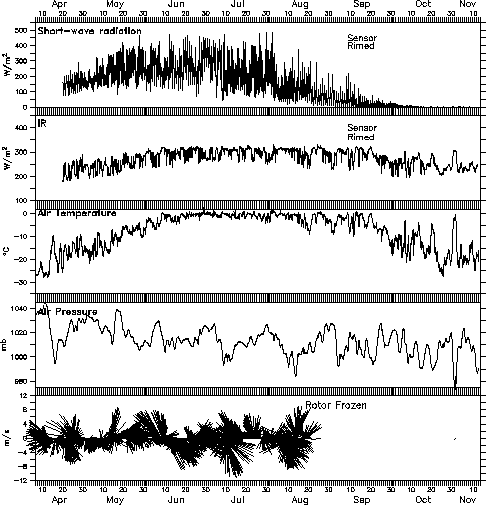
Except it isn’t measured, as in ‘physically detected’. It’s calculated. By the instrument.
Rob Bradley, a description from Wiki.
“A pyrgeometer is a device that measures near-surface infra-red radiation spectrum in the wavelength spectrum approximately from 4.5 µm to 100 µm.
It measures the resistance/voltage changes in a material that is sensitive to the net energy transfer by radiation that occurs between itself and its surroundings (which can be either in or out). By also measuring its own temperature and making some assumptions about the nature of its surroundings it can infer a temperature of the local atmosphere with which it is exchanging radiation.
These instruments generally have no spectral (frequency/wavelength) measurement capabilities – they use a single (non-frequency resolved) resistance/voltage measurement. They are constructed to be sensitive to the infra-red radiation spectrum that extends approximately from 4.5 µm to 100 µm, thus excluding the main shortwave (solar) spectrum.
Since the mean free path of IR radiation in the atmosphere is ~25 meters, this device typically measures IR flux in the nearest 25 meter layer.”
Note the last sentence, does it sound like IR Photons can get from the area of the Atmosphere where they are free of Water Molecules down to th Surface?
Look up “the mean free path”.
Kristian December 24, 2017 at 6:06 am
Except it isn’t measured, as in ‘physically detected’. It’s calculated. By the instrument.
It’s called ‘calibration’, I suppose you think that the temperature measured by Pt resistance thermometers or by Thermocouples is ‘calculated’ too.
A C Osborn December 24, 2017 at 8:18 am
Since the mean free path of IR radiation in the atmosphere is ~25 meters, this device typically measures IR flux in the nearest 25 meter layer.”
Note the last sentence, does it sound like IR Photons can get from the area of the Atmosphere where they are free of Water Molecules down to th Surface?
Why exactly do you think this matters, we want to know the downwelling IR at the surface?
Rob Bradley December 24, 2017 at 8:45 am
Thanks AC, you have addressed my concern with Kristian saying: ” it isn’t measured, as in ‘physically detected’.”
….
Something has to physically impinge on the instrument.
Yes it’s called Infrared light.
Rob Bradley says, December 24, 2017 at 8:45 am:
Yes, the instrument physically detect the instantaneous EXCHANGE of radiative energy at the sensor surface. This is NOT the IR from the cool atmosphere to the warm sensor, much less the IR from the cool sensor to the warm SURFACE of the Earth. The instantaneous exchange produces a voltage which is translated into a flux value. This SHOULD be common knowledge.
Phil. says, December 24, 2017 at 8:48 am:
Time for a simple 101 lesson in how DWLWIR is “measured” in the everyday world for little Phil.
https://en.wikipedia.org/wiki/Pyrgeometer#Measurement_of_long_wave_downward_radiation
“Measurement of long wave downward radiation
The atmosphere and the pyrgeometer (in effect its sensor surface) exchange long wave IR radiation. This results in a net radiation balance according to:
E_net = E_in – E_out
Where:
E_net – net radiation at sensor surface [W/m^2]
E_in – Long-wave radiation received from the atmosphere [W/m^2]
E_out – Long-wave radiation emitted by the sensor surface [W/m^2]
The pyrgeometer’s thermopile detects the net radiation balance between the incoming and outgoing long wave radiation flux and converts it to a voltage according to the equation below.
E_net = U_emf / S
Where:
E_net – net radiation at sensor surface [W/m^2]
U_emf – thermopile output voltage [V]
S – sensitivity/calibration factor of instrument [V/W/m^2]
The value for S is determined during calibration of the instrument. The calibration is performed at the production factory with a reference instrument traceable to a regional calibration center.
To derive the absolute downward long wave flux, the temperature of the pyrgeometer has to be taken into account. It is measured using a temperature sensor inside the instrument, near the cold junctions of the thermopile. The pyrgeometer is considered to approximate a black body. Due to this it emits long wave radiation according to:
E_out = σT^4
Where:
E_out – Long-wave radiation emitted by the earth surface [W/m^2]
σ – Stefan-Boltzmann constant [W/(m^2 K^4)]
T – Absolute temperature of pyrgeometer detector [kelvins]
From the calculations above the incoming long wave radiation can be derived. This is usually done by rearranging the equations above to yield the so-called pyrgeometer equation by Albrecht and Cox.
E_in = U_emf / S + σT^4
Where all the variables have the same meaning as before.
As a result, the detected voltage and instrument temperature yield the total global long wave downward radiation.”
(My boldface.)
No. They’re called IR photons.
Rob Bradley said, December 24, 2017 at 3:54 pm:
Nope. It detects a radiative heat flux. The sensor in question is a so-called “thermal detector”. If the sensor is cooler than the air layers above, then the heat flux is INCOMING, which will induce a positive voltage signal, and if the sensor is warmer than the air layers above, the heat flux is OUTGOING, inducing a negative voltage signal. This is basic stuff that you can find out by simply reading what the manufacturers of these particular radiometric instruments are writing.
Nope. A thermal detector warmer than the air layers above does NOT detect IR from the atmosphere. It detects the radiative flux moving OUT.
Oh, yes there is. “Radiation” can be described MACROscopically, or it can be described MICROscopically. A radiative flux is MACROscopic “radiation”, while photons are MICROscopic “radiation”.
If we’re talking about a pyrgeometer, the sensor (a thermal detector) is “warm”, but not necessarily warmER than the air layers above. A “quantum detector” is a different creature altogether, and is normally cryogenically cooled.
Rob Bradley said, December 25, 2017 at 6:02 am:
*Sigh* No, Rob. What did I just write in my previous comment? “If we’re talking about a pyrgeometer, the sensor (a thermal detector) is “warm”, but not necessarily warmER than the air layers above. A “quantum detector” is a different creature altogether, and is normally cryogenically cooled.”
No, it’s all-important.
Rob Bradley said, December 25, 2017 at 6:15 am:
No. A “photon” can be described as “radiation”, but only in a strictly MICROscopic sense. A “radiative flux”, on the other hand, is “radiation” in a strictly MACROscopic sense. It is the average movement (spatial direction and frequency) of ALL individual photons within some specified part of the universe. As a consequence, a radiative flux is – by definition – UNIdirectional. It moves spontaneously from hot to cold 🙂
Kristian December 24, 2017 at 3:25 pm
Phil. says, December 24, 2017 at 8:48 am:
“It’s called ‘calibration’, I suppose you think that the temperature measured by Pt resistance thermometers or by Thermocouples is ‘calculated’ too.”
Time for a simple 101 lesson in how DWLWIR is “measured” in the everyday world for little Phil.
You can cut the gratuitous insults (a sure sign you’re losing the argument).
The analysis you quoted fro Wikipedia is correct and indicates that the unknown quantity is the LW radiation received from the atmosphere, all other parameters being eliminated by calibration.
Just like measuring the temperature of a flame using a thermocouple, correct for (or design to be insignificant) the conduction and convection from the junction, use a radiation shield to minimize the radiation loss (the biggest error term) or correct for it. If you didn’t do those corrections if you measured a flame temperature at ~1100K your measurement would be about 100K too low.
“Yes it’s called Infrared light.”
No. They’re called IR photons.
Your source refers to it as ‘IR radiation’, I don’t see the need to invoke ‘photon’ since we’re not analyzing the process on the basis of individual QM interactions.
Rob Bradley said, December 25, 2017 at 4:57 pm:
Hahaha! Sorry to remind you, Rob, but the world doesn’t revolve around you. You’re a latecomer to this party. It started long before you arrived. So you see, you don’t own it. And you don’t get to dictate what it’s about and what not.
It all started out with pyrgeometers and what they allegedly measure. Pyrgeometers are, after all, the specific radiometric instruments being used daily all around the globe to “measure” the atmospheric “back radiation” to the surface. And the DWLWIR values provided by these instruments are distinctly COMPUTED internally, based on the physical signals they actually do detect: 1) The radiative heat flux at the sensor surface, and 2) the sensor temperature. This is all common knowledge, Rob. Undisputed and totally uncontroversial. So I’m afraid you’re just being a little child here …
Er, a quantum (‘photonic’) sensor physically detects photons, yes. I’ve never said otherwise. It seems you’re fighting a straw man, Rob 😉
OMG! How uninformed can a person get …!? Seriously? Night vision goggles!!?
What does this have to do with anything!? If you’re detecting a photon (MICRO), you’re not detecting a radiative flux (MACRO).
The “direction” gives itself. It’s where the AVERAGE (“net”) movement of radiative energy through the given area goes. You need to read up on this topic, Rob. You come off as a guy who’s just frantically looking up whatever’s on the table just in order to have something to say about it. Without any previous contextual understanding.
I don’t. So leave it be. You need to distinguish between what happens at the MICRO level (quantum effects) and what’s happening at the MACRO level (thermodynamic effects). These two descriptional levels simply relate to different aspects of reality.
Hahahaha!! You’re completely ignorant about this subject, aren’t you? LOL!
Rob Bradley said, December 25, 2017 at 5:07 pm:
Hahahahaha!
Er, no.
I think we’re done here. You’re not an interesting person to discuss this particular topic with, since you obviously have no real understanding of what we’re in fact discussing … Bye.
Phil. said, December 26, 2017 at 8:39 am:
You don’t have an argument, Phil. You look at that plot of yours and seriously believe that is shows a measured DWLWIR value, when it is CLEARLY just a mathematically DERIVED one. This factual circumstance isn’t really a point up for debate. That’s just the way it is. Everything beyond that will be nothing but a bunch of waving of hands.
So why are you still debating it!? It CLEARLY states that the DWLWIR isn’t something that the instrument actually DETECTS physically in any way. It COMPUTES it, based on 1) a two-way transfer assumption, 2) a BB sensor assumption, 3) the voltage signal given by the direct detection of a radiative heat flux at the sensor surface, and 4) the detected sensor temperature. There’s no direct measurement of DWLWIR here, Phil. Sorry I have to be the one breaking it to you. Look up “thermal detector”.
As I already pointed out in a previous comment: “Radiation” can be described MICROscopically (photons) and MACROscopically (radiative fluxes). It isn’t more complicated than that …
Well, if we’re analysing the process on a MACROscopic level (thermodynamic/thermal effects), there IS no spontaneous radiative flux from cold to hot. The radiative transfer is from hot to cold only. MACROscopically. Thermodynamically. Whenever you’re talking about “IR radiation” from cold “impinging” on hot, then you’re – by definition – talking about photons. Then you’re distinctly operating in the MICROscopic (quantum) realm. And there are no thermal (thermodynamic) effects in the quantum realm …
Kristian December 27, 2017 at 7:13 am
Phil. said, December 26, 2017 at 8:39 am:
You can cut the gratuitous insults (a sure sign you’re losing the argument).
You don’t have an argument, Phil. You look at that plot of yours and seriously believe that is shows a measured DWLWIR value, when it is CLEARLY just a mathematically DERIVED one. This factual circumstance isn’t really a point up for debate. That’s just the way it is. Everything beyond that will be nothing but a bunch of waving of hands.
The analysis you quoted fro Wikipedia is correct (…)
So why are you still debating it!? It CLEARLY states that the DWLWIR isn’t something that the instrument actually DETECTS physically in any way. It COMPUTES it, based on 1) a two-way transfer assumption, 2) a BB sensor assumption, 3) the voltage signal given by the direct detection of a radiative heat flux at the sensor surface, and 4) the detected sensor temperature. There’s no direct measurement of DWLWIR here, Phil. Sorry I have to be the one breaking it to you. Look up “thermal detector”.
Thanks for your apology for your insult. (sarcasm mode off)
The response of the pyrgeometer obeys the following relationship:
E_in = U_emf / S + σT^4
Where:
E_in – Long-wave radiation received from the atmosphere [W/m^2]
U_emf – thermopile output voltage [V]
S – sensitivity/calibration factor of instrument [V/W/m^2]
σ – Stefan-Boltzmann constant [W/(m^2 K^4)]
T – Absolute temperature of pyrgeometer detector [Kelvins]
So U_emf is a measured quantity, S is a measured calibration factor, and T is a measured temperature.
Which leaves E_in, if as you appear to believe that E_in isn’t Long-wave radiation from the atmosphere what do you propose is the alternate source of that energy flux?
This is based on well established radiation heat transfer mechanisms which are successfully used everyday by engineers.
We also know by independent methods that there is downwelling IR radiation, for example spectroscopic methods, thermal imaging etc.
Well, if we’re analysing the process on a MACROscopic level (thermodynamic/thermal effects), there IS no spontaneous radiative flux from cold to hot. The radiative transfer is from hot to cold only.
Not true, net flux is from hot to cold however there is radiative flux from cold to hot.
For example measure flux from an object at 0ºC using a cryogenically cooled detector, get about 300W/m^2.
Now place a target at 20ºC where the detector was, it’s still receiving 300W/m^2 of incoming radiative flux.
Just as indicated by the equation from your source:
E_net = E_in – E_out
We can measure each of those quantities independently for such an instrument.
Phil. said, December 27, 2017 at 8:27 pm:
What insult? Drop the holier-than-thou attitude. You obviously do need an introductory course on this subject. I simply call it like I see it. Your confusion (ignorance?) still shines through in what you write.
Not really. U_emf is simply the particular voltage output signal resulting FROM 1) the prior calibration of the instrument, and 2) the direct input of the radiative heat flux at the sensor surface. The calibration is between the radiative heat flux at the sensor surface and the resulting voltage output signal. IOW, the actually detected physical phenomenon here is the radiative heat flux. Notice what the article says:
“The pyrgeometer’s thermopile DETECTS the NET RADIATION BALANCE* between the incoming and outgoing long wave radiation flux and converts it to a voltage according to the equation below.
*[that’s the “radiative heat flux”, Phil.]
E_net = U_emf / S
(…)
The value for S is determined during calibration of the instrument.”
There IS no such flux, Phil.!! That’s the whole point! It is PURELY an ASSUMED entity with a COMPUTED value! You still don’t get it!?
The instrument detects the radiative heat flux at the sensor surface and the sensor temperature only. That’s it! Everything else is just based on the ASSUMPTION, and on the MATHEMATICAL FORMALISM, that the actually detected radiative flux is somehow made up of TWO internal, opposing macroscopic fluxes. And so, even if these hypothetical “hemifluxes” did in fact exist as discrete, independent macroscopic entities, you couldn’t possibly see or feel any of them separately, distinct from its counterpart. Within one and the same radiative heat transfer. You can only ever ASSUME their presence, and from this, CALCULATE their magnitude. How hard is this to comprehend!?
No. It is based on a well-established mathematical formalism that is successfully used every day by scientists and engineers alike – the two-way model of radiative transfer, the natural extension of the caloric “Theory of Exchanges”, proposed by Pierre Prevost back in 1791:
http://www.oxfordreference.com/view/10.1093/oi/authority.20110803100344457
However, this is NOT how radiation and radiative transfer REALLY behave macroscopically. Radiation and radiative transfer are most realistically described macroscopically today as statistical (probabilistic) phenomena:
“The radiation field consists of a large number of particles or quanta distributed in space and time moving in various directions with differing energies. A description of such a system is necessarily statistical in nature and rests on the introduction of a six-dimensional phase space, the direct product of configuration space and momentum space constructed from the position and momentum co-ordinates.”
https://www.science.mcmaster.ca/radgrad/images/775CourseResources/775_ch3.pdf
Radiative flux:
“The monochromatic flux F_v is the integral of the product I_v cos(θ) over all solid angles. This is the net flow of energy perpendicular to some surface dA whose normal makes an angle θ with respect to the observer. Note that flux is a vector. It depends on θ. Intensity is a scalar. We often separate the flux into two parts, an ingoing and an outgoing part. F = F^+ – F^-. (…)”
http://www.astro.sunysb.edu/fwalter/AST341/idef.html
Notice how the bidirectional approach is strictly a mathematical formalism, optionally employed ‘after the fact’, as a simplifying method of calculation only. The two “hemifluxes” are NOT themselves in any way a necessary (naturally emergent) “statistical” result …! They only “appear” after you have first made the conscious choice to divide the field into two directional hemispheres. You simply have two DIRECTIONS in which to look. And so you naturally incorporate this perspective into your MATHEMATICAL analysis of the transfer. But there is only ONE actual macroscopic movement of radiative energy through the radiation field – the radiative (heat) flux.
Nope. Still confused, I see. If you cool your detector to below the temperature of the air layers above it, what will happen? You set up a natural HEAT TRANSFER from those warmer air layers to your cooler detector. And THIS is what you’ll detect. Still. The colder you manage to make your detector, the “cleaner” the heat transfer will be. Ideally, in order for you to measure (detect) a macroscopic radiative flux (W/m^2) from the atmosphere to your instrument (that is, NOT to the surface!!) that matches the magnitude of the ones computed by the thermal detectors found in pyrgeometers, your detector’s temperature needs to be as close to absolute zero as possible. This is why total flux values given by radiometric instruments with quantum detectors are normally considerably lower than the equivalent values provided by pyrgeometers (with thermal detectors). The radiative heat flux they experience simply isn’t “clean” enough.
This isn’t very complicated, Phil. That’s why I’m so surprised by your continued confusion on this topic.
Again, no. There is no radiative FLUX, no MACROscopic movement of radiative energy, from cold to hot.
You NEED to be able to distinguish between the MICRO and the MACRO aspects of reality in order to get this. Photons and radiative fluxes are NOT equal (or equivalent) physical phenomena. They’re NOT the same thing!
Hehe, no, that’s exactly it. You won’t be able to measure the same flux if your detector gets warmer, Phil.
Nope. You will HAVE to turn them both into radiative HEAT fluxes before you can ‘see’ them as separate macroscopic entities. Which you can only do if you cool your detector down towards absolute zero. But then you will STILL only observe a net movement of radiative energy. And that net movement STILL isn’t moving from the cool atmosphere down to the warm surface. That is something that simply isn’t happening. The (warmer) surface only LOSES radiative energy to the (cooler) atmosphere above. Your detected flux distinctly moves from the cool atmosphere to your much, much colder detector. IOW, you’re no longer looking at the same thing, the situation we started out discussing – the radiative transfer between the atmosphere and the surface.
In conclusion, get the distinction between the MICRO and the MACRO descriptions of radiation and radiative transfer sorted out in your head, and you will hopefully start seeing what I’m talking about.
Phil, do you believe as Mr Eschenbach does that two identical cooling objects at the same temperature do not make each other warmer?
Kristian December 28, 2017 at 4:46 am
Phil. said, December 27, 2017 at 8:27 pm:
“Thanks for your apology for your insult. (sarcasm mode off)”
What insult? Drop the holier-than-thou attitude. You obviously do need an introductory course on this subject. I simply call it like I see it. Your confusion (ignorance?) still shines through in what you write.
“So U_emf is a measured quantity (…)”
Not really. U_emf is simply the particular voltage output signal resulting FROM 1) the prior calibration of the instrument, and 2) the direct input of the radiative heat flux at the sensor surface. The calibration is between the radiative heat flux at the sensor surface and the resulting voltage output signal. IOW, the actually detected physical phenomenon here is the radiative heat flux. Notice what the article says:
“The pyrgeometer’s thermopile DETECTS the NET RADIATION BALANCE* between the incoming and outgoing long wave radiation flux and converts it to a voltage according to the equation below.
*[that’s the “radiative heat flux”, Phil.]
As the article you quoted says it’s the net result of two fluxes: “the NET RADIATION BALANCE* between the incoming and outgoing long wave radiation flux” (emphasis mine)
Kristian December 28, 2017 at 4:46 am
Nope. You will HAVE to turn them both into radiative HEAT fluxes before you can ‘see’ them as separate macroscopic entities. Which you can only do if you cool your detector down towards absolute zero. But then you will STILL only observe a net movement of radiative energy. And that net movement STILL isn’t moving from the cool atmosphere down to the warm surface. That is something that simply isn’t happening. The (warmer) surface only LOSES radiative energy to the (cooler) atmosphere above. Your detected flux distinctly moves from the cool atmosphere to your much, much colder detector. IOW, you’re no longer looking at the same thing, the situation we started out discussing – the radiative transfer between the atmosphere and the surface.
OK little Kristian, you seem to be laboring under the delusion that an object only emits energy by radiation if it ‘sees’ a target that is colder than it is. In reality the object is always emitting the same quantity of radiation regardless of its surroundings, what counts is how much radiation it receives in turn from its surroundings.
There IS no such flux, Phil.!! That’s the whole point! It is PURELY an ASSUMED entity with a COMPUTED value! You still don’t get it!?
No there are in fact fluxes emanating from both the object and the surroundings depending on the temperature of each. I’m afraid it’s you who doesn’t get it.
Kristian, if you had to identical hot steel plates, say 1000 K each about 10 cm apart, would you stick your hand between them? Net flux is zero. Shouldn’t be uncomfortable, right?
So maybe you don’t want to stick your hand in there. How about we just suspend a small plate between those two white hot ones. Tell me what happens to that plate in your net 0 flow.
BTW just to make it simple, put the whole mess in a vacuum.
Phil. said, December 29, 2017 at 11:51 am:
*Sigh*
No. That’s the two-way ASSUMPTION, Phil. The preconceived idea that the observed one-way transfer is in fact just the difference between TWO opposite transfers, that there are really two fluxes making up the one. Even though you only ever observe the one.
You will note how they are careful to point out that what the instrument actually DETECTS is very much a UNIdirectional transfer of energy, the radiative (heat) flux. But they still CALL this unidirectional transfer of energy “the net radiation balance between the incoming and outgoing long wave radiation flux”. Because they adhere to the two-way model of radiative transfer, and because they naturally employ the mathematical formalism of two conceptual “hemifluxes” (which are really just mathematically derived radiative expressions of each body’s temperature).
IOW, you focus on what people SAY about physical observations, specifically on people’s theoretical interpretations. While I concentrate on the actual physical OBSERVATIONS.
This whole discussion started out with me telling Willis that the radiometric instruments allegedly “measuring” the atmospheric “back radiation” to the surface, the pyrgeometers, are NOT actually ‘measuring’ (as in ‘physically detect’) this quantity at all. They CALCULATE it based on two theoretical assumptions plus the detection of two OTHER physical quantities – 1) the radiative heat flux at the sensor surface, and 2) the sensor temperature. You then came on trying to defend Willis’ silly ‘misunderstanding’ by posting a chart obviously showing plotted pyrgeometer data (you gave no source, though). So, either you’re being deceitful, or you’re ignorant about how these instruments actually produce their DWLWIR data …
And now this discussion has been going on for a while, and you STILL have your heels digged in. Is it because you just don’t want to admit the reality of Willis’ (and your) initial misconception, or is it because you still don’t understand what this discussion is even about …!?
Phil. said, December 29, 2017 at 12:08 pm:
No, Phil. You’re not this stupid. So why are you deliberately ‘misreading’ (or not reading at all) what I’m writing? Why are you not addressing what I actually say, but rather your own, privately constructed straw man? Have you finally realised you’re losing the argument …?
Micro (quantum) vs. macro (thermo), Phil. Photons vs. radiative fluxes. That’s what you need to sort out …
Yes, that’s the mathematical formalism, Phil. But it is not how MACROscopic reality actually works. It is not a realistic description of macroscopic reality. It is strictly a conceptual one. It is purely a simplifying model of reality. Based on the geometrically conceived concept of “view factors”, plus the quantum concept of photons. However, photons are not MACROscopic phenomena. They are distinctly MICROscopic phenomena. And so they only exist OUTSIDE the “thermodynamic limit”.
In macroscopic reality, IN the “thermodynamic limit”, and thus governed by the Laws of Thermodynamics, there is just the UNIdirectional transfer of radiative energy between two radiating objects – the radiative (heat) flux. This is ALL we will ever observe macroscopically. No matter how much you twist and turn, you cannot escape this simple fact of life.
There aren’t two separate macroscopic radiative fluxes (W/m^2) inside the ONE macroscopic transfer of radiative energy between the surface and the atmosphere, Phil. There are PHOTONS flying in ALL spatial directions, but the macroscopic transfer of energy between the two regions in question is only the net of ALL these photons, their individual paths and frequencies. You don’t statistically average all photons within the integrated radiation field and get TWO net movements. This only happens once you MENTALLY/CONCEPTUALLY/MATHEMATICALLY decide to divide the radiation field into two hypothetical hemispheres, pointing in two opposite general spatial directions.
There are two spatial DIRECTIONS in which to look, Phil. Because there are two radiating regions ‘facing’ each other. But if you find yourself immersed in the radiation field ‘between’ the two, it doesn’t matter in which direction you look: up, down, back, forth, or to the sides – you will ALWAYS experience/detect photons coming in and going out. Why? Because you’re in the middle of a thermal photon cloud!! Where photons fly around everywhere! At all times. That’s what they do!
Look, even a SINGLE object in space will constantly absorb its own emitted photons, both internally and at its surface. It’s a prerequisite for it to reach thermal equilibrium and for it to be able to emit a thermal flux of radiative energy to its surroundings according to its temperature (blackbody radiation). That doesn’t mean, Phil., that it thereby produces TWO opposing internal/external radiative FLUXES! Photons and fluxes are NOT the same thing! They are NOT directly relatable! They exist at fundamentally different descriptional levels of reality! It seems you labour under the delusion that they are somehow one and the same thing …! That if you have the one, then you automatically have the other. You don’t. If you have the direction and intensity (frequency) of ONE individual photon, or even a thousand, YOU DO NOT THEREBY KNOW IN WHAT DIRECTION THE RADIATIVE FLUX, OF WHICH THE PHOTONS ARE BUT A MICROSCOPIC PART, MOVES, Phil.!
No. You’re confused. Photon vs. flux! Micro vs. macro. Read up! Get the distinction!
While you think about how that little plate reacts to 50,000 W/m² coming at it from both sides, answer this paradox for me…..
The white hot plates have no net radiation flux so by your postulate those inside surfaces are not radiating, yet they are white hot which means they are giving off visible light.That,s still radiation right? Explain to me how that works. Shouldn’t they go dark in your theory?
Paul Bahlin said, December 29, 2017 at 1:50 pm:
That depends. Is your hand also at 1000 K? You see, there is no thermal flux of energy between two objects at the same temperature, but there IS one between an object at 1000 K and a human hand at, say, 300 K held 4-5 cm away from it.
So make it a small plate between two very large white hot plates. Put it in and describe what happens.
Mr Bahlin, what utter and shear stupidity comes from your mind.
You should seek help.
Pounding the table is a sure sign you can’t answer the question.
It’s pretty simple really. Two white hot plates facing each other in a vacuum. According to Kristian there is only net radiation flow in the world so in that postulate you have no flow between the two plates, ergo no radiation, yet they are both emitting white light. Why?
Answer it without childish name calling if you can.
Crickets!
While you are avoiding answering my last question, here is another one to throw against the albedo = f(T) theory…..
Two equally energetic bodies placed in a vacuum, with only net energy flow =0 between them, violates 2nd law of thermodynamics because it is decreasing entropy in an isolated system by creating asymetrical radiation fields.
Of course my statement eminates from a feeble mind so you can ignore it if you like.
A.C. rants….
“Sometimes I wonder if you are actually a human being or a BOT.
Both plates are emitting the equivelent 51,000W/M2, so if there is a “Flux” where the hell is it going and why aren’t they both getting much hotter?”
Read the thread for God’s sake. Kristian says there is ONLY NET FLUX, in this case zero. I claim net flux is zero too. But, and this critical to get into your head before you start regurgitating idiotic statements, My net is the result of two equal and opposite energy flows. He denies such a flow regime is possible.
I say if there is no flow in his regime explain why they emit white light.
Sometimes I wonder if you are actually a human being or a BOT.
Both plates are emitting the equivelent 51,000W/M2, so if there is a “Flux” where the hell is it going and why aren’t they both getting much hotter?
Because 2 objects at the same Temperature DO NOT make each other hotter.
So all this crap about Photons are Photons and when absorbed MUST raise the temperature of the absorbing body is just that, CRAP.
It does not happen!
Just as photons from a Cold Body DO NOT make hot bodies hotter.
I am talking from experience and you are talking from bullshit Maths.
Paul Bahlin said, December 30, 2017 at 12:10 pm:
No, that’s by YOUR postulate. You’ve created a straw man, Paul.
They look white hot to YOU. Are your eyes at ‘white hot’ temps? Do you even understand how heat transfers work …!?
Paul Bahlin said, December 30, 2017 at 9:07 am:
What difference does it make? My hand, a small plate. Same thing. There will be spontaneous heat transfers from hot things to cold things. How hard is this?
Paul Bahlin said, December 30, 2017 at 4:03 pm:
No, in the MACROSCOPIC world.
That’s right. There is no flow – no flux, no net movement – of radiative energy.
No. Saying there’s no net movement of radiative energy is NOT equal to saying there is “no radiation”. There is still radiation, as in “photons flying around everywhere”. If you’ve got completely calm air, does that mean the air molecules aren’t still flying around at ferocious speeds in all directions? You need to distinguish between the MICRO and the MACRO aspects of reality, Paul.
Kristian says…
“No. Saying there’s no net movement of radiative energy is NOT equal to saying there is “no radiation”. There is still radiation, as in “photons flying around everywhere”. If you’ve got completely calm air, does that mean the air molecules aren’t still flying around at ferocious speeds in all directions? You need to distinguish between the MICRO and the MACRO aspects of reality, Paul.”
You can’t have it both ways. Your macro micro concept is a diversion. You have stated repeatedly that there is only one flow, cold to hot and that it is not a vector sum of opposing flows, just a unitary vector.
Extend that thinking to net=0 and there is no flow from either plate. You can’t suddenly turn it on. Take two white hot plates at nearly equal temps. You say there is one vector, hot to cold. Yet it would have to be very small, nearly zero. Still, the hotter plate is white hot. Explain how you get a white hot surface emitting, say 50 W/m² in your photon fog.
Now as the plates reach equilibrium that hot to cold vector gets smaller and smaller, approaching 0, right? Then at equilibrium it becomes a 50,000 W/m² monster facing down an equal one from the other side, where an instant ago there was nothing.
BTW, don’t try to answer by telling me I am stupid. Makes good snark but it mostly shows up as pounding the table for lack of a cogent answer.
Kristian December 30, 2017 at 8:52 am
Phil. said, December 29, 2017 at 11:51 am:
“As the article you quoted says it’s the net result of two fluxes: “the NET RADIATION BALANCE* between the incoming and outgoing long wave radiation flux” (emphasis mine)”
*Sigh*
No. That’s the two-way ASSUMPTION, Phil. The preconceived idea that the observed one-way transfer is in fact just the difference between TWO opposite transfers, that there are really two fluxes making up the one. Even though you only ever observe the one.
It’s not an assumption, there are two fluxes in opposite directions which can be physically separated.
This whole discussion started out with me telling Willis that the radiometric instruments allegedly “measuring” the atmospheric “back radiation” to the surface, the pyrgeometers, are NOT actually ‘measuring’ (as in ‘physically detect’) this quantity at all. They CALCULATE it based on two theoretical assumptions plus the detection of two OTHER physical quantities – 1) the radiative heat flux at the sensor surface, and 2) the sensor temperature. You then came on trying to defend Willis’ silly ‘misunderstanding’ by posting a chart obviously showing plotted pyrgeometer data (you gave no source, though).
I didn’t think it was necessary since if you click on the image it shows the source on your computer.
There aren’t two separate macroscopic radiative fluxes (W/m^2) inside the ONE macroscopic transfer of radiative energy between the surface and the atmosphere, Phil. There are PHOTONS flying in ALL spatial directions, but the macroscopic transfer of energy between the two regions in question is only the net of ALL these photons, their individual paths and frequencies. You don’t statistically average all photons within the integrated radiation field and get TWO net movements. This only happens once you MENTALLY/CONCEPTUALLY/MATHEMATICALLY decide to divide the radiation field into two hypothetical hemispheres, pointing in two opposite general spatial directions.
So take an incandescent light bulb and place a 45º red dichroic mirror in its light path you’ll see red light reflected to the side and the rest of the spectrum carries on undeviated. Place another bulb pointing in the opposite direction and you’ll see another red beam reflected to the other side. Clearly there are two physically separable beams of light traveling in both directions.
Mr Bahlin, you are a hypocrite for calling out other people qyestioning YOUR eintelligence and credibility.
You have done so with practically evry one of your I am so superior condescending remarks.
I should know as I have been on the end of a lot of them.
You seem to be avoiding Kristian’s last remark “No. Saying there’s no net movement of radiative energy is NOT equal to saying there is “no radiation”. There is still radiation, as in “photons flying around everywhere””
I see that you are now admitting that there is NO HEATING between objects of equal temperature and yet when I conducted that very experiment you called it names, told me I was wasting my time and suggested the only thing to do was drink the beer.
What has changed your mind?
Answer the question or go away.
A C Osborn December 31, 2017 at 2:42 am
Sometimes I wonder if you are actually a human being or a BOT.
Both plates are emitting the equivelent 51,000W/M2, so if there is a “Flux” where the hell is it going and why aren’t they both getting much hotter?
Because 2 objects at the same Temperature DO NOT make each other hotter.
So all this crap about Photons are Photons and when absorbed MUST raise the temperature of the absorbing body is just that, CRAP.
It does not happen!
Just as photons from a Cold Body DO NOT make hot bodies hotter.
I am talking from experience and you are talking from bullshit Maths.
Let’s clearly define the situation:
A steel plate heated to white heat (~1500K) in a flame, background at room temperature (~300K)
Add a similar plate nearby and parallel to the original in the flame, when they equilibrate they will both be at a higher temperature than the original one was.
You really haven’t got a clue.
Goodbye.
Kristian December 31, 2017 at 3:40 am
No. Saying there’s no net movement of radiative energy is NOT equal to saying there is “no radiation”. There is still radiation, as in “photons flying around everywhere”. If you’ve got completely calm air, does that mean the air molecules aren’t still flying around at ferocious speeds in all directions? You need to distinguish between the MICRO and the MACRO aspects of reality, Paul.
Except unlike molecules, photons are not continually hitting each other and bouncing off in different directions. For the most part they continue traveling in the direction they were originally traveling in, regardless of any others heading in the opposite direction.
A C Osborn December 31, 2017 at 10:03 am
You really haven’t got a clue.
You are the clueless one, the concept is extremely simple.
The single plate achieves a temperature below the temperature of the flame because of losses to its surroundings. The temperature reached is a result of the balance between incoming heat via conduction/convection and loss of heat to its surroundings. When a parallel plate is placed near it the area for heat transfer by conduction/convection doubles, however the area available to the surroundings does not double because of the overlap between the plates and the interchange of radiation between them. Consequently the temperature of the two plates is higher (and nearer to the flame temperature) than the single plate. QED
Paul Bahlin said, December 31, 2017 at 4:14 am:
Yes. MACROscopically.
Correct.
Yup. As soon as there’s a temp difference, you “turn it on”. It’s called “heat transfer”, Paul. Maybe you should consider reading a book.
Correct. It all depends on the temperature difference.
No. It’s just “hot”. That is, it has a high temperature, a high content of internal energy. It just LOOKS “white hot” to YOU.
MICRO vs. MACRO, Paul. Photon vs. radiative flux.
Yes.
Huh? No. Equal temps, no net movement of thermal radiative energy, no “flow”.
Again, I have to ask you, Paul:
Do you understand the distinction between bulk air and air molecules? Between the MOVEMENT of the bulk air and the MOVEMENT of its air molecules? Do you see how we’re in fact addressing two fundamentally different aspects (descriptive levels) of reality here? MACRO vs. MICRO.
So white hot objects only look like they are hot to my eyes. HaHaHaHaHaHaHaHaHaHaHaHa
You really believe this crap?
If you put two white hot plates facing each other in a vacuum There are only three ways to get no radiant exchange in the gap.
1. neither radiates anything to the gap. Which results in objects with one surface at something like 1000K and the other at 0K. Laughable.
2. They radiate opposing equal energy flows to the gap. which results in a system that is completely in balance.
3. They radiate equally but the energy being poured into the gap (around 100kW/m²) just makes photons wizz around (your words) in a gas like air particles and neither interior surface is affected in any way by the wizzing. The white hot surfaces don’t really radiate they just look white to my eyes and it’s all due to the micro-macro thingy which allows you to pick scale values as needed to explain away the fact that you can not provide an accounting for your fantasy at either scale.
I will leave it more astute readers than either of us to decide who needs to read a book. Me, I’m just laughing.
Phil. said, December 31, 2017 at 5:54 am:
Yes, it is.
No, there aren’t.
How long are we going to let this charade go on, Phil. You have nothing at this point, just arguments by assertion.
I’m talking about the instrument being used. Not readily gathered from the link alone.
Phil., it seems you are still under the delusion that what I’m saying is that objects somehow aren’t RADIATING once they’re faced with other objects.
Once more,
Macroscopic reality doesn’t look like this:

It looks like this:
That final one is what statistical mechanics teaches us – ALL the microscopic movements/actions average out to ONE bulk movement/property. Not two. One.
You get two only when YOU – in your mind – decide to distinguish between two general DIRECTIONS in space …
A “radiative flux” is ALL (!!!) photons within the thermal radiation field at once. Their AVERAGE intensity and their AVERAGE direction. Not the average of just the ones that YOU have chosen to include!
MICRO vs. MACRO, Phil.
Kristian, there is no need to make the distinction between “macro” and “micro” viewpoints. All radiative transfer phenomena can be described from the “micro” viewpoint.
Phil. said, December 31, 2017 at 10:08 am:
*Facepalm*
Always this “counterargument”. And just as irrelevant as always.
I’m not describing what I’m describing to Paul to try and convince him that molecules really behave like photons. I’m doing it to make him understand how the MICRO and the MACRO realms are NOT directly relatable aspects of reality. In order to get this message across, it matters not one bit whether the microscopic constituents of the bulk entity we’re discussing crash into each other or not.
My point is only to show how dividing a thermal radiation field and its NET movement of radiative energy into TWO opposite “fluxes” is just as arbitrary, just as much a mental (mathematical) construct, and nothing else, as deciding to define a volume of air as the net of TWO opposing “winds”, simply because you COULD say that, at any one time, about half the air molecules making up the air is moving in ONE general direction (within one “hemisphere”), and the other half in the exact opposite general direction (the “other” hemisphere). Yes, you could say that, in the next instant, the molecules moving within the one hemisphere will no longer be the same as the ones doing it in the previous instant, because they’ve all changed their direction from collisions in the meantime. But the total number would still be the same. It, after all, AVERAGES OUT. And so the “wind arrow” would basically be unchanged. (Photons inside a thermal photon gas/cloud are also not conserved over time. And they DON’T move in just TWO spatial directions.)
Here’s the equation for convective heat transfer (look familiar?): Q = hA (T_h – T_c)
MICRO vs. MACRO, Phil.
A cooler atmosphere is not REALLY sending a radiative FLUX (W/m^2) down to a warmer surface, Phil. This is totally misunderstood. Only mathematically so. Not physically. It WOULD if the surface were cooler than it. And the average magnitude of this flux WOULD’VE been ~345 W/m^2 if – and only if – the surface were at absolute zero. However, it isn’t … It’s a POTENTIAL flux.
Kristian said:
Arbitrary? Not in the least. There are actually two different flows of energy.
We can demonstrate this in a variety of ways. For starters, you can use night vision glasses to look at the two objects. The fact that you can see them both indicates that both are individually radiating energy.
But no, this isn’t like the wind at all. With the wind, you CAN’T have two opposing flows because the two flows physically interfere by bouncing off each other. It’s like having two opposing flows of automobiles—it can’t happen, they’d crash into each other and the flow in either direction is stopped.
But this is NOT true for photons. The two opposing flows of photons pass right through each other and don’t interfere.
Finally, the equation for radiative heat transfer is simple. It is:
Q = ( σ ε T_h ^ 4 ) – ( σ ε T_c ^ 4 )
where sigma is the Stefan-Boltzmann constant and epsilon is the emissivity.
Those two terms on the right are the two opposing actual physical flows that Phil and I are trying to get you to notice. One is the flow from the hot object, the other is the flow from the cold object. Both of those are very real flows—we can and do measure them individually.
The NET flow, of course, is the larger minus the smaller, and always flows from hotter to colder. However, the fact that we can subtract one from the other doesn’t make them imaginary or not physical. Those flows are given by the Stefan-Boltzmann equation, and they are both assuredly real.
Seriously, amigo, you desperately need to read a thermo book. You are embarrassing yourself here, people are gonna start pointing and laughing.
w.
Paul Bahlin said, January 2, 2018 at 9:12 am:
No. Read what I write. Hot objects are objectively hot. What your eyes see, however, is specific to you eyes. Do you seriously believe otherwise …?
Kristian, so, according to you, if I used a sensor that is cooled to near absolute zero, I could measure the radiative flux (W/m^2) emitted downward from the “cold” atmosphere. Now, if I then raise the temperature of this sensor to above the temperature of the “cold” atmosphere, this radiative flux vanishes.
…
How do the molecules of the “cold” atmosphere realize the sensor is no longer cold and stop emitting? You got some pretty clever little photons coming from the upper atmosphere Kristian.
Paul Bahlin said, January 2, 2018 at 9:37 am:
*Sigh*
Listen to me, dimwit: MICRO vs. MACRO. Quantum vs. thermo. Photon vs. radiative flux. Learn the distinction!
“Micro-macro thingy”! Hahahahaha!!
Seems to me you have a theory that you can feed enormous energy into even a tiny gap and it doesn’t do anything at all. You are using your scale fantasy to concoct a quantum effect that has no rational result in the physical world.
Explain where all that energy goes, with something more substantial than handwaving. Every time yiu call me a name, you prove that you can’t.
Ralph Dave Westfall said, January 2, 2018 at 9:37 am:
Heard of “statistical mechanics”, Ralph?
Ralph Dave Westfall said, January 2, 2018 at 10:08 am:
No, you would measure A radiative flux from the cool atmosphere to your much, much colder detector.
Yup. Or, rather, it now moves the other way. It’s called (radiative) heat transfer.
They haven’t stopped emitting. MICRO vs. MACRO. Quantum vs. thermo. Photon vs. radiative flux.
I’m only talking about the radiative flux (W/m^2), Ralph. Not the photons. Just like, when I’m talking about wind, I’m talking about BULK air masses, not individual air molecules.
Using probability and statistics to describe the behavior of quantum objects is perfectly acceptable Kristian. Using these tools does not change the viewpoint from “micro” to “macro.” The average kinetic energy of a set of helium atoms is perfectly acceptable from the “micro” viewpoint.
Statistal Mechanics: “The benefit of using statistical mechanics is that it provides exact methods to connect thermodynamic quantities (such as heat capacity) to microscopic behaviour..”
..
ref: https://en.wikipedia.org/wiki/Statistical_mechanics
Kristian January 2, 2018 at 9:08 am
Phil. said, December 31, 2017 at 5:54 am:
“It’s not an assumption (…)”
Yes, it is.
“(…) there are two fluxes in opposite directions which can be physically separated.”
No, there aren’t.
There certainly are, there are two physically separable sources and the flux from each of them can be independently measured.
How long are we going to let this charade go on, Phil. You have nothing at this point, just arguments by assertion.
I didn’t think it was necessary since if you click on the image it shows the source on your computer.
I’m talking about the instrument being used. Not readily gathered from the link alone.
It was included at the site not really that hard to find:
“PIR The PIR is an Eppley radiometer that measures incoming radiation with wavelengths between 3.5 and 50 µm. This instrument is also called a pyrgeometer. Units are Watts/m**2”
So take an incandescent light bulb and place a 45º red dichroic mirror in its light path you’ll see red light reflected to the side and the rest of the spectrum carries on undeviated. Place another bulb pointing in the opposite direction and you’ll see another red beam reflected to the other side. Clearly there are two physically separable beams of light traveling in both directions.
Phil., it seems you are still under the delusion that what I’m saying is that objects somehow aren’t RADIATING once they’re faced with other objects.
You’re constantly saying that there’s only one macroscopic flux which is not separable, if that were so then this experiment would not be possible. If they are independently radiating dependent on their temperature then there is no problem using a pyrgeometer to measure the downward flux
You get two only when YOU – in your mind – decide to distinguish between two general DIRECTIONS in space …
A “radiative flux” is ALL (!!!) photons within the thermal radiation field at once. Their AVERAGE intensity and their AVERAGE direction. Not the average of just the ones that YOU have chosen to include!
There are two separate sources, that gives us two separate radiation fluxes, which can be used to determine the net flux, or you can measure the net flux and one of the two and so determine the other.
MICRO vs. MACRO, Phil.
Nonsense, Kristian
Kristian – At some stage, the penny should drop. Just not holding my breath. Never mind, it is Christmas Day here in New Zealand. God Bless and keep all of us as we seek the truth…..
Brett, no chance.
Have a good one and a happy, healthy and prosperous New Year
https://tallbloke.wordpress.com/2013/04/26/pyrgeometers-untangled/
This from a basis of AlecM having helped develope these devices originally. Rock solid. Reminds me of that joke concerning a Canadian lighthouse keeper and the Captain of the USS Nimitz. Joyeaux Noel, Mes Amis.
https://tallbloke.wordpress.com/2013/04/26/pyrgeometers-untangled/
One of the correspondents, AlecM, helped develop these devices.
“According to the CERES satellite data, globally, the solar energy absorbed by the surface averages 162 W/m2.”
How much of that 162 Watts is conducted and convected to the air in contact with the ground? Half?
Crispin in Waterloo December 24, 2017 at 12:00 pm Edit
Trenberth puts the number at about 20 W/m2 or so. From their paper Earth’s global energy budget
Kevin E. Trenberth, John T. Fasullo and Jeffrey Kiehl, 2008, (SH = sensible heat):
w.
A. C., you keep asking for experiments showing back radiation. You’ve been pointed to this one more than once, but no reply … so I’ll point to it again:
Slaying the Slayers
How about you repeat that very experiment and tell us what you find out before you start going on about some vague description of something you did?
w.
I am a sceptic, and thus I am sceptical of the position adopted by the group to whom you refer. But you might like to ponder on the point that I raise below regarding the extremely small volume of water that DWLWIR is absorbed in. The contrast with solar irradiance could not be more stark.
See richard verney December 25, 2017 at 1:28 am
[snip – language and abuse on Christmas Eve. Tsk Tsk – mod]
Well I can see your absolute need to protect Mr Eshenbach’s reputation, but if some words offended they could have been snipped. So I can see exactly what you are doing
I will just write and post it again and it will still destroy his reputation.
So thanks mod and happy Christmas to you too.
You did actually say abuse didn’t you?
Wow.
Actually on second thoughts the boiler in the warehouse will get warmer as the water in the rads get’s hotter, but that doesn’t have anything to do with back radiation either.