Last week I hinted at this upcoming paper, which was embargoed until this morning. I noted then something Dr. Roy Spencer said in his book about clouds: The Great Global Warming Blunder: How Mother Nature Fooled the World’s Top Climate Scientists and how this new paper could be the “holy grail” of climate science, if it is true.
“The most obvious way for warming to be caused naturally is for small, natural fluctuations in the circulation patterns of the atmosphere and ocean to result in a 1% or 2% decrease in global cloud cover. Clouds are the Earth’s sunshade, and if cloud cover changes for any reason, you have global warming — or global cooling.”
Today, we have news of something that modulates cloud cover in a new paper by Henrik Svensmark in Nature Communications.
PRESS RELEASE: DTU Space at the Technical University of Denmark
A breakthrough in the understanding of how cosmic rays from supernovae can influence Earth´s cloud cover and thereby climate is published today in the journal Nature Communications. The study reveals how atmospheric ions, produced by the energetic cosmic rays raining down through the atmosphere, helps the growth and formation of cloud condensation nuclei – the seeds necessary for forming clouds in the atmosphere. When the ionization in the atmosphere changes, the number of cloud condensation nuclei changes affecting the properties of clouds. More cloud condensation nuclei mean more clouds and a colder climate, and vice versa. Since clouds are essential for the amount of Solar energy reaching the surface of Earth the implications can be significant for our understanding of why climate has varied in the past and also for a future climate changes.

atmosphere and produces a cascade of secondary particles who ionize molecules when traveling through the air. One 100 GeV proton hits every square meter at the top of the atmosphere every second.
Cloud condensation nuclei can be formed by the growth of small molecular clusters called aerosols. It has until now been assumed that additional small aerosols would not grow and become cloud condensation nuclei, since no mechanism was known to achieve this. The new results reveal, both theoretically and experimentally, how interactions between ions and aerosols can accelerate the growth by adding material to the small aerosols and thereby help them survive to become cloud condensation nuclei. It gives a physical foundation to the large body of empirical evidence showing that Solar activity plays a role in variations in Earth’s climate. For example, the Medieval Warm Period around year 1000 AD and the cold period in the Little Ice Age 1300-1900 AD both fits with changes in Solar activity.
“Finally we have the last piece of the puzzle explaining how particles from space affect climate on Earth. It gives an understanding of how changes caused by Solar activity or by super nova activity can change climate.”
says Henrik Svensmark, from DTU Space at the Technical University of Denmark, lead author of the study. Co- authors are senior researcher Martin Bødker Enghoff (DTU Space), Professor Nir Shaviv (Hebrew University of Jerusalem), and Jacob Svensmark, (University of Copenhagen).
The new study
The fundamental new idea in the study is to include a contribution to growth of aerosols by the mass of the ions. Although the ions are not the most numerous constituents in the atmosphere the electro-magnetic interactions between ions and aerosols compensate for the scarcity and make fusion between ions and aerosols much more likely. Even at low ionization levels about 5% of the growth rate of aerosols is due to ions. In the case of a nearby super nova the effect can be more than 50% of the growth rate, which will have an impact on the clouds and the Earth’s temperature.
To achieve the results a theoretical description of the interactions between ions and aerosols was formulated along with an expression for the growth rate of the aerosols. The ideas were then tested experimentally in a large cloud chamber. Due to experimental constraints caused by the presence of chamber walls, the change in growth rate that had to be measured was of the order 1%, which poses a high demand on stability during the experiments, and experiments were repeated up to 100 times in order to obtain a good signal relative to unwanted fluctuations. Data was taken over a period of 2 years with total 3100 hours of data sampling. The results of the experiments agreed with the theoretical predictions.
The hypothesis in a nutshell
- Cosmic rays, high-energy particles raining down from exploded stars, knock electrons out of air molecules. This produces ions, that is, positive and negative molecules in the atmosphere.
- The ions help aerosols – clusters of mainly sulphuric acid and water molecules – to form and become stable against evaporation. This process is called nucleation. The small aerosols need to grow nearly a million times in mass in order to have an effect on clouds.
- The second role of ions is that they accelerate the growth of the small aerosols into cloud condensation nuclei – seeds on which liquid water droplets form to make clouds. The more ions the more aerosols become cloud condensation nuclei. It is this second property of ions which is the new result published in Nature Communications.
- Low clouds made with liquid water droplets cool the Earth’s surface.
- Variations in the Sun’s magnetic activity alter the influx of cosmic rays to the Earth.
- When the Sun is lazy, magnetically speaking, there are more cosmic rays and more low clouds, and the world is cooler.
- When the Sun is active fewer cosmic rays reach the Earth and, with fewer low clouds, the world warms up.
- The implications of the study suggests that the mechanism can have affected:
- The climate changes observed during the 20th century
- The coolings and warmings of around 2°C that have occurred repeatedly over the past 10,000 years, as the Sun’s activity and the cosmic ray influx have varied.
- The much larger variations of up to 10°C occurring as the Sun and Earth travel through the Galaxy visiting regions with varying numbers of exploding stars.
The authors
- Dr. Henrik Svensmark, Danish National Space Institute, in the Technical University of Denmark (DTU).
- Senior Resercher Martin Andres Bødker Enghoff, Danish National Space Institute, in the Technical University of Denmark (DTU).
- Professor Nir Shaviv, Physics Institute, Hebrew University of Jerusalem.
- Ph.D. student Jacob Svensmark, Dark Cosmology Center, University of Copenhagen.
Full journal reference
H. Svensmark, M.B. Enghoff, N. Shaviv and J. Svensmark, Increased ionization supports growth of aerosols into cloud condensation nuclei, Nature Communications DOI: 10.1038/s41467-017-02082-2
The paper is here https://www.nature.com/articles/s41467-017-02082-2
Abstract:
Increased ionization supports growth of aerosols into cloud condensation nuclei
H. Svensmark 1, M.B. Enghoff 1, N.J. Shaviv2 & J. Svensmark1,3
Ions produced by cosmic rays have been thought to influence aerosols and clouds. In this study, the effect of ionization on the growth of aerosols into cloud condensation nuclei is investigated theoretically and experimentally. We show that the mass-flux of small ions can constitute an important addition to the growth caused by condensation of neutral molecules. Under present atmospheric conditions the growth rate from ions can constitute several percent of the neutral growth rate. We performed experimental studies which quantify the effect of ions on the growth of aerosols between nucleation and sizes >20 nm and find good agreement with theory. Ion-induced condensation should be of importance not just in Earth’s present day atmosphere for the growth of aerosols into cloud condensation nuclei under pristine marine conditions, but also under elevated atmospheric ionization caused by increased supernova activity.
From the discussion section of the paper:
This suggests that there are vast regions where conditions are such that the proposed mechanism could be important, i.e., where aerosols are nucleated in Inter-Tropical Convergence Zone and moved to regions where relative large variations ionization can be found. Here the aerosols could grow faster under the influence of ion condensation, and the perturbed growth rate will influence the survivability of the aerosols and thereby the resulting CCN density. Finally the aerosols are brought down and entrained into the marine boundary layer, where clouds properties are sensitive to the CCN density2.
Although the above is on its own speculative, there are observations to further support the idea. On rare occasions the Sun ejects solar plasma (coronal mass ejections) that may pass Earth, with the effect that the cosmic ray flux decreases suddenly and stays low for a week or two. Such events, with a significant reduction in the cosmic rays flux, are called Forbush decreases, and can be used to test the link between cosmic ray ionization and clouds. A recent comprehensive study identified the strongest Forbush decreases, ranked them according to strength, and discussed some of the controversies that have surrounded this subject.
Atmospheric data consisted of three independent cloud satellite data sets and one data set for aerosols. A clear response to the five strongest Forbush decreases was seen in both aerosols and all low cloud data. The global average response time from the change in ionization to the change in clouds was ~7 days, consistent with the above growth rate of ~0.4 nm h−1. The five strongest Forbush decreases (with ionization changes comparable to those observed over a solar cycle) exhibited inferred aerosol changes and cloud micro-physics changes of the order ~2%7. The range of ion production in the atmosphere varies between 2 and 35 ions pairs s−1 cm−337 and from Fig. 1b it can be inferred from that a 20% variation in the ion production can impact the growth rate in the range 1–4% (under the pristine conditions). It is suggested that such changes in the growth rate can explain the ~2% changes in clouds and aerosol change observed during Forbush decreases.
It should be stressed that there is not just one effect of CCN on clouds, but that the impact will depend on regional differences and cloud types. In regions with a relative high number of CCN the presented effect will be small, in addition the effect on convective clouds and on ice clouds is expected to be negligible. Additional CCNs can even result in fewer clouds. Since the ion condensation effect is largest for low SA concentrations and aerosol densities, the impact is believed to be largest in marine stratus clouds.
Further reading:
COSMIC RAYS, CLOUDS AND CLIMATE
Henrik Svensmark – DOI: 10.1051/epn/2015204
National Space Institute – Technical University of Denmark – Elektrovej, Bygning 328, 2800 Kgs – Lyngby, Denmark
The most profound questions with the most surprising answers are often the simplest to ask. One is: Why is the climate always changing? Historical and archaeological evidence of global warming and cooling that occurred long before the Industrial Revolution, require natural explanations.
Link to the PDF: SvensmarkEPN_46-2-2_2015
From that article:

Further Reading:

Scientists agree that the earth has become hotter over the last century. But on the causes, despite what looks to the public mind like a consensus, there are dissenting voices. Based on Henrik Svensmark’s research at the Danish National Space Center, this book outlines a brilliant and daring new theory that has already provoked fresh thinking on global warming. As prize-winning science writer Nigel Calder and Svensmark himself explain, an interplay of the sun and cosmic rays – sub-atomic particles from exploded stars – seem to have more effect on the climate than man-made carbon dioxide. For anyone interested in the real science behind our climate, this book is a must-read.
COUNTERPOINT:
I asked prominent solar physicist Dr. Leif Svalgaard his opinion on the paper (and sent him the advance full copy). He had this to say:
Think about this:
TSI over a solar cycle causes a variation of 0.05-0.10 degrees C. If GCRs as per Svensmark has 5-7 times the effect of TSI, that would translate to a temperature variation of 0.35-0.50 C over a cycle, which is simply not observed, hence the paper can be dismissed out of hand.
The battle over this paper will soon be waged in press and peer-review.
Leif says…
TSI over a solar cycle causes a variation of 0.05-0.10 degrees C.
Really?
So Leif claims he can detect a variation in the GLOBAL temperature to an accuracy of FIVE ONE HUNDREDTHS of a Degree?!!!
It would be challenging to measure the temperature of a black object in a vacuum to that degree of accuracy.
I’m fed up with so called ‘scientists’ claiming they can measure or detect things which are patently unmeasurable… and then taking up snotty superior positions.
About ten years ago a dust storm moved from the deserts of central Australia moved east and covered most of NSW, that’s an area of 800,000 sq K.
I also have a distinct memory of hundreds of oil wells burning in Kuwait for several months pouring billions of cubic meters of smoke into the atmosphere.
Or what about the particles from the current crop of of California wildfires?
Or even the thousands of vapour trails left by aircraft daily?
It seems to me that quite often these so called ‘scientists’ prefer to focus on arcane and obscure micro mechanisms whilst ignoring the ‘bleeding obvious’.
Possibly because there’s no research funding available to look into things that an ordinary person can see for themselves.
So Leif claims he can detect a variation in the GLOBAL temperature to an accuracy of FIVE ONE HUNDREDTHS of a Degree?!!!
Absolutely not. From basic physics we calculate that the solar cycle variation of TSI will result in a variation of temperature of 0.05-0.10 C. This is in the noise level and has barely been observed, if at all [some people claim to see up to 0.2 C, but this is not generally accepted].
You don’t need cosmic rays to increase cloudiness. Cirrus clouds don’t cool, however, they warm.
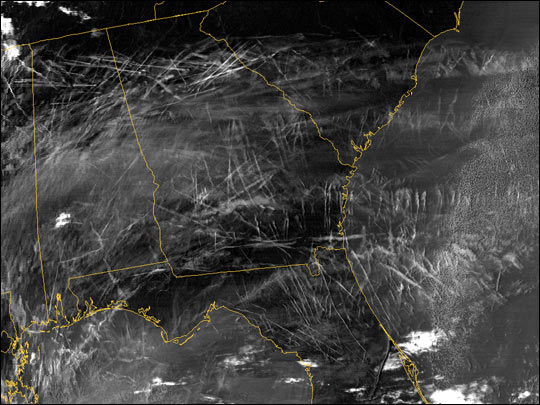
https://earthobservatory.nasa.gov/IOTD/view.php?id=4435
As always, Dr. Svalgaard pretends that unless the impact on temperature happens immediately, then it doesn’t exist.
He ignores the thermal mass of the system as well as other confounding factors.
Dr. Svalgaard hasn’t ignored anything. He already eroded a fjord through your musings, up thread, here:
https://wattsupwiththat.com/2017/12/19/new-svensmark-paper-the-missing-link-between-cosmic-rays-clouds-and-climate-on-earth/#comment-2697175
Not only that, but nearly the sum total of mankind’s knowledge and speculations about the Sun can be found on the research pages at his website. Read up. Then, you won’t feel so bad for having made such a remark.
Being an expert on the sun makes one an expert on how the sun affects the earth?
I’ve already read Dr. Svalgaard’s response and I stick by my statement.
Being an expert on the sun makes one an expert on how the sun affects the earth?
Being an expert on the sun and solar-terrestrial relations [including weather and climate] does give one a certain grasp on how the sun affects the earth.
You might enjoy http://www.leif.org/EOS/1976NASA-1973-Sun-Weather.pdf and
http://www.leif.org/EOS/Sun-Weather-Climate.pdf
“We are especially indebted to Dr. Ray Wexler, Dr. John M. Wilcox, Dr. S. J. Bauer, and Dr. Leif Svalgaard for reading several complete drafts and revisions and offering constructive criticism. Others who read complete drafts and contributed helpful comments include Dr. George C. Reid, Dr. James Barcus, Dr. Rudolf Penn-
dorf, Dr. Kaichi Maeda, Dr. Eldon Ferguson, and Dr. A. Ebel.”
At least my peers in this field recognize my expertise. After reading the above you may too.
To learn more look at the last reference on pages:
Svalgaard, L., 42, 77, 78, 79, 193, 198, 199, 200, 205; with Heath, 29; with Wilcox, 5, 193, 201, 202, 215, 266
Wow. Experiments as well as theory. It sounds just like science for a change.
Lots of Backfire Effect going on here today, by a lot of folks. Which is good, because we get to see the differences of opinion, and knowledge, on the subject matter at hand. Plus, there are a lot of very smart people here today, which makes it even more interesting. Excellent Post!, and superb reading. We all learn more today than we knew yesterday. Science progresses one day at a time.
Now I don’t know what to think with regards to these cosmic rays, and I sure am not anything close to being as remotely smart as a lot of these folks are. There is definitely something to this, but is it an overwhelming force? Is it a new holy grail of climate science that overwrites everything else? I don’t think so…on the face of it, but what do I know? It seems to me we should be be able to test the hypothesis in the near term by measuring earth’s albedo regarding any change of 1%-2% cloud cover on Earth. But we may have to wait decades to measure any difference in oceanic/atmospheric cooling/heating because it will take time (and perhaps several solar cycles) to manifest itself in the thermal inertia of the heat sink for the good Earth, which are the oceans.
My conjecture still stands that the September 2017 local maxima in solar activity (31 August – 10 September 2017) was a Forbusch-type Event but with high EUV from the sun and solar protons. A big downward dip in the neutron count also occurred as a result of that enhanced solar activity. Dr Spencer has already commented on the usual divergence of his UAH TLT from the surface record temperature data sets. The surface temp data sets are governed by SST, which this event was too short in duration to alter the OHC to be seen in the data, especially diven the developing La Nina in the Pacific. This La Nina also is anomalous for being “delayed”. Was this delay in La Nina due to that solar event?
This conjecture further posits that it was the increased ozone production in the stratosphere in the late Northern Hemisphere summer resulted in a 2 month spike in Troposphere and lower Stratosphere temps. Also the increased cloud nucleation (enhanced solar protons) would have helped Atlantic Basin hurricanes form precipitation, enhancing their strength through elevated convective heat release.
“….Svensmark has 5-7 times the effect of TSI, that would translate to a temperature variation of 0.35-0.50 C over a cycle”
I would have to read the paper to see if Svensmark actually makes the claim Leif asserts above, but even if he does, the claimed effect on CCN would be primarily above the oceans. Hence it would change ocean heat content and not necessarily be reflected in global surface temperature in the short term.
Again! Many who should know better apparently fail to realize that [to determine] the effect of a forcing (a measure of power such as TSI) [its anomaly] must be integrated over time for comparison with temperature [which when divided by effective thermal capacitance] is a measure of energy.
No, not really. Consider the time frame of one year [or even one day]. The total energy of TSI integrated over that year is just TSI*(seconds in one year) Joule. Thus the ‘conversion’ factor between power and energy is just a constant, meaning that we can use TSI as a measure of energy [apart from a constant factor] of the system. Similarly, temperature is just [apart from a constant conversion factor] a measure of the average energy of the molecules involved. This does not depend on the number of molecules so is not a measure of the total energy of the whole shebang. So, in practice, it is perfectly legit to compare TSI and Temps.
I wonder if this failure to grasp simple engineering/physics is shared by the climate science community.
“I wonder if this failure to grasp simple engineering/physics is shared by the climate science community.”
I don’t wonder at all.
I’m utterly certain that it is, and I have been for decades.
We can thank our lucky stars that is highly unlikely that any responsible individual would ever put most of them in charge of a mission critical engineering project such as designing a supermarket trolley as they would fail dismally.
Leif: I get what you are saying.
So I will posit this question to perhaps end the integrative argument. What if, (hypothetically) the average TSI dropped by 0.1% across the spectrum. In other words, a 0.1% phase-shift drop forever. What would the theoretical longterm effect on temperature equilibrium be?
It is profoundly wrong to say “TSI as a measure of energy”. TSI is a measure of power.
How much temperature change results from TSI anomaly for a second? How does temperature fluctuate over a year, or ten years, as TSI fluctuates over that time span?
Watt is power. Watt hour is energy. Watt hour is the time-integral of Watt. TSI anomaly is power measured in Watts/m^2. Temperature change times effective thermal capacitance is energy, measured in Watt hr/m^2. Comparing power to energy is not meaningful.
Dan Wrote: [It is profoundly wrong to say “TSI as a measure of energy”. ]
If you are referring to what Leif actually wrote “The total energy of TSI integrated over that year” He is perfectly correct. Power integrated of time is energy.
Saying “Power integrated of time is energy.” is, of course, correct. But he did not stop there. He added “Thus the ‘conversion’ factor between power and energy is just a constant”. This is misleading at best. It will give the energy change (temperature change if divide energy change by effective thermal capacitance) at a single point in time if you use average TSI anomaly. To get the temperature trajectory vs time for comparison with measured trajectory the time integral up to each point on the trajectory must be used.
It is mathematically incorrect to compare TSI anomaly trajectory with temperature change trajectory.
To get the temperature trajectory vs time for comparison with measured trajectory the time integral up to each point on the trajectory must be used.
I showed you that this is not the case.
And BTW your statement doesn’t make much sense as written. Perhaps you can improve on it.
Dan: I certainly agree with you. An integrator needs to capture the power over time adding up all the slices in order to provide the energy. Saying something that variers is a constant is just plane false. Especially when we are looking for extremeley tiny changes….
“The Stefan–Boltzmann law describes the power radiated from a black body in terms of its temperature. Specifically, the Stefan–Boltzmann law states that the total energy radiated per unit surface area of a black body across all wavelengths per unit time (also known as the black-body radiant emittance or radiant exitance), {\displaystyle j^{\star }} j^{\star}, is directly proportional to the fourth power of the black body’s thermodynamic temperature T”.
The SB-law shows that power is directly given by temperature. No integration over time needed.
Yes, Leif. Power “per unit time” matters, and the SB law gets it correctly. I know you know that is true.
So a measure of power is also a measure of temperature.
Only if all of the parameters are met, and at a single defined point in time -or- a sum of all of the points in a time span. Yes, then your statement is precise and correct in my opinion.
a sum of all of the points in a time span
Make that time span one year as is often done [yearly average TSI, yearly average Temps]…
Leif, you’re talking about power as if it’s energy again. You cannot precisely calculate the temperature of earth based on TSI unless you know what the earth is absorbing or reflecting. So no, power does not equal energy except in a hypothetical world which is not this planet.
You cannot precisely calculate the temperature of earth based on TSI unless you know what the earth is absorbing or reflecting.
But we do know that. It is called the albedo and is about 0.3. And we don’t even need that if we want to calculate how much the temperature will change for a given change of TSI.
Leif wrote: “But we do know that. It is called the albedo and is about 0.3. And we don’t even need that if we want to calculate how much the temperature will change for a given change of TSI.”
It’s about 3? On average? Really… it’s not ever 0.25 or 0.35 and for how long and when? Rhetorical question. Does the earth ever look mostly white with clouds to the sun and does that affect albedo?
You’re taking some average and guessing it’s constant. And it is not. It is not constant… and we do not know it’s 0.3 constantly. That’s why people are studying this phenomenon. You over simplifying that you know the earth receives a constant average albedo because that is true plus of minus some error band which is larger than the tiny fractions of a degree K we are all trying to figure out.
It’s like saying we know that changing solar spectral radiation has no affect on albedo… just because we know. That is also an untrue over simplification that attempts to end the scientific debate.
Mario
My experience is that TSI is not a good proxy for anything, really, because it is measured TOA and no material really can withstand what happens TOA for too long.
T max is a good proxy for whatever heat is coming through the atmosphere.
T min is a good proxy to prove that there is no man made warming [from adding CO2 & others] as presumably we should see chaos developing with the minimum T if there were any AGW.
It’s about 3? On average? Really
No, it is about 0.3, not 3.
And we measure it with satellites and by observations of the Earthshine on the Moon.
But, as I said, knowledge of the albedo is not needed to compute the change in temperature caused by a change of TSI.
Why does albedo have nothing to do with temperature received?
If TSI [radiation received, S] increases, the temperature [T] increases too, regardless of the albedo [a]. The physics behind that is the Stefan-Boltzmann law: (1-a) S = k T^4. Now differentiate [getting a small increase of S]: (1-a) dS = 4k T^3 dT. Then (1-a) dS/((1-a) S) = 4 k T^3 dT/(k T^4) or dS/S = 4 dT/T, or dT/T = (dS/S)/4.
Both (1-a) and k cancel out. So dS/S of 0.1% = 0.001 [typical value for solar cycle variation] means a dT/T of 0.00025, or dT = 0.00025 T. T is 288 K, so dT becomes 0.00025 * 288 = 0.072 K, regardless of the albedo a.
This is circular reasoning. You cannot know how much energy the earth is receiving…
We know how much it is radiating to space [given by its temperature] so that is also what it must be getting from the sun. So, yes, we do know [we also have satellites that measure that].
yup… makes sense. energy out is measured… energy in is deduced…
Leif, let me try a different tack. Of course you are correct about the effect of TSI anomaly on AGT change for say 1895 if you use the average TSI anomaly for 1895. But what about 1896? We know TSI is not constant. The average TSI 1895-1896 is required. And for 1897 the average 1895-1897 is required and so on.
The same energy change 1895-1897 is obtained using the time-integral of TSI anomaly 1895-1897 (with increments of one year because that is the frequency of reported data) and in general, the energy change 1895-X is obtained using the time-integral of TSI anomaly 1895-X to construct the trajectory of energy change vs time. TSI is not available that far back so SSN anomaly, known to be a proxy for TSI anomaly, is used. Because SSN is also a proxy for Svensmark’s work, the time-integral of SSN anomaly is accounting for both.
Of course you are correct about the effect of TSI anomaly on AGT change for say 1895 if you use the average TSI anomaly for 1895. But what about 1896? We know TSI is not constant. The average TSI 1895-1896 is required. And for 1897 the average 1895-1897 is required and so on.
For 1896 you use the average TSI [not anomaly] for 1896. For 1897 you use the average TSI for 1897, etc.
The main reason is that what came in in 1895 was by 1896 radiated away [because the Earth radiates according to the temperature it has no matter how high or low that is], and what was received in 1896 was radiated away during 1896 [like what was received yesterday was mostly radiated away last night – the slight imbalance in each hemisphere being equalized after a year as the seasons run their course (not to speak about the fact that whatever imbalance there is is further counteracted by the other hemisphere)], and so on. That is how it works. Anything else is just [invalid] curve-fitting.
Leif, Doing the complete calculation for each year, like you described, would also work except you have not accounted for net average SST oscillation or the effect of increasing water vapor and energy out was not measured in 1896. As you described at 12/23 11:51 PM the outgoing energy matches the incoming energy over a long time period. That is what establishes, as a first approximation, the average value for SSN as a proxy. This average value is the base from which anomalies are with respect to. The anomalies account for the part of earth temperature change caused by solar change.
This and other knowledge results in Eq (1) in my blog/analysis. Next comes the process you ridicule which is adjusting coefficients to achieve the best match to known average global temperatures. The 98+% match with measured since 1895 and a credible trend back to the depths of the LIA demonstrates that the right stuff is being accounted for.
The big uncertainty is what is going to be the eventual effect of the rising water vapor. It is currently rising about twice as fast as it should be based on temperature increase and is countering the global cooling that would otherwise be occurring. WV must eventually stop rising. It will eventually be countered by rising cloud cover.
As you described at 12/23 11:51 PM the outgoing energy matches the incoming energy over a long time period.
Not al all. Over perhaps a year, but no longer. The Earth radiates all the time.
Leif, You say something that everyone who passed high school science knows “The Earth radiates all the time.” But include in the same post something that is not only bogus, it contradicts something you said earlier. How do you now explain that earth average global temperature, as measured using proxies, has been within a degree or so of the average for the last 8000 years?
Because the sun shines all the time, too
“TSI over a solar cycle causes a variation of 0.05-0.10 degrees C. If GCRs as per Svensmark has 5-7 times the effect of TSI, that would translate to a temperature variation of 0.35-0.50 C over a cycle, which is simply not observed, hence the paper can be dismissed out of hand.”
I have a ton of respect for Dr Svalgaard, but, (isn’t there always a ‘but’?), I’m not sure this should be dismissed ‘out of hand’. I think Dr Svalbaard’s statement would be true if there was a uniform effect, which the paper specifically states that there is not, “It should be stressed that there is not just one effect of CCN on clouds, but that the impact will depend on regional differences and cloud types. “In regions with a relative high number of CCN the presented effect will be small, in addition the effect on convective clouds and on ice clouds is expected to be negligible. Additional CCNs can even result in fewer clouds. “
I’m not sure this should be dismissed ‘out of hand’.
What is to be dismissed is the claim that their ‘breakthrough’ settles the matter of climate change and that the GCRs are the major, chief, dominant, only [?] driver of climate.
If there is any effect, it is tiny, buried in the noise, dependent on time and location [and thus not the global overwhelming effect claimed].
One could say the same about C02.
That one notion is wrong does not mean that any other one is right.
Perhaps they are both wrong.
My thoughts, exactly.
Sorry, just to clarify, my reply was to Jim.
Leif,
My thought as well.
the effect on convective clouds and on ice clouds is expected to be negligible
Most clouds in the tropics where most of solar heating takes place [and where our climate is mostly controlled] are convective clouds [thunderstorms]…
A further comment would be that there isn’t ‘one forcing to rule them all’. The earth’s ocean-atmosphere system is an exceedingly complex, open, non-linear, coupled chaotic system and I doubt that there is ‘one forcing’ that controls the direction of temperature. To attempt to posit one is a Don Quioteesque effort.
My opinion on Dr. Leif Svalgaard’s comment: What he says would be true if response is instantaneous, in my opinion, but Earth as a rather huge thermal “flywheel” in its oceans. This likely moderates / damps that normal cyclical behavior. I believe it is possible that what is required to cause a significant change in climate is a reduction of the solar magnetic field for a period of time longer than a single cycle. Then the climate would reach a new equilibrium at a lower temperature but it would take more than one half cycle to do so.
“Think about this:
TSI over a solar cycle causes a variation of 0.05-0.10 degrees C. If GCRs as per Svensmark has 5-7 times the effect of TSI, that would translate to a temperature variation of 0.35-0.50 C over a cycle, which is simply not observed, hence the paper can be dismissed out of hand.“.
OK, I have thought about it. It’s tosh. The IPCC express doubts about whether clouds warm or cool – on balance they think maybe they cool. So to expect big results in a very few years is ridiculous, and from a scientist who presumably would like to be taken seriously, it is very disappointing. Instead of ‘dismissing out of hand, wouldn’t it have been better to consider the possibility that the major effect is via the oceans and that results are therefore not instantaneous.
crospatch and others have already made similar points.
The IPCC express doubts about whether clouds warm or cool – on balance they think maybe they cool. So to expect big results in a very few years is ridiculous
Tell that the Svensmark et al. They are the ones who claim their ‘breakthrough’ explains everything.
It’s not Svensmark I should speak to, it’s the IPCC. Clouds do cool the ocean. The IPCC is obsessed with surface temperature.
And the push back by the popular press partisans has already begun…
https://gizmodo.com/no-supernovae-arent-changing-earths-climate-1821439511
The tangled galactic magnetic field scrambles the cosmic rays to obliterate where they come from.
Here is what a map of the Galaxy looks like in cosmic rays:
So CR flux ain’t squat and Tony Phillips wastes his time?
If you say so…
Well, at least I know for sure that was an answer from the real Doc S.
Leif,
Cosmic Rays and gamma rays almost certainly have common sources in our galaxy.
The difference is that we can see where the gamma rays are coming from as they are not deflected by the tangled galactic magnetic fields as are the cosmic rays [which are not rays, BTW].
I get your point, we can’t see any sources. Predicting that our star system will traverse areas of higher background CR is just speculation.
… and it’s not just galactic magnetic fields that scramble the GCR vectors, but b/c GCR’s are mass particles in addition to moving at < c, gravity fields move them around too, further defocusing/blurring their sources.
I should say (to keep Albert and Isaac happy), gravity moves GCR protons around more so than photons. As their interactions with space-time curvature.
GCRs are atomic nuclei from which all of the surrounding electrons have been stripped away during their high-speed passage through the galaxy. They are particle showers, If I am correct, like driving through a rainstorm. These particles should be well-dispersed in the galaxy after bouncing about in electromagnetic chaos. I can easily visualize that. I would think that for us to recieve particle concentrations above the background level there would have to have been a nearby supernova recently detected.
Leif, could one say that the cosmic rain is steady, but when the sun is active the windshield wipers of the heliosphere are on high and vicey versey?
One could say that. The intensity of GCRs depends on three things:
1) the strength of the [currently decreasing] geomagnetic field. This determines the very long term variation [century time scale].
2) the ‘warp angle’ of the Heliospheric Current Sheet: when flat [small warp angle] GCrs have easy access to the inner solar system. At solar maximum the Current Sheet extends all the way to the poles and that makes access to the inner solar system more difficult Slides 51-56 of http://www.leif.org/research/Observations-polar-magnetic-fields-and-Cycle-25-prediction.pdf
3) within each cycle the number of sunspots regulates the number of solar storms which also hinder the access.
Thanks and have a wonderful holiday, you really are a good teacher. At least for this dumb old dog.
As Willis once said: “the only dumb questions are those that are not asked”
Pop Piasa
There is a very accessible on-line tutorial from the University of New Hampshire covering GCR, interstellar medium, heliopause, heliosphere and other good stuff related to your questions here: –
http://www-ssg.sr.unh.edu/ism/intro.html
See also the Wiki article on the Heliosphere here: –
https://en.wikipedia.org/wiki/Heliosphere
What I find most interesting is how recent much of our knowledge is and how surprising were the discoveries from the Voyager probes as they transitioned from our solar system into interstellar space.
“…the impact is believed to be largest in marine stratus clouds.”
It may not be as much about quantity as location. Day clouds over water inhibit the heating of the surface layer. They also locally increase winds when intermittent. I associate broken stratus clouds with cool and gusty conditions. Great on a hot summer day (when you can get it). If key areas of the oceans were to be shaded long enough, might the usual ENSO piling up of warm water (during La Nina) be morphed into a piling up of “not so warm” water? What happens then when El Nino comes around? Less effects on weather?
Are we seeing the heat stored decades past in the oceans (when the heliosphere was dense enough to damp the GCR flux) now being released in the upper latitudes?
Could this released ocean heat be evaporating more water into the high-latitude weather mix and causing more snow to fall?
Could this snow making cloud cover and humidity be the reason that winter temperatures run above normal lately in some polar regions? Why are the summer temperatures still normal?
The theory of a Forbush decrease has been proven by direct observation in the field.
What field observations directly link increasing (or decreasing) CO2 to the change of temperatures that have occured since the dawn of industry?
Svensmark et al. only claim an order-of magnitude larger effect upon temperature than TSI–an effect not necessarily coherent with the solar cycle. Hence, this irrelevant objection can be dismissed out of hand.
“Svensmark et al. only claim an order-of magnitude larger effect upon temperature than TSI–an effect not necessarily coherent with the solar cycle. Hence, this irrelevant objection can be dismissed out of hand.”
“Only”
AFAIK an order-of-magnitude is 10x
And Leif points out ….
“It is Svensmark et al. that claim they finally have a breakthrough to explain everything; in particular that the observed global warming is almost solely caused by their GCR theory. If you read their papers you will find that they do not invoke any lag at all.
But observations show it is “coherent with the SC” – but anti-correlated….
http://scienceofcycles.com/wp-content/uploads/2017/11/cosmic-ray-particles-versus-sunspots.gif.png
Hence your “this irrelevant objection can be dismissed out of hand.”
Can be dismissed out of hand.
As their figure plainly shows, the claim that Svensmark et al make is a strong linear relationship between GCR and temperature variations at time scales of millions of years. While the idea of an order-of-magnitude amplifying mechanism arose from Shaviv’s oceanic calorimetry over decadal time-scales, the shown anti-correlation with sunspot cycles is far removed from the core issue
I always thought this was the best explanation for the warming, and it explains why the oceans are warming.
Climate change causing clouds to rise higher in the sky and move towards poles
The trend was predicted by climate models and is likely to continue – unless there are major volcanic eruptions
http://www.independent.co.uk/environment/climate-change-clouds-higher-sky-towards-poles-greenhouse-gases-global-warming-volcanoes-a7131216.html
If the “official” climate view is that the known effect (allegedly) of CO2 is a 1.2°C increase for doubling the its concentration but that this can be increased to 3, 4, or even 5° by (imaginary, unproven) forcing that has been calculated (using heavily manipulated data that has been tortured until it provides the desired result) then cosmic radiation should also have a forcing effect that can be calculated by the same methodology.
To dismiss cosmic ray hypotheses out of hand while accepting the (increasingly questionable?) hypotheses surrounding CO2 as near-gospel doesn’t seem very scientific. At least not to this layman. We know clouds are a puzzle. The remarks above in this thread prove there is no firm consensus on how clouds impact our climate. Svensmark may have found one of the missing pieces. We should surely welcome this research which in theory should be repeatable by other scientists.
The graph looks very interesting, shows plausible correlation (but not necessarily causation), and is worth further verification (or rejection). At least this area of inquiry lends itself to the application of the scientific method. That would be a novel and welcome change in the study of climate change.
To dismiss cosmic ray hypotheses out of hand while accepting the (increasingly questionable?) hypotheses surrounding CO2 as near-gospel doesn’t seem very scientific.
Who says that? I don’t. Why do you attack a straw man like this? Perhaps some thought into the matter would help you.
If the “official” climate view is that the known effect (allegedly) of CO2 is a 1.2°C increase for doubling the its concentration but that this can be increased to 3, 4, or even 5° by (imaginary, unproven) forcing that has been calculated (using heavily manipulated data that has been tortured until it provides the desired result) then cosmic radiation should also have a forcing effect that can be calculated by the same methodology.
(OK – the sarcasm light is on)
To dismiss cosmic ray hypotheses out of hand while accepting the (increasingly questionable?) hypotheses surrounding CO2 as near-gospel doesn’t seem very scientific. At least not to this layman. We know clouds are a puzzle. The remarks above in this thread prove there is no firm consensus on how clouds impact our climate. Svensmark may have found one of the missing pieces. We should surely welcome this research which in theory should be repeatable by other scientists.
The graph looks very interesting, shows plausible correlation (but not necessarily causation), and is worth further verification (or rejection). At least this area of inquiry lends itself to the application of the scientific method. That would be a novel and welcome change in the study of climate change.
God bless you, Leif. I hope you are keeping warm on your skis! If we can gen a few more clouds, then perhaps even more snow this winter (which has started early this year here in the northeast and I am guessing/forecasting it will be one of our harder winters). As an olde cross-country skier, my heart calls out to bring it on but cries out when we get to the shoveling! Merry Christmas to all!
T-Man
Leif. I hope you are keeping warm on your skis!
Out here in California the snow cover is really not very suitable for skiing…
Coordinates: 38°14′45″N 122°37′53″W
(he doesn’t believe in god either)…
Oh, yes. There is a god and she is absolutely evil…
Leif,
You are confused. God is good, be He a He or a She. And there is no such thing as evil only a lack of good.
Dream on…
If I am right I win and you lose. If you are right I lose nothing and you still lose as you did not at least have the “dream”.
You lose the dream, but so what, it is faux anyway.
lsvalgaard
As Bishop Blougram (in Robert Browning’s poem) observed, the only choices available are a life of faith diversified by doubt, or a life of doubt diversified by faith. Put another way, does one consider a chess board to be black, but painted white in places, or white, but painted black in places? According to Blougram the difference, which appears to be no difference, is a world of difference.
good for him, but it is like whether the glass is half-full or half-empty. Who cares? .
And perhaps we can get back to science instead of pointless posturing.
It’s the science which causes some of us to believe. Every time we punch through another frontier we find out that what we believed yesterday about our physical world was not quite right or sometimes completely wrong. It’s His sense of humor and encouragement to keep searching.
Caused me to remember 1572, Tycho Brahe, & the nova that became the Crab Nebula. I wonder what sort of impact that had?
This is an interesting discussion. Mostly what I get out of it though, is that all the smart guys still can’t explain what’s going on and why with any ability to predict…but at least this crowd does not march in lockstep in completely the wrong direction like the AGWers…
If feedbacks are generally negative for tsi, as they may well be for backradiation from co2, then the calculated warming of .07C from solar min to max doesn’t mean much. (if we haven’t seen .6C warming that can be attributed to a half way to doubling of co2, then we’re not going to see the calculated number of .07C for solar either) And yet observationally we actually do see .12C warming from solar min to solar max. Therefor, there would have to be a strong feedback mechanism that is unique to the sun (to amplify the lower than calculated solar warming). The premise that TSI over a solar cycle causes a variation of 0.05-0.10 degrees C may in reality be a false assumption (based on a calculation) to begin with. In this way, we can see how it is that the sun could cause an amount of warming that backradiation from co2 cannot…
Within 5~7 years, the Svensmark Effect will likely be confirmed by: falling global temperature trends, growing polar ice extents, increasing polar land-ice masses and the slowing down of Sea Level Rise, despite 1/3rd of all manmade CO2 emissions since 1750 being made over just the last 25+ years.
In 5~7 years, the disparity between CAGW’s global warming projections vs. reality will likely exceed 3+ standard deviations for 25+ years, which should be sufficient duration and disparity to make the CAGW hypothesis laughable.
I expect the blowback against Leftists who wasted $trillions on this CAGW ho@x for 40 years will be profound.
We’ll likely know in 5~7 years if the Svensmark Effect is a viable hypothesis.
“Truth is the daughter of time”. ~Sir Francis Bacon
Well, as a geologist, I’m used to look at past events…. According to the French historian Emmanuel Leroi Ladurie, in his 2005 book “Canicules et glacieres – Histoire humaine et comparée du climat”, during the Maunder Minimum (ther’s a whole chapter of the book devoted to it), astronomic observatories in Europe could only work 1 night every 3 nights (33% of time), because the sky was too cloudy over Europe…
Just my two cents, of course…
Is this paper saying that if the cosmic rays that hit the earth increase by x then on average cloud cover will increase proportionally to x, on the same day ? Meaning no lag.
If so then over a long time period we should be able to see the signal, though I’m not sure how long the period needs to be. We are assuming the cosmic ray effects are independent of other cloud cover effects.