Last week I hinted at this upcoming paper, which was embargoed until this morning. I noted then something Dr. Roy Spencer said in his book about clouds: The Great Global Warming Blunder: How Mother Nature Fooled the World’s Top Climate Scientists and how this new paper could be the “holy grail” of climate science, if it is true.
“The most obvious way for warming to be caused naturally is for small, natural fluctuations in the circulation patterns of the atmosphere and ocean to result in a 1% or 2% decrease in global cloud cover. Clouds are the Earth’s sunshade, and if cloud cover changes for any reason, you have global warming — or global cooling.”
Today, we have news of something that modulates cloud cover in a new paper by Henrik Svensmark in Nature Communications.
PRESS RELEASE: DTU Space at the Technical University of Denmark
A breakthrough in the understanding of how cosmic rays from supernovae can influence Earth´s cloud cover and thereby climate is published today in the journal Nature Communications. The study reveals how atmospheric ions, produced by the energetic cosmic rays raining down through the atmosphere, helps the growth and formation of cloud condensation nuclei – the seeds necessary for forming clouds in the atmosphere. When the ionization in the atmosphere changes, the number of cloud condensation nuclei changes affecting the properties of clouds. More cloud condensation nuclei mean more clouds and a colder climate, and vice versa. Since clouds are essential for the amount of Solar energy reaching the surface of Earth the implications can be significant for our understanding of why climate has varied in the past and also for a future climate changes.

atmosphere and produces a cascade of secondary particles who ionize molecules when traveling through the air. One 100 GeV proton hits every square meter at the top of the atmosphere every second.
Cloud condensation nuclei can be formed by the growth of small molecular clusters called aerosols. It has until now been assumed that additional small aerosols would not grow and become cloud condensation nuclei, since no mechanism was known to achieve this. The new results reveal, both theoretically and experimentally, how interactions between ions and aerosols can accelerate the growth by adding material to the small aerosols and thereby help them survive to become cloud condensation nuclei. It gives a physical foundation to the large body of empirical evidence showing that Solar activity plays a role in variations in Earth’s climate. For example, the Medieval Warm Period around year 1000 AD and the cold period in the Little Ice Age 1300-1900 AD both fits with changes in Solar activity.
“Finally we have the last piece of the puzzle explaining how particles from space affect climate on Earth. It gives an understanding of how changes caused by Solar activity or by super nova activity can change climate.”
says Henrik Svensmark, from DTU Space at the Technical University of Denmark, lead author of the study. Co- authors are senior researcher Martin Bødker Enghoff (DTU Space), Professor Nir Shaviv (Hebrew University of Jerusalem), and Jacob Svensmark, (University of Copenhagen).
The new study
The fundamental new idea in the study is to include a contribution to growth of aerosols by the mass of the ions. Although the ions are not the most numerous constituents in the atmosphere the electro-magnetic interactions between ions and aerosols compensate for the scarcity and make fusion between ions and aerosols much more likely. Even at low ionization levels about 5% of the growth rate of aerosols is due to ions. In the case of a nearby super nova the effect can be more than 50% of the growth rate, which will have an impact on the clouds and the Earth’s temperature.
To achieve the results a theoretical description of the interactions between ions and aerosols was formulated along with an expression for the growth rate of the aerosols. The ideas were then tested experimentally in a large cloud chamber. Due to experimental constraints caused by the presence of chamber walls, the change in growth rate that had to be measured was of the order 1%, which poses a high demand on stability during the experiments, and experiments were repeated up to 100 times in order to obtain a good signal relative to unwanted fluctuations. Data was taken over a period of 2 years with total 3100 hours of data sampling. The results of the experiments agreed with the theoretical predictions.
The hypothesis in a nutshell
- Cosmic rays, high-energy particles raining down from exploded stars, knock electrons out of air molecules. This produces ions, that is, positive and negative molecules in the atmosphere.
- The ions help aerosols – clusters of mainly sulphuric acid and water molecules – to form and become stable against evaporation. This process is called nucleation. The small aerosols need to grow nearly a million times in mass in order to have an effect on clouds.
- The second role of ions is that they accelerate the growth of the small aerosols into cloud condensation nuclei – seeds on which liquid water droplets form to make clouds. The more ions the more aerosols become cloud condensation nuclei. It is this second property of ions which is the new result published in Nature Communications.
- Low clouds made with liquid water droplets cool the Earth’s surface.
- Variations in the Sun’s magnetic activity alter the influx of cosmic rays to the Earth.
- When the Sun is lazy, magnetically speaking, there are more cosmic rays and more low clouds, and the world is cooler.
- When the Sun is active fewer cosmic rays reach the Earth and, with fewer low clouds, the world warms up.
- The implications of the study suggests that the mechanism can have affected:
- The climate changes observed during the 20th century
- The coolings and warmings of around 2°C that have occurred repeatedly over the past 10,000 years, as the Sun’s activity and the cosmic ray influx have varied.
- The much larger variations of up to 10°C occurring as the Sun and Earth travel through the Galaxy visiting regions with varying numbers of exploding stars.
The authors
- Dr. Henrik Svensmark, Danish National Space Institute, in the Technical University of Denmark (DTU).
- Senior Resercher Martin Andres Bødker Enghoff, Danish National Space Institute, in the Technical University of Denmark (DTU).
- Professor Nir Shaviv, Physics Institute, Hebrew University of Jerusalem.
- Ph.D. student Jacob Svensmark, Dark Cosmology Center, University of Copenhagen.
Full journal reference
H. Svensmark, M.B. Enghoff, N. Shaviv and J. Svensmark, Increased ionization supports growth of aerosols into cloud condensation nuclei, Nature Communications DOI: 10.1038/s41467-017-02082-2
The paper is here https://www.nature.com/articles/s41467-017-02082-2
Abstract:
Increased ionization supports growth of aerosols into cloud condensation nuclei
H. Svensmark 1, M.B. Enghoff 1, N.J. Shaviv2 & J. Svensmark1,3
Ions produced by cosmic rays have been thought to influence aerosols and clouds. In this study, the effect of ionization on the growth of aerosols into cloud condensation nuclei is investigated theoretically and experimentally. We show that the mass-flux of small ions can constitute an important addition to the growth caused by condensation of neutral molecules. Under present atmospheric conditions the growth rate from ions can constitute several percent of the neutral growth rate. We performed experimental studies which quantify the effect of ions on the growth of aerosols between nucleation and sizes >20 nm and find good agreement with theory. Ion-induced condensation should be of importance not just in Earth’s present day atmosphere for the growth of aerosols into cloud condensation nuclei under pristine marine conditions, but also under elevated atmospheric ionization caused by increased supernova activity.
From the discussion section of the paper:
This suggests that there are vast regions where conditions are such that the proposed mechanism could be important, i.e., where aerosols are nucleated in Inter-Tropical Convergence Zone and moved to regions where relative large variations ionization can be found. Here the aerosols could grow faster under the influence of ion condensation, and the perturbed growth rate will influence the survivability of the aerosols and thereby the resulting CCN density. Finally the aerosols are brought down and entrained into the marine boundary layer, where clouds properties are sensitive to the CCN density2.
Although the above is on its own speculative, there are observations to further support the idea. On rare occasions the Sun ejects solar plasma (coronal mass ejections) that may pass Earth, with the effect that the cosmic ray flux decreases suddenly and stays low for a week or two. Such events, with a significant reduction in the cosmic rays flux, are called Forbush decreases, and can be used to test the link between cosmic ray ionization and clouds. A recent comprehensive study identified the strongest Forbush decreases, ranked them according to strength, and discussed some of the controversies that have surrounded this subject.
Atmospheric data consisted of three independent cloud satellite data sets and one data set for aerosols. A clear response to the five strongest Forbush decreases was seen in both aerosols and all low cloud data. The global average response time from the change in ionization to the change in clouds was ~7 days, consistent with the above growth rate of ~0.4 nm h−1. The five strongest Forbush decreases (with ionization changes comparable to those observed over a solar cycle) exhibited inferred aerosol changes and cloud micro-physics changes of the order ~2%7. The range of ion production in the atmosphere varies between 2 and 35 ions pairs s−1 cm−337 and from Fig. 1b it can be inferred from that a 20% variation in the ion production can impact the growth rate in the range 1–4% (under the pristine conditions). It is suggested that such changes in the growth rate can explain the ~2% changes in clouds and aerosol change observed during Forbush decreases.
It should be stressed that there is not just one effect of CCN on clouds, but that the impact will depend on regional differences and cloud types. In regions with a relative high number of CCN the presented effect will be small, in addition the effect on convective clouds and on ice clouds is expected to be negligible. Additional CCNs can even result in fewer clouds. Since the ion condensation effect is largest for low SA concentrations and aerosol densities, the impact is believed to be largest in marine stratus clouds.
Further reading:
COSMIC RAYS, CLOUDS AND CLIMATE
Henrik Svensmark – DOI: 10.1051/epn/2015204
National Space Institute – Technical University of Denmark – Elektrovej, Bygning 328, 2800 Kgs – Lyngby, Denmark
The most profound questions with the most surprising answers are often the simplest to ask. One is: Why is the climate always changing? Historical and archaeological evidence of global warming and cooling that occurred long before the Industrial Revolution, require natural explanations.
Link to the PDF: SvensmarkEPN_46-2-2_2015
From that article:

Further Reading:

Scientists agree that the earth has become hotter over the last century. But on the causes, despite what looks to the public mind like a consensus, there are dissenting voices. Based on Henrik Svensmark’s research at the Danish National Space Center, this book outlines a brilliant and daring new theory that has already provoked fresh thinking on global warming. As prize-winning science writer Nigel Calder and Svensmark himself explain, an interplay of the sun and cosmic rays – sub-atomic particles from exploded stars – seem to have more effect on the climate than man-made carbon dioxide. For anyone interested in the real science behind our climate, this book is a must-read.
COUNTERPOINT:
I asked prominent solar physicist Dr. Leif Svalgaard his opinion on the paper (and sent him the advance full copy). He had this to say:
Think about this:
TSI over a solar cycle causes a variation of 0.05-0.10 degrees C. If GCRs as per Svensmark has 5-7 times the effect of TSI, that would translate to a temperature variation of 0.35-0.50 C over a cycle, which is simply not observed, hence the paper can be dismissed out of hand.
The battle over this paper will soon be waged in press and peer-review.
To state the obvious, which somehow does not seem to get stated all that often, there is more than one effect from our favorite local variable star. The lower magnetic activity is in conjunction with the lower tsi. Both of these tend to increase the global albedo which is a positive feedback situation to increase the global albedo. Cosmic rays have their role and I suspect it is not minor. But just measuring cosmic rays over time with C14, etc. and saying that they are the only reason thing were warmer or cooler misses a lot of what is going on. The C14 proxy is a proxy for more than one process.
Omitted variables is a common problem in modeling and prediction for both sides of the argument….
http://www.climate4you.com/images/NOAA%20SST-NorthAtlantic%20GlobalMonthlyTempSince1979%20With37monthRunningAverage.gif
Omitted variables is a common problem
What you omitted here was the sunspot cycle [and hence also the GCR cycle]. Adding it shows that there is no correlation between the solar cycle and the North Atlantic SST anomaly:
http://www.leif.org/research/SST-SN-since-1979.png
If the oceans are a storage system then one would not expect a correlation in a zero lag relationship.
If the oceans are a storage system then one would not expect a correlation in a zero lag relationship.
Yet Svensmark claims there is no lag. So he must not think that the oceans are a storage system.
Nowing of the presence and Effects of ENSO, the AMO, PDO and now the Southern Ocean Oscillations why would you expect direct correlation when it not the only thing going on?
Surely it would just be another factor?
Maybe a supercomputer can untangle all of these variables. As long as it is not used for bias confirmation as at present.
Maybe a supercomputer can untangle all of these variables. As long as it is not used for bias confirmation as at present.
No, a supercomputer is the wrong tool. There really is a limited data set, so even Machine Learing (ML) is useless.
All supercomputers for climate “science” allow you to do is make wild extrapolations that nobody can understand or prove are valid. c.f. climate models.
As Willis has shown, a decent workstation with ‘R’ is sufficient. You get good analysis and can actually understand how it works.
For limited problem types with massive data available ML can do some amazing things, but they still suffer from the property of “why” does a particular set of neural net weights work. We just know they work, not why.
And any model with large number of variables, neural net or not, suffers from the same problem.
Peter
You know, one day, I’m going to wake up and read here how shock waves (with highly numbers of GCRs) from supernovae like the Crab Nebula, were responsible for dramatic cooling events like the Little Ice Age. I’d love to read a treatment of that.
See my comment below.
I have not read all the above information carefully, but my impression is that this is NOT new news. I was aware of the proposed cloud seeding effect of cosmic rays, years and years ago. Why is this being touted as “new” now?
I don’t see where Svensmark’s observations conclude that maximum effect must occur, Even if so, I do not agree that the observations can be dismissed out of hand. There is some climate effect of cosmic rays on and from cloud formation just as there is some effect of human activity on and from CO2 formation. Clearly not as much as their potential based on observation and due to a vast number of other primary, secondary and tertiary effects.
Clouds represent Important questions of climate requiring detailed answers. There seem to be a few answers here. One more question for example: What is the temporal relation of climate, clouds, cosmic rays and other factors? We’re not getting a strong causal signal from CO2, which is all the reason needed for scientific rejection “out of hand” of measures proposed to control the climate.
Even if so, I do not agree that the observations can be dismissed out of hand
What can be so dismissed is the claim that the GCR-hypothesis is the major driver of climate. There are lots of little things that feed in to that equation.
“Cosmic rays, high-energy particles raining down from exploded stars”
Isn’t even this assumption (concerning the source of cosmic rays) coming under question these days? As so often happens, the more we discover, the more we discover how little we know. Nature is a bitch who doesnt give up her secrets easily 🙂
@L Svalgaard :
“a temperature variation of 0.35-0.50 C over a cycle, which is simply not observed,”
Agreed but there is an assumption here that the relationship with clouds is linear & more or less instantaneous. We know there will be lags in the system due to the heat capacity of the oceans and we know the system in immensely complicated so I don’t think there is any reason to expect that it would be linear or instantaneous . Given the complexity of the system, I would expect a convolutional response would be more likely than a linear response, ie :
(change in cloud cover)*(Ocean Impulse response)*(Atmospheric Impulse response)*(impulse response) = Total System Response.
Multiple convolutions = extremely complex , non linear & lagged system response
Agreed but there is an assumption here that the relationship with clouds is linear & more or less instantaneous

Apart from the fact that Svensmark does not think there is a lag, even if there were, there should still be a cyclic effect [lagged by whatever] and thus a signal in the power spectrum at the frequency of the solar cycle, and there isn’t. But there may be more direct evidence of no lag:
Assuming instantaneous response is simply unphysical.
I’m sure Svensmark would like to know. Tell him.
It is disturbing that so many who should know better apparently fail to realize that the effect of a forcing (a measure of power) must be integrated over time for comparison with temperature (a measure of energy). The difference in curve shape between a Wattmeter and a Watt hour meter does not mean that the two are unrelated. The time-integral, which is mandated by the relation between mathematics and the physical world, is too-often misidentified as a lag’
It is disturbing that so many who should know better apparently fail to realize that the effect of a forcing (a measure of power) must be integrated over time for comparison with temperature (a measure of energy).
The important point is over how long the integration must proceed. If that is left unspecified the procedure amounts to no more than curve-fitting with the ‘window’size a free parameter without any physical underpinning. In addition, since the power input is always positive, what must be integrated is the deviations from a suitable ‘mean’, which now becomes yet another free parameter. If the actual mean value over the window is used, the integral is always identically equal to zero. Adding in further effects [e.g. assumed ocean variations] provides yet another free parameter, and so on. The whole thing just boils down to numerology which is always fun, but should not be basis for serious action.
Integration is done from a start point up to each of all following times to generate a trajectory of integrals as a function of time (in Leif’s terms, all ‘window sizes’ are used). Of course the integral is of the deviation from a ‘suitable mean’. Because the values deviate above and below the ‘suitable mean’ the trajectory of the integrals also goes up and down. The assertion that the integral is “always identically equal to zero” indicates a failure to grasp the method.
First approximation of a ‘suitable mean’ is obtained by optimizing the fit of a candidate equation to the trajectory of all average global temperatures deemed to be reasonably accurate (IMO since 1895). The optimization is done by adjusting the contribution coefficients of each of the contributing factors. This results in an equation which can calculate average global temperature (AGT) back to the depths of the LIA. Adjusting the ‘suitable mean’ up results in a higher estimate of LIA temperature and adjusting it lower results in a lower estimate of LIA. The ‘suitable mean’ is selected which results, after maximizing R^2, in the best estimate of LIA. Thus ‘suitable mean’ is not a “free parameter” at all.
The only ‘curve matching’ is the approximation of the net effect of ocean surface temperature cycles. Approximation is necessary because no one (to my knowledge) has yet determined a physical basis for them (I suspect resonance with planet synodic cycles).
Equation (1) at http://globalclimatedrivers2.blogspot.com combines the above with the influence of the rising (8% since 1960) water vapor (the only significant ghg) to obtain a 98+% match with measured AGT since before 1900.
First approximation of a ‘suitable mean’ is obtained by optimizing the fit of a candidate equation to the trajectory of all average global temperatures deemed to be reasonably accurate
As I said: pure curve-fitting. No physics or understanding.
“with four parameters I can fit an elephant, with five I can make him wiggle his trunk”
+1
But you are trying to get this across to people who will not consider such lags.
Complicated and that sums up the basis for relegation of the ocean cycles to constant effects and the sun to minuscule effects for purposes of moving on with models of the IPCC crew. This allowed for policy to run ahead of the science based on a handful of assumptions made for convenience.
Apparently not everyone can recognize the physics . . . or understand.
Please, authors, do not assume that everybody knows what your acronyms stand for.
TSI — I know, this might seem obvious, but it’s very annoying to have even a moment’s doubt to try to figure out what it means. Think of the readers at all levels. Thanks.
“Total Solar Irradiance”, I suppose.
“Too Stupid to Intuit” ? — on my part? (^_^) … still a parenthetic clarification would be appreciated … TSI (Total Solar Irradiance)
Robert Kernodle
TSI = Total Solar Irradiation. Average of the sun’s total output measured in space at the average radius of the earth’s orbit.
TOA = Top Of Atmosphere. Actual total measured solar radiation in space at the earth’s actual distance from the sun on that specific day of the year.
The solar community assures us that the the sun’s average output – the TSI value – has not changed recently. However, the recorded (measured and published) TSI value have consistently been going down since in-space measurements began early in the satellite era.
However, if “published TSI values” were used in the first Global Circulation Models (GCM 3d “climate” models) at 1376 watts/m62, and recently TSI published solar energy values at the average earth orbit are ACTUALLY now only 1362 watts/m^2, why are the Global Circulation models providing the same results (output is the same 3 watts/m^2 forcing for CO2 levels now as when Hansen began publicizing them in 1987-88); when a large change in TSI (as input the entire model) have changed by more than 10 watts/m^2 ?
Intriguing. I read the article and I would need far more evidence to support the hypothesis. Are there any hard, verifiable data connecting cosmic ray showers over the last 150 years and an increase/decrease in aerosols during that period?
I think Leif and Willis have the better of this debate with Henrik Svensmark. The reason is a historical event commencing 4 July 1054 and recorded in Chinese, Japanese, and Arab writings at the time. SN 1054 exploded and now comprises the Crab Nebula. This supernova was so bright it could be seen in daytime for 11 days, and at night for over two years. SN 1054 produced massive doses of GCR on Earth during that period through mid 1056. It is only 6500 light years from our solar system and would have overwhelmed any solar system GCR shielding mechanisms.
There is a lot of written history for those years for Europe and the Arab world. For example, the east-west schism of the Catholic Church was in 1054 (Rome/Byzantium) and the Seljuk Turks captured Bahgdad in 1055. Nowhere have I been able to find any contemporaneous historical references to sudden cooling from extremely cloudy skies as would have been required by the Svensmark hypothesis. It seems Nature herself falsified it via ‘experiment’.
A second reason to be doubtful is that there are many CCN sourcesthat do not rely on the posited SO2/ion mechanism. Over land, soot from forest fires, dust, terpenes from coniferous forests, isoprenes from deciduous and tropical forests. At sea, sea salt spray and dimethylsulfide from phytoplankton. Svensmark has not parsed his mechanism by all the other CCN sources, so even if his mechanism is right, it is potentially CCN rounding error as Leif has indirectly pointed out.
Rud,
Neither the supernova in AD 1006 nor AD 1054 was not large enough to leave traces in the 14C record. Hence, there is no reason to expect a climatic response from whatever high speed protons or other cosmic radiation they might have emitted. SN 1054 was just too far away to have any discernible effect.
My comment noted that SN 1054 was ‘only’ 6500 light years away. That is very close. Milky Way galaxy has an estimated 100000 ly diameter.
A reference to the lack of 14C associated with those supernovae.
https://www.nature.com/news/mysterious-radiation-burst-recorded-in-tree-rings-1.10768
Gabro, TY. 14C generation something I had not thought about. Did some research. GCR come in a wide range of energies from about 10^3eV to at least 10^26eV. The higher the energy, the fewer there are—of course. Svensmark calculates from 100GeV (10^14 if I have converted hismunits correctly), which is medium in the GCR energy range. Tried but could find a paper discussing the minimum GCR energy to produce the thermal neutron necessary for 14C synthesis from 14N. Did learn that NASA has evidence suggesting most high energy GCR originate in the vicinity of the massive black holes near the galaxy center rather than in supernovas. Somethin about slingshot acceleration plus relative abundance. Also the anomalous 774-775 14C spike,in Japanese temple cedar wood is thought black hole related as there is no record of an associated supernova. Idea in oayman’s speak is we got hit by the slingshot.That is pretty well accepted in the GCR/14C literature I read this PM. So, one explanation formyourmobservation is supernova GCR don’t produce much 14C but should clouds per Svensmark mchanism, based on relative GCR energeties. Perhaps you know the 10^x eV minimum for 14C and could further enlighten us here.
My second reason for doubt that Svensmark has identified a main climate effect remains true. When you smell a pine forest or see the Great Smokies ‘smoke’, you are smelling and seeing natural terpene and isoprene CCNs. Ditto smelling sea air (salt and dimethylsulfide CCNs).
Rud,
The AD 774 spike has been associated with Solar Energetic Particles, not the galactic center black hole.
But, yes, most cosmic rays affecting climate do originate from the galactic center, not from supernovae in our vicinity.
A GeV is 10^9 electron volts, ie a billion, so 100 GeV is 10^11. A TeV is 10^12 evs, ie a trillion. Supernovae explosions can accelerate charged particles to energies beyond 100 TeV (10^14 evs). But energy isn’t the only consideration in determining the climatic effects of cosmic rays. We are bathed in GCRs from the galactic center, while a SN explosion is a point source of particles, subject to dispersion over distance, hence only a small portion might actually hit earth. That’s why 6500 lys is actually far away from the stand point of 14C generation, however close it might seem in cosmic terms.
Of course there are abundant sources of biological and other sources of CCNs. However, those are largely confined to the lower troposphere. GCRs affect the whole atmosphere. And, given any climatic beginning state, the natural rate of CCN production is more or less constant, so that additional GCR-generated CCNs will have an affect. When the climate changes, so does the rate of biological CCN production, in a feedback effect.
Speaking of natural experiments, both solar magnetic flux and EM radiation power are correlated with terrestrial climate, as shown by the chilliness of grand solar minima.
I should perhaps add that during the 11th century solar magnetic flux was high, so cosmic rays were deflected at a higher rate than during, say, the Maunder Minimum of the 17th century.
The main point is however that too few charged particles reached earth from SN 1054 to show up in the 14C record, let alone have an observable climatic effect.
Atmospheric effects of the AD 774 SEP event, depending upon season of its occurrence:
Atmospheric impacts of the strongest known solar particle storm of 775 AD
https://www.ncbi.nlm.nih.gov/pmc/articles/PMC5368659/
Abstract
Sporadic solar energetic particle (SEP) events affect the Earth’s atmosphere and environment, in particular leading to depletion of the protective ozone layer in the Earth’s atmosphere, and pose potential technological and even life hazards. The greatest SEP storm known for the last 11 millennia (the Holocene) occurred in 774–775 AD, serving as a likely worst-case scenario being 40–50 times stronger than any directly observed one. Here we present a systematic analysis of the impact such an extreme event can have on the Earth’s atmosphere. Using state-of-the-art cosmic ray cascade and chemistry-climate models, we successfully reproduce the observed variability of cosmogenic isotope 10Be, around 775 AD, in four ice cores from Greenland and Antarctica, thereby validating the models in the assessment of this event. We add to prior conclusions that any nitrate deposition signal from SEP events remains too weak to be detected in ice cores by showing that, even for such an extreme solar storm and sub-annual data resolution, the nitrate deposition signal is indistinguishable from the seasonal cycle. We show that such a severe event is able to perturb the polar stratosphere for at least one year, leading to regional changes in the surface temperature during northern hemisphere winters.
Svalgaard has a burr up his posterior for Svensmark…..always has.
Willis, man, you aren’t a god. Get over yourself.
Let’s guess. Both of you spent a grand total of 15 minutes vigorously reading the paper and the accompanying references.
How about both of you spend the next 15 years of your lives doing research, experiments, combing through the data and stop being armchair nothings. Let’s see your equations.
Dr. Roy Spencer was critical and skeptical of Dr. Svensmark. In 2011 he changed his mind based on his own observational evidence. Maybe he has reversed his position by now.
http://www.drroyspencer.com/2011/05/indirect-solar-forcing-of-climate-by-galactic-cosmic-rays-an-observational-estimate/
While I have been skeptical of Svensmark’s cosmic ray theory up until now, it looks like the evidence is becoming too strong for me to ignore. The following results will surely be controversial, and the reader should remember that what follows is not peer reviewed, and is only a preliminary estimate.
I’ve made calculations based upon satellite observations of how the global radiative energy balance has varied over the last 10 years (between Solar Max and Solar Min) as a result of variations in cosmic ray activity. The results suggest that the total (direct + indirect) solar forcing is at least 3.5 times stronger than that due to changing solar irradiance alone.
If this is anywhere close to being correct, it supports the claim that the sun has a much larger potential role (and therefore humans a smaller role) in climate change than what the “scientific consensus” states.
I’ve made calculations
Ah, yet another know-it-all peddling his stuff.
As far as I remember my interest in sun-weather-climate relations go back to 1973 as we reported in Science Magazine:
J. M. Wilcox, P. H. Scherrer, L. Svalgaard, W. 0. Roberts, R. H. Olson, Science 180, 185, (1973)
“I’ve made calculations
Ah, yet another know-it-all peddling his stuff.
As far as I remember my interest in sun-weather-climate relations go back to 1973 as we reported in Science Magazine”
I was still in high school back then Dr. Svalgaard and appreciate you generously sharing with us your views in your area of expertise and 4+ decades of research.
However, it’s impossible for you to know what you think that you do about the effect of GCR’s(I have been an operational meteorologist since 1982 and can tell you clearly why you and I can’t possibly know with any degree of confidence).
Sorry to repost this from earlier but it’s more appropriate here:
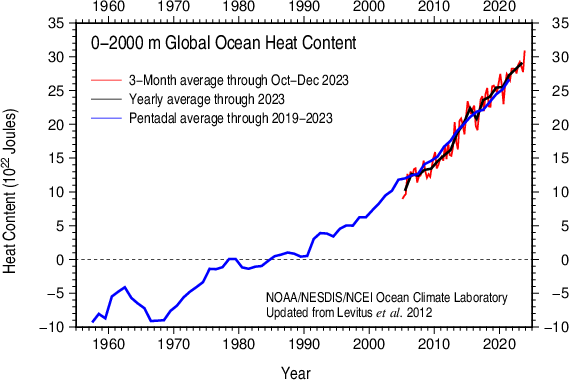
“The oceans have 1,000 times more stored heat than the atmosphere. Heat that went into the oceans last century may still be coming out today.
When the temperature of a key area of the tropical Pacific ocean goes up, it warms up the entire global atmosphere………..an example of how powerful this effect is from heat belching out of the oceans.
The main source for ocean heating is solar radiation. Can an increase in cosmic rays result in a big enough increase in clouds to cut solar radiation to make a significant difference in the amount of heat going into the oceans? It’s plausible.
What we would not likely see is some immediate, easy to measure thermal response in the atmosphere that is in phase with the change in cloudiness.
The oceans are constantly moving, mixing, circulating. Warm blobs pops up with no explanation. El Nino’s and La Nina’s emerge from pockets of warm/cool with no long term predictability.
We have longer term/decadal oscillations PDO, AMO, for instance that repeat with unique temperature profiles in certain parts of the oceans but since the sun is providing the ocean with most of its heat, what solar cycle do these correlate to?
So one would also not expect to see the increase in GCR’s from the recently weak sun(only the previous cycle was significantly weaker than the previous ones) and the increase in clouds/reduction in solar radiation, if that was the response to just jump out with an obvious short term finger print that provides the smoking gun metric.
If this effect is significant, it should takes decades to gradually reverse the net heat gains of the ocean from last century to heat losses this century.
How many decades? Probably not a high number but certainly more than 1, possibly as few as 2 but thats a wild guess……………even if this effect is significant.
If we are accumulating heat from greenhouse gas warming at the same time and can’t separate this effect from the theoretical effects of GCR’s, nobody can say the warming slow down was caused by the increasing GCR’s or not………..or whether some of last century’s warming was in part from less GCR’s.
The above discussion is not from somebody that “wants to believe” in the GCR theory. It’s just factual statements regarding the physics of the oceans/atmosphere and knowing enough to know that those who claim they know the GCR theory is invalid because they don’t see the smoking gun……….can’t possibly know………even if it was Albert Einstein making that statement.”
We are conditioned to seeing/needing scientific proof to support our beliefs. Lack of proof, often means NOT believing…………….and in the majority of cases, this turns out to be correct.
However, I believe that its a lack of understanding of the massive heat reservoir, our oceans and how heat is stored, released and circulated/mixed that is misleading many into thinking a significant increase/decrease in heating from the change in GCR’s CAN’T be happening because they can’t see it……….based on their conditioning to needing to see the solid empirical evidence.
I also know enough about cloud physics and aerosols to go with knowing that we would likely not be able to trace the increased or decreased heat going into the oceans, that “could be” significant.
Not IS significant but COULD BE significant and still not show up within a short term, 1 very weak solar cycle time frame.
The vast oceans take a very long time to warm and cool(or, possibly not warm as fast as before if one of the heat contributing factors becomes less). They have 99.9% of all the stored heat on this planet. Global atmospheric temperatures go up and down in sync with ocean temperatures(look at what an El Nino does). UV solar radiation provides all the heat that is stored in the oceans.
The main source for ocean heating is solar radiation. Can an increase in cosmic rays result in a big enough increase in clouds to cut solar radiation to make a significant difference in the amount of heat going into the oceans? It’s plausible.
You miss the point. It is Svensmark et al. that claim they finally have a breakthrough to explain everything; in particular that the observed global warming is almost solely caused by their GCR theory. If you read their papers you will find that they do not invoke any lag at all. Observations show that there is no lag in the good correlation between cloud cover [caused by whatever] and temperatures. More clouds = higher albedo = less sunllight = cooling. The Svensmark et al. claimed factor of GCRs being 5-7 times more efficient than TSI in regulating temperatures is simply not observed. In my book, if you make a firm quantitative prediction and it does not pan out, your theory is falsified. Some people here invoked unknown effects that somehow mask the effect of GCRs. I find that to be special pleading that must be dismissed out of hand.
“They have 99.9% of all the stored heat on this planet.” The part of the planet that include the atmosphere and oceans.
“I have been an operational meteorologist since 1982”
Mike:
I was from 1974 to 2006 (UKMO).
Good to meet you.
Don’t you think that the lack of correlation between both OHC and GMT on any timescale we can see with decent data just isn’t there?
Which is Leif’s main point I think.
Given the small “dimming” tendency of our Sun this last ~50 years would we be seeing data like this, were that the case? …..

Less “Sun” more GCR’s > more (low?) clouds > cooling
Unless it’s more (high?) clouds > warming of course.
DR December 19, 2017 at 8:37 am
“How about both of you spend the next 15 years of your lives doing research, experiments, combing through the data and stop being armchair nothings”
I believe you owe Dr Svalgaard a very sincere apology. That is, of course, if you take your own advice and do some research about him instead of being an armchair nothing yourself.
“Why is the climate always changing?”
Let’s bring in Joe Dirt’s dad for the answer.
“Hey, how exactly is a rainbow made? How exactly does the sun set? How exactly does the posi-trac rear end on a Plymouth work? It just does.”
I would have liked to see in the paper some conversion to more familiar units. Their Figure 1 compares Forbush decrease with liquid water cloud fraction and Aangstroem exponent.
I suspect what most laymen would like to know is: what does this translate to as a change in Watts/m2?
Can anyone out there help me with this?
My layman’s reading of this paper is that like AGW, the physics of cosmic ray/CCN are correct but the effect is dominated by much larger effects and the signal is lost in the noise.
PS If I was going to show a connection to temperature, I would have taken the next logical step and shown how the effect on CCN translated to a change in incoming watts/m2 of radiation. That this step is missing raises a red flag for me. Comparing million year resolution wasn’t compelling.
Roy Spencer, who studies clouds,said this:
============================================================================
But What Else Could Cause Clouds to Change, Besides Temperature?
Any “expert” who asks such a naive question obviously has little training in meteorology. Unfortunately, this is indeed the case for many climate scientists.
Cloud formation is influenced by countless processes…the presence of cloud condensation nuclei, the temperature lapse rate and temperature inversions, wind shear, the presence of fronts, changes in ocean upwelling, to name a few.
The climate system is a non-linear dynamical system, and it is constantly changing. Chaos is not just a short term phenomenon affecting weather. I think that long-time scale quasi-chaotic changes in ocean circulation, like that associated with the Pacific Decadal Oscillation, are capable of causing climate change. The great climate shift of 1977 is evidence of that.
Even the IPCC and the climate modelers know that the huge reflective regions of marine stratocumulus over the eastern ocean basins have a dramatic effect on climate, and so any changes in upwelling of cool water in these regions can then indirectly cause global warming or cooling.
Of course, there is also the Svensmark et al. theory of cosmic ray indirect forcing cloud cover, and I suspect there are effects on cloud formation we have not even discovered yet.
Just because we do not understand these things well enough to put them in a climate model does not mean they don’t exist.
==========================================================================
P.S. What physics of AGW is correct?
The time-integral of sunspot number anomalies is an excellent proxy for Svensmark’s findings and also the direct effect of TSI change. Combined with an approximation of ocean surface temperature cycles and the increase of atmospheric water vapor (8% since 1960) results in a 98+% match with measured average global temperatures since before 1900.
Forget theory and experiments, how about direct observations of total cloud cover changes with the solar magnetic field.
Also, wouldn’t clouds tend to decrease daytime temperatures but increase nighttime temperatures, essentially moderating temperatures overall? Venus is blanketed with clouds, and certainly isn’t cooler than it should be for its distance to the sun, but it does have extremely low latitudinal and diurnal temperature variance.
I think the missing climate link is estimates for thermal convection and retention of heat within the atmosphere from gravity.
This.
It is plain to see that it is Water that controls the “Stability” of our Surface and Atmosphere.
Compare the Tropics to the Deserts to the Moon.
The less Moisture the wider the Diurnal Swing.
Dr. Svalgaard, which cycle, over what time frame? It would seem to me that the oceans have a long time constant that would smooth out any signal as short as 11-12 years. Also everyone seems to think that GCRs are constant, I’ve never seen any data backing that up.
Dr. Svalgaard, which cycle, over what time frame? It would seem to me that the oceans have a long time constant that would smooth out any signal as short as 11-12 years.

It is up to people who make positive claims to specify the ‘which’ and the ‘what’
Also everyone seems to think that GCRs are constant, I’ve never seen any data backing that up.
The GCR flux outside the solar system is very constant on time scales we care about. Inside the system the low-energy particles modulated by solar activity. https://en.wikipedia.org/wiki/Cosmic_ray
That graph alone destroys the CO2 control knob theory, there is nowhere that sort of relationship with Temps & Co2.
So what? Most people seem to see the issue as a choice. If you don’t believe the CO2 knob, you’ll latch on to whatever other straws that are waving in the wind, regardless of their validity.
.
It looks to my eye to demolish the notion that there is a great lag between clouds and temps. Nothing to do with CO2.
Tropical cloud cover goes down…..temps go up
….Tropical cloud cover flattens out…..temps flatten out
…what’s not to like?
and there’s record snow in Alaska, Russia, and Europe
Reading the responses of some of the ‘regulars’ on here about this, it is increasingly clear to me that the ‘great CO2 swindle’ has created another group of people dependent on the continuation of this rubbish. There are the CO2 nuts with all their modelling etc; and then there are the pseudo sceptics, the luke-warmers, who don’t really want alternative explanations , This second group regularly posts here.
Personally I have no doubt that temperatures are highly correlated to cloud cover which in turn are highly correlated to the sun’s behaviour. Svensmark has produced a great piece of real expermental science, it appears to describe part of this process. Now its up to others to positively take this forward to find the rest of the process.
Jim says “Personally I have no doubt that temperatures are highly correlated to cloud cover which in turn are highly correlated to the sun’s behaviour.”
In spite of your lack of doubt, and in spite of Svensmark’s interesting experiments, uncontroversial observational evidence reveals that this effect is very small and while perhaps true, is being swamped by other effects. If it was a large effect, then we would see the sunspot cycle affect ocean SSTs. As has been shown previously on WUWT, there is no correlation no matter how compelling the idea may be. Dr Shaviv’s claim only holds when you ignore all the SST data that does not correlate!
The uncertainties around AGW are how strong of an effect is it and what are the negative and positive feedbacks. It is surprising that so many posters here that rightfully criticise the CAGW crowd for unsupported claims of the strength of the AGW effect, are so quick to make the same mistake themselves.

Dave
‘The uncertainties around AGW are how strong of an effect is it and what are the negative and positive feedbacks’
I think you demonstrate exactly what I was referring to as a ‘luke-warmer’. There are no uncertainties about AGW, its a load of unsubstantiated rubbish.
Proof AGW theory & IPCC are wrong has been hiding in plain sight. Demonstrated by ‘notch’ in TOA radiation measurements, energy absorbed at low altitude by CO2 molecules is immediately redirected to water vapor molecules. CO2 has no significant effect on climate.
Leif attributes the calculation to Svensmark? Even though Svensmark clearly states:
“[2]. In 2008 Shaviv quantified the solar climate link. Using the oceans as a calorimeter the solar forcing over the (~11 year) solar cycle was estimated to be in the range 1.0 -1.5 W/m2. This value is 5-7 times larger than the forcing from solar irradiance alone, and points to an amplification mechanism, that may well involve clouds [3].”
And he used words like “estimates” and “may”. Later the paper uses empirical evidence and experiments.
Leif’s attitude causes me to often dismiss his remarks out of hand.
“Think about this:
TSI over a solar cycle causes a variation of 0.05-0.10 degrees C. If GCRs as per Svensmark has 5-7 times the effect of TSI, that would translate to a temperature variation of 0.35-0.50 C over a cycle, which is simply not observed, hence the paper can be dismissed out of hand.”
I would not expect there to be a direct instant correlation, as again, we know that a change in energy balance is not able to be seen easily by looking at radiation in the same time period. The energy can be stored and go where you cannot see it… deep oceans for example. It could take years, decades to show up and it does not show up where you can see where it came from on short time scales. Look at CO2 and temperature… the correlation is in many time scales.
How does this compare/contrast to CERN CLOUD experiment results from almost 2 years ago. To me I’m seeing only agreement.
The CERN results in a nutshell:
– In the pre-industrial age there was a shortage of cloud droplet precursors so GCRs had a significant impact.
– In the industrial age, pollution provides the cloud droplet precursors and GCRs have minimal impact.
The CERN results also conform with the fact that there is no correlation between sun cycles are cloud cover in the satellite age.
See my comment above. In the preindustrial age there were still vast CCN sources unrelated to the GCR mechanism. That is still true today. The humid summer ‘smoke’ of the Great Smokey Mountains in SE US is isoprene CCN induced ‘fog’
lvslagaard wrote
“The issue is to what degree the GCR hypothesis explains the climate change we actually observe today. If the effect is hidden [no smoking gun] and may not show up for decades, centuries, or more, it is less relevant to the current climate debate.”
Not so. It is exactly relevant to the debate. The crux of the debate is:
“Is anthropogenic activity the dominant source of dangerous global warming or not ?”
If it turns out that the climate is dominated by energy stored in the oceans and the rate of energy accumulation is controlled by the mechanisms explained by Svensmark and Shaviv then this changes the debate entirely.
If the warming is dangerous and humans are the dominant cause then de-industrialization and the UN plans to remove sovereignty from all nations become marginally less evil and insane.
However, if the warming is not dangerous or humans are not the dominant factor in the warming then the Left will be acting on falsehood (not for the first time, mind you) and will be the most evil people in the history of the planet (nudging out even Caliph Abd Al Malik’s confected mythology called “Islam” in Arabic – if you think Islam came from “Mohammed” you don’t know any of the real archeology of the region).
Not so. It is exactly relevant to the debate. The crux of the debate is:
“Is anthropogenic activity the dominant source of dangerous global warming or not ?”
That is the POLITICAL debate, not the SCIENCE debate.
Not sure what you mean by “that is the POLITICAL debate, not the Science debate.” Politics is very much part of the debate – a very large part.
So what is the Science debate?
So what is the Science debate?
The science debate has to do with the evidence for changes in the relevant parameters [such as TSI, GCR flux, EUV flux, Solar Magnetic Field, Sunspot Number, etc] and with what their effect on the Earth’s environment might be. This especially with respect to the long-term variation of the parameters. The last decade has seen significant progress in this field http://www.leif.org/research/IAGA-2017-1227-Solar-Activity.pdf
Here in Tucson, the University of Arizona is SOOO invested in studying GCRs and their atmospheric physics. As you can see here, their lab on top of 9,100′ high Mt Lemmon.
http://i65.tinypic.com/9ibhw3.jpg
close-up of door reads (if you zoom in)
The University of Arizona
Institute of Atmospheric Physics
High Altitude Cosmic Ray Laboratory
(phone number)
http://i67.tinypic.com/2aaagl0.jpg
… and yes that is tree growing around that white water tank.
http://i65.tinypic.com/5vaz9s.jpg
Note the hole in the garage door for animals.
The UA went All-In on the climate hustle and gave-up on studying real atmospheric physics 25 years ago. Follow the money. Blame Vice President Al Gore.
The diversion of real science by corrupt consensus CACA and squandered trillions would merely be a crying shame were it not for the megadeaths inflicted by this criminal cult, which makes it an outrage.
here is the Google Maps location of this derelict GCR laboratory:
https://www.google.com/maps/place/32°26'30.0“N+110°46’56.2″W/@32.4416571,-110.7828132
try this one:
https://goo.gl/maps/E8GrfqLExuT2
Ionization rises most in high latitudes. Therefore, it can increase the albedo of the Earth, especially in the conditions of La Niña.
http://tropic.ssec.wisc.edu/real-time/mtpw2/product.php?color_type=tpw_nrl_colors&prod=global2×pan=24hrs&anim=html5
I assume that Roy Spencer will read this post and comments. I re-read his book in preparation for this post, as suggested by Anthony. The book was based upon satellite readings from 2000 to 2008. I assume that you have done the same analysis on satellite readings up to 2017 – is this right, Dr Roy? If so, do they continue to support your conclusions in the book?