Monster minimum or short solar cycle?
Guest essay by David Archibald
This recent post was on the fact that the Sun’s EUV emissions had fallen to solar minimum-like levels well ahead of solar minimum. The implication was that the Solar Cycle 24/25 minimum was either going to be very deep and prolonged, or that Solar Cycle 24 would be very short, which in turn would be strange for a weak cycle.
The indicator of the EUV flux is the Lyman alpha index. To recap, this chart shows the index over the last three cycles, starting from solar minimum:

Figure 1: Lyman alpha index Solar Cycles 22,23,24
Figure 1 shows that Solar Cycle 24 has reached solar minimum-like levels three years ahead of minimum, if Solar Cycle was going to be 12 years long. What happens at solar minimum is that the proportion of EUV as part of Total Solar Irradiance falls. For the 23/24 minimum, the extent of the fall was a surprise, with the density of the thermosphere shrinking 30%. The following figure plots up the ratio of the F10.7 flux, less its activity floor at 64, and the Lyman alpha index, less a presumed average floor of activity of 3.5:

Figure 2: F10.7 Flux/Lyman alpha ratio 1980 – 2017
The peak associated with the 23/24 minimum that surprised atmospheric researchers is quite evident. Also evident is a smaller peak associated with the 22/23 minimum. Nothing much seemed to happen prior to that. How that plots up with the F10.7 flux, and thus the solar cycles, is shown in the following figure:

Figure 3: F10.7 Flux/Lyman alpha ratio 1980 – 2017
As Figure 1 showed, the departure of the Lyman alpha index to minimum-like levels seemed early. But just how early is it if everything else is normal? That is shown in the following graphic:

Figure 4: F10.7 Flux/Lyman alpha ratio aligned on solar maximum
Figure 4 aligns the F10.7 Flux./Lyman alpha ratio on solar maximum for solar cycles 21 to 24 to two years beyond solar minimum, with the maxima being:
- Solar Cycle 21 December 1979
- Solar Cycle 22 November 1989
- Solar Cycle 23 November 2001
- Solar Cycle 24 April 2014
Based on the normal cycle tail from solar maximum, Solar Cycle 24 might have another three and a half years to go. So what is going to be: a monstrous minimum with a shrunken thermosphere and all the climatic effects associated with that, or a strangely short cycle?
We know when a solar cycle is over when the heliospheric current sheet flattens. The current state of the heliospheric current sheet is shown in the following figure:

Figure 5: Heliospheric Current Sheet Tilt Angle 1976 – 2017
The heliospheric current sheet tilt angle is 10° off the apparent floor of 3° but, based on the prior solar cycles, could still take a few years to get there. If Solar Cycle 24 does turn out to be short, then there is one person who predicted that: Ed Fix. Ed Fix, a retired B52 pilot in Ohio, sent me his planet-based solar model in 2009. He was inspired to created the model because the oscillation of the solar cycle reminded him of the ideal spring in mechanics. This is how the model plots up (red) and the historic sunspot record in green:

Figure 6: Ed Fix’s solar activity model
The model has the Solar Cycle 24/25 minimum in 2017. Solar Cycle 25 is predicted to be weak and short also. If events of the next year or so prove Ed Fix’s model to be correct, then it will be as significant as the results of any of the expeditions to observe solar phenomena over the last three centuries, but we get to watch in real time.
David Archibald is the author of American Gripen: The Solution to the F-35 Nightmare
Ed Fix
Putting rainfall data into the relevant Hale cycles gives interesting patterns…
It is a pity that North America is not prepared for a real “earthquake”.
leif, ren
on another note
– nothing to do with my earlier comment to lsvalgaard just now –
it seems very feasible to me to assume that a change in solar magnetic field strengths also re-aligns earth’s magnetic field,
similar to how a magnetic stirrer works [in a lab]
My own results show no warming in the SH but some warming in the NH over the past 40 years.
How is this possible to explain other than by a movement of earth’s inner core?
Come down 1 km down in a gold mine here in South Africa and notice the elephant in the room…
Indeed, last time I looked I did find that the north pole has been moving, fast, over the past 50 years, north east. I think it is already outside Canada by now.
Indeed I wonder if this was not the reason for the earth quake in Japan and the F. nuclear disaster.
Indeed, in that case, if my thinking is right,
leaving California soon might not be a bad thing to do…
Henry, i believe the magnetic north pole is now in siberia. (been a while since i took an interest in that so i’m not really sure) i was in a small earthquake back in the 80s in hawaii. It made all the news there in hawaii and i learned back then a curious bit of info. Earthquakes were being recorded in just 4 states here in the u.s. California, Hawaii, Alaska and (upstate) New York. Several years ago, i was listening to audio of a geologist who gave the same stat. Back in the day just 4 states, but now 17 states(!) i grew up north of washington d.c. My sister told me back in ’09 that she felt a trembler in northern virginia. In 2010, a 3.9 magnitude quake was measured in my home town of rockville, maryland. And in 2011, of course, there was the quake that shook all of washington d.c. They even had to shut down the washington monument (an obilisk) for repairs. That sort of stuff was NOT happening when i was a kid. So, i would think that something is up. One last tidbit, fox news reported that the annual sunrise festivals at the artic circle no longer happen on the same day as they used to. (love it when this type of news boils up to the surface of the main stream media, as did the movement of the magnetic north pole) We live in strange times indeed…
interestingly, the scientist speaking towards the end of the this video mentions a cycle time of 240 years.
Anyone any idea where he got this from?
In March of 2011 the Great Tohuko Quake inspired me to start following the daily quake map. At the time I was still commenting at Newsvine. I started a post that was meant to be a place for me to record daily changes in the quake count. The process was interesting, and I started making connections, mainly with changes in the quake count coinciding with Moon phases. Also of minor interest at the time, but of more import now as I see it was that for 6 to 7 months after the Japan quake I never noted any quakes striking in Oklahoma or anywhere in the eastern US.
Then in around Oct/Nov of 2011 I noted a quake striking in Oklahoma. I made a note of it at the time in my post at Newsvine as it was an oddity as far as I knew. Following that initial Oklahoma quake the area started to post quakes every day or two, and then the flurries started of multiple quakes in a day or several days. Then there was a quake in Arkansas. I made a joke about Clinton’s library getting too heavy, which none of the many liberals on Newsvine thought was funny. In the following months there were occasional quakes in some of the other eastern states, and Oklahoma had become a steady producer of small quakes.
That is when I came across info on the New Madrid Fault Zone in further reading. Along with that I noticed the correlation between large quakes striking the NMFZ and GSM/Gleissberg periods. It was apparent to me that the probability for large quakes as well as large volcanic eruptions increased during the time of a GSM or Gleissberg event. Being that we should be close to the next Gleissberg, and possibly the next GSM then it would not be surprising for a large quake on the NMFZ, or elsewhere in the active quake zones around the planet. As for the prediction below for a 9+ mag quake on the West Coast, I came across a possible clue which points to that event being more likely to occur around the year 2200. That does not mean that a lesser strength quake is out of the question in the interim.
The sun accounts for over 99% of all the energy released on earth. Take all the oil, gas, uranium, wood, etc. consumed in a day, and it only amounts to <1% of the energy hitting earth and its atmosphere from the sun.
In m opinion, the “monster solar minimum” is speculative hyperbole. Let’s see what happens first. Having one weak cycle is not a “monster solar minimum” nor would two weak cycles. It would be akin to the Dalton which would be significant but not a “monster”. Can we dial back the histrionics a little?
crosspatch
lsvalgaards position as shown by his comments is that the sun is god and that it does what it wants….this is the same thinking of the Egyptians 5000 years ago and it worked for them. But they knew the cycles and were able to correlate them with the flooding of the Nile…50 years generally going down and thereafter 50 years generally going up..
some of us here and some of our forefather scientists [before they allowed the CO2 nonsense to take hold in their lives] believe or can see correlation with solar activity [SA] and the position of the planets. The word is not 100% out if SA is caused by or cause to the position of the planets but assuming the first, it is possible to postulate that it may be possible that the barycenter of gravity required to make the switch to min to max and max to min could simply be missed. In that case you could have 2 max or 2 min in one cycle. Hence we have actual evidence in recent history of a medieval warm period and a little ice age.
I think looking at the latest results for the solar polar field strengths, it looks like we made the switch as also the planets Uranus and Saturn arrived exactly in time in their expected positions opposite each other.
Thanks be to the God that we cannot see but perhaps He is in the sun as He [His Spirit] is also in us….
no monster minimum…
[my] logic based on my own results says that SC 25 will be similar in strength to SC 23….
http://www.leif.org/research/Solar-Polar-Fields-1966-now.png
henryp
Not necessarily. As you can see the solar dynamo can surprise us.
http://www.solen.info/solar/polarfields/polar.html
http://www.vukcevic.talktalk.net/PF.gif
ren
my results for the speed of warming, in K/year, especially maxima and minima, show a sine wave for incoming energy with a wavelength of about 86-87 years. The last top was in 1971/1972 and the last bottom was in 2013/2014.
This year, 2014, is also when the solar polar field strengths was at its lowest….
In the graph from Leif that I showed earlier he showed the trend line as linear going down. Obviously that is not the correct fit for this situation. I think you can imagine drawing a parabola bottom to top and a hyperbole top to bottom for the solar polar field strengths that would represent the average solar polar field strengths?
This means there were dead end stops in 1971 and 2014 where the direction of the warming/cooling changes. Vuks formula is correct until 2014 or if there were no dead end stop in 2014. But there is. We did not miss the switch. Luckily. We don’t really want a little ice age!!
SC 25 will be more or less equal SC 23. You can put a mirror at 2014 in the graph and see how it fits.
The decrease of the polar fields in 2017 is not real. The WSO was broken and all field values were reported about a factor two too small, see http://www.leif.org/research/WSO-Problem.pdf
The 11 year cycle, is compounded by much longer cycles and the positions of the gas giants. And it’s the clouds Svensmark
ren
also from ssn you can see something odd happening 1927, 1971 and 2014
http://www.woodfortrees.org/graph/sidc-ssn/from:1969/to:2017/offset/trend/plot/sidc-ssn/from:1920/to:2017/plot/sidc-ssn/from:1925/to:1969/trend/plot/sidc-ssn/from:1925/to:2017/trend
leif
please clarify
is this graph correct or is it not?\
http://www.leif.org/research/Solar-Polar-Fields-1966-now.png
Values in 2017 are too smal, but that does not impact the graph you show.
thanks!
In this situation, you can only believe in continuous measurement of neutrons. Is anyone afraid of panic? Continuous data correction will not help.
CINDI and C/NOFS were designed to study disturbances in Earth’s ionosphere that can result in a disruption of navigation and communication signals. The ionosphere is a gaseous envelope of electrically charged particles that surrounds our planet and it is important because Radar, radio waves, and global positioning system signals can be disrupted by ionospheric disturbances.
CINDI’s first discovery was, however, that the ionosphere was not where it had been expected to be. During the first months of CINDI operations the transition between the ionosphere and space was found to be at about 260 miles (420 km) altitude during the nighttime, barely rising above 500 miles (800 km) during the day. These altitudes were extraordinarily low compared with the more typical values of 400 miles (640 km) during the nighttime and 600 miles (960 km) during the day.
The height of the ionosphere/space transition is controlled in part by the amount of extreme ultraviolet energy emitted by the Sun and a somewhat contracted ionosphere could have been expected because C/NOFS was launched during a minimum in the 11-year cycle of solar activity. However, the size of the actual contraction caught investigators by surprise. In fact, when they looked back over records of solar activity, they found that C/NOFS had been launched during the quietest solar minimum since the space age began.
https://www.nasa.gov/topics/earth/features/outer_atmosphere.html
In this situation, you can only believe in continuous measurement of neutrons
Not even that, as the cosmic ray measurements have their own issues with stability and corrections. Different stations report different trends over time.
The rotational averages are the radio emission from the Sun at a wavelength of 10.7 centimetres averaged over the Carrington Rotation. Vertical scale units are in solar flux units (1 sfu = 10-22.m-2.Hz-1), horizontal units are Carrington Rotation number. Carrington Rotation Number is the number of times the Sun has rotated since 9th November, 1853. The rotation period is roughly 27 days.
http://www.spaceweather.gc.ca/auto_generated_products/solradrot_eng.png
The 10.7cm Solar Flux is currently one of the best indices of solar activity we have. It now forms a consistent, uninterrupted database covering more than 50 years. Only sunspot number counts cover a longer period, going back to at least the 17th Century. However, these data are subject to subjective effects in observation and evaluation, and are affected by the weather.
Between 1946 and 1990, the measurements were made in the Ottawa area. In 1990, following the closure of the last good observing site in the area, the programme was relocated to the Dominion Radio Astrophysical Observatory, where it will be for the foreseeable future.
The 10.7cm Solar Flux is currently one of the best indices of solar activity we have. It now forms a consistent, uninterrupted database covering more than 50 years.
We can estimate the Solar Flux with good accuracy back to the 1740s.
http://www.leif.org/research/F107-since-1741.png
I told you people that with the current situation you cannot rely too much on anything being measured outside of an N2/O2 atmosphere. The lower the magnetic field strengths, the more of the most energetic particles are being released from the sun. It is quite simple, really. Forget about TSI. Look at the distribution of radiation coming into earth.
It is not a mystery to me.
Yet, the system devised, [obviously there is a plan] actually prevents earth from either overheating or overcooling. It has all these marvelous brakes designed into the system…..
Anyway, if this graph
is correct
[until the date indicated],
I don’t see any disaster coming up except the drought similar to the dust bowl drought of 1932
which should start in a couple of years
2017-87 = 1930
2 more years to go.
EVERYONE FIDDLING, LIKE NERO
YET NOBODY REALLY HAS A CLUE
I told you people that with the current situation you cannot rely too much on anything being measured outside of an N2/O2 atmosphere.
It is the other way around. The atmosphere is distorting what we measure. To measure things the best we have to be outside of the atmosphere. Luckily we have good measurements from space.
Therefore, you must still be corrected?
>Leif
I am an independent person relying on my own results rather than that of others.
For minima, I have reported my results here:
https://wattsupwiththat.com/2017/07/11/monster-solar-minimum-approaching/comment-page-1/#comment-2549301
For maxima, I find that the global drop for the speed of warming from 1974-2015 is best given by y=0.039ln(x) – 0.1112
where y= speed of warming/cooling [in K/annum]
and x = years in the past
The correlation coefficient for the above equation was found at 0.9964.
[4 measuring points, 54 weather stations, balanced to zero latitude]
please let me know exactly which satellite measurements correspond [at least 99% correlation] with my own results?
please let me know exactly which satellite measurements correspond [at least 99% correlation] with my own results?
I would not expect any, for obvious reasons, e.g. only 4 data points.
relying on my own results rather than that of others
Sometimes [most of the time] it is valuable [and necessary] to rely on others. The easiest person to fool is oneself, as you demonstrate.
leif
as you well know, I stumbled on the 86.5 year Gleissberg cycle after analyzing all the data on maximum T of a weather station in Alaska.
As you can see from the link below, I do not stand alone on this, as you propose.
http://onlinelibrary.wiley.com/doi/10.1029/2002JA009390/abstract
I suspect the reason why they find 88 [instead of my 86.5] is that there were instances where a switch from min to max or vice versa was missed
[ which is why some people here feared a MONSTER minimum]
let us end the argument and leave it at that?
I stumbled on the 86.5 year Gleissberg cycle
The Gleissberg ‘cycle’ has been ~104 years the last 400 years, not 86.5.
This is not an argument, but an attempt of education.
Dr Svalgaard, I see that there is a sharp drop being shown on today’s Oulo Monitor. Is that due to the CME which is currently impacting the Earth?
leif
ok
I am interested and in for a fight
where do you get your 104 years from?
here is my confirmation for the 86-87 that I found
for the past 100000 years
[the 88 was for 12000 years]
http://www.nonlin-processes-geophys.net/17/585/2010/npg-17-585-2010.html
where do you get your 104 years from?
Just looking at the data shows that clearly:
http://www.leif.org/research/No-Trend-OSF-GCR-GN.png
A more formal determination:
http://www.leif.org/EOS/Lomb-Sunspot-Cycle-Revisited.pdf
“This study has found evidence for long-term modulation of the solar cycle over periods of 28 to 450 years. At this stage there is no indication if any of the modulation periodicities are real or if they just represent a Fourier fit to a random variation. It can be noted though that a period of around 100 years, which matches the well-known Gleissberg cycle [9], does seem to be persistent in the data.”
Thus 100 yrs not 86.5, currently.
Leif
ok, not bad from your side, probably even completely correct, but you / Lomb analysed over a period of 300 years, [i.e. from 1700 AD]. This would include the LIA where we possibly lost 23 years, i.e. if I am correct in determining that here we missed a switch from min to max that would give a delay of ca. 23 years.
I analysed 54 stations from 1974
only one station from 1942
Going by all of my own investigations, I stick to my 86-87
Must say though that going by Moses [who must have learned from the Egyptians] you are not far away. He put the half GB cycle at 49 + 1 year. Perhaps he was able to get long term observations from his forefathers.
I think it all depends on the opportunity to come up with reliant data in a certain period of time.
Like I said, the periodicity of missing a switch seems to depend on the DeVries and other long term cycles.
ok, not bad from your side, probably even completely correct, but you / Lomb analysed over a period of 300 years, [i.e. from 1700 AD].
Those are the years that count for the modern behavior of then Sun, not what Moses may have seen. So, the Gleissberg cycle is currently 100 years, not 86.5.
I am happy with the 100
this is exactly what William Arnold said
http://www.cyclesresearchinstitute.org/cycles-astronomy/arnold_theory_order.pdf
if I remember correctly, you thought the report was rubbish,
[he was out by only 5 years according to my own results]
if I remember correctly, you thought the report was rubbish,
It was and still is. Any idiot can see it is 100 years [you should thus also be able to see that; even I can]. So, it is good if you can admit that the 86.5 simply doesn’t fit.
Henry said
if I remember correctly, you thought the report was rubbish,
Leif says
It was and still is. Any idiot can see it is 100 years [you should thus also be able to see that; even I can]. So, it is good if you can admit that the 86.5 simply doesn’t fit.
Leif
You are contradicting yourself now. William Arnold looked at Nile flooding and correlated it with the planets’ positions and SSN. Because he looked back for almost the same period as your Lomb report he also calculated GB / weather cycle at 100 years. So? If the report concludes the same as Lomb, it cannot simply be regarded as just rubbish?
Like I said, currently it is 86.5 years because we did not have a miss [i.e. an irregularity in the sine wave]
Arnold speculated [sometime before 1985] on 1990 as a turn around point.
My results show it was in 1995.\
hence we have:
http://oi64.tinypic.com/5yxjyu.jpg
If the report concludes the same as Lomb, it cannot simply be regarded as just rubbish?
Like I said, currently it is 86.5 years because we did not have a miss [i.e. an irregularity in the sine wave]
Arnold tortured his data enough to make it 100 years. If he hadn’t, everybody would immediately notice that they did not fit the obvious 100-yr period that has been there the past several centuries. Only an idiot would maintain that the period would be anything else than the 100 years so clearly visible in the data.
Leif
Ehhh…
Scratch…scratch….
I think you are contradicting yourself again.
We all agree it might be 100 or close to that if we looked at it from 1700 AD.
But there was an anomaly.
I just say it is 86.5 if we look over the past 190 years.
Also if we look at 100000 years.
Go figure.
I just say it is 86.5 if we look over the past 190 years.
Nonsense. Solar activity now is like it was 100 years ago and as it was 200 years ago.
There is no 86.5 yr period the last 190 years. Any fool can see that, even Arnold.
Leif
you honestly don’t see the anomaly in your own data [three graphs] between 1800 and 1825?
https://wattsupwiththat.com/2017/07/11/monster-solar-minimum-approaching/#comment-2553156
Maunder Minimum perhaps ring a bell?
Clearly, all long term evidence > 10000 year is for 86.5 or 88 depending on which investigation you chose, as I have quoted to you.
Myself , I find it at 86.5 currently, from my own results which spans only about one half GB cycle.
It is your own loss if you do not want to look and /or respect it. I left enough clues here.
you honestly don’t see the anomaly in your own data [three graphs] between 1800 and 1825
Of course not. There is no such anomaly. Solar activity is simply low, as it was between 1900 and 1925 and now between 2000 an 2025. To see that take one of my graphs and put your 86.5 yr ‘sine wave ‘ on it and see for yourself that it doesn’t fit.
leif says
https://wattsupwiththat.com/2017/07/11/monster-solar-minimum-approaching/#comment-2554172
henry says
ok.
show me your periodicity from whatever data from 1840
show me your periodicity from whatever data from 1840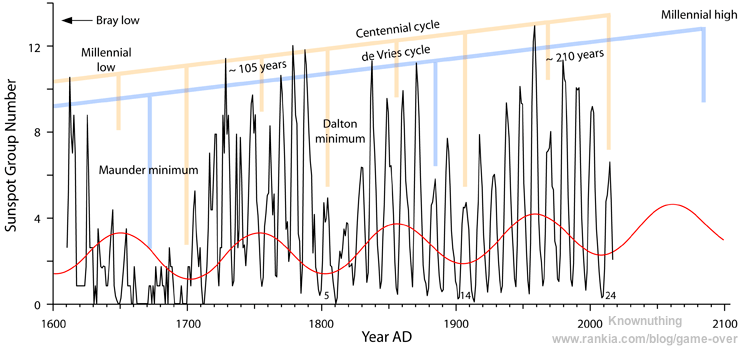
is a good example of the 100-yr variation.
and it is not MY period, but everybody else’s.
you are now showing a graph from 1600, with even more anomalous sections, either true or related to inaccurate measurement…
I asked you / whoever to re-estimate the cycling from whatever your solar data from 1840
could it perhaps be something like 86.5 – 88 years?
I asked you / whoever to re-estimate the cycling from whatever your solar data from 1840
You seem even thicker than I thought possible.
Here are the 100-yr cycles again. For your benefit I have made a box around the data since 1840:
http://www.leif.org/research/100-yr-Cycles.png
I suppose that this answers my question, as well. I have never noted such high across the board activity on spaceweatherlive. con before. …https://www.spaceweatherlive.com/en
goldminor: yes, a CME does provide a short-term shield for cosmic rays [called a Forbush Decrease]
https://en.wikipedia.org/wiki/Forbush_decrease
leif
like I said, the length [of the long term GB weather cycle] depends on the length of time you take to analyse.
I can easily also agree that there can be a delay for a decade or so before we see any change in weather after reaching the top or bottom of the sine wave.
I am happy with the 100 years for the last millennium. However, for the short term, I think perhaps we should rather take my measurement of 87 years.
In a cooling world there is more likely less moisture in the air, but even assuming equal amounts of water vapour available in the air, a lesser amount of clouds and precipitation will be available for spreading to higher latitudes. So, a natural consequence of global cooling is that at the higher latitudes it will become cooler and/or drier, at the lower latitudes there will be more clouds and rain. Overall, the change in T at most places in the world is of such order that nobody will really notice….
\
therefore, following my logic, the 1932 drought is only a few years away. (2017-87=1930)
http://www.ldeo.columbia.edu/res/div/ocp/drought/dust_storms.shtml
after that, count 1932-87= 1845, and notice again the drought time apparent on the great plains of northern America.
https://www.researchgate.net/publication/252814284_Drought_in_the_Western_Great_Plains_1845-56
Too much of a coincidence to toss it aside?
I am happy with the 100 years for the last millennium. However, for the short term, I think perhaps we should rather take my measurement of 87 years.
It sis te other way around. For the short-term [the last few hundred years and now, it has been 100 years.
fyi
https://wattsupwiththat.com/2017/07/11/monster-solar-minimum-approaching/#comment-2554172
leif says\
For your benefit I have made a box around the data since 1840:
henry says
you are not serious? you show the same graph with a box..
like I said, my own data show a sine wave with wavelength of 87 years [43.5 years per half cycle]
it seems to correspond with SSN ….[for the past 100 years]
http://www.woodfortrees.org/plot/sidc-ssn/from:1969/to:2017/offset/trend/plot/sidc-ssn/from:1920/to:2017/plot/sidc-ssn/from:1925/to:1969/trend/plot/sidc-ssn/from:1925/to:2017/trend
you are not serious? you show the same graph with a box..
I am very serious. I you only want to look at the data since 1840, look inside the box and ignore everything outside. Easy, no?
like I said, my own data show a sine wave with wavelength of 87 years [43.5 years per half cycle]
it seems to correspond with SSN ….[for the past 100 years]
No, [shall I draw yet another box?]. For the last 100 years it is clear [as the graph shows] that solar activity now is what is was 100 years ago, just like in the other centuries before. If your ‘data’ does not show that, your ‘data’ are wrong [or your interpretation of them]. This is the usual criteria in the scientific method.
Here is another graph. I have fitted your ‘period’ [red curve] to the most recent cycle:
http://www.leif.org/research/Henry-p-cycle-and-reality.png
as you can see, there is no match at all outside of the fitting period. A sure sign that the fit is entirely spurious: there is no 86.5-yr period in solar activity during the last 400 years.
ja,ja
must be that either your or my data are wrong….
https://wattsupwiththat.com/2017/07/11/monster-solar-minimum-approaching/#comment-2549301
must be that either your or my data are wrong
It is not MY data, but the effort of hundreds of observers over centuries. And sunspot, cosmic rays, and geomagnetic data all largely agree about the data since 1610, so those data are good and correct. So, that makes it easy to choose which one to rely on. What is bothersome is that you claim that your faulty data “seems to correspond with SSN” when they patently do not [as you now admit].
ok.
good comment.
comparing my data with ssn does not seem to work.
ssn is not really a measurement? It is more like a go-no go…?,,
although one assumes that somehow there must be correlation.
Let me think about it some more.
ssn is not really a measurement?
yes it is, we measure [count] the number of spots, measure their area, and measure their magnetic field. We measure the amount of cosmic rays, and we measure the size of the geomagnetic variation. All measurements and all agreeing and all a measure of solar activity. Now, you do nothing like that, so perhaps your data has nothing to do with the sun [since they do not behave like the solar data].
I think I figured it out already.
Has to do exactly what Hale and Nicholson said as per the William Arnold report quoted earlier. In two successive Schwabe cycles one must show SSN as positive while the other is negative. That is just how it is.
Indeed, if that were the case, I think my data would show a good fit, at least for the last GB cycle.
In two successive Schwabe cycles one must show SSN as positive while the other is negative
No, that is a very artificial device meant to confuse, if you take random numbers between 0 and 1 [one number per year] and reverse the sign every 11 years; that is: making 11 positive followed by 11 negative years, you manufacture a spurious 22-yr cycle that did not exist in the original random numbers. At all times, there are positive and negative magnetic fields on the sun. Now, even if you reverse the sign for every other cycle, the numbers you so construct, still show the 100-yr cycle.
As you can see here:
http://www.leif.org/research/22-yr-Cycles-GN.png
The best fit period is 108 years. With every other cycle reversed, you get TWO 108-yr fits [red and blue]
OK.
Good comment.
At least we found proof of the DeVries cycle [not so?]
Now, how come then the [natural] proof of the GB cycle [86.5 – 88 years]
https://www.nonlin-processes-geophys.net/17/585/2010/npg-17-585-2010.html
and the persistence of it [as observed in natural processes]?
http://simsee.org/simsee/biblioteca/CICLO_SOLAR_PeristykhDamon03-Gleissbergin14C.pdf
are you saying they are wrong?
are you saying they are wrong?
Just like the ’11-yr’ cycle has a period varying between 8 and 14 years, the GB ‘cycle’ [if real] has a length varying over time between 80 and 110 years. The past 300+ years the period has been about 100 years. Some people claim that in the distant past, the period was at times shorter, e.g. near 90 years, or 88 years, or some number like that. That is perfectly possible. ‘They’ were possibly not wrong. It is definitely wrong to maintain that the GB cycle has been anywhere near 86.5 years at any time in the last 300+ years.
http://oi63.tinypic.com/2ef6xvo.jpg
I am showing your graph where clearly you can see a pattern emerging from 1971 until 2014 (43.5 years)
My own results show a drop in maxima [54 weather stations] exactly from 1971. Too much of a coincidence.
As expected, the solar magnetic forces move up from 2014 [not depicted, do you have the latest correct results?] but to such an extent that a stronger next SC is expected. Hence the 1971-2014 downward trend has been broken.
I predict that for the 43 years [from 2014] we will see 4 SC’s that will be exactly the mirror image of the previous 4 SC’s in respect of the solar polar magnetic forces,
what do you predict?
I am showing your graph where clearly you can see a pattern emerging from 1971 until 2014 (43.5 years)
The Sun does not operate by ‘patterns’. If anything, solar activity has been decreasing since the 1950s [with an anomaly in cycle 20]. My graph’s starting point is determined by when we first had accurate measurements. Had we started in 1986 your ‘pattern’ would show a period of 30×2 = 60 years. Had we started in 1952 [which we actually did, but with less accurate data] you would see a 100-yr pattern as the polar fields in the mid-1950s were the strongest ever measured.
do you have the latest correct results?
Yes. SC25 will be a bit [not much] stronger than SC24.
I predict that for the 43 years [from 2014] we will see 4 SC’s that will be exactly the mirror image of the previous 4 SC’s in respect of the solar polar magnetic forces
Again, the Sun doesn’t operate like that, but if there is a ~100 yr period from the 1950s then we would expect a minimum 50 years later [now] and a new maximum 50 years later again in the 2050s.
Get into your head that the past 300+ years there has not been an 86.5 year cycle, but a ~100-yr variation.
leif
I am trying to help and you and others see the light.
Many people here, including myself, including William Arnold, as reported,
have noted the correlation of solar activity with the position of the planets.
To deny the correlation exists is futile.
The periodicity noticed by me appears consistent with the Hale cycle occurring on the sun i.e, 2 successive Schwabe cycles. One Hale cycle makes up for one sine wave quadrant of the GB cycle.
Therefore, under normal circumstances, 8 Schwabe cycles makes up for one GB cycle.
The exception to this rule occurs when there is a prolonged minimum or maximum, presumably /possibly because the barycenter of the weight available is not enough to throw the switch in the sun.
I am trying to help and you and others see the light.
Perhaps you think so, but, obviously you cannot see the light that real solar activity shines on you.
You are trying to defend the undefensible against the actual solar data. Whatever reasons or hypotheses you come up with falter of the hard reef of reality. And yet, you persist. Against such blindness there is no cure. I almost think that even if your god appeared and told you there is no 86.5 cycle, you would denounce her.
leif
try playing the ball, not the person
Best wishes to you and all,
Henry
Playing the ball seems not seem to be useful in your case, so perhaps playing the person who throws or carries the ball might help [as in Rugby and American Football].
So you slink away, steadfast in your beliefs after having wasted a lot of bandwidth and time. Good riddance, until next time.
Leif
I am sure we have all learned something.
At least you admitted that there is a ca. 100 year periodic [weather] cycle [during the past 300-400 years or so] which you previously thought was not probable.
I agree that it is probable that it was 100 years [instead of 87-88 years] if looked at it for this past period. However, IMHO the period looked at is not long enough.
I think this is /was a reasonable outcome / result of this whole discussion?
…
I do not see it as a waste of time.
FWIW, thanks for your participation.
At least you admitted that there is a ca. 100 year periodic [weather] cycle
I don’t know where you dream that up. There obviously is no such climate cycle [as I have said repeatedly]. To wit: the current climate [warm] is very different from the climate 100 years ago [cold]. The use of ‘admit’ [especially since it is false] is not playing the ball, is it?
I agree that it is probable that it was 100 years [instead of 87-88 years]
Try to remember that next time you peddle your 86,5 year ‘cycle’.
to wit
seems to me the climate 100 years ago was pretty much the same as what it is now:
https://wattsupwiththat.com/2008/03/16/you-ask-i-provide-november-2nd-1922-arctic-ocean-getting-warm-seals-vanish-and-icebergs-melt/
Perhaps it is a matter of a difference in instruments between now and 100 years ago?
87 years is what other people measured in the growth data, as quoted to you, using sophisticated equipment.
I can see 87 coming from the sun, looking at the correct data, for the past 44 years, e.g. maxima, ozone, peroxide, etc. versus declining solar polar field strengths.
I suggest you try looking at it as well.
seems to me the climate 100 years ago was pretty much the same as what it is now:
Not so:
http://www.leif.org/research/US-Temps-since-1900.png
http://www.leif.org/research/Global-Temps-since-1880.jpeg
leif
100 years ago they used glass mercury thermometers, that were read a few times a day [if you were lucky] and the thermometers were never re-calibrated. We know that in time glass reacts with mercury leaving a deposit, which is why the thermometers must be re-calibrated at regular intervals. The earliest proof of re-calibration I have is from 1948…
Nowadays we use thermocouples connected to recorders that are calibrated and they measure once a second every day and they compute a max, min and average for the day.
You honestly want us to compare measurements now with 100 years ago?
globally…?
You are the one who is comparing apples with pears.
You honestly want us to compare measurements now with 100 years ago? globally…
The standard thermometer up to very recently was the glass thermometer for which “According to British Standards, correctly calibrated, used and maintained liquid-in-glass thermometers can achieve a measurement uncertainty of ±0.01 °C in the range 0 to 100 °C”
Tom Skilling is chief meteorologist at WGN-TV and says:
“Temperature readings taken from precise mercury thermometers in use by the U.S. Weather Bureau in the late 1800s were more accurate than readings provided by today’s electronic thermometers.
Once properly calibrated, a mercury-in-glass thermometer requires no additional adjustment to its readings, so long as the glass bulb that contains the mercury reservoir and its attached expansion tube are undisturbed. Temperature measurements in the late 1800s were accurate to one- or two-tenths of a degree Fahrenheit.
However, readings from those thermometers had to be obtained manually, whereas digital readouts from today’s electronic thermometers are continuously available and can be remoted. The tradeoff for this convenience is accuracy. Most electronic thermometers are considered accurate within plus or minus 2 degrees F., and require maintenance because they gradually go out of calibration.”
100 yyears ago people were not interested ii measuring accurate to 0.5 degrees never mind. Your 0.01 is nonsense.
Scientists were very interested. The 0.01 C is not MY 0.01, but the accuracy established by the British Government Standard.
Nowadays we use thermocouples connected to recorders
How many of your infamous 54 weather stations used glass thermometers and how many used thermocouples?
My sample of weather stations is carefully balanced. 27 x in nh and 27 x sh. All 54 latitudes counted together makes zero latitude. Your global sets are all biased toward nh….
More vegetation traps some heat. See las vegas.
You evaded the question: how many used thermocouples?
All
We changed in the 70s to automatic recording.
First prove that ‘All’ did. How do you know for each station? And the thermocouples are BTW less accurate than the glass thermometers.
The type of recording i.e intermittent by a person or continuous by a computer is what causes the biggest error.
You cannot compare results from now to those from 100 years ago. Same as ssn. How big is spot? What magnification? Etc
Anyway
I am going to sleep now. Have a good time today.
Your ignorance is great. Weather stations have thermometers that automatically measure the maximum and minimum temperature. And the ordinary measurements are not ‘intermittent’ but on a very fixed schedule [every three UT hours at the same time all over the world]. The measurements are very comparable to those 100 years ago. In some case even better [no airport tarmac or AC exhaust to content with]. Sunspots are also very carefully measured, e.g. by photographing the sun every day by instruments with the same magnification since 1874 and measuring their area accurately.
You claim to learn something, so take the above to heart.
And you still evade the issue: How do you know that ‘ALL’ your 54 were using the less accurate thermocouples?
We are totally OT now. And we totally disagree. ?zoom=2
The subjects we stir should be discussed, in more details, but at the correct opportunity when the subject is relevant.
\ I am suggesting we get back OnT
I am in fact still puzzled about your fanatic denial of the GB cycle [87 yrs] in the light of the overwhelming evidence that I have presented, both in the last 10000 (cycle: 88) and last 100000 (Cycle: 86.5) years
[that represents those investigations]
Above, we are looking at the development of the magnetic field strengths of the sun from 1971.
Supposing there was no turning point at 2013/2014
[as predicted by me from my own results on maxima: at this time we were right in the middle of the GB cycle]
where would you think could we end up with solar magnetic field strengths?
I am in fact still puzzled about your fanatic denial of the GB cycle [87 yrs] in the light of the overwhelming evidence that I have presented, both in the last 10000 (cycle: 88) and last 100000 (Cycle: 86.5) years
As i explained, the solar cycles vary in length. The 11-yr cycle has had lengths between 8 and 14 years. The 100-yr variation also varies in length from 50 to 100 years. The past 300+ years it has been a 100-yr cycle.
Supposing there was no turning point at 2013/2014
There is no ‘turning point’. The polar fields are a good predictor of the solar cycle. In fact, the polar fields predicts the cycle about 6 years in advance, so as the sunspots vary, so vary the polar fields. Hence, if the sunspot cycle have had a 100-yr variation, so have the polar fields. The title of my paper on prediction of the cycle reads “Sunspot cycle 24: Smallest cycle in 100 years” [http://www.leif.org/research/Cycle%2024%20Smallest%20100%20years.pdf] because that the long cycle is 100 years: activity now is low, a hundred years ago it was also low and halfway it was high and in another half century it will perhaps be high again. No 86.5 year cycle in sight.
I want to answer but it seems the link to your paper does not work?
http://www.leif.org/research/Cycle%2024%20Smallest%20100%20years.pdf
leif says
As i explained, the solar cycles vary in length. The 11-yr cycle has had lengths between 8 and 14 years. The 100-yr variation also varies in length from 50 to 100 years. The past 300+ years it has been a 100-yr cycle.
henry says
You must realize that the true SC is two successive Schwabe cycles. Seems to me Dikpati mentioned a 17-21 year periodicity.
My observation [planets’ position] is 19-23 for the past 4 Hale cycles giving me GB at ca. 88 (3 x 23 + 19)
50 seems ridiculous> cannot be.
Your paper mentions the possibility that SC 25 would be even smaller then SC 24.
i.e. “solar cycle (s)” (sic). This has not happened. Hence, there was a turning point. Around 2013-2014. Must be.
You did not see that coming?
You must realize that the true SC is two successive Schwabe cycles.
Not at all. Each cycle is actually 17 years long and two adjacent cycles overlap. The new cycle beginning several years before the old one goes away.
Seems to me Dikpati mentioned a 17-21 year periodicity.
No, she didn’t. She claimed that each single cycle is 17-21 years long, that being the time it takes for the magnetic field to make one complete cycle from inside the sun to the surface and back again.
50 seems ridiculous. cannot be.
It is more like 100 years currently.
Your paper mentions the possibility that SC 25 would be even smaller then SC 24.
Nowhere do I say that. Quote the exact words to gain some credibility.
Leif
Great apology to you. indeed, you did not say it.
The exact quote is:
Several other recent predictions [Schatten, 2003; Schatten and Tobiska, 2003; Badalyan et al., 2001; Duhau, 2003; Wang et al., 2002], but not all [Tsirulnik et al., 1997; Hathaway and Wilson, 2004], also seem to indicate lower solar activity for the coming cycle(s).
Seems we both agree then from each of our own results that SC 25 will be stronger than SC 24.
You can be right for the wrong reason.
I gather my own data and do my own investigations. I knew from my own results on maxima that 2014 was a dead end stop.
If your results confirm my own findings I am happy.
Now. The next dead end stop will be in ca. 40 years from now.
Are we both going to be around to see it happening?
Now. The next dead end stop will be in ca. 40 years from now.
More like 50 years, although it is not scientifically correct to base a forecast on cycles. cycle 20 was a good example of the folly of doing so.
Are we both going to be around to see it happening?
No
Leif
I would be 100
maybe I will make it.
You keep focused on Schwabe. What about Hale?
What happens if you average SC’s 23 + 24, 22 + 21, 20 + 19 and 18 +17?
no more funny 20 perhaps?
You keep focused on Schwabe. What about Hale?
The Hale ‘cycle’ is in your mind only. The Sun doesn’t know about it. Each Schwabe cycle is a singular event, created from the debris of the previous cycle. As the energy in a magnetic field goes with the square of the field, its sign is irrelevant [minus one times minus one is plus one].
Just to finish off here: I think we are all agreed that there is no monster minimum approaching? The next dead end stop of the sun is 40 years from now, or perhaps even 50 years as Leif beliefs, IMHO that could only happen if there would be a prolonged maximum [40 years from now]. I cannot exclude that possibility, after all we have evidence of a period about 1000 years ago when a great part of Greenland was really green [evidence of some settlements from that period only becoming visible now. as the snow melts…]
True enough, I am still in the dark as to whether the positions of the planets, which clearly show correlation with solar activity (SA), are cause to or because of SA.
If the planets’ positions are cause to the SA, I can imagine a problem arising if something happens to one of them….
[only Jesus [God] predicts that just before the end of the world [i.e. the end of time\ ] the days will become shorter.]
The next dead end stop of the sun is 40 years from now, or perhaps even 50 years as Leif beliefs, IMHO that could only happen if there would be a prolonged maximum [40 years from now].
If there are real cycles [not a given], there might be a number of large solar cycles about 50 years from now [100 years after the previous batch of large cycles and 200 years after the batch before that and 300 years after the batch before that again. The planets have nothing to do with that.