Increased leaf abundance is a double-edged sword
From the AMERICAN ASSOCIATION FOR THE ADVANCEMENT OF SCIENCE

A new global assessment reveals that increases in leaf abundance are causing boreal areas to warm and arid regions to cool. The results suggest that recent changes in global vegetation have had impacts on local climates that should be considered in the design of local mitigation and adaptation plans. A substantial portion of the planet is greening in response to increasing atmospheric carbon dioxide, nitrogen deposition, global warming and land use change. The increase in leafy green coverage, or leaf area index (LAI), will hold important implications for climate change feedback loops, yet quantifying these impacts on a global scale can be challenging. Here, Giovanni Forzieri and colleagues analyzed satellite data of global LAI coverage between 1982 and 2011.
Their results varied depending on the local biome, where increased LAI in boreal regions caused a reduction in surface albedo (reflection of sunlight), and thus resulted in a warming effect; in contrast, increased LAI in arid regions caused an increase in transpiration, and thus drove a cooling effect. What’s more, the authors found that these relationships between LAI and surface biophysics were amplified up to five times under extreme warm-dry and cold-wet years. They estimate that, across about 60% of the global vegetated area, greening has buffered warming by about 14%; for the remaining areas, which mostly include boreal zones, LAI trends have amplified the raise in air temperatures, leading to an additional warming of about 10%.
###
The study:
More leaves causes an increase in transpiration everywhere, not just in arid regions.
And transpiration causes cooling, to oppose any albedo effect.
Duh!
But I guess its the wrong kind of transpiration.
The wrong kind of water.
And the wrong kind of leaves.
The wrong shade of green.
So yes, we’re still doomed (sigh of relief) and still need your money.
It’s interesting how the siberian taiga mostly has greened, but there’s a clearly visible and quite lage violet area of 30% leaf area reduction. That seems to be in the vicinity of perhaps the most polluting city of the world, Norilsk. Shows what /real/ pollution still can do!
Simple stuff.
Glacial Periods = White Death Mass Extinctions of land and aquatic Flora and Fauna.= Bad.
Interglacial Periods = exponentially increases land and aquatic Flora and Fauna = Good.
Evolution is constantly changing the environment and environmental alarmist want to reduce the Carbon Dioxide that creates and sustains all life, wanting evolution to stand still = Bad.
Increasing Carbon Dioxide in the environment sustains life as it promotes the increase of more evolution of life = Good.
Harmful weather is created by the temperature degree of differences in the cold at the polar regions and the warmer temperature around the Equator mixing by the Jet Streams and Ocean Currents. Reducing one to be closer to the other reduces the severity of the storms.
Reducing the heat at the Equator creates Glacial Conditions of White Death. Because the Sun controls the amount of Solar Radiation reaching our atmosphere, we cannot just flip a switch to turn it off. We could Nuke our known Super Volcanoes and create a Glacial nightmare that could wipe out all life on Earth = BAD.
Reducing the Ice locked in land and Polar Glaciers is what Global Warming in Interglacial Periods do naturally. That can be promoted by increasing the known Greenhouse Gases in the environment. Changing the Climate to a Global Tropical Weather from pole to pole. Arid Desert areas would support more life as would Ice Locked Deserts would support more life from the increased precipitation. Global growing seasons would increase and yield more food of Flora and Fauna. Species will adapt or go extinct during the several decades to hundreds of years it would take to do it. Larger Oceans from the melted glaciers will dilute the so called Acidification = Good.
I do not believe that glacial periods feature mass extinctions. The flora and fauna just migrate, North or South, as necessary.
Depends on what is meant by “mass” – there’s plenty of evidence for plenty of species going extinct as a result of ice ages, and a new paper suggests that the Permian-Triassic mass extinction was caused by an ice age. Not every species can migrate, and not every species can migrate fast enough to outrun the ice age, and not every species can find a suitable habitat beyond the ice – the non-iced over parts of the planet wren’t just the Earth pre-ice age but shrunk down.
It’s from fossil records that those mass extinctions occurred. Some species had small numbers of survivors nearer to the warmer areas and others went totally extinct. Yes, some migrated and more did not. While some could adapt to the colder climate the duration of thousands of year’s killed their food sources and went extinct because their food sources went extinct. How is that not obvious?
Someone, I forget where, postulated that, since ice ages also decrease CO2 drastically, there may not be enough forage for the vegetarians and some die out because they just can’t get enough to eat.
Whenever the environment and climate change dramatically, some species will go extinct and others evolve.
This has been observed repeatedly in the Pleistocene glaciation and the Holocene, as in prior such alternations.
Consider the genus Mammuthus in the family Elephantidae or the order Proboscidea. The first known members of Mammuthus are the African species M. subplanifrons from the Pliocene (before 2.6 Ma), thought to be the ancestor of later forms, including M. africanavus from the Pleistocene.
Mammoths entered Europe around three million years ago, before the Pleistocene. The earliest European mammoth, M. rumanus, spread across Europe and China. Only its molars are known, which show that it had 8–10 enamel ridges. A population evolved 12–14 ridges, splitting off from and replacing the earlier type, becoming the southern mammoth (M. meridionalis) about 2–1.7 million years ago. In turn, this species was replaced by the steppe mammoth (M. trogontherii) with 18–20 ridges, which evolved in eastern Asia around 2–1.5 million years ago. It died out in Eurasia about 370 Ka, but continued evolving in North America.
The Columbian mammoth (M. columbi) evolved from a population of M. trogontherii which crossed the Beringian land bridge and entered North America about 1.5 million years ago. It retained a similar number of molar ridges to the steppe mammoth. A 2015 study of mammoth molars confirmed that it evolved from Eurasian M. trogontherii, not M. meridionalis as had been suggested earlier. This was confirmed by a 2016 a genetic study of North American mammoth specimens.
Mammoths derived from M. trogontherii evolved molars with 26 ridges 400,000 years ago in Siberia and became the woolly mammoth (M. primigenius), which spread to Europe and North America, for a holarctic distribution close to the ice sheets, from Ireland east to the Grand Banks of Newfoundland.
Sorry. Should read “of the order”.
This shows the steppe mammoth larger than its Columbian descendant, which on average wouldn’t be right. But of course there was overlap. That’s if you consider the imperial mammoth just a big subspecies of the Columbian.
http://www.prehistoric-wildlife.com/images/species/0/mammoth-mastodon-elephant-size-comparison.jpg
M. exilis is a dwarf subspecies of M. columbi.
Mastodon is only distantly related to mammoths. It’s not in the elephant family, but is naturally a proboscidean.
Getting shorter than its ancestor was one of the woolly’s adaptations to the colder climate. Also, hairier, smaller ears, different trunk “fingers”, dental differences noted above, blubber, etc.
If I thought the next glacial would wipe out all the liberals, I’d say bring ‘er on right NOW!
Well…if you go by how they voted in the last US election. The coastal state’s votes more liberal. If the flood from melted glaciers raise the ocean’s… The fools would be moving into more rightwing states and bring their bs with them.
Gold,
Since only the hardy will survive, it would. Unfortunately, it won’t start working its Darwinian magic for thousands of years yet. The SJW will have lots of time in which to destroy civilization, the work of ten thousand years.
You seem pretty positive that the Yellowstone Super Volcanoes System is not going to blow and no massive meteors are going to hit earth, or the Solar Minimum that is being predicted won’t happen. The Ocean’s have been spreading more in the last billion years… This is volcanic activities that have been mapped and supports the Expansion Theories more than the super continent’s theories. Where do you think those gasses go? If that happened tomorrow what would the effects be?
johchi7 May 27, 2017 at 2:39 am ?itok=r4L7D8Kb
There is zero evidence to support an expanding earth conjecture. It’s no a theory, since it no scientific facts, ie observations, support it.
There was more ocean a billion years ago, not less.
https://www.sciencenews.org/article/new-fascination-earths-boring-billion?mode=topic&context=60
The fact of tectonic plate movement isn’t a “theory”. It’s a fact, ie an observation, with a body of theory trying to explain how it happens. The velocity of each plate can be and is measured. Subduction is constantly observed.
Despite overwhelming evidence to infer “continental drift”, it remained an hypothesis or theory before the discovery of seafloor spreading, which provided the missing mechanism.
I seriously do not have time to reply at this time. Going to work soon and I don’t get back until early Sunday morning.
Chimp. Do you even listen to your thoughts before you write? You answered your own argument against the expansion theory, by including that the Plate Tectonics theory adopted the spreading of the oceans theory, that came from the expansion theory. Calling something by a different name and changing the way it’s explained doesn’t negate or disprove the same action. When the theories of what created mountains and orogeny with subduction was the answer, it always skips over “what created the pressure to force the plates together” to cause the effect in the first place. When Orogeny and subduction are basically words describing a reduction or subtraction event, where was the addition event to cause the effect of them. Isn’t it convenient that all that massive lithosphere covered by ocean surrounding Patagonia all subducted away to leave no evidence of it’s existence. If you believe in subduction as the mechanism of which the lithosphere is forced into the mantel to be remelted by it, there is your added mass being displaced in the ridge-lines spreading the oceans by it’s cooling rapidly as it’s exposed to water. Plate Tectonics theories have so much conjecture, hypothesis and the “we don’t have any proof to answer this or that’s” when it was debated and agreed upon in the 1970’s. Yet, in the 1970’s almost nothing was known about the ocean floors and today we know just a little more, because we are not advanced enough to reach those depths to drill cores with any way to map them. Even on land we cannot drill to depths to get to the Mantel, or through miles of ice to reach the Wilkes Land Crater.
Chimp. It is accepted science that the Earth Day has changed throughout history from around 14 hours over 3 billion years ago to the over 24 hours today. They came up with some really strange explanations to keep the Earth the same diameter about ocean tides and drag caused by the ocean floor, the action/reaction of the Moon with the Earths Core flexing the Tectonic Plates, yawda yawda… When a simple use of the Expanding Earth from a Smaller Earth at the same rpm would explain how the day was shorter then than it is now. And as the Earth Expanded in Size – not mass as I previously showed – the Moon would be moving away from the Earths orbit by it’s increase in diameter. You will also notice – if you studied the Expansion Theories – and applied some logic with the occurrences of those time frames of the known dating of the Ocean Floor, that they coexist with the jumps in the Earth Day increases and the Orogeny occurrences.
Simply put. The Tectonic Theorist 40 years ago that made their ideologies “settled science” placed the Expansion Theorist along the lines of the “Flat Earthers” and “Hollow Earthers” while actually adopting Expansion Theories every time they include in their papers “…the oceans are spreading by X amounts…” because the continents are getting farther apart.
The wife made plans for today, so I have no time to play with you now.
Chimp. Quote “Despite overwhelming evidence to infer “continental drift”, it remained an hypothesis or theory before the discovery of seafloor spreading, which provided the missing mechanism.” then you say that the Expansion Theories were not adopted into the Plate Tectonic THEORIES. Note emphasis because most every source on PT use the words Hypothesis, Hypothesize and Theory, Theorize, and Assumed to describe what they cannot give proof for. Like a religious fanatic you are a zealot in your ideology that is right up there with the Environmental Cases that say Global Warming and Climate Change is “Settled Science” to stop the discussion because they don’t want to be contradicted and proven wrong… or at least admit they were not totally right. I admit that a lot of the things Adams and others state are pure garbage to imply that no subduction occurs, or about dark matter and cosmic rays creating matter that adds mass… Again. Subduction that is redissolved by the mantel is redistributed as volcanic activity as most geologist agree. The thinnest areas of the plates are on the ocean floor and it is accepted that those areas are spreading. That modern space observations show very little increase, does not explain what occurred millions and billions of years ago. Pyroplastic of Magma while molten expand upon cooling as trapped gasses and minerals form different rock formations. The term Intrusive Rocks being something forced through existing formations creates an Expansion of the existing formation – that dissolves some of that existing formation in the Intrusive Rock. We see this everywhere as newer veins and mass bodies of younger rocks through older rocks. Rapid cooling by the cold of deep oceans water mixing with the igneous spewing into it, is going to build upon itself.
Johchi,
You clearly don’t understand how plate tectonics work. Nor where the fact came from, which most certainly was not from the false on its face conjecture of an expanding earth. Whence do you imagine that the water for the oceans came to cover the surface of a supposedly expanding earth?
Not only can we today measure the movements of the plates absolutely and relatively to each other, but we can measure the uplift of the mountains above subduction and collision zones, such as the Andes and Himalayas. We can also directly observe subduction occurring in the ocean depths. Not to mention the earthquakes caused by plate slippage.
We can observe the seafloor spreading ridge now better than ever, and every observation confirms the fact of new seafloor creation, driving the continents away from the ridges. We can date the age of seafloor, and sure enough, the oldest dates to the breakup of Pangaea, with ever younger floor as you approach the ridges.
OTOH, there is zero evidence in favor of the lunatic notion of an expanding earth.
We have in fact recovered rocks from the mantle, but also have other ways of following the currents in it. Drilling into may start soon.
The fact of plate tectonics is not theoretical. It’s based upon direct observations, as I said. Where I live, getting the science right is a matter of life and death to millions:
Jochi,
There is no possible mechanism for an expanding earth, and as I said, zero evidence in favor of the conjecture. On the contrary, the mechanism for plate tectonics can be seen, as can its results.
After the collision which spun off the moon, an earth day was about six hours. At that Hadean Eon time, the moon would have been about a mere 25,000 kilometers away. The moon’s tidal effect is the main reason our day has been lengthening, and that the moon’s orbit has been widening.
Any climate model that does not properly model the CO2 fertilization effect, photosynthesis and botany is wrong. Pretty sure that includes all existing models.
Those per se research and/or study publishing “climate scientists” who do not understand the biology of planet earth are doomed to failure for their predictions of future weather/climate events.
The trouble with these climate boffins is that they see everything through the warm vs cool goggles. They can’t see the forest through the trees. “Climate mitigation” is an idiotic notion, as is worrying about adapting to climate change, particularly since what they are calling “climate change” is mainly just weather.
They’re just desperate to find something “good” about chopping down more forestland for solar farms.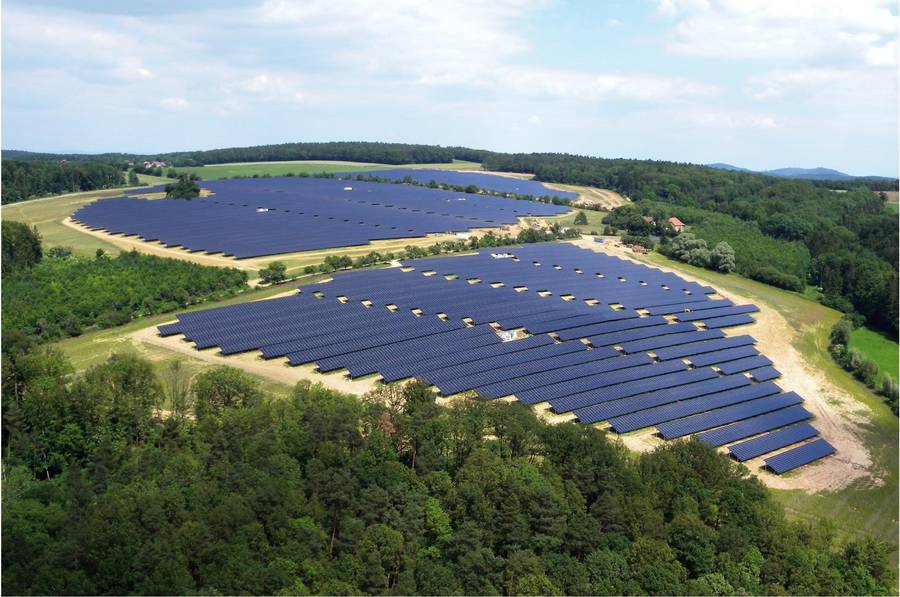
I wonder what kine of erosion problem they are going to have with all that exposed dirt and nothing to hold it during rain run off.
Plus all the herbicide and pre-emergent that will be in the run off.
Little did we know that Douglas Adams was prescient in his “Hitchhiker’s Guide to the Galaxy”, where at the end of the story, newly marooned humans adopt the leaf as the new media of exchange then proceed to burn down forests to raise the value of the leaf.
Which just shows that Adams, for all his literary brilliance, didn’t udnerstand the basics of economics!
The “value” of your medium of exchange is a meaningless term.
What an incredibly stupid map projection:

That projection (likely Molleweide or Apian II, see https://www.giss.nasa.gov/tools/gprojector/help/projections.html ) makes sense when the poles are at the top and bottom, but when the north pole is centered, then the latitude lines are all ellipses when circles would be more accurate. Perhaps they just wanted to something to take up a rectangular space.
Willis used a sensible version:
Actually, the north pole isn’t centered, perhaps Greenwich is, and the projection is trimmed to exclude much of the Pacific. While that’s reasonable, I’m still offended by the aspect ratio.
Looks like it’s centered on Geneva
So only the leafy plants are measured. There must be terrific growth also of coniferous in the huge boreal forests of Canada, Scandinavia and Russia. These were already large net carbon sinks before the age of doomsters. And maybe the larger of the sinks, phytoplankton, is quietly dwarfing all this.
So maybe their models aren’t bad, they just didn’t number any agronomists, botanist and foresters among their ranks and they tripled observational warming with their all-is-lost formula . Even the estimable Ferdinand Englebeem was taken by surprise – Henry’s Law got too big a billing in the scheme of things.
The next shoe is going to drop in the next months with the “dead cat” bounce from the steep drop in ENSO now peaked out (Chatelier Principle doing it’s thing) the drop into La Nina will continue and dreaded Pause will resume, despite the Karlization headwinds.
Yep. And the plankton will have their say.
In this context conifers are considered to have leaves.
There is nothing controversial in the study. It refers to changes in earth’s albedo due to changes in green areas of earth. “Watts Up With That” addressed the issue on September 12, 2010.
“Christy on irrigation and regional temperature effects”
What the paper said was, thanks to irrigation, and transpiration in plants, the San Joaquin Valley had
cooler days and warmer nights, with an overall warming. There is the same effect in Florida, at about the same latitude as the Sahara Desert. Thanks to the effects of albedo and transpiration in plants, Florida has cooler days and warmer nights than the Sahara Desert, with an overall slightly warmer climate.
https://wattsupwiththat.com/2010/09/12/christy-on-irrigation-and-regional-temperature-effects/
Even good news is bad.
Well, I won’t read the study, because I have other things to do, but my take on it is simple.
1 – The Earth has its own agenda.
2 – We have no control over what the Earth decides to do
3 – Extra greening means extra photosynthesis available, meaning extra oxygen and water released by plants into the atmosphere.
What’s the problem?
I’m going to go make cookies now.
When I was a boy in Potomac MD, I could walk through the woods unencumbered by understory. Now, that is impossible in all but the oldest forests. The air could move and you felt like you could breath easier in the less-desnse forests of the 1960s. It felt cooler. I’ll make a prediction: The deciduous forects of the mid-atlantic are transforming into jungles.
What about the direct effect on humans of shade from those leaves? Did these folks ever work out in the hot sun and need a break? Or, do people really count in all this?
They seem to be mostly city dwellers who don’t mow their own lawns.
Rhoda —
You may be right.
The heading should read the pros and pros of leaf abundance. The only cons I can see is the one being played by the authors to extract public grant money for such a ridiculous study.
More leaves more rakes in the fall. Invest in rake companies…
Pure CLAP TRAP! The greening is a fairly reliable FACTUAL observation. (I.e., it has a BASELINE, it has a time line, and it has (unlike for example…the CONUS USA, based on Surfaces Stations Data) pretty good quality control and cross checking. THIS write up by these CLOWNS is pure calculational conjecture and needs to be treated as such. WARNING: Don’t fly on an AIRPLANE designed by CLOWNS like this. You won’t live long.
well looks like i will have to buy more Roundup weed killer
Ken. I live in the arid Arizona desert. My delima is convincing the wife, with this article, to let the weeds grow and water them more.