Guest essay by Rud Istvan

Dr. Murry Salby has been getting substantial attention in the climate blogosphere, for two reasons. First is his theory that at least 2/3 of the observed increase in atmospheric CO2 is natural and temperature induced. Second are the circumstances surrounding his departure from U. Colorado and later termination from Macquarie University. This post covers the first and not the second, and is motivated by a very recent WUWT post on the mysteries of OCO-2, where the Salby theory was raised yet again in comments.
Background
Dr. Salby developed a substantial scientific reputation for work on upper atmosphere wave propagation and stratospheric ozone. He has published two textbooks, Atmospheric Physics (1996) and Physics of the Atmosphere and Climate (2012). His new theory that most of the increase in atmospheric CO2 is naturally temperature induced (NOT anthropogenic) is not published. He explicated it in a Hamburg lecture 18 April 2013, and a London lecture 17 March 2015. Both are available on YouTube. (Search his name to find, view, and critique them before reading on if you want to deep dive.) This post does not reproduce or critique his arguments in detail. (There are fundamental definitional, mathematical, and factual observation errors. Perhaps a more detailed companion post will follow detailing them with footnotes if this does not suffice.) This post only addresses whether his conclusions are supported by observations; it is a macro Feynman test rather than a Salby details deep dive.
Controversial CO2 Atmospheric Concentration Theory
The core of Salby’s theory is derived using CO2 data from MLO’s Keeling Curve since 1958, and satellite temperature data since 1979. (His few charts reaching back to 1880 contain acknowledged large uncertainties.) His theory builds off a simple observation, that in ‘official’ estimates of Earth’s carbon cycle budget, anthropogenic CO2 is only a small source compared to large natural sources and sinks. This is illustrated by IPCC AR4 WG1 figure 7.3.

He then deduces there must be rapidly responding temperature dependent natural CO2 net sources much greater than anthropogenic sources. This is a very questionable argument on short decadal time frames. Gore got it wrong, and Salby got it wrong. The ice core based CO2 lagged change to temperature is about 800 years, common sensically corresponding to the thermohaline circulation period. (For rigorous calculations on Salby’s decadal time scales using residency half-lives and efold times, see Eschenbach’s post at http://wattsupwiththat.com/2015/04/19/the-secret-life-of-half-life/

He observationally bolsters his conclusion by ‘showing’ that highest CO2 concentrations are over relatively uninhabited/unindustrialized regions like the Amazon basin, so must have natural origins. The following ‘observational’ figure is from his Hamburg lecture. Except it is completely disproved by OCO-2.

Critique
As Feynman said, observation trumps theory.
First, if Salby is right, the rise in atmospheric CO2 concentrations should have slowed or stopped because of the ‘pause’. They haven’t. They bear no short or long term relationship to one another. Since 2000, CO2 has increased about 35% on the 1958 Keeling curve base; temperatures haven’t (the pause). The seasonality of the northern hemisphere terrestrial photosynthetic sink is apparent in the Keeling curve, as is the temperature/CO2 discrepancy disproving Salby.

Second, satellites have NOT generally observed higher CO2 concentrations over uninhabited/ unindustrialized regions in past two decades. (The following NASA charts use AIRS IR sensors on various satellites to estimate gridded CO2 concentrations from peak CO2 OLR absorption wavelengths. The new OCO-2 data is even more stark.)

Third, Salby’s theory requires that land and/or sea serve as the temperature dependent CO2 net sources that ‘overwhelm’ anthropogenic CO2 emissions from fossil fuels and cement production. That is NOT true either; both land and sea have been serving as net sinks.
Terrestrial biomass (net primary productivity, NPP) is an increasing sink. This has been observed in multiple ways, including NASA AVHRR (1982-2009) and MODIS (2000-2009) ‘normalized difference vegetative index’ (NDVI). NDVI has been ground truthed by sampling NPP including both ‘roots and shoots’ by ecosystem. The terrestrial net biological sink has increased since 1980. It is not a source. The most recent paper is NASA’s 14% greening in 30 years, published 4/16/2016 and previously remarked at WUWT.

That leaves oceans. Biologically, oceans are a net carbon sink through photosynthesis and calcification. Satellites detect this through planktonic chlorophyll concentrations.

But there are certainly large ocean zones that are relatively barren (mainly from lack of iron fertilization in the form of dust). Those large blue barren swaths are where ocean water pCO2 and pH are monitored, precisely to minimize confounding biological sink influences recently explained on WUWT by Dr. Jim Steele. Could those also be a net source?
Barren ocean regions are mainly influenced Henry’s Law and Le Chatellier’s Principle. The first says partial pressures of ocean dissolved CO2 and atmospheric CO2 will equilibrate. The second partly says colder water stores more dissolved CO2. ARGO suggests the oceans are warming. Could Le Chatellier be stronger than Henry, in which case oceans could provide Salby’s requisite rapidly temperature dependent net natural source? There are two stations, Aloha 100 km north of Oahu (maintained by University of Hawaii and WHOI) and BATS off Bermuda (maintained by WHOI) where the hypothesis can be tested by observations. Both show even barren oceans are a net carbon sink since 1980. Barren ocean pH declines as pCO2 increases.

If there are no observational temperature dependent natural CO2 sources, and temperature dependent sinks (NH temperate terrestrial vegetation) increase with temperature, then Salby’s natural carbon dioxide theory cannot be true. It is falsified. Even before detailing his definitional, mathematical, and factual errors.
Today I read a very interesting paper unknown to me till now:
http://www.pnas.org/content/94/16/8370.full.pdf
Dependence of global temperatures on atmospheric CO2 and solar irradiance
David J. Thomson (Bell Labs), 1997
(presented at a colloquium entitled ‘‘Carbon Dioxide and Climate Change,’’ organized by Charles D.
Keeling, held Nov. 13–15, 1995, at the National Academy of Sciences, Irvine, CA.)
Apart from his amazing accuracy in getting rid of numerous biases in trend computations still ignored by many today’s scientists, one impressive result in the paper was that he discovered (in 1994!)
« Analysis of the low-frequency and annual parts of the temperature records yield at least three largely independent indicators of climate change
– the change in distribution of individual station phase trends about the mean, the change in average phase
– and the increase in average temperature. »
This is exactly what we actually experience in the polar regions, where sea ice extent anomaly plots for the recent years look as if the annual cycles hadn’t been removed out of their originating time series.
What an interesting lecture for a layman!
The same discussion between Ferdinand and Bartemis took place years ago here:
http://notrickszone.com/2013/10/08/carbon-dioxide-and-the-ocean-temperature-is-driving-co2-and-not-vice-versa/
A never ending process, as it seems…
Yes, it has been going on even longer than that. I’m not sure I could put a precise date on it, but I think it is over a decade.
And, throughout that time, the relationship between the rate of change of atmospheric CO2 and temperature has remained true. The rate settled out with the “pause” in temperature anomaly while emissions kept accelerating onward and upward.
http://i1136.photobucket.com/albums/n488/Bartemis/scale%200.22_zpsq4jxp1xy.png
http://cdiac.ornl.gov/images/global_fossil_carbon_emissions_google_chart.jpg
It tracked the El Nino blip we just went through. And, it is now falling rapidly in sync with the current plunge in temperature anomaly.
With luck (of a sort), we will soon reconverge to the ~30 year downcycle, of the ~60 year periodic component evident in the temperature records, that was delayed in appearance by the monster El Nino. When the curve decelerates in sync, we will hopefully have proof positive that nobody can deny any longer.
Bindidon,
Yes, the same discussion bursts out every few months since several years… Until some sudden cooling event would show up that shows one of us is right…
“Until some sudden cooling event would show up that shows one of us is right…”
And on that day, ferdinand, we’re gonna serve you up a great big plate of crow! (with a nice big slice of humble pie for dessert!)…
All kidding aside, it would really be a shame to wait five years or so for that to happen. Such a discussion should begin now. (or at least every effort should be made to get there sooner) It would be a shame to see great talents wasted on an argument that’s going nowhere. It’s not unheard of to assume something that you think wrong is right, just to advance knowledge and understanding. And if that doesn’t happen, i hope one of y’all can break the stalemate so that you don’t have to wait five more years. (that’s how long it will take to wade through ferdinand’s interannual variability) Life is short…
Mod – my reply here seems to have disappeared into the ether. Can you please see if you can rescue it? Thx…
Trophobiosis
Hydrocarbons upwell from deep underground until they reach a strata
of soil we call topsoil. Aerobic microbes extend into the soil to the
depth oxygen can penetrate. These microbes use the oxygen and
hydrocarbons to oxidize the hydrocarbons, excrete CO2 and fertilize
the soil in their life cycle. The fertile soil and the CO2 allow the
plant, in the presence of sunlight, to perform photosynthesis. As the
plant grows, this process produces oxygen, which feeds the microbes.
The above described process means that local CO2, at ground level,
can be a very much higher in areas which have very rich soil, such
as Kansas or the Ukraine. This extra CO2 means that lower growing
plants in these areas are not dependent on limited CO2 levels elsewhere.
As long as topsoil anywhere has access to oxygen, plants growing in
that soil will not starve for CO2.
On my property, in a separation of 1500 feet, the amount of upwelling
hydrocarbons vary by a factor of 2.
The exact amount of CO2 emitted by the microbes is unknown and would
require an amount of effort to survey which I cannot comprehend.
The fact that I have seen no indication of an attempt quantify this
source of CO2 means most, if not all carbon balance models, are at
best, SWAGS and probably WAGS.
The foregoing is the result of my research, not theories.
Nope. Fossil [hydrocarbons] never emerge from the surface; (Green River); they emerge from kerogen strata buried deep enough to be in the temp/pressure ‘oil window’ of catiagenesis. . Hydrocarbons upwell [until] stratigraphically capped by some impervious cap rock like a salt dome or Kern River caliche. Else no conventional oil reservoir forms from an underlying source rock shale. Like the giant ‘oil spill’ known as Athabascan tar sands.
JH, you need to study a lot more petroleum geophysics before commenting again.
Rud, my challenge stands. Lets do a real test, No bluster or theories.
A real test.
As a parting post, please everyone note that atmospheric concentration has been at a steady rate of about 2 ppmv/year ever since the “pause” began:
http://i1136.photobucket.com/albums/n488/Bartemis/scale%200.22_zpsq4jxp1xy.png
Total FF emissions just keep right on accelerating:
http://cdiac.ornl.gov/images/global_fossil_carbon_emissions_google_chart.jpg
Indeed, there is a marked acceleration in emissions about 2000, just at the time concentration suddenly decelerated.
Ask yourself, why? Is this consistent with emissions being the driving force behind atmospheric concentration?
No, it is not. After the latest El Nino, temperatures are plunging fast. The “pause” has been reinstated, and may continue indefinitely, or even transition into a cooling era. As emissions keep on accelerating, and concentration at most remains at essentially constant rate, it should not be too much longer before the discrepancy is too great even for the diehards to defend.
Please note that, in the above plot of the rate of change of concentration, the units are ppmv/month. A rate of 2 ppmv/year is 0.17 ppmv/month.
Bart you are ridiculous. If the “pause” persists for 1000 years, and CO2 continues to rise at 2 ppm/yr, then 1000 years from now, global temperature will remain the same but CO2 will be at 2400 ppm. Your “theory” doesn’t work.
You are one dumb kid.
Darby, by the time 1000 years would go by, a new equibrium state temp would have been reached and the carbon growth rate would be zero. (bart has explained this over and over and over again) Please pull your head out of your backside before you comment, it’s painful watching you embarrass yourself…
Michael is right, as there is zero feedback in Bart’s formula. Thus no matter how much CO2 enters the atmosphere, there is no feedback from the increased CO2 pressure in the atmosphere on the influxes and outfluxes from the oceans and vegetation.
Despite that vegetation is an observed, growing sink for CO2, thanks to the increased CO2 pressure in the atmosphere.
Despite that the oceans are an observed, growing sink for CO2, thanks to the increased CO2 pressure in the atmosphere.
Zero influence of these growing sinks on the increase of CO2 in the atmosphere: in Bart’s (and Dr. Salby’s) formula, the net influx remains exactly the same for a fixed temperature offset, despite a 30% (90 ppmv) increase of CO2 pressure in the atmosphere in less than 60 years (what will that be after 1000 years?)…
There is absolutely feedback in my model. You have now crossed the line into a lie.
Bart,
In you final formula, there is zero feedback from any increase of CO2 in the atmosphere. Even of that doubles or triples…
That is incorrect. The final formula has the “r” factor subsumed into the “k” factor, as I described here. That is the impact of the feedback you are talking about. It is all there. Just do the math.
Bart,
In your “toy model” you say:
Since r is small, the bulk of both the source H and the temperature constricted outflow k*T goes into the oceans. Suppose, e.g., that r = 0.01.
In the real world:
r := 10 for any change in the ocean surface as result of a change in the atmosphere (the “Revelle” factor).
r := 1 for the current distribution of CO2 from human emissions between atmosphere and deep oceans.
r := 0.01 for the ultimate distribution of all human emissions between atmosphere and deep oceans, but that has a response time of ~51 years for any CO2 pressure above steady state.
r depends of temperature, but that is mainly for the steady state between ocean surface layer and atmosphere. The exchanges with the deep oceans are hardly influenced by temperature changes.
Again what completely lacks in your formula is the response of r to pressure changes: that is where the real negative feedback is…
Ferdinand – after all these years, you have finally convinced me that you have absolutely no math skill whatsoever. I am tired of arguing about things you clearly do not understand. We’ll no doubt pick it all up at the same point next time. Until then, I’m done with this thread.
Bart,
My math skills are completely rusty, but that doesn’t mean that I don’t know what happens in the atmosphere-ocean exchanges, of which you haven’t the slightest idea.
In your formula, you use the ultimate distribution of human CO2 between atmosphere and deep oceans, which indeed is about 1:100.
What you did is applying the ultimate 1:100 distribution to the momentary distribution of human CO2, which doesn’t take into account the relaxation time needed to redistribute that extra CO2 in the atmosphere into the deep oceans…
The momentary distribution is about 1:10 ocean surface – atmosphere.
The momentary distribution is about 1:1 deep oceans – atmosphere.
The relaxation time is ~51 years.
Again, where is the response to an increased CO2 pressure in the atmosphere anywhere in your toy story?
Your math skills are nonexistent.
The response is in my model, from the beginning to the end. I did the math. I showed the math. You do not understand math. It’s hopeless.
Bart:
Your “math” is here:
Since r is small, the bulk of both the source H and the temperature constricted outflow k*T goes into the oceans. Suppose, e.g., that r = 0.01.
Translated into human language:
“Since r is small” means: I have no idea, but my model needs a small r.
“constricted outflow k*T” means: and then a miracle happens, but my model needs such miracle.
“Suppose, e.g., that r = 0.01” means: in the real world r = 1 to 10 (deep oceans – surface), but my model needs a much smaller r.
Bartemis May 17, 2017 at 5:45 pm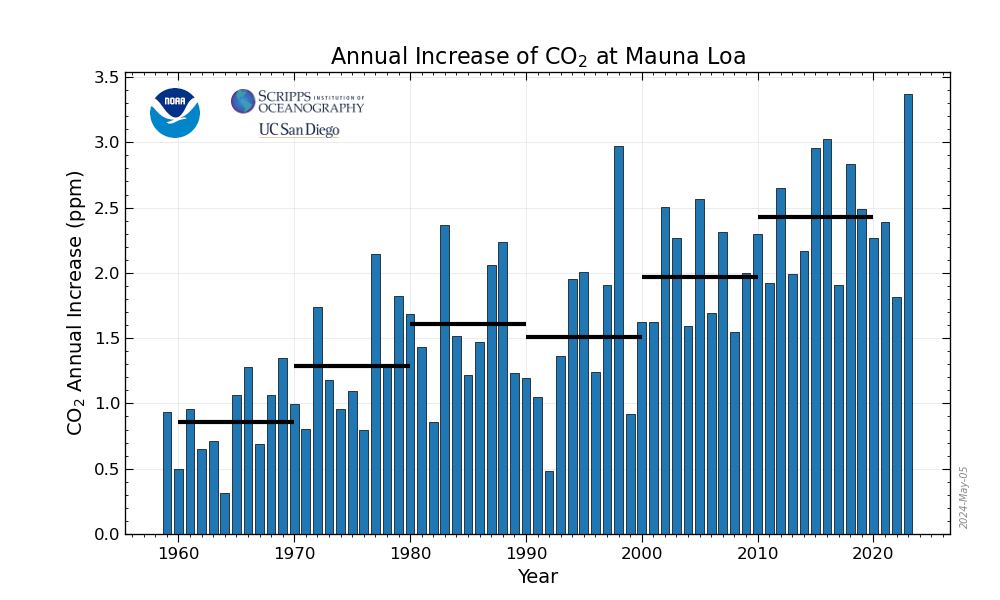
As a parting post, please everyone note that atmospheric concentration has been at a steady rate of about 2 ppmv/year ever since the “pause” began:
Better plot above. Here, excluding El Nino and La Nina years with a trend line:
http://i1136.photobucket.com/albums/n488/Bartemis/trend_zpsynmigzzn.png
All,
No problem with that graph, as the alternative is simply the sum of the effect of human emissions and natural variability caused by temperature variability. The first gives near all the trend, the second near all the variability.
To give a clear picture of the trend, which is caused by human emissions minus the linear sink rate (in ratio to the CO2 pressure above equilibrium), that is here plotted alone, not in combination with natural variability:
http://www.ferdinand-engelbeen.be/klimaat/klim_img/dco2_em6.jpg
The effect of human emissions is in the middle of natural variability thus no need to declare that all increase is from temperature. Temperature variability gives only +/- 1.5 ppmv around the trend of 90 ppmv, the temperature increase maximum 13 ppmv (per Henry’s law). Thus the trend is mainly from human emissions at 155 ppmv over the same time span.
Note the drop in effect of human emissions in the last years: even with constant emissions, the CO2 in the atmosphere increases further and more CO2 is pushed in the oceans and vegetation. Thus the residual amount of human emissions (the “airborne fraction”) gets lower. For constant emissions, ultimately the sinks will equal the emissions and CO2 will not rise further, at a higher CO2 level in the atmosphere.
Further, human emissions fit all observations:
http://www.ferdinand-engelbeen.be/klimaat/co2_origin.html
Dr. Salby’s and Bart’s temperature-only theory violates Henry’s law and about every observation…
They don’t violate Henry’s Law, they enforce it. We’ve been over and over this. You are being dishonest.
Your emissions curve is not total emissions. Total emissions are continuing to accelerate even now, while concentration remains at a steady rate.
Bart,
According to Henry’s law, the maximum increase of CO2 in the atmosphere for the 0.8°C increase since 1958 is maximum 13 ppmv. No matter if you take a single sample or equilize with the whole oceans, via the deep ocean inputs and outputs (if the deep oceans ever reach 15°C).
Most natural inputs and outputs (seasonal, equator to poles) are temperature driven. That is what gives the observed residence time of ~5 years.
The human input is an increase in pressure of the atmosphere, which only can be removed by a pressure influence on the difference between inputs and outputs. That has an observed e-fold decay rate of ~51 years.
Two practical unrelated decay times, one mainly temperature related, the other pressure related.
As long as you don’t accept that the influence of temperature and pressure on the same processes is different, we can repeat this discussion until eternity…
Global CO2 emissions from:
https://www.iea.org/newsroom/news/2016/march/decoupling-of-global-emissions-and-economic-growth-confirmed.html
Sorry,
Something wrong with the closing tag after difference…
[Well, other than being in the wrong place, it looked OK to the mods. 8<) .mod]
No, Ferdinand. That is not what Henry’s Law dictates. Henry’s Law dictates only that there is a temperature dependent ratio between the atmosphere and the surface oceans.
It does not in any way constrain a build-up of the absolute level within the oceans. This is your shallow pond hypothesis, which is not credible under any rational consideration.
“Global CO2 emissions from:…”
Read it again. This is just “energy related” emissions.
I want to point out something about your plot above. You have the flat portion of your incomplete emissions in blue becoming a downward slope in the red one. I assume that is because you are applying a 50 year relaxation filter to the data, per your comment above.
As I explained here, that represents a physically illegitimate decoupling of the natural and anthropogenic flows, because you now have natural inputs being only 1.2X the size of the anthropogenic ones, when they should be more like 30X, at the very least 20X.
Bart:
It does not in any way constrain a build-up of the absolute level within the oceans.
What build-up? Only in your fanatasy? If the waters get warmer, they release more CO2 to the atmosphere, thus from sources to sinks the waters are depleted of CO2 if they get warmer.
It is just the opposite: an increase from 15 in temperature gives a decrease in solubility of ~5%.
The 30% increase of CO2 in the atmosphere (1958-current) gives a 30% increase of CO2 in solution.
http://www.engineeringtoolbox.com/gases-solubility-water-d_1148.html
The net flux thus is from atmosphere into the oceans, not reverse…
This is just “energy related” emissions
Usually the same coal, gas, oil,… as in your plot. Not including highly uncertain land use changes.
I assume that is because you are applying a 50 year relaxation filter to the data
Nothing filtered, the drop in the red line is because emissions are flat, but the increase in the atmosphere still is going up and thus the difference between total CO2 in the atmosphere and steady state for the current ocean surface temperature. The relaxation time of which is ~51 years. That effect is subtracted from human emissions of that year.
because you now have natural inputs being only 1.2X the size of the anthropogenic ones
Comparing anthro inputs to natural inputs is completely irrelevant: at no moment in time there is 150 GtC natural input in the atmosphere, only +/-10 GtC seasonal variation, in average half the increase of human emissions.
“…thus from sources to sinks the waters are depleted of CO2 if they get warmer.”
No, they are not. There are new parcels upwelling every second, and downwelling transport is inhibited by the temperature rise.
“Comparing anthro inputs to natural inputs is completely irrelevant:”
Sorry, no. It fundamentally constrains you. Your 51 year relaxation time violates the requirement that anthro inputs are not more than 3-5% of natural inputs.
Herewith, a math lesson. I strongly advise you to study it, because you are making a very basic mistake.
Let’s suppose I have some variable x representing some quantity that is fed by some input u, and it has a feedback with time constant tau:
dx/dt = -x/tau + u
Let’s suppose that the input u is constant. Then, x eventually settles out to
x_ss = tau*u
At any given time, the amount flowing in is u, and the amount flowing out is x_ss/tau = u.
Now, suppose we want to propate an anomaly, A = x – x_ss. Since x_ss is constant, we have
dA/dt = -(A+x_ss)/tau + u = -A/tau
Suppose we add a perturbing input p. We then have
dA/dt = -A/tau + p
We can have p be whatever we want. But, if we must have p less than 5% of u, then we must have x_ss/tau greater than 20X p. That is simple math, because x_ss/tau is equal to u.
If we back-substitute for A, we can write the equation as
dx/dt = -(x-x_ss)/tau + p
The term x_ss/tau represents the full input u because it is the full input u that established the equilibrium in the first place.
This is all very simple algebra, really. It’s just substituting variables.
Bart:
No, they are not. There are new parcels upwelling every second, and downwelling transport is inhibited by the temperature rise.
If you mean that water is piling up near the poles, how many seconds will that last? Let it be 60 years?
If you mean that water is downwelling normally, but CO2 is not downwelling with that water, with a 12 orders of magnitude slower CO2 diffusion speed than water sink speed, how can CO2 not sink with the waters?
Pure fantasy of yours…
Your 51 year relaxation time violates the requirement that anthro inputs are not more than 3-5% of natural inputs.
The 51 year relaxation time is for any extra CO2 input above steady state, completely independent of any natural inputs or outputs.
It is the difference between the turnover within a bussiness (=throughput or residence time) and the gain (or loss) the same bussiness has at the end of the fiscal year.
Will respond further tomorrow, need some sleep now…
I’ve been wondering how long it would take you to rationalize something to explain away this failure. But, I’m sorry, you cannot. Not and remain credible in any way.
It is not independent. I’ve been telling you it is impossible to affect a balance proportionately more than the proportion of your addition to the input that established that balance. I finally realized where you had gone wrong, and violated that precept. As I knew you had to have done somewhere along the line.
Your model is nonphysical. It is nonphysical for the reasons I have been telling you. The automobile example I gave below may help you understand why. You cannot legitimately decouple the equilibrium dynamics from the processing of anthropogenic inputs as you have.
As it gets a mess here, I have repeated Bart’s math further on with my response just below it…
Ferdinand wins Bart loses.
We all win. We can reap the benefits of affordable energy without worry that we are significantly impacting either CO2 concentration, or global temperatures.
Ferdinand is a good man. He has defended his viewpoint with vigor, and helped elucidate issues that otherwise would not have come to light. That is what science is all about. Science requires open discussion, and the give and take of ideas.
But, I think it is safe to say that the evidence unequivocally indicates he is mistaken. There is no physically viable alternative to the near term model of
dCO2/dt = k*(T – T0)
that fits the data. Temperatures determine CO2 concentration, with an integral relationship in the near term that forbids significant climate forcing in the present climate state. It would pose an unstabilizable positive feedback otherwise – the gain at some low frequency would always be greater than unity. The system would have been unstable, driving itself to a saturation condition eons ago.
AGW is a damp squib. It is wrong on every count:
1) We are not significantly influencing global CO2 levels
2) Surface temperatures are not significantly influenced by CO2 levels in the present climate state
3) Warmer temperatures are better than cold
4) Weather would become less extreme in a world with more evenly distributed temperatures, not more
The world is much bigger than us. It is said that only 3% of the Earth’s surface is covered by urban areas. Despite all the long lines of cars and factories many of us see everyday, it is really only a tiny proportion of the entire world, and the rest of the world has a far greater impact than we do.
Perhaps, one day, we will be so numerous and expansive that our everyday activities will have global implications. But, that day has not yet arrived, and probably never will if current population trends continue on their current trajectory.
Except on point 1) we do agree…
Bart, when will you with or without Salby be publishing? You need to see if your wacky theory can pass peer review. You can argue until the cows come home with Ferdinand, and spew your nonsense in blogs, but we really need to see a research paper published.
I posted my comments above on May 14, 2017 at 7:28 am.
Thank you all for your comments – minus the name-calling – we can do better than that.
As a non-combatant (“agnostic”) in this argument, I am often hit by fire from both sides – this was a pleasant exception.
My best wishes to all of you.
Regards, Allan
Excerpt of my post:
https://wattsupwiththat.com/2017/05/13/is-murry-salby-right/comment-page-1/#comment-2502282
For the record, I disapprove of the rancor that is so often displayed in this discussion – Murry Salby is a decent guy who has been severely wronged – the “piling on” against him is bullying.
At the risk of offending both sides of this SCIENTIFIC argument, I am agnostic about it. As I stated below:
“While this question is scientifically interesting, it is not critical to the assessment of the risks of catastrophic humanmade global warming (“CAGW”). One can make conclusions regarding the risks of CAGW with a high degree of confidence, without fully resolving the primary source of increasing atmospheric CO2.”
Consider the following hypothesis:
“Something” is causing an increase in atmospheric CO2 – this CO2 increase could be mostly natural or mostly humanmade. On top of this CO2 increase is a clear signal, that CO2 lags temperature by ~9 months in the modern data record. The causative relationship dCO2/dt vs. temperature T is incontrovertible.
http://www.woodfortrees.org/plot/esrl-co2/from:1979/mean:12/derivative/plot/uah5/from:1979/scale:0.22/offset:0.14
CO2 also lags temperature by ~~800 years in the ice core record. CO2 lags temperature at all measured time scales.
I suggest that the following conclusions are valid:
TEMPERATURE, AT ALL MEASURED TIME SCALES, DRIVES CO2 MUCH MORE THAN CO2 DRIVES TEMPERATURE.
What we see in the modern data record is the Net Effect = (ECO2S minus ECS). I suspect that we have enough information to make a rational estimate to bound these numbers, and ECS must be very low, so small as to be practically insignificant, far too small for there to be a significant risk of dangerous humanmade global warming.
Regards to all, Allan
Allan M.R. MacRae on May 18, 2017 at 2:50 am
I posted my comments above on May 14, 2017 at 7:28 am.
Thank you all for your comments – minus the name-calling – we can do better than that.
With the noteworthy fact that nobody answered to your comment (all answers in its region were dedicated to Janice Moore).
I guess your goal rather was to repeat your (thoroughly redundant) comment.
Bindi, Allan was an early proponent of the theory that temps drive carbon growth. So, when he says “thank you all” he literally means ALL. (all 700+ comments that is) He isn’t referring to replies to his own. Redundance? That’s o.k., too. A lot of people need to hear it over and over, because they’re just not getting it the first time round. The more people know about the basics of this argument the better. Not because it’s necessarily correct, but because it’s an intriguing argument…
Allan’s comments are always appreciated.
This was not the point.
Allan,
The causative relationship dCO2/dt vs. temperature T is incontrovertible.
Have a better look at that plot: there is zero lag between dCO2/dt and T. Thus there is no (proven) causative relationship between t and dCO2/dt
The lag is between the variability in CO2 around the trend vs temperature variability and between dCO2/dt variability and dT/dt variability. As dT/dt has no trend, only a small offset, it is not responsible for the slope of dCO2/dt, neither is T responsible for the bulk of the trend in CO2: CO2 leads T since ~1850…
Hello Ferdinand,
I do enjoy MOST of your comments, because you are intelligent and honest and you are a gentleman.
However Ferdinand, I must take exception to your post of May 18 at 4:43pm.
You state: “CO2 leads T since ~1850…”. This is false, imo, because:
1. Let us agree that atmospheric CO2 has probably been increasing on average by ~1-2ppm/year since about 1850 (yearly average CO2, that is, eliminating the annual ~6-8ppm average seasonal oscillation called the Keeling curve). However, global average temperature T warmed from ~1850-1940, cooled from ~1940-1975, warmed from ~1975-~1997 and has been flat since then (“the Pause”). So the correlation of T vs CO2 has been positive, negative, positive again and then zero (flat) – so there is NO consistent lead or lag in the macro data.
2. However, since 1958 when we obtained good quality atmospheric CO2 data from Mauna Loa, we can see a close and consistent relationship of dCO2/dt with T, and a ~9-month lag of (the integral of dCO2/dt = ) atmospheric CO2 after T. The close relationship of dCO2/dt vs T and the resulting ~9-month lag of CO2 after T is incontrovertible – it exists in both the surface temperature data record since 1958 and the satellite temperature data record since 1979.
3. The Keeling curve involves a consistent seasonal oscillation in atmospheric CO2 that ranges from ~16 ppm in the far North (Barrow Alaska) to ~2 ppm at the South Pole, and averages about 6-8 ppm globally. This seasonal CO2 oscillation is clearly temperature-driven, and that conclusion is also incontrovertible. There is no question that atmospheric CO2 lags temperature and is seasonally driven by temperature as reflected in the Keeling curve data.
So clearly we disagree regarding your statement that “CO2 leads T since ~1850…”.
However, I prefer to point out the important areas where we do agree. Bart wrote on this page:
“1) We are not significantly influencing global CO2 levels
2) Surface temperatures are not significantly influenced by CO2 levels in the present climate state
3) Warmer temperatures are better than cold
4) Weather would become less extreme in a world with more evenly distributed temperatures, not more.”
You replied:
“Except on point 1) we do agree…”
Count me in gentlemen: Agnostic on point 1, but in strong agreement on points 2, 3 and 4. And those are the points that really matter to humanity and the environment.
And I will add one more, point 5: “More atmospheric CO2 is good and a lot more CO2 is better, up to limits that will never be exceeded by currently hypothesized causes.”
Earth is now in a mode of near-CO2 starvation, and will approach CO2 starvation in one of the next major Ice Ages. As a devoted fan of carbon-based life on Earth, I suggest that we should advocate on behalf of our common life form.
I must add that I am not prejudiced against non-carbon-based life forms – they could be very nice – I just do not know any of them well enough to develop an informed opinion. 🙂
Best regards to all, Allan
Allan,
We agree that the lag – and thus the relationship – is between CO2 and T and also between dCO2/dt and dT/dt
But there is NO lag between dCO2/dt and T, thus no integral relationship. That is where Dr. Salby and Bart go wrong.
Still there is a huge correlation between dCO2/dt and T, but that is the same correlation (if corrected for the lags) as between T and CO2 (not more that +/- 1.5 ppmv around the 90 ppmv trend) and between dT/dt and dCO2/dt.
Why? if you take the derivative of CO2, not only you remove most of the trend, but you shift the variability pi/2 back in time, removing all of the lag, thus now you have a perfect synchronization between the variabilities of T and dCO2/dt.
Integrating T in this matter has no physical meaning as one should integrate dT/dt to obtain the real increase of CO2 due to the increased temperature, which is not more than 16 ppmv/K per Henry’s law or maximum 13 ppmv over the full time span of Mauna Loa measurements. The rest of the 90 ppmv is caused by human emissions, which surpass the extra CO2 from the temperature increase.
Hello again Ferdinand,
As I said, I am agnostic on point 1 above that you and Bart are discussing (the causes of increasing atmospheric CO2 – mostly humanmade or natural?) .
I do strongly agree with this statement of yours, as will Bart:
“Still there is a huge correlation between dCO2/dt and T”
And that is the key to this mystery – how does this tiny “signal” survive, loud and clear in this huge global-scale seasonal CO2 flux? Whether you or Bart are more correct in your debate about point 1 is of great scientific interest, but I just do not feel the need to resolve it right now.
Why? Because it is obvious to me that since this close correlation of dCO2/dt vs. temperature T exists, and thus CO2 lags T by ~9 months in the modern data record, then it is clear that temperature drives CO2 much more than CO2 drives temperature, and the sensitivity of climate to increasing atmospheric CO2 must be very small, so small as to be insignificant. Therefore, the alleged global warming crisis is fictitious.
Furthermore, increasing atmospheric CO2, whatever the primary cause, is strongly beneficial to the environment and to humankind. When you and Bart finally resolve your differences, the only decision we will have to make is whether to thank Mother Nature, or Exxon, BP and Shell. 🙂
Best wishes to all, Allan
Guys – let’s get real.
This is the plot of total emissions vs. yearly average concentration at MLO:
http://i1136.photobucket.com/albums/n488/Bartemis/CO2_Emissions_zpsifwpbxp8.jpg
This is the plot of the integrated temperature model:
http://i1136.photobucket.com/albums/n488/Bartemis/tempco2_zps55644e9e.jpg
It’s really no contest.
My apologies. I jumped to a conclusion. For a fair comparison, it should have been against total accumulated emissions:
http://i1136.photobucket.com/albums/n488/Bartemis/CO2_Emissions_zpssarxe2dg.jpg
So, this test does not deliver the knock-out blow I thought it did.
Well If you convert CO2 (ppmv) to Gt by multiplying by 2.1 the slope becomes ~0.54, so ~54% of the accumulated emissions remain in the atmosphere.
Nope. Almost all of the emissions are removed in short order.
The fit with the temperature model is better because it also matches in the derivative.
Bartemis May 18, 2017 at 12:34 pm
Nope. Almost all of the emissions are removed in short order.
Really, so why doesn’t the pCO2 decrease?
Because temperature anomaly is above the equilibrium level for the rate of change of CO2.
Bartemis May 18, 2017 at 1:42 pm
Because temperature anomaly is above the equilibrium level for the rate of change of CO2.
In which case the emissions will not be “removed in short order”.
Almost all of everything is removed in short order. But, the natural emissions are so much larger than anthropogenic ones that the residual is almost all natural.
“First, if Salby is right, the rise in atmospheric CO2 concentrations should have slowed or stopped because of the ‘pause’. They haven’t. ”
The pause is only for the surface temperature, not the global mean temperature that includes the deep ocean.
When you include the increase in temperature in the deep ocean, the secular temperature; and therefore, the atmospheric CO2 is increasing.
Here is a paper that shows during the hiatus period at the surface, the ocean heat content in the deep ocean is increasing:
“For the past decade, more than 30% of the heat has apparently penetrated below 700 m depth that is traceable to changes in surface winds mainly over the Pacific in association with a switch to a negative phase of the Pacific Decadal Oscillation (PDO) in 1999.”
http://onlinelibrary.wiley.com/doi/10.1002/2013EF000165/full
Girma,
If I remember well, the “heat content” increase of the deeper oceans translated to temperature is somewhat like 0.02°C /decade, Willis Eschenbach has calculated the real figures some time ago. If that warming is added to the surface plus a constant warming by the sun in the tropics, that gives an extra increase of CO2 of 0.32 ppmv/decade… Not the 15 ppmv/decade as observed…
Fonzie – I described the issue in more detail here. This all gets back to the fundamental principal that one cannot displace a natural balance to a greater degree proportionately than one’s proportionate addition to the inputs which established the balance.
Done properly, Ferdinand’s equation would have been commensurate with that principle. Instead, he just substituted his own dynamics which gave him the response he wanted. This caused a glaring contradiction, in that the numbers no longer added up to reflect the small ratio of anthropogenic forcing to natural forcing.
These guys – Ferdinand, Phil, et al. – believe that, just because something is at an equilibrium level, they can then dismiss the equilibrium dynamics as having no further impact. Were that so, I could go out to my car, which is at an equilibrium level between the springs on the undercarriage pushing it up and gravity pulling it down, and lift it up with my pinky. The fact is, I can lift it no further proportionately than my proportional contribution to the spring force that is holding it up. My pinky would fracture well before I could produce any significant lift at all.
They’ve studied the narrative, and they know it very well. But, they lack the mathematical skill to understand the contradictions inherent in it. Their models are not physically and mathematically consistent. They are in a land of make-believe.
Bartemis May 19, 2017 at 10:04 am
These guys – Ferdinand, Phil, et al. – believe that, just because something is at an equilibrium level, they can then dismiss the equilibrium dynamics as having no further impact.
Not at all, we just understand how equilibrium systems work.
For example in the case of the partition of CO2 between the ocean and the atmosphere. The ratio of CO2 in each phase at equilibrium is determined by temperature, if the situation is in equilibrium and CO2 is added to one phase then the excess is transferred into the other phase until equilibrium is restored. In chemical equilibrium this is known as Le Chatelier’s principle.
The rate of change of CO2 in both phases when not in equilibrium will depend on both T and pCO2.
Bart manages to get an equation independent of pCO2 by arbitrarily choosing an equilibrium coefficient for his ‘toy’ model that is at least ten times smaller than reality (from which he derives a rate of exchange which is way off too.
“…we just understand how equilibrium systems work.”
You really don’t. You are gibbering.
Go out and try to lift your car with your pinky, and get back to me.
Bart,
Will you please lookup what Le Chatelier’s principle means?
There is (for once) a good definition of that principle at Wiki:
When any system at equilibrium is subjected to change in concentration, temperature, volume, or pressure, then the system readjusts itself to counteract (partially) the effect of the applied change and a new equilibrium is established.
And about temperature and pressure influence:
Le Chatelier’s principle applied to changes in concentration or pressure can be understood by having K have a constant value. The effect of temperature on equilibria, however, involves a change in the equilibrium constant. The dependence of K on temperature is determined by the sign of ΔH. The theoretical basis of this dependence is given by the Van ‘t Hoff equation.
Thus a change in temperature changes the “setpoint” of the steady state, while a change in concentration gives a deviation of that setpoint, thus for an increasing pressure change in the atmosphere, the result is an increasing sink rate only dependent of the deviation from the setpoint, not dependent of the size of inputs or outputs.
Their example for pressure changes doesn’t apply, as that is for reactions between gases, not the solubility of gases into liquids.
BTW, I have no problems to lift my car from the ground, as I use a jack, which increases my poor force to a huge force that overcomes gravity… No matter the weight of the car or the opposite force from the suspension.
The speed of lifting the car is completely independent of the forces which give the equilibrium at “steady state” of the car…
Once again, you attempt to extrapolate simple concepts to a complex system, and fall flat on your back. You do not understand what is written here.
But, it is moot. It has no bearing on the correctness of your model. Your model is fundamentally discontinuous. It assumes an arbitrary dispensation of anthropogenic CO2 inputs that is inconsistent with the dispensation of natural CO2 inputs.
“…as I use a jack…”
A jack puts in proportionately as much additional force as it proportionally raises the car. You are proposing that equilibrium dynamics do not matter. Well then, if they do not matter, then you can lift that car with your pinky.
You can, using just a little force from your little finger, raise that vehicle far more than your proportionate forcing.
That is what you are saying you can do with anthropogenic CO2 relative to the natural flow. It’s magic.
So, go ahead. Extend that pinky out, and effortlessly lift your car.
Bart,
I know, the car lift was a stupid example…
More appropriate would be that I have no trouble to move the car forward or backward, when the suspension and the weight of the car are in equilibrium.
That is the whole point in this discussion: the huge natural in/out fluxes are all temperature induced with the resulting pressure differences and resulting CO2 fluxes.
The small human contribution only affects the pressure differences, independent of the temperature changes/differences, which level off to a small increase over a full year, about half human emissions.
Different reactions on temperature changes and pressure changes of the same (or different) processes.
Absolute nonsense. You are not positing a different degree of freedom for atmospheric CO2. You are claiming you can move it higher with less forcing than that which establishes the equilibrium. You are proposing perpetual motion again.
Ferdinand,
The correlation is between the deep ocean warming given by the 64-year (768-month) moving average of the global mean temperature (GMT) and the annual atmospheric CO2 as shown in the following data
http://www.woodfortrees.org/plot/hadcrut4gl/mean:768/from:1959/normalise/plot/esrl-co2/mean:12/to:1985/normalise
The 64-year moving average of the GMT, like the atmospheric CO2, has been monotonically increasing, so as the solubility of CO2 decreases with temperature, the ocean releases more CO2 to the atmosphere as a result of the deep ocean warming
It would seem a stretch to think that the oceans could keep on warming for centuries and yet hold the same amount of CO2…
Girma,
No matter if the ocean surface warming comes from the deeper ocean layers or from the sun (or from CO2…), the solubility of CO2 in seawater only slightly changes with temperature.
CO2 in seawater and CO2 in the atmosphere are tightly coupled, for a fixed temperature in the surface, there is a fixed CO2 level in the atmosphere, even if lots of CO2 are emitted near the equator and lots of CO2 sink near the poles.
For the current (weighted) average ocean surface temperature, the fixed CO2 level is at ~290 ppmv in the atmosphere. It was ~280 ppmv around 1850, before humans started the industrial revolution. Thus ~10 ppmv increase is caused by warming oceans.
We are at 400 ppmv now, ~110 ppmv above that dynamic equilibrium (“steady state”). Humans emitted ~200 ppmv CO2 since 1850. Seems rather obvious that humans are te cause…
“…there is a fixed CO2 level in the atmosphere…”
Eventually, but only after a long period of equilibration, during which time the CO2 rate of change is approximately proportional to the appropriately baselined temperature anomaly.
Bart,
See my response further down…
Bart,
The equilibration between ocean surface temperature and atmospheric CO2 is a matter of a few years, as the response of the atmosphere follows temperature changes in the ocean surface (El Niño) with less than a year.
Any change of the deep ocean temperature or CO2 concentration is so slow, that it hardly plays a role on time scales of decades to centuries…
Worthless assertion.
“Any change of the deep ocean temperature or CO2 concentration is so slow, that it hardly plays a role on time scales of decades to centuries…”
It is slow. That is what begets the rate of change relationship. Just like
dx/dt = -x/tau + u
becomes
dx/dt := u
when tau is long.
Claiming it has no role is a mere assertion, and is obviously false.
All,
As we get at the source of the dispute, I do repeat Bart’s fundamental point here and respond in a next message.
Bart said:
Herewith, a math lesson. I strongly advise you to study it, because you are making a very basic mistake.
Let’s suppose I have some variable x representing some quantity that is fed by some input u, and it has a feedback with time constant tau:
dx/dt = -x/tau + u
Let’s suppose that the input u is constant. Then, x eventually settles out to
x_ss = tau*u
At any given time, the amount flowing in is u, and the amount flowing out is x_ss/tau = u.
Now, suppose we want to propate an anomaly, A = x – x_ss. Since x_ss is constant, we have
dA/dt = -(A+x_ss)/tau + u = -A/tau
Suppose we add a perturbing input p. We then have
dA/dt = -A/tau + p
We can have p be whatever we want. But, if we must have p less than 5% of u, then we must have x_ss/tau greater than 20X p. That is simple math, because x_ss/tau is equal to u.
If we back-substitute for A, we can write the equation as
dx/dt = -(x-x_ss)/tau + p
The term x_ss/tau represents the full input u because it is the full input u that established the equilibrium in the first place.
This is all very simple algebra, really. It’s just substituting variables.
Bart,
You are completely wrong in your idea of how the sinks work. That is the main point in our discussion.
The net sinks (sources – sinks) in the ocean surface – atmosphere system are not proportional to the CO2 inputs of one year, neither of the size of the inputs or outputs, they are proportional to the extra CO2 pressure in the atmosphere above steady state. No matter what the origin is of the extra pressure in the atmosphere. No matter the size of the inputs or outputs.
1. Ocean sources and sinks react on pressure differences with the atmosphere, independent of each other.
2. Ocean CO2 pressure, pCO2(aq) is a matter of temperature at the ocean surface and concentration. For a fixed temperature and concentration, pCO2(aq) is fixed.
At the sources, temperature is high, thus pCO2(aqH) is a lot higher than in the atmosphere. At the sinks, pCO2(aqL) is a lot lower than in the atmosphere.
3. Ocean CO2 influx is directly proportional to the difference between pCO2(aq) and pCO2(atm):
CO2influx = k1*[pCO2(aqH)-pCO2(atm)]
4. Atmospheric CO2 outflux is directly proportional to the difference between pCO2(atm) and pCO2(aq):
CO2outflux = k1*[pCO2(atm)-pCO2(aqL)]
(There is a difference between the k1’s in [3] and [4], which is caused by the difference in transfer speed -by wind and waves- and surface area involved. That is not important here).
5. At steady state CO2influx = CO2outflux = ~40 GtC/year:
k1*[pCO2(aqH)-pCO2(atm)] = k1*[pCO2(atm)-pCO2(aqL)]
pCO2(atm) = [pCO2(aqH) + pCO2(aqL)]/2
Statement A:
At steady state, the CO2 level/pressure in the atmosphere is equal to the average CO2 level/pressure in the ocean surface, as Henry’s law dictates.
Statement B:
The steady state level in the atmosphere is completely independent of the size of the natural inputs and outputs. The level only depends of the average temperature / pCO2 pressure in the ocean surface
6. For the current average ocean surface temperature of ~15°C, the steady state CO2 level in the atmosphere is ~290 ppmv.
7. As the CO2 pressure in the ocean surface depends of temperature, at about 16 μatm/°C, any change in average temperature of the ocean surface will give a change of steady state in the atmosphere of ~16 ppmv/°C.
8. If for any external reason pCO2 in the atmosphere increases above the steady state level, then:
– The CO2influx = k1*[pCO2(aqH)-pCO2(atm)] decreases as pCO2(atm) increases.
– The CO2outflux = k1*[pCO2(atm)-pCO2(aqL)] increase as pCO2(atm) increases.
9. The disequilibrium of CO2outflux – CO2influx is proportional to the extra pressure in the atmosphere above steady state.
Statement C:
The net sink rate for any extra CO2 in the atmosphere depends of the pressure difference with the steady state, completely independent of the size of the natural inputs and outputs
10. That gives for the current increase in the atmosphere:
dCO2/dt = -[CO2plus]/tau2 + H
Where [CO2plus] is the extra CO2 pressure in the atmosphere above steady state.
H is yearly human emissions and
tau2 about 51 years.
Currently H is about 4.5 ppmv/year while -[CO2plus]/tau2 is about 2.15 ppmv/year, the difference builds up in the atmosphere.
In no way there is any direct influence of the size of inputs or outputs on the decay rate of any extra CO2 pressure above steady state, whatever the origin of that extra pressure.
In conclusion:
Bart’s math is right for a process where outputs are directly depending of the (sum of) inputs.
In the case of CO2 in the atmosphere, the removal of any extra CO2 input is independent of the size of the inputs and only depends of the extra CO2 pressure above steady state.
This is hand waving nonsense. If you cannot admit when you have been trivially wrong, then I do not have anymore time to waste.
I will leave you with one last insight into your ridiculously shallow argument.
There is no special time at which you can say “the equilibrium occurs here”. At times in the past, you could say the equilibrium occurred at 7000 ppmv, or 4000, or 1000, or whatever. If you can switch out the dynamics whenever you want to declare an equilibrium has been reached, then it’s totally arbitrary.
This is not science. It is voodoo. It is just another dumb argument like the pseudo-mass balance. Dumb, dumb, dumb, dumb, dumb.
Bart,
Again only content-free comment from yours. If I made a mistake somewhere, just show where and what the mistake is.
If you don’t understand that the sinks respond different to temperature changes and pressure changes, then you have simply no idea of what happens in the real world.
A temperature change at the ocean surface of 1°C pushes 5% more CO2 in the atmosphere at a new steady state or ~16 ppmv extra.
A pressure change of 30% in the atmosphere pushes 30% more CO2 into the ocean surface in deviation of the steady state for a given temperature, The process dynamics need time to get rid of the extra CO2 above the temperature controlled steady state.
That are the very elementary process dynamics between ocean surface and atmosphere today. If you don’t (want to) understand that, then so be it, you are just wasting everybodies time with your temperature-explains-all theory, only based on a real fit of small variabilities and an imaginary fit of a small trend in temperature with a huge trend of CO2.
Further, as you don’t seem to know, Henry’s law is a matter of temperature and CO2 concentration in seawater. The concentration in seawater millions of years ago was a lot higher than today, but most of that CO2 is now in thick layers of chalk like the white cliffs of Dover, not in seawater anymore.
CO2 levels of 60 millions and more years ago have nothing to do with CO2 levels today. That is a non-argument.
Over the past few million years (foramins) and 800,000 years in ice cores, CO2 levels in the atmosphere follow ocean surface temperature changes in thight ratio, thus there was not much change in seawater CO2 concentration in recent periods.
I’ve shown you the mistake. I’ve shown it over and over and over and over again.
You have one set of dynamics for natural CO2, and another for anthropogenic CO2. Somehow, in your world, nature distinguishes the two, and discriminates against the latter.
This is not a negotiation. You are wrong.
Bart,
I repeat again where you are completely out of your knowledge of natural processes:
CO2 sinks and sources react differently to temperature changes in the ocean surface than to CO2 pressure changes in the atmosphere.
In both cases, no matter the composition or the origin of the CO2 in the atmosphere or the oceans: the sinks react in equal way to natural and human CO2.
The problem in all your math is that you didn’t include any influence of a change in CO2 pressure in the atmosphere (whatever the origin of that change), while it is the main negative feedback for any temperature change.
That is your essential mistake, not ours…
Just to be precise, Ferdinand, here is where you go wrong. This should have been obvious from previous discussions, but maybe it will help to collect it all in one place.
You say:
dCO2/dt = -[CO2plus]/tau2 + H
Your nomenclature is very confusing, as you jump between “CO2” and “pCO2”, and they appear to refer to the same thing. But, the above equation could be written as
dCO2/dt = -[CO2 – CO2eq]/tau2 + H
You have previously written CO2 – CO2eq as pCO2(t) – pCO2(0).
In this equation, CO2eq/tau necessarily reflects the natural input, which you claim to be at steady state. We know the natural inputs are at least (at least!) 20X the anthro inputs, so we must have
CO2eq/tau > 20H
which implies
tau < CO2eq/(20H)
You have CO2eq = 290 ppmv, and H = 4.7 ppmv/year. As a result, you must have
tau < 3.1 years.
You have posited tau = 51 years. That choice is outside the bounds required for proper accounting of the natural vs. anthropogenic forcing, and fundamentally reflects the fact that you are giving far more weight to anthropogenic inputs than natural inputs.
“The problem in all your math is that you didn’t include any influence of a change in CO2 pressure in the atmosphere …”
That is completely untrue. You just cannot follow the math.
You are going by what you feel must be true. I have done the math. You are wrong.
“Over the past few million years (foramins) and 800,000 years in ice cores, CO2 levels…”
On this, thanks to Fonzie’s citation of David Middleton’s article, we know that the ice cores do not capture the full range of CO2.
Thus, this argument is very weak.
Bart,
Indeed I used CO2 and pCO2 intermixed, as CO2 is the concentration expressed in ppmv while pCO2 is in μatm as that is the real partial pressure in the atmosphere, which must be in equilibrium with the real partial pressure in the ocean surface. With a small difference: ppmv is in dry air, μatm in wet air, which makes a few % difference near the sea surface. Anyway, in all cases pCO2 is the real thing.
In this equation, CO2eq/tau necessarily reflects the natural input, which you claim to be at steady state. We know the natural inputs are at least (at least!) 20X the anthro inputs, so we must have
That is where you go wrong. CO2eq/tau2 doesn’t reflect the natural input, as the tau to build up CO2eq (or the CO2 variability over the seasons) is not the same as tau2 that removes any CO2 above CO2eq.
CO2eq is the direct effect of temperature (changes), which gives a complete different tau to build up the steady state from natural CO2 inputs and outputs. The tau in that case indeed is less than a year and that gives the residence time of ~5 years for any CO2 molecule in the atmosphere.
tau2 is the direct effect of CO2 pressure (changes) around CO2eq, completely independent of the size of CO2 fluxes in or out, only dependent of the influence of a pressure change in the atmosphere on the size of these fluxes, thus the difference between in and out fluxes…
Further, where in any detail is the influence of any increase in pCO2 in the atmosphere in your “toy” model?
“CO2eq/tau2 doesn’t reflect the natural input, as the tau to build up CO2eq (or the CO2 variability over the seasons) is not the same as tau2 that removes any CO2 above CO2eq.”
Nope. They must be the same. You cannot remove natural input with one tau, and anthro input with another. That is fundamentally treating them differently, and nature has no means to distinguish between them.
“Further, where in any detail is the influence of any increase in pCO2 in the atmosphere in your “toy” model?”
r*O-A
You can posit two different time constants, if you like. Or, more. But, they must apply equally to both inputs.
In all cases, treatment of natural and anthro inputs must be the same, or you will be giving preferential weight to one or the other.
It does not matter what hand waving process you claim produces the input. Once it is there, it is removed in the same way, in the same characteristic time.
Bart:
we know that the ice cores do not capture the full range of CO2.
I have missed that discussion, but as far as I know, the 560 years resolution of the 800,000 years Dome C ice cores act as a 560 years running average of the real CO2 changes in the atmosphere.
The current 90 ppmv increase over the past 56 years would show up as a peak of ~9 ppmv in the 560 year running average. With a repeatability of ~1.2 ppmv (1 sigma) in the same ice core, still measurable as a 10% peak above the 8 ppmv/K glacial-interglacial ratio in the ice core…
There are no such deviations from the CO2/T ratio in the Dome C record.
Better resolution ice core records for more recent periods (are e.g. Taylor Dome, 130,000 years) should show even higher deviations.
Bart:
Nope. They must be the same. You cannot remove natural input with one tau, and anthro input with another.
Bart you are simply deaf for any argument.
CO2eq is established by the temperature of the oceans where the speed of that estabishment is tau. No matter how much natural or human CO2 is in the ocean surface or the atmosphere. These are treated excactly the same.
The net sink speed for any extra CO2 above CO2eq is tau2, no matter what caused the extra CO2 in the atmosphere. No matter the natural/human composition of the CO2 in the atmosphere at any moment. Human and natural CO2 are treated exactly the same.
tau2 is about a factor 10 slower than tau.
Different taus for different reactions of the same processes to temperature and pressure changes, for anthro and natural CO2 alike.
There is no different treatment of natural and natural CO2. There is a different treatment for temperature changes than for pressure changes.
r*O-A
Bart all what you alluded to in your explanation of your toy model is temperature, as having little influence on the ratio between oceans and atmosphere, which isn’t true, but so what. The point is no mentioning of the influence of the CO2 concentration in the atmosphere on the momentary partitioning (not the final partitioning, as that indeed is 1:100, but then you have the time factor):
The ratio r is, in fact temperature dependent. However, temperature dependence of r does not lead to a buildup of CO2, merely a small change in proportionality.
Thus you simply ignored the effect of any pressure increase in the atmosphere already in the buildup of your formula, which leads to your complete ignorance of the effect of pressure changes in your final formula.
Ferdinand – you are simply deaf to rational argument. It absolutely does not matter, this silly diversional argument of yours about temperature and pressure. It does not matter how the CO2 got there. It is still going to be removed the same way. You are engaging in special pleading.
You are fundamentally treating natural and anthro CO2 differently. Your model is invalid.
“The point is no mentioning of the influence of the CO2 concentration in the atmosphere on the momentary partitioning…”
Yes, there is. The feedback dynamic of r*O-A is to equilibrate r*O to A, in accordance with the pressure differential.
This is such an idiotic exchange. You keep insisting on physically nonviable separation of the dynamics of natural and anthro input flows, and on alleged deficiencies in my model which do not exist.
I don’t see any point in continuing at this juncture. You are going to continue to believe what you are going to believe, with no physical basis whatsoever, and we are just going to keep going back and forth saying the same things, over and over. We might as well save the volley of accusations until the next time the topic comes up.
When temperatures start their inevitable downturn, you will see what happens. CO2 rate is going to continue to track the temperatures, and emissions are going to keep going in the opposite direction. You will see.
Of course:
There is no different treatment of natural and natural CO2. There is a different treatment for temperature changes than for pressure changes.
Must be:
There is no different treatment of natural and human CO2. There is a different treatment for temperature differences/changes than for pressure differences/changes.
to be complete…
“There is no different treatment of natural and human CO2. There is a different treatment for temperature [induced] differences/changes than for pressure [induced] differences/changes.”
FIFY. There is no distinction of any physical significance. You are treating the flows differently, period. That is physically nonviable.
PV = n*R*T
It is the same. Over and out.
Bart:
his silly diversional argument of yours about temperature and pressure. It does not matter how the CO2 got there. It is still going to be removed the same way.
Repeating again the physics of CO2 solubility in water:
A change in water temperature of 1 K gives a new “setpoint” in the steady state with the atmosphere at a 5% higher level.
A 30% change in CO2 level in the atmosphere gives a 30% change in water.
The first establishes the ratio between water and atmosphere with a short response on temperature changes giving a residence time of 5 years. The second establishes the mass transfer needed to fulfill the ratio of the first by changing the balance between inputs and outputs, That has a decay rate of ~51 years.
Yes, there is. The feedback dynamic of r*O-A is to equilibrate r*O to A, in accordance with the pressure differential.
The problem is: which O?
For the ocean surface, r := 10:1 between A and O, with a tau of less than a year, due to ocean buffer chemistry.
For the deep oceans, currently r := 1:1 between A and O, with a tau of ~51 years towards 1:100, due to the limited exchanges between deep oceans and atmopshere.
I suppose that this is the difference of the main reactions on temperature and pressure changes:
All fast water temperature changes are in the ocean surface layer (seasonal, year by year), together with the temperature influence on vegetation , that is the fast CO2 cycle. The removal of any extra CO2 in the atmosphere is only for 10% in the ocean surface, the rest is in the deep oceans and more permanent vegetation, which is a much slower process…
Ferdinand
There is no correlation between observed change in atmospheric CO2 and human emission of CO2. For example, every year, from May to September, atmospheric CO2 falls, but human emission always rises. During every El Nino, the atmospheric CO2 growth rate increases. During every volcanic eruption, the atmospheric CO2 growth rate falls. The cause of the increase atmospheric CO2 is the increase in the global warming rate. When the global warming rate falls during period like the maunder minimum, the atmospheric CO starts to fall. Human emission is only about 3 % of the 45 ppm transfer between the atmosphere and the ocean. This transfer is not in equilibrium. During the warm period the direction is from the ocean to the atmosphere, during cool period the direction is from the atmosphere to the ocean.
Here is a paper that describes the coherence between temperature and atmospheric CO2:
http://search.proquest.com/openview/78601ccc8c74d138fab9d987ba9253b2/1?pq-origsite=gscholar&cbl=40569
Girma,
The natural fluxes are in and out about the same. Thus at the end of a full seasonal cycle there is only a small residual increase in the atmosphere.
Human emissions are one-way additional. They add CO2 above the natural cycles. It doesn’t make any difference if the natural cycles are 15 or 150 or 1500 GtC in and out, all what counts is the difference at the end of the year.
In the past near 60 years, in every single year the increase in the atmosphere was less than human emissions. Thus at the end of each year, the natural cycles were more sink than source (oceans as well as vegetation, except in El Niño years for the latter). With a lot of variability, caused mainly by temperature variability. That variability is a variability in the sink capacity of the oceans and vegetation, not a variability of the main source: human emissions:
http://www.ferdinand-engelbeen.be/klimaat/klim_img/dco2_em2.jpg
Thus while there is coherence between temperature variability and CO2 rate of change variability, that says next to nothing about the cause of the trend.
BTW your reference also says that there is a correlation between the trends, but their graph shows a drop in temperature 1945-1975, while CO2 increases (1945-1957 in high resolution ice cores, after 1958 Mauna Loa)
“Thus at the end of each year, the natural cycles were more sink than source (oceans as well as vegetation, except in El Niño years for the latter).”
Pseudo-mass balance argument again. Dumb, dumb, dumb, dumb, dumb.
Bart,
If that is all argument you can offer?
From your reference:
Nature reacts to the sum total of inputs. That means that U is composed of a sum of two terms, Un which is induced by En, and Ua which is induced by Ea, U = Ua + Un.
Which is completely bogus.
The sinks react on the difference between their local pCO2(aq) and pCO2(atm), the CO2 pressure in the atmosphere. Not to the sum of all inputs of any given year.
Local pCO2(aq) changes with local temperatures: seasonal and over longer periods.
pCO2(atm) is build up or reduced over time if there is any discrepancy between total CO2 input fluxes and total CO2 output fluxes over time. If there is no discrepancy, steady state is reached, where pCO2(atm) is the same as the average pCO2(aq) for a given ocean surface temperature.
Humans add CO2, which increases pCO2(atm) above steady state. That reduces the CO2 influx and increases the CO2 outflux, which makes that the oceans are a net sink for CO2…
This is too stupid to comment on any further. I’ve reached my quota for the day. I can’t take anymore.
All right. Just one more…
“The sinks react on the difference between their local pCO2(aq) and pCO2(atm), the CO2 pressure in the atmosphere. Not to the sum of all inputs of any given year.”
The CO2 pressure in the atmosphere is the sum total of all inputs and outputs over all time. It is thereby linearly dependent on the “sum of all inputs of any given year”, and the result holds generally.
The pseudo-mass balance argument is too stupid for words.
Bart:
The CO2 pressure in the atmosphere is the sum total of all inputs and outputs over all time. It is thereby linearly dependent on the “sum of all inputs of any given year”, and the result holds generally.
No, the CO2 pressure in the atmosphere is NOT linearly dependent of the sum of all inputs, it depends of the sum of all yearly (inputs + outputs).
As the difference between natural inputs and natural outputs is negative in every year, the sum of these inputs and outputs is negative over all years, while the sum of all human inputs over all years is twice what we see as increase in the atmosphere…
You see, if you integrate over more years, the ratio between human and natural inputs is of zero importance, as only the balance between natural inputs and outputs is important and then the one-way human emissions easily win the contest…
Not that stupid that mass balance argument.
Just wow.
You are profoundly depressing, Ferdinand. Your thought processes are bizarre.
Ferdinand, i’m probably going to have a difficult time articulating my point here (but here goes anyhow)… It would seem that if the sink rate for co2 above the equilibrium state (290 ppm) were dependant on partial pressure then the sink rate shouldn’t change much from year to year on average. Human emissions were about 3 ppmv/ year circa 2000 and let’s say the rise was about 1.5 ppmv/ year at that time. Now we’re up to 4.7 ppmv/ year with a 2 ppmv/ year rise on average. In the former we would be sinking 1.5 ppmv (3 – 1.5) and the latter 2.7 ppmv (4.7 – 2). That’s starting to get close to double the sink rate. And yet the increase in co2 above the steady state has only increased by about say 33%. Should we expect such a large increase in the sink rate with a relatively modest increase in co2 concentrations (and partial pressure)? And if co2 concentrations continue to rise indefinitely at just 2 ppmv/ year while emmissions continue to sky rocket (along with the sink rate), would that or would that not be in line with expectations?
Seems my comment disappeared (again…), if and when it shows up, the following is an addendum:
i guess what i’m trying to say is that at a time with sky rocketing emissions growth, one would think that the airborne fraction should be growing not shrinking.
(i sure hope my comment shows up, because without it my little add on won’t make a lick of sense… ☺)
Yeah, Bart, something seems terribly wrong with what ferdinand is saying here. If the sink rate is tied to the partial pressure of co2 above the (290 ppm) equilibrium state, then it should be slowly and steadily rising. One would think that any shifts in the amount of natural emissions would then overwhelm the sink rate and readily show up in the atmosphere…
(p.s. this is not my original comment that didn’t show up… ☺)
Fonzie,
Good reasoning, but you need to take into account that the sinks don’t react on the human input of one year, they react on the total extra pressure in the atmosphere above steady state for the momentary ocean surface temperature.
Have a good look at the graph just above this part of comments. If you make a trendline through each of the variables, you will see that human emissions increased about a fourfold. So did the increase in the atmosphere (from ~315 ppmv in 1958 to ~390 ppmv in 2010) or about 25 and 100 ppmv above steady state.
As result of the latter, the net sink rate also increased a fourfold and the difference, the net increase in the atmosphere also did increase a fourfold.
Thus the sinks follow the increase in the atmosphere, regardless of the natural or human inputs or natural outputs of any given year. As human inputs in all years since 1958 were always larger than the net sink rate, the difference accumulates in the atmosphere and increases the sink rate, but not fast enough to get rid of all human emissions in the same year as emitted.
If humans emissions would stay the same over the years, the increase in the atmosphere would reduce to zero at the moment that emissions and sinks are equal at a higher CO2 pressure in the atmosphere.
If humans would reduce their emissions to about half the current, then there wouldn’t be any further increase of CO2 in the atmosphere.
If humans would stop their emissions today, the next years the sink rate would slowly drop to zero when steady state for the current ocean surface temperature is reached.
The observed sink rate for any CO2 pressure above steady state is ~51 years, quite constant over the past near 60 years.
Note: If Dr. Salby’s and Bart’s temperature-only theory were right, to reach the same increase in the atmosphere, the natural cycles also should have increased a fourfold in the past near 60 years, or you violate the equality of the sinks for any CO2, no matter the origin.
There is no indication for such a fourfold increase of any natural CO2 cycle…
Bart,
There is a fundamental problem with your “Nature reacts to the sum total of inputs” as at no moment in time the sum total of inputs is present in the atmosphere. Thus the sinks can’t (and don’t) react on any individual input or sum of inputs in the atmosphere, they react on local temperature and as result the local CO2 pressure difference with the atmosphere.
That is the case within a day, seasons, a year and years. Any summation of inputs alone within short time spans or accumulated over years doesn’t make sense, as the sinks don’t react on inputs…
A further problem with Salby’s and your theory is that for the largest part of the CO2 cycles, the seasons, the correlation between temperature is negative: warmer temperatures give the lowest values. That is for 110 GtC/year (~55 ppmv/year) CO2 in and out the oceans and vegetation. The countercurrent fluxes make a global about 10 GtC (~5 ppmv) drop of CO2 in the NH summer.
Thus 2/3 of your “sum of inputs” in reality is a net sink for CO2, of the same order as human emissions (at ~9 GtC). Thus counting all natural inputs as total inputs, “dwarfing” human emissions, has zero bearing in the real world.
The other 1/3, the continuous CO2 flow between upwelling and sinks has zero effect on CO2 levels at steady state and is currently more sink than source…
So, to sum it all up once again:
1) The current article does not address Salby’s model, and is thereby irrelevant to the conversation
2) The data show a remarkably precise fit between the rate of change of atmospheric CO2 and temperature anomaly, to the tune of the differential equation
dCO2/dt = k*(T – T0)
There is no physically viable alternative to this model. Ferdinand has offered a model, but it is seen to treat natural and anthropogenic inputs differently, and is therefore not physically viable.
Temperatures determine CO2 concentration, with an integral relationship in the near term that forbids significant climate forcing in the present climate state.
Bart:
1) While not addressing Salby’s model as was original meant, there are more than enough problems with that model to reject it.
2) As proven beyond scientific doubt, most of the smalle variability (+/- 1.5 ppmv) around the 90 ppmv trend is caused by the reaction of (tropical) vegetation on temperature variability, while the trend is NOT caused by vegetation: vegetation is a net sink for CO2.
Thus variability and trend are completely decoupled and any arbitrary match between variability and trend is entirely spurious.
The formula dCO2/dt = k*(T – T0) violates Henry’s law, as there is zero reaction of the increased CO2 pressure in the atmosphere which reduces dCO2/dt to zero at 16 ppmv/K temperature change.
The real formula as established by over 3 million seawater samples (and 800,000 years of ice cores) is:
dCO2/dt = k*(T-T0) – k2*(pCO2(t) – pCO2(0))
At the new steady state dCO2/dt = 0 and
k*(T-T0) = k2*(pCO2(t) – pCO2(0))
pCO2(t) – pCO2(0) = k/k2*(T-T0)
where k/k2 = ~16 ppmv/°C
Ferdinand has offered a model, but it is seen to treat natural and anthropogenic inputs differently
Only in your imagination that there can’t be an alternative model for your “unique” temperature-fits-all model.
My model fits exactly the same variability and the same trend, by two clear assumptions:
– Near all variability is caused by temperature variability.
– Near all trend is caused by the difference between human emissions in a given year and the net sink rate in the same year.
The latter is the direct effect of the increased CO2 pressure in the atmosphere (whatever its cause) above steady state for the momentary ocean surface temperature per Henry’s law.
As the extra sink is directly proportional to the increased CO2 pressure in the atmosphere, it doesn’t matter if that is caused by human emissions, natural emissions (in disequilibrium), volcanoes,…
Any extra injection in the atmosphere above steady state is treated the same, no matter its origin.
My model fits all observations.
Your model violates all observations.
But of course, if the observations don’t fit your model, the observations must be wrong (or the “interpretation” of the observations must be wrong)…
“As proven beyond scientific doubt…”
You offer no proof. Just assertions and feelings.
“The formula dCO2/dt = k*(T – T0) violates Henry’s law…”
It doesn’t. The derivation for my model explicitly relies upon Henry’s law.
“The real formula as established…”
Your formula captures only the near term effect of temperature on the surface layer of the oceans. It does not capture the long term equilibration process.
“My model fits exactly the same…”
Your model violates the requirement that anthropogenic and natural inputs must be treated the same.
Bart,
It gets ridiculous, whatever argument I use, based on real world observations, you react childish with as only argument “I am right”, “my model is the only one”, without any real counterargument.
You don’t have any observation in the real world that variability and trend of the CO2 rate of change are caused by the same process, a necessary point for causality in your formula. Thus any real world proof that shows the opposite can’t be right, as your model is the only one…
And a constant influx of CO2 from a fixed temperature offset without any reaction from the increased CO2 pressure in the atmosphere violates Henry’s law, as you increase the CO2 ratio between atmosphere and ocean surface beyond Henry’s ratio coefficient.
And indeed your are deaf to any argument that shows that human and natural CO2 is treated exactly the same in my model…
“And a constant influx of CO2 from a fixed temperature offset without any reaction from the increased CO2 pressure in the atmosphere violates Henry’s law, as you increase the CO2 ratio between atmosphere and ocean surface beyond Henry’s ratio coefficient.”
I’m going to post one more response to this silly statement.
I never said the ratio between atmosphere and ocean surface was changing at all. I said both reservoirs were increasing in content as downwelling transport is constricted. That says nothing about the ratio.
There is no contradiction here, and you are attacking a straw man.
And, maybe one more…
“And indeed your are deaf to any argument that shows that human and natural CO2 is treated exactly the same in my model…”
They aren’t. Your model is not physically viable.
Hasta la vista…
Bart,
I have reacted many times on your:
I said both reservoirs were increasing in content as downwelling transport is constricted.
There is zero restriction of downwelling CO2 transport due to temperature in the liquid. That is pure fantasy of yours. All CO2 exchanges are between water and atmosphere and back hardly between water parcels. No CO2 piles up in the waters just before sinking, as the migration speed of CO2 in water is extremely slow and may orders of magnitude slower than the transport/sink speed of the waters themselves or the transfer speed between water and atmosphere thanks to wind and waves.
It is just the opposite: any increase in the atmosphere, whatever its cause, will reduce the outgassing of CO2 at the upwelling and increase the uptake at the sinks. At the current pressure in the atmosphere, that gives much more sink than the extra source due to increased ocean temperatures…
“That is pure fantasy of yours.”
Quite the contrary, it is something that is known:
Bart,
See the contradiction in one sentence:
Without an infusion of fresh carbonate-rich water from below, the surface water saturates with carbon dioxide.
Less carbonate-rich water is upwelling, thus the surface saturates with CO2???
Carbonate-rich = more CO2 for the same temperature and pH. As the deep ocean waters are colder and richer in total DIC (CO2 + -bi- + carbonates), they release more CO2 into the atmosphere when they warm up at the surface. Thus more stratification in first instance is less upwelling and thus less CO2 release…
Stratification reduces CO2 release at the upwelling places as well as CO2 uptake at the sink areas. Thus one need to know where the stratification over the past decades was to know which prevailed.
They don’t give any indication that there is more overall stratification in the oceans over the past decades, besides the large natural oscillations. To the contrary for the Southern Ocean (a few pages further):
Since 1981, winds in the Southern Ocean increased, and Le Quéré believes that the ozone hole and global warming are to blame.
Thus less stratification… Still no rescue for your “temperature fits all” hypothese…
Last but not least, the same research that you now cite has shown that the oceans in balance still are a sink for CO2, not a source:
https://www.pmel.noaa.gov/pubs/outstand/feel2331/exchange.shtml
and following chapters…
“Henry’s Law and Le Chatellier’s Principle. The first says partial pressures of ocean dissolved CO2 and atmospheric CO2 will equilibrate. The second partly says colder water stores more dissolved CO2.”
This is the wrong way around.
“Le Chatellier’s Principle and Henry’s Law. The first says partial pressures of ocean dissolved CO2 and atmospheric CO2 will equilibrate. The second partly says colder water stores more dissolved CO2.”
One final remark…
Bart’s thesis (May 18, 2017 at 12:44 pm) stands on:
The natural flows must add at least 20X (more likely 30X or more) of the anthropogenic flows in order for it to be a physically viable model.
That is a requirement for Bart’s interpretation only, not for the alternatives.
The current percentage of human emissions vs. the sum of all natural inputs is ~9 GtC/year vs. ~150 GtC/year or 6%, starting from near zero around 1850.
As human emissions were average about 4% in the past ~60 years and never were higher than 6%, how then is het possible that the human “fingerprint”, the 13C/12C ratio of all CO2 in the atmosphere, currently shows about 7.5% “human” CO2 in the atmosphere, despite the redistribution of all CO2 (whatever the origin) over all reservoirs (exchanging ~20% of all atmospheric CO2/year) and despite the increase in 13C/12C ratio due to the greening of the earth…
Which shows – again – that Bart’s model violates all observations.
Nope. All sides agree on the magnitude of natural vs. anthropogenic flows:
Which is to say, all sides agree the former are much larger than the latter.
Bart,
According to your calculation, human emissions in the atmosphere never can be higher than 4%, as these are not more than 4% of all natural inputs (average over the past 60 years).
So, how is it possible that human CO2 (based on δ13C measurements) are now at 7.5% in the atmosphere, despite that the only other main source of low 13C, decaying vegetation, in balance with photosynthesis is an increasing sink for CO2, thus increasing the δ13C level…
The main problem in your theory is that you see the CO2 changes as one temperature driven process, while there are a lot of independent processes at work, even countercurrent, each with their own exchange rates.
Take the seasonal fluxes, where the ocean surface reacts positive on temperature changes, but NH extratropical vegetation reacts strongly negative:
Oceans:
dCO2/dt = k1*(T-T0) in your formula
Vegetation:
dCO2/dt = -k2*(T-T0)
overall:
dCO2/dt = (k1-k2)*(T-T0)
Where T varies +/- 1 K around T0 globally.
and dCO2/dt, integrated over a full seasonal cycle, is +/- 10 GtC (5 ppmv) around the global trend, negative for T.
That makes that at no moment in time there is a 60 GtC input from vegetation in the atmosphere or 50 GtC from the oceans in the atmosphere (as mass; the other 40 GtC from the oceans is not seasonal, that is the continuous flux between upwelling and sinks).
Thus temperature changes already eliminate 110 GtC of your 150 GtC inputs as a residual (negative!) seasonal variation around the trend… That makes that human emissions at any moment of time are 25 +/- 5% of all natural inputs…