Guest post by David Middleton

[…]
The thaw is happening far faster than once expected. Over the past three decades the area of sea ice in the Arctic has fallen by more than half and its volume has plummeted by three-quarters (see map). SWIPA estimates that the Arctic will be free of sea ice in the summer by 2040. Scientists previously suggested this would not occur until 2070. The thickness of ice in the central Arctic ocean declined by 65% between 1975 and 2012; record lows in the maximum extent of Arctic sea ice occurred in March.
The most worrying changes are happening in Greenland, which lost an average of 375bn tonnes of ice per year between 2011 and 2014—almost twice the rate at which it disappeared between 2003 and 2008 (see chart). This is the equivalent of over 400 massive icebergs measuring 1km on each side disappearing each year. The shrinkage is all the more perturbing because its dynamics are not well understood. Working out what is going on in, around and underneath a supposedly frigid ice sheet is crucial to understanding how it will respond to further warming and the implications of its demise for rising global sea levels (see article).
[…]

375 billion tonnes per year… Oh my!
400 massive icebergs measuring 1km on each side disappearing each year… Oh no!!!
Wait a second… Those sound like big numbers… But how big are they compared to the Greenland ice sheet?
The USGS says that the volume of the Greenland ice sheet was 2,600,000 km3 at the beginning of the 21st century.
According to the “ice sheet goeth” graph, since 2001, Greenland lost about 3,600 gigatonnes of ice or about 3,840 km3 … That equates to a 16 km x 16 km x 16 km cube of ice (3√ 3,840 = 15.66). That’s YUGE! Right? Not really.
It’s not even a tiny nick when spread out over roughly 1.7 million square kilometers of ice surface. That works out a sheet of ice less about 2 meters thick… Not even a rounding error compared to the average thickness of the Greenland ice sheet.
- 2,600,000 km3 / 1,700,000 km2 = 1.53 km
The average thickness of the Greenland ice sheet is approximately 1.5 km (1,500 meters). 2 meters is about 0.15% of 1,500 meters.


From a thickness perspective, 2 meters looks like this:

Using The Economist ratio of 400 km3 to 375 gigatonnes, 2,600,000 km3 works out to 2,437,500 gigatonnes. When some actual perspective is applied, it is obvious that “the ice sheet goeth” nowhere:

Despite all of the warming since the end of Neoglaciation, the Greenland ice sheet still retains more than 99% of its 1900 AD ice mass.
Multiple Choice Quiz
Fill in the blank:
Alarmists are _________ perspective.
- a) allergic to
- b) ignorant of
- c) willfully ignoring
Discover more from Watts Up With That?
Subscribe to get the latest posts sent to your email.
And still no “acceleration” in sea level rise.
Yep! The Alarmists can lie about Greenland’s ice sheet melting away and the western ice shelf of the Antarctic collapsing all they want but until actual sea level rise impacts populated coastal areas the average person isn’t going to care. In the mean time such claims as this just damage their credibility as time passes and their multiple predictions of disasters do not materialize.
https://phys.org/news/2017-05-antarctic-peninsula-ice-stable-thought.html
Now that the Paris deal is done, the truth comes out.
Considering that Colorado University published the title:
“Is the detection of accelerated sea level rise imminent?”
and since the changeover to Jason-3 will almost certainly occur on the next release (CU is way overdue for that) I’m sure “acceleration” will be found and that “news” trumpeted far and wide. Oh, the acceleration will no doubt be a function of data manipulation more than anything else.
Gosh. What kind of tree rings are we gonna use for sea level rises?
so I peed in the ocean and you didn’t notice!!!!
That raises the level of all the oceans of the world about 5X10-17 inches. Much more than I would have thought.
Thermal expansion.
But 97% of scientists agree that you raised its volume when you peed in the ocean, ergo, there is a disaster imminent.
I’m going to stop swallowing seawater now!
You just doubled the amount that the oceans have warmed over the last decade.
Dang, now that’s truly messed up the glacial isostatic adjustment !!!!
“so I peed in the ocean and you didn’t notice!!!!”
“I’m going to stop swallowing seawater now!”
Just think of what all the fish do in it….
Environmentalists would be horrified…but would never be appalled that all sea life does the same. 🙂
The (ignorant) Warmista Clan don’t believe in Archemedes …
“And still no “acceleration” in sea level rise.”
It’s hiding in the deep oceans
LOL…thought you’d like that
..you also have to keep your eye on the ball (in this case gray) with these c r o o k s…..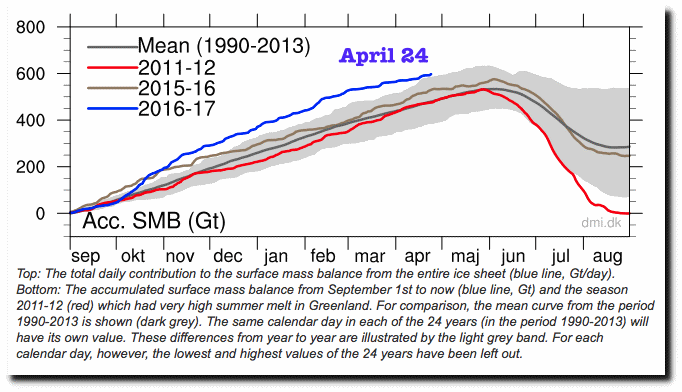
…notice anything different between these two charts?
This is the way they reported it at the end of April
They changed the mean to make it look like less.
What is the percentage of error on the measurements. It appears the the “loss” could fall within that boundary.
Also, as I recall the 2011-12 graph originally didn’t end at zero accumulation (it was originally a positive gain) either but was updated to zero sometime later in the year. Never saw an explanation for that update (not that they didn’t publish one, I just thought it was a strange update that year).
“Danish Meteorological Institute Moves To Obscure Recent Record Greenland Ice Growth”
http://notrickszone.com/2017/04/28/danish-meteorological-institute-moves-to-obscure-recent-record-greenland-ice-growth/#sthash.utgAyOOl.dpbs
Today it is -18C
http://www.summitcamp.org/status/webcam/
Summit camp, the ONLY permanent weather station in the interior that is measuring weather parameters.
From Wiki: https://en.wikipedia.org/wiki/Summit_Camp
“The climate is classified as polar, and the weather is highly variable. Typical daily maximum temperatures at Summit Camp are around −35 °C (−31 °F) in winter (January) and −10 °C (14 °F) in summer (July). Winter minimum temperatures are typically about −45 °C (−49 °F) and only rarely exceed −20 °C (−4 °F). Annual precipitation is about 3,000 mm (118.1 in), much of which falls as sleet or snow, which is possible in any month. Inland, the snow line in summer is at an altitude of about 300 m (984 ft). The highest temperature at Summit Camp was 3.6 °C (38.5 °F), recorded on July 16, 2012; the lowest recorded temperature is −67.2 °C (−89.0 °F)”
Average high deg C, June -11, July -11, Aug -14.
Average mean deg C, June -15, July -13, Aug -16
Average low deg C, June -19, July -15, Aug -21
Mighty warm ice that melts at -11 C.
Lat – Glad David showed the top map of Greenland with the location of GRIP2.
please see ftp://ftp.ncdc.noaa.gov/pub/data/paleo/icecore/greenland/summit/gisp2/isotopes/gisp2_temp_accum_alley2000.txt
About half way down the data is :
2. Accumulation rate in central Greenland
Column 1: Age (thousand years before present)
Column 2: Accumulation rate (m. ice/year)
 Age Accumulation
 1st   0.144043 0.244106
 last 2 48.9746 0.091739
        49.0034 0.091599
So 48,856 years and there are no negative numbers for Accumulation. Or every time period has increased volume. On the summit, Greenland over the last 49,000 years has only gained ice.
{changed to fixed font for table. Not sure it is any more clear. .mod]
For the last 3,000 years they have data points about every 30 years, but nothing more recent than 144 years ago. Does it really take that long for the snow to compress into ice?
It usually takes longer… particularly in Antarctica. It’s dependent on the snow accumulation rate.
But what does this actually show?
For example, in 2011/12 (the red line) it suggests that there was no gain or loss of ice that year. In other words, as from 1st September 2011, ice accumulated, reaching a peak at the end of May/beginning of June 2012, and then lost ice through to 31st August 2012 such that by 31st August 2012 there was approximately the same amount of ice as there was on 1st September 2011.
However, the black line (the mean0 appears to suggest that throughout the year, on average over a 30 year period, there has been a gain of about 380GT each year.
If the mean is correct and each year ends with approximately some 350GT more ice than when the year started, it would appear that Greenland has gained some 10,500GT (ie., ~350 x 30) during the period 1981 to 2010.
Am I missing something? Am I mis-reading this plot?
CORRECTION
The reference to 380/350GT should be 300GT.
The reference to 10,500GT should be 7,200GT (ie., 300 x 24).
The chart shows gain from snow fall and loss from melting and sublimation. It does not include loss from glacial calving.
The web page ( http://beta.dmi.dk/en/groenland/maalinger/greenland-ice-sheet-surface-mass-budget/ ) states: “Over the year, it snows more than it melts, but calving of icebergs also adds to the total mass budget of the ice sheet. Satellite observations over the last decade show that the ice sheet is not in balance. The calving loss is greater than the gain from surface mass balance, and Greenland is losing mass at about 200 Gt/yr.”
Of course, this text has remained the same even though this year and last year were both years of large snowfall.
Thanks
I should have checked their web page, it contains a useful summary. That said, I consider the plot ought to contain a better description of what it is showing.
latitude,
to me that change means that this years increase is similar to the levels last reached in the 1980s.
BTW
Glacier calving is not the same as glacier melting
– calving is a lot of ice reaching the sea
– melting is the glacier RETREATING
Yep.
Increased calving is usually a sign that the glacier is growing.
Recycled.
“When glaciers calve, alarmist have a cow.
That explains all the bellowing!”
Ice cap loss and gain of mass is a function of precipitation and the calving of icebergs. That cause and effect relationship is separated by hundreds of years. Hence the change in ice mass today is likely due to the change in precipitation patterns hundreds of years ago. Assigning the cause of today’s ice loss on current CO2 emissions and climate is just plain silly.
Glaciers that aren’t advancing can’t calve icebergs.
Allencic – 2:22 pm
Glaciers that aren’t advancing can’t calve icebergs.
You don’t get it. If alpine glaciers recede it’s Global Warming, if continental glaciers advance, it’s Global Warming. Do you see how that works? Whatever happens leads to catastrophic disaster and CO2 and Climate Change are the cause.
They can if the seas rise!
As for “if”, if my aunt had balls, he’d be my uncle. Sea level rise is ~1mm per year.
But then doesn’t that result in the same loss of ice from the glacier? Whether it melts or runs off a cliff seems to me to be immaterial. Pls correct me if I am wrong.
Only if you think that taking your dog to a taxidermist is the same as taking him to a veterinarian, because they both return your dog to you when they are done.
You are wrong. Got it?
If there wasn’t calving and melting, then all the water on the planet would end up at the poles–like Mars. That would lead to other problems.
Jim
Scientists are happy to admit they were wrong — as long as it was wrong in the “worse than we thought” direction: “SWIPA estimates that the Arctic will be free of sea ice… by 2040. Scientists previously suggested this would not occur until 2070.”
You never see blaring headlines in the other direction.
Notice the current prediction is an “estimate”; the previous was a mere “suggestion”.
And didn’t Professor Wadhams “predict” 2015, no, I meant 2017, no I meant 2020?
Re: Retired_Engineer_Jim (May 1, 9:19 am): Professor Wadhams sure did, and so did Paul Beckwith, head of Sierra Club Canada.
Don’t forget Al Gore and John Kerry’s echoing of those predictions.
Maybe I’ll make it to 2040 so then I can comment again the North Pole is still there.
Well, I don’t think the geographic pole will have moved, but lets hope that Santa isn’t treading water by then. (although I severely doubt it.)
🙂
The ultimate cherry pick is taking an arbitrary five year period and comparing it to an arbitrary three year period to come up with a 25 year into the future prediction of dire consequences.
AFAIK one of the greatest problems with GRACE measurements is the problem of identifying where Greenland ends and the sea begins. It’s not an exact science, let’s put it that way.
Told you…
However, one of larger errors in GRACE measurements, land–ocean
leakage effects, restricts high precision retrieval of ocean mass and
terrestrial water storage variations along the coasts, particularly
estimation of mass loss in Greenland. The land–ocean leakage effect
along the coasts in Greenland will contaminate the mass loss signals
with significant signal attenuation. In this paper, the precise glacier
mass loss in Greenland from GRACE is re-estimated with correction of
land–ocean leakage effects using the forward gravity modeling. The
loss of Greenland ice-sheets is −102.8 ± 9.01 Gt/a without removing
leakage effect, but −183.0 ± 19.91 Gt/a after removing the leakage
effect from September 2003 to March 2008, which has a good agreement
with ICESat results of −184.8 ± 28.2 Gt/a. From January 2003 to
December 2013, the total Greenland ice-sheet loss is at−261.54±6.12
Gt/a fromGRACE measurements with removing the leakage effect by
42.4%,while twothirds of total glacier melting in Greenland occurred in
southern Greenland in the past 11 years. The secular leakage effects on
glaciermelting estimate is mainly located in the coastal areas, where
larger glacier signals are significantly attenuated due to leaking out
into the ocean. Furthermore, the leakage signals also have remarkable
effects on seasonal and acceleration variations of glacier mass loss in
Greenland. More significantly accelerated loss of glacier mass in
Greenland is found at −26.19 Gt/a2 after correcting for leakage
effects.
Re-estimation of glacier mass loss in Greenland from GRACE with
correction of land–ocean leakage effects
Shuanggen Jin a,b,⁎, Fang Zoua,c
http://www.sciencedirect.com/science/article/pii/S0921818115301168
The GIA (glacial isostatic adjustment) is also a big issue. The GIA is often much larger than the asserted ice loss.
Bit of an own goal, here, by the alarmists.
Their *first* point, about sea ice, was cogent. It *could* disappear during the summer months, with unknown effects on weather systems. Unlikely, according to some, but debatable.
Their, *second* point, however, about the Greenland ice sheet, is pure horse puckey.
Putting the two side by side only weakens the first point, without making the second more credible. It seems the CAGW enthusiasts can’t resist talking ball hooks, *even when they’re right*!
” unknown effects ?” Open Arctic waters allow more “ocean effect” snow to fall upon Greenland, with obvious consequences not involving Melt!!!
Never Right, invariably Left.
What happened to, d) all of the above?
My thought as well.
Only if you assume different answers don’t apply to different people. “All of the above” is possible if it applies to multiple different classes of warmists.
Good point… But that would be “any of the above.”
+1 – I knew someone had to have asked that already.
B and C are incompatible. “All of the above” is a logical impossibility.
These figures are a bit like 300ppm CO2 in the 18th Century to 400ppm now. It sounds a lot until you express it as 0.03% to 0.04%.
Or if you take into consideration that the additional .01% CO2 is being added to an atmosphere that in aggregate with water vapor included already contained about 3% ‘greenhouse’ gases. Time for panic. Uh huh, uh huh.
… and take into consideration the Beer-Lambert Law.
And take into consideration that whatever means of measuring CO2 were rudimentary to nonexistent in the 18th Century. Comparing proxy data to instrument data isn’t really very sound.
It’s OK to *compare* proxy data to instrumental data. It’s not OK to assume that it is a direct comparison… This leads to hockey sticks because the instrumental data demonstrate (higher frequency and higher amplitude temperature variations than the proxy reconstructions.
Or 3 molecules in 10,000 to 4 in 10,000
The DMI precipitation model has Greenland ice INCREASING – apart from one small corner.
I know the answer to the quiz! It’s “all three!”
Nice article.Perspective is important!
I do hope they have booked their cruises in the Arctic. I think I can get a really good price on popcorn futures this far ahead.
They should be OK, the Russians are building another 10 icebreakers.
And what was the growth of the Greenland ice cap 1940-75? I do seem to remember a bit about WWII planes found tens of meters down in ice.
Greenland has a fairly high snow accumulation rate, even when its mass balance is negative.
Those planes were buried under about 82 meters of ice, after just 50 feet.
http://www.airspacemag.com/history-of-flight/glacier-girl-the-back-story-19218360/?all
82 meters is an astonishing number. That’s an average of 1.6 meters of ice per year, which is equivalent to more than 24 meters of annual snowfall.
That snow was mostly from water evaporated from the Arctic Ocean, lowering global sea-level.
s/after just 50 feet/after just 50 years/
http://p38assn.org/glaciergirl/images/GPR-measurement-concept.jpg
So, correction:
Buried under 61 meters of ice plus 24 meters of packed snow, after just 50 years.
Dave – the man in your graphic is 65 ft. tall. Doesn’t do the burial rate justice..
Quiet, he’s looking for Captain Amaerica
The post Ice age warming began ~10,000 years ago and yet it continues. Ice ages have come and gone without the influence of human activity. And so it shall continue. Why would you NOT expect that the post ice-age warming to continue?
Why would anyone think it would stop?
Well it has actually stopped, it is just that the temperature fall after the Holocene Optimum has been a kind 1400 year phugoid with successively cooler optima we are about to see how cool the next dip in temperatures will be.
Ian W,
I number myself among the many of those who are skeptical that the earth is warming at this time, not to mention, skeptical of warming due to to human influence. More often I dismiss any melt report as hype, but here I wanted to express a different, related idea this time. I wish to reinforce the notion that the earth at one time was covered in ice and then it warmed, with no help from people.
Looking at ice core data from Antarctica, there is no significant trend over the Holocene. I was surprised since I’ve taken the “warmer” early Holocene pretty much on faith. It was technically very slightly warmer, but nothing to write home about. There’s a very weak correlation with increasing age. R-squared is about 0.008. Essentially no significant relationship between time and temperature in the Vostok data over the last 11,000 years. That was derived using a simple linear model in R. Vostok data has an increasing interval with increasing age.
The Vostok and most Antarctic cores are of very low resolution and the insolation trends of the Northern and Southern Hemispheres are different.
http://ars.els-cdn.com/content/image/1-s2.0-S0277379113004162-gr4.jpg
I love how they conflate Greenland ice sheet melt with loss of arctic sea ice. They discuss seemingly big numbers of one (nice work debunking this by adding the appropriate scale for perspective) and then offer it as unconnected and unsupported proof of the second. They then close with obligatory hat tip toward DOOM and it is very clear that the emotional response that they are trying to evoke is: BE AFRAID. BE VERY AFRAID.
This from the Economist, no less. I expect better from them.
One time maybe. In recent decades, no.
Whether it is economics or global warming, the Economist has drunk the left wing kool aid.
….they’ve gotten very good at spinning f a k e news
The Economist does this sort of nonsense all the time these days. Has for quite a few years now.
3,840km^3 spread out over the sea surface area 510.082e6 km^2 gives a sea level rise of 7.528e-6 km
=7,528e-6*1e3*1000mm=7.53mm if I have the maths right.
over 16 years that’s 0.47mm/year
A veritable Noachian deluge… /Sarc
0.47mm is a reasonable proportion of the 2.7mm/year since 2003 I though that the slr was down to thermal expansion.
Compared to the coldest time in the last 150 years, arctic ice has fallen.
Oh the humanity of it all.
Perspective? Wazzat?
As I have said many times:
Any scientist can calculate a value. It takes engineering perspective to let you know how big of a shit load that really is…or in this case…is not.
That is why we can engineer to 4 nines, and not have to worry about the next 4.
Do any of you ever point out their mistakes to “them” in letter, or email form?
Not in quite a while. The general response is “thank you” and the “mistake” is never corrected.
Becky, while we may view the omission of perspective as “error”, I firmly suspect they do not, as it detracts from their alarmist narrative. Given the frequency of occurrence, the omissions of mitigating data or perspective appear to be intentional to mislead “useful idiots”.
I’ve often thought and still do think along the same lines as you Becky: no point in making such (VALID) comments here, when they’ll only be read, let alone taken seriously by like minded people – sceptics like us. What’s desperately needed is something that is all but impossible, at least for the short term: MSM (especially TV and radio) exposure of this site’s and similar site’s hard-facts and truthful content.
Socialism has never worked, so we can only hope that soon it will end up doing what history has shown always happens – it will destroy itself. The useful idiots that are currently used to spread the fear and ramp up CAGW / climate change hysteria, must eventually realise at some time that they have been used and it will be their lives that will be compromised no less than the lives of other ordinary people, by this wicked, misanthropic scam…
Alan. Socialism does always destroy itself, unfortunately it seems take forever in term of human suffering and subjugation. Venezuela is a recent example.
Alan Vaughn:
You have introduced a ‘red herring’ that Leonard Lane has picked up.
The global warming scare is promoted by governments of all political types. It is a ‘band wagon’ that they are riding because it suites their various desires.
Indeed, the scare was started by Margaret Thatcher (i.e. a vituperative anti-socialist) and her political party (i.e. the UK’s Conservative Party aka ‘the Tories) still promotes it.
All politicians need to raise taxes but people don’t want to pay taxes so politicians seek a tax that people want to pay. Here in the UK we have one such tax that people want to pay; i.e. the National Lottery. When politicians fail to find a tax that people want to pay then they seek a tax that people will not object to paying. And who could object to paying a tax intended to save the planet for our children and our children’s children?
Also, each national government has its own special interests in global warming but, in all cases, the motives relate to economic policies. In general, the USA fears loss of economic power to other nations while this is desired by those other nations. Universal adoption of ‘carbon taxes’, or other universal proportionate reductions in industrial activity, would provide relative benefit to the other nations by altering relative competitiveness. Unfortunately, if a few nations adopted the changes they would increase their manufacturing, transportation and energy costs and thus lose economic competitiveness and industrial activity to all other nations.
Developing nations cannot afford technological and economic advances that would benefit them and also reduce their increases to CO2 emissions as they develop, so they are seeking gifted technology transfers and economic aid from developed countries as ‘climate compensation’.
These matters have nothing to do with any political ‘ism’.
We have truth on our side. Shouting about falsehoods damages credibility.
Please try to keep on topic.
Richard
“richardscourtney” writes “You have introduced a ‘red herring’ that Leonard Lane has picked up”, and then proceeds to declare that since “governments of all political types” promote the global warming scare, then no particular political “ism” can be blamed. But that’s a non-sequitur, since there is rarely a “pure” “ism” in any government, but rather all governments have varying degrees of alignment with, and opposition against, that particularly heinous abuse of science.
Dancing around the May Pole, as it were, distracting the reader from the clear pronouncements from U.N. one-worlders and leftists the world over, denouncing capitalism, declaring that abolishing capitalism is the way to fix the climate, demanding massive “progressive” taxes to fix the climate, etc.
Collectivism of any sort is the political insanity which permits the acceptance of this false science, since it is precisely the sort of “problem” that demands a “collective” solution. Socialists and one-world-government types simply can’t help themselves when presented with such a “problem” demanding a solution.
And it’s simply not rational not to recognize the affinity for collectivists and “global warming”.
Tom in Oregon City:
Clearly, logic is not your strong point. You say
Anybody can see the non sequitur is yours.
It matters not whether there is a pure “ism” when governments of all political types promote the global warming scare.
Please put down the ‘red herring’ and discuss the subject of this thread instead.
Richard
Becky:
Please read this.
I would be very grateful if you – or anybody – were to suggest a solution to the problem highlighted by your question.
Richard
Richardscourtney: good on you for trying.
Thanks for the update David. It’s another zombie climate scare that keeps coming back, no matter what. So many climatist claims are clearly “unfalsifiable”, in that tno evidence can stop them to be reasserted.
Greenland is Melting was a theme ahead of Paris COP, and there are the same six good reasons not to fear.
http://rclutz.wordpress.com/2015/10/29/greenland-is-melting-really/
You need to have 400,000 cubic kilometres of LAND ICE melting to raise global sea level by 1 metre.
It is amazing to me that the vast majority of climate scientists seem to be completely unaware of the fact that global warming increases snow and ice accumulation on ice sheets and glaciers, reducing sea-level, and offsetting ice loss through melting and iceberg calving. They frequently refer to “the two ways” in which warming influences sea-level: by melting of grounded ice, and by thermal expansion. They seem not to know that the process of accumulation of snow & ice on ice sheets and glaciers is at least as important in its effect on sea-level.
Decreased sea ice coverage in the Arctic and Southern Oceans increases water evaporation. The additional evaporation increases “lake-effect/ocean-effect” snowfall downwind. Some of that snow falls on the ice sheets and glaciers, increasing ice accumulation, and offsetting meltwater losses.
(Digression: the increased evaporation has other effects, too. It cools the ocean by evaporative heat loss — a negative/stabilizing climate temperature feedback. It also causes more snowfall on other land, increasing albedo and snowpack, decreasing land temperatures, and prolonging winter. It also apparently increases cloudiness, increasing albedo at altitude, and probably further cooling the surface, though clouds and their effects are very complex, and poorly understood.)
Snow accumulation has a HUGE effect on grounded ice mass, which in turn affects sea-level.
The magnitude of ice accretion from snowfall on ice sheets was illustrated by the team which salvaged a WWII P-38 (now called “Glacier Girl”) from under 268 feet(!!) of accumulated ice, 50 years after she landed on the Greenland ice sheet. That is an astonishing number. 268 feet of ice in 50 years is 5.4 feet of ice per year, which is equivalent to more than 80 feet of annual snowfall. That snow was mostly from evaporated water, removed from the Arctic Ocean.
daveburton says:
“They frequently refer to “the two ways” in which warming influences sea-level: by melting of grounded ice, and by thermal expansion. They seem not to know that the process of accumulation of snow & ice on ice sheets and glaciers is at least as important in its effect on sea-level.”
They know but it does not fit the narrative and thus their objective of continued funding. The Arctic was warmer than average for most of this winter and what did we see? Greater than average accumulation of snow on the vast majority of Greenland. Contrasts in the temperatures of air masses are a critical component in creating precipitation but that is just “weather” and has nothing to do with climate in their minds apparently.
“.. the Arctic will be free of sea ice in the summer by 2040. Scientists previously suggested this would not occur until 2070.” 2070, really? It used to be 2016.
According to Al Gore´s movie, An inconvenient truth, it was going to be 2014.
BTW, he has another movie coming this summer. An inconvenient sequel: Truth to power.
http://www.imdb.com/title/tt6322922/?ref_=nm_ov_bio_lk3
Maybe here we will now the new Arctic emancipation date.
The biggest thing is that these scaremongerers do not even mention the change, which have been visible since 2014, after all, already in the third year: http://beta.dmi.dk/uploads/tx_dmidatastore/webservice/b/m/s/ D / e / accumulatedsmb.png
The right link: http://beta.dmi.dk/en/groenland/maalinger/greenland-ice-sheet-surface-mass-budget/