
Guest essay by Eric Worrall
In the wake of the science committee testimony, Climate Scientist Kevin Trenberth has insisted that Climate Science does follow the scientific method. But Trenberth himself may have strayed outside accepted scientific methodology.
Yes, we can do ‘sound’ climate science even though it’s projecting the future
Nobody can observe events in the future so to study climate change, scientists build detailed models and use powerful supercomputers to simulate conditions, such as the global water vapor levels seen here, and to understand how rising greenhouse gas levels will change Earth’s systems. NCAR/UCAR, CC BY-NC-ND
April 6, 2017 4.01am AEST
Authors
Kevin Trenberth
Distinguished Senior Scientist, National Center for Atmospheric Research
Reto Knutti
Professor, Eidgenössische Technische Hochschule (ETH) Zürich
Increasingly in the current U.S. administration and Congress, questions have been raised about the use of proper scientific methods and accusations have been made about using flawed approaches.
This is especially the case with regard to climate science, as evidenced by the hearing of the House Committee on Science, Space and Technology, chaired by Lamar Smith, on March 29, 2017.
…
Chairman Smith accused climate scientists of straying “outside the principles of the scientific method.” Smith repeated his oft-stated assertion that scientific method hinges on “reproducibility,” which he defined as “a repeated validation of the results.” He also asserted that the demands of scientific verification altogether preclude long-range prediction, saying, “Alarmist predictions amount to nothing more than wild guesses. The ability to predict far into the future is impossible. Anyone stating what the climate will be in 500 years or even at the end of the century is not credible.”
…
Why climate scientists use models
The wonderful thing about science is that it is not simply a matter of opinion but that it is based upon evidence and physical principles, often pulled together in some form of “model.”
In the case of climate science, there is a great deal of data because of the millions of daily observations made mostly for the purposes of weather forecasting. Climate scientists assemble all of the observations, including those made from satellites. They often make adjustments to accommodate known deficiencies and discontinuities, such as those arising from shifts in locations of observing stations or changes in instrumentation, and then analyze the data in various ways.
…
Projections, not predictions
With climate models as tools, we can carry out “what-if” experiments. What if the carbon dioxide in the atmosphere had not increased due to human activities? What if we keep burning fossil fuels and putting more CO2 into the atmosphere? If the climate changes as projected, then what would the impacts be on agriculture and society? If those things happened, then what strategies might there be for coping with the changes?
These are all very legitimate questions for scientists to ask and address. The first set involves the physical climate system. The others involve biological and ecological scientists, and social scientists, and they may involve economists, as happens in a full Intergovernmental Panel on Climate Change (IPCC) assessment. All of this work is published and subject to peer review – that is, evaluation by other scientists in the field.
The question here is whether our models are similar enough in relevant ways to the real world that we can learn from the models and draw conclusions about the real world. The job of scientists is to find out where this is the case and where it isn’t, and to quantify the uncertainties. For that reason, statements about future climate in IPCC always have a likelihood attached, and numbers have uncertainty ranges.
The models are not perfect and involve approximations. But because of their complexity and sophistication, they are so much better than any “back-of-the envelope” guesses, and the shortcomings and limitations are known.
…
Trenberth has a lot of faith in his models – so much so, a few years ago he demanded that the “null hypothesis” be reversed. If accepted, this would have meant a reversal of the burden of proof regarding the assumption of human influence on global climate.
…
“Humans are changing our climate. There is no doubt whatsoever,” said Trenberth. “Questions remain as to the extent of our collective contribution, but it is clear that the effects are not small and have emerged from the noise of natural variability. So why does the science community continue to do attribution studies and assume that humans have no influence as a null hypothesis?”
To show precedent for his position Trenberth cites the 2007 report by the Intergovernmental Panel on Climate Change which states that global warming is “unequivocal”, and is “very likely” due to human activities.
…
Read more: https://wattsupwiththat.com/2011/11/03/trenberth-null-and-void/
Trenberth’s demands for a reversal of the burden of proof with regard to climate were rejected by the scientific community. Even climate advocate Myles Allen, head of University of Oxford’s Atmospheric, Oceanic and Planetary Physics Department, thought Trenberth’s demands for a reversal of the burden of proof were wrong.
…
“The proponents of reversing the null hypothesis should be careful of what they wish for,” concluded Curry. “One consequence may be that the scientific focus, and therefore funding, would also reverse to attempting to disprove dangerous anthropogenic climate change, which has been a position of many sceptics.”
“I doubt Trenberth’s suggestion will find much support in the scientific community,” said Professor Myles Allen from Oxford University, “but Curry’s counter proposal to abandon hypothesis tests is worse. We still have plenty of interesting hypotheses to test: did human influence on climate increase the risk of this event at all? Did it increase it by more than a factor of two?”
###
All three papers are free online:
Trenberth. K, “Attribution of climate variations and trends to human influences and natural variability”: http://doi.wiley.com/10.1002/wcc.142
Curry. J, “Nullifying the climate null hypothesis”: http://doi.wiley.com/10.1002/wcc.141
Allen. M, “In defense of the traditional null hypothesis: remarks on the Trenberth and Curry opinion articles”: http://doi.wiley.com/10.1002/wcc.145
Read more: Same link as above
The problem with climate science is there is no way to test the core prediction, that the Earth will heat substantially in response to anthropogenic CO2 emissions, other than to wait and see.
Important secondary predictions which should be observable by now, such as the missing tropospheric hotspot, or a projected acceleration in sea level rise, have not manifested.
Even more embarrassing, mainstream models cannot even tell us what climate sensitivity to CO2 actually is.
Is equilibrium climate sensitivity 1.5C temperature increase per doubling of CO2? Or is it 4.5C / doubling of CO2? The IPCC Fifth Assessment Summary for Policy Makers cannot give you that answer.
… The equilibrium climate sensitivity quanti es the response of the climate system to constant radiative forcing on multi- century time scales. It is de ned as the change in global mean surface temperature at equilibrium that is caused by a doubling of the atmospheric CO2 concentration. Equilibrium climate sensitivity is likely in the range 1.5°C to 4.5°C (high confidence), extremely unlikely less than 1°C (high confidence), and very unlikely greater than 6°C (medium confidence)16. The lower temperature limit of the assessed likely range is thus less than the 2°C in the AR4, but the upper limit is the same. This assessment re ects improved understanding, the extended temperature record in the atmosphere and ocean, and new estimates of radiative forcing. {TS TFE.6, Figure 1; Box 12.2} …
Read more: IPCC Fifth Assessment WG1 Summary for Policy Makers (page 14)
Why is this range of possible climate sensitivities embarrassing? Consider the Charney Report, from 1979;
… We believe, therefore, that the equilibrium surface global warming due to doubled CO2 will be in the range 1.5C to 4.5 C, with the most probable value near 3°C …
Read more: http://www.ecd.bnl.gov/steve/charney_report1979.pdf (page 16)
As theories are refined, key physical quantities should be resolved with greater accuracy. For example, the first measurements of the speed of light, conducted in 1676, were 26% wrong – a remarkable estimate for that period of history, but still wide of the mark. More research – better quality measurements and calculations resolved the original uncertainty about the speed of light, which is now known to a high degree of accuracy.
This failure of climate science to follow the normal scientific progression to more accurate estimates should be a serious concern. This lack of convergence on a central climate sensitivity estimate, after decades of research effort, strongly suggests something is missing from the climate models.
Whatever the missing or mishandled factor is, it has a big influence on global climate. The evidence for this is the embarrassingly broad range of estimates for climate sensitivity to a doubling of CO2, and the failure of those estimates to converge.
If climate models were capable of producing accurate predictions, if they showed any sign of converging on a reasonable climate sensitivity estimate, if predicted secondary phenomena such as the tropospheric hotspot and sea level rise acceleration were readily observable, there would be a lot less resistance to Trenberth’s apparent demand that climate model projections be accepted as somehow equivalent to empirical observations.
It should be obvious to anyone there are way too many loose ends to even come close to such acceptance.
According to the Oxford English Dictionary, the scientific method is A method of procedure that has characterized natural science since the 17th century, consisting in systematic observation, measurement, and experiment, and the formulation, testing, and modification of hypotheses.
Any suggestion that model projections should be accepted as a substitute for systematic observation and experiment, any suggestion that model output from models which have failed several key tests can be relied upon, any suggestion that defective model output constitutes proof of human influence on global climate, in my opinion utterly violates any reasonable understanding of what the scientific method should be.
…If the past historical temperature data does not match your models, then change the past historical temperature data to match your models…If the present temperature data does not match your models, then change the present temperature data to match your models ..Presto ….now the temperature models of the future are accurate !! D’OH !!
Trenberth, unlike most in Ali Baba’s band of climate thieves, has moments of clarity. This is not one of them.
If you know what you’re doing, you can usually do useful back-of-the-envelope calculations. All the sophistication and complexity in the world won’t help you if you don’t know what you’re doing.
‘complexity and sophistication’ is code for ‘ineffably idiotic’
lol +1 🙂
Kevin Trenberth
Draft Contributing Author for the Summary for Policy Makers,
contributing author to Ch 1, a lead author for Ch 3, and
contributing author to Ch 7 of the 4th UN IPCC report on climate change, AR4.)
12 Oct 2009: …we have broken records the past two days for the coldest days on record. (…) and it smashed the previous records for these days by 10F. (…) The fact is that we can’t account for the lack of warming at the moment and it is a travesty that we can’t. (. . .) Our observing system is inadequate. (1255352257.txt)
——————-
Oct 14, 2009: We are not close to balancing the energy budget. The fact that we can not account for what is happening in the climate system makes any consideration of geoengineering quite hopeless as we will never be able to tell if it is successful or not! It is a travesty! (1255523796.txt)
from: http://www.debunkingclimate.com/selectedemails.html
Even if God Himself wrote the computer code with complete knowledge of all the requisite physics for modeling the earth’s climate, and He was only limited by having to run the code on any digital computer built by man, the projections of His model would eventually diverge from the actual climate at some future point. It’s called the butterfly effect. The actual, real model – the Universe – runs with infinite precision. Models run on any digital computer necessarily has finite precision, which eventually causes the divergence between model and reality.
The computer necessary to adequately model the universe would be larger than the universe.
Of course maybe that’s the computer that’s running the simulation that we exist in. (Cue spooky noises)
Good to know the Designer decided it was “very good”. Average global temperatures over geological eras have been remarkably stable within relatively narrow bounds compared to annual temperature extremes.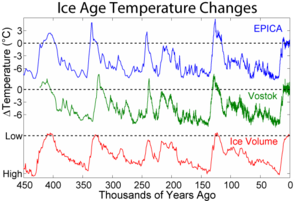
“the projections of His model would eventually diverge from the actual climate at some future point. It’s called the butterfly effect. The actual, real model – the Universe – runs with infinite precision.”
None of that is true. The divergence of weather from predictions is familiar, and happens aftre a few days. Climate prediction is not an initial value problem. It is a search for an attractor, which is fixed by the balance of forcings and response.
You can say a lot about the tides next year. That doesn’t mean that you measured the present state with high precision and fended off butterflies with digital arithmetic etc. It’s done by knowledge of the forcings and response.
As to “infinite precision”, that is meaningless. There is no way of knowing, and there is all kinds of quantum stuff etc that says it is not true. You can’t say that the universe is determined by an initial state, because you can never measure with certainty that state.
You can say a lot about the tides next year.
================
not from first principles, because the tides and climate are unpredictable from first principles. that is why climate models cannot calculate future climate.
Instead we calculate the tides next year using the same method that humans used to calculate the seasons, long before they understood what caused the seasons. The method is known as Astrology. The only method yet that has been shown capable of predicting the future state of chaotic systems with any degree of accuracy.
The method is known as Astrology.
=============
which also explains why the Farmer’s Almanac routinely outperforms climate models.
And the climate prediction ensemble is like bowl of spaghetti.
hunter:
In the semi-official terminology of global warming climatology, each piece of spaghetti is not a “prediction” but rather is a “projection.” None of today’s climate models predict. All of them project.
Did you mean astronomy instead of astrology?
Not just the butterfly effect, but rounding error would guarantee that eventually the results of the model are meaningless.
Rounding error increases with each iteration, and these models go through millions of iterations.
I was studying the ACS Climate Change tool kit sections on the single and multilayer theories (what I refer to as the thermal ping-pong ball) of upwelling/downwelling/”back” radiation and after seeing a similar discussion on an MIT online course (specifically says no transmission) have some observations.
These models make no reference to conduction, convection or latent heat processes which leads me to conclude that these models include no molecules, aka a “non-participating media,” aka vacuum. This is a primary conditional for proper application of the S-B BB ideal, i.e. ε = 1.0, equation.
When energy strikes an object or surface there are three possible results: reflection or ρ, absorption or α, transmission or τ and ρ + α + τ = 1.0.
The layered models use only α which according to Kirchhoff is equal to ε. What that really means is that max emissivity can equal but not exceed the energy absorbed. Nothing says emissivity can’t be less that the energy absorbed. If α leaves as conduction/convection/latent than ε will be much less than 1.0.
These grey bodied layered models then exist in a vacuum and are 100% non-reflective, i.e. opaque, surfaces, i.e. just like the atmosphere. NOT!
So the real atmosphere has real molecules meaning a “participatory” media and is 99.96% transparent i.e. non-opaque.
Because of the participating molecules only 63 W/m^2 LWIR of the 160 W/m^2 that make it to the surface leave the surface.
63 W/m^2 and 15 C / 288 K surface gives a net effective ε of about 0.13 when the participating media is considered. (BTW “surface” is NOT the ground, but 1.5 m ABOVE the ground per WMO & IPCC AR5 glossary.)
So the K-T diagram is thermodynamic rubbish, earth as a ball in bucket of hot mush is physical rubbish, the Δ 33 C w/ atmosphere is obvious rubbish, the layered models are unrelated to reality rubbish.
What support does the GHE theory have left besides rabid minions?
I see no reason why GHE theory gets a free pass on the scientific method.
https://www.acs.org/content/acs/en/climatescience/atmosphericwarming.html
http://web.mit.edu/16.unified/www/FALL/thermodynamics/notes/node136.html
http://writerbeat.com/articles/14306-Greenhouse—We-don-t-need-no-stinkin-greenhouse-Warning-science-ahead-
http://writerbeat.com/articles/15582-To-be-33C-or-not-to-be-33C
So since we can’t observe “future events” we should give the models the benefit of the doubt??? I’m not following the logic here, primarily because there isn’t any!
But the models come from “Supercomputers”! Not just your Dell Inspiron piece of crap!
This is a prophecy from a Distinguished Senior Scientist, man! That’s heavy sh1t!
Am I supposed to be impressed?
Not just impressed, but a little grovelling would be nice.
http://rationalwiki.org/wiki/Scientific_method
1) Observe – Look at the world and find a result that seems curious.
2) Hypothesize – Come up with a possible explanation.
3) Predict – The most important part of a hypothesis or theory is its ability to make predictions that have yet to be observed. A theory that makes no new predictions is scientifically worthless. Predictions must be falsifiable and specific.
4) Test Predictions – Compare the predictions with new empirical evidence. This step is the reason why a hypothesis or theory has to be falsifiable — if there’s nothing to falsify, then the experiment is pointless because it’s guaranteed to tell you nothing new.
5) Reproduce – ensure the result is a true reflection of reality by verifying it with others.
Pseudoscience — All but the first two steps are omitted from the process in pseudosciences. Pseudosciences do observe the world, and do come up with explanations, but are often unable or unwilling to follow through in testing them more thoroughly. Refining the hypotheses is also undesirable in pseudoscience as this could lead to abandoning the central dogma of the belief.
Scientific skepticism is a vital element in the scientific process, ensuring that no new hypothesis is considered a Theory until sufficient evidence is provided and other scientists have had their chances to debunk it. Even then, all of science is always considered a “good working model” and the “best understanding we have at the present time.
Pseudoscientists have discovered an obvious way to ‘cheat’ the scientific method. It goes like this:
1) Pick a personal belief that you already ‘know’ is true, but for which you want ‘proof’.
2) Perform some related observations or experiments, and note the results.
3) Generate a hypothesis that shoehorns said results into your personal belief.
4) Falsely claim that your personal belief predicts the particular results, and that the observations/experiment confirmed your suspicions.
This is a blatant perversion of the scientific method, but to someone not versed in science, fallacies, or psychology, it might seem similar enough to be accepted as legitimate.
Kevin Trenberth may have once been a scientist, but he is now a pseudoscientist. I’ve known this ever since he reported that climate change caused more hurricanes based on nothing.
correction will cause more ‘in the future ‘ or classic ‘heads you lose tails I win ‘
Wasn’t Trenberth complicit in ClimateGate? Just asking …. if he[?] was, isn’t he as complicit as the other conspirators in such as the Hockey-Schtick fiasco, e.g., Mann, Jones, et al?
Pls excuse my asking … I just haven’t had time to read *all* the above!!!
Of course he appears in the ClimateGate emails. Thar is where the “travesty” comment comes from, if I remember right. I do not think he came off as one of the bad guys, though.
As noted here;
https://wattsupwiththat.com/2013/05/22/kevin-trenberth-struggles-mightily-to-explain-the-lack-of-global-warming/
Here ya go, Mr. King:
(copied from the WUWT 10th Anniv. anthology, p. 518)
Dom: “This one is huge. Compare what Trenberth says here : http://fortcollinsteaparty.com/index.php/2009/10/10/dr-william-gray-and-dr-kevin-trenberth-debate-global-warming/ …while exactly at the same moment he was writing:
From: Kevin Trenberth
To: Michael Mann
Subject: Re: BBC U-turn on climate
Date: Mon, 12 Oct 2009 08:57:37 -0600
Cc: Stephen H Schneider , Myles Allen , peter stott , “Philip D. Jones” , Benjamin Santer , Tom Wigley , Thomas R Karl , Gavin Schmidt , James Hansen , Michael Oppenheimer
(http://wattsupwiththat.com/2009/11/19/breaking-news-story-hadley-cru-has-apparently-been-hacked-hundreds-of-files-released/#comment-227456 )
{Yes, this is the second time I’ve attempted to post this. It has been over 12 hours, though, so, I’m assuming it was simply “lost” and, thus, I’m trying again, this time, editing for all the possible “bad” words.}
(copied from the WUWT 10th Anniv. anthology)
Dom: “This one is huge. Compare what Trenberth says here : http://fortcollinsteaparty.com/index.php/2009/10/10/dr-william-gray-and-dr-kevin-trenberth-debate-global-warming/ …while exactly at the same moment he was writing:
From: Kevin Trenberth
To: Michael Mann
Subject: Re: BBC U-turn on climate
Date: Mon, 12 Oct 2009 08:57:37 -0600
Cc: {see original comment for list of names — too many spam-bin-triggers in there, IIRC}
Hi all
Well I have my own article on where the heck is global warming? We are asking that here in
Boulder where we have broken records the past two days for the coldest days on record. We
had 4 inches of snow. … ***The fact is that we can’t account for the lack of warming at the moment and it is a travestythat we can’t. …”
(http://wattsupwiththat.com/2009/11/19/breaking-news-story-hadley-cru-has-apparently-been-hacked-hundreds-of-files-released/#comment-227456 )
He was mentioned in ClimateGate, but I don’t think that makes him “complicit”.
More importantly, he was most likely the one who presumably was behind the sacking of the editor of “Remote Sensing Journal”, because the periodical had the gall to publish a paper by Roy Spencer.
To me, that one action is a greater travesty than all of ClimateGate. It’s not that he merely disagreed with Roy Spencer’s paper … he had the editor canned. That casts a pall on any “skeptic” research.
I hate this logic: it’s complex; therefore it’s legitimate.
it’s complex; therefore it’s legitimate
=======================
The whole history of science shows that almost every complex formula is wrong, and that there is a more accurate, simpler formula that can replace it and deliver better results.
In science, complexity is almost always a guarantee that what you are looking at is wrong. Nature uses very, very simple methods to create what appears an first look to be complex.
For example, this fractal below looks very complex, yet the underlying equation is simplicity in itself.
z = z^2 + c.
However, if you undertook to describe the fractal without the above equation, the result would be very complex, running to tens if not hundreds of pages, and it would still not be correct.

Let’s saying you are running one of the big honking supercomputer climate models (based on Hansen’s 1978 assumptions directly built into the code like all of them are). Each run takes several days.
You run your model, it costs $20,000 and you are off the historical climate by a mile. Your model run says we should have gone back into an ice age in 1933.
Well, you try to figure out what went wrong and you discover the water vapor feedback was off.
You fix it and you run your model again. Another $20 G’s, and it comes back and says the Earth went Venus-like in 1977.
You fix it and you run your model again and viola, it now says temperatures will only rise by 0.5C by 2100.
Then you go in and plug all the numbers to result in 3.0C per doubling because that is what it is supposed to say. You spend your last $20,000 for model runs and viola, a perfect IPCC result that gets you many accolades.
You see the issue. There is ZERO transparency in what is “really” happening in this science. You can’t reproduce the result because they are not going to let you run their precious climate model and they are not going to give you a $20,000 budget to try it and prove how weird these models are.
$80,000 later and the model is simply some plugged result to keep everyone on the climate dole happy.
Flawless.
I wonder if climate “scientists” would fly in airplanes designed, built and tested to the standards they set for themselves.
If the observations are on your side, pound on the observations,
if the theory is on your side, pound on the theory,
If neither, just pound on the table……..
Cheers, KevinK
I’ve just completed Mike’s Nature trick of adding in the real temps
to each series for the last 20 years (ie from 1981 onwards) amd from
1961 for Keith’s to hide the decline. …
Cheers
Phil
(from this WUWT article: https://wattsupwiththat.com/2009/11/19/breaking-news-story-hadley-cru-has-apparently-been-hacked-hundreds-of-files-released/ )
Percy W. Bridgman, Harvard Physicist and 1946 Nobel Prize winner-
” I personally do not think that one should speak of making statements about the future.For me, a statement implies the possibility of verifying its truth, and the truth of a statement about the future cannot be verified.”
P.W. Bridgman, ” The Way Things are” (1959),p.69.
For some reason my comment in both the Test page and in this page have evaporated.
Notepad version
Towards the end of the mails the running theme is, ‘Where the hell is global warming anyway?’ 1255318331 Stephen Schneider, who has been here before, having predicted a catastrophic global cooling in the 1970s, passes on some bad news: ‘Paul Hudson, BBC’s reporter on climate change, on Friday wrote that there has been no warming since 1998, and that pacific oscillations will force cooling for the next 20-30 years.’ (A goody-goody student, of whom I expect a great career in the climate research field, has alerted him to this, asking, ‘Do you think this merits an op-ed response in the BBC from a scientist?’). Schneider refers to the reporter as ‘this new “IPCC Lead Author”‘, which I think is meant to be sarcastic but I call a mortal insult. Then he says the weather will be getting hotter soon anyway, because, well, the sun-spots that drive the temperature will be back. Michael Mann says ‘extremely disappointing to see something like this appear on BBC’ and perhaps they should get the British Met Office to respond. ‘I might ask Richard Black [someone at the BBC he can trust] what’s up here?’ But then 1255352257 all hell breaks loose. Kevin Trenberth responds: ‘Well I have my own article on where the heck is global warming? We are asking that here in Boulder where we have broken records the past two days for the coldest days on record. We had 4 inches of snow. The high the last 2 days was below 30F and the normal is 69F, and it smashed the previous records for these days by 10F. The low was about 18F and also a record low, well below the previous record low. This is January weather … The fact is that we can’t account for the lack of warming at the moment and it is a travesty that we can’t.
http://michaelkelly.artofeurope.com/cru.htm
Event Attribution Science is not science
https://papers.ssrn.com/sol3/papers.cfm?abstract_id=2929159
Heck, they’re using “powerful supercomputers” to guess/predict/forecast the future. That’s good enough for me!
/snark
If it’s a supercomputer, it can’t be wrong, can it? It’s got the word “super” in the name.
Hello all. Is no one going to point-out that it’s Kevin, not KevEn?
Yours sincerely, lifelong Kevin.
Fixed, thanks
Thanks clipe & Anthony.
“These are all very legitimate questions for scientists to ask and address.” When you say it like that, in this context, it rings clear. No, these are philosophical questions on par with eugenics and euthanasia. Scientists are challenged to be referees in the debate.
“Whatever the missing or mishandled factor is, it has a big influence on global climate.”
Shouldn’t this be plural? ie there may be (and probably are) more than one factor. Since we don’t know what is missing – we just know the models/theories don’t match reality – there is no reason to assume a single factor.
Keven Trenberth is a true embarrassment of Science. Much of the problem is the bulk work of embarrassments populating the NAS, NSB and NSF and the ‘Old Girls Clubs’ of AAAS, AGU, AMS and APS, i.e. 4:20 Stoners simply put. But it is the Stoners in the NAS, NSB, NSF and Old Girls Clubs that through positive feedback brought us to this embarrassing moment in Science.
The “Great Horse Manure Crisis” of 1894 was solved, not intentionally, but by cheap gasoline, easy-to-stamp parts and Henry Ford’s automated assembly line! Google it.
Solving the “Stoner Problem” can be achieved by requiring daily urine testing for substances prohibited by Federal employment.
Solving the “Stoner Problem” will solve the current problem affecting Science. I can not go so far to write that “Climate Science” is in Fact a Science, yet.
It has been recognized since Francis Bacon that the scientific method produces increments in human knowledge via the process of acquiring observational data, which is to say, by doing experiments.
The calculated, intentional intellectual dishonesty of academic scientists calling a model run an “experiment” is simply stunning.
+1000000.
Call it a scenario in my book, nothing like an experiment.
A theorist (or “natural philosopher” as they used to be called) makes a model from some observations. Ptolemy: “It’s quite evident that the objects in the sky revolve around the Earth, on tracks that double back every so often.”
Some durned observer comes along and breaks your model. Galileo: “Not so! Take a look at Jupiter through this gadget.”
Another theorist comes up with a new model that fits the experimenter’s data. Kepler: “Using the notion of heliocentrism (hat tip to Nicky here), the way the objects in the sky seem to behave is quite simple – here, look at these diagrams of elliptical orbits around the Sun.”
Some durned observer comes along and finds flaws in the new model. Every astronomer who ever paid attention to objects less than one parsec distant: “Hey, Johnny, cool theory – but Mercury doesn’t seem to work that way. Keeps precessing around the place.”
Yet another theorist comes around with yet another new model. Einstein: “Well, this notion of mass actually warping space-time explains the whole thing.”
We’re getting some observers these days finding things that really cannot be explained by Albert…
Every time, though, the same attitude cycle repeats. The theorists are the saints, and the observers are the heretics.
The “climate theorists” have given us their theory: “CO2 increase is the only force that can be responsible for the recent warming, and here is the graph that tells us so, and how much.”
We are obviously heretics for saying “Oh really? Care to take a look at these radiosonde results, and these ocean buoy readings, and these satellite measurements? Don’t seem to match the theory…”
There was a time when heretics in thought weren’t metaphorically (and sometimes literally) burned at the stake. Perhaps we have avoided a return to that time – but listening to the current crop of “saints,” I’m not so sure.
Projections, not predictions. With climate models as tools, we can carry out “what-if” experiments.
A scientist see a frog jump 20ft. Goes home build a computer model that says “what if” the frog had wings it would jump 25ft. The following day the scientist see the same frog jump 25ft and says my computer model predicted that. Tells his fellow scientist frog must have invisible wing. But the frog still bumps it’s A#%.
Trenberth: “The wonderful thing about science is that it is not simply a matter of opinion but that it is based upon evidence and physical principles, often pulled together in some form of “model.””
In all fairness, he did put the word “model” in quotes.
I have a question for all of the “climate scientists”:
Which “model” uses all of the known physical principles of the Earth’s climate system?
Unless I’m mistaken (which certainly is possible) I believe the Climate “modelers” have stated that they do not include all of the known physical principles because, well, it is just too hard.
I then submit that this is evidence that the current climate “models” are not science.
But then, “who” am I?
Mark Twain’s wonderful thing about science is more apt here: “one gets such wholesale returns of conjecture out of such a trifling investment of fact.“
MOD, a couple of my posts with links got caught in spam purgatory. Can you take a look? Thanks. They point to a little WUWT Trenberth history.
Thanks, Mod (CTM? 🙂 )