Guest essay by Larry Hamlin
The new climate model study by Dr. Curry addressed in the February 21 WUWT article provides some very powerful conclusions regarding the unsuitability of using climate models for purposes of projecting future global climate behavior.

In the Executive Summary of this study Dr. Curry delivers the bottom line on the unsuitability of climate models for use in addressing future global climate behavior by noting:
“The climate model simulation results for the 21st century reported by the Intergovernmental Panel on Climate Change (IPCC) do not include key elements of climate variability, and hence are not useful as projections for how the 21st century will actually evolve.”
She further concludes that current climate models:
“are not fit for the purpose of attributing the causes of 20th century warming or for predicting global or regional climate change timescales of decades to centuries, with any high level of confidence.”
“are not fit for the purpose of justifying political policies to fundamentally alter world social, economic and energy systems.”
These are powerful and well supported conclusions which challenge the validity of global governmental political forces which have proposed massively costly, bureaucratically intrusive and economically damaging initiatives to address global CO2 emissions entirely based upon climate model results which Dr. Curry finds to be woefully inadequate and lacking in scientifically supportable evidence.
Dr. Curry’s new study describes global climate models (GMCs), how they are constructed using various schemes and assumptions to try and address the complicated processes of global climate and also assesses their reliability. She provides the following summary of GMC reliability:
“GCM predictions of the impact of increasing carbon dioxide on climate cannot be rigorously evaluated on timescales of the order of a century.”
“There has been insufficient exploration of GCM uncertainties.”
“There are an extremely large number of unconstrained choices in terms of selection model parameters and parameterizations”
“There has been a lack of formal model verification and validation, which is the norm for engineering and regulatory science.”
“GCMs are evaluated against the same observations used for model tuning.”
“There are concerns about a fundamental lack of predicability in a complex non-linear system.”
Additionally she addresses in detail and summarizes the basic failings and inadequacies of climate models in projecting excessively high global temperatures as a function of atmospheric CO2 levels and in dealing with the chaotic nature of the climate system and internal climate variability.
Figure 6 from Dr. Curry’s new study shows an updated IPCC AR5 Fig. 11.25 demonstrating that using temperature observations through 2015 the CMIP5 climate model simulations project warming, on average, about a factor of 2 higher than observed temperatures. She attributes this excessive projected warming to “a combination of inadequate simulations of natural internal variability and oversensitivity of the models to increasing carbon dioxide (ECS).”

Figures 2 and 3 from Dr. Curry’s new study show global surface temperature anomalies since 1850 and climate model simulations for the same period respectively. She notes that the modeled global temperatures match closely for the period 1970 to 2000 but fail to capture the warming period between 1910 and 1940.

The failure of climate models to address the earlier warming period is described by Dr. Curry as follows:
“If the warming since 1950 was caused by humans, then what caused the warming during the period 1910-1940? The period 1910-1940 comprises about 40% of the warming since 1900, but is associated with only 10% of the carbon dioxide increase since 1900. Clearly, human emissions of greenhouse gases played little role in this early warming. The mid-century period of slight cooling from 1945-1975 – referred as the ‘grand hiatus’ – has also not been satisfactorily explained.”
In the study Summary Dr. Curry further notes:
“The 21st century climate model projections do not include:
a range of scenarios for volcanic eruptions
a possible scenario for solar cooling, analogous to the solar minimum being predicted by Russian scientists
the possibility that climate sensitivity is a factor of two lower than that simulated by most climate models
realistic simulations of the phasing and amplitude of decadal – to century- scale natural internal variability”
“Hence we don’t have a good understanding of the relative climate impacts of the above or their potential impacts on the evolution of the 21st century climate.”
This is actually incorrect. It is not a study. It is an expert opinion article. They are quite different things.
I once read the beginning of an article, written by a HARVARD climate scientist, that began with these words: “I created a synthetic data base”. I stared at the word “synthetic” for a long time, not believing what my mind was thinking.
Anyway, his “data” conclusively proved that it was a sudden, completely mysterious, increase in the CO2 that ended the last ice age. And by the way I owned a home just 3 miles north from the terminal moraine of a glacier. According to the USGS the ice was 6 miles thick at that point. At Omaha, NE.,
It is estimated to have been 10 miles thick. Have always been amazed by their estimates.
Dr. Pat Frank demolishes all the popular climate models with this presentation in July, 2016: https://www.youtube.com/watch?v=THg6vGGRpvA&feature=youtu.be
Good presentation of fundamentally simple statistical technique which shows how all these models are used by people who don’t understand science and maths.
As Dr Frank says what he has done could and should have been done 25 years ago ( or at any time between then and now); he is amazed how all the scientific authorities have just accepted this junk without fairly simple analysis which shows its ineptness. Why and how? I try very hard not to think of conspiracies, but its impossible not to conclude that a lot of ‘power and money’ was and is behind this.
It does seem to be about controlling society by changing some fundamental aspects of how we live.
I don’t like thinking that stories about ‘agenda 21’ , ‘nwo’ etc are true, it seems too extreme. Maybe its all about designing ways to redistribute wealth globally ( along with immigration effects etc). Who’s hand is on the tiller?
Agenda 21 is not a “story.” It is a process initiated by the UN designed to make the world “sustainable,” which rhymes with “controllable.”
See, for example: http://www.democratsagainstunagenda21.com/index.html
The purpose of climate models is not to predict, but to destroy.
HOW TO BRAINWASH A NATION
by Yuri Bezmenov (KGB defector)
8 minutes
Dr. Curry’s paper is I think flawed. She starts by stating the obvious – that Climate models are
not perfect and all have some error. However at no point does she quantify the errors nor does
she look to see how fast they grow with time. And that is crucial – there is a huge difference between saying that we can predict the global temperature to within 0.2 degrees and saying that we can do so to within 2 degrees. Furthermore there is no logical way of going from saying that the models are wrong to saying that there is nothing to worry about. There is always the possibility that things might be much worse. For example the Nature paper “Evolution of global temperature over the past two million years” published last years suggests a climate sensitivity of 9 degrees per doubling of CO2.
This is based on past temperature reconstructions and does not use any results from global climate models.
So I could take all of Dr. Curry’s points about the problems with global climate models add in a
recent estimate of the global sensitivity and come to the conclusion that we need urgent action
to stop the rise of CO2. So being skeptical about climate models is no reason for doing not acting.
Agreed. Unless skeptics think the chance of CAGW is zero, I don’t understand the unwillingness to support action. If I own a house I will get fire insurance even though the chance of a fire is .3% per year.
Ah yes, the Precautionary Principle, favorite hobbyhorse of the greens. Come up with a scary scenario, and demand it be disproven. Despite the minor little factor that one cannot prove anything “safe”.
Only if the cost of the insurance is in some way equivalent to the risk. If your insurance cost you twice as much as the value of house, would you take it out? I assume not, so you need to rethink your analogy.
Moreover, every year, houses burn down. We know that for a fact, and we have years of reliable data on the risk. So we can assess that risk and the insurance company can set premiums at the right rate.
On this we have no reliable data on either whether it will happen, nor if it does what the costs will be. So what should we pay for insurance?
The insurance analogy simply doesn’t work.
I think we should be redirecting all the climate money into asteroid-proofing civilization, since there is a non-zero chance of an asteroid striking the Earth. AKA the Precautionary Principle in action. We MUST act now!
“Unless skeptics think the chance of CAGW is zero, I don’t understand the unwillingness to support action.”
Because:
1) The ‘C’ in ‘CAGW’ implies any warming will be ‘Castastrophic’ when it could in fact be beneficial.
2) ‘Action’ requires trillions dollars in the form of vague goals that can be better spent elsewhere.
3) Quite simply, the models don’t work. What part of that don’t you understand?
The real question is: ‘Is AGW via CO2 real?’, let alone CAGW.
The chance of CAGW is zero. It may even be less than zero.
For absolute proof of this. CO2 levels have been above 5000ppm in the past and nothing bad happened.
So the idea that going from 280ppm to 500ppm is going to cause something catastrophic is ridiculous.
Chris would you still buy fire insurance if the annual cost exceeded the value of your house?
Since it’s been well shown that temperature leads CO2 at a variety of time scales, CO2 may be a consequence of temperature, but it can’t cause anything except beneficial plant growth 🙂
Again that is a logical fallacy. Temperature rises can cause CO2 levels to increase and
CO2 increases can cause temperature rises – this is caused positive feedback and is
well understood. Nobody is stating that CO2 is the only cause of temperature increases just
that it is A CAUSE and currently it is the only driver of temperature that humans are influencing.
Pure waffle. The CO2 levels have been steadily rising since 1950, due mostly to anthropogenic emissions. The temperature went up, then down, then up and has now plateaued out. Just because a laboratory demo can be set up to show that CO2 can reradiate certain bands of IR does NOT mean that its presence will have any detectable effect on the Earth’s climate system.
Pull the blinders back and you’ll see that, over half the Earth’s history, CO2 has been anti-correlated with temperature just as often as it has been correlated.
http://www.geocraft.com/WVFossils/PageMill_Images/image277.gif
In real science, we call this an absence of any cause-effect relationship.
If positive feedback was happening the measured RSS tropospheric data would show a tropical hotspot like the models all show. Why doesn’t the data match the models? Because the models are wrong. It’s called the Scientific Method. Ever hear of it? It was big in Galileo’s day.
Of the plethora of models supported by the IPCC, only one can possible be the correct model. It is time for the IPCC to chose the one correct model and to delete consideration of all the other wrong models. All the models that required some sort of correction applied to them in order to fit past climate data are wrong and must be deleted. Maybe all to the models are wrong.
________________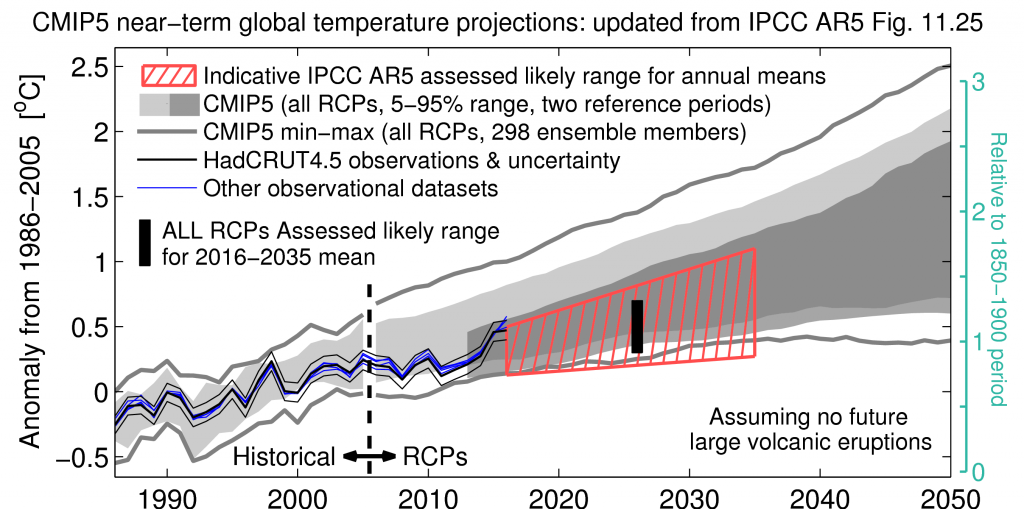
I don’t see how it shows any such thing. It shows that observations up to 2015 (from the least warm surface data set, HadCRUT4) were well within the 5-95% model range and closing in on the multi-model average, based on annual comparisons.
Ed Hawkins, who produced that chart, has updated it with 2016 results showing that, on an annual basis at least, observations at end 2016 were actually running ‘higher’ than the CMIP5 multi-model average:
Re-reading the above quote, it struck me that maybe I’d misunderstood it. Perhaps it was saying that over the projected period (since Jan 2006) the average temperatures in the models or the warming ‘trend’ in the models was running “a factor of 2” higher than observations.
To test this I downloaded ‘CMIP5 mean rcp4.5’ from climate explorer (link below). This gives the average of all the RCP 4.5 model runs. I also averaged the GISS, HadCRUT4 and NOAA surface data records, as this is the metric used by the WMO, then base-lined everything to 1961-90 anomalies.
From what I can see, since 2006 in terms of absolute numbers the models are running about 23% higher than observations (not a “factor of 2” higher). However, the linear trend in the observations is running slightly higher than that in the models (0.29 versus 0.24 C/dec).
In other words, since 2006 average temperatures forecast by the models are running slightly higher than those seen in reality; but the ‘rate’ of warming seen in reality has been slightly higher than that projected by the models. Nothing is “a factor of 2” higher than anything else.
CMIP5 model data link: https://climexp.knmi.nl/selectfield_cmip5.cgi?id=someone@somewhere
And what purpose is the multi-model average exactly?
Using the multi-model average is just a handy way of estimating how observations are going relative to average expectations for any given RCP. In this case it tells us that, of the 42 model projections in RCP4.5, observations are lying somewhere around the middle of the projected warming range.
It’s basically a con, giving a false impression that if so many models agree, within some MODEL- ENSEMBLE-BASED variance/ uncertainty, then the overall modelling must be on the right track. But this is nothing to do with the uncertainty inherent within the models themselves. IPCC figures, and similar junk, pretend that the uncertainty bands around various scenario runs are the real uncertainties in the model calculations, They are just the variance between (near identical) model runs. Pat Frank shows nicely what the REAL uncertainties look like:
http://cornwallalliance.org/wp-content/uploads/2016/08/Patrick-Frank-Uncertainty-Propagation-in-Projections-of-GAT-300×250.jpg
(Note the vertical scale spanning about 20°C)
Garth Paltridge, in his book “The Climate Caper”, reveals the further con that these models are somehow all “independent” efforts – nothing could be further from the truth:
“They take some or all of the code from the model of another group, and slightly modify those bits of it that are relevant to their particular interest and expertise. The overall process ensures that there is a gradual, and largely unconscious, move towards a situation where all the supposedly independent models have common physics and common values for their tuneable parameters. Quite naturally they begin to tell the same story.”
Multi-model average is meaningless. Only one model can be the correct model. All the other models are wrong and must be thrown out.
Neither the multi-model mean nor any particular model projection is ‘correct’; nor are they expected to be.
Part of the function of having so many and varied models for the one emissions scenario is to compare individual performance against observations then try to understand some of the factors responsible for the differences.
Identify those factors that work in reality and weed out those that don’t for the next model phase.
The IPCC has been playing this game for more than two decades and they have yet to advance to the next stage. In their first report the IPCC published a very wide range of possible valuse for the climate sensivity of CO2. In their last report the IPCC published the exact same values. So far they have learned nothing that would allow them to narrow the range of their gureese one iota. They are still just guessing. Their theroy, the AGW conjecture, is based on a radiant greenhouse effect that does not exist. It is all science fiction.
I’m having post after post vanish into nowhere. Are other people having that problem? I usually don’t have it.
So nice to see Dr.Curry unshackled. Scientists behaving as scientists is so refreshing .
My thoughts too. Bravo!
For more then two decades the IPCC has made absolutely no progress in determining what the climate sensitivity of CO2 really is. Without the the correct value of the climate sensivity of CO2 there can be no correct model. Recently Kyoji Kimoto pointed out that the original calculations of the Planck sensivity of CO2 is too great by more than a factor of more than 20 because the fact that doubling the amount of CO2 in the Earth’s atmosphere will cause a slight but significant decrease in the dry lapse rate in the troposphere which is a cooling effect. So instead of 1.2 degrees C we are talking about less than .06 degrees C which is trivial. Then there is the issue of H2O feedback. The IPCC likes to assume that the feedback is positive but the wet lapse rate is significantly less than the dry lapse rate so the feedback must be negative. so the climate sensivity of CO2 must be somewhere between .06 and 0.0 degrees C if not negative.
willhaas
What do you believe caused the observed warming of ~0.9C since the mid 20th century? If the IPCC is right in suggesting that practically all of that increase is the result of enhanced greenhouse warming, then that would suggest a CS of 1.7C at the very least (assuming no further warming).
“What do you believe caused the observed warming of ~0.9C since the mid 20th century?”
Probably the same thing that caused the Medieval, Roman and Minoan warm periods. Warming out of a cold period, like the Little Ice Age.
“Probably the same thing that caused the Medieval, Roman and Minoan warm periods. Warming out of a cold period, like the Little Ice Age.”
What do you think that something is?
natural variation,
certainly it was not CO2 since it is the IPCC’s contention that CO2 levels did not significantly change before about 1940/1950.
The Earth has warmed since The Little Ice Age,
CO2 causes warming,
Therefore the Earth’s warming was caused by CO2
Fallacy of Affirming the Consequent https://en.wikipedia.org/wiki/Affirming_the_consequent
..After the Little Ice Age, the Earth would have warmed up NATURALLY, even if there was ZERO CO2 in the atmosphere…!! Argue with, that Seaice1 !!
From all the work done with climate models one can conclude that the climate change we have been experiencing is caused by the sun and the oceans over which mankind has no control. The AGW conjecture is based upon the concept of a radiant greenhouse effect caused by trace gases that have LWIR absroption bands. A real greenhouse does not stay warm because of a radiant greenhouse effect. A real greenhouse stays warm because the glass limits cooling by convection. It is a convective greenhouse effect that keeps a greenhouse warm. So to on Earth. As derived from first principals, the surface of the Earth is on average 33 degrees C warmer because of the atmosphere because gravity limits cooling by convective. It is a convective greenhouse effect that accounts for all 33 degrees C that has been observed. There is no additional radient grenhouse effect on Earth or on any planet in the solar system with a thick atmosphere. The radiant greenhouse effect caused by so called greenhouse gases is fiction as is the AGW conjecture. If CO2 really affected climate then one would expect that the increase in CO2 over the past 30 years would have caused at least a measureable increase in the dry lapse rate in the troposphere but such has not happened.
Probably solar activity
http://appinsys.com/globalwarming/GW_Part6_SolarEvidence_files/image013.jpg
The GCMs are wrong because they are based on a wrong climate physics model (CO2 is the climate controller).
Since no one understands exactly what causes climate change, developing a climate physics model is an impossible task.
The causes of climate change probably include the sun, water vapor / clouds, oceans, “greenhouse gasses”, albedo, and planet / sun geometry changes (long term).
I challenge any “climate scientist” to provide a more specific explanation of what causes climate change — even short term changes (a degree or two, over a century of two).
The GCMs are a total waste of taxpayers money — worthless computer games!
Most climate “scientists” on government payrolls are also wasting taxpayers money.
The climate in 2017 is better for humans and plants than it has been in at least 500 years — there is no problem — there has been no abnormal climate change — there is no need to make wild guess predictions of the future climate and overreact to them.
Some people, however, do have a need for more attention and power, and know they can get both by scaring ordinary people with the false claim that CO2 is an evil gas, and only they can save the world.
Unfortunately, there are a lot of gullible, stupid people (mainly leftists) who believe the scaremongers!