Guest Post by Werner Brozek, Edited by Just The Facts

As can be seen from the above graphic, the slope is positive from January 1998 to December 2016, however with the error bars, we cannot be 95% certain that warming has in fact taken place since January 1998. The high and low slope lines reflect the margin of error at the 95% confidence limits. If my math is correct, there is about a 30% chance that cooling has taken place since 1998 and about a 70% chance that warming has taken place. The 95% confidence limits for both UAH6.0beta5 and RSS are very similar. Here are the relevant numbers from Nick Stokes’ Trendviever site for both UAH and RSS:
For RSS:
Temperature Anomaly trend
Jan 1998 to Dec 2016
Rate: 0.450°C/Century;
CI from -0.750 to 1.649;
t-statistic 0.735;
Temp range 0.230°C to 0.315°C
For UAH:
Temperature Anomaly trend
Jan 1998 to Dec 2016
Rate: 0.476°C/Century;
CI from -0.813 to 1.765;
t-statistic 0.724;
Temp range 0.113°C to 0.203°C
If you wish to see where warming first becomes statistically significant, see Section 1 below. In addition to the slopes showing statistically insignificant warming, the new records for 2016 over 1998 are also statistically insignificant for both satellite data sets.
In 2016, RSS beat 1998 by 0.573 – 0.550 = 0.023 or by 0.02 to the nearest 1/100 of a degree. Since this is less than the error margin of 0.1 C, we can say that 2016 and 1998 are statistically tied for first place. However there is still over a 50% chance that 2016 did indeed set a record, but the probability for that is far less than 95% that climate science requires so the 2016 record is statistically insignificant.
If anyone has an exact percentage here, please let us know, however it should be around a 60% chance that a record was indeed set for RSS. In 2016, UAH6.0beta5 beat 1998 by 0.505 – 0.484 = 0.021 or also by 0.02 to the nearest 1/100 of a degree. What was said above for RSS applies here as well. My predictions after the June data came in were therefore not correct as I expected 2016 to come in under 1998.
What about GISS and HadSST3 and HadCRUT4.5? The December numbers are not in yet, but GISS will set a statistically significant record for 2016 over its previous record of 2015 since the new average will be more than 0.1 above the 2015 mark. HadSST3 will set a new record in 2016, but it will only be by a few hundredths of a degree so it will not be statistically significant. HadCRUT4.5 is still up in the air. The present average after 11 months is 0.790. The 2015 average was 0.760. As a result, December needs to come in at 0.438 to tie 2015. The November anomaly was 0.524, so only a further drop of 0.086 is required. This cannot be ruled out, especially since this Nicks site shows December 0.089 lower than November:
Also worth noting are that UAH dropped by 0.209 from November to December and RSS dropped by 0.162. Whatever happens with HadCRUT4.5, 2016 and 2015 will be in a statistical tie with a possible difference in the thousandths of a degree. The difference will be more important from a psychological perspective than a scientific perspective as it will be well within the margin of error.
In the sections below, we will present you with the latest facts. The information will be presented in two sections and an appendix. The first section will show for how long there has been no statistically significant warming on several data sets. The second section will show how 2016 so far compares with 2015 and the warmest years and months on record so far. For three of the data sets, 2015 also happens to be the warmest year. The appendix will illustrate sections 1 and 2 in a different way. Graphs and a table will be used to illustrate the data. Only the satellite data go to December.
Section 1
For this analysis, data was retrieved from Nick Stokes’ Trendviewer available on his website. This analysis indicates for how long there has not been statistically significant warming according to Nick’s criteria. Data go to their latest update for each set. In every case, note that the lower error bar is negative so a slope of 0 cannot be ruled out from the month indicated.
On several different data sets, there has been no statistically significant warming for between 0 and 23 years according to Nick’s criteria. Cl stands for the confidence limits at the 95% level.
The details for several sets are below.
For UAH6.0: Since November 1993: Cl from -0.009 to 1.784
This is 23 years and 2 months.
For RSS: Since July 1994: Cl from -0.005 to 1.768 This is 22 years and 6 months.
For Hadcrut4.5: The warming is statistically significant for all periods above four years.
For Hadsst3: Since March 1997: Cl from -0.003 to 2.102 This is 19 years and 9 months.
For GISS: The warming is statistically significant for all periods above three years.
Section 2
This section shows data about 2016 and other information in the form of a table. The table shows the five data sources along the top and other places so they should be visible at all times. The sources are UAH, RSS, Hadcrut4, Hadsst3, and GISS.
Down the column, are the following:
1. 15ra: This is the final ranking for 2015 on each data set.
2. 15a: Here I give the average anomaly for 2015.
3. year: This indicates the warmest year on record so far for that particular data set. Note that the satellite data sets have 1998 as the warmest year and the others have 2015 as the warmest year.
4. ano: This is the average of the monthly anomalies of the warmest year just above.
5. mon: This is the month where that particular data set showed the highest anomaly prior to 2016. The months are identified by the first three letters of the month and the last two numbers of the year.
6. ano: This is the anomaly of the month just above.
7. sig: This the first month for which warming is not statistically significant according to Nick’s criteria. The first three letters of the month are followed by the last two numbers of the year.
8. sy/m: This is the years and months for row 7.
9. Jan: This is the January 2016 anomaly for that particular data set.
10. Feb: This is the February 2016 anomaly for that particular data set, etc.
21. ave: This is the average anomaly of all months to date.
22. rnk: This is the rank that each particular data set would have for 2016 without regards to error bars and assuming no changes to the current average anomaly. Think of it as an update 55 minutes into a game. However the satellite data are complete for the year.
| Source | UAH | RSS | Had4 | Sst3 | GISS |
|---|---|---|---|---|---|
| 1.15ra | 3rd | 3rd | 1st | 1st | 1st |
| 2.15a | 0.261 | 0.381 | 0.760 | 0.592 | 0.86 |
| 3.year | 1998 | 1998 | 2015 | 2015 | 2015 |
| 4.ano | 0.484 | 0.550 | 0.760 | 0.592 | 0.86 |
| 5.mon | Apr98 | Apr98 | Dec15 | Sep15 | Dec15 |
| 6.ano | 0.743 | 0.857 | 1.024 | 0.725 | 1.11 |
| 7.sig | Nov93 | Jul94 | Mar97 | ||
| 8.sy/m | 23/2 | 22/6 | 19/9 | ||
| Source | UAH | RSS | Had4 | Sst3 | GISS |
| 9.Jan | 0.539 | 0.681 | 0.906 | 0.732 | 1.15 |
| 10.Feb | 0.831 | 0.994 | 1.068 | 0.611 | 1.33 |
| 11.Mar | 0.732 | 0.871 | 1.069 | 0.690 | 1.29 |
| 12.Apr | 0.713 | 0.784 | 0.915 | 0.654 | 1.08 |
| 13.May | 0.544 | 0.542 | 0.688 | 0.595 | 0.93 |
| 14.Jun | 0.337 | 0.485 | 0.731 | 0.622 | 0.75 |
| 15.Jul | 0.388 | 0.491 | 0.728 | 0.670 | 0.83 |
| 16.Aug | 0.434 | 0.471 | 0.770 | 0.654 | 0.98 |
| 17.Sep | 0.440 | 0.581 | 0.710 | 0.606 | 0.90 |
| 18.Oct | 0.407 | 0.355 | 0.586 | 0.601 | 0.88 |
| 19.Nov | 0.452 | 0.391 | 0.524 | 0.488 | 0.95 |
| 20.Dec | 0.243 | 0.229 | |||
| 21.ave | 0.505 | 0.573 | 0.790 | 0.629 | 1.01 |
| 22.rnk | 1st | 1st | 1st | 1st | 1st |
| Source | UAH | RSS | Had4 | Sst3 | GISS |
If you wish to verify all of the latest anomalies, go to the following:
For UAH, version 6.0beta5 was used.
http://www.nsstc.uah.edu/data/msu/v6.0/tlt/tltglhmam_6.0.txt
For RSS, see: ftp://ftp.ssmi.com/msu/monthly_time_series/rss_monthly_msu_amsu_channel_tlt_anomalies_land_and_ocean_v03_3.txt
For Hadcrut4, see: http://www.metoffice.gov.uk/hadobs/hadcrut4/data/current/time_series/HadCRUT.4.5.0.0.monthly_ns_avg.txt
For Hadsst3, see: https://crudata.uea.ac.uk/cru/data/temperature/HadSST3-gl.dat
For GISS, see:
http://data.giss.nasa.gov/gistemp/tabledata_v3/GLB.Ts+dSST.txt
To see all points since January 2016 in the form of a graph, see the WFT graph below.

As you can see, all lines have been offset so they all start at the same place in January 2016. This makes it easy to compare January 2016 with the latest anomaly.
The thick double line is the WTI which shows the average of RSS, UAH6.0beta5, HadCRUT4.5 and GISS.
Appendix
In this part, we are summarizing data for each set separately.
UAH6.0beta5
For UAH: There is no statistically significant warming since November 1993: Cl from -0.009 to 1.784. (This is using version 6.0 according to Nick’s program.)
The UAH average anomaly for 2016 is 0.505. This sets a new record. 1998 was previously the warmest at 0.484. Prior to 2016, the highest ever monthly anomaly was in April of 1998 when it reached 0.743. The average anomaly in 2015 was 0.261 and it was ranked third but will now be in fourth place.
RSS
Presently, for RSS: There is no statistically significant warming since July 1994: Cl from -0.005 to 1.768.
The RSS average anomaly for 2016 is 0.573. This sets a new record. 1998 was previously the warmest at 0.550. Prior to 2016, the highest ever monthly anomaly was in April of 1998 when it reached 0.857. The average anomaly in 2015 was 0.381 and it was ranked third but will now be in fourth place.
Hadcrut4.5
For Hadcrut4.5: The warming is significant for all periods above four years.
The Hadcrut4.5 average anomaly so far is 0.790. This would set a record if it stayed this way. Prior to 2016, the highest ever monthly anomaly was in December of 2015 when it reached 1.024. The average anomaly in 2015 was 0.760 and this set a new record.
Hadsst3
For Hadsst3: There is no statistically significant warming since March 1997: Cl from -0.003 to 2.102.
The Hadsst3 average anomaly so far for 2016 is 0.629. This would set a record if it stayed this way. Prior to 2016, the highest ever monthly anomaly was in September of 2015 when it reached 0.725. The average anomaly in 2015 was 0.592 and this set a new record.
GISS
For GISS: The warming is significant for all periods above three years.
The GISS average anomaly so far for 2016 is 1.01. This would set a record if it stayed this way. Prior to 2016, the highest ever monthly anomaly was in December of 2015 when it reached 1.11. The average anomaly in 2015 was 0.86 and it set a new record.
Conclusion
Does it seem odd that only GISS will probably set a statistically significant record in 2016?
“Does it seem odd that only GISS will probably set a statistically significant record in 2016?”
A more interesting fact is that almost all indices will set records. Land, sea, global surface, troposphere. But the situation with GISS is that it had a relatively small rise in 2015. NOAA and HADCRUT rose much more. It’s as if they responded earlier to El Nino. All three rose by about the same amount in total since 2014.
“A more interesting fact is that almost all indices will set records.”
Not really. There was a big El Nino. Meh.
There was a bigger one in ’98 but this one peaked at ~ 0.4C above that.
Noise. Signal variability. Meh. It was also a much narrower spike. You are just trying to convince yourself of something that is not in evidence.
Sorry ToneB, but the 1998 El Nino did not occur at the peak of the AMO. All the differences between the two sets of data are easily explained by the AMO. I realize you aren’t interested in the truth. You are simply here to push your bias.
It is interesting to note that 2015 saw the largest jump in CO2 at 3.03 ppm. The previous record was 1998 at 2.93 ppm. Does this suggest that the 2015/16 was slightly stronger then in 1997/98? Last year came in at 2.77 which is 3rd highest in the Mauna Loa record.
I think it has more to do with China and India emitting much more CO2.
No body must read what I write. Over and over I’ve gone on about NOAA changing the record in 2005 from 2.52 to 3.10. That’s above even what you are saying if it is truly the number you say it is. The co2 levels in addition to following temperature also follow the solar cycle peak to peak. That’s why I’m upset about NOAA changing the data. Do you know how much more co2 per year we are producing now as opposed to 1998 ? I thought the count this year (2016) would have been at least 4 or 5. If it’s 3.01, that’s unbelievable. Really unbelievable. That means the co2 sinks are accelerating. Or the natural release of co2 is diminishing, by a lot.
Bartemis:
Apples v apples – GMST’s are ~ 0.4C higher than 18 years ago.
And that you say …..
“You are just trying to convince yourself of something that is not in evidence.”
It’s even on a trop sat temp series.
That RSS is now disowned here, along with GISS of course.
Makes the above just typically “down the rabbit-hole”.
Richard:
“Sorry ToneB, but the 1998 El Nino did not occur at the peak of the AMO. All the differences between the two sets of data are easily explained by the AMO. I realize you aren’t interested in the truth. You are simply here to push your bias.”
No.
I am here to correct the bias of denizens.
To deny some of the ignorance on display.
Like, every, literally every, climate related science head post on here is introduced as “from the dept of …..”. Or “Claim …..”
The bias comes from the ideological standpoint, projected onto the science.
Just like it is impossible to get ever forecast right, it is equally impossible to get every one wrong my friend.
Here they are all wrong.
And you think WUWT has no bias?
The AMO is it?
Well it isn’t wasn’t much different in ’16 than ’98, though it was riding a curious spike in ’98.
The PDO/ENSO has far more effect
Yet temps didn’t dip during the -ve phase through the “pause”…..
http://2.bp.blogspot.com/-Fkg790Q3b8o/VMRGN17t2oI/AAAAAAAAHwo/GTCVnmku248/s1600/GISTempPDO.gif
rishrac @ur momisugly January 12, 2017 at 8:10 pm
“That means the co2 sinks are accelerating. Or the natural release of co2 is diminishing, by a lot.”
Accelerating sink activity is a kluge used to explain the apparent change in the relationship between emissions and concentration. It is apparent, but it is not real, because emissions do not drive concentration. The rate of change of concentration is simply tracking temperature.
http://woodfortrees.org/plot/esrl-co2/derivative/mean:12/from:1979/plot/rss/offset:0.6/scale:0.22
Toneb @ur momisugly January 13, 2017 at 3:32 am
“It’s even on a trop sat temp series.
That RSS is now disowned here, along with GISS of course.”
Not this RSS:
http://woodfortrees.org/plot/rss
Perhaps you are talking about some “adjusted” product that is not carried on WFT yet.
“GMST’s are ~ 0.4C higher than 18 years ago.”
El Nino’s are variable, not like a standard candle in astronomy. And, temperatures as of now are comparable to the whole of the past two decades, and falling fast.
Bartemis:
WFT interactive still has RSS v3.3 TLT
Of which RSS say ….
“The lower tropospheric (TLT) temperatures have not yet been updated at this time and remain V3.3. The V3.3 TLT data suffer from the same problems with the adjustment for drifting measurement times that led us to update the TMT dataset. V3.3 TLT data should be used with caution.”
Therefore, as I said above – This is the equivalent.
Well, isn’t that convenient. Too bad. RSS was doing a good job. I guess the pressure was too great.
It still does not change the fact that you are basing your conclusion on a needle sharp spike that would be virtually eliminated with a little more smoothing than is already done. And, the influence of El Nino hasn’t faded entirely yet. We will see what happens in the year to come.
This seems to me like two bald men fighting over a comb. It matters not whether the pause continues or not or whether December’s temperature is a hundredth of a degree higher or lower. It probably does matter to the record keepers, but not to the climate change debate.
The relationship between temperature and carbon dioxide is broken at this juncture. That is the conclusion. The temperature may be flat or increasing slightly since 1998, but it is less of an increase than the long term warming and very much less than the warming promised by AGW. That is the conclusion.
” very much less than the warming promised by AGW”
No, it’s quite close. Here is the comparison of CMIP 5 averages with recent surface temperature observations
Yeah, maybe it’s quite close no, but … ::
No.
Current observations are well within the FAR range of uncertainty.
And actually above SAR.
http://blogs.reading.ac.uk/climate-lab-book/files/2016/02/WGI_AR5_Fig1-4_UPDATE.jpg
CMIP 5 was published in 2014, so 90% of that graph is meaningless and incredibly misleading.
Is this an ensemble of different models with different assumptions and different initialisation values?
Eh?
I was responding to the graph posted by Robert.
It has a trend drawn from 1990.
Does nobody understand that the climate of the 21st Century has not responded as predicted by IPCC climate models? They even had the actual numbers through 2005, and still got it wrong.
Quit arguing minutia, and attack the liars where they live.
Showing the range of estimates from FAR to AR4 – which was published in 2007.
Robert Kermodle,
“Yeah, maybe it’s quite close no, but”
That’s MofB’s trick graph where he rings in troposphere data instead of the surface measures they were predicting.
Just noting that we just had a super-El Nino which kind of makes it silly to run a 12 month running mean and compare that to global warming projections.
NCDC-NOAA was 0.32C in November on your chart above, well below all of the AR5 forecasts produced just 3 years ago (as in they had all the data up to 2013). NCDC-NOAA is also going lower in the months ahead to about 0.1C on your above chart.
Hadcrut4.5 was 0.29C in November on your chart and will also be going lower in the months ahead.
So, it took a lot of work to put that together and it kept some people “believing” for a period of time right now. But what happens when you have to face the music again in the near future about the models being so far off (even ones produced just a few years ago which had all the historical data to work with).
The solution can not be be to adjust the temperature data once again because even that is not working. Its still way below even though they just added 0.1C to the numbers over the last year.
WHEN is it face the music time?
Not to mention the elephant in the room – they have no evidence that CO2 is the CAUSE OF the minuscule amount of warming, regardless of how close or far apart the models are from reality. Push THAT discussion to its conclusion, and invariably it will end up at “they can’t otherwise account for it,” which is the classic AGW argument based on climate ignorance.
Miniscule is right. We’re getting wrapped around the axle here over a 1 degC rise per century, when the ASHRAE standard for the temperature differential between your head and your feet is a whopping 3 degC!
Yes, there is a mechanism to account for warming other than CO2 and that is “Ozone Depletion” which can be anthropogenic or natural. Ozone depletion allows additional UVB to reach the lower troposphere and earth’s surface and produce additional warming of the troposphere and surface. Since oxygen photodisassociation and creation of ozne UVB in the stratophere normally absorbs most of the UVB, less absorption of UVB in the stratosphere produces stratospheric cooling (this has been observed) but surface and troposphere warming. From 1970 to 1998 ozone depletion was anthropogenic due to human made and released chlorofluorcarbon gases. This is well known., Ozone depletion was at its maximum in 1998 and was superimposed on the El Nino event so warming was maximum. Lucky for the AGW crowd, Boaorabunga volcano in Iceland erupting starting in Oct, 2014 and continued through March, 2015. The eruption was effusive not explosive so it produced no significant aerosols or particulates to produce cooling but lots of gases. Effusive eruptions release HF, HCl, and HBr (halogen gases) that still reached the stratopshere within a few months and produce ozone depletion. This occurred by February, 2015, resulting in warming through 2015 into 2016 .(so AGW crowd now think they have been saved from the “hiatus” – they will be disappinted!). Ozone depletion probably peaked in mid-2016 and is now reversing. The peak in ozone depletion corresponded to the El Nino event related warming which is why 2015-2016 were near or at record temperatures. The reversal in the ozone depletion trend will now correspond to the La Nina cooling trend so the downward temperature trend for 2017-2018 should be steep as the trend for November and December, 2016 suggests. If these correlations with exogenous, random events are correct, calculating trendlines, correlation coefficients, error ranges, and probabilties have no real world relevance.
Now the “ozone depletion” theory is not my idea. The significance of ozone depletion to mean global temperatures is Dr. (PhD) Peter Langdon Ward’s idea. A full explanation can be found at his website: https://www.WhyClimateChanges.com. My miniscule contribution is suggesting that ozone depletion peaks have accidently corresponded with El Nino events exacerbating warming and the following:
The Davos Conspiracy (of January, 2017)
Davos elites meet and greet with alarm to decry with derision
the possible decrepitation of their “global warming” delusion
but it’s just a billionaire’s Juke and Jive dance to distract us
while they slither into the pocketbooks of each dumb cuss.
CO2 doesn’t cause climate change as Al Gore’s preachin’,
his religious obfuscation of the truth of “ozone depletion”
from the impact of CFC’s and effusive volcanic gas emissions,
a marvelous dance between oxygen’s photodisassociation
from UVB radiation and ozone creation and destruction.
Check out https://WhyClimateChanges.com for a lesson,
and you will conclude Davos is a conspiracy of high treason
worthy of a racketeering and corrupt practices conviction.
MHPublishing, Copyright 2017 – distribute freely with attribution.
The ozone depletion idea is controversial because it means calculations of current calculations of radiant energy are incorrect and leads to the conclusion that the current physics paradigm of visualizing light as packets with wave-particle duality is an artificial contruct and has no basis in reality. It works for me because it can explain the recent temperature records, the historical anecdotal climate record, and the geologic record. As a geologist, the geologic record is all that really counts to me and the CO2 AGW theory just doesn’t cut it. The rocks tell the story and volcanoes rule. It also means humans can affect the earth’s climate. Just start up CFC production again if you want to swim on a Greenland beach without freezing or put a cork in Iceland’s volcanoes if you don’t.
For two scientists communicating with each other, I agree. But if you want to mention it to your neighbor at a coffee shop, “no warming” is much easier to understand than “no statistically significant warming at the 95% level over 20 years”. His glazed eyes will soon be looking for the door.
Werner,
Where did you get the 0.1C and 0.2C margins of error you quoted?
From here:
http://www.drroyspencer.com/2017/01/global-satellites-2016-not-statistically-warmer-than-1998/
But where did I say 0.2C? Are you referring to the latest RSS anomaly of 0.229 C that was rounded to 0.2 C?
You made a comment about the pause returning in half the time if the temp dropped 0.2C vs 0.1C below the mean.
I’m guessing he’s referring to that.
Thank you! If that was meant, see my comment at:
https://wattsupwiththat.com/2017/01/12/satellite-records-and-slopes-since-1998-are-not-statistically-significant-now-includes-november-and-december-data/comment-page-1/#comment-2395807
Werner, as I’ve told you before to justify this statement:
“On several different data sets, there has been no statistically significant warming for between 0 and 23 years according to Nick’s criteria. Cl stands for the confidence limits at the 95% level.”
you need to be performing a one-tailed test, is that what you did?
When you do a two-tailed test you’re saying that the 2.5% chance that the warming above 1.784 (For UAH6.0) is not warming, which is clearly nonsense!
Phil.,
He’s using results from here. There is a 95% probability of being within CIs (t limit1.96), so yes, 2.5% of being beyond each extreme. So when Werner says “no significant warming” I think he means that zero trend is within those 95%CIs about the observed trend.
Exactly, I pointed this out to him before, if he wants to say ‘warming’ he has to change his limit, I think it’s ~1.65 rather than 1.96.
When will the pause return?
No one knows when or if the pause will ever return. However certain conditions must be met. Namely the area below the zero line after December 2016 must be equal to the area above the zero line from February 2016 to November 2016. The average from February to November on RSS was 0.60. The zero line, which is where RSS is at present is 0.23. That leaves a difference of 0.37 for a period of 10 months above the zero line. 0.37 x 10 = 3.7.
So if the RSS anomaly drops by 0.10 from 0.23 to 0.13 and stays there, it would take 37 months for the pause to return.
If the anomaly drops by 0.2 from 0.23 to 0.03 and stays there for 19 months, the pause will return.
If the anomaly drops by 0.3 from 0.23 to -0.070 and stays there for 12 months, the pause will return.
If RSS makes adjustments, the pause will never return! ☹
“If my math is correct, there is about a 30% chance that cooling has taken place since 1998 and about a 70% chance that warming has taken place.”
Golly, I am pretty sure every single person who is not an active skeptic has clean forgotten to mention anything about confidence levels or uncertainty ranges!
That goes for every MSM news source too.
Must be just an innocent oversight, huh?
I mean, anyone who has taken and passed even one single college level science class knows all about uncertainty, what it is and what it means, not to mention how important it is, so, it must just be an innocent oversight…right?
By every one of them, every single time they mention anything about it, for years on end…just an oversight.
One thing that I’m not sure about with all this talk of significant warming, is how much it matters that there are multiple data sets.
To take the question of whether 2016 was warmer than 1998, if we only have UAH 6.0 and that’s showing 2016 as 0.02 C warmer than 1998, then given the amount of uncertainty there might be a 40% (or whatever) chance that 1998 was warmer. But if RSS 3.3 is also showing 2016 as being 0.02 C warmer, then that must increase the confidence that 2016 really was warmer. If both data sets were completely independent than the chances of 1998 being warmer would drop to 16%, but as they are not independent I guess the real odds of 1998 being warmer would be somewhere between 16% and 40%.
And that’s only looking at the two data sets showing the smallest difference between the two years.
The slight difference in CO gain for the year/s involved may be a clue. 2015= 3.03 ppm, 1998= 2.93 ppm. The year 1998 held the record as the greatest yearly gain on the Mauna Loa site. Now 2015 is 1st with 2016 3rd at 2.77 ppm
Probability UAH LT for 2016 is warmest year is 61%. See the comments on Roy’s blog, or my blog.
UAH press releases says 2016 is “warmest.”
Thank you! So I was in the ballpark.
I must have missed your comment earlier. Was your post in moderation for a long time?
Thank you Werner and JTF, and Nick too!
Good info sharing once again.
I find it interesting we debate hundredths of a degree to leverage change in policies. Frankly, we need warmer Temps to feed the populations and provide a place to house them. CO2 could be our saviour, until the logarithmic relationship to temperature comes into play more so. Just sayin, careful what you wish for……
Lack of statistically significant warming doesn’t mean that it hasn’t been warming!
Let’s compare the warming trend for UAH6.0 for the first half of the record, the last half of the record and the full record:
1/79-10/16: 0.883 K/century (95% ci of 0.411 to 1.256 K/century). “statistically significant”
1/79-1/98: 0.283 K/century (95% ci of -0.695 to 1.263 K/century). “statistically insignificant”
1/98-10/16: 0.611 K/century (95% ci of -0.803 to +2.024 K/century). “statistically insignificant”
Interesting. Two periods with insignificant warming add up one combined period with significant warming. (:)) So what does a lack of statistically significant warming prove? Nothing. It just means variability/noise can make it difficult to prove the existence of warming over relatively short periods.
Notice that the warming trend for both shorter periods is lower than for the full period and larger during the so-called “Pause”. Ouch.
An interesting point! But are your numbers right? For the full period for UAH6.0beta5, I get:
Temperature Anomaly trend
Jan 1979 to Dec 2016
Rate: 1.230°C/Century;
CI from 0.815 to 1.646;
t-statistic 5.803;
Temp range -0.209°C to 0.257°C
The rate of 1.23 C/century is not too high, but your number of 0.883 K/century is even less! Should we even be concerned about that?
Werner: Nick is correct. I selected UAH6mt rather than UAH6.LT. Thanks for catching my mistake. Nick’s numbers below are correct. They support essentially the same point: Absense of statistically significant warming does not prove the absence of warming. Natural variability obscures warming over periods of one or two decades.
I forget which record I was working with, but I found a dividing point where the full period slope and both half period slopes were very similar, but only the full period was significant.
Frank and Werner,
” but only the full period was significant.”
I think that is to be expected. If you throw four heads in a row that is not significant (1/16). If it happens again, that isn’t significant on its own. But eight in a row is (1/256).
“I think that is to be expected. If you throw four heads in a row that is not significant (1/16). If it happens again, that isn’t significant on its own. But eight in a row is (1/256).”
Yes. This is a point that I don’t think everyone using the term “statistically significant” realizes. Whether something is significant or not depends both on the strength of the signal over the noise, and the size of the sample.
Say you were testing a drug – you give it to 50 people and find it did significantly better than a control group given a placebo. Now if you you split the 50 people into two groups of 25 each it may well be the case that neither group shows a significant improvement over the control, not because the results are worse but simply because 25 is a smaller sample than 50. It would be absurd to point to the sample of 25 and claim that this meant the drug stopped working on those 25.
But this is what happens with the temperature trends. There is a statistically significant warming since the start of the satellite era, but by looking at the last 20 years or so that warming becomes insignificant. In part this might be because the trend was smaller, but it might also be because the sample size is less. Just saying the rise was insignificant since 1998 tells us little.
To a certain extent, you are right. Keep in mind that all numbers from Section 1 show from where the warming could include zero. So one or more months longer does not include zero any more.
I talked with a warmist years ago regarding Phil Jones interview and at that time he said that 8 years means nothing, but that 15 years should be taken more seriously.
Nick wrote: “I think that is to be expected. If you throw four heads in a row that is not significant (1/16). If it happens again, that isn’t significant on its own. But eight in a row is (1/256).”
However, many people think multi-year climate change is deterministic, not chaotic. They think in terms of cause and effect, not coin-flipping.
According to climate models, in any five-year period with today’s growing forcing, there is a 25% chance the temperature has fallen. Your coin flipping analogy is valid. So there shouldn’t be too many 10-year periods in your post 1979 trend viewer with cooling, but the 95% confidence interval certainly should include 0 warming. I personally think observations show that models produce too little unforced variability and/or too much warming, but that is hard to prove.
Werner, Frank
“C:\mine\blog\bloggers\Reader\WUWT\_WUWT.html”
I think Frank has given figures for UAH6.6 MT, which also makes the point. For LT I get
Also two insignificant parts, with a significant whole.And the trend for the first part is really quite high.
“Should we even be concerned about that?”
No. Planes will be OK. Surface temperatures are our issue.
Sorry I pasted the wrong thing here. I’m responding to Werner
“But are your numbers right? “
Thank you!
The El Nino heat spike comming quickliy back to normal can be explained in a simple way.
The the sudden atmospheric warming can simply explained by the fact that hot water stored some hundred meters deep in the West pacific is suddely released to the surface of the whole Pacific, which makes one third circumference of the globe – a real big area!
The heat in the West Pacific comes from the trade winds, having no clouds and exposing a big part of the entire Pacific permanently to the sun. Without the winds, the warmed up and piled up waters are flushing back toward East and the American Continent.
Water can store 1000 times more heat than air, so the atmophere is heated up quickly. When cold water again is pushed from America to the West Pacific, the heat release is stopped. And the atomosphere ist radiating quickly its surplus heat towards space.
But co2 should be slowing the quick radiation to space so the heat should be retained in the atmosphere longer. Is it?
Per Nick, Tonedeaf, griff and others we have not yet reached equilibrium so why doesn’t this new heat stay in the atmosphere and just get us closer to equilibrium? The co2 molecules should be absorbing all this LWR and then transfer it to other molecules through collision and it should stay trapped. They rate of heat transfer to space should stay the same.
Unless this heat is some how magically being returned to the oceans there is nothing in CAGW theory that should allow it to quickly radiate to space. But if you look at h2o and co2 as radiative coolers of the atmosphere than it makes sense how this heat escapes. I have said it a thousand times the oceans oceans warm and heat the atmosphere not the other way around. CO2 is not the magic blanket that causes the oceans to warm.
Bob wrote: “Unless this heat is some how magically being returned to the oceans there is nothing in CAGW theory that should allow it to quickly radiate to space.”
The idea the GHGs permanently trap heat in the atmosphere was created by alarmists for the simple-minded. GHGs both absorb and emit thermal infrared radiation. As with almost all materials (N2 and O2 begin important exception in our atmosphere), emission increases with temperature. You can use the S-B eqn to show that a blackbody near 255 K, for example, emits about 3.8 W/m2 for every 1 degK it warms. So the 0.5 K increases in temperature during strong El Ninos potentially could emit an additional 2 W/m2 of LWR to space. Given that current forcing from anthropogenic GHGs is only about 2.5 W/m2, it is crazy to say that the temperature doesn’t drop after an El Nino because it is escaping to space.
The temperature falls every winter because GHGs emit radiation to space. It falls every night for the same reason.
You are correct in saying that we haven’t reached a new equilibrium temperature in response to the current forcing of about 2.5 W/m2 because the heat is flowing into the deep ocean – about 0.5 W/m2 according to ARGO. The atmosphere “doesn’t know” about heat flux into the deep ocean – (following the laws of physics), it radiates more heat towards space and the surface when it is warmer during El Ninos.
That’s not the information for the energy budget of the earth.The net retained was greater than the outgoing. Via the satellite back then when co2 levels were 370 ppm, the net retained was 2/3 of the incoming. After years of constant increases in co2, one would expect to have more, not less retained energy. Show me in the energy budget there was a net spike in energy released. That would also be the end for AGW as well. I’ve even argued that when there is more evaporation that more heat is released. The answer to that was the energy budget, that the latent heat heat was retained rather than released.
I can’t tell if you are a skeptic or a warmist, but the argument supports a skeptics view.
In essence what I’m overall saying is that after 20 years, the global temperature is currently up only 0.2 C, that is a demarcation point. Water does have a higher heat capacity, where is the heat being stored ? If you ignore the trends, the question to ask is, in the next 12 months will the global temperature rise or fall ? If it rises is it due to co2, if it falls below the long term average of what was considered equilibrium, then climate can not possibly be related to co2. The water would be warmer than the atmosphere at that point and would be giving up heat rather than absorbing it. Isn’t that the rationale behind the Arctic ice melting ?
Frank
The myth is that there is such a thing as equilibrium when it comes to global temperature and that warming of the oceans have anything to do with CO2 when the opposite is the truth.
Rishrac wrote: “That’s not the information for the energy budget of the earth.The net retained was greater than the outgoing. Via the satellite back then when co2 levels were 370 ppm, the net retained was 2/3 of the incoming.”
Satellites are incapable of measuring the difference between incoming and outgoing radiation with enough accuracy to detect a radiative imbalance of a few W/m2. (They don’t cover the full wavelength range of incoming and outgoing energy with a linear response. 1 W/m2 is only an 0.4% change in the post albedo 240 W/m2 entering the planet) If you believed their raw output, the Earth would be warming much faster than it is. However, satellites can detect a CHANGE of a few tenths of a W/m2 in both SWR and LWR.
Since most (roughly) of the energy entering our planet ends up in the ocean, we deployed the ARGO buoys to measure our current imbalance. The current best estimate is 0.5 W/m2 (and it is currently being used to correct some versions of the satellite data, CERES-EBAG.)
rishrac: “Water does have a higher heat capacity, where is the heat being stored ?
ARGO tells us that 0.5 W/m2 of heat (from a radiative imbalance) is accumulating in the deep ocean. The top 100 meters of ocean warms and cools with ENSO (and seasons), but the accumulation of heat below is fairly steady. Unfortunately, when that little heat flux is spread over 2000 m of ocean, the temperature rise in a decade average only 0.025 K (assuming my calcs are correct). Does ARGO have this level of accuracy? It was designed to be this accurate. There are 3000 of them reporting every 10 days. Sample buoys are removed and tested for biases every year. The picture is evolving slowly. WIllis reported at WUWT that all oceans are not warming at the same rate. (I don’t have much faith in preARGO data; it is limited and required large corrections.)
http://climate4you.com/images/ArgoWorldOceanSince200401%2065N-65S.gif
http://climate4you.com
rishrac comments: “I can’t tell if you are a skeptic or a warmist, but the argument supports a skeptics view.
Does it make a difference? The important question is whether I have provided Bob with the correct reason why the temperature falls after El Ninos – and summers and daylight hours. And accurate information to you. I’m a skeptic – about both the IPCC and skeptics. I’d like to understand what is true, no matter where that leads. So, if I’ve got something wrong, let me know.
Bob Boder: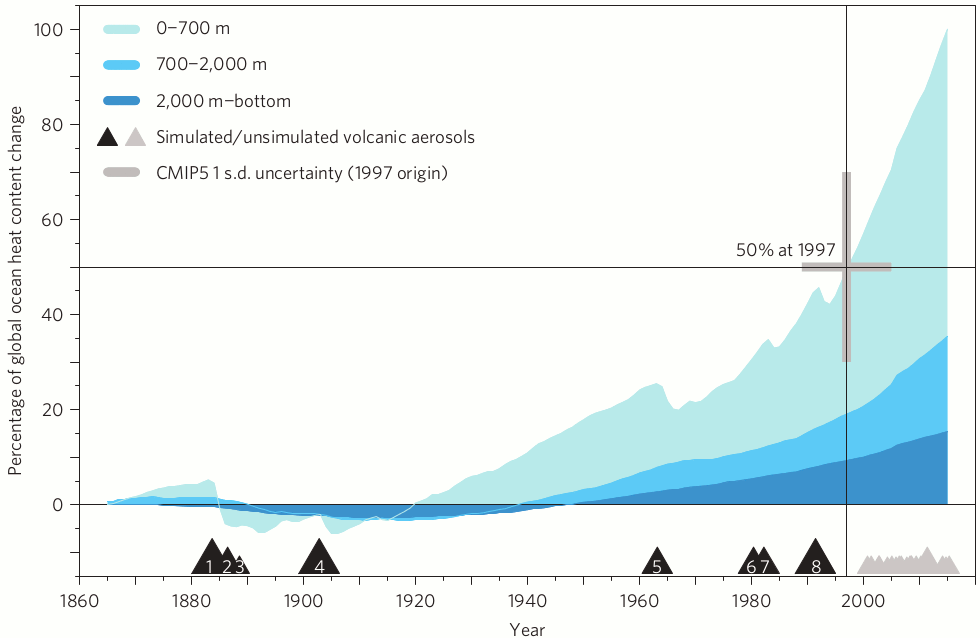
“Per Nick, Tonedeaf, griff and others we have not yet reached equilibrium so why doesn’t this new heat stay in the atmosphere and just get us closer to equilibrium? The co2 molecules should be absorbing all this LWR and then transfer it to other molecules through collision and it should stay trapped. They rate of heat transfer to space should stay the same.
Becasue ~93% of TSI goes into the oceans … which then releases it to the atmosphere.
OHC shows us that it is storing it long-term – if it were not then there would be just natural variation in it NOT a steep climb for the last ~ 100 years – (NB: bar temporary coolings due volcanic aerosol injection into the stratosphere).
The equilibrium will only come once the atmosphere is heated enough by the oceans to attain a temp high enough to “get through” the GHG “fog” and exit to space.
AT that point incoming will equal outgoing and both ocean and atmos temps will stabilise.
“CO2 is not the magic blanket that causes the oceans to warm.”
It’s not “magic” just basic radiative physics.
GHG molecules attenuate LWIR’s ability to exit to space. That allows more TSI to be absorbed as the “insulation” takes place. Just like you or I do when we put on thick clothing. Our bodies are still radiating (sun still shining) but your heat is kept in (GHG “blanket” thicker). Energy in>energy out=warming.
Frank:
“The idea the GHGs permanently trap heat in the atmosphere was created by alarmists for the simple-minded.”
It wasn’t “created” – it was discovered by repeated experimentation and observation and verified by applied theory, going all the way back to Tyndall and Arrhenius from 1859. (were there “alarmists” then??
http://history.aip.org/climate/co2.htm
Tonedeaf
I have never purchased a blanket that is a heat radiator I like staying warm.
The oceans will never reach equilibrium because they warm and cool over hundreds, thousands and tens of thousands of years and co2 has nothing to do with it. Your statements are more proof of the failure of understanding of the theory you try to defend.
“The equilibrium will only come once the atmosphere is heated enough by the oceans to attain a temp high enough to “get through” the GHG “fog” and exit to space.”
If your cartoon version of the physics were accurate, it would never “get through” the “GHG fog” to any significant extent. Rather, the mode of the temperature distribution would move higher, and the increased radiation exiting beyond the IR band would balance things out.
But, that is not the only avenue for getting around the GHG filter. E.g., increasing convection lofts heat higher in the atmosphere, from where it is freer to radiate. And, there are other ameliorating feedback effects, such as cloud cover in response to increasing evaporation.
It is by no means a given that increasing CO2 concentration will significantly increase the temperature of the Earth, and indeed, it cannot in the aggregate response. Higher temperatures increase atmospheric CO2. If CO2 appreciably increased temperatures in turn, that would comprise a positive feedback loop that could not be stabilized even by T^4 radiation, and we would have reached a tipping point eons ago.
“Tonedeaf
I have never purchased a blanket that is a heat radiator I like staying warm.
The oceans will never reach equilibrium because they warm and cool over hundreds, thousands and tens of thousands of years and co2 has nothing to do with it. Your statements are more proof of the failure of understanding of the theory you try to defend.”
Bob Boredwith
“They don’t warm and cool over ….”.
In order to do that there has to be an imbalance.
Otherwise if they absorbed more (and OHC rose) – then the atmosphere would cool.
Has to, as if solar energy in = LWIR energy out – then if more went into the oceans the atmosphere would recieve less back from them and cool.
If oceans absorbed less then the atmosphere would warm.
However.
For the last ~ 100 years the oceans have been warming.
And the atmosphere has as well, especially since around 1970, when aerosols no longer neutralized the +ve forcing of GHG’s.
Yours is the failure my friend,.
You don’t defend an oulier opinion (and it is outside of this rabbit-hole) by hand-waving … “Your statements are more proof of the failure of understanding of the theory you try to defend.”
If you do not follow scintific reasoning then try to use common sense.
Tonedeaf
Hand waving?
Your trying to teach me that a warming ocean cause the atmosphere to warm. I have been saying that since the first post I made here years ago, the hand waving is when you and your buddies say that CO2 is the cause of the oceans warming which is and has been all along ridiculous, first you say co2 warms the atmospher, but can’t prove it, then you wave your hand and now it’s the oceans warming the atmosphere with Co2 now warming the oceans, but can’t prove that.
The oceans warm and cool and always have and they can do it with or with out an “imbalance”, the oceans store energy and release over very long time scales, the heat being released now could have accumulated thousands of years ago. The variability in cloud cover can dwarf any change in “forcing” the co2 causes. Your arguements have just continued to prove my point.
Toneb January 13, 2017 at 10:36 am
What is the percentage change of the ocean heat content? That is just another fake chart.
The Ocean heat content has not risen 100%.
To do that, the temperature would have had to double.
But the temperature of the 0-2000 metre ocean has risen from about 279.15K (6.0C) to 279.23K (6.08C) or just 0.02%
So your math is off by 99.98% That’s as bad as it gets. When your quote of 100% is off by 99.98% that is BAD.
Quit posting fake charts.
If you want to properly say what is really happening, it is that the 0-2000 metre ocean is absorbing about 0.5 W/m2/year while global warming theory predicted it would rise at 1.4 W/m2/year. And the 0.5 W/m2/year should be compared to the current GHG forcing of 2.3 W/m2/year. Where is the MISSING ENERGY. In 100 years, at current trends, the 0-2000 metre ocean will increase in temperature from its current 6.08C to 6.28C. NOTHING will happen based on this flimsy change.
“Tonedeaf
Hand waving?
Your trying to teach me that a warming ocean cause the atmosphere to warm. I have been saying that since the first post I made here years ago, the hand waving is when you and your buddies say that CO2 is the cause of the oceans warming which is and has been all along ridiculous, first you say co2 warms the atmospher, but can’t prove it, then you wave your hand and now it’s the oceans warming the atmosphere with Co2 now warming the oceans, but can’t prove that.
The oceans warm and cool and always have and they can do it with or with out an “imbalance”, the oceans store energy and release over very long time scales, the heat being released now could have accumulated thousands of years ago. The variability in cloud cover can dwarf any change in “forcing” the co2 causes. Your arguements have just continued to prove my point.”
Bob Boredwith:
You can Sky-Dragon slay all you want.
Be my guest – it advances the idea that certain “sceptics” are irrational.
“the heat being released now could have accumulated thousands of years ago..
Eh?
With what mechanism?
How does heat stored thousands of years ago magically reappear?
Somehow heat the ocean through it’s entire depth.
It’s plainly coming in at the surface, so it has to have come from above.
Stored heat would have to be at the bottom and move up from there.
I think you will find that colder waters lie at depth.
If you don’t understand basic thermodynamics, don’t pretend you do and talk absolute b****ks.
Simply stated.
The oceans are warming.
The oceans heat the atmosphere.
Something is doing it.
It is not the oceans heating themselves.
If the heat wer coming from he oceans entirely to heat the atmosphere then the.oceans would cool. (Under radiative balance)
It is not the sun.
Not energy coming in.
It MUST be slowing of energy going out.
You can do your “with one bound he was free” logic as Sky-dragon slayers do but in the would outside of your rabbit-hole it is empirical science.
CO2 is a GHG. It’s forcing for 400ppm is known and corresponds to observations by spectroscopic analysis.
Tata
A couple of decades? It’s too short a time to determine any anthropogenic warming signal. Look at 50 years. Or a hundred is better.
Or, don’t bother.
Any trend that is so shallow that it takes a century to be identified is too small to be practically significant.
We will adapt to it via technologoiy and infrastructure upgrades.
Werner – Thyis entire article is abject nonsense, even apart from those three ridiculous lines on your first graph/ Your problem is that you don’t understand what to do with El Ninos and La Ninas that block your way. There is an El Nino at year 2010 and a La Nina at year 2008. Together they block the nnormal path that a temperature graph would take in the absence of that ENSO segment. Since ENSO is not part of the background warming ignore it completely and draw a straight line from 2002 to 2012. That is your real temperature curve for this segment of “warming” because warming it is not. It has a negative slope of minus 0.15 degrees Celsius per decade, indicating cooling. Before you start drawing any lines, though, take a magic marker and go over the entire temperature record with it in semi-transparent pink. That makes the temperature more visible, especially if the original data were jagged. The correct temperature line now starts near the top of the warming curve and joins the rise to the 2015/16 El Nino at 2012 after crossing the ENSO parts at 2008 and 2010. Negative means cooling and you had no idea that this is what was there all along. There is no excuse for ignoring the actual temperature. You should always make sure you know what the temperature curve tells you. Do not follow in the footsteps of those pseudo-scientists from IPCC who invent warming that does not exist.
My reports go to the latest month for which records exist.
ALL data sets show warming so far in 2016. Granted, adjustments do occur, but at least some warming in 2016 is real and not invented. As for the root causes of the warming, that is a different subject.
Arno: The surface of the ocean is much warmer than the bulk of the ocean below. A small reduction in the upwelling of cold deep water (and downwelling of warm surface water) can raise surface temperature substantially. This overturning of the ocean involves fluid flow and therefore is an inherently chaotic process. Changes in upwelling and downwelling are an important aspect of ENSO. Chaotic fluctuations in the redistribution of heat within our environment (the surface, atmosphere and ocean) are responsible for the rapid 0.2 degC changes in temperature that occur with one or two months and the occasional occasional 0.5 degC spike during El Ninos. (A radiative imbalance of +1 W/m2 provides enough energy in ONE YEAR to raise the temperature of the mixed layer of the ocean and atmosphere by 0.2 degC, so the rapid changes in temperature over a few months aren’t cause by a change in radiative heat transport to and from the planet – our satellites would detect these changes. They are caused by changes in where heat is stored within the planet.
Therefore, it makes good sense to use linear regression to smooth out the large amount of noise due to energy redistribution using linear regression so that we can accurately see how much heat (if any) is accumulating due to the expected slowdown in radiative cooling to space from rising GHGs.
CO2 is rising at a current rate of 2 ppm/yr or 0.5% per year. If a doubling of CO2 is slows down radiative cooling to space by about 4 W/m2, at the current rate of increase we expect an increase in heat retained of roughly 0.2 W/m2/decade. For a variety of reasons including poorly understood feedbacks, this retained energy is expected to be producing a warming of about 0.2 degC/decade. With monthly changes of 0.2 degC and El Nino spike of 0.5 degC due to internal redistribution of heat, we aren’t going to be able to see slow long-term changes in temperature by measuring from one El Nino spike to another. Not all El Ninos are created equal.
Maybe you don’t understand Frank. What matters is the energy budget. How much is incoming and how much is outgoing. The fact that when there is a release of heat from an el nino, is irrelevant to whether the oceans are absorbing energy or not. That is only when the difference between the water temperature and air are great enough for a release. According to AGW, the imbalance in energy retained has been about 2/3 tetained, 1/3 emitted. The obvious implication of more co2 is that moved the retained heat above the 2/3’s level, and the 1/3 emitted should fall to 1/4. That didn’t happen. AGW went looking for the heat and didn’t find it. And do you know how that was confirmed, SLR. If the ocean had warmed in response to AGW, the rise would have been significant. I did the math, and it would have. The numbers are too large. Much discussion went on about the energy it takes to raise the temperature of ice to the same temperature as water.
AGW wasn’t kidding about both poles melting by 2013. And the math they produced ( which I believe is wrong ) backed that assertion up. Going on about how much is going where now is useless in terms of the energy budget. They backed the assertions up with the satellite data, the S-B equations and the TSI, and the properties of co2. If I didn’t think they were wrong, I’d have to agree. Moreover, if the changes had come about as a result of these things, I would have changed my position. Just the opposite has happened. I am more convinced than ever that C/AGW isn’t just mistaken, but it looks like they’ve committed fraud in order to effect a political agenda.
Is AGW going to engage in revisionist history by saying they didn’t say , ” we never said it was 343 w/m^2 incoming, retained 240 w/m^2, and 103 w/m^2.. ” ? If it’s not in the oceans, and it didn’t get released ( and if it did, how did that happen ) …. where is it ?
rishrac: I think we may agree on some things, especially what you call the energy budget and what I call the radiative [im]balance at the TOA. Above Arno was saying that we should focus on temperature change from El Nino peak to peak, not the long term trend – which is less than the IPCC forecast.
There are lots of dubious claims being made by both sides. I don’t want to waste my time discussing history, except to say that it has provided ample justification for skepticism.
Your discussion of 2/3 and 1/3 could be refined. It is an intrinsic property of all materials to emit more radiation when they warm. If we apply a blackbody or graybody (e = 0.61) to the Earth (at 255 K or 288 K), we expect the planet to emit 3.8 or 3.3 W/m2 more radiation to space for every 1 K or surface warming. The fundamental question is what fraction of that increase in radiative cooling escape through the Earth’s atmosphere and escape to space (despite feedbacks). The IPCC’s models say only 25-40%, or 0.7-1.5 W/m2/K. If we say that the planet has warmed 0.5 K during the satellite era, then that would be 0.35-0.75 W/m2. For ECS of 1.6 K (Lewis and Curry), the increase in radiative cooling would be 2.0 W/m2/K, the increase would be about 1.0 W/m2. Changes this small measured over a third of a decade with changing technology are problematic.
When considering the increase in radiative cooling with temperature, we also need to account for changes in SWR reflected by clouds and the surface. So the numbers I cited above are for the total change in TOA OLR and reflected SWR.
The best way to see how our planet really behaves to look at its response to 3.5 K of seasonal warming that occurs every year because of the lower heat capacity of the NH. In the LWR channel, radiative cooling appears to increase at about 2.3 W/m2/K and that value is very linear and reproducible. That is consistent with an ECS of about 1.6 K. The SWR response is not as linear and is biased by differences between the hemisphere. Global warming is not seasonal warming.
http://www.pnas.org/content/110/19/7568.full.pdf
No matter what the right answer is, the above paper proves that climate models do a lousy job (and mutually inconsistent job) of modeling the LWR and SWR changes that actually occur during seasonal warming.
I’ve been down the rabbit hole on the laws of thermodynamics. How AGW can spin things is truly amazing. I had to back off from the minutia and define it this way for AGW and the energy budget. 1) if incoming and outgoing are balanced not much is going to happen, AGW is not valid, 2) outgoing is less than the incoming then by how much and what was predicted, if it meets the target then AGW is valid. Even if there is some warming that doesn’t mean the co2 is the cause. Scientificly it has to meet the target numbers in the time parameters that were ascribed, it is suppose to be based on actual science. 3) obviously if outgoing is greater than incoming, we have cooling, and we are all praying that co2 can be our salvation. AGW is not valid under this condition.
AGW has failed. There isn’t any other way around it. As I answered Toneb, the current spike in temperature from the last el nino, should be the bottom of what global temperature should be under AGW, not the top and falling. Additionally, there is no way of knowing where the heat is other than escaping, which they aren’t admitting to. It isn’t in the oceans as we would see a dramatic increase in sea level rise from thermal expansion. Heat escaping under AGW negates the positive feedback.
Without a good statistical model with all the proper correlations, all this talk of “statistical significance” is just so much arguing over how many angels can dance on the head of a pin.
The El Nino has yet to work itself out of the data. In the coming year, we will get a much better view of whether the pause is continuing, or transitioning into a warming or a cooling era. My money is on the last. We shall see…
For average temperature compilations, the margins of error are too large to apply statistical analyses to tiny temperature anomalies, and the report results with two and three decimal places.
That is bad math and bad science.
This article does just that — so what we really have here is mathematical mass-turbation by someone who loves playing with numbers and ignoring reasonable data margins of error.
The proper way to work with very rough estimates like these is to stand far back from a chart and observe the general trend ( and you must do that before the goobermint bureaucrats “adjust” the data into a new trend ! )
What appears from a long distance away from a chart is a flat trend between the 1998 and 2015 2016 El Nino temperature peaks.
That could be a meaningful trend … or 50 years from now it could appear to be a meaningless random variation, cause unknown, of a mild long-term warming trend that started in 1850
You don’t need any math to state a general observation from a chart.
But if you want to use math, the observation changes to either a slightly rising trend, a flat trend, or a slightly declining average temperature trend when INCLUDING reasonable margins of error (more than +/- 0.1 degree C., in my opinion).
For the surface measurements, based on the history of those data, you know in advance the initial number are no good and will be repeatedly “adjusted” until they are “right”!
It makes no sense to apply statistics to surface data you know will be repeatedly “adjusted”,
have a claimed margin of error of +/- 0.1 degrees C., which is false precision (complete nonsense),
and are compiled by smarmy left-wing scientists people who can’t be trusted.
The same people who have predicted a coming global warming catastrophe, have shown their bias in the past by adjusting raw data to show more warming, and better match their long-term predictions.
How can we trust the temperature actuals if the people compiling the actuals are the same people who make the temperature predictions … and of course they want their predictions to be right ?
Please take this up with Nick Stokes.
Please take this up with Dr. Spencer.
“How can we trust the temperature actuals if the people compiling the actuals are the same people who make the temperature predictions … and of course they want their predictions to be right ?”
Simple.
By not involving a conspiracy just because you do not like the outcome of the “predictions”.
They do not “want their predictions to be right”.
You ignor the fact that eh are scientists and therefore investigate things for a living. To study and learn.
The “predictions” (1.5 to 4.5C per x2 CO2) are a work in progress with field investigation then modelling the chief tools to learning.
No one here or elsewhere has found fault such that any “adjustments” materially affect the global warming numbers.
Oh, and I don’t know about you, but personally don’t get any satisfaction at cheating whilst playing patience.
Oh, and again, neither did the Exxon scientists either.
“No one here or elsewhere has found fault such that any “adjustments” materially affect the global warming numbers.”
Utter rubbish.
Stop making stuff up.
You really need help Toneb. Every skeptic on here has complained about the changing numbers. In fact, it has been the subject of several articles on this site. It’s been a continence issue. This isn’t the only site where it has been discussed and complained about. ….. the irony is even with the adjustments in AGW favor, the theory has stilled failed. AGW should have died in 2015 when the paper showing co2 followed temperature for the last 60 years. But wait ! NOAA improved the numbers so that no such relationship existed, so no need to complain. Are you out of your mind ?
Perhaps you also remember when AGW also started changing the ending and starting dates of global temperatures when temperature wasn’t going their way. They only got a year or two out of that. And nobody said anything about throwing away the original documents after the numbers had been altered ?
But then you’re right, nobody that is a true believer in the Holy religion of AGW, is going to complain. And that’s the only people who matter to you.
Leftist politicians want a “crisis” to respond to with more government.
Leftists tend to be a very consistent group, like a flock of parrots, on every subject.
Consider their recent “Russians elected Trump” squawk squawk “Russians elected Trump” squawk squawk “Russians elected Trump” squawk squawk
Not one shred of evidence has been presented to the public to prove that allegation, yet Dumbocrats will repeat it as a “fact” for the rest of their lives.
And Al Gore was cheated in Florida too.
Leftists like you can not be reasoned out of their beliefs, because they were never ‘reasoned into them” in the first place
The false climate change “crisis” has worked well for the leftists — a lie repeated enough times can seem to be the truth to many people.
An invisible crisis — the best kind !
Claiming a climate change catastrophe is is progress … when anyone with sense would think the current climate was wonderful.
Claiming the ability to predict the climate 100 years into the future … even after 40 years of grossly inaccurate predictions … 100-year predictions so bad they usually look foolish after just ten years of actuals are collected.
Fools like you Toneb, demonize CO2 when there is no evidence in 4.5 billion years of climate history that CO2 ever controlled the average temperature, or that C02 levels much higher than today ever caused runaway warming.
The “scientists” on the government payroll got there, under Obama certainly, because they believe in the “crisis”.
Since Earth is always cooling or warming, it is always possible to extrapolate the recent average temperature trend and claim a climate crisis, either a warming or cooling ‘crisis”, is on the way.
And that “crisis” will arrive, we are ALWAYS told, in the future … even after predicting it for 40 years, the “crisis” is still off in the future.
The “adjustments” have consistently caused more global warming, either by cooling the past, or warming the present.
Much, if not most, of the claimed warming since 1880 is from “adjustments”
Much, if not most, of the surface measurements are infilling (wild guesses).
And, instead of the number of surface thermometers going up over time for better coverage, the number of thermometers used in the global average have declined significantly since the 1960s.
Toneb, not only are you a fool for believing the CO2 is evil, you are also a liar.
In your comment you falsely accused me of claiming there is a conspiracy
” … just because you do not like the outcome of the “predictions”.
I never claimed there was a “conspiracy”.
I only point out that leftists have a very consistent belief about a coming climate crisis (wrong, but consistent), and they are the only people hired by governments headed by leftists to “study” the climate … and when people have a belief, they are subject to confirmation bias.
Not once in writing about climate change have I ever said I don’t “like” the outcome of the predictions — what I consistently say is I don’t like predictions, for two very good reasons:
(1) Predictions about the future tend to be wrong, and
(2) Predictions about the average temperature in the future have been consistently wrong — for about 97% of the simulations — in the past 40 years
I complain about predictions from skeptics just as much as I complain about predictions from mindless CO2 is evil believers like you.
The entire climate change crisis claim is based on predictions.
No one knows what causes climate change but almost everyone makes predictions!
That’s idiotic.
The coming global warming crisis predictions could have been made in 1940, at the beginning of the age of manmade CO2.
They would have been wrong.
The average temperature declined from 1940 to 1975, and there was a flat trend between the 1998 and 2015/2016 El Nino peaks — both significant periods with no warming trend while CO2 rose significantly.
We skeptics automatically know from the bad science (predicting the future climate is not really science at all) and the “hide the decline” and the phony Mann Hockey Stick Chart, and especially leftists cowards like you who avoid debate by launching character attacks … which is exactly what you did to me in your comment on January 15, 2017 at 2:22pm:
(1) You falsely accused me of claiming there was a conspiracy, and falsely claimed I did that because I didn’t “like” the predictions:
“ By not involving a conspiracy just because you do not like the outcome of the “predictions”.
(2) You falsely summarized the skeptics who write articles posted here, and those who comment on articles at this website:
” No one here or elsewhere has found fault such that any “adjustments” materially affect the global warming numbers.”
(3) You falsely attacked … I’m not sure who — maybe Exxon — with your concluding, and completely incoherent, sentences:
“Oh, and I don’t know about you, but personally don’t get any satisfaction at cheating whilst playing patience. Oh, and again, neither did the Exxon scientists either.
You have to be a leftist, because your comment was one character attack after another — you attacked me, skeptics who get articles posted here, skeptics who make comments about the articles here, and I suppose you were attacking Exxon and any scientists on their payrolls.
Hey, you forgot to attack Walmart and MacDonalds !
Nice job with the character attacks — very concise — although incoherent at the end of the comment.
I suppose your belief is that everyone who observes the current wonderful climate is wrong, and you and your scary predictions of a coming global warming catastrophe are right?
Is that what you are trying to tell everyone by commenting here?
Please explain your own climate beliefs in simple English — we all need to laugh.
My own beliefs are simple and posted under my real name:
(1) NO ONE CAN PREDICT THE FUTURE CLIMATE, and
(2) THERE IS NO EVIDENCE CO2 CONTROLS THE AVERAGE TEMPERATURE OF OUR PLANET
To a leftist like you, I suppose my modest skepticism makes me a “radical”,
and perhaps I should be imprisoned for being a “science denier”?
Toneb, what is your real name, and what do you do for a living?
I assume you’re not involved with science, but am still curious.
(My real name in on all my posts, and I’m retired, since the end of 2004,
from the product development organization of a manufacturing company.)
Frank wrote “The idea the GHGs permanently trap heat in the atmosphere was created by alarmists for the simple-minded.”
Tonyb replied: It wasn’t “created” – it was discovered by repeated experimentation and observation and verified by applied theory, going all the way back to Tyndall and Arrhenius from 1859. (were there “alarmists” then??
Frank responds: Tyndall, Arrhenius, and other early scientists discussed radiative forcing by GHGs from a surface energy balance perspective. We now know that this approach is grossly flawed. Radiative imbalance at the TOA is the thing that is important. Fortunately, we didn’t have a bunch of environmental fanatics running around back then inflating fears, and we were able to use fossil fuels to dramatically improve our standard of living.
In the 1960s, Keeling demonstrated that about 50% of CO2 from burning fossil fuels was accumulating in the atmosphere; and Manabe and Weatherall discovered how heat flux through the atmosphere was controlled by a combination of radiation and convection. That shifted our attention from surface energy balance to TOA energy balance and the role GHGs played in that. Despite billions of dollars spent, we aren’t much closer to understanding how much warming that will cause – even the IPCC says the 70% ci for ECS is 1.5-4.5 K/doubling.
GHGs do not “trap” heat by absorbing thermal infrared. They both absorb and emit thermal infrared. To a first approximation, doubling CO2 doubles both absorption AND emission. Radiative forcing the small difference between the increase in both created by the temperature gradient in our atmosphere. It is accurate to say that GHGs slow radiative cooling to space, but they don’t trap anything.
Frank:
“Frank responds: Tyndall, Arrhenius, and other early scientists discussed radiative forcing by GHGs from a surface energy balance perspective. We now know that this approach is grossly flawed. Radiative imbalance at the TOA is the thing that is important. Fortunately, we didn’t have a bunch of environmental fanatics running around back then inflating fears, and we were able to use fossil fuels to dramatically improve our standard of living.”
No they observed by experiment the degree of attenuation of LWIR by concentration of CO2.
This can then be applied via the Beer Lambert equation to the path length of the atmosphere, which is why CO2 cannot be “saturated” at such small concentrations.
More can always be added such that the effective height of net emission to space keeps rising. t present this is around 7km which corresponds to an atmospheric temp of -18C. The Earth’s emitted temp as seen from space and the temp it would have with no GHG’s.
“GHGs do not “trap” heat by absorbing thermal infrared. They both absorb and emit thermal infrared. To a first approximation, doubling CO2 doubles both absorption AND emission. Radiative forcing the small difference between the increase in both created by the temperature gradient in our atmosphere. It is accurate to say that GHGs slow radiative cooling to space, but they don’t trap anything.”
GHG’s don’t “trap” literally, as in never getting out.
A delay, such that during it more SW comes in to the tune of around 150 W/m2.
They emit at a higher level in the troposphere, as stated above and therefore do so at a colder temp and so less efficiently.
And thanks for indicating where your “ideas” come from.
Not science.
But ideological motivation.
Toneb, with a net retention of 240 w/m^2 over the last 20 years, would you care to tell us what the earth’s temperature should be ? That was when co2 levels were a frighting 370 ppm/v. If those numbers were right, with out any more co2 produced from that time on, which didn’t happen, co2 kept being produced in record amounts, I can assure you that 1) there would have been severe sea level rise from thermal expansion of the oceans ( that by the way is why the heat isn’t hiding in the oceans, we aren’t talking about a couple of millimeters here) 2) both poles would have been completely melted by 2013, Al Gore wasn’t joking about that, and I agree that if the math were right that would have happened. 3) that last spike from El nino would be the bottom of current global temperature.
Your picture is wrong and as a result, your analyses is wrong. I have no ideological motivation. If AGW were correct, I would support it. I think most people here would too. However, over time I have become very convinced that AGW is not only wrong, but is fraudulent as well. No other science would allow the kind of manipulation that occurs in AGW . I can assure you that those that once believed in AGW that have become skeptics, aren’t going back unless there is convincing evidence. If anything the evidence is that AGW is dead.
The changeover from a warming period to a pause in warming began in about 2002 not 1998. The spikes or dips in the temperature record caused by short term climate events like El Nino or La Nina should be ignored during the study of long range temperature change as they can serve as confusing distractions. If a horizontal line is drawn from the temperature reading for 2002 forward to the present (ignoring the El Nino reading of 2016) the pause in warming, shown by the temperature record, becomes evident.
v’