We covered another press release on this subject December 20th, and I normally wouldn’t repeat it, but they have a new map that’s worth looking at because it bolsters the claim I made then that the issue is more about political bent and media reporting in highly democratic voter states than it is about experience with weather.
From Boston University.
By Caitlin Bird
In early 2014, freezing air from the polar vortex at the North Pole swept into the United States. The resulting record cold temperatures and snowfall grounded planes, knocked out power, and caused unusual weather across the country. Even states with normally balmy weather, like Georgia and Louisiana, saw freezing rain and declared states of emergency to get through the storms.

But the weather doesn’t have to be that extreme to leave a mark. In a study published in the Proceedings of the National Academy of Sciences in December 2016, scientists have found that experiencing record high or low temperatures affects people’s stated belief in climate change. The study was funded by the Robertson Foundation and the British Academy.

Robert Kaufmann, Boston University professor of Earth and environment, is lead author of the study. The research began when he and PhD candidate Xiaojing Tang (GRS’12,’17) wanted to develop a new measure of local climate change based on record high and low temperatures in the US. This index, called TMax, rises as the number of recent record high temperatures increases relative to the number of recent record low temperatures. After Tang calculated TMax using data from weather stations across the United States, he presented a map to Kaufmann, who was surprised to see a pattern.
“It clicked in my mind,” says Kaufmann. “It looked like where people do and do not believe in climate change.” Specifically, Tang’s map of TMax resembled maps that climate change researcher and study coauthor Peter Howe, assistant professor of environment and society at Utah State University, had compiled showing the percentage of state and county residents who, in 2013, answered yes to the question: “Is global warming happening?”
The climate picture is complicated because the US is both warming and cooling. If climate in the country remained stable, only about 5 percent of weather stations would, simply by chance, show local warming or cooling. Instead, Kaufmann and his team saw that nearly 50 percent of weather stations had high values for TMax, indicating local warming over time. Unexpectedly, about 10 percent of weather stations showed local cooling, with more frequent recent record cold temperatures. Looking at the map, warming areas are located at the coasts, cooling areas in the middle of the country, near the Ohio and Mississippi rivers.
When Kaufmann and his collaborators compared the map of TMax directly to Howe’s, they found a correlation: in counties where recent weather was dominated by record low temperatures, a smaller percentage of people were likely to agree that global warming was happening.

Why might this be? Study coauthor Jacqueline Liederman, BU professor of psychological and brain sciences and director of the University’s Cognitive Neurophysiology Lab, believes it’s because humans are prone to learn from their own experiences. What they hear from leading scientists doesn’t dissuade them from what they see for themselves. “We know people have certain biases,” says Liederman. One of these biases is something called “recency weighting,” the tendency for people to assign more value to events that have happened recently, even if they don’t fit a long pattern over time. This was especially true for counties that experienced recent low temperatures. Even if the data showed that record high temperatures were more recent over the past 30 to 50 years, people in counties where there had been many record lows since 2005 were more skeptical of global warming.
Liederman explains that the research also reflected an effect called “confirmation bias.” Essentially, it isn’t easy for anyone to accept information that goes against entrenched beliefs, so conflicting evidence is ignored. The effect of confirmation bias was one-sided in the study, found only in areas where there were recent cold temperatures. If you are more likely to trust your personal experience, and it’s been cold recently, you can discount a rogue record high temperature as just a hot day, rather than evidence of global warming.
Areas with more record low temperatures tended to be in traditionally conservative areas of the country, counties where belief in global warming was already low. Climate change is a politically charged topic in the United States and stark divisions exist along party lines regarding how serious the problem is and what the consequences will be, according to the Pew Research Center. But Kaufmann’s study found that local climate affected people’s willingness to believe in global warming beyond what party affiliation would suggest.
Kaufmann’s group is planning a future project to better determine whether political allegiances affect how people learn from experience. In the meantime, he hopes that what he and his colleagues have learned from this study will help change the way that scientists communicate with the public about climate change. “I think climate scientists have to step back and rethink…and use very different sorts of evidence to convince people that climate change is real,” he says.
###
The paper: http://dx.doi.org/10.1073/pnas.1607032113
Have a look at the map included with this press release:

Now, if you imagine reversing the colors, so that the map looks like the traditional red/blue Republican/Democratic states, it is easy to see the “leftcoast” of CA, OR, WA, and some other left-leaning hotspots, such as Austin, Minneapolis, Chicago, Washington, DC, Miami, and the traditionally democratic voting NE USA states, NY, VT, NH, CT, RI, MA, ME.
I made the same comparison before in commenting on the previous press release:

Personallly, this study looks more like a political bias coupled with a media reporting bias (left-leaning counties tend to have left leaning newspapers that will report the talking point belief of weather is a symptom of climate change) than it is anything else..
Kaufmann notes in the BU PR:
Kaufmann’s group is planning a future project to better determine whether political allegiances affect how people learn from experience.
I think he should have done that first, because that’s just good science, to weed out anything that biases the study. As it stands, I don’t think much of this study, and I’m not the only one:
Dr Richard Tol notes in comments:
The problems with this paper are more fundamental than Anthony suggests.
Kaufmann et al. extensively discuss their right-hand variable of interest, temperature, but they are almost completely silent about the left-hand side, belief. This variable is taken from an earlier paper by Howe et al. It is based on 12 nationally representative samples of about 1,000 observations each. The samples are for different years, of course, something that Kaufmann and co overlook. More seriously, there are 3,000 counties in the USA, so that a 1,000 strong sample will leave many counties unobserved. Howe et al. interpolate their data to obtain coverage for all counties. Kaufmann et al. do the same: They interpolate weather station data to counties.
In the end, therefore, Kaufmann regresses imputed, spatial data on imputed, spatial data. Chances are they found that the spatial imputation schemes are similar.
Rud Istvan adds to Tol’s comment:
My degee in econometrics taught that when you regress madeup data on madeup data, the result is highly statistically likely to be made up, err… imputated. Nice catch in the junk methodology.
Yep, “junk methodology”. Looks like fodder for Retraction Watch.
RomanM, a statistician, comments and does his own analysis:
Richard is correct on the fact that the belief data comes from the Howe paper that he refers to. If anyone wishes to look further at this aspect, the paper can be found at http://www.nature.com/nclimate/journal/v5/n6/full/nclimate2583.html
Although the paper itself is behind a paywall, the Supplementary material provides good information along with Excel files containing their results not only for the question of whether it is warming but also for a number of questions including whether humans are causing it, scientific consensus, etc. A pre-publication working copy of the paper itself is available at http://papers.ssrn.com/abstract=2515649
The ‘global warming question as used in Howe et al reads:
Question: Recently, you may have noticed that global warming has been getting some attention in the news. Global warming refers to the idea that the world‘s average temperature has been increasing over the past 150 years, may be increasing more in the future, and that the world‘s climate may change as a result. What do you think: Do you think that global warming is happening?
[Response Scale: Yes, No, Don’t Know]
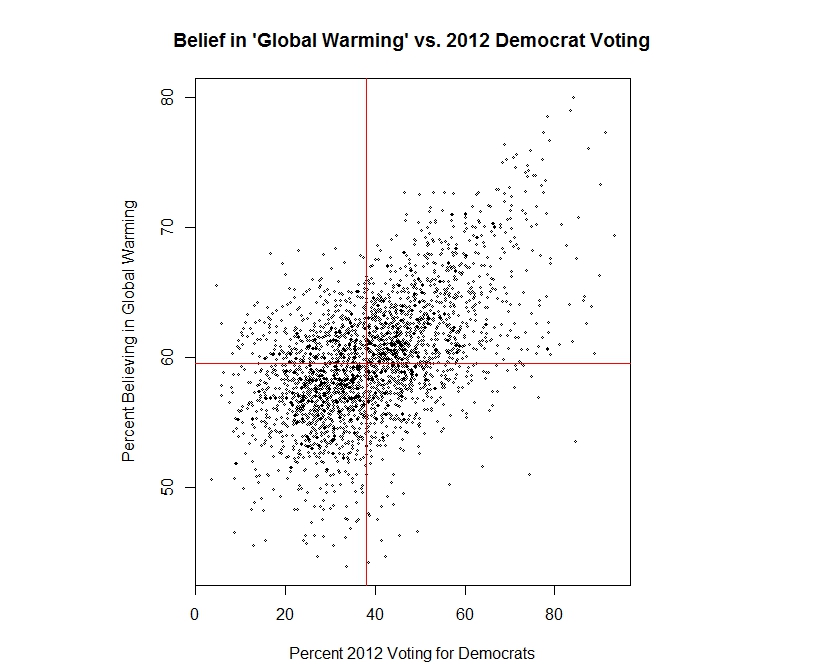
Here is how the cobbled-up beliefs by county fare against the vote for Obama in 2012 (red lines are placed at the medians of the two variables):
https://statpad.files.wordpress.com/2016/12/gwarm_demvote.jpeg

But Kaufmann got his headlines. Anyone care to bet his followup study on political bias won’t happen?
And a personal note, Dr. Kaufmann left a comment on the previous thread that was pretty ugly, and I snipped it it because, well, it played that stupid “smoking causes cancer denial” that the left likes to hurl in the context of climate change, he didn’t give his full name, which is typical for people that throw insults. The email address he used and the IP address check out as being from bu.edu You’d think Kaufmann would stand behind his own words.
In retrospect, I should have let it stand to demonstrate how petty he is. Based on the stat experts that commented, plus my observation of the maps, I think it is safe to say that the Kaufmann study is little more than a statistical mishmash using some very bad assumptions. It should probably be retracted.
You can base your beliefs on the “three blind men and an elephant” parable or you can look through the tattered client science research and temperature history to see if we are warming, cooling, stable or we just can’t figure it out just yet.
rbabcock
Thanks.
I note that you – like me – concede at least a possibility of “we just can’t figure it out just yet.”
Frankly, given the number of variables, I think you are, unquestionably, right.
Straight down the line.
There are a lot of things out there that may – MAY – affect climate (AND weather).
We probably do not have a full list of the factors.
And, even those we can list may not be fully understood. Like, say, CO2 . . . . .
Auto
Yes, but does huffing car exhaust (CO2) cause the belief in global warming?
Don’t know, but it can sure cause you to get a concentrated does of carbon.
And a bad case of CO
You could retain it on this site as an exemplum horrendum, to show that such reasoning from such data actually does exist and has made it into print, in spite of all the reasons not to permit that to happen.
If this paper didn’t address the political angle, then all we have is correlation and not causation. In other words, the paper is incomplete; the conclusion not justified.
dgp
No, but does huffing car exhaust (CO) cause the end of times, for those who partake.
With modern computer controlled fuel injected engines, the CO output is almost negligible. The last emissions test for my V8 SUV showed CO below detectable levels.
Detectable with what?
– A Lab Rat in Waterloo
That’s the rats way of life –
When the first rat lives through the 1st 24 hours the food source is good for the hole bunch.
To have something “click in” your mind seems to be the mantra for theory development these days. “I think so it must be so.”
There’s a good, brief, book by Richard Baggozi, titled Causal Models in Marketing. It’s aimed at anyone who works with social science data, including geo-spatial data. It provides a brief discussion of the different notions of validity, covers measurement, and then talks about structure of path models to test for validity and causality. Implicitly it would be brutally dismissive of anyone who approaches a topic as “it just clicked in my mind.”
I happen to have a couple extra copies, since I’ve been drunk with the author, and he’s very generous with his publisher’s money when he’s in a good mood. I thought I’d send a copy to Kaufman, but then started to believe that the subject matter is beyond his grasp, so maybe I’ll give the extra copy to my 8 year old neighbor who believes that Bill Nye is just a nerd who does crappy experiments.
Happy Holidays everyone, I’m off to build snow forts with a bunch of kids …
Mark
Enjoy.
Not to o o o o o much beer with the forts, and then back for dinner.
Auto
I guess you are outside the High Atlas featured earlier.
But – do enjoy the kids. Giggling is infectious.
I had it on a bus to London Bridge tonight – and several of us guffawed!
I think there is more support from the data that belief in global warming causes bias errors in the recording and treatment of the temperature data itself. Look that the state borders of Colorado and New York, for example, why do man-made boundaries have a significant effect on the temperature data?
“Why might this be? Study coauthor Jacqueline Liederman, BU professor of psychological and brain sciences and director of the University’s Cognitive Neurophysiology Lab, believes it’s because humans are prone to learn from their own experiences.”
Exactly right.We have experienced the coastal “elites” lying to us over and over.
And why shouldn’t “humans” “learn from their own experiences”??? I think the author should have proofread her remarks a little more carefully before publishing this. Or is this the signal that a new kind of medievalism is taking over: our authority over your experience?
Who are you going to believe, me or your lying eyes?
I noticed that too. The authors virtually said: Don’t trust your own experience with the weather/climate. We’re scientists and our computer models know better.
It appears to me that the high number of occurrences of the word “belief” in this paper would make it more suitable for a philosophy, psychology or religious publication.
Believe in Lobal Warming corresponds to liberal population centers.
Need I add… “From the department of Duh!”
Belief… darned autocorrect.
wallensworth
Thanks.
It is belief, pure and simple. No need for science/facts/data.
Again, may be fun – but no facts.
Auto
Oh Yeah, lobal warming from the ‘self thinking forbidden syndrome’:
https://www.google.at/search?client=ms-android-samsung&biw=360&bih=264&ei=o6pcWPDxCcGYgAbW7aTYBw&q=frontal+lobe+damage+&oq=frontal+lobe+damage
Kaufmann has a politically correct position as Professor of Earth and the Environment, which sounds like a sop to pressure groups and/or funders. Why should he not produce something as fundamentally politically correct (and silly) as this study, or my all time favorite, “feminist glaciology”?
The places with the most warming are, by and large, urban due to UHI. Similarly, the places with cooling or no warming tend to be rural.
The places with the most left-wing voters tend to be urban. The places with the most right-wing voters tend to be rural.
We have a spurious correlation between climate and political alignment. The paper is garbage. The warming due to UHI isn’t really enough to notice. Democrats have a well known bias to AGW. That’s what Kaufmann is seeing.
I’m surprised by the “climate change/global warming” results, actually. As a skeptic on AGW/CAGW, I would still have answered the question in Howe, et al in the affirmative. Basically it doesn’t even demand attribution to mankind driving the warming, and only says it “might” continue in the future and “may” cause the climate to change. I can’t think of a more simplistic question designed to elicit a positive response, as it only covers one of the three tenets (is warming, is man-caused, is dangerous).
Looks like a strawman to me, and even so they get widely differing answers. Wonder what the scatter plot would have looked like if they had asked the CAGW question?
Spot on. I can only see myself answering a stupid question like that with questions of my own. “What do you mean by “global warming?” (follow up – “Do you mean human-caused warming?”) would be the first question. Any meaningful answer would come only after the question was sufficiently clear, since I don’t like having words shoved into my mouth.
I can’t tell from the map but demographics plays a really big part. Basically if you are over about 45 you have sufficient memory experience to know that the AGW claims are rubbish. Further you have been through an education system that hadn’t been infiltrated by the AGW mantra.Even in areas that voted republican , the academic institutions and the towns that surround them would be AGW islands. The indoctrination of a generation of students is the biggest hurdle that the climate realists have to overcome.
David S, you hit the nail on the head, It is really hard to listen to the rubbish that my grand children are being taught. We happen to visit them (they live a long way away so we sadly only see them once or twice a year) and the school work we read through was appaling.
Amen (born 1951). I live in the Puget Sound area of Washington state, and to represent that region as being anomalously warm is just laughable. The only aspect that might align is the apparent fact that our winters are less bitter in recent decades (somewhat less freezing and snow), but this could still be an artifact of Urban Heat Island effect.
The reduced snowfall in the Cascades has nothing to do w UHI. And for UHI to be the cause of warmer winters seems highly unlikely given the very low insolation received in the Puget Sound area in the wintertime.
looks to me more like an urban vs rural thing.
if you live in a city of 1M souls, you have pollution, crime and traffic in your face every day and crave the nanny to do something while you tell yourself that sacrifice = civilization.
if you aren’t armpit deep in people you don’t want to know, you haven’t got those problems.
was the data used to calculate the temperature factors based upon the Raw Data recorded at the weather stations or was it based upon the Adjusted (Karlized) data??
____________________________________________
Why ask – Kaufmann’s group can do with ANY data.
In agreement with Dr Richard Tol, who said it much more technically and completely than I ever could, I think (as I commented in the other post on this subject) that the study is shallow, because it does not go deep enough in how people form beliefs about their perceptions of local weather.
If you experience cold weather day after day, and a convincing enough story comes your way day after day saying it’s because of global warming, then you CAN believe that cold means warming.
Unless researchers have a way of gauging HOW people arrive at their judgements (e.g., political leaning, news-media leaning), you have only half an explanation in an incomplete study at best.
It leads me to wonder based on this,
was the data used to calculate the temperature factors based upon the Raw Data recorded at the weather stations or was it based upon the Adjusted (Karlized) data??
The problem with the atheists / believers is, you do not know whether your priest is in a religious crisis while doing the Morning Devotion.
Perhaps he was already appealing for a transfer to a lonesome mountain village.
The citation for the temperature data is from NOAA – I haven’t yet checked, but I strongly suspect they used adjusted data. (How else could they claim that the scientific evidence for warming is “overwhelming”?)
Another strange thing about their map is that, while mirroring political differences, it doesn’t reflect the basic pattern of differences between the part of the country east of the Rockies and the part on the west side. From my limited reading, going back to Rosvold’s 1952 article on the then recent cooling trend, this is the basic distinction when it comes to climate change in the US. Yet in Kaufmann et al’s map, the northeast and the tip of Florida are both red in contrast to the rest of the eastern US.
“I think climate scientists have to step back and rethink…and use very different sorts of evidence to convince people that climate change is real,” he says.
“rethink” as in send more money please.
goes hand in hand with the sanctuary city/county map…..
http://cis.org/sites/cis.org/files/Sanctuary-Cities-Map.png
Aha, here’s another paper waiting to be written! From the looks of it there’s an almost perfect correlation.
Article: “Robert Kaufmann, BU professor of Earth and environment, has shown that local high and low temperatures can influence whether people in the United States believe in global warming. Recent record low temperatures were especially powerful in promoting climate change skepticism.”
I live in one of the hottest parts of the United States and have been a skeptic of human-caused global warming/climate change since the time the switched from global cooling to global warming. The transient weather at my place had nothing to do with it.
Article: “Liederman explains that the research also reflected an effect called “confirmation bias.” Essentially, it isn’t easy for anyone to accept information that goes against entrenched beliefs, so conflicting evidence is ignored.”
Yeah, well, in the case of CAGW there is no conflicting evidence to ignore. The lack of evidence is the problem skeptics have with the CAGW speculation.
This is about as unconvincing a study as any I have seen in a long time.
So many of these sniffy holier-than-thou pronouncements could be as easily applied to the other side, and more often than not, arguably are MORE applicable to the other side. Confirmation bias works both ways, basing ideas on own experiences works both ways…
The definition of confirmation bias used here looks *amazingly* like rational update of beliefs using Bayes’ Rule https://en.wikipedia.org/wiki/Bayesian_inference If you have sufficient evidence for your beliefs, it is irrational to let them be overthrown easily. These people are putting a really *creepy* weight on the Argument from Authority.
Agreed. My skepticism has nothing to do with local weather, and everything to do with the complete lack of any hard science to back up the ridiculous notion of “CO2 drives temperature,” and in particular, “CO2 drives catastrophic increases in temperature,” along with “human fossil fuel burning related CO2 emissions (which are a pittance compared with natural CO2 emissions) drive temperature/drive catastrophic increases in temperature.” Until they have any actual scientific proof, it’s just hypothetical BS.
To me, this map is just crazy. Global Warming would appear to respect City Limits and State Lines.
Kaufmann looks at this map and concludes that amount of warming determines belief in warming. But that doesn’t explain why it follows already existent political bounders.
I look at this map and conclude that the Political Control of an area determines how much global warming is ‘measured’ there.
“Global Warming would appear to respect City Limits and State Lines.”
More importantly, this study shows that homogenization is an invalid approach if parts of the country are warming (more record high temp) while others are cooling (more record cold) which seems to be the conclusion (or preconception?) of Kaufmann’s study. Homogenization assumes trends track over large geographic areas. Since that doesn’t seem to be the case, you can bias site selection one way or another and achieve any trend in any direction that you want.
It’s the scientists whose beliefs are influenced by weather and climate, as seen by the cold scare of the 70’s. Arrhenius and Callendar were exceptional by modern standards in that they thought CO2 warming would be a wonderful thing (as did Roger Revelle according to Arrhenius’s grandson). Singer, on the other hand, was concerned about warming back in 1960 when most were beginning to worry about the cold, and most thought petroleum would run out within a few decades. The wells did not run dry, the grand experiment went on, and the majority of the warming remained in the minds of the modelers. –AGF
http://www.governing.com/gov-data/food-stamp-snap-benefits-enrollment-participation-totals-map.html
https://www.google.at/search?q=percentage+of+people+on+welfare+by+county%2C+graphics&oq=percentage+of+people+on+welfare+by+county%2C+graphics&aqs=chrome
I would like to make a map showing a percentage of people on welfare by county, but I don’t know how.
This is similar to saying that AGW is caused by the invention of the jet engine. Not because of the CO2 output, but because of the UHI effect surrounding airports. Airports have long been the official air temperature of cities large enough to have international airports. Since the invention of the jet engine, air travel has increased along with the larger runways, taxiways, terminals, baggage handling faculties, parking lots, and expressways feeding vehicles into the area. It seems obvious that this would increase the local readings, to push several warm but not record days, into record territory. Those same areas have local news coverage that tends to cover the record temps, but not give the same coverage to cooler than average temps. There you have it. Localized UHI, and the propaganda machine to sell it as the “hottest evah!!”
Interesting. So, perhaps we might learn something by comparing nationwide large airport temps on/around 9/11, when the jets were grounded.
Well, Tucson certainly had a quite coincidental cold front move in – and stick around for several days. Officially, that is…
That time nearly drove me nuts – when you live next to an air base, you become adapted to the normal sounds. (Davis-Monthan AFB is a tactical training base – and those aircraft were grounded, too. I think the only “active” AFBs were those that had interceptor wings assigned.)
Yes, Steve.
The answer roots in
https://www.google.at/search?q=Reagan+flight+controls+tower+staff&oq=Reagan+flight+controls+tower+staff&aqs=chrome
Eh?
Writing Observer, the question was
Steve Fraser on December 22, 2016 at 2:14 pm
Interesting. So, perhaps we might learn something by comparing nationwide large airport temps on/around 9/11, when the jets were grounded.
What part of my answere You don’t understand :
Johann Wundersamer on December 22, 2016 at 11:54 pm
Yes, Steve.
The answer roots in
https://www.google.at/search?q=Reagan+flight+controls+tower+staff&oq=Reagan+flight+controls+tower+staff&aqs=chrome
I see Your Problem, Writing Observer:
You leave it to the Federals.
To the federal Marshalls trained in Israel.
America You’ve got it better.
Cheers – Hans
That was a beautiful day in history.
Agreed. It’s a map of UHI with liberals living in cites where the greatest amount of UHI is experienced. It is also a map of where the most recent drought was experienced (California) Texas had a drought a few years ago and already that has been forgotten with the recent rainy period and cooler weather.
Yup, both “warming” and “record high temperatures” have lots to do with where you put the thermometers, and/or how the locations of the thermometers change over time. Increased urbanization and population, with its related increases in traffic, increases in buildings with their HVAC equipment, increases in areas covered in concrete and asphalt, and the aforementioned increases in idling and take-off blasting jet engines (especially since airports seem to be such popular places for thermometers these days), have more to do with the “warming” and “record highs” than actual changes to the climate do.
Climate begats weather. Would somebody PLEASE smack these stupid c**ts in their s**t filled heads! PLEASE!!!!!!!
Consistent weather and trends produce climate . Many situations can produce weather which is out of the ordinary for that location, it does not mean that is the climate. Siberia can experience temperatures in the 30c range. But it is not a tropical climate. It can snow in Florida, but it is not Alpine or Tundra.
Climate begats weather, stupid. Figure it out. Oh, yea, you believe the stupidity spewed by fakenews-R-us, never mind.