From the EUROPEAN GEOSCIENCES UNION
Antarctic explorers help make discovery — 100 years after their epic adventures

Heroes of Antarctic exploration have played a crucial role in research that suggests the area of sea ice around Antarctica has barely changed in size in 100 years.
Ice observations recorded in the ships’ logbooks of explorers such as the British Captain Robert Scott and Ernest Shackleton and the German Erich von Drygalski have been used to compare where the Antarctic ice edge was during the Heroic Age of Antarctic Exploration (1897-1917) and where satellites show it is today.
The study, published in the European Geosciences Union journal The Cryosphere, suggests Antarctic sea ice is much less sensitive to the effects of climate change than that of the Arctic, which in stark contrast has experienced a dramatic decline during the 20th century.
The research, by climate scientists at the University of Reading, estimates the extent of Antarctic summer sea ice is at most 14% smaller now than during the early 1900s.
Jonathan Day, who led the study, said: “The missions of Scott and Shackleton are remembered in history as heroic failures, yet the data collected by these and other explorers could profoundly change the way we view the ebb and flow of Antarctic sea ice.
“We know that sea ice in the Antarctic has increased slightly over the past 30 years, since satellite observations began. Scientists have been grappling to understand this trend in the context of global warming, but these new findings suggest it may not be anything new.
“If ice levels were as low a century ago as estimated in this research, then a similar increase may have occurred between then and the middle of the century, when previous studies suggest ice levels were far higher.”
The new study published in The Cryosphere is the first to shed light on sea ice extent in the period prior to the 1930s, and suggests the levels in the early 1900s were in fact similar to today, at between 5.3 and 7.4 million square kilometres. Although one region, the Weddell Sea, did have a significantly larger ice cover.
Published estimates suggest Antarctic sea ice extent was significantly higher during the 1950s, before a steep decline returned it to around 6 million square kilometres in recent decades.
The research suggests that the climate of Antarctica may have fluctuated significantly throughout the 20th century, swinging between decades of high ice cover and decades of low ice cover, rather than enduring a steady downward trend.
This study builds on international efforts to recover old weather and climate data from ships’ logbooks. The public can volunteer to rescue more data at oldweather.org.
Day said: “The Southern Ocean is largely a ‘black hole’ as far as historical climate change data is concerned, but future activities planned to recover data from naval and whaling ships will help us to understand past climate variations and what to expect in the future.”
Capt Scott perished along with his team in 1912 after missing out on being the first to reach the South Pole by a matter of weeks, while Shackleton’s ship sank after becoming trapped in ice in 1915 as he and his crew journeyed to attempt the first ever cross-Antarctic trek.
In addition to using ship logbooks from three expeditions led by Scott and two by Shackleton, the researchers used sea-ice records from Belgian, German and French missions, among others. But the team was unable to analyse some logbooks from the Heroic Age period, which have not yet been imaged and digitised. These include the records from the Norwegian Antarctic expedition of 1910-12 lead by Roald Amundsen, the first person to reach both the south and north poles.
###
Here is the link to the paper
What are the probable errors in measurement from historic records? Location measurement in overcast weather used to be very difficult, so determining where the edge of the ice was has some definite error. It is probable that there are statistical tools that can be used to estimate just how reliable the reconstruction is.
Those errors are likely to be smaller than the errors introduced by torturing data into submission.
GISS waterboarding always produces results from inconvenient data and you can take that to the Great Green Blob Bank.
The errors would be quite small. They were in a ship, with chronometers, perhaps a radio to receive time signals that were transmitted at the time they were they.
If the batteries go flat and have to rely upon a ‘rated’ chronometer, then the latitude (distance from the equator) can be obtained from the sextant without time.
They were there for a long time and their measurements would have been as accurate as a small yacht sailor would achieve today using a sextant – within a few miles.
In the very last sentence of this excellent posting is a very common error, the use of “lead” where “led” is intended. One of the pronunciations of “lead” rhymes with “led”, but that is for the metal…..
Ian M
Thank you for your weighty comment.
+ Pb
The work done by these guys is PHENOMENOLOGY, the editor of the journal should forbid the ludicrous attempt to link it to climate models, leave that to the people who deal with those models. How can an abstract of a scientific paper call results “surprising”, what is the algorithm used to determine whether something is surprising? GRRRR, what has happened to science!
The surprise estimation algorithm involves $ to some exponential factor.
The surprise is because they were looking for confirmation of the story that global warming is melting the Antarctic ice. That it has changed very little over a century isn’t what they expected – or probably wanted – to find out. Approaching climate with an open mind just doesn’t happen much now.
Excellent presentation of reality…Why would anyone living North of the Canadian / U.S. border, want anything but MORE warmth/heat during the nasty winter months ( and in Northern Canada, those winter months can get pretty nasty).. I was raised in Blind River, just North of Sudbury, Ontario….I can tell you, when people talk about walking through 5 feet of snow, just to get to school, it is the truth…The walking “uphill both ways” your Grampa told you…Not so definite….
You forgot the broken glass…
…And the bare feet.
In Australia we had to walk under a blazing sun for miles, over plains covered with knife-sharp gibber stones, and with venomous spiders, snakes, and crocodiles lurking behind every tuft of spinifex grass.
Man, you had it easy, RoHa!
Here in Oregon, USA, we had to go to Public School, with 60’s/70’s educated university educated union teachers ….
OK, DonM wins!
Marcus, don’t forget to mention the growing seasons have been at optimal temperatures and no deserts have formed in Canada yet.
Youngsters! Pups, I call them.
Back in the day, going to school was tough. We had to go though 10 feet of snow, *in July*!
It was uphill, *both ways*.
Chased by wolves.
The big kids had to watch out for the little kids, so the wolves would not get them. We would lose one from time to time, anyway.
Mrs. Jones: “what happened to little Sally Smith?”
Big Kid: “Wolves get her, she wasn’t fast enough, nothing we could do”
Mrs. Jones: “Mrs. Smith will be so upset, Sally was her last one.”
Kids These Days
Echoes of the four yorkshire men sketch, 😅
Nowadays children remain children – even into college where they congregate in safe rooms to keep from meltdown under the slightest heat of duress – snowflakes all of them.
True story: I really did have to get up at 4:30 am to catch my 5:00 am bus in 1963 and when daylight savings time happened in Arizona, I protested about getting up at 3:30 am and won my fight so to this day, Arizona doesn’t have daylight savings time.
Er… Marcus. Last time I was there, Blind River was west of Sudbury.
Sorry, sometimes I can’t help being pedantic.
Perhaps climate change has rotated the Canadian Shield? CO2 can do so many amazing things……
The summary above is a bit confusing. The authors seem to be saying that the Antarctic ice extent was greater than today’s by at most 14% BUT that there is evidence that it was still greater in 1930-60:
Our estimate of the change in extent between the Heroic
Age and the present day is small relative to estimates
of the change between the 1950s and 1970s, based on
whale catch data (Cotté and Guinet, 2007; de la Mare,
1997; Titchner and Rayner, 2014). This suggests the
possibility that the sea ice was significantly more extensive
during the period 1931–1961 than during the
Heroic Age.
And between 8000 and 1000 years ago, Antarctica had much less sea ice and ice shelves than today according to these findings:
http://www.abc.net.au/science/articles/2009/08/04/2645375.htm
So – How could this be without anthropogenic greenhouse gases ???
Did you read the last sentence?
“We’re talking about natural processes here,” de Bruyn says, “not the extremely rapid climate change related to human activities, which is likely to be largely detrimental to many or most species.”
@Simon
This is just the usual “submission” sentence under the AGW-zeitgeist which mainstream scientists have to utter in order to get further research grants nowadays…
And: I doubt very much that the warming 8000 years ago was slower than in the second half of the 20th century (if there is any significant 20th century-warming in Antarctica at all) if you look how strong the ice shelves were melted away then compared to today.
And still: How could Antarctica get so warm until 1000 years ago, if CO2 is really the magical control knob of the global climate?
“Did you read the last sentence?”
That last sentence cinched the deal for the $20,000 grant award.
From their conclusion……
“Outside the Weddell Sea, the mean change in ice edge latitude is small ……”
and
“Either way, the climate was much more similar to the present conditions than one might expect based on climate model simulations of the early 19th century (e.g. Turner et al., 2013)”.
Does this not lend weight to the idea that soot is the major culprit in Arctic warming, since soot is much less prevalent in the Antarctic.
No, it lends weight to the fact that you should not assume Arctic ice coverage was constant because you have no data for earlier periods.
There is similar, sparse records showing that Arctic has much less ice in 1930s. The idea that Arctic ice cover was constantly at 1979 levels until AGW kicked in, is nothing more than laughable speculation driven by warmists’ expectations and nothing more.
I’m waiting for someone to comb through the log books of ships that have sailed the Arctic waters.
Rhoda R November 25, 2016 at 2:05 pm
I’m waiting for someone to comb through the log books of ships that have sailed the Arctic waters.
It’s been done.
http://seaice.alaska.edu/gi/data/whaleshipdata
https://polarbearscience.com/2016/10/14/new-ecology-book-25-myths-that-are-destroying-the-environment/
Why has the Arctic ice been affected far more than the Antarctic?
This Solar Gloom effect of particulate carbon and sulphates reduces solar energy reaching the Earth’s surface. The West’s Clean Air Acts and Anti-Acid Rain provisions from the 1950’s to the 80’s-90’s reduced this effect and thus generated temperature increases. The Developing World’s follow-on massive increase in such emissions in the 90’s to the present reversed this trend and led to the recorded flattening out of temperature rises. Hansen, himself, used this Solar Gloom effect to explain the recent flattening of temperature rises, apparently forgetting that this effects must have similarly induced the earlier false temperature rises in the 2nd half of the 2oth century!
Virtually all these Solar Gloom effects are in the Northern Hemisphere and are not self sustaining as these emission materials settle out or otherwise disperse. The far more populated, developed and industrial Northern hemisphere also has excessively more man-made heat generation than the Southern Hemisphere. Do these effects on temperature largely only effect the Northern hemisphere and hence mainly affect the Arctic and not the Antarctic?
By contrast CO2 emissions entering the atmosphere are far more self sustaining, particularly as recorded de-forestation reduces absorption of CO2; any CO2 “causation” of temperature rises thus remains relatively stable in place and balances globally, equally affecting both the Arctic and Antarctic.
The main reason for the difference is the ocean currents and winds.
The Supplement (large 60 Mb download) has terrific videos showing the expansion and contraction of the ice over the years of the various expeditions–particularly good 3-year record of Shackleton’s Endurance. In that case the expansion is out to 56 S and the contraction goes to 64-72 S.
Some where I read about the issues of the island of Tau going solar, anyone have a link?
http://www.theverge.com/2016/11/22/13712750/tesla-microgrid-tau-samoa
well if the island of Tao wants to live up to its name, it needs to go solar and lunar. Just going solar is far too Yang. 😉
where does this little rider about the Arctic come from? I don’t see any mention of Arctic voyages being studied here.
There was a notable decline between 1997 and 2007 but the data in HadISST database showing perfectly unchanging ice cover before that is laughable.
So there is no “stark contrast” except in the eye of media studies student who wrote the press release. There may be a contrast in that they have found some records for early 20th c. Antarctica where as we do not have a comparable study for the Arctic.
Now someone needs to do some similar work for the Arctic to replace the fictional Arctic data currently present in HadISST showing a mythic constancy before the satellite period.
Well there’s one paper that claims we’ll be seeing Antarctic increasing with warming for several decades. Surprised Mosh hasn’t arrive yet to single that one paper out and claim that these observations are “consistent with global warming theory.”
For the sake of reference, here’s the 2012 WUWT post for the discovery of maps documenting the late 1930’s sea ice lows in the ARCTIC.
https://wattsupwiththat.com/2012/05/02/cache-of-historical-arctic-sea-ice-maps-discovered/
At this point in time, globally sea ice is in serious trouble. There is no denying it….
https://www.bostonglobe.com/opinion/columns/2016/11/22/one-chart-captures-alarming-decline-sea-ice/ndn2lcr80WxKfetCfbzDsI/story.html
The Boston Globe opinion page! Man you sure got us there. Not. What drivel. How can sea ice be “in serious trouble”? That’s just nonsense anthropomorphism designed to promote an emotional response. Since all our good data starts at 1979, and climatic responses are slow moving (tens to hundreds of years), how can you tell what’s really happening with sea ice? For all you know, you are just looking at a small slice of a sine wave on it’s way down.
I guess some people just feel the need to panic.
The boston globe is full of s hit
Paul Penrose
So the graph is wrong is it? Simple question. So the graph is an opinion is it? Simple question. I kept them simple for a reason.
Even worse, the author is Bill the weepster McKibben, professional Alarmist, with zero science knowledge or credibility.
Bruce Cobb
And your credentials are???? And again what part of the graph do you dispute? Arctic and Antarctic sea ice are extremely low. Temps in the arctic are at historic highs( for time of year) so the graph is pretty much expected. So again what part of it do you dispute?
“I am surprised though that the graph has not been the subject of an article.”
Perhaps there is a reason it is not. This is serious stuff.
This graph is so far off from the usual range of values at the moment that I’m rather sure it must be because of some sort of instrumental or methodical artefact. But let’s wait and see. I guess we will hear more of it soon…
This is serious stuff………….why?
This is a comment on a post that says we just discovered something new we didn’t know before.
..in other words….we can’t claim “history” squat
Since IPCC CMIP3 models got Polar Amplification so wrong, the modelers tweaked CMIP5 models to further heat the Arctic (even then, though, not enough). Sadly, those tweaks resulted in other regional metrics being even further off.
IPCC climate models are bunk.
Forrest Gardener
“Simon, my money is on instrumental error or the recent change in calculation method.”
Can I suggest you money is on instrumental error because you just don’t want to believe the reality. It’s been 20c warmer than average in some places up there. Take a look at the temp graph on Nick Stokes page
https://moyhu.blogspot.co.nz/p/latest-ice-and-temperature-data.html#NCAR
It’s cooled a bit lately but still bizarrely warm. There is no error, this is real…..
Latitude November 25, 2016 at 2:32 pm
This is serious stuff………….why?
I am not going to bother wasting my time. This is why the “D” word is the only accurate description for people like you. You would deny there was a problem if the walls were melting around you.
…can’t explain why it’s serious stuff huh?
Why is it a problem Simon…when no one knows the history
Simon, please read essay Northwest Passage in ebook Blowing Smoke. It contains hostorical information about Arctic sea ice, as well as issues concerning its more recent satellite measurement, that may provide you a new perspective. Relying on a graph in an opinion piece by McKibbon is probably not the best path to true understanding.
Simon November 25, 2016 at 2:42 pm
Starting in 1942 the United States and Canada were shipping Lend lease to the USSR. Soviet flagged ships would go via US west coast to Vladivostok Than through the arctic to Murmansk. Safer route no PQ-17s.
Yes some of the cargo was of loaded and shipped by rail but the Trans-Siberian was very limited in capacity and the Russians were loathed to over load it due to lack of maintenance. (Steel going to T-34s etc)
If you dig you will find the route was open and hundreds of ships used it on a regular basis.
I have seen telegraph communications discussing the route between President Roosevelt and J. Stalin.
Well could we duplicate volume and scale of shipping in the ice cover today,, without ice breakers?
Less ice then,
The link is something I hit on in a minute search.
Read more history less climate stuff you will be less gullible.
http://lend-lease.airforce.ru/english/articles/paperno/
michael
Forrest, it is my relatively educated OPINION that past Arctic ice changes (both up and down) reflect long-term minor warming from the Little Ice Age minimum, plus multi-decade variations in our climate system of undetermined origins.
There SEEMS to be approximate 60 to 70-year climactic cycles associated with osculations in both the Pacific (PDO) and North Atlantic (AMO) oceans of undetermined origins.
There MAY be AGW associated with CO2 production, land use, etc.
Climate, through the water cycle, APPEARS to self-regulate in a fairly narrow range.
IPCC climate models have PROVEN to be bunk.
There is OBVIOUSLY no reason to change our society, economy nor energy systems at great cost over fear of CAGW.
Michael…1942 was the height of the AMO…just like it is now
Latitude November 25, 2016 at 7:01 pm
Michael…1942 was the height of the AMO…just like it is now
Okay but again could we using same tech do it. All it proves is nothing new.
michael
exactly it’s nothing new at all…but it’s toss up with wind blown floating ice, depending on which way the wind blows
But I would bet with you…no, we couldn’t do that again right now
That’s what I was pointing out….the AMO was at it’s peak, just like it is now
Atlantic current goes right into the NWP, that’s what melts it…..it’s 90% under water
Latitude November 25, 2016 at 7:01 pm
Michael…1942 was the height of the AMO…just like it is now
Sorry, I study history ,military. I know the AMO changes. I thought we were at the height of the warm point.
Are you pointing out that history has repeated itself? I am of the mind it is still not as warm as the early 1940s.
The USSR received 90% of its aviation from the U.S. it passed through this route. It had to be open enough of the time to meet the changing demands.
At first I interpreted you as disagreeing with me.
Am I misunderstanding you?
sorry should have waited
michael 🙂
Latitude November 25, 2016 at 7:42 pm
oops aviation fuel same as we gave the Brits. 99% octane
Really, Forrest? The last few squiggles on the ice graph?
In that case we are discussing the Siberian high; weather, not climate.
Simon November 25, 2016 at 2:42 pm
“I am not going to bother wasting my time. This is why the “D” word is the only accurate description for people like you. You would deny there was a problem if the walls were melting around you.”
Interesting analog Simon, are you curious as to what the one is that is applicable to you. It is the person who smells cigarette smoke on the person next to them and proceeds to hysterically scream fire.
take a long look in the mirror before you say such things again.
michael
That graph is based on bad data. If you look at the cryosphere website at
http://arctic.atmos.uiuc.edu/cryosphere/
you will see this comment:
OTOH if you look at the National Ice and Snow Data Center, you see this graph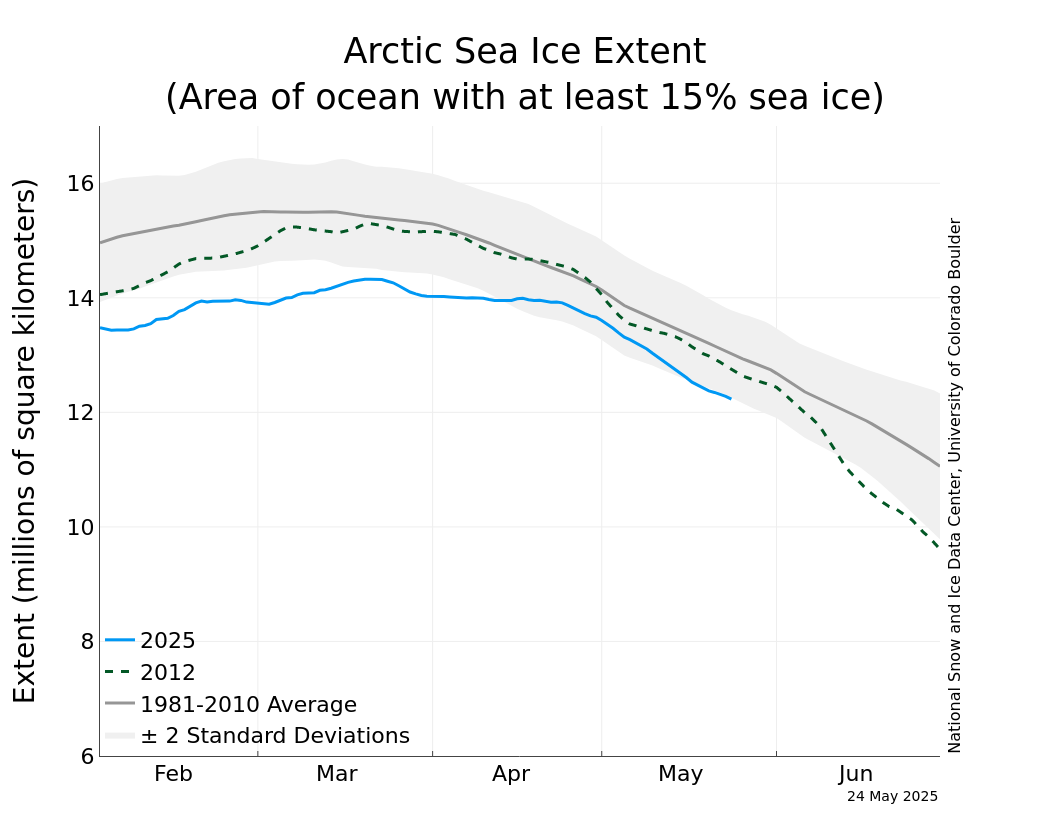
Showing 2016 Arctic ice being low, but nothing as dramatic as the cryosphere one.
Anyone abstracting and publishing data from a source that specifically says “SPURIOUS DATA” can be called many things, but “scientist” is not one of them…………”climate scientist” would be one of the more appropriate labels, perhaps.
The cryosphere data as is well known to all with an interest in arctic sea ice is broken and has been for months…
The NSIDC shows actual data from a working satellite – showing sea ice at its lowest for the 37 year satellite record it represents…
A concerning and unusual condition – more background here:
https://www.scientificamerican.com/article/the-arctic-is-seriously-weird-right-now/
I’m wondering why so many people here are one more time supposing, guessing, pretending and claiming such a bunch of nonsense about a simple graph, with spurious insinuations à la “… from tipping points to instrument failures and a recent change in the calculation method”.
A simple graph whose plots after all are nothing else than yearly sums over Arctic and Antarctic sea ice extents. Oh my…
Frenchies love to say: “Le sceptique doute de tout, et donc ne se doute de rien”.
And – “Accounts From 19th-Century Canadian Arctic Explorers’ Logs Reflect Present Climate Conditions”
http://www.thegwpf.com/accounts-from-19th-century-canadian-arctic-explorers-logs-reflect-present-climate-conditions/
“We know that sea ice in the Antarctic has increased slightly over the past 30 years, since satellite observations began. Scientists have been grappling to understand this trend in the context of global warming”. But there has been no global warming, so nothing to grapple with. Anyway, global warming is a meaningless concept; it would be Antarctic warming that they should grapple with.
“But the team was unable to analyse some logbooks from the Heroic Age period, which have not yet been imaged and digitised. These include the records from the Norwegian Antarctic expedition of 1910-12 lead by Roald Amundsen, the first person to reach both the south and north poles.”
There is also no data from the Filchner and Nordenskiöld expeditions, which were both to the Weddell sea area, where they complain about the lack of data. And Filchners book on the expedition (with detailed information on ice conditions) is even available online! Just Google: “Zum sechsten Erdteil die zweite deutsche Südpolar-Expedition”. Clearly a case of “if-it-isn’t-in-english-it-doesn’t-exist”.
And of course there is no data from the Japanese Hirase expedition, or the several Argentinian and Chilean ventures in the same time-frame…
Unable to read until digitized? Hell, give me the log books and I’ll read them to these guys.
“tty November 25, 2016 at 12:47 pm
“But the team was unable to analyse some logbooks from the Heroic Age period, which have not yet been imaged and digitised.”
And therein lies the problem with modern science. Nothing can be done until logbooks (Or any book or non-electronic records for that matter on the subject) is digitised, meaning you won’t ever get to see the original logbooks etc, EVAH! You will only get to see the “adjusted” data/records.
The British Royal Navy have sea and ocean records dating back hundreds or years, but the general public does not have free access to that information.
Which suggests that sea ice extent is not necessarily a reliable proxy for temperature:
Oops, I was commenting on this statement:
“Published estimates suggest Antarctic sea ice extent was significantly higher during the 1950s, before a steep decline returned it to around 6 million square kilometres in recent decades …”.
I dont think the arctic has been on a continuous downward slope for all the 20th Century. Has it?
No. It declined considerably in the 30’s into the 40’s, then recovered. Arctic ice is a cherry picker’s delight for the Alarmists.
Correct. The first one season transit of the Northwest Passage was Larsen in 1944. And sailed a route considerablly further north than Northabout this past summer.
It declined considerably in the 30’s into the 40’s, then recovered
===
The first one season transit of the Northwest Passage was Larsen in 1944
====
Just like the AMO is doing now….
http://static.rms.com/email/images/blog-mtr-monthlyamoindexvalues.jpg
But it has now declined below the lowest point of the 30s and 40s and is still going down.
Judith curry’s series on historical sea ice clearly shows the lowest 40s figure was over the 2007 level and we are currently seeing years below or at 2007 level…
Ristvan there can be no comparison between any transit of the NW passage since 2000 and any before.
Now the NW passage is nearly annually open to any class of ship without ice breaker assistance. Like that huge cruise liner this year.
That simply was not the case in any years before the millennium.
We never before saw multiple years in a decade with completely free passage
Pure speculation, but is there any relationship between the AMO peaking over the last decade and the Arctic ice extent bottoming out (flat) over the same period?
http://www.asp.ucar.edu/colloquium/2000/Lectures/holland12.jpg
Latitude, Bob Tisdale does some great work:

https://bobtisdale.wordpress.com/2015/05/29/new-paper-confirms-the-drivers-of-and-processes-behind-the-atlantic-multidecadal-oscillation/
For example:
And:
As I keep suggesting to Simon, give it a few years. [Before you allow the IPCC to fundamentally alter our society, economy and energy use patterns at a cost of trillions.]
yep……90% of it is under water…..that controls thickness….which controls melt…which controls multi-year ice
…which controls extent/area in the next years….
wash, rinse, repeat
Pure speculation, but is there any relationship between the AMO peaking over the last decade and the Arctic ice extent bottoming out (flat) over the same period?
===
Dave, put this post:
https://wattsupwiththat.com/2012/05/02/cache-of-historical-arctic-sea-ice-maps-discovered/
Together with this graph:
https://en.wikipedia.org/wiki/Atlantic_multidecadal_oscillation#/media/File:Amo_timeseries_1856-present.svg
Together with when ships historically went through the NWP….
…and I think the problem is solved
I dont think the arctic has been on a continuous downward slope for all the 20th Century. Has it?
Nobody has ever pretended such a nonsense.
But some ‘skeptics’ manifestly love to pretend some so called ‘alarmists’ would have 🙂
No reference to the American Wilkes expedition?
http://www.south-pole.com/p0000079.htm
Hey, thanks for arousing my curiosity! That’s quite a story.
That was much earlier.
Can someone come up with the 1922 report on conditions in the arctic?
Ian M
I illustrated the August 1921 DMI Arctic ice extent map in essay Northwest Passage. And compared to DMI August 1938. 1921 plainly greater sea ice extent. You can go get August 1922 yourself from DMI. Or just get the essay in ebook Blowing Smoke. DMI maps were compuled from seasonal fishing/whaling logs. More accurate on the Atlantic than Pacific sides of the Arctic for obvious reasons.
The Antarctic sea ice has a huge sink of relative cold up its butt. It will take more than a few degrees over a few centuries to change that.
At least you can see ice. Lots of other hard to document history has been easy to ignore. One exception, extensive study from logbooks (based on dissertation, wow!) below.
Jonkers, A. R. T. 2003. Earth’s Magnetism in the Age of Sail. Johns Hopkins University, Press. Baltimore. 300pp.
Jonkers, A. R. T., A. Jackson and A. Murray 2003. Four centuries of Geomagnetic Data From Historical Records. Reviews Geophysics. 41(2), 1006, doi:10.1029/2002RG000115.
For those who are interested here is a video of the Mawson expedition at Commonwealth bay in 1912. Note the clear water in much of the video. This area was choked with ice when the “Ship of fools” was stuck just a few years ago. At the end of this video you can see Sir Douglas Mawson walking on the shore.
IIRC, Gore was going to mount an expedition to this region to show how global warming was melting all the sea ice. I think someone must have shown him this video.
For Simon:
Scroll down to the article from 4 April 1923.
It says – “with hitherto unheard of high temperatures”.
So you have posted nothing new. Al happened before.
http://realclimatescience.com/ice-free-arctic-forecasts/
For Simon:
Scroll down to the article from 4 April 1923.
It says – “with hitherto unheard of high temperatures”.
So you have posted nothing new. All happened before.
Oh so there have been high temperatures before. Well there you go, all sorted,who would have thought? Everyone can go home……Except if you are going to take your lead from a site like that you have no hope of ever getting the real picture. Try this Ted talk. By a guy who actually studies the arctic and has for 30 years.
Looks like this guy is drinking the CO2 Koolaid. Maybe he should read the book I just read Seductive Poison by Deborah Layton.
J. Philip Peterson November 26, 2016 at 6:22 pm
“Looks like this guy is drinking the CO2 Koolaid. Maybe he should read the book I just read Seductive Poison by Deborah Layton.”
Or….. maybe you should listen to what he has to says, so we can have an intelligent conversation.
I quote: “Antarctic sea ice is much less sensitive to the effects of climate change than that of the Arctic, which in stark contrast has experienced a dramatic decline during the 20th century.”
Another case of non-readers publishing nonsense. Had you bothered to read my article on the Arctic in E&E in 2011 you would know it is not a dramatic decline of Arctic ice but a dramatic redirection of the Gulf Stream directly into the Arctic Ocean that causes it. Direct measurement of Atlantic water flowing into the Arctic Ocean in 2011 verified that the water temperature entering the Arctic there exceeds any previous known temperature values. At the turn of the twentieth century there was a rearrangement of the North Atlantic current system that caused the Gulf Stream that was going north parallel to the East Coast to start flowing more directly into the Arctic. tHIS This caused the reduction of the summer ice cover that is still going on. It was interrupted for thirty years in themiddle of vthe century when the previous current flow briefly returnede but the warm currents returned about 1970 and are still active. Eventually a balance of current temperatures will bev achieved but we are not therev yet. All measurements of Arctic temperature go back no more tyhan the middle seventies with the result that all these Arctic “exp[erts” have no idea what happened vbefore. They should know that for two thousand years before the turn of the twentieth century nothing much happened except for a slow, secular cooling. If this source of warm water could be removed the Arctic and the Antarctic would reach the same temperature again.
Wow.
I really can’t remember even one comment by Arno Arrak which didn’t start with
Another case of non-readers publishing nonsense. Had you bothered to read my article on … you would know it is not a … but a … that causes it.
Amazing! Merci, Monsieur le Professeur.