OAK RIDGE, Tenn.,—In a new twist to waste-to-fuel technology, scientists at the Department of Energy’s Oak Ridge National Laboratory have developed an electrochemical process that uses tiny spikes of carbon and copper to turn carbon dioxide, a greenhouse gas, into ethanol. Their finding, which involves nanofabrication and catalysis science, was serendipitous. Video follows.
“We discovered somewhat by accident that this material worked,” said ORNL’s Adam Rondinone, lead author of the team’s study published in ChemistrySelect. “We were trying to study the first step of a proposed reaction when we realized that the catalyst was doing the entire reaction on its own.”
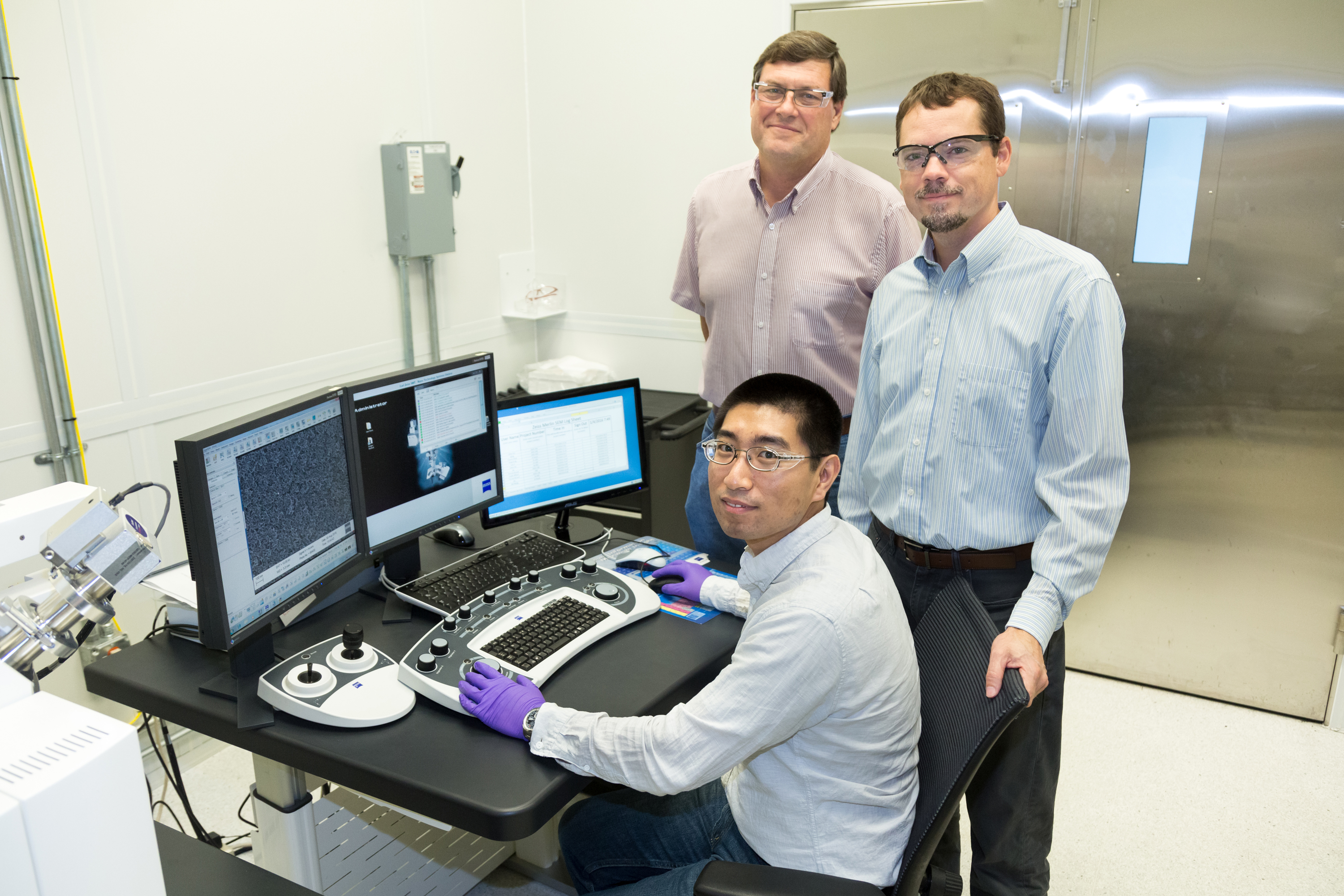
The team used a catalyst made of carbon, copper and nitrogen and applied voltage to trigger a complicated chemical reaction that essentially reverses the combustion process. With the help of the nanotechnology-based catalyst which contains multiple reaction sites, the solution of carbon dioxide dissolved in water turned into ethanol with a yield of 63 percent. Typically, this type of electrochemical reaction results in a mix of several different products in small amounts.

“We’re taking carbon dioxide, a waste product of combustion, and we’re pushing that combustion reaction backwards with very high selectivity to a useful fuel,” Rondinone said. “Ethanol was a surprise — it’s extremely difficult to go straight from carbon dioxide to ethanol with a single catalyst.”
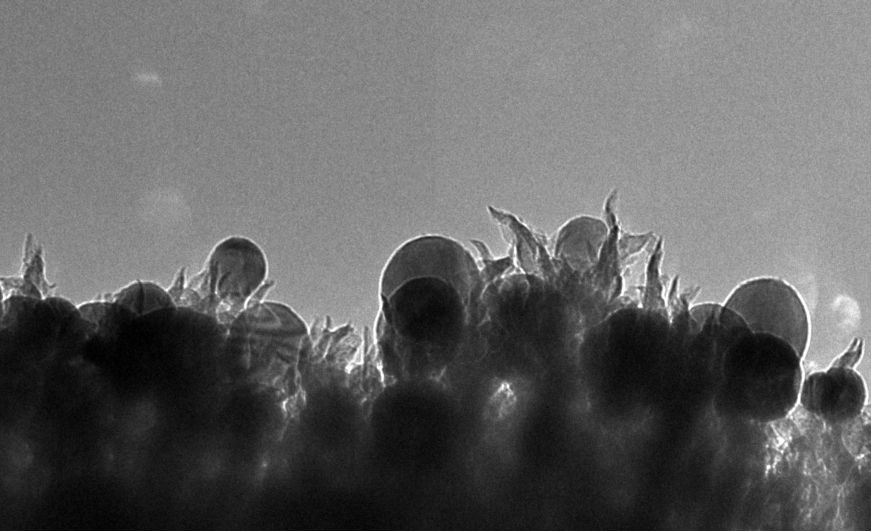
The catalyst’s novelty lies in its nanoscale structure, consisting of copper nanoparticles embedded in carbon spikes. This nano-texturing approach avoids the use of expensive or rare metals such as platinum that limit the economic viability of many catalysts.
“By using common materials, but arranging them with nanotechnology, we figured out how to limit the side reactions and end up with the one thing that we want,” Rondinone said.
The researchers’ initial analysis suggests that the spiky textured surface of the catalysts provides ample reactive sites to facilitate the carbon dioxide-to-ethanol conversion.
“They are like 50-nanometer lightning rods that concentrate electrochemical reactivity at the tip of the spike,” Rondinone said.
Given the technique’s reliance on low-cost materials and an ability to operate at room temperature in water, the researchers believe the approach could be scaled up for industrially relevant applications. For instance, the process could be used to store excess electricity generated from variable power sources such as wind and solar.
“A process like this would allow you to consume extra electricity when it’s available to make and store as ethanol,” Rondinone said. “This could help to balance a grid supplied by intermittent renewable sources.”
The researchers plan to refine their approach to improve the overall production rate and further study the catalyst’s properties and behavior.
ORNL’s Yang Song, Rui Peng, Dale Hensley, Peter Bonnesen, Liangbo Liang, Zili Wu, Harry Meyer III, Miaofang Chi, Cheng Ma, Bobby Sumpter and Adam Rondinone are coauthors on the study, which is published as “High-Selectivity Electrochemical Conversion of CO2 to Ethanol using a Copper Nanoparticle/N-Doped Graphene Electrode.”
The work was supported by DOE’s Office of Science and used resources at the ORNL’s Center for Nanophase Materials Sciences, which is a DOE Office of Science User Facility.
So how much energy is lost from the system to turn CO2 into ethanol. I mean how much after you burn the ethanol as auto fuel oxygenate ??
Somewhere behind a curtain, there must be some undisclosed source of energy being surreptitiously introduced to this serendipitous chemistry.
G
It this can be scaled up, it could be a huge benefit to the power grid and the US economy in a relatively short period of time! Oil industry won’t be too pleased.
A little bit of orange flavoring to divert it from the fuel tank, perhaps?
It would appear that the relevant word in this process is electrochemistry–i.e. it is using electricity to produce a chemical reaction. How much power? How much relative to current batteries if one is using the ethanol as energy storage?
It sounds like something for nothing. Which makes me skeptical that thus is legit.
If the energy lost is less than battery storage, this could be a positive development. It would mean more oil for cars (yay!), until we get below 150 ppm in CO2 and all the plants die.
Very interesting, of course everything depends on this scaling up from a laboratory curiosity to industrial quantities, a lot of things look good at first blush but don’t pan out well. Still there is no obvious show-stoppers so maybe this will be the disruptive technology that’ll shut up the whiny greens without cause 5 billion people to starve.
You beat me to it george e. smith. Until they repeal the Laws of Thermodynamics and let us build a perpetual motion machine it ain’t gonna work! I think that’s what William Yarber is saying too?!
MM
If this was scalable, it would essentially turn ethanol into a fuel cell.
Here in Alberta, where a lot of our electricity comes from coal, this could allow us to run our cars on coal power…(Coal>>electricity>>Ethanol>>car)
In physics, chemistry and life—
TANSTAAFL
It’s not something for nothing – as Tom Halla above points out, electricity is consumed. What is critical to the viability of this process is how much. I would imagine it is more that the ethanol produced could generate!
In theory, it would help solve the problem of storeage, making renewables more grid-friendly. However, it wouldn’t solve the cost issue. And yes, a bit Rube Goldbergian. Greenies will go for it, though.
I remain skeptical. Has this been replicated? What are the energy costs for this conversion?
Anyone else remember “Cold Fusion”?
Since there are no free lunches, it’s a safe bet that the process consumes more energy than is in the ethanol being generated.
I’m impressed that the article doesn’t make claims that this technology could be used by fossil fuel power plants on engines to convert their waste CO2, since that would require more energy then you’d get from burning the fuel in the first place.
As a means of storing energy from intermittent sources it has potential. But it depends on how much energy is lost in the process. Wind and solar are already more expensive then fossil fuels on a per Mw/h bases, losing half the energy produced converting it to ethanol and back won’t make it any cheaper.
maybe a better use for this technology would be a way to produce high energy fuels for transportation with Nuclear Power. Hell, it would even be ‘Green’.
Guys, you are missing the big picture – world economic meltdown!
BATF will remove the “A” from its name, Beer companies and distilleries will go bankrupt along with bars, etc. Total chaos, dogs and cats living together, Amazon delivery of DYI kits , just add water, flip the switch and the local power becomes your liqour store @ur momisugly ~$1 /gal.
The workers paradise realized. I can sleep easy now. Isn’t science wonderful?
It’s awesome. We burn more fossil fuel to make CO2 to make ethanol. Sweet. How long before lefty starts harping about “endangered copper” ? 🙂
“A process like this would allow you to consume extra electricity when it’s available to make and store as ethanol,”
The same can be said about the electrolysis of water and fuel cells, especially if the low voltage, high current DC generated by solar cells is used directly for the electrolysis. I also like the idea of using Aluminium as the storage mechanism which is also produced with low voltage, high current DC and then the energy can be released in a thermite reactor (the other ingredient, rust, is omnipresent). Aluminium is also the safest way to store and transport stored energy (until you turn it into the Aluminium dust required for the thermite reactor).
I’ve been predicting that the eventuality of CO2 to Ethanol conversion will make the generation of atmospheric CO2 the worlds top priority so that we don’t run out and crash agriculture, which will also be an issue when the next, inevitable ice age arrives.
How about this for the next gen cogen facility:
Located out in the middle of a desert, the plant will use DC solar power to directly electrolyze water, produce Aluminium and produce Ethanol from atmospheric CO2, all of which are processes that require low voltage, high current DC. The H2 and Ethanol reacts with atmospheric O2 in fuel cells to produce electricity. A thermite reactor produces heat from Al and Fe2O3 to run a turbine generator and produces molten iron and Al2O3 as its waste products. The O2 generated by the electrolysis of water is used to efficiently convert the iron back into rust to fuel the reactor along with the Al produced from solar input as the Al2O3 produced by the thermite reaction becomes the input to the Al electrolysis cells. Another low voltage, high current DC process is the production of silicon wafers which can be utilized to create the solar cells the plant uses to produce the electricity powering the electrolytic processes.
The basic idea is for a self replicating power plant that uses solar energy to produce fuel and which produces electricity from that fuel. The only inputs the plant requires is water, Al2O3 and Fe2O3,although most of the reactants are recycled through the fuel cells and thermite reactor. With a continuing supply of Fe2O3 and Al2O3, the plant can also be a net producer of Al and Fe.
The headline possibilites for this story are endless.
The person interviewed in the video says that > 60% of the electricity used is converted into Ethanol by the catalyst. Unfortunately, nothing was said about total power consumption. I’m curious about the possibility of using this process to replace corn-based Ethanol production. That’s a big waste of many resources.
Stop the conversion process before all the dissolved CO2 is consumed, and hops and sell it as
Power Plant Pilsner? Market it to the ecological aware crowd.
Fossil fuel powered electrical generating plants are generally owned by utilities which have severely limited profits. This might be extremely interesting as a side revenue generator ( Ah excuse the pun)
A perpetual motion machine. Finally. ……. should I put a sarc tag here?
It’s a pretty cool engineering feat, but how does this make ethanol any less destructive of the engines in which it’s used as a fuel–whether to power cars or to reconvert into electricity?
Eric Hines
It is interesting with this new developments, but why is it always packed with this:
” For instance, the process could be used to store excess electricity generated from variable power sources such as wind and solar.
“A process like this would allow you to consume extra electricity when it’s available to make and store as ethanol,” Rondinone said. “This could help to balance a grid supplied by intermittent renewable sources.”
The essential is to make ethanol from CO2 and water with electricity, all the other could be to hide a really bad effectivity by greenwashing. Tell about the power needed to make ethanol. How many kWh is needed to make 1kWh of ethanol combustion energy, then we can talk again.
I could find many uses of that excess electricity to save some gas burning in my boiler, and without making it to ethanol first. I might also use ethanol to other uses than heat, but that’s an other story.