From the fear and self-loathing in Capetown department, Josh had this take on it awhile back.

Phys.org reports:
The Anthropocene, or “new age of man,” would start from the mid-20th century if their recommendation—submitted Monday to the International Geological Congress in Cape Town, South Africa—is adopted.
That approval process is likely to take at least two years and requires ratification by three other academic bodies.
But after seven years of deliberation, the 35-strong Working Group has unanimously recognised the Anthropocene as a reality, and voted 30-to-three (with two abstentions) for the transition to be officially registered.
“Our working model is that the optimal boundary is the mid-20th century,” said Jan Zalasiewicz, a geologist at the University of Leicester.
“If adopted—and we’re a long way from that—the Holocene would finish and the Anthropocene would formally be held to have begun.”
Scientists refer to the period starting from 1950 as the “Great Acceleration”, and a glance at graphs tracking a number of chemical and socio-economic changes make it obvious why.
Read more at: http://phys.org/news/2016-08-anthropocene-scientists.html#jCp
From the Times:
The Working Group on the Anthropocene (AWG), which is meeting in Cape Town this week, is proposing that the starting date for the new epoch should be set for around 1950.
The group’s committee of 35 members voted by a majority of 20 to recognise the new time division as an epoch, rather than the lower ranked age, such as a subdivision of the Holocene, or a higher ranked period like the Jurassic or Cretaceous.
The search is now on to find what geologists call a “golden spike”, a physical reference point that can be dated and taken as a representative starting point for the Anthropocene epoch.
A river bed in Scotland, for example, is taken to be the representative starting point for the Holocene epoch.
Prof Jan Zalasiewicz, a palaeobiologist at the University of Leicester and a member of the working group, said carbon and nitrogen levels in the atmosphere had remained reasonably steady before the “great acceleration” of the 20th Century.
“Human action has certainly left traces on the earth for thousands of years, if you know where to look,” he said.
“The difference between that and what has happened in the last century or so is that the impact is global and taking place at pretty much the same time across the whole Earth.
“It is affecting the functioning of the whole earth system.”
The concept of an Anthropocene epoch was first proposed by Nobel-prize winning chemist Paul Crutzen and colleague Eugene Stoermer in 2000.
This week’s AWG vote is scientific endorsement that the epoch is geologically real and of a sufficient scale to be considered for formal adoption as part of the International Chronostratigraphic Chart.
More here
From their website:
What is the ‘Anthropocene’? – current definition and status
- The ‘Anthropocene’ is a term widely used since its coining by Paul Crutzen and Eugene Stoermer in 2000 to denote the present time interval, in which many geologically significant conditions and processes are profoundly altered by human activities. These include changes in: erosion and sediment transport associated with a variety of anthropogenic processes, including colonisation, agriculture, urbanisation and global warming. the chemical composition of the atmosphere, oceans and soils, with significant anthropogenic perturbations of the cycles of elements such as carbon, nitrogen, phosphorus and various metals. environmental conditions generated by these perturbations; these include global warming, ocean acidification and spreading oceanic ‘dead zones’. the biosphere both on land and in the sea, as a result of habitat loss, predation, species invasions and the physical and chemical changes noted above.
- The ‘Anthropocene’ is not a formally defined geological unit within the Geological Time Scale. A proposal to formalise the ‘Anthropocene’ is being developed by the ‘Anthropocene’ Working Group for consideration by the International Commission on Stratigraphy, with a current target date of 2016. Care should be taken to distinguish the concept of an ‘Anthropocene‘ from the previously used term Anthropogene (cf. below**).
- The ‘Anthropocene’ is currently being considered by the Working Group as a potential geological epoch, i.e. at the same hierarchical level as the Pleistocene and Holocene epochs, with the implication that it is within the Quaternary Period, but that the Holocene has terminated. It might, alternatively, also be considered at a lower (Age) hierarchical level; that would imply it is a subdivision of the ongoing Holocene Epoch.
- Broadly, to be accepted as a formal term the ‘Anthropocene’ needs to be (a) scientifically justified (i.e. the ‘geological signal’ currently being produced in strata now forming must be sufficiently large, clear and distinctive) and (b) useful as a formal term to the scientific community. In terms of (b), the currently informal term ‘Anthropocene’ has already proven to be very useful to the global change research community and thus will continue to be used, but it remains to be determined whether formalisation within the Geological Time Scale would make it more useful or broaden its usefulness to other scientific communities, such as the geological community.
- The beginning of the ‘Anthropocene’ is most generally considered to be at c. 1800 CE, around the beginning of the Industrial Revolution in Europe (Crutzen’s original suggestion); other potential candidates for time boundaries have been suggested, at both earlier dates (within or even before the Holocene) or later (e.g. at the start of the nuclear age). A formal ‘Anthropocene‘ might be defined either with reference to a particular point within a stratal section, that is, a Global Stratigraphic Section and Point (GSSP), colloquially known as a ‘golden spike; or, by a designated time boundary (a Global Standard Stratigraphic Age).
- The ‘Anthropocene’ has emerged as a popular scientific term used by scientists, the scientifically engaged public and the media to designate the period of Earth’s history during which humans have a decisive influence on the state, dynamics and future of the Earth system. It is widely agreed that the Earth is currently in this state.
Talk about subjective science…
Considering that it will be adjusted and homogenized data produced by Homo sapiens being used to determine the boundary I believe the term “Homocene” would better suit the new epoch.
There are also less syllables and it’s easier to remember since “m” follows “l” alphabetically.
Personally can’t wait to hear Climate scientists everywhere talk endlessly about the new Homocene.
As far as ‘cenes’ go, it promises to be the hottest ever.
after adjustments
Hockeystickocene
Paul Crutzen won the Nobel prize for work on the “ozone hole” which was about as well deserved as Gores “peace prize” so figures that he would be first to start a climatacentric term like Anthropocene. But it really should be renamed the Anthrobocene or perhaps the .Alarmosene.
I think it’s spelt Anthroposcene; pretty much the same Mediaevil Roman root as Obscene.
g
It can’t possibly be science simply because it requires a VOTE. Science is based on experimental verification, not consensus. Only one negative to the proposal should be enough to squelch the whole concept if it is to mean anything ‘scientifically’. [ref, the famous Einstein quote]
Remember we are talking about geology here – lest we forget:
its an operational definition.
science has to do with explanation and prediction.
These types of “arbitrary” decisions on definitional matters are common.
Simply: One doesnt scientifically determine (by observation, explanation and prediction) What words to use. The formal definition of terms is a pre requisite of science, not science itself. It is governed
( like all semiotics) by a different set of rules. largely social.
Perhaps a better clip would be:
Great cartoon!
This would make the Holocene an unprecedentedly short epoch.
They usually last millions of years. Even tens of millions.
The long Cretaceous Period has been assigned only two of them.
Why don’t these misanthropic bozo’s name the new epoch after themselves, i.e. “The Cretinaceous”?
I’m all for that!
I’d date the onset of the Cretinocene Epoch from Hansen’s congressional air conditioner stunt.
LOL. Yes please! I love that one! 🙂
Gabro
That’s what I was thinking. What will they do when he earth starts to cool.
Do you get mulligans in epoch naming
Um….I’m kinda geologically ignorant but aren’t geologic scales…I dunno, GEOLOGIC in nature? Like the Holocene didn’t begin in the year X (by the current calendar), ending the previous geologic timeline and beginning the new one did it?
I always thought it was a range of geologic years…not an actual date. THAT alone should stop this from becoming a reality.
Geological periods are typically defined by the appearance of characteristic assemblages of biota. Thus we have the Archaeozoic, Paleozoic, Mesozoic, and Cenozoic. The “-zoic” is the clue, same root as “zoo”, referring to the “animals” of the period. In general the International Commission on Stratigraphy (ICS) has the final word on the introduction, timing and diagnostic signifiers of a given geological period. The ICS has not yet agreed to introduce the “Anthropocene” or any variant of that. Though apparently the congress is taking the idea seriously.
If you were to argue that human-induced changes are “minor” and won’t be visible in say 10,000 or 10,000,000 years, you would not find many geologists agreeing. The basic “mineralogy” of marine sediments will be affected. The geologically abrupt dispersal of many species of plants and animals around the planet without a correlating geological event would definitely serve as a marker. The place where the convention will have a great deal to discuss is that many of the greater transitions, and even some lesser ones, are marked by significant climate changes. And, while the worriers are cure it is going to happen, there’s no geological support for that yet, if ever. The climate “changes” of the “Anthropocene” are non-existent geologically, though the shift in carbon isotope ratios might remain visible geologically.
Evidence of human activity from burials to plastic will be geologically visible far into the future. Douglas Adams’ Shoe Horizon comes to mind.
Humans will have practically no effect upon the animal life characteristic of our time. We helped kill off the Pleistocene megafauna, but elephants, rhinos, horses, deer, etc are still with us. Even in Australia, there are still lots of marsupials, despite the carnage among that unique fauna wrought by Aboriginal and European human invaders. There also still exist kin to the reptiles wiped out.
I guess that settles it then. Since we humans are the characteristic biota, it must be the Homozoic .
But if we consider life in today’s cold oceans, maybe it should be the Krillocene.
I guess, then, we do need to make changes, but I favor, if we were to use “-zoic,” we should use either “libtarzoic or moronizoic.” As for “cene,” moronocene seems to be the most appropriate starting in the mid 20th century when these morons came onto the scene.
More apt would be to tie the concept to politics not geology: Year Zero
. . of the Carbonefarious period
And you thought Idiocracy was only a movie.
LOL!
I’d vote for “Idiocene”
Anyone who still thinks this is an idiocy problem . . is part of the problem, me thinks ; )
Surprisingly, I agree with the proposal. But not because of CO2. My support is based on the CERN CLOUD experiment results of a couple months ago.
They have shown a strong likelihood that the cloud formation mechanism in the pre-industrial age is fundamentally different than the cloud formation mechanism in the industrial age.
That is a massive and very fundamental change. Who knows where it will lead. Certainly all of the GCMs will have to be significantly adjusted in an attempt to address the new findings.
fyi:
Pre-industrial age: Biogenic vapors (from trees, etc.) are the foundational building blocks and GCRs (ala Svensmark) act to magnify their growth into CCNs (cloud condensing nuclei). The obvious results are the medieval warm period and the little ice age that correlate with sunspot activity (and thus GCR activity).
Industrial age: Sulfuric Acid pollution molecules are the foundational building blocks, Biogenic vapors are attracted to them and the combination grows into CCNs. Note the lack of need for GCRs, or at least a much reduced impact from GCRs. (That probably explains why temps haven’t meaningfully fallen even though we are at the end of a very low energy solar cycle.)
These are the 2 papers of interest:
Pre-industrial: http://www.nature.com/nature/journal/v533/n7604/full/nature17953.html
Industrial: http://www.nature.com/nature/journal/v533/n7604/full/nature18271.html
It takes thousands of years to identify the long term unique properties of such ages.
Not if you use models….. and the IPCC has proven over and over they can do models
Whereas the instantanious can happen in mere nano-seconds; sometimes even less !
g
George
Are you familiar with Terry Pratchett’s kingon particle?
Much quicker than mere laggard light, kingons move royal power instantaneously across continents (if need be).
Auto – a fan of the Discworld novels
instantaneous
No I’m not familiar with Terry Pratchett or any other fiction writer. I don’t read it; too busy trying to make sense out of writings that are supposed to be about real stuff.
Don’t know about any time particles. The only reason for time is so everything doesn’t all happen at once. It’s bad enough that everything happens as soon as it can happen and no sooner (or later). And nothing ever happens again, so you better catch it when it happens, because after that it will be something new happening; not something that already happened.
G
Not if you use models….. and the IPCC has proven over and over they can do models
Please delete? Damn mini keyboards
Please watch your language around here; might give some people ideas.
g
Holocene is already a stupid division as nothing distinguish current interglacial from the about 46 interglacials that have taken place in the last 2.6 million years since the current Quaternary Ice Age started, except that we have lived all our civilization within it, but that is not a geological criteria.
If Holocene has really no sense as we are essentially under the same conditions of the Pleistocene as previous interglacial, Anthropocene has even less sense. A geological period of 65 years? Give me a break.
Anthropocentrism is running rampant through science these days. It took great scientists like Copernicus and Darwin a lot of effort to dispel it, yet it is back thanks to climatologists.
geesh…you’re math is bad….66 years lol….
And 67 next year!
Older than me!
68 the year after [still older than me!]
And 69 . . . . . . and so on ad infinitum
OT
[Big bugs will have little bugs to bite ’em
And so on down – ad infinitum!]
Until we decide that a bad spring means we’re in to the Glaciologocene [say] or the Revisocene – which will last a couple of Olympiads . . . .
Auto – concerned at the self-importance of a few offal-bags that think they have affected a planet so much a new Age must dawn.
I have my doubts.
Your spellun is werse.
Javier
August 30, 2016 at 9:47 am
Holocene is already a stupid division as nothing distinguish current interglacial from the about 46 interglacials that have taken place in the last 2.6 million years since the current Quaternary Ice Age started,
——————–
You could be right, but the reason for Holocene to be a stupid division, could probably be because of another entirely different reason, contrary to one you think.
Our, current interglacial is very different and distinguishable from the 46 previous ones.
I say “ours” because that how it stands due to the orthodox climate science interpretation of paleo climate data.
When any other previous interglacial has a simple pattern similar for all of them, where the swing in temps and co2 ppm is quasi the same when comparing the warming trend versus the cooling trend.
The previous 46 interglacials in principle are no warming periods, there is approximately the same swing up in temps during the warming trend as there is a swing down during a cooling trend and the swing up and down stars from a below the “mean” of the trend and ends up below it..
Same with CO2ppm(s).
Only the Interglacial optimum qualifies as a warming period, the apex of the swing up.
According to the climatology and the climatic assessments, in the current interglacial the warming trend consist at ~3.5C at the very least or even 4C up swing and the corresponding swing down during the cooling trend is only 1.2 C at most, so some 2C short at the very least……making the whole interglacial seem as a warming period.
Same with ppm(s), up swing ` 90 ppm,,,, down swing ` 20-30 ppm, at least 60 ppm short in a 90 ppm swing expexted… a huge error or discrepancy……..in that interpretation of paleo data.
Holocene purpose is only to cover that obvious discrepancy, or if I may call it an obvious error.
No wonder why the whole interglacial is considered as a warming period, the Holocene effect……
If you have doubts, please read AR5 and find out at what pain the eggheads have gone to explain the very possible anthropogenic effect since the beginning of the human civilization, or even maybe earlier.
That is the real main new thing in the AR5.
The current cooling trend of the current interglacial is 2C short in an ~3.5C expected swing down and 60 ppm short in an ~90 ppm expected drop.
That makes “our” current interglacial actually “alien” in nature if it is not anthropogenic, when compared to other previous interglacials……
In the AR5 these guys really have gone to extremes to make the ends fit, by trying to show a very significant anthropogenic effect from times before even the birth of Noah up to the time Napoleon had the very first breath .
The warming and the cooling trend do not relate or correspond to each other in this current interglacial, in the same way these two do in any other previous interglacials…. Then there you have the smoke and mirrors by the invention of the term Holocene…….behold the Holocene..:)
Holocene does not seem to have any other rational purpose, as far as I can tell.
cheers
.
I don’t know how hard you have looked at previous interglacials, but each one is different from the rest in terms of shape, duration, and temperature. That is not a distinctness of the Holocene. Besides geological periods are defined by geological features. The Holocene has no distinct geological features besides being the layer on top.
If we want to call this interglacial Holocene, that’s fine with me, but the geological period should still be Pleistocene, as geological conditions have not changed. We are still in the Quaternary Ice Age until one of the poles melts. I know that there are people that think this is going to happen next summer, but they are probably wrong and we are more likely to see a new glacial period than the end of the Ice Age.
The Pleistocene and Holocene are both Epochs, not Periods. I agree that the Holocene is at best an age or stage, geologically speaking, as just the latest interglacial.
Our current Period is now called the Neogene, composed of the Miocene, Pliocene, Pleistocene and Holocene Epochs. Our Era is the Cenozoic and Eon the Phanerozoic, which consists of the Paleozoic, Mesozoic and Cenozoic Eras.
“Anthropocentrism is running rampant through science these days. It took great scientists like Copernicus and Darwin a lot of effort to dispel it, yet it is back thanks to climatologists.”
You’re conflating earth centrisim with man centrism when you recruit Copernicus into your . . rock centric worldview, it seems to me, Javier. And the results of moving away from human centric thinking were genocides, not any sort of scientific advancement I am aware of.
Many now can see the dehumanizing propaganda taking place right before out eyes, but few seem to me to have the functional intelligence (freedom of the mind over IQ ; ) to wonder how much of what we were taught was dehumanization indoctrination as well.
Geocentrism was just a variety of Anthropocentrism that stated that our planet is the most important celestial body because, well it is our planet.
Anthropocentrism is a natural inclination that got a boost from Judeo-Christian tradition that the world was created to be at our service. It is everywhere from our legislation, as humans are the only living creatures to be entitled to rights, to most people and many scientists believing that humans are the most evolved creatures on Earth. Evolution never stops for any species. They are all equally evolved in different directions.
Anthropocentrism is therefore a bias that prevents us from getting a better understanding. In climate sciences Anthropocentrism consists in a belief that our actions are more important and have far reaching consequences than natural changes when not supported by evidence.
Copernicus and Darwin are the two most important scientists whose findings helped reduce Anthropocentrism in society by determining that we are just another species in another planet.
Javier,
“Geocentrism was just a variety of Anthropocentrism that stated that our planet is the most important celestial body because, well it is our planet.”
Stated that? Most important? Show us please, where that was stated?
I’m pretty sure you mean it’s in you mind, which is to say you are “stating” it to yourself, essentially. I’m pretty sure you were indoctrinated to say it to yourself, with some derision . . but please think about it for a moment; Which celestial body is most important to you (and all the “living creatures” you have any awareness of)?
It’s the same place, huh? . . “because, well it is our planet”, right? And that makes perfect sense, it seems to me, no matter how much some zealous atheists or “futurists” or Eco justice warriors or CAGW fanatics rant and judge anyone/everyone, it just makes sense, to you too, right?. And if any of the other “living creatures” on this celestial body could chime in, I bet they’d agree, don’t you think?
So, I suggest that’s just indoctrination saying things in your head . . not reason.
Cause & effect. Man’s success is an effect of the current climate age, not the cause of one, (and no, the IPCC can’t do models).
This is an entirely political move, so no scientific argument will dissuade the protagonists.
Wouldn’t the “Liarcene” or “Scamocene” be more appropriate?
From what I have read in various paleo-geological papers, the last 4 Interglacials going 500,000 years were warmer than today by between 3-5°C.
I am expecting to see a new paper out shortly dealing with these ‘alleged’ interglacials…
I agree, one senses that this is close, the establishment will come out with outright denial of ice ages and of any climate change whatsoever during the Edenic “pre-industrial” 4 billion years.
…And that would have to make us wonder…who are the REAL ” Climate Change D’Nyers” ??
Stravochilaricene ? Obamobscene?
‘Mannobscene’?
My vote goes for the obscenoscene
Idiocene
Hoaxocene? Scamocene?
Here’s +1 vote for Leo’s Idiocene. I guess if I were Democratic I could/should vote several more times for it.
At least this one won’t cost us much and will be easy to undo once we wrest control of those “societies” back from the politicians who currently run them.
“Human action has certainly left traces on the earth for thousands of years, if you know where to look,”
So has every other animal that has ever lived. You just have to know where to look.
You usually wait for a phenomenon before assigning it a name, rather than creating a theoretical one. But that’s what passes for science these days I suppose.
How about Black Body radiation ??? Haven’t seen much of that around lately.
G
Similar, I think, to Obama’s Nobel Peace Prize. They should have waited to see if he did anything worthy before they gave it to him. No, he did not.
This period of time in the climate is in no way unique and further global cooling will be the trend from here on out.
Of course it’s unique.
Ain’t ever going to happen again. Nothing ever happens again. Just something new happens.
G
” … the starting date for the new epoch should be set for around 1950.”
This makes sense since it will include man’s destruction of the entire planet of Pluto. That planet existed in the ’50’s, but no longer exists solely due to man’s actions.
How about making it 1957/58. AKA the International Geo-physical year. That’s when CO2 was first discovered on Mauna Loa.
G
Or 1939, when the outbreak of WW2 accelerated the need for heavy industry?
This sounds like the Baby Boomers and the Gen-X’ers saying:
…..”It’s all about me! It’s all about ME!”
After all, isn’t that what their mama’s told them when they were 4 years old so it must be true?
Yes, and we know exactly when it started. It began at noon EST on January 20, 2009.
Adjustocene is a more accurate term.
They are not adjusting the data, they are falsifying it!
Maybe then ” Falacyne “.
g
This is all far too hasty. Wait and see what the next glaciation scrapes away, and if you can still find your “Anthropocene” boundary, then *maybe*, Until then, no cigar.
It is only in the last 50 – 200 years that homo sapiens has had the capacity to fundamentally, materially and permanently change the nature of our planet. The hard evidence (roads, mines, airports, housing etc) is widespread, large scale extinctions will be evident, land and marine use changes are likely to be long lasting and permanent (assuming mankind survives). Prior to this homo sapiens impact was inconsequential in the grand scheme of things.
It has a rather greater claim to “epoch” than the holocene which was largely indistinguishable from the pleistocene save for the emergence of modern man. All previous epochs were marked by natural changes and/or extreme events (typically asteroids, earthquakes, volcanoes etc)
Your “Prior to this homo sapiens impact was inconsequential…” is an unsupportable assertion upon critical examination.
Large beasts (megafauna) in the NH began disappering as the holocene warming set in. Most tend to ascribe human predation as the reason giant sloths and mammoths disappeared. But recent evidence from Alaskan islands showed wooly mammoths there disappeared where there is no evidence of man and his hunting tools. So why they died off is not just attributable to “anthropogenic cause”. Thus using disappearance of megafauna that has been occuring since the end of the LGM would an intellectually dubious affair. Further, the disappearance of the American bison from the NA plains began happening in the mid-18th century, and was complete by 1900. This is not a clear and distinct post-1950 signal needed to mark the end of the holocene.
Megafauna in Africa are suffering greatly under on-going anthropogenic causes. African Elephants in the wild may become extinct outside of a few small preserves where there is enough police to stop poachers, but then lack of population genetic diversity may ultimately lead to their demise. The rhinos are all but gone already.
Joel,
IMO humans can be blamed for most megafaunal extinctions, since the same species survived the Eemian (warmer than the Holocene) and prior interglacials.
Woolies found a refuge from human predators on Wrangel Island, which wasn’t large enough to support them as warming progressed. During the Eemian, they enjoyed more expansive such northern refugia, due to a lack of anatomically modern hunters.
There have been few if any man-made extinctions since 1950. There were a lot more back at the Pleistocene-Holocene transition.
Although the Holocene is just another interglacial out of many, it’s wrong IMO to say it’s little different from the Pleistocene, during most of which the world is much icier. Other interglacials however have been even warmer than the Holocene.
People have been materially changing the face of the planet for much longer than 50 years. Roman roads, aqueducts and buildings are still here, as are the Great Wall of China, the Pyramids and Stonehenge. Even before our engineering feats, however, we cut and burned down forests and converted other biomes to grassland.
So, in effect, the Holocene is the Anthropocene, since we’ve had a noticeable effect on environments for the past 11,400 years. But our effects are still trivial compared with the cycles of nature. Only our hubris makes us imagine that we exist outside nature.
In fact, agriculture might have started as long ago as 13,000 years.
There is no support for the idea that humans caused the late Pleistocene extinctions other than correlation. The argument is similarly structured to arguments about CO2 and climate warming, but with even less scientific support. If you follow the anthropology of ideas, the argument emerges from the emergent environmentalism of the ’70s, which assumed humanity was a pathology, a “fallen” species destroying its own nest.
The end of the Pleistocene was a trying time. Just recently it was published that the cave bear, (Ursus speleaus) was a vegan:
https://www.sciencedaily.com/releases/2016/08/160823083557.htm
The bears went extinct as the last glacial epoch neared its peak (or depth if you think in terms of temperature) and very likely did so because unlike their omnivorous cousins they simply would not or could not adapt to a new diet. There is no reason not to suggest that similar problems were not faced by all late-Pleistocene species and loads of evidence to argue that they were. Like climate changes, extinctions happened long before there were humans around to cause them.
All the evidence in the world supports the human role in extinction of megafauna in Australia, Eurasia and the Americas.
Caribbean ground sloths were the last to go because they didn’t die out until humans reached Cuba and Hispaniola, to cite but one example.
Most Pleistocene species survived a number of glacial maxima and interglacials until humans added to the stress. Cave bears for instance survived the previous glacial maximum, although I’ve never taken a position on the human role in their demise during the last glacial maximum (Würm in the Alps), earlier than most megafaunal extinctions. And, at least in the Alps, the maximum of the Riss glaciation was more extensive than the Würm.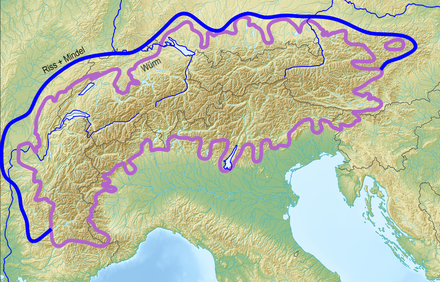
The end of the last glacial was “violently” punctuated by the Younger Dryas. That by itself would have put a serious kink in adaptive success for many species because they rely on consistent habitats. Three abrupt temperature reversals in about three to six thousand years would have created extraordinary problems for plant communities. They can’t pick up and move easily. And, if the plant communities (the primary production and energy-fixation foundation for ecosystems) suffer, every population dependent on them does as well right up the consumer chain to the vultures over head. As regards extinctions, in the Americas the Younger Dryas corresponds to the disappearance (extinction) of the Clovis culture as well – a Quaternary extinction event that is not commonly discussed. Likewise, in Europe, Africa and Asia the end of the Pleistocene sees pronounced changes in human societies. Older cultures vanish. In the Middle East farming appears, meaning desperate folks were reduced to relying on low-grade, work intensive foods like plant seeds. They were literally competing with grazers for the first time. Along the Atlantic coast of Europe Mesolithic people turned to and leaned heavily on shell fish, marine resources, and other work intensive food sources. Australia I don’t know about.
In the Americas there appears to be, as I said, some correlation between extinctions and the [apparent] appearance humans. However if you examine the data, it is not strong. And, there is increasing evidence that humans were present in the Americas perhaps as early as 18 ky to 20 ky ago, possibly longer. In which case even the apparent correlation vanishes. The human-driven extinction hypothesis depends on humans appearing North America like a horde of locusts and essentially eating their way through monster herds of horses, camels, mammoths and bison all the way to Tierra del Fuego. In Europe human-driven extinctions at the end of the Pleistocene never made sense, and in Africa it never happened. There is no indication that there were ever enough humans on the planet at the time – let alone in North America to achieve that.
Also, when various animals in the Americas became extinct is a genuine problem. Bison latifrons seems to have be extinct or nearly so by between 30 ky ans 20 ky ago, probably killed off by the Glacial Maximum climate. So, just possibly the very earliest paleoindians kissed the very last B. latifrons goodbye. Meanwhile cousin B. latifrons turns into B. bison and essentially survives into the present – i.e. never was extinct. Smilodon lasted until the tag end of the Pleistocene or even the very early Holocene, depending on who you read. Giant ground sloths may have lasted up into the mid-Holocene and there is no evidence, that I am aware of, that they were ever hunted by humans in North America or in South America. Horses seem to have vanished by the end of the early Holocene – possibly more recently than 8,000 BP. They were certainly hunted, but there is no evidence of wholesale slaughter that I know of. I can go on, but the gist is clear. There is no strong correlation between extinctions and the appearance of humans in the Americas. Elsewhere, the argument can’t simply be logically made that people were to blame (except maybe Australia – as, I said, I don’t know about Australia). They and the animals that became extinct had been existing side by side for tens of thousands of years.
If you consider bison, the manner in which Native Americans hunted them was supremely wasteful up until the horse was reintroduced to the Americas. Jump sites can contain hundreds of skeletons and some may contain thousands. Yet the bison survived that. It took the wholesale hunting of them for hides for robes, and the drive belts for industrial, factory power-delivery systems to finally wipe them almost out. Traditional [non-industrial] societies simply don’t have that kind of impact. Elephants survive in Africa into the present, even under pretty desperate hunting stress, as do rhinos.
So, no, there is no evidence in the world that humanity was responsible for the Quaternary Extinction.
Arrgh – B. anitquus changed into B. bison.
We are still in the Pleistocene Terry Warner, as vast volumes of ice and snow still exist on the planet. The Holocene does not mark the end of the Pleistocene, except in the narrow, ignorant minds of warmists.
“… the holocene which was largely indistinguishable from the pleistocene save for the emergence of modern man”.
That’s what I would define as a science-free statement, as it pays no respect to the vast body of empirical evidence and ‘peer reviewed’ palaeo-geological science that says otherwise.
You’re clearly not a geologist Terry Warner.
Yes, I agree with that assessment.
The Holocene has little geological relevance.
It doesn’t even equate with the emergence of modern humans who have been around for possibly 200,000 years.
It has more relevance to the emergence of agriculture and markers within it are human/archeological, not geological.
From..https://en.wikipedia.org/wiki/Holocene
“Paleontologists have defined no faunal stages for the Holocene. If subdivision is necessary, periods of human technological development, such as the Mesolithic, Neolithic, and Bronze Age, are usually used. However, the time periods referenced by these terms vary with the emergence of those technologies in different parts of the world”
GregK says “The Holocene has little geological relevance”. I beg to differ.
There is an abundance of important geology in the Holocene, in particular providing empirical evidence for the retreat of continental ice sheets, and resultant large and rapid rises in sea level. The Holocene Age is defined by geology, not fauna, nor by human development. Geology forms a solid foundation for our knowledge of Holocene interstadial climate conditions and, in turn, the rise of civilization.
Citing Wikipedia as a reference is a trap for young players. It’s a playground for CAGW activists who seek to rewrite the geological record and by extension, Holocene climate history, to serve a political agenda. Fortunately, they aren’t geologists, so they fail in these endeavors.
More logical to peg it to Aug 6, 1945 when the first human created nuclear fission materials were released into the environment.
That is not the permanent stable signal in the sediment strata that stratigraphers demand. Radioisotopes by definition decay, i.e. Not stable.
I propose that the Anthropocene epoch end at the onset of the next ice age.