By Christopher Monckton of Brenchley
I do apologize for not having replied sooner to my friend the irrepressible, irascible, highly improbable but always fascinating Willis Eschenbach, who on August 15 had commented on a brace of earlier postings by me on the vexed question of climate sensitivity.
The delay is because my lovely wife and I are on a two-week trip to the thrusting new Scotland of the ghastly totalitarians who call themselves the Scottish National Party. We had left our beloved Scotland five years ago when we had sensed the advance of the legalists – as the early Chinese philosophers would have called today’s totalitarians. We are what the Chinese would have called Confucians – in today’s money, libertarians.
How said it is to see the Scotland we left just five years ago in such rampant and almost entirely unreported decline. Even in Perth, our old and once prosperous county town, the thriving shops have largely gone, to be replaced by dismal bingo-halls, desperate charity shops and boarded-up windows.
The cottage where we were unwise enough to lodge during our first week’s visit cost us well north of $1000 for the week, and the wretches who let it to us did not provide free electricity or even logs for the fire. The place was filthy; the oven unusable; the wood-burning stove so clogged with clag that one could not see through the glass to where the fire within would have been if there had been any logs; the gutters not maintained; the water not even basically filtered to remove the lumps of peat that turned my white shirts brown. And the internet? They said that if we stood in the kitchen corner we might occasionally get a flicker of a signal. Well, we didn’t get one.
In Paris last December, while playing the piano for the late and much missed Bob Carter in the swank foyer of the grandest of grand hotels on the Champs-Elysees, I mentioned to him that we were by no means the only ones who had left Scotland. Had I been younger, I said, I’d have stood and fought. As it was, a tide of talent and brains and wealth was pouring southward; businesses were closing down all over the boarded-up shop; the oil price had collapsed; and everyone who was anyone was getting out.
Bob said, “Monckton, you’re exaggerating. And I’m going to prove it.” He got out his cellphone and telephoned a friend in Aberdeen who employed 400 people there. “Is it true,” he asked, “that there is an unreported exodus from Scotland?”
“I can’t speak for the whole of Scotland,” said Bob’s friend, “But I will say this. I and all 400 of my employees are leaving just as soon as we can get out.”
Which explains why there was no internet. The notion of providing a service has now largely vanished from Scotland. Inferentially, the signal from furth of Shangri-La did not reach our corner of the damp cottage kitchen because the Amalgamated Union of Semaphore Flag-Wavers and Mountain-Top Beacon Fettlers was on strike. Again.
So to Willis’ posting.
Willis thought I was wrong (Wrong? Moi?) about the value of the pre-feedback climate-sensitivity parameter, widely known in the climate literature (see e.g. Roe, 2009) as λ0.
Misleadingly, Willis refers to this “Planck parameter” as a “feedback”. Properly understood, it is nothing of the kind: for, as the equation that I had illustrated in my previous postings demonstrated, its role in determining climate sensitivity – and that was the role in which I had cast it – is manifestly distinct from that of any true feedback.
Willis says: “The Planck feedback is how much the outgoing long-wave radiation of the globe increases per degree of increased temperature.” It is much better understood the other way about, for the models use its reciprocal, the Planck parameter, to convert Watts per square meter of long-wave radiation change (i.e., of forcing) to Kelvin of temperature change (i.e., climate sensitivity). See the interesting discussion in Roe (2009) on this point.
The Planck parameter, which I shall accordingly denominate hereafter in Kelvin of temperature change per Watt per square meter of radiative flux-density change, occurs twice in the official climate-sensitivity equation.
First, at the pre-feedback stage, the Planck parameter is the constant of proportionality that converts any change in long-wave radiation as a result of a radiative forcing such as atmospheric CO2 enrichment into a corresponding change in temperature.
Secondly, the Planck parameter acts in exactly the same way on temperature feedbacks. Feedbacks are denominated in Watts per square meter per Kelvin of temperature change arising from the original, direct forcing. The product of the Planck parameter (in purple) and the sum of these feedbacks (in bright blue) is the unitless temperature-feedback factor f (in pink) in my illuminated presentation of the official climate-sensitivity equation.
The value of the Planck parameter is, therefore, of paramount importance. And Willis, who is prone to rush to the data (which, to be fair, are usually not a bad place to start), rushed to the data and determined the value of the Planck parameter not as the 0.313 Kelvin per Watt per square meter that I (supported by IPCC and dozens of scientific papers and models I could name) had asserted, but a mere 0.2 Kelvin per Watt per square meter.
How come this discrepancy?
Simple. Willis, in his posting, made the same mistake that I had myself made in the very first article I had written on climate sensitivity, which had appeared ten years ago all over the front page of the Weekend section of the London Sunday Telegraph and had been so popular with readers that it crashed the Telegraph website for the first and only time in its history, attracting the then-unheard-of hit-rate of 127,000 hits in two hours at midnight on a Sunday morning. By that metric, it was the most popular article the Telegraph group had ever published.

Fig. 1 The official climate-sensitivity equation. Pre-feedback sensitivity ΔT0 = λ0 ΔF. Post-feedback sensitivity ΔT is the product of ΔT0 and the post-feedback gain factor G. By a suitable choice of the feedback sum, the equation can model transient or equilibrium climate sensitivity.
The mistake that Willis (and, at that time, I) had made was to perform the calculation to determine the Planck sensitivity at the Earth’s surface and not, as it should be performed for climate-sensitivity studies, at the Planck emission surface, whose mean pressure altitude is about 300 hPa up in the mid-troposphere.
The Planck emission surface is, by definition, the locus of all points of least altitude at which incoming and outgoing radiation are equal in the atmospheric columns that may be thought of as subsisting above all points on the Earth’s surface.
This strange surface is the surface from which satellites perceive outgoing radiation from the Earth to emanate. It is – again by definition – one optical depth down into the atmosphere as seen from above.
And it is at this emission surface, and not at the Earth’s hard-deck surface, that the Planck parameter falls to be determined.
Here is how it is done. There is really very little argument about the value of the Planck parameter, for its derivation is so very straightforward.
Begin with the data (Willis will like that bit). The SORCE/TIM data show that the mean total solar irradiance is about 1361 Watts per square meter, and all datasets are within a few Watts per square meter of this value, so I shall use the SORCE/TIM value.
The Earth presents a disk-shaped cross-section to the incoming radiation, but its surface is a rotating sphere. So it is necessary to divide the total solar irradiance by 4, which is the ratio of the surface area of a sphere to that of a disk of equal radius.
Next, one must allow for albedo. The Earth (or, in particular, the clouds, which account for some 97% of its albedo) reflect about 30% of all incoming solar radiation harmlessly straight back into space. So the mean flux density at the Earth’s emission altitude is 1361 (1 – 0.3) / 4 = 238.2 Watts per square meter.
Now it is time to determine the mean emission temperature represented by that radiation of 238.2 Watts per square meter. This is done by using one of the very few proven results in the generally slippery subject of climatology – the fundamental equation of radiative transfer.
The equation states that the radiative flux at the emission surface of a celestial body is equal to the product of just three values: the emissivity of that surface, the Stefan-Boltzmann constant and the fourth power of temperature.
Since we know the radiation at the Earth’s emission surface, and we know that after allowance for albedo the emissivity of that surface is unity, and we know the Stefan-Boltzmann constant is reassuringly constant at 0.000000056704 Watts per square meter per Kelvin to the fourth power, it is a simple matter to deduce the one unknown quantity in the equation: the Earth’s emission temperature, which turns out to be 254.6 Kelvin, or around 34 Kelvin cooler than the hard-deck surface where we live and move and have our being.
To find out the relationship between any change in radiative flux density at the emission surface and any consequent change in the temperature at that surface, it is necessary only to take the first derivative of the fundamental equation of radiative transfer.
It is not always appreciated that, provided that one expresses the derivative in terms of both temperature and flux density, the relation between radiation change and temperature change is linear, even though the derivative comes from a fourth-power relation.
Here is the math:
 K W–1 m2.
One final adjustment is needed, and, to verify IPCC’s value, some years ago I obtained from John Christy a datafile containing 30 years’ temperature-anomaly data for the mid-troposphere. Using these data (Willis would be pleased again), I was able to determine the Hölder coefficient from the integration of latitudinal values for λ0 using equialtitudinal latitudinal frusta, for are not frusta that are equaialtitudinal also conveniently equiareal? [Hint: yes, they are].
The bottom line: the product of the Hölder coefficient 7/6 (which allows for the fact that a sum of latitudinally-derived fourth powers, for instance, is not the same as the fourth power of a sum) and the first differential obtained by taking the derivative above gives a very good approximation to the current value of the Planck parameter λ0, namely 0.313 K W–1 m2.
Phew!
Can the value of the Planck parameter vary? Yes, if insolation varies, and yes, if albedo varies. But, since the solar “constant” is near-invariant, and since the albedo is unlikely to change much even if major ice losses eventually occur, lambda-zero will continue to be at or close to 0.313 K W–1 m2 for the foreseeable future.
With respect, therefore, Willis was infelicitous in referring to the Planck parameter as a “feedback”, for it is unlike any true feedback; he was incorrect (as I had once been) in attempting to determine it at the hard-deck surface rather than the emission surface of the Earth; he was accordingly incorrect (as I had once been) in determining its value to be of order 0.2 Kelvin per Watt per square meter; he was incorrect in imagining the Planck parameter to be non-linear (I knew enough calculus not to fall for that one); and he was incorrect in imagining that its value had been determined without regard to latitudinal non-linearities (I do more homework than I usually show in these columns for general family entertainment).
Apart from that, Mrs Lincoln, how did you enjoy the play?
But let us end with a richly-deserved compliment to Willis. Like me, he is largely an autodidact. Like me, he makes mistakes. And this time I am in no position to crow: for the mistakes he has made are the mistakes I had once made myself.
Above all, like me he is interested enough to ask questions – usually very good questions – and to do his very best to find the answers. To him, as to me, science is a matter not of belief but of diligent, disciplined inquiry. It is this passionate curiosity that unites us, and marks us out from the totalitarian true-believers who are wrecking Scotland and have done their best to wreck science too. To them, and not to him, I award the accolade “Thick as two short Plancks”.
“How said it is to see the Scotland we left just five years ago i ”
Should that be “SAD” Sir Monckton ?
Brilliant! A typo! We can hereby declare the entire analysis null and void.
… and don’t you just love it when the pedant makes an error of his own.
Lord M, Marcus, not Sir.
Yup! Let’s declare Monckton’s analysis null and void.
That’s Lord Monckton. Specifically Viscount Monckton (the 3rd of Brenchly).
Sir is for Knighthoods.
Gotta give credit where credit is due.
G
Maybe I misspelled Brenchhley ??
G
Above my pay grade, but always a pleasure.
As defined here, “Planck’s Parameter” is a feedback, Lord Clownschtick von Brenchley. It is not a complicated concept.
Climate sensitivity analysis treats the earth as a control volume or control mass, and if an increase in input directly causes an increase of a certain type of output, that is a feedback by definition. Willis actually gets credit for having been confused about this concept in the past but getting it right this time.
MS, nope. The feedbacks are mainly clouds and water vapor affecting what CO2 would do by itself absent them. The literature CO2 only derivations range from 1.1 (TAR) to 1.2 (AR4 and Lindzen). Here, 1.16C for the Planck result absent feedbacks, using the delta forcing generally accepted as 3.7w/m2 and generally accepted lambda0 of 0.31.
Matt Skaggs: As defined here, “Planck’s Parameter” is a feedback,
I was taught that a “feedback” was a response that altered the input. Is there some debate about that, or variation among intellectual groups?
That is the standard definition. Unless one’s goal is to just confuse the subject.
Agree fully – a feedback is some portion of the output FEDBACK to the input.
An output as a result of an input is defined by the transfer function. One can then take some of the output and FEED IT BACK, adjusted by a FEEDBACK gain (hopefully negative), to the input.
Basic control engineering. Maybe they don’t teach that anymore.
Mr Marler has hit the nauil on the head. A feedback is indeed the transfer of some fraction of the output of a dynamical system so that it is fed back to the input, either augmenting or attenuating the original amplification that may have been present. In that key sense, the Planck “feedback” is manifestly not a feedback. Furthermore, as the illustration in the head posting shows, the Planck parameter has a role manifestly and in multiple respects distinct from a true feedback.
I have long learned, when studying the slippery subject that is climatology, to become alert when someone uses a term like “Planck feedback” for an operator that is so obviously not a feedback and that so obviously has a role in many material ways distinct from any feedback. I have been using these pointers for years to feel my way towards where the errors lurk in the models. For it may be that there are some who know what the errors are, and they are anxious for reasons of power or profit to conceal them. If so, they will take certain steps to assist in the concealment, and, by following those steps, one is guided towards what they are concealing. Watch this space.
Mr Skaggs is, as usual, wrong. Though the reciprocal of the Planck parameter is often described as a “feedback”, it is better understood as the constant of proportionality that relates changes in radiative flux to changes in temperature in the absence of feedbacks.
It is also self-evident that the Planck parameter, as presented in the head posting, is denominated in Kelvin of temperature change per Watt per square meter of radiative forcing, whereas temperature feedbacks in the climate are (whether or not they should be) denominated in Watts per square meter per Kelvin of the temperature change that caused them.
Furthermore, the Planck parameter has a role quite distinct from that of a true temperature feedback. For this reason, it is treated differently from true feedbacks (see e.g. IPCC, 2013, fig. 9.43a, where the feedbacks are summed without the Planck “feedback”.
Also, just look at the climate-sensitivity equation illustrated in full technicolor in the head
posting. The true feedbacks (in bright blue) are summed, but the Planck parameter, far from being added to them as though it were a feedback, is instead multiplied by their sum to obtain what passes in IPCC’s analysis for the feedback factor. Also, the Planck parameter, but not any of the feedbacks, is multiplied by the initial forcing to generate the initial or pre-feedback temperature change.
For all these reasons, it is better to consider the Planck parameter is part of the reference frame of the climate object than as a feedback, which is why I said that calling it a “feedback” is infelicitous. See Roe (2009) for a discussion on this very point.
There is, however, a concerted campaign in some quarters to try to confuse the public as much as possible so as to conceal the numerous methodological defects that have led to the absurd exaggerations of the computer models for just a little bit longer.
Well, the sands of time are running out. Watch this space.
“Climate sensitivity analysis treats the earth as a control volume or control mass, and if an increase in input directly causes an increase of a certain type of output, that is a feedback by definition.”
Not on my planet, Mr. Skaggs ; ) that’s just a response . . Feedback involves an output effecting input.
Increased sound entering a microphone causing increased sound coming out of a speaker, is a response . . If the speaker’s output feeds sound back into the mike, you get feedback.
“There is, however, a concerted campaign in some quarters to try to confuse the public as much as possible…”
Exactly.
You have in the past; probably on several occasions, said that the best way to address the CAGW discussion was to employ their own methodology in showing where they are in error. The IPCC that is, and I have always taken your use of “”.. official climate-sensitivity equation. ..”” as a starting point , that the warmists adhere to, rather than your own preferred explanation of the climate.
I have also been very reluctant to embrace the use of classical feedback system methodology to analyze climate variability, after spending much of my 56 year career in industry designing not a few electronic amplifier systems employing feedback.
The electronic field is the area where feedback systems have been most extensively studies and analyzed, but other fields such as mechanics, and chemistry have some quite similar situations.
The electronic feedback ” amplifier “, or even non-feedback amplifiers have some fairly simple rules of conduct.
We can consider an amplifier system to be a four terminal or two port black box, with a single input port comprising terminals 1 and 2 to which a signal from some source is applied, and a single output port comprising terminals 3 and 4 which are commonly connected to a load component . Very often, terminals 2 and 3 are considered to be common and refer to them as “ground” or some such label, so I have labeled the four terminals of the black box in CCW order.
So we can think of terminal 1 as the primary input terminal, and terminal 4 as the primary output terminal.
In such circuits, signals can be either voltage signals or current signals, but are actually both, and are linked by an impedance which in general will be complex, perhaps consisting of Resistive, Capacitive, and Inductive elements.
At the input port, we would have an input voltage V12 and an input current I12 and the ratio V12 / I12 would be the input impedance Z12.
At the output port, we will have V43 and I43 as the output voltage and current respectively, and V43 / I43 would be the load impedance Z43.
So the black box innards will convert the input V12 to an output V43 with a voltage gain ratio Av given by V43 / V12. Also the box converts the input current I12 to an output current I43 that flows in the load impedance, with now a current gain Ai given by I43 /I12.
Now this is true regardless of whether the system has any feedback at all .
With the relevant black box model described above, a little simple algebra gives us the universal (electronic) amplifier relation: Av.Z12 = Ai. Z43 or more commonly written as :
Av.Zin = Ai Zl where Zin is Z12 and Zl (load) is Z43.
So regardless of the design of the black box innards, the final result obeys this simple relationship.
Now on paper, we would tend to regard the above parameters as fixed values independent of signal levels, but in actual practice they will differ from that assumption and designers seek to minimize any negative effects of such non- ideality.
When we start adding feedback AROUND the above black box, we discover some additional complexities.
The output from the black box is not simply a voltage, but is both a voltage and a current presumably locked in embrace by the load impedance Zl or Z43.
We could sample either the output voltage V43 or the output current I43 to obtain a proportional feedback signal, and we could combine that with the input signal either as a voltage or as a current.
I won’t burden you with all the gory details; but as a consequence of the multiple possibilities for the feedback, it will be found that both the resultant voltage gain and the resultant current gain (Avv and Aii) will be changed, as will the effective input impedance of the composite amplifier and also the output impedance, and those changes will be quite different for the different types of feedback. We can make the input impedance higher or lower depending on the feedback type, and similarly with the output impedance of the black box.
Well it takes too much space to describe (in words) all of the complexities of feedback amplifiers; but suffice it to say, that what I just described here, is infinitely simpler than the earth climate system, which certainly has many more inputs and many more outputs and very few known solid relationships between all of those variable and parameters.
So the fact IPCC has enshrined the equation which LMofB has expounded on here, one should not presume that the global climate is anywhere near as simple as IPCC thinks, and which Christopher has detailed for us here.
I for one have not even been able to discern what is a real signal and what is any kind of a forward gain.
It seems to me that if we consider TSI to be an input signal, we know that the majority of that energy goes into “hiding” in the deep oceans to come back to haunt us at some later time; but is that a feedback or is it simply a time delay or phase shift in the “forward gain” of the system .
How much of it goes into hiding determines how much is left to give relatively prompt variations in the climate variables.
Personally, I think IPCC is barking up the wrong tree, and LMofB’s detailed analysis clarifies why I think IPCC is not dealing with anything even remotely akin to a real simple feedback amplifier.
G
Takes too many words to describe what one picture can show clearly. Sorry about that.
George E. Smith’s characteristically interesting comment has a bearing on some work I am doing at present on temperature feedbacks and their handling in the climate models. If he would get in touch via monckton [at] mail.com, I may be able to rope him in and get his expert assistance.
That does not sound like feedback to me. Feedback implies that the output of a system modifies the input in either a positive or negative manner. Your definition is lacking. But you ad homme Monckton, then proceed to beclown yourself.
+1 for using be- prefix. You are a pretty linguistically entertaining lot, even if getting the meaning of feedback is difficult. Never before I knew be- is probably cognate to ambi- in ambivalent, and comes from PIE *ambhi. Wow.
Well, Robert, I saw no ad hominim in his response. He merely said Skaggs was wrong. And then explained his position. Legitimate argumentation, imo.
Oops, I misread your comment, Robert. I thought you were referring to Monckton as the source of the “ad homme”. My abject apologies, sir.
You missed the missing comma, JimB! Easily done.
His L0rdship’s response did contain an “ad homme.” I have noted (with regret) a growing trend in this type of response which adds nothing of value and detracts from the veracity and cogency of any comment being made. I wish that all (including his L)rdship and other contributors such as Willis) would cut out this unfortunate habit, and stick to the facts.
His L0rdship said:
We (and this includes his L0rdship) do not know how many decisions, comments, expressions of opinion Mr Skaggs makes each year (or over the course of his life to date) so it is impossible to know whether more than 50% of these are wrong,
It may be possible to check each comment he has posted on this site and make an evaluation of which if any are wrong, materially or otherwise. But this would be a very difficult task not least because of the uncertainty in this area and the deficient data sets upon which this “science” is based.
The comment <b.as usual was an “ad homme,” it was unnecessary being mere surplusage and, in my opinion, would have been best omitted from his L0rdship’s response. Let the thrust of argument speak for itself.
We can all form a view on what is the proper meaning of feedback, whether the nomenclature is being incorrectly used, and if so what bearing this has. Sometimes sloppy wording has no impact but at other times it can be very significant, and at the very minimum it often suggests a lack of understanding or a cavalier attitude to the application of precise facts that have the potential to lead to error elsewhere in reasoning and/or in application.
PS for what it is worth, I consider that the expression feedback is often being incorrectly used.
Mr Verney should know that there are various trolls who surface again and again here to make silly points in the hope of confusing the argument – a hope that will shortly and permanently prove vain. To clarify matters for those who are not so regular here, when one of these trolls dive-bombs the site with a silly comment I point out that that troll is, as usual, wrong, for the troll in question,, like all of his ilk, is not interested in getting anything right: merely in preserving a Party Line that will soon become irrevocably, laughably unsustainable.
richard verney,
Would your objection have been short circuited, so to speak, had Mr. Monckton added a few words to his . . rebuff, such as;
*Mr Skaggs is, as usual it seems to me, wrong.* ?
“if an increase in input directly causes an increase of a certain type of output, that is a feedback by definition”
I would love to know what book you got that definition from.
According to this definition, the only thing that isn’t a feedback, is something that has no affect at all.
“if an increase in input directly causes an increase of a certain type of output, that is a feedback by definition”
That’s not feedback.
That’s the definition of a standard amplifier, iirc?
That is not a feedback. A “feed” “back” must feed…. back. An input causes an output which causes a modulation of the input. What you have described is simple cause and effect. You push down on the gas pedal, you accelerate, wind and mechanical resistance increases- the acceleration relative to fuel consumption increase and power output declines.
Not so.
A feedback takes a signal that depends on the OUTPUT (of a system) and uses that to modify the INPUT to the system.
The forward gain of the system is NOT altered by feedback; the effective input signal IS, and that effective input is still magnified by the original forward gain of the system.
In properly designed feedback systems, the final real output for a given real input, is largely independent of the forward gain and is determined almost solely by the feedback.
And since the forward gain is effectively removed as the determining factor, then it does not need to be a constant or even a linear function of the signal level.
The real input signal to the climate system is the 1362 W/m^2 of the TSI.
The effective output of the system is the “climate ” whatever climate is supposed to be.
It seems as if the measure of earth’s climate is simply a temperature; well actually a temperature anomaly, and nobody knows just where that was measured.
G
So you have it exactly backwards.
@Matt Skaggs
“It is not a complicated concept.”
No, it isn’t. So why is it so confusing for some. An input results in an output. If part of that output becomes an input (which results in another contribution to output) then it is called a feedback. No need to try to make it sound all fancy. Not rocket science.
” if an increase in input directly causes an increase of a certain type of output, that is a feedback by definition”
No, it is absolutely nothing of the sort, you patronising, abusive little fellow.
You don’t actually know what a feedback is, do you?
Congratulations on the most spectacular show of pig ignorance I’ve seen for some time.
Very nice derivation of lambda0. The importance of the ERL (the emissive surface around 300 hPa, aka effective radiating level) is a source of much confusion. The saturation argument. Salby’s opacity equivalent mistake. Convection versus radiation.
Not to mention your nice previous posts using this value and the equation to calculate sensitivity near the middle of the range using IPCC AR5 values (Lewis and Curry 2014) and Bjorn Smith’s newer more constrained aerosol value (Lewis 2015). Range 1.5-1.8. Your result ~1.6.
CMIP5 median 3.2, mean 3.4; another way to show the models are observationally wrong. They disagree with one another on absolute temp by +/- 3C even hindcasting; so they dont get cricial water phase transitions right. They diverge since 2000 from satellite and balloon temperatures by a factor of more than 2 globally (pause) and a factor of almost 4 for the tropical troposphere (the missing hot spot). Unavoidable parameterization inherently imbeds the attribution problem seen by comparing virtual identical warming ~1920-1945 to ~ 1975-2000. Even AR4 said the former period could not be attributed mostly to CO2; there wasn’t enough of a rise. But the latter period was attributed mostly to CO2–wrong. Now coming back to haunt the warmunists as Mother Nature continues to refuse to cooperate with them.
Mr Istvan is very kind. I thought it was worthwhile to explain the derivation of lambda-zero in some detail, because it is one of the very few quantities on which we can broadly agree with the Thermageddonites (most of whom, however, have no idea that it even exists, let alone what its value is).
It is becoming apparent that not only the direct forcing from CO2 but also the temperature feedbacks have been much exaggerated in the models – and especially the top-end feedbacks that lead to disproportionate and silly predictions of warming up to 10 K per CO2 doubling (see, e.g., Murphy, 2008).
During my sojourn in Scotland (I’m now in Rob Roy’s cottage, where, splendidly, the hot water works, though the place has not been cleaned since Rob Roy’s time), I’ve been studying the official representation of feedbacks. An interesting and very large error in the official methodology has come to light. Watch this space.
You have more reach than my three ebooks, especially The Arts of Truth climate chapter vetted by Lindzen himself (a rather personally humiliating experience recounted in th blogosphere elsewhere) and Blowing Smoke on energy and climate, with a wonderful foreword from Judith Curry.
Your posts are brilliant. Even our prior minor (archived for posterity) tussle over at Judith’s when your irreducible equation first published (I mathematically reduced it further, but she could not publish the math so I had to supply a .pdf version, but still reached your same general climate conclusion anyways so what the hey…).
Highest regards, Lord Monckton. We shall soldier on together.
With all due respect, English translation of ristvan’s comment:
“…time for the bad guys to do another temp adjustment…”.
JC, lets hope they do. You take screen shots and catch the miscreants. Then we can ‘hangem high’. About time.
@Rud Istvan
August 22, 2016 at 1:03 pm: well, Rud,if you keep trying to down Prof. Salby, an actual Atmospheric Physicist, you owe it to science to state a proper case. Our current Trolls can only delight in your so far empty words re Salby who deserves far better from us. And they will repeat them forever…..
Brett, see my more detailed comments on Salby’s latest Youtube lecture over at Judith Curry’s Climate Etc. concerning his opacity error. No need to repeat here just for you. And another commenter totally took apart his basic carbon sinks/sources math. Just algebra plus one derivative theorem from calculus.
Salby is wrong. He misstates the GHE, his facts about GHGs pre and post 2000 are wrong, he misunderstands 14C bomb spike residency time ( individual molecules not the same as net concentration PPM), and his source/sink math is shonky. All indefensible. Get over it already.
And as usual i learned at least one new word! :>)
Milord,
Should Scotland vote to leave the UK in order to remain in the EU, England can expect hungry refugees crossing the Border, just as Venezuelans now stream into Colombia from their socialist paradise in search of food.
Having oil can’t rescue socialism nor save its victims. Maybe the Germans will send food parcels to their fellow European Unionists in need, but there must be a limit to such charity.
Scottish National Socialist Party rule would produce productive refugees to match those who fled the Third Reich, or more, proportionally.
What became of your Classical Cottage project in the Highlands?
Soon oats and sheeps’ stomachs will be in short supply. Buy haggis futures now!
Garbro
“Having oil can’t rescue socialism nor save its victims” – yes, but it can make the slave masters very rich.
Few in Scotland will get rich on today’s oil prices. Aberdeen is even more devastated than most other cities in Scotland. Even Union Street, which rivaled Princes Street in Edinburgh as Scotland’s grandest shopping street when we used to live in the county, now has boarded-up shops here and there, and the surrounding area is undergoing a sharp and uncomfortable decline following the collapse in oil prices.
There is a certain amount of shale gas under the central belt of Scotland, but naturally the National Socialist Workers’ Party of Scotland is implacably imposed to enriching Scotland’s people by extracting it.
No doubt Hugo’s cronies have salted away their oil loot in the Caymans and Switzerland, for after the slaves rise up in revolt.
Scotland’s SNP is both socialist and nationalist. Speaking historically, that is not a good combination.
The British will not abandon Scotland even if a few Scots do.
There are political storms and then there are tea-cups.
Lord Monckton.
It’s a sad observation Scotland is in serious decline. I have travel the length and breadth many times, but no more. The world is getting more verboten, smaller and more restrictive. The bucket list is becoming a thimble by comparison. Without a doubt my care free and extensive traveling adventures are long gone.
As for the rest I agree with Bloke down the pub
Above my pay grade, but always a pleasure.
Scotland is no longer worth visiting, The lunatics in charge are intent on covering all the mountains with useless wind turbines so that they can proudly proclaim that they have 100% renewable electricity. To think that Scotland used to be famous for producing top-notch engineers.
I’ve traveled most of the world repeatedly and the West coast of Scotland is an all time favorite. Love the people, food, accommodation and Islay scotch. Not necessarily in that order. Sitting in a Bowmar waterside pub with a plate of Scallops caught just off shore and a glass of Lagavulin 16, well it can’t get much better.
I do think their politics are suicidal but can’t really judge since there’s a witch running for president in my own country.
It’s pretty bad when even the libertarian is saying a carbon tax might be a good thing. Libertarian AND tax???
You are more upbeat than I. My list includes all of Europe.
There are plenty of vacant lots available in Detroit and quite a lot of fixer upper houses or shell structures. The real sadness is the percentage of people who can’t find the common denominator of the two areas.
It is this assumption of a constant albedo that I question, and may be at the root of Willis’s variation in the lambda-zero. At any given point on the earth, it’s albedo changes by the hour, if not the minute. For the earth as a whole, maybe it averages out to a constant value — ceteris paribus
But if we assume a changing temperature of the earth, even regionally, then the constancy of albedo is much in question.
As an aside, I am astounded at continued use of “30%” for the albedo of the earth, a most critical parameter in the system of equations. One, maybe two significant figures. Then we worry about the output of the equations to 4 or 5 significant figures? Something is very wrong.
Is the albedo of the earth 3.000(+/- 0.002)E-01 (4 significant figures). If so, I’d like to see a link to the supporting data. Or is it “about 30%” which is (generously) two semi-significant figures?
Actually, the Earth’s albedo is measured in various ways by satellites and it doesn’t seem to vary by very much. An interesting paper from 2011 explains one reason why. Some 97% of the Earth’s albedo is reflection from clouds, and only 3% is surface albedo.
I agree that it would be better to obtain a more precise value, but for present purposed 0.3 will do.
Yes. An even ‘weirder’ observational result: NH and SH maintain observationally about the same albedo!! We dunno why, only that it is. Major paper maybe three years back. Webster was a co-author.
Well then, I repeat my objection. If 97% of albedo comes from clouds, and the formation of clouds is a function of temperature, in particular ocean surface temperature,
(a glitch caused an unintended submit of the above…)
If 97% of albedo comes from clouds, and the formation of clouds is a function of temperature, in particular ocean surface temperature, then if we argue that an Increase in CO2 will cause SOME warming, It must follow that there will be more clouds and a greater level of albedo.
From Willis’s look at the data, the amount of cloud formation is a non-linear relation to surface temperature.
It would be worth reading Callendar (1938), who has a brief but clear account of the various counterbalancing mechanisms that keep the climate system stable, one thing offsetting another.
And, in a short essay, one cannot consider every possible variation, so, since albedo does not seem to change much, I choose to treat it as near-invariant under modern conditions. Of course, anyone is free to do the calculations on any other basis.
Monckton of Brenchley – in your interesting article, you say “the Planck parameter is the constant of proportionality that converts any change in long-wave radiation as a result of a radiative forcing such as atmospheric CO2 enrichment into a corresponding change in temperature“. So I’m not convinced that you need to assume constant albedo – a changing albedo may change the radiative forcing but I don’t see that it necessarily changes the “proportionality”. ie, if it change the radiative forcing then it would presumably change temperature too, in line with the (constant) Planck parameter.
Monckton of Brenchley – I now note that your “emission surface” is at 300hPa, so isn’t it well above virtually all clouds? In which case, should you be adjusting the flux density at all for albedo?
Mr Jonas may like to know that a variation in albedo would cause a variation in the value of lambda-zero, which is dependent upon it.
And, if he reads the careful definition of the emission surface in the head posting, he will see why the cancelation of short-wave radiation by albedo is justifiable – and, therefore, why it is standard practice.
I should make it plain that the derivation of lambda-zero in the head posting is mainstream climate science and any disagreements with it should be addressed not to me but to the IPCC secretariat.
Monckton of Brenchleu – I’m trying to understand what you are saying, rather than disagreeing with it, and there are some things that don’t add up in my rather limited brain.
“The Planck emission surface is, by definition, the locus of all points of least altitude at which incoming and outgoing radiation are equal in the atmospheric columns that may be thought of as subsisting above all points on the Earth’s surface.“. The Planck emission surface appears to be higher than virtually all clouds. At points above clouds, there is more outgoing SW radiation because it is reflected by clouds and less outgoing LW radiation because it is impeded by clouds. The primary net effect – if there is one – on the Planck emission surface would be a change of altitude. NB. The Planck emission surface is purely conceptual, it can move without there being any physical movement.
“Pre-feedback sensitivity ΔT0 = λ0 ΔF. [The Planck sensitivity calculation] should be performed for climate-sensitivity studies, at the Planck emission surface“. This now seems to me to be a very curious calculation, because (again, to my simple mind) the major variation re clouds is likely to be caused by movement of the emission surface to a place with a different temperature, rather than a change of temperature caused by radiation variations at a fairly fixed emission surface. In other words, when cloud cover changes the Planck emission surface moves, so ΔT0 is not a measure of the warming effect of radiation.
And if there is no net effect from clouds, then no adjustment for clouds would be needed.
It seems that what you are really saying is that the Planck sensitivity calculation has to be made for some notional constant cloud cover, rather than that cloud cover actually is constant. The IPCC secretariat is unlikely to be useful in resolving this, because they assume that clouds are just a feedback (“Large uncertainties remain about how clouds might respond to global climate change.” – IPCC AR4 TS6.4.2).
It is stated here that 1) ~97% of Earth’s albedo comes from clouds (which is more than I would initially think), and that 2) Earth’s albedo appears to change very little, which is then tantamount to saying that the global cloud cover fraction is remarkably stable.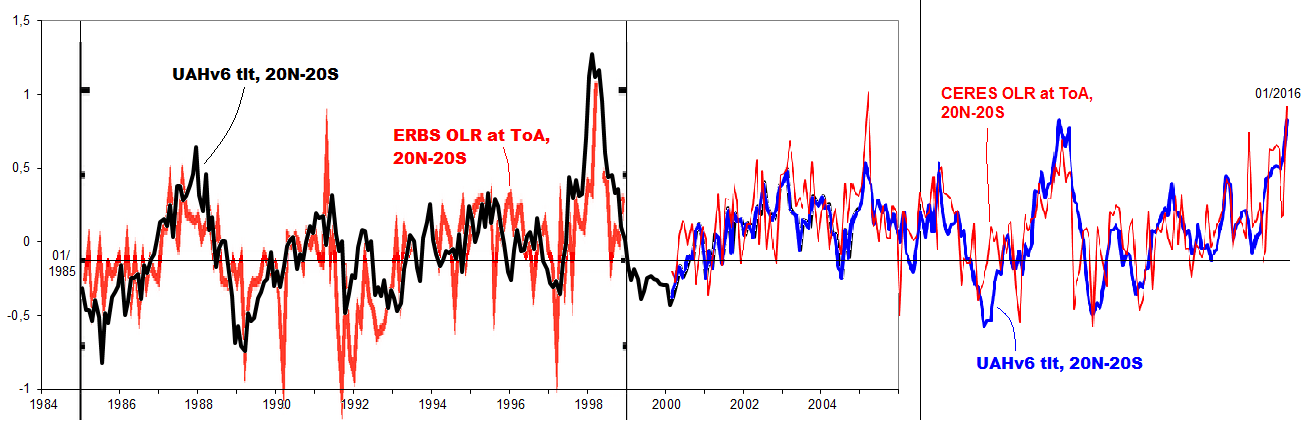


However, this second claim seems based only on data spanning from the last part of the 90s till today, a period within which there has basically been no (tropospheric) warming.
More interesting then to check with data stretching back to times when there actually was proper (tropospheric) warming occurring, like say from the mid 80s to ~2000.
What do we have? We have ERBS data. We have direct ISCCP cloud data and indirect ISCCP flux data (FD), derived from (among other inputs) the cloud data. We have HIRS data. And then we have TLT data (UAH and RSS).
What does the data show?
continued …
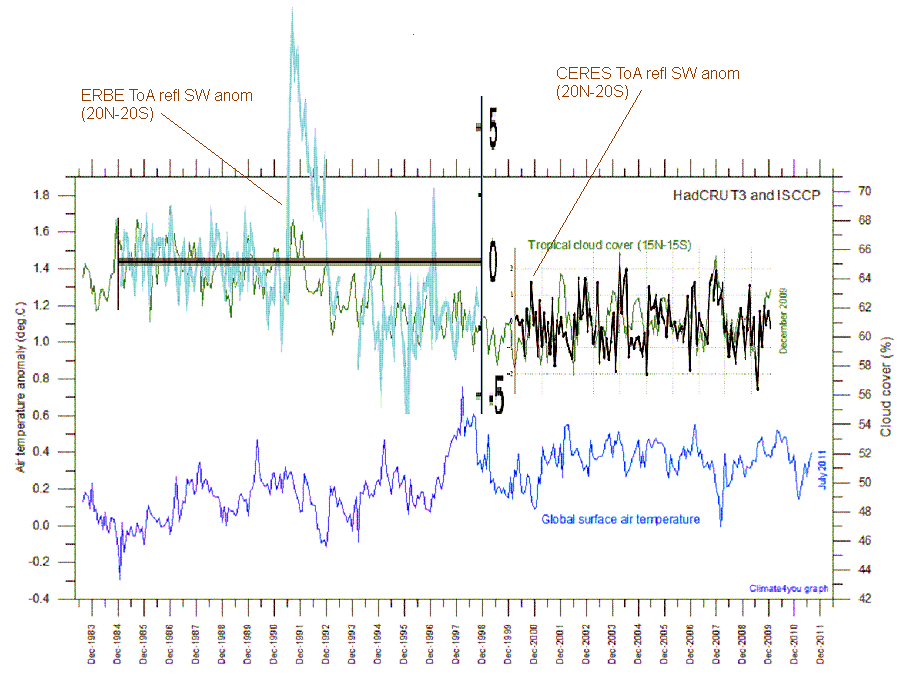

It’s all evidently due to a substantial decrease in cloud cover from the last part of the 80s to about 2000. Earth’s albedo, significantly in the tropics, went down. At the same time, there has been no observable “enhancement” of any “radiative GHE” since at least 1984-85. More ASR, not less OLR, is the direct cause of the radiative imbalance at the ToA. The Sun, not CO2. And with that, the case is pretty much closed …
Thanks Kristian. That is exactly what I have been saying for several years now. The sun changes cloud cover by altering the gradient of tropopause height between equator and poles which shows up as a change in jet stream behaviour.
Don’t thank me, Stephen. ‘Thank’ the data …
It’s right to thank you because most don’t read the data let alone reproduce it.
Kristian and others are apparently surprised by LMof B’s assertion that 97% of albedo comes from clouds (I agree with that).
Part of the reason for their misunderestimation is their lack of understanding of ” Albedo “.
Albedo is a SINGLE number (variable) that simply states the total fraction of the incident TOA TSI (about 1362 W/m^2) which is returned directly to space, by processes of reflection or refraction and scattering UNMODIFIED by those processes as to frequency or wavelength; save that those processes may not be spectrally flat (constant) over the entire incident solar spectrum.
In other words, the effective REFLECTANCE may not be a constant over all solar wavelengths.
Absorption followed by re-emission processes such as by GHGs or other materials is specifically EXCLUDED from Albedo.
ALBEDO is NOT a reflection coefficient of some random surface or volume. It is ONE NUMBER for the entire planet.
So please stop using “Albedo” as a synonym for “reflection coefficient”. it is NOT.
G
Stephen Rasey – I agree with you that albedo is not constant, but I can’t tell from your wording how you relate albedo to temperature ie, which is cause and which is effect. I think it is highly likely that temperature varies in reaction to albedo – significantly over multi-year timescales if not primarily.
See https://www.newscientist.com/article/dn5048-earthshine-fall-heats-global-warming-debate/
and http://www.spacearchive.info/news-2004-05-27-cit.htm
New Scientist 27 May 2004 “A new study of earthshine, the sunlight reflected back onto the Moon from our planet, suggests that falling cloud cover could explain the warming of the Earth’s lower atmosphere seen over the last 20 years.“.
For New Scientist, that’s a pretty impressive statement, even if they do go on to try to discredit it.
@Mike Jonas
In the terms of the subject model, the assumption is that albedo is constant within the precision of other factors. Also in terms of the model, the albedo is an parent input that determines “Mean Flux Density”
But I am challenging the assumption that albedo is constant and that it is particularly insensitive to surface temperature. Willis’s studies of the TERRA data set and the buoys strongly imply that cloud cover, and by inference albedo, are strongly and non-linearly dependent upon surface temperature. I agree with that.
Therefore, in the context of a climate model with increasing global temperatures, I feel that an assumption of a constant albedo highly questionable.
If indeed 20+ years of measurement of the albedo has shown it to be approximately constant, we still have this nasty “Pause” to consider. Either:
1. the Albedo does not change with temperature (which flies in the face of hourly measurements) or,
2. a measured albedo that turns out to be constant confirms the Pause.
FWIW, Dr Spencer is of the mindset that it is small changes in cloud cover associated with the PDO that cause most of our warming (and cooling). Hans Von Storch is also on the record saying that one reason that the models perform so poorly is that they don’t model cloud formation very well. (and then there is Svenmark)…
@ur momisugly Mike Jonas
August 22, 2016 at 2:11 pm: Our studies of solar system tropospheric clouds eg Venus-Earth etc., lead us to think they are more an effect than an agent of T. Why? Optical Depth maybe, but most folks haven’t started thinking on these things yet.
Brett Keane – I’m interested. Do you have further details? Willis has explained frequently how tropical storms (and hence presumably clouds) can be a response to SST, so clearly clouds can respond to T. However, on other timescales and in other ways and places it seems extremely likely to me that the major effect is the other way, ie. of clouds on T. I need to do more investigation one day (I’m travelling etc for the next couple of months) so some detailed information would be helpful. TIA.
To a quick approximation, the Earth’s surface temperature should be proportional to the fourth root of the ratio of its emission coefficient divided by its albedo. A 1% change in this ratio (as from albedo) would correspond to a 1.34 deg F change. Think about this: All the temperature changes we are arguing about can be fiddled by changes in natural parameters that we do not know to any better accuracy.
So the planetary albedo is constant?
Remember that Vangelis called his 1976 studio album Albedo 0.39?
Curiouser and curiouser said Alice.
I mind that simply the total absorptivity=emissivity spectrum is not presented as measured . Then the albedo with respect to the Sun’s spectrum can be calculated by a simple dot product . And extending that to a spectral map over the sphere in an APL such as 4th.CoSy is a matter of just a few more succinct expressions .
I do appreciate having recently seen , sorry I don’t have time to more than browse much of these posts these days , Christopher discuss the difference between averaging temperatures over areas and the temperature corresponding to averaging energy densities . Hopefully I’ll find time to go back and read that in detail . It is fundamental .
Christopher Monckton of Brenchley, thank you for the essay.
What do you think is the sensitivity estimate for the Earth surface?
In answer to Mr Marler, climate sensitivity at CO2 doubling will be about 0.8-1.3 K. See Monckton of Brenchley (2015ab) in the Science Bulletin of the Chinese Academy of Sciences for a discussion.
My current researches suggest that high-end sensitivities, in particular, arise from a fundamental error that has lurked at the heart of the models for 30 years. So I expect a little warming from doubled CO2, but certainly not a lot. And I hope that I shall soon be in a position to prove it.
I luv u
Thank you sir.
My son and daughter in law are returning from 2 weeks in Scotland. It will be interesting to learn of their experience.
My lovely wife and I visited Helensburgh on the north bank of the Clyde today. It was once a fine Victorian town with terraces of noble merchants’ houses on the hill looking out across the estuary where the world’s ships were once built. But the town center now has many boarded-up shops and a number of low-rent retail outlets. This seems to be the pattern wherever we go.
Before long the National Socialist Workers’ Party of Scotland will be unable to conceal the depth of its own financial ineptitude. It had based its pre-independence-referendum calculations on the assumption that oil would be $100 a barrel. Er, no.
And even then there’s a huge black hole in Scotland’s accounts. The totalitarian centralization of the police farce has halved the number of bobbies on the beat and crime is soaring. Every hilltop seems to have a forest of wretched windmills on it. Our great birds are being smashed out of the sky and will soon all be gone, but the urban mob don’t care. Kill everything to save the planet: that’s their motto. Well, it won’t do. People are beginning, just beginning, to notice how shoddy the totalitarians’ manifesto is, and how much shoddier their record in office.
The head bureaucrat of the EU would not even meet Ms Fish when she called a couple of weeks ago. The National Socialists have had their day, and Scotland is visibly the poorer for it.
It takes time to run down all the industries and the hope. What follows is excuses and the hunt for other people’s money. Greece is not such a bad analogy. The desperation phase lends itself to a carbon tax at multiple levels as another angle on resources. All of the income taxes, sales taxes, and VAT taxes got their start in bad times and the need for large blocks of new money. Each new tax started as a play on the wealthy or faceless corporations and not the middle class. Financial trading taxes and carbon taxes fit the bill for another few decades of power play. Taxing the internal combustion engine is too tempting for them on the carbon side.
There is a more fundamental problem. By definition, fossil fuel TRR is finite. It will deplete. And in Scotland, has. Save for untapped possible fracked shales using new US invented technology. Scotland’s choice to wither and die, or modernize.
Thank you sir. I am re-reading “That Hideous Strength” and find that Lewis really caught a glimmer of how bad things can get under the rule of the sciencey veneer over laying the statists of any sort.
How about a wind-powered distillery, producing an eco-friendly green windskey?
While I certainly will defer to Lord Monckton, Brits, Scots and others more familiar with Scotland than I, my son and I visited Scotland the last 10 days of June this year and had a wonderfully enjoyable and enriching time. We stayed in Edinburgh, Inverness, Fort William, Oban, and Glasgow, touring the cities and surrounding environs, and visited the Glengoyne, Deanston, Oban, and Auchentosan distilleries ( of course sampling numerous single-malts). The people, sometimes a bit reserved at first, were lovely and the landscape was breathtaking. Having only been to Scotland once before as part of a cruise around Great Britain, I cannot compare the current condition of Scotland to the past however, if what has been said about the decline of the country is true, I consider my son and I to be fortunate to have visited when we did and can only fervently hope that the decline of Scotland can be reversed by competent government, which unfortunately seems seriously lacking in North America, Europe, and elsewhere.
Did you visit a little town called Peebles near Edinburgh?
“Can the value of the Planck parameter vary? Yes, if insolation varies, and yes, if albedo varies.”
There is an overlay of muddle in this account. The Planck parameter is correctly described as the product of the emissivity, S-B constant, and a function of emission temperature. The insolation and albedo governing the incoming solar flux, which then, at equilibrium, balance the outgoing IR flux, to which the Planck argument is applied. They do in the end affect the emission temperature, but it is only through that quantity that they bear on the Planck sensitivity.
I have to again note the mislabelling of the equation with ΔT=… as the “official equation”. The original version quoted, and also used by Willis, had ΔTeq=… That does have a reasonable claim to be the official definition of equilibrium sensitivity, using equilibrium temperature. The vertion with ΔT=… is a Monckton morph, and has no claim to official status. And it makes no sense; if T is not equilibrium, there is no reason to expect the ratio of T to F to be a constant of any kind.
Mr Stokes continues to be confused. The pre-feedback warming occurs in picoseconds; the principal feedbacks occur in days to years; but ocean heat uptake somewhat delays the emergence of equilibrium warming.
A little elementary mathematics will perhaps assist Mr Stokes. If the system gain factor G is unity, as it is if feedbacks have not yet acted, or if they are net-zero (which is possible, given the thermostatic properties of the climate object), then pre-feedback and post-feedback sensitivity will be equal.
If they system gain factor has any value other than unity, then feedbacks will have acted to some extent, or perhaps completely. One can use the equation to simulate the evolution of the temperature response over time by selecting any appropriate value for G, from 1 when feedbacks have not acted to any appropriate higher (or lower) value thereafter.
The equation is no less the official equation for that.
“A little elementary mathematics will perhaps assist”
The maths is even more elementary. You want the coefficient terms on the right to be constant. They are just feedback factors; no time dependence is assumed. The equation is just
ΔT = K ΔF
where ΔF is the constant applied flux (eg instantaneous CO2 doubling). But if ΔT is time-varying, while oceans etc are warming in response, then K can’t be a constant. It would be time varying too. K only makes sense as a fixed number if you wait till the transient effects on T have settled – ie at equilibrium.
However Lord Monckton, how can you treat a heterogenous mix of gasses all at different energy levels as a “Surface”. The temperature of a fluid is defined by an average of its individual components. The real temperature of the gas being a (poisson?) distribution of individual molecular kinetic energies about a mean.
I would also like to point out that your feedback equations ignore time – that is wrong, this cannot be expressed correctly in a scalar equation, attempts to do this in electronics creates oscillators. In reality Ci is COMPLEX as the various feedbacks all have different transfer functions and in this case, unlike a carefully designed electronic circuit the various feedbacks are NOT independent or even linear (for example consider what happens over ocean as the temperature exceeds about 33 degrees), that means you CAN’T SUM THEM. It’s no wonder climate science had a lot of trouble forcing the models to be stable!
I would also ask for a comment.
Climate science also treats the logarithm as if it will continue forever never saturating (despite the limits of the atmosphere I might note – Anthropogenic CO2 does not add anything, it merely replaces O2 with CO2) and attribute this to the thickening of the spectral lines as CONCENTRATION INCREASES. But if bandwidth is considered to be due to the distribution of doppler shifts in a real gas leading to again a distribution of apparent frequencies about a mean depending on velocity and direction of travel WRT to the observer (satellite) then it is clear that emission bandwidth is not a product of gas CONCENTRATION but a product of gas TEMPERATURE, and the corollary of that is that as you depart from the mean emission frequency toward the tails, the IR must come from lower (warmer) parts of the atmosphere. This means the emission layer is not physical at all, it is a contrivance that needs to be tested, and the IR trapping effect WILL SATURATE. I believe this is a huge model mistake.
A very small challenge – a demonstration if you will
I would also ask that you do the following math, break up the feedbacks based on the literature (or physics) into two classes, negative and positive, apply the feedbacks separately (even with the inappropriate scalar model) negative feedbacks first then calculate the positive feedback loop gain required to move form the negative feedback applied state to the final IPCC proposed value (Gain of 3.3) come back and tell us the loop gain required to do that.
Bobl, you can teach yourself the answer to your question qualitatively, without any fancy math at all. One way is to read my essay Sensitive Uncertainty in ebook Blowing Smoke. Another way would be google. Your questions reflect true even qualitative ignorance of GHE and relevant issues. Why should Monckton provide you with remedial math education? Educate yourself. It is easy. And for you, qualitative suffices.
Ristvan,
I don’t need “remedial Math” or your rudeness. Nothing I have said is in fact provably wrong (Qualitatively or Quantitatively). Let’s put it this way, say I had a positive feedback in the climate but it had a 5.5 year delay, what would be the net result of that on the climate? Oops, the effect of the delay would be to destructively cancel the oscillation due to the 11 year sunspot cycle, turning a positive feedback into a negative one, so delay/phase DOES MATTER.
With regard to the heterogeneous gas mixture that is our atmosphere, what I have said is as I understand it correct, different frequencies toward the tail of the emission band come from different effective levels in the atmosphere, the question is – is it appropriate to average this to a single layer at a single height, I don’t think so.
I know the answer already to part 3 already, but Lord M does not. I want him to discover it and add it to his repertoire.
Now Lord Monckton has said that he stays with the official equation because it makes it easier to break cAGW than to propose a large change to it, but IMHO simply reordering the feedbacks and breaking them into two components is not a huge change, and when you do that you find that the loop gain required of the positive feedback component is impossibly high. The value of that positive feedback component loop gain gives an estimate for the peak gain in the characteristic. This is very close to the bode singularity which would cause temperature instability, In a climate where temperature is dead-set constant to 1 part in 300 such high loop gains are impossible.
“””””….. The temperature of a fluid is defined by an average of its individual components. The real temperature of the gas being a (poisson?) …..”””””
Actually it’s a Maxwell-Boltzmann distribution, but the difference does not radically alter the content of your post bobl. And supposably the mean KE is kT/2 per degree of freedom; k being Boltzmann’s Constant and T the thermodynamic Temperature.
Depending on the gas molecule, there will be at least three degrees of freedom (x,y,z) (Ar monoatomic) but maybe five for binary molecules like N2, O2, H2, for two rotations perpendicular to the dumbbell axis. I guess they presume that the moment of inertia about the dumbbell axis is negligibly small since the nucleus contains nearly all of the mass, and is a near point object. So unless it can spin on the dumbbell axis at some blithering speed, there’s no energy stored there.
G
What fraction of a day is T in equilibrium?
The “official equation” says that if you apply a constant flux F, that will yield a proportional change in temperature. To use it, you need to decide what that means. The temperature is a global average, and obviously must also be a time average. It is the temperature at which the applied flux is balancd by the outgoing, and there is no longer heat being absorbed in heating oceans etc.
That is the million dollar question. The Stefan-Boltzmann constant is an equilibrium constant. I’ve never heard of anyone trying to apply it under non-equilibrium conditions. A similar problem occurs in chemistry. Most of the major constants are for equilibria. The chemical engineers have devoted many volumes to how to apply that to non-equilibrium reactions with varying degrees of success that often turn out to be ‘effective’ parameters. Presumably climate scientists are doing the same thing. Making more assumptions without any explanations.
Nick
Equilibrium never has nor never will be reach so you can keep wishing.
In answer to Philohippous and to the mathematically challenged Stokes, if there are no feedbacks then the climate-sensitivity parameter is multiplied by the radiative forcing to yield the pre-feedback temperature change. If feedbacks have all fully acted, the equation gives final or equilibrium climate sensitivity. For all feedback values in between, the equation gives temperature change over any desired timescale. It really isn’t difficult.
” For all feedback values in between, the equation gives temperature change over any desired timescale.”
There seems to be some notion here that the feedbacks are applied in some time-sequential way. They aren’t; they apply from the beginning of the change. There is no timescale information in the “official equation” above. The feedbacks c_i listed just have numerical values, and with λ0, they combine arithmetically to give
ΔT = K ΔF
for some constant K (ECS). ΔF is the prescribed initial flux change, so there is no wriggle room there. The formula gives a unique ΔT. Nothing about desired timescale. Just one number, which is the equilibrium temperature. What else could it be, with no time scale?
Nick is making a great point, the scalar representation of the climate equation makes the assumption that all the feedbacks are scalar, and occur instantly ( That is they are non-causal ) such a construct in the real world is unrealisable (although you CAN do it in the imaginary environment of a computer). Climastrologists claim that the relevant feedback parameter is derived from the models ( that is the models estimate feedback rather than the feedback being a parameter of the model) and thus they claim that the feedback “Just is” because the models say so, however when you subject this to analysis the impossibly high loop gain for the positive feedback component suggests that the models are wildly wrong, in the real world feedbacks have non linear time delays and are often highly temperature dependent and non-linear. The idea that all those variable feedbacks would always sum to a dimensionless number (without time/temperature dependency is for all practical purposes) impossible, yet that is what they effectively claim.
C_i is actually a function of time, temperature, and humidity so the equation should be
λ0 ΔF ( 1-Σf(T,t,H)i )^-1
Excuse the missing subscript formatting (i) but hopefully you get what I mean
“Climastrologists claim that the relevant feedback parameter is derived from the models ( that is the models estimate feedback rather than the feedback being a parameter of the model) and thus they claim that the feedback “Just is” because the models say so”
Actually, climate scientists don’t talk about feedback nearly as much as folks at WUWT. And they don’t talk about the time of onset of feedbacks when talking about ECS, as in the “official equation”. The reason is simple; that concept is of diffrence between states. There is no information input about timing. The concept of equilibrium assumes that any transience in development of feedbacks will have been resolved in comparing the states.
Nick,
Exactly, but in a chaotic non linear open system like the climate, the path one takes to get from one state to the next is vitally important. It is wrong to calculate it this way, it’s exaclty akin to assuming you will have an amplifier of X Gain judging only fro the DC conditions of the amplifier. One might THINK one can predict the future state, but given the reactive elements (time delays) in the feedbacks along the way from state A to State B anything can happen.
This is an improper way to model a dynamic system.
Well one very seldom encounters a real equilibrium situation relating to earth climate or even things that closely approximate black body radiation behavior.
The Stefan-Boltzmann equation applies to a closed system where the BB object is in Thermal equilibrium with the radiation. This pre-supposes that the entire closed system is isothermal; everything at ONE Temperature greater than zero kelvin.
If the system is open, and radiation can escape from the BB with it remaining at the same fixed Temperature, then such an object must radiate a Planck black body spectrum fitting the Planck Radiation Law, and also the Stefan-Boltzmann total radiation appropriate to that Temperature.
A grey body with a less than 1.00 emissivity radiates a spectrum with the Planck spectrum as an upper bound (at all wavelengths.).
So the radiating black body, in the open system must be losing energy, so ther must be some other energy source that is maintaining the iso-thermal Temperature, so the system cannot be in thermal equilibrium.
Well the earth is anything but an iso-thermal system so its external radiation spectrum above TOA cannot be a black body spectrum, but it can be a conglomerate of separate regions each radiating a near BB spectrum appropriate to their own local Temperatures.
So using the measured far field external spectrum of the earth to calculate an effective radiating Temperature is simply a farce.
For a start, you have a high frequency solar spectrum due to earth albedo, which should have a roughly 6,000 K bb spectrum and an LWIR spectrum from each region of the earth that has a local Temperature determining that spectrum.
Various regions of the earth surface can have Temperatures from perhaps -95 deg. C up to perhaps +65 deg. C, which is 178 K to 338 K (+0.15).which is a ratio of 1.898, so T^4 ratio is 12.98.
Also at those extremes of the Temperature range, the BB spectral peak wavelength will shift from about 16.33 microns at the coldest spots, down to 8.60 microns for the hottest surfaces, compared to 10.1 microns for the 288 K global average Temperature.
So in addition to the hottest deserts radiating nearly twice the rate of the global average surface, their spectrum peaks at 8.60 microns which is well inside the atmospheric window, and even below the ozone absorption peak, while for the earth’s coldest regions the radiative emittance is less than one sixth of the global average, and it peaks at 16.33 microns which is longer that the center of the CO2 bend mode band, so CO2 blockage of surface LWIR is very efficient in the polar regions further slowing down their radiative cooling effect.
A very good experiment for anyone to perform; maybe at a4-H club outing, is to take a nice two inch magnifying glass, that you can demonstrate in use to focus the sun on a piece of paper until it ignites.
Then try the same experiment with a two stop neutral density photographic filter in front of the lens, which will cut the real TSI of 1362 W/m&2 down to the official Trenberth 342 w/m^2, and now use that to set the paper on fire.
Then you should try adding a 2 inch square 3mm thick Schott RG-695 dark red sharp cut filter which will remove virtually all of the visible spectrum, and leave the near IR of the soalr spectrum where water starts to absorb solar near IR. Now try to start the fire with the IR (some call it “heat” (noun)) from the solar spectrum at 342 w/m^2 ersatz TIR.
Edmunds Scientific can sell you all of those items for a few dollars. I already have a complete set of calibrated Schott Color glass filters, so I already have the stuff.
Then try and convince yourselves that IPCC and GCMs are real models of planet earth climate and can predict the future.
G
Nick, where do you think it is getting too hot for humans, wildlife and plants to live, today vs. 40 years ago?
The models have always said that most warming will occur at night, in winter, in higher latitudes. Which is to say, O2-aided global warming would be beneficial, as proposed by Arrhenius over a century ago, with respect to humans living in Scandinavia, at any rate.
During the MWP, Greenalnd hosted successful agriculture, and Yorkshire accommodated a wine industry. Not so much today.
Last year an overzealous artifact collector was prosecuted for removing a 1000-year-old Native American bow from the receding glacier line in California, which had been buried by ice earlier. But native bowhunters were not hunting prey roaming on the icepack, in all probability. Ergo, the edge of the icepack was higher 1000 years ago than up until our lifetime.
Nick, where do you live? Is it too hot. For the sake of your children and grandchildren, are you moving up to the Northwest Territories, or Nunivut or Alaska? If not, you are not translating your scientific-mathematical knowledge into practical decisions.
Thirty-four years ago, on an Air New Zealand flight to the U.S. in late April, I met a Canadian who was flying home after spending a 3 month sojourn in the Southern Hemisphere, exchanging a cold Northern Winter for a Southern Summer. Since then I’ve met dozens of “snowbirds” who strike out from Canada and northern-tier U.S. states to winter in Arizona and Florida, and return home to the north in spring, just like real birds.
When this phenomenon ends, I’ll believe that AGW is something real and necessary to stop.
Sorry, O2-aided
Sorry CO2-aided.
The bow was only introduced into California in the fairly recent past – not more than about 1,500 BP. The glacial ice the bow was found in is thus probably attributable to the Little Ice Age (Matthes advance in the Sierra). Unfortunately, the doc yanked the bow out of its context so there are problems understanding the significance of the find. I searched, but since the verdict was only reported this month as near as I can tell, it will be some time before we see anything more, IF we see anything at all.
I am so pleased that great minds are working hard on this wicked corruption on my behalf. The mathematics are beyond my understanding, but my years in business have taught me to know when I’m being sold a pup.
I wish I could offer more to the debate. Thanks to all at WUWT for improving my knowledge.
Albedo varies enough to cause the climate changes we have observed.
Wavy jet stream tracks which occur when the sun is less active produce more clouds than straighter jet stream tracks which occur when the sun is more active.
Clouds form best when air masses of different characteristics mix together and that happens along the jet stream tracks so the longer and wavier thay are the higher the global albedo and the less solar energy enters the ocreans.
Stephen I find myself in complete agreement with you in contrast to this article which is on the wrong path as far as trying to link climate sensitivity as a means test to determine if AGW theory has any validity. We know the answer to this question is no, therefore to keep looking at this issue is a waste of time.
What is the correct path to determine why the climate may change is what will influence the albedo of the earth to change enough to have a climate impact. I will send more on my next two post.
Can someone please give a 50-wods-or-less explanation of why Scotland wants to succeed from the UK? is it:
1. After 413 years, Scotland still hates the English?
2. Scotland thinks they will get more free goodies from Brussels than England?
3. EU has promised to outlaw cold, damp winters?
4. The smoldering 1776 revolutionary spirit has finally burst into flame?
5. Scotland is embarrassed to cash English welfare checks? Upon further review, I withdraw this as a possible reason…
6. Righteous anger that Scottish welfare checks have not grown as fast as the amount of money being earned in London?
7. Some/all of the above?
Scotland doesn’t want to secede as shown by the last referendum but some do wish to do so because they want power in a personal fiefdom. The previous price of oil and gas was a major temptation and some have not yet realised that an independent Scotland would soon become an impoverished northern outpost.
Other than that, all of the above.
Scotland did however vote to stay in the EU, which could set up another secession vote. If Germany can outbid England to buy Scottish votes, the UK could yet split up, with Scotland and its Ulster plantations divorcing Great Britain to shack up with continental Europe and Ireland in a menage a beaucoup.
Correction to Gabro
Scotland did not vote to stay in the EU. It voted for UK to stay in EU. There’s a big difference.
Andy,
Scotland voted for the UK to stay in the EU, but now that England and Wales disagreed with them, the SNP predictably wants a new referendum. Thus to the party leadership, anyway, and at least in one poll, the majority of Scots, do link the two votes.
If the UK wants out of the EU, then it appears Scots voters want out of the UK.
Gabro: “it appears Scots voters want out of the UK.”
Unfortunately for Wee Krankie and her extremely noisy Nationalsozialistische Schottische Arbeiterpartei, the EU have made it very clear that they have no interest in recruiting yet another state with a negative economy that will need substantial subsidies to survive, but both Spain and Belgium, both of which have secessionist movements themselves (the Catalans and Walloons) have announced that they will certainly veto any such attempt.
So she’s just blowing smoke out of her fundament.
Incidentally, I noticed this morning that Scotland’s income from North Sea Oil has fallen by 97% to a princely £60 million, and ScotzNatz’s infatuation for destroying the most beautiful scenery in the British Isles by infesting it with bird mincers and the concomitant pylons and substations has severely damaged the tourist industry has not helped their economy in the slightest.
So in fact the majority of Scots, who are a very sensible group of people and well aware of matters of economics, have no interest whatsoever in leaving the UK.
Scotland doesn’t want to secede from the UK. They had a referendum and voted to remain in the UK. The Scottish Nationalist Party’s dilemma is that they know that the outcome of another referendum would be the same. Which is a problem when your party’s fundamental policy is for another referendum. So they’re caught between despising “the English” for not granting such a referendum, while at the same time fervently hoping one is NOT granted.
Clear?
Another referendum might end with the same result, but the UK’s pro-Brexit vote could change that. London, Scotland and Northern Ireland want to stay. The rest of England and Wales want to go.
A very similar pattern to what we in Canada saw with Quebec! Call their bluff and the fire goes right out of them. If you want to go, GO!
Excellent!
“smoldering 1776”
I think you mean 1745.
The English kicked my family out of Scotland around 1670. I long since have forgiven them.
The Scottish people voted to stay part of Great Britain, despite the SNP leadership who are the ones who want it and will be the only winners.
Now, after Brexit the question is moot. The Scottish people will be truly barking if they vote to leave Great Britain (assuming another opportunity) as they will not be allowed to join the EU. This will require unanimous support from all existing members and Spain have already said no and will continue to say no or risk the loss of the Catalan region in a similar situation. Not likely in my opinion.
I cannot see a way for Brexit to take place leaving Scotland remaining in the EU.
SteveT
Here’s your 50 words or less: Scotland does not want to secede from the UK and recently voted not to do so, because Scots are canny enough to know that without the English subsidies their nation would again be as bankrupt as it was when Scotland petitioned to join the Union.
Much as I said one minute before you 🙂
Stephen,
You were first, but used 62 words by my quick count ;o)
The 55% who voted ‘No’ understood that an independent Scotland would be Greece without the sun or ECB support. It’s sad that 45% of a country that invented so much can no longer add up.
I can find no evidence for this. This appears to be nothing more than an opinion based on some patchy anecdotal evidence.
If albedo were to change by a small amount, the value of lambda-zero would have to change. So far, though, albedo has changed little, if at all. Until it does change, imagining that it may change, and imagining how much it may change, is speculation. For present purposes, therefore, albedo is held fixed, but the head posting fairly notes that if albedo changes then the value of the Planck parameter changes.
Mr Finn cannot have looked very hard. Instead of assuming there is no evidence without actually looking for it, he should emulate the late Professor Bob Carter, who, when I told him of the collapse and emigration the National Socialist Workers’ Party of Scotland was causing, picked up his cellphone and telephoned a friend in Aberdeen who employs 400 people. Was Monckton exaggerating, he asked. His friend said he could not speak for the rest of Scotland, but he himself and his 400 employees were getting out just as soon as they could.
Just try driving around almost any country town. The decline is visible, and heartbreaking.
Are you a Scotsman, or living there? Or is your comment based on “patchy anecdotal evidence”?
John Finn: “I can find no evidence for this. This appears to be nothing more than an opinion based on some patchy anecdotal evidence.”
Really.
Try this for starters.
Scotland’s North Sea oil revenues plunge 96pc in a year
http://www.telegraph.co.uk/business/2016/08/24/scotlands-north-sea-oil-revenues-plunge-96pc-in-a-year/
Look harder.
I suppose no one talks about the Irish tax model because they know it’s too late for that from a debt standpoint and it implies no capacity for power plays and goodies anyway. That kind of stalemate leaves only out-migration as the answer.
Monckton of Brenchley
August 22, 2016 at 2:04 pm; Not so in the Highlands and most of the land, just the self-bankrupted Lowland Merchant Lords (Darien etc.?) No end in sight even yet to the consequences.
ALBEDO IS THE GAME AS OPPOSED TO CO2 TRAPPING LONG WAVE HEAT RADIATION.
This is what is going to determine the future course of the climate.
The most important factors determining albedo are clouds, snow coverage, and sea ice coverage.
If these factors change albedo will change and hence the climate.
…an oft-neglected possibility, I agree.
Thank you Salvatore.
THIS IS THE PATH OF STUDY TO DETERMINE CLIMATE CHANGE.
PROVE ME WRONG.
The climate in the big picture is controlled by Milankovitch Cycles, Land Ocean arrangements, with Solar Activity and the Geo Magnetic Field Strength of the earth superimposed upon this.
These factors then exert influences on the terrestrial items on the earth that determine the climate.
Terrestrial Items
Atmospheric Circulation
Sea Surface Temperatures
Global Cloud Coverage
Global Snow Coverage
Global Sea Ice Coverage
Enso
Volcanic Activity
All of this gives an x climate over x time. The historical climatic record supports this.
That is WHAT likely makes the climate change, NOT the scam they promote which is AGW.
The historical climatic record showing this period of time in the climate is in no way unique while changes in CO2 concentrations having no correlation in leading to resultant climate changes.
Now how the cooling evolves will have to be monitored. Of course going from an El Nino condition to an La Nina condition is going to cause an initial cooling.
For clues that if solar is involved the depth of the cooling will have to be monitored and if the cooling is accompanied by the terrestrial items I have mentioned above.
Each one of those terrestrial items having been shown to be linked to Milankovitch Cycles Land Ocean Arrangements in the big slow moving picture while solar and geo magnetic variability being factors that can change these terrestrial items on a much smaller time scale.
The solar parameters needed are
Solar Wind sub 350 km/sec.
AP index 5 or lower
EUV LIGHT 100 units or less
COSMIC RAY COUNTS – 6500 or greater
SOLAR IRRADIANCE – off by .15% or greater.
SOLAR FLUX SUB 90
All very attainable going forward and being compounded by a weakening geo magnetic which if attained with sufficient duration of time will translate into bringing the terrestrial items that control our climate to values which will cause the climate to cool gradually if not in a sharp drop off if certain thresholds should be meant.
The path of study to determine climate change:
Extraterrestrials are in control of it.
Prove me wrong.
Dr. Spencer you said you agreed in the earlier post. I say what I say because I believe right or wrong that the GHG effect is a result of the climate more then being the cause of it.
That is what the historical climatic data shows as far as I can see.
Dr. S., you don’t really believe that, do you? (☺)
Dr. Spenser –
they say they aren’t.
Why would they lie?
nope its unicorns
or maybe factor X from the sun
no wait its natural variability
@ur momisugly Roy Spencer
August 22, 2016 at 2:32 pm: Maxwell used the above-mentioned Poisson when he pre-proved you wrong, no need of ET. However, if he does wish to phone back…..
Roy Spencer,
can you tell us more about your theory on the role of Extraterrestrials in global warming.
It sounds very interesting.
Thank you
Extra-Terrestrials are prohibited from controlling ALL of earth’s climate at the same time.
They get control of it some places some times, and something pops out of whack some place else.
I think it must be Heisenberg that controls the climate. Well that seems as likely as any other cause I have heard of.
And I’ll believe that until proven false.
G
All the terrestrial items I mentioned in the above having an albedo impact and or the balance of radiation reaching and leaving the earth.
And all superseded in capacity and effect by the slow, slow turnover of deep ocean waters. Hundreds of times the heat capacity of the atmosphere and unveiling themselves on hundred or thousand year time scales. The surface temperature anomalies we exorcise ourselves over are equivalent to the two and three foot waves on the surface of the ocean. We are the ants in this system.
It is unwise for Mr del Prete to say that the only thing that matters is changing albedo, when there is not much evidence for a significant enough change in albedo to make a difference to climate sensitivity.
Besides, the topic of the head posting is how lambda-zero is – like it or not – determined. It is determined as I say it is, and not as my good friend Willis Eschenbach says it is.
Thinking of Earth as if it would be a black/gray body is wrong. That mythical surface does not exist, not that mythical surface temperature. Neither the emission spectrum of a black/gray body. Ex falso, quodlibet.
Are you saying the Earth does not have an infrared emissivity in the 0.9-1.0 range? What is that observation based upon?…because the IR emissivity of many materials, natural and manmade, have been measured with laboratory instruments and are widely available.
I’m saying what I’m saying. Earth is not a black body. No thermal equilibrium. Neither is a gray body. The emission spectrum is very far from a spectrum corresponding to such an idealized body. Ex falso, quodlibet.
blackbody is not required for thermal equilibrium. And gray body usually just means emitting at less than unit emissivity. Most terrestrial surfaces emit somewhere between 0.9 and 0.95 emissivity or so. If the assumed emissivity is off by a few percent it makes essentially no difference to discussions of climate sensitivity, or other climate change issues. I don’t know why people bring it up.
“blackbody is not required for thermal equilibrium” I did not say that. It’s a little bit the other way around 🙂 And gray body means much more than that. It means like a black body, with the relaxed emissivity thingy. Not fulfilled for Earth. It has various emissivity values in various places, which more, vary in time… and more, depend on frequency and so on. It’s very far from the picture of a black/gray body. Easily observable from the actual emission spectrum of Earth, too, so the black/gray body assumption is empirically falsified. Climastrology is plagued by averaging intensive quantities and it’s very easily provable that using the averages lead to incorrect physical results, except very few simple (and not fulfilled by Earth) coincidences. The albedo was also mentioned in the above post, an albedo given by clouds… just try a computation with half a planet with albedo 1 and half 0, that is, the average of 0.5 for albedo. Do first with 0.5 average over the whole surface, then consider 1 on the night side and 0 for the day side. Then turn around and consider 1 for the day side and 0 for the night side. Have a surprise. If you get the same result for all cases, you did something very wrong.
And the spectral emissivity need only be roughly constant over that range of the LWIR spectrum that is significant in total spectrum radiative power; AT THAT EMISSION TEMPERATURE.
That means the 98% that lies between one half the spectral peak wavelength and eight times the spectral peak wavelength of the Planck formula spectral radiant emittance.
Maybe we should use the 97% of total power as that seems to be the only accepted value for credibility.
G
PS for the earth the range of interest would be about 5.0 microns to 80.0 microns at 288 K Temperature.
We know black bodies cannot exist. But some pretty damn close approximations do exist.
Earth is not one of those ‘close approximations’.
“””””…..
Adrian Roman
August 24, 2016 at 1:12 pm
Earth is not one of those ‘close approximations’. …..”””””
Never said it was. But I can pick up an (online) catalog and buy a Copper Freeze (ersatz) Black Body source, which will track Planck as close as anyone on this planet can measure.
G
NO real Physical material can absorb 100.000….% of even one single wavelength of electromagnetic radiation, or band of wavelengths, let alone do it for all EM radiation from zero frequency up to zero wavelength. BB is a complete fiction, yet one of the crown jewels of modern Physics.
I hope you know what ignoratio elenchi means.
“””””…..
Adrian Roman
August 25, 2016 at 1:12 pm
I hope you know what ignoratio elenchi means. ……”””””
I hope you know what Tena koe means.
g
Not the first emigration from Scotland. My ancestors include McBride, McDonald and McBain. That seems to be where I get my engineering instincts to the extent such things might be in DNA or culture.
My father left Scotland in 1921, at the age of 17, virtually forced out by lack of education – his one year of secondary schooling the limit his widowed mother could afford – and subsequent lack of opportunity. As he had an uncle who was farming in New Zealand, that’s where he was sent.
Over the next two decades he worked as a farmhand and a builder’s labourer, accumulating along the way enough kit and expertise to call himself a carpenter. Manpowered to Auckland in the 1940s to work on the naval base being readied for the Yanks, he settled there when hostilities ended and prospered, through hard work and intelligence, in the post-war house-building boom.
Some time in the 1960s or ’70s, maybe later, as we were sharing a dram or two, he told me of his one shot at decent employment when he was a young fella. Good at mathematics and above-average at technical drawing, he’d heard of an opening with a firm of architects in Largs, about fifteen miles from his village of West Kilbride. Scrubbed and polished and wearing his best suit, he’d set off for an interview on a borrowed bicycle, giving himself what he thought was plenty of time for the journey. Unfortunately, the bike was little better than a wreck and had the unpleasant habit of shedding its chain at regular intervals. The upshot was that he arrived late in Largs, his hands, face and clothes smeared with grease and in no fit state to present his case.
As he was telling this tale of woe, the old man’s emotions, kicked along by Johnnie Walker, came into play. The lost opportunity, being forced from his homeland, a life that he may have led – all this and more I could see swirling around in his mind. It was sad to behold.
Or it would have been except that dawning on me was the realisation that my existence had depended on that shaky bike and its failing chain. And even if he had managed to sire me wherever he’d ended up, there was on the one hand Scotland and on the other New Zealand. Scotland or New Zealand? New Zealand or Scotland? Is that even a valid question? Might as well ask, Morris Minor or Ferrari? Gabardine raincoat or Armani suit? Uncluttered, sun-drenched, sandy beaches or the Firth of Clyde? Rugby or soccer?
As my father descended into melancholy, I was figuring out if it was possible to find the bike lender and organise a case of Glenlivet to be delivered instantly with an annual top-up in perpetuity.
To my credit, though, I did have the good grace to pat the old guy on the shoulder and tell him, “Tough break, Dad.”
Scotland does have the advantage however of being in the Northern Hemisphere, along with 90% of humanity.
Hmm. Maybe “advantage” is the wrong word.
Whither Willis? I’m in awe of his mathematical expertise. Now, let’s see if we are in awe of his character. Let’s give Willis a few days. Let him work through things. He may (or may not) reach the same conclusion, given this exposition. I don’t think there is anything “attacking” or out of place in the Brenchly response. A good point by point either defense of Willis position, or “modification” and change to agreement with the good Lord’s work. (Little joke there.) Will tell the tale. In either case I expect neither gentleman to make like a MANN, but both of the gentlemen to be REAL MEN!
HerrMann of Pennsylvania is not as Mathematically adept as either Willis or Lord Monckton of Brenchley, and as such, I expect if HerrMann is still teaching classes at the State Penn, then he will plagiarize the above article for his lectures. But since HerrMann is rather bad at “ciphering,” he is not likely to to actually try to explain how Plank’s variable is used in this model.
Guys, guys, will you please ease-off knocking Scotland.
We really DON’T hate the English (Javert Chip). Anybody who says this is allowing themselves to be influenced by the nosiest, empty vessels.
Scotland was asked to leave the UK in 2014 and the result was to stay in the UK. Scots voted differently from England in the Brexit vote, but why not leave it to the SNP to kid themselves that this is some kind of a mandate for a re-run of the independence referendum.
Twice now, Scots have voted for the status quo. If the SNP fool themselves into holding another referendum, it will not be unwelcome: referendum-weary Scots will vote again for the status quo, and likely with a bigger margin.
Monckton, there are many cottages in Scotland serving the hillwalking community. I venture you arrived at the cottage with different expectations to the usual occupants. Hillwalkers are likely to be groups who are happy to bed-down in sleeping bags under anything with a roof and an open fire. A group will share costs, and this probably holds up the hire costs, especially at the height of the tourist season.
You paid the going rate – that’s just the market. I wouldn’t have expected you to complain about the operation of the market.
If you want cheap and clean, go for a chain like Premier Inn. They are everywhere these days.
Perth has suffered from the internet shopping revolution, just like most provincial towns who don’t have the size to support a nice summertime shopping experience. Sadly, you’ll need to stick to the urban centres of Edinburgh or Glasgow if you want plenty of choice of shops.
That said, there are some really great rural shopping experiences to be had in Scotland, if you know where to look. There is very posh country-style shopping at House Of Bruar, nestled in beautiful Blair Atholl. But beware, posh country shopping is for the well off, so don’t go there if you are likely to come away girning about prices.
If your still in Scotland this weekend, why not go to the Blair Horse Trials for a great experience. But it’s posh, so be sure to bring your wallet and put your wife in charge of the spending.
Correction: “not be unwelcome” = “not be welcome”
Polls differ as to the effect of the Brexit vote on current Scottish independence support:
http://www.telegraph.co.uk/news/2016/06/26/scottish-independence-has-nearly-60-per-cent-support-poll-finds/
http://www.theguardian.com/politics/2016/jul/30/no-real-shift-towards-scottish-independence-since-brexit-vote-poll
Whether Scots would vote as they tell pollsters they will is another matter.
Just as long as the Scottish National Socialist Workers’ Party doesn’t nationalize the whisky industry.
and “you’re still”…
Thank you Lord M (rap street name). A great understandable explanation.
This whole climate thing is fascinating from the math to the physics. You, Willis, Bob Tisdale, Tim Ball, Eric Worrell, Anthony and many others write great essays with great explanations.
Here, Here!
Agree, thank you Lord Monckton.
You mean “Hear, hear”?
Geoff
A fascinating discussion. I am particularly impressed that Mr. Monckton does not simply does not simply drop an article and leave but stays and engages with readers. I often learn as much from the discussion is from the original article.
I’m also interested to see some exchanges which on the surface appear to be strong disagreements but turn out to be only modest differences. Stephen Rasey is concerned about the value of the albedo parameter. I am as well. I think Mr. Monckton initially dismissed the concern for good reason — the point of the essay is to note that the calculation of the Planck parameter should not be done at the Earth’s surface but at the Planck emission surface. That important point does not turn on whether the albedo is .3 or .25 or .35. Of course, the specific value of the parameter will be a function of the albedo, but the core point that one must do the calculation at the emission surface is not changed. I’m happy to see that Mr. Monckton did return to this point; namely that a good value of the albedo would be useful to have.
However, once that point is settled, we can move on and address two other points raised by Mr. Rasey. The first point is that it is troubling to calculate values of parameters to several decimal places when one of the key inputs is known to roughly one place after the decimal point. I’m sure someone must have studied this in some detail but my very cursory review produce a troubling large range of values. I am not at all troubled that the albedo of the earth varies from spot to spot and may even be different this week than last week. As long as there is no secular trend (hold on to address the second point in a moment) it can vary in time and place without causing damage to the formulas. It still would be nice to have a more precise value.
The second important point is that if modestly increasing temperature of the earth translates into changing cloud cover, and cloud cover is the major determinant of albedo, one must do some studies to find out whether there is a secular trend. This turns out not to be trivial (assuming one can project the change in aggregate clouds) as the albedo of clouds is a function of the type of cloud so it may matter, not just what happens to the aggregate amount of clouds but the type of clouds created. I know there are some studies looking at cloud creation but at the moment I don’t recall whether they identified the change in albedo from the change in clouds.
Phil if you look at my earlier post I show how a secular trend in albedo could come about with solar changes as the back drop for this.
In answer to the other Phil, the rule I follow for precision is that the precision of the final desired quantity – in the present instance, equilibrium sensitivity – should be presented as equivalent to the precision of the least-precise term that was used in the process of determining it. For this reason, equilibrium sensitivity is usually expressed to the nearest tenth of a degree.
More than “nice”. It is fundamental that your result is only as accurate as the least significant factor.