New research has identified clear signs that the hole in the Antarctic ozone layer is beginning to close.

Scientists from the University of Leeds were part of an international team led by Professor Susan Solomon of the Massachusetts Institute of Technology to confirm the first signs of healing of the ozone layer, which shields life on Earth from the sun’s harmful ultraviolet rays.
Recovery of the hole has varied from year to year, due in part to the effects of volcanic eruptions.
But accounting for the effects of these eruptions allowed the team to show that the ozone hole is healing, and they see no reason why the ozone hole should not close permanently by the middle of this century.
These encouraging new findings, published today in the journal Science, show that the average size of the ozone hole each September has shrunk by more than 1.7 million square miles since 2000 — about 18 times the area of the United Kingdom.
The research attributes this improvement to the 1987 Montreal Protocol, which heralded a ban the use of chlorofluorocarbons (CFCs) — then widely used in cooling appliances and aerosol cans.
Professor Solomon said: “We can now be confident that the things we’ve done have put the planet on a path to heal. We decided collectively, as a world, ‘Let’s get rid of these molecules’. We got rid of them, and now we’re seeing the planet respond.” Co-author Dr Ryan R Neely III, a Lecturer in Observational Atmospheric Science at Leeds, said: “Observations and computer models agree; healing of the Antarctic ozone has begun. We were also able to quantify the separate impacts of man-made pollutants, changes in temperature and winds, and volcanoes, on the size and magnitude of the Antarctic ozone hole.”
University of Leeds colleague and co-author Dr Anja Schmidt, an Academic Research Fellow in Volcanic Impacts, said: “The Montreal Protocol is a true success story that provided a solution to a global environmental issue.”
She added that the team’s research had shed new light on the part played by recent volcanic eruptions – such as at Calbuco in Chile in 2015 – in Antarctic ozone depletion.
“Despite the ozone layer recovering, there was a very large ozone hole in 2015,” she said. “We were able to show that some recent, rather small volcanic eruptions slightly delayed the recovery of the ozone layer.
“That is because such eruptions are a sporadic source of tiny airborne particles that provide the necessary chemical conditions for the chlorine from CFCs introduced to the atmosphere to react efficiently with ozone in the atmosphere above Antarctica. Thus, volcanic injections of particles cause greater than usual ozone depletion.”
The ozone hole begins growing each year when the sun returns to the South Polar cap from August, and reaches its peak in October – which has traditionally been the main focus for research.
The researchers believed they would get a clearer picture of the effects of chlorine by looking earlier in the year in September, when cold winter temperatures still prevail and the ozone hole is opening up. The team showed that as chlorine levels have decreased, the rate at which the hole opens up in September has slowed down.
Key facts
- Scientists from the British Antarctic Survey discovered in the mid-1980s that the October total ozone was dropping. From then on, scientists worldwide typically tracked ozone depletion using October measurements of Antarctic ozone
- Ozone is sensitive not just to chlorine, but also to temperature and sunlight. Chlorine eats away at ozone, but only if light is present and if the atmosphere is cold enough to create polar stratospheric clouds on which chlorine chemistry can occur
- Measurements have shown that ozone depletion starts each year in late August, as Antarctica emerges from its dark winter, and the hole is fully formed by early October
- The researchers focused on September because chlorine chemistry is firmly in control of the rate at which the hole forms at that time of year, so as chlorine has decreased, the rate of depletion has slowed down
- They tracked the yearly opening of the Antarctic ozone hole each September from 2000 to 2015, analysing ozone measurements taken from weather balloons and satellites, as well as satellite measurements of sulphur dioxide emitted by volcanoes, which can also enhance ozone depletion. And, they tracked meteorological changes, such as temperature and wind, which can shift the ozone hole back and forth.
- They then compared yearly September ozone measurements with computer simulations that predict ozone levels based on the amount of chlorine estimated to be present in the atmosphere from year to year. The researchers found that the ozone hole has declined compared to its peak size in 2000. They further found that this decline matched the model’s predictions, and that more than half the shrinkage was due solely to the reduction in atmospheric chlorine and bromine
- Chlorofluorocarbon chemicals (CFCs) last for up to 100 years in the atmosphere, so it will be many years before they disappear completely
- The reason there is an ozone hole in the Antarctic is that it is the coldest place on Earth — it is so cold that clouds form in the Antarctic stratosphere. Those clouds provide particles, surfaces on which the man-made chlorine from the chlorofluorocarbons reacts. This special chemistry is what makes ozone depletion worse in the Antarctic.
###
Further information
Dr Anja Schmidt is an Academic Research Fellow in Volcanic Impacts and Hazards at the University of Leeds’ School of Earth and Environment. Dr Ryan R. Neely III is a Lecturer in Observational Atmospheric Science at the Leeds-based National Centre for Atmospheric Science and Leeds’ School of Earth and Environment.
Scientists from the Atmospheric Chemistry Observations and Modeling (ACOM) Laboratory at National Center for Atmospheric Research in Boulder, Colorado, also worked on the research, which was supported in part by the National Science Foundation and the US Department of Energy.
* The paper, Emergence of Healing in the Antarctic Ozone Layer, is published in Science today.
http://science.sciencemag.org/content/early/2016/06/30/science.aae0061
Abstract
Industrial chlorofluorocarbons that cause ozone depletion have been phased out under the Montreal Protocol. A chemically-driven increase in polar ozone (or “healing”) is expected in response to this historic agreement. Observations and model calculations taken together indicate that the onset of healing of Antarctic ozone loss has now emerged in September. Fingerprints of September healing since 2000 are identified through (i) increases in ozone column amounts, (ii) changes in the vertical profile of ozone concentration, and (iii) decreases in the areal extent of the ozone hole. Along with chemistry, dynamical and temperature changes contribute to the healing, but could represent feedbacks to chemistry. Volcanic eruptions episodically interfere with healing, particularly during 2015 (when a record October ozone hole occurred following the Calbuco eruption).
A side comment, refrigeration Freon was blamed for the decrease in the Ozone layer, but the replacements, negotiated with Dupont to not start a scientific battle, were in some ways worse. R134a is not as efficient at R-12, for example. One of the current replacements is CO2, which requires higher compressor pressures, and hydrocarbons, which are too cheap for anyone to get rich on. Arguably, R-134a in an auto cabin is less safe than a small amount of iso-Butane as the former can cause a heart attack. And the latter has ‘way less explosive energy than gallons of gas in the fuel system or the power of closely packed lithium ion batteries or hydrogen cells.
And the beat goes on…
I swear on a stack of bibles I read on here the hole was the largest on record very recently, perhaps even last year.
Ah ha! You see, larger is really smaller…
http://www.nasa.gov/feature/goddard/annual-antarctic-ozone-hole-larger-and-formed-later-in-2015
Stop being holier than thou, ya hear. All you dang holey rollers around here.
ShrNfr
Don’t you go blaspheming now. I’m sure you’ll have your “Come to Gaia” moment soon enough. 🙂
The “ozone hole” was spotted the first time they looked for it. Last year was touted as a “near record” huge ozone hole. I’ll bet this is just normal natural variation and I also wonder if the weak solar cycle is having an impact. Lets see what it looks like come southern hemisphere spring later this year.
CFC molecules? What happened to the fluorine concentrations?
Either they didn’t bother to measure the fluorine or the results didn’t support their hypothesis.
Cherry picked.
Nor were there any obvious attempts to verify chlorine sources other than automatically assumed man caused… Confirmation Bias at work and play.
Then again, every tie I see that Solomon name it means bad science, bad research and it’s always man’s fault with climate doom approaching.
The relative stabilities of the halogen compounds that are involved in the ozone destroying reactions mean that the effectiveness is in the order Br>Cl>>F. F is sequestered in the atmosphere in the form of HF unlike Cl and Br and therefore plays no part in the O3 depletion.
Resulting HF remainders should leave detectable fluorine levels as proof that CFCs are involved in degrading the ozone.
No fluorine, no proof; just shallow flimsy distractions and claims.
I wonder if Phil. was involved in bringing the ozone scare to the public?
funny that scientists involved in the ozone – and CO2 scare seldom or never apologize.
I suppose it must be because they made money out of it….
HenryP:
Ya gotta love the bafflegab chemistry response, while leaving fluorine’s final stable state as HF.
HF is not stable, especially with other atmospheric molecules bouncing around.
True. Phil. is not exactly an apologist for the teachers of the unfounded AGW – and ozone scares.
ATheoK July 8, 2016 at 7:30 pm
Resulting HF remainders should leave detectable fluorine levels as proof that CFCs are involved in degrading the ozone.
No fluorine, no proof; just shallow flimsy distractions and claims.
That’s your province! Fluorine has been measured in the stratosphere for decades, as I stated above it isn’t involved in the degradation of O3 for well known thermodynamic and chemical kinetic reasons. Try learning about the subject rather than making unjustified assumptions with no facts to back them up.
Check out: Stolarski, R. S. and Rundel, R. D. (1975), Fluorine photochemistry in the stratosphere. Geophys. Res. Lett., 2: 443–444. doi:10.1029/GL002i010p00443
http://onlinelibrary.wiley.com/doi/10.1029/GL002i010p00443/abstract
“The photochemistry of fluorine in the stratosphere is surveyed in order to estimate the effect on ozone of fluorine atoms released by the breakdown of chlorofluoromethanes. The catalytic efficiency for ozone destruction by fluorine is found to be less than 10−4 that of chlorine in the altitude range from 25 to 50 km.”
ATheoK July 10, 2016 at 10:00 am
HenryP:
Ya gotta love the bafflegab chemistry response, while leaving fluorine’s final stable state as HF.
HF is not stable, especially with other atmospheric molecules bouncing around.
More nonsense with no scientific basis for it!
Bond enthalpies are:
H-F 562 kJ/mol
H-Cl 431
H-Br 366
H-I 299
Also HF has a very high boiling point wrt the others and has a high affinity for water due to its hydrogen bonding ability. For related reasons HF is a weak acid when in solution unlike HCl and HBr which are strong acids.
From http://www.atmos-chem-phys-discuss.net/15/34361/2015/acpd-15-34361-2015.pdf
“Many of these fluorine-containing species deplete stratospheric ozone, and are regulated by the Montreal Protocol. Once in the atmosphere they slowly degrade, ultimately leading to the formation of HF, the dominant reservoir of stratospheric fluorine due to its extreme stability.”
Also: http://tinyurl.com/gpcb4ey
“Unlike HCl, HF cannot react with OH, as the reaction is endothermic. In addition, photolysis cannot occur to any significant extent in the stratosphere, making HF an essentially permanent reservoir of stratospheric fluorine.”
Most of the fluorine from CFCs ends up as HF in the stratosphere, the total HF in the stratosphere increased by a factor of 3-4 between 1978 and 1989.
R. Zander, M.R. Gunson, J.C. Foster, C.P. Rinsland, and J. Namkung, “Stratospheric ClONO2, HCl, and HF
concentration profiles derived from ATMOS/Spacelab 3 observations – an update”, J. Geophys. Res. 95, 20519, 1990.
R. Zander, M. R. Gunson, C. B. Farmer, C. P. Rinsland, F. W. Irion, and E. Mahieu, “The 1985 chlorine and fluorine inventories in the stratosphere based on ATMOS observations at 30 degrees North latitude”,
J. Atmos. Chem. 15, 171, 1992.
More recent measurements show the stratospheric fluorine continues to increase at about 1%/yr.
http://www.atmos-chem-phys.net/14/267/2014/acp-14-267-2014.pdf
This paper concludes that:
“In the lower altitudes these budgets are dominated by the large mixing ratio of CFC-12. At its peak CFC-12 contributes around 39 % of total fluorine. Other species are much less important. HCFC-22 contributes 15 % at its maximum and combined contribution of the other HCFCs and HFCs used in this study peaks around 10 %. The remaining CFCs and halons used in this study contribute a maximum of about 23 %. As altitude increases HF overtakes CFC-12, between 21 km in the extra-tropics and 28 km in the tropics as the most dominant species in the total fluorine budget.”
The 2015 paper referred to above has the following conclusion:
“The observed global HF trends reveal a substantial slowing down in the rate of increase of HF since the 1990s: 4.97±0.12%year−1 (1991–1997; HALOE), 1.12± 0.08 % year−1 (1998–2005; HALOE), and 0.52±0.03 % year−1 (2004–2012; ACE-FTS)”
Hi Phil.
I am really not interested in this debate around F2 and HF as I think the quantities involved are too small. The sun constantly makes so much more ozone and peroxides and N-oxides from the basic substances available in the air that your favorites HF and F2 are inconsequential. If it were not so you and I would not be alive/ living.
What I am interested in knowing if ever they measured the peroxide content inside “the hole”?
https://wattsupwiththat.com/2016/07/02/scientists-claim-they-have-observed-first-signs-of-healing-in-the-antarctic-ozone-layer/#comment-2254483
I suspect that if they did measure it, they would get a surprise.
HenryP July 11, 2016 at 10:37 am
Hi Phil.
I am really not interested in this debate around F2 and HF as I think the quantities involved are too small. The sun constantly makes so much more ozone and peroxides and N-oxides from the basic substances available in the air that your favorites HF and F2 are inconsequential.
They’re inconsequential because they don’t participate in the O3 destruction reactions, regardless of concentration.
ATheoK brought them up as some imagined refutation of CFC’s role in O3 depletion, so I refuted it.
I referred to your peroxide question below.
ozone chemistry of the stratosphere occurs only above the tropics. the reason we have any ozone at all at the greater latitudes is that they are taken there by atmospheric circulations like the Brewer-Dobson.
if you look at total column ozone (tco) above the tropics you don’t find any trends that would suggest depletion or healing.
http://papers.ssrn.com/sol3/papers.cfm?abstract_id=2719537
a more comprehensive and more convincing test is to look at latitudinally weighted mean global tco. there, too, we find no evidence of depletion or of healing because there are no trends in mean global tco.
http://papers.ssrn.com/sol3/papers.cfm?abstract_id=2748016
http://papers.ssrn.com/sol3/papers.cfm?abstract_id=2757711
http://papers.ssrn.com/sol3/papers.cfm?abstract_id=2794991
I’ve always been a little curious why the Antarctic near surface ozone counts seemed to go up in winter while the “Ozone hole” was forming and total column ozone was going down.
A possible explanation of this, apart from the chemistry of UV based ozone creation/destruction, and for why ozone levels at the poles behave so differently from the tropics, has to do with the potential for thermal collapse of the tropopause during winter, allowing stratospheric air, including ozone, to sink toward the surface, where it can be moved by more unpredictable winds. Unfortunately this one is pay-walled.
http://www.sciencedirect.com/science/article/pii/S0273117703005878
I would also note that if the atmosphere actually shrinks over Antarctica during winter due to the cold, then space based measurements of total column ozone that look through the atmosphere parallel to the surface, might actually be looking through less mass, and hence provide misguided results. I’m not making an assertion that this is so, only raising the question.
There is so much rotten science here, as there has been for decades, that it defies belief. In the so-called ‘hole’, the implication is that there is zero ozone. So what is the limit of detection for ozone that they are working with? What is their definition of a hole? How many PPM or PPB of Ozone inside and outside of the hole? It will not be ‘zero’ inside of it, but just less than some arbitrarily defined concentration. What is the boundary condition for a hole, or not a hole? Who decided what that boundary concentration should be and why? Politics, politics, politics, and all because someone with an ax to grind, wanted to ban chlorofluorocarbons as though there was a relationship.
This is like the definition of an ore-body, which can appear or disappear overnight, or grow larger or shrink, depending upon the market price of the metal, but is not left up to the manipulation of political vested interests, or environmentalists with some fear to foment.
Just another greenist, alarmist snow-job . The theyists want to steal our rights and sell them to feather their own nests and achieve their goal of world socialism. How can we trust any of them? I’m starting to have serious doubts about the “so-called” theory of electricity.
I’m sure there’s no connection to the weak solar cycle 24.
Who cares? No one live permanently in the antarctic, and the few people who are there don’t spend a lot of time outside in beach wear so the they are unlikely to get too sunburned.
Penguins?
Tuxedos.
Correlation a maybe (not last time I looked at the actual figures), causation not proven. I always thought it was an interaction of the magnetosphere, and the sun’s radiation, which also correlates well given the fall in the number of sun spots. But a natural cause for the existence of the hole in the ozone layer doesn’t fit the narrative, so I guess you would not be allowed to do the research.
My understanding was that there is little reduction in the production of CFC’s world wide as there were massive subsidies to destroy them, perversely resulting in new production being necessary. The article does not mention CFC levels.
The fun part is when you realize that the original prediction about “closing the ozone hole” was that, if everyone followed the Montreal Protocol to the letter and completely stopped using CFCs by the early 1990s, the ozone hole would START to close by 2050. Due to the long atmospheric half-life of CFCs (on the order of a century), upper-atmospheric effects from their breakdown products were supposed to keep going for at least another three decades. We should still be in the down-trend, if they were right.
Since a number of countries were still producing “bootleg” CFCs until at least 2010, there should be approximately zero reduction in their level, worldwide. At best, the levels now should be at about the same level as 1980, when the effect was starting to peak.
So why is the ozone layer rebounding now? It completely breaks the hypothesis…
Yes, but that proves it ! It’s like snowy winters prove global warming. You’re not very good at this climate business, are you?
Possibly because it has always been there. It is alleged to
have been “discovered” by a British Antarctic Survey party
in 1984 (Wikipedia repeats the allegation). It was seen and
noted in 1958 or 1959 by a Swedish researcher.
The hypothesis was…rubbish! Reality trumps models and…*yawn*…sorry I fell asleep with all this…climate doo…..ZZZZZZZ..z.z.z..z…z..z…..z..z.z………
If the ozone hole is reducing then the Sun`s impact on the Earth`s upper atmosphere is weakening. is weakening.
The ozone hole over the Antarctic heals every summer. It’s not clear how they’re going to get rid of the polar vortex during the winter.
“Last October threw a big scare into scientists who had been tracking the Antarctic. After years of slow decline, the ozone hole blew up to its biggest size ever.
“It was ‘Oh my God, how could there be this record large ozone hole’?’ Solomon said. “It was a huge setback.”
Read more here: http://www.centredaily.com/news/nation-world/article86903342.html#storylink=cpy
The switch from efficient R-12 to less efficient, more expensive alternatives has obeviously
been very effective. /sarc
I give this absolutely zero credibility, based on past performance.
Yawn. The Sun is going night-night and the ozone destroying reaction involving solar radiation and nitrogen gas is less effective. Wake me up when something notable occurs.
So can I have my $5 CFC asthma inhaler back now?
The Ozone Hole 2015
NASA Report
The ozone hole over Antarctica grew relatively large in 2015, according to data acquired by the Ozone Monitoring Instrument (OMI) on NASA’s Aura satellite and the Ozone Monitoring and Profiler Suite (OMPS) on the NASA-NOAA Suomi NPP satellite.
On October 2, 2015, OMI observed that the hole had reached its largest single-day area for the year. The image above, based on data acquired with OMI, shows the hole on that day. It spanned 28.2 million square kilometers (10.9 million square miles)—the fourth-largest area measured since the start of the satellite record in 1979. The largest single-day ozone hole recorded by satellite was 29.9 million square kilometers (11.5 million square miles) on September 9, 2000.
http://theozonehole.com/2015.htm
Oh look. The Queen of Computer Modelling alleges the
Great Antarctic Ozone Hole is healing. Let’s see, now.
(Counts on fingers, (this is an Apple and it doesn’t have
a scientific calculator. It might be dangerous.))
Yep, to a precision of +/- 1, this is the third time in the last
16 years I’ve heard this message. Because there’s a Computer
Model referenced this time, it must be true.
Nasa publish the annual “area” and its ozone content for each
year for late September or early October at
Nasa’s Ozone Watch .
Click on an “Annual Records” graph to get to the data page.
Then you too can play “Spot The Trend,” although the graphs
umm don’t show one very clearly.
Points to remember: the equipment measuring atmospheric
chlorine is located at McMurdo Base, which is 30 miles downwind
from Mt Erebus on Ross Island in McMurdo Sound of the Ross Sea.
Erebus has been a “live” volcano in continuous eruption since
1972 (the crater has had a pool of molten lava since then, which
is a definition of an eruption) and its plume has been measured
to contain about 1000 tonnes of Chlorine per day. That’s about
365,240 tonnes per year.
It has been estimated that about 1% of man-made CFCs are
photo-dissociated to provide the special chlorine needed to deplete
ozone. That would be about 7500 tonnes pa.
Have fun.
I suggest you stop reading Dixy Lee Ray as she is totally wrong on this subject! Emissions from Erebus are more like 20 tons/day which just drifts out of the crater and virtually none of it reaches more than 0.5km above the rim where in common with most such volcanic emissions it is washed out of the atmosphere and ends up in the snow below.
G. Zreda-Gostynska, P. R. Kyle, and D. L. Finnegan, “Chlorine, Fluorine and Sulfur Emissions from Mt. Erebus, Antarctica and estimated contribution to the antarctic atmosphere”, Geophys. Res. Lett. 20, 1959, 1993.
Yeah, except it already has a head start in altitude and location that man-made refrigerants don’t have. Why don’t our emissions get ‘washed out of the atmosphere?’ Are they not as heavy – further, I don’t think ours were simply released into the atmosphere in general.
The HCl emissions are coincident with about a 1000 times more water emissions in which the HCl is very soluble, consequently it dissolves in the water and falls as rain/snow which is why it’s found in the Antarctic snow and ice. CFCs are not water soluble and don’t react with any constituent of the atmosphere and so have lifetimes in the troposphere of over one hundred years giving them plenty of time to reach the stratosphere (where they are routinely measured) once there the intense shortwave UV causes their slow photolysis generating the Cl atoms that cause the catalytic destruction of O3 in the vicinity of the PSCs in the Antarctic spring. Read this account of the discovery and development of the science associated with the polar O3 destruction:
http://rstb.royalsocietypublishing.org/content/361/1469/769
If the World levels of Ozone played any part in the “Ozone hole” then NASA’s own data shows this report to be nonsense.
There has been no increase in Atmosperic Ozone since 1957, in fact there has been a slight decline in many of the places measuring it.
Take a look cor yourself
http://www.esrl.noaa.gov/gmd/ozwv/surfoz/
“Healing”
So when the tides come back in, the sea is “healing”.
When the Sun rises, the daytime is “healing”.
When the sun sets, the night is “healing”.
Ice returns in Winter, The Ice Cap is “healing”
“Healing” ?
I don’t think that word means what they think it means.
“Healing” does NOT mean we’re on the upside of a cycle.
roflmao !
Four mentions of the word model(ing) and TWELVE of healing! I am sure they are serial!
not a hole, just an interesting picture of Jupiter’s aurora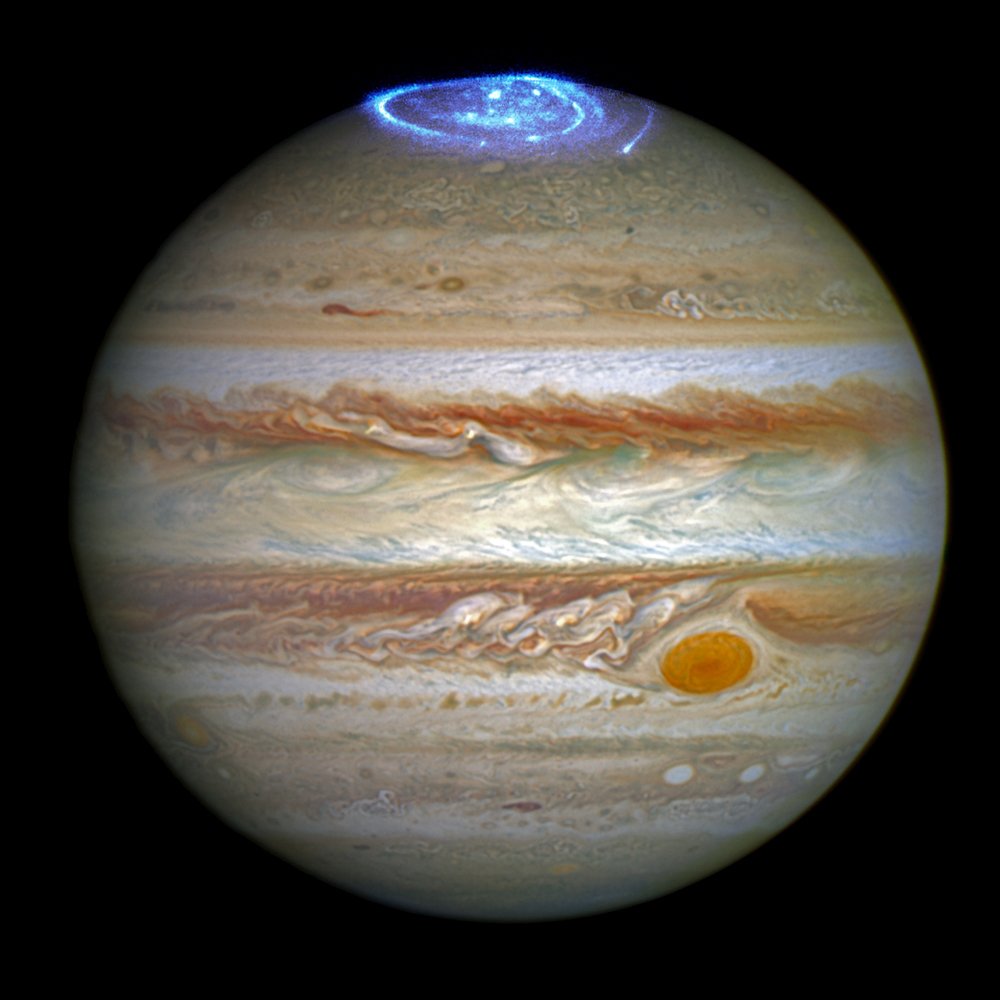
somehow, “that is going to leave a mark” comes to mind. could solar ionization play a role in the ozone hole? for example, is ozone produced at the poles in winter?
What stuck me odd about that is that its not arourae. Where is the southern one?
The top one look seriously offset so maybe the it’s around the back from this view. There seems to be considerable mis-alignment of the magnetic and rotational poles.
That’s already beautiful image, I expect we will see some interesting stuff coming back in the next few days. I hope the probe stands up to the environment they are throwing it into, long enough to get some good data back.
It’s a real kamakazi mission, it will be plunging into very hostile conditions .
more here
https://youtu.be/3O8ds7_9n_o
planetary magnetic axis alignments
http://lifeng.lamost.org/courses/astrotoday/CHAISSON/AT313/IMAGES/AT13FG09.JPG
listen what happens when Juno enters Jupiter’s magnetosphere
https://youtu.be/8CT_txWEo5I
A friend sailed to Aruba via several other Caribbean islands a couple years back. Thinking I’d want sum rum, he asked me what I’d like him to bring me back. I asked him to look for both of us some R-12 refridgerant for our old cars and his boat’s fridge and freezer. I ended up with two cases of 16oz R-12 cans I used to get at Walmart for 68c/pound, NOT the $10/12oz the greedy ^%$$#$%% want now. (expletives deleted) An inspection of a can showed it was made in TENNESSEE long after Americans were not allowed to buy it to “save the ozone hole” BS. The rest of the world can still buy 16oz for less than a dollar, dammit!
Larry , not exactly the same thing but during the second world war my father in law was in the American Third Army as they collided with the Red Army in Czechoslovakia at the end of the war. As you might imagine soldiers from both sides were pretty chummy after having defeated the Nazis so Dad noticed that the Russians were mounted in Studebaker duce and a halfs and pointed it out to one of the Russians there as an interpreter “I see you’ve got Studebaker trucks” to which the patriotic Russian proudly replied “yea, yea—we make them in the Soviet Union”
the energy coming from the sun has a chi-square distribution but the top can shift a bit, to the left or to the right, depending on the solar polar magnetic field strengths.
As it shifts, the amount of energy below the curve (TSI) remains more or less the same but if the solar field strengths are lower, obviously more of the most energetic particles can escape. This affects all reactions TOA that produce ozone, peroxide and nitrous oxide.\
e.g.\
ozone is increasing, not only above the southern hemisphere:
In turn these substances affect the amount of UV reaching the oceans, hence we are currently globally cooling.
Interestingly enough, after looking at the A-spectra of ozone and hydrogen peroxide I was stunned. They are exactly the same, i.e. they do exactly the same job: protect us from the most harmful rays coming from the more sun. So there never was a ozone “hole” either. Another big hoax. Obviously, above the oceans, more OH radicals are present and the peroxide is formed preferentially to ozone [doing exactly the same thing as ozone]
@ur momisugly HenryP…I think that this remark of yours “…the energy coming from the sun has a chi-square distribution but the top can shift a bit, to the left or to the right, depending on the solar polar magnetic field strengths…”, very likely correlates with my idea that the shift in sunspot dominance between hemispheres is what causes the ENSO region to shift it’s sign. In the back of my mind, I thought that what I was looking at had to do with angular changes to incoming radiation. Which is the best way which I can think of for explaining what may be occurring.
The reason I first came to think about this was from looking at the Silso N/S hemispheric changes…http://sidc.oma.be/silso/monthlyhemisphericplot
I immediately recognized, around 3 years ago, from viewing this low resolution graph that the hemispheric shifts in northern sunspot dominance correlated exactly with the cooling from the late 1940s to 1976/77. While the shift towards southern hemisphere dominance correlated with the warming trend we have experienced since 1976/77. Then when David Archibald made a post last year where a high resolution graph of the shifts from north to south could be seen in detail, I was able to cross reference every shift from north to south with shifts in the ENSO regions from negative back to positive conditions. So I also immediately recognized that your words which I first quoted are very likely the reason why the hemispheric sunspot change leads to changes in the ENSO regions, in my opinion.
low solar activity
http://www.woodfortrees.org/plot/sidc-ssn/from:1972/to:2016/offset:10/trend/plot/sidc-ssn/from:1927/to:2016/plot/sidc-ssn/from:1927/to:1972/trend/plot/sidc-ssn/from:1927/to:2016/trend
most certainly means lower solar polar magnetic field strengths meaning more of the most energetic particles being released from the sun.
The sun is now at its brightest and most dangerous to humans in 87 years….don’t go in the sun without a hat! The atmosphere is trying to protect us making more ozone, peroxides and nitrous oxides. Sadly, nobody started even looking at the latter two chemicals up there…
I live in the mountains of Northern California. I had noticed over the last 3 years, in particular, that the Sun seemed to feel hotter than I had ever noticed before. And I do pay attention and notice things in my life. Of course, there is also the fact that my hair has thinned considerably over the last decade or so.
Hallo [this actually means: good health to you]
I live in Pretoria, South Africa and I have noticed the same thing. Compared to 40 years ago when I arrived here, the sun definitely feels hotter on my skin. I started not going out into the sun without a hat when I realised what is going on. Skin problems are definitely on the uptick here.
Paradoxically, as the atmosphere is protecting us against more of the most energetic particles being released from the [more spotless] sun, it causes more ozone, peroxides and nitrous oxides being formed TOA, causing global cooling, because these substances deflect more UV off from earth.
Go figure.
Hallo, to you!
again, what I was trying to say here is not go out in the sun without a hat, especially when your hair is thinning…
No further info on this for some time? Why?
http://www.nature.com/news/2007/070924/full/449382a.html
it doesn’t fit with the “healing” narrative ,so i doubt it would pass pal review.
Because the experiment on which it was based was shown to be flawed by at least two independent studies.
LInks to such studies Phil?
Here’s one of them:
http://science.sciencemag.org/content/324/5928/781.full
Basically Pope used a method for preparing Cl2O2 which had an impurity present and gave erroneous results.