
Guest essay by Eric Worrall
Renewables in their current form are a nonsense solution to the world’s energy needs. However, there is a combination of technologies which could make solar power a significant, reliable contributor to the World’s energy needs. But I doubt any green will rush to embrace it.
How do we make solar power reliable? The problems which make solar power unreliable are mainly related to weather – clouds, rain, snow, winter, poor air quality, anything which interrupts the flow of light reaching the collector.
The solution is to put the solar panels beyond the reach of all these problems – by putting them into orbit. Launching solar panels into orbit might sound far fetched, but it is being seriously considered by a number of national space programmes.
Space-based solar power (SBSP) is the concept of collecting solar power in space (using an “SPS”, that is, a “solar-power satellite” or a “satellite power system”) for use on Earth. It has been in research since the early 1970s.
SBSP would differ from current solar collection methods in that the means used to collect energy would reside on an orbiting satellite instead of on Earth’s surface. Some projected benefits of such a system are a higher collection rate and a longer collection period due to the lack of a diffusing atmosphere and night time in space.
Part of the solar energy (55–60%) is lost on its way through the atmosphere by the effects of reflection and absorption. Space-based solar power systems convert sunlight to microwaves outside the atmosphere, avoiding these losses, and the downtime (and cosine losses, for fixed flat-plate collectors) due to the Earth’s rotation.
Besides the cost of implementing such a system, SBSP also introduces several new hurdles, primarily the problem of transmitting energy from orbit to Earth’s surface for use. Since wires extending from Earth’s surface to an orbiting satellite are neither practical nor feasible with current technology, SBSP designs generally include the use of some manner of wireless power transmission. The collecting satellite would convert solar energy into electrical energy on board, powering a microwave transmitter or laser emitter, and focus its beam toward a collector (rectenna) on Earth’s surface. Radiation and micrometeoroid damage could also become concerns for SBSP.
SBSP is considered a form of sustainable or green energy, renewable energy, and is occasionally considered among climate engineering proposals. It is attractive to those seeking large-scale solutions to anthropogenic climate change or fossil fuel depletion (such as peak oil).
SBSP is being actively pursued by the Japan and China. In 2008 Japan passed its Basic Space Law which established Space Solar Power as a national goal and JAXA has a roadmap to commercial SBSP. In 2015 the China Academy for Space Technology (CAST) briefed their roadmap at the International Space Development Conference (ISDC) where they showcased their road map to a 1 GW commercial system in 2050 and unveiled a video and description of their design. A proposal for the United States to lead in Space Solar Power has recently received high level attention after it won the D3 (Diplomacy, Development, Defense) competition sponsored by the Secretary of Defense, Secretary of State, and USAID Director. As of May 21, 2015, there was an on Change.org and a second active petition at Whitehouse website.
Read more: https://en.wikipedia.org/wiki/Space-based_solar_power
The obstacle to space based solar power is obviously the launch cost. If you are paying thousands of dollars per kilogram for payload delivered into Earth orbit, launching thousands of tons of solar collector equipment is a sure route to a very expensive solar space station.
So how do we bring down the launch cost? There are a number of technologies on the drawing board, but lets stick with known technology, preferably a technology which has already been tested to some extent.
There is one cheap space launch technology which stands out – simple design, high thrust, high impulse, based on well understood engineering principles, capable of economically launching thousands, even millions of tons into any orbit you want, using a single stage launch vehicle. The only problem is the fallout.
Project Orion was a study of a spacecraft intended to be directly propelled by a series of explosions of atomic bombs behind the craft (nuclear pulse propulsion). Early versions of this vehicle were proposed to take off from the ground with significant associated nuclear fallout; later versions were presented for use only in space.
The idea of rocket propulsion by combustion of explosive substance was first proposed by Russian explosives expert Nikolai Kibalchich in 1881, and in 1891 similar ideas were developed independently by German engineer Hermann Ganswindt. General proposals of nuclear propulsion were first made by Stanislaw Ulam in 1946, and preliminary calculations were made by F. Reines and Ulam in a Los Alamos memorandum dated 1947. The actual project, initiated in 1958, was led by Ted Taylor at General Atomics and physicist Freeman Dyson, who at Taylor’s request took a year away from the Institute for Advanced Study in Princeton to work on the project.
The Orion concept offered high thrust and high specific impulse, or propellant efficiency, at the same time. The unprecedented extreme power requirements for doing so would be met by nuclear explosions, of such power relative to the vehicle’s mass as to be survived only by using external detonations without attempting to contain them in internal structures. As a qualitative comparison, traditional chemical rockets—such as the Saturn V that took the Apollo program to the Moon—produce high thrust with low specific impulse, whereas electric ion engines produce a small amount of thrust very efficiently. Orion would have offered performance greater than the most advanced conventional or nuclear rocket engines then under consideration. Supporters of Project Orion felt that it had potential for cheap interplanetary travel, but it lost political approval over concerns with fallout from its propulsion.
Read more: https://en.wikipedia.org/wiki/Project_Orion_%28nuclear_propulsion%29
I doubt greens are going to rush to embrace a renewables solution which involves the release of atmospheric nuclear fallout, even if that fallout could be constrained to safe levels. But if the future viability of the planet was really at stake, and if nuclear power was unacceptable for whatever reason, solar power satellites could realistically and reliably deliver the energy our civilisation needs, with minimal carbon emissions, other than whatever was emitted during the construction of the components.
Vacuum tube electromagnetic gun embedded in Mt Kilamanjaro is the ticket @elonmusk.
I guess it will be powered by Elon Musk batteries
Ba Dum Tiss
More like Elon Musk hot air.
Rail guns are becoming practical weapons. Scaling them up to launch materials into space seems like a pretty straightforward engineering problem.
More to the point, wind in good locations is practical and cost effective today without subsidies. Solar is getting close. Provided you only want to use them for 20-30% of energy supply. Much above that and you need massive inter-regional transmission facilities like the European Supergrid concept. People talk about batteries, but transmission is about 10x more cost effective for the same services.
The failure of renewables in Europe is because of excessive government intervention. Feed in Tariffs are a form of inefficient central management. The US uses a competitive bidding process, so our costs are much lower. If we used the model of having the Federal utilities (BPA, TVA, WAPA, SRP) finance and own the wind and solar project like they do most of the hydro projects in the country, they could achieve wind costs in the low $20s/MWh and solar in the low $40s/MWh today without subsidies. This is in line with wholesale energy costs. These technologies are capital intensive and these entities have very low borrowing costs, so they’re a good fit.
Even more to the point, in what world would nuclear bomb powered rockets be more acceptable than nuclear power plants?
The only cost effectively decarbonized electricity network that doesn’t rely on hydro is in France. Their energy costs are low (for Europe) and reliability is high. Waste isn’t a real issue. Reprocessing technology has existed for decades. It is poo-pooed today because it is more expensive than getting new uranium from the ground. Safety isn’t a real issue. Nuclear is far safer than any other energy technology (including solar – installers fall off roofs). Cost isn’t a real issue. US nuclear costs about 3x as much as South Korean nuclear because of our regulatory structure, not for any real technical reason.
The only real issues are perception and over-regulation – and they have solutions. Identify nuclear development zones where the plants will be safe and welcome by the locals, build lots of plants in those areas. Add transmission as necessary. Wyoming would be happy to host a few dozen reactors for California. West Virginia is begging for jobs and could provide nuclear energy to most of the East Coast. Reform the regulatory model to copy the successes of other nations.
Read “The Moon is a Harsh Mistress,” by Robert Heinlein.
You are far more optimistic than I about the long term viability of renewables, but I will agree with your solution. More research and long term development are the key to any future.
You’ve obviously never done the calculations for a rail or light gas gun launch system. Here’s a hint: it takes many, many kilometers of gun to launch into an elliptical orbit assuming you’re not just launching bulk goods which can withstands 10s to 100s of g’s.
Wind is not cost effective even in good locations today without subsidies. Wind still relies on the implicit subsidy of feed in tariffs and the PTC of $0.02/kWh. And none of this addresses the cost of backup power to cover their intermittency. The problem with renewables is not the regulation. Regulation and subsidies are the only things keeping them afloat!
And if you think utilities can scale up the application of renewables just because they’re capital intensive-they’re also quite labor intensive-you need to explain why solar city has been such a financial disaster.
In my opinion the best place to put nuclear power stations is under the ocean. That is because the ocean itself protects them from many dangers such as earthquake, aircraft collisions and tsunami (at the bottom of the ocean the effects of a tsunami are minimal). And also because if there is a problem such structures will fail safe. If Fukushima had been a submerged structure then opening the doors and flooding the thing would have immediately ended the problem with minimal contamination. Fukushima turned into the mess it became mostly because they couldn’t get enough water in there fast enough to stop the reaction and cool it down. As for disposal, use lifting buoys to tow the entire structure to the deepest ocean trench and drop it there. Find a subduction zone if possible,Ten miles down buried in ocean muck is a pretty safe place for the long term disposal of radioactive material.
vboring June 1, 2016 at 6:29 am: “Rail guns are becoming practical weapons.”
I read the other day that the U.S. military has a new railgun they claim has a 135 mile range. They claim it is “unstoppable”.
China is desperately trying to hack into the developer’s site to steal the technology. My question: Why do these U.S. guys need to connect their databases to the internet? Are they incapable of developing without doing this?
“Rail guns are becoming practical weapons.”
Railguns are no closer to being practical than they were 100 years ago. They got one to work in a lab, whoopiee. They were making them work in labs 100 years ago. You can find articles about them and coilguns in Popular Mechanics in the 1920s and 30s.
The problems now are the same as back then. No material exists to build the rails from that can withstand the forces of firing for any length of time. You need something as conductive as copper with the melting point of tungsten that is several times the strength of steel. Anything else is going to be scrap metal within a few shots if you operate it at the power levels necessary for a weapon, as happens with the current lab toy the Navy has.
The articles you are seeing are nothing more than sales brochures, trying to hype up the technology to get yet more funding from congress so it can become the next F-35 fiasco.
There are far more fruitful areas of research. Light-gas guns have potential, but conventional gun technology has a lot to offer as well. The 16″ guns of the Iowa class were only 50 calibers long. In small arms terms, that is a 30 caliber rifle that only has a 15″ barrel. High velocity small arm calibers like the 22-250 often have a barrel that is 100 calibers in length.
A 100 caliber 16″ smoothbore that uses fin stabilized sabot rounds of 8-12″ in diameter that are either rocket assist or base bleed would easily get 100+ miles in range. Granted you couldn’t (easily) mount such a gun in a turret, but would probably have to put it in a ship facing forward with only a limited traverse and aim by steering the ship. Not a problem when what you are shooting at is 100 miles away.
The 16″ guns of an Iowa could fire 2 shots a minute. Something like I outlined above could probably be loaded in a similar amount of time, but even if we cut the rate of fire in half, to one shot a minute, it is still a significant amount of firepower for significantly cheaper than missiles. Probably fit two guns side by side on a cruiser sized ship and build a dozen or so of them. Then you can have as many or as few as you want in one place for fire support.
Of course all that uses largely proven technology that wouldn’t cost a ton to develop, o nobody is interested.
Stop being so Terra-centric.
Launching all the mass needed to build solar power satellites (SPS) from Earth to orbit can not part of the solution.
So far, even the space agencies that have considered this solution to the generation of electricity just don’t get it.
Heavy industry and power generation need to be moved off of the earth into orbit. We need to mine the moon and the near earth asteroids for raw materials and we need to process those raw materials in orbit. In 20 years not an ounce of material should come from ground based factories.
This is a 40+ year old idea. We’ve been thinking about it for a very long time. Every objection you can think of has been raised and dealt with in detail before many of you were born.
The power density of the microwave transmission is to low to fry anyone or anything.
(SPS) can’t be used as an energy weapon.
Every piece of technology needed to do it has been developed and is being tested right now.
It will orbit at 22,000 miles above the equator in geosync orbit, the same orbit as comsats and weather sats do now.
Taking everything up from earth is OK to begin with, but in the long term we need to mine the moon and asteroids for the raw materials to build them.
“That guy” in the 70s was Gerard K. O’Neill, a Princeton physicist who asked his students where a technologically advanced civilization should be based? Their answer was “in high earth orbit. Read his books to understand his vision.
Orion just isn’t going to happen. It’s not a part of this.
Go visit SSI.ORG for more.
As a long term solution, maybe, but then you need the initial forge and drilling operation to get up there. You’ve not changed the mission, just the end goal.
An average French Nuke is a 1GW affair; that is Electricity on the grid peak power I presume.
To do that with present earth based hi tech silicon single crystal solar cells at say 25% AM1.5 solar to DC electric; shall we say 20% AM1.5 solar to Grid AC electric, would require 4 million square meters of solar cells, oriented normal to the sun vector.
That’s actually a 2km square array.
Well you would have to break that up into a more practical array size to be fully steerable over the daily sun movement. I can’t imagine that they would want to be bigger than say 20 m square of 400 square meters per module, so that’s only 10,000 units; just a fraction of the Ivanpah / Tonopah mirror count, but I don’t think those mirrors are quite that large, so I am thinking quite large steerable units.
But like those desert KFC plants, you need to space the steerable arrays far enough apart to not shadow each other at any time during the working day.
So the committed land area may beat least five times that size, and more likely ten times.
Seems like it would need to be as big or bigger than I / T to replace one French Nuke
Well you wouldn’t have 24 hour on time, but that is not too big a deal.
Personally I’m of the opinion that it is preferable to NOT use steerable modules. Too costly and too complex.
A flat array basically horizontal to the ground, can use far less land area than steerable arrays, with some obliquity penalty thrown in.
Even so it takes a lot of solar panels to replace a single nuke, and that is just for the working period.
Now I’m not presenting this as an ideal solar PV farm. I think for ground based arrays, the use of non-imaging optics trough stationary arrays is the better approach; rather than steerable.
The sun moves +/- 23.5 degrees in zenith angle over the year, and that can be covered, with a stationary trough and a single axis magnification of 2.50 .
So the cells would be seeing about 2.5 kW per square meter at local noon.
With the cells stationary, it would be fairly simple to run cooling water through a heat sink mounting, to keep the Temperature down. I don’t think you need active cooling (refrigeration).
Well I don’t want to do a complete design right here, I’ve gone through it often enough; just never had the incentive to build my own.
I think space collection of solar energy destined for earth is just a fairy tale. And I’m not even thinking of the energy to get all the hardware up there. And the accelerated decay of the cells is just one of the space problems.
G
Hi L5Rick. Love your handle.
I always liked the “inflatable balloon” SPS design. You launch a one-mile-diameter balloon, deflated, and covered on the outside with flexible solar cells, into orbit, and then inflate it once it is in orbit. I believe it would take about 40 pounds of helium to inflate the structure.
You don’t have any pointing issues with a sphere. Half of it will always be in sunlight.
As for a heavy-lift system, all you need to do is revive the Space Shuttle launch system or something similar. The Space Shuttle launch system could put over 100 tons of cargo in low-Earth orbit, if you substituted a cargo-carrier for the space shuttle on the launch stack.
And with the advancements made lately, they could make the Space Shuttle Launch system, or something similar, even more economical by using reusable boosters.
If you are interested in space development, the Space Studies Institute promoted by L5Rick in his post, is a very good place to go.
Concur, except for demonstration projects. Using lunar materials is the way to go.
BTW, folks, in space design “large” (and SPS’s are VERY large) doesn’t mean heavy. The structure can be relatively flimsy by terrestrial standards.
The technology behind the SPS has been well proven and demonstrated several times. We are now getting to the point where they can be cost efficient.
The standard for microwave power transmission is 23 mW per sq cm ==> 230 W per sq M at beam center, tapering off toward the edges to 1 mW per sq cm.
So even with no tapering (full power over the whole collector), a 1 terrawatt beam takes 4,347,826,087 sq M or 4,337 sq KM (bigger than the land area of Rhode Island).
So let me guess. We are going to put some super batteries up in orbit, and charge them up, up there free of clouds. Then once they are fully charged, we drop them back down to land on an Elonmuskobile, to be sent by his vacuum tunnel to where the juice is needed and plugged into the system.
Meanwhile the discharged batteries come back to the launch pad to go fly back to space.
What !! You think there’s a better way to get that space generated electricity down to earth. You’re going to WHAT ! turn it into electro-magnetic radiation and radio it down to earth ??
What a great idea. The problem we have now is that the solar energy beaming to earth in a 30 arc minute conical beam (almost), only has an irradiance near the earth surface of about 1 kW per square meter, and it takes too much land to catch it all.
So now what did you pick for your new EM radiation beam frequency or wavelength ??
You would need to find something that comes through the atmosphere with less absorption or scattering, than the present 250 nm – 4.0 micron wavelength band that we have now.
You would also want to be using a high enough frequency for your new TsR (Total satellite Radiance), so that the irradiance on the ground is higher than 1kW per square meter, or else you would need even larger antenna arrays than are now required for sun spectrum EM radiation.
Well I’m all ears; do tell what your chosen spectrum of re-emission is going to be.
Maybe a geo-synchronous orbit tether ed satellite could be connected to the ground by a big electric cable.
I think I’m going to go and buy a nice rocking chair, and go and sit outside to watch this thing work.
G
Re this and previous post. No, you don’t break up the panels “for maneuverability” the whole SPS (and the usual figure for an economically viable SPS is 10 square kilometers) stays pointed towards the sun. Just because a satellite is geosynchronous doesn’t mean that it always faces towards Earth! (The antenna, of course, is on a gimbal).
What’s this “drop batteries” stuff? The power is transmitted back, either by microwave or IR laser.
Marshall Savage had a similar idea in his book The Millennial Project
https://en.m.wikipedia.org/wiki/The_Millennial_Project:_Colonizing_the_Galaxy_in_Eight_Easy_Steps
The SPS has been studied for over 30 years. Lots of ways to do it.
Woo Hoo! Orion is something to make the green blob go into a meltdown. Agreed, solar is not practical ground based, and especially without useful storage. It is interesting, though, that the greens will deny that storage is a real issue and cite imaginary installations. Even though the actual risks of radiation are usually overstated, it is something of a risk, and a proper cost-benefit analysis should be done with real numbers.
Solar cells still have a very short lifetime of a couple decades or so. How does this figure into the scheme?
Wikipedia article mentions 8 times more damage in space. That means replacement every 2 to 3 years. A never ending supply from Earth. A catastrophic impact would create so much space junk that you wouldn’t be able to fly a space mission for years to come.
“Alex June 1, 2016 at 12:05 am”
Space junk is already a problem for space vehicles and satellites etc and, like climate change, there is sweet FA we can do about it.
Great, how ingenious. Get around the concerns of an explosion leading to a breach of containment leaking highly toxic radioactive materials in the atmosphere by ENSURING that there is an unconstrained nuclear explosion dumping highly toxic radioactive materials directly into the atmosphere.
Cut out the middle man ! A stroke of genius.
Hey let’s restart airborne nuclear testing while we’re about it. Bikini Island 2.0 , way to go !!
I’ve read some dumb shit ideas in my time but this has to be the winner.
I’m with Greg. Why are we even talking about Orion? That was an interesting thought experiment, but the environmental damage alone is insane, much less the potential loss of human life due to routine nuclear blasts.
Alex, why did you have to go and spoil the fairy tail ??
Just as it was getting to be a fun read.
So ground based solar cells take up too much space to collect sun at 1,000 watt per square meter (and say 25% efficiency).
And we are going to lower that irradiance at a different frequency, and convert it to as much usable electricity, with a much bigger antenna.
Well say goodbye to that Southern California waste desert land project that was going to put up 30,000 square miles of silicon solar cells. (the exact same size as the entire ANWR.) So Ok maybe we will need 300,000 squ miles.
That’s for about one ordinary Nuke’s worth of electric capacity.
G
The greenies have calculated the efficiency of space based solar is infinitely greater than space based wind mills. Infinite! Can’t get better than infinite!
You replace them. And no, not from Earth, at least not for very long. The nice thing about building in space is that you can trade size for cost. Photovoltaic cells made by depositing the semiconductors on metal foil are less efficient, but much cheaper than glass cells.
Hmmm, I’m pretty sure there is a world wide ban on “Weapons in Space”, for a good reason…
Indeed! Imagine the damage one could inflict by redirecting a couple of terrawatts of concentrated microwave energy at some point on the ground. Dr. Evil will finally have access to real killing power from space!
You are absolutely right. Any energy beam that can be directed and focused on a collector can also be focused even more so on a target. Star Wars technology orbiting over their heads would or should not make anybody happy, even those whose country put it up, a such a weapon can easily be turned on the citizens.
Unless we succumb to a totalitarian one-world government, energy transmission from space is NOT viable. In such case, the energy beam would still be a weapon to use to quell any rebellion against the one-world order power-elite.
It doesn’t even have to be intentional. Suppose the beam steering computer failed – a terrawatt beam wandering across the landscape.
Please get educated about the technology. There is no way a couple of terrawatts of microwave energy could be concentrated at some point on the ground. That is not how this works. We’ve been studying this for over 40 years. Every objection you can think of has been address.
A great idea, used in at least two James Bond movies.
First off, while the beam may be terra watts, on any square millimeter of ground it’s only a few milli-watts.
Secondly built in fail safes. If the monitoring computer detects any problems with the guidance system, it shuts down the beam. Add several layers of backups just to be sure.
Sure, didn’t Google’s self driving automobile have all those safety features when it ran into that bus? I spent over 35 years working in/on/&around system reliability, both hardware and software. There is no way in hell I would trust current technology with something as potentially dangerous as transmitting several megawatts of power from space back to the earth in a usable form. Take a look at the additional costs of designing and building a medical system. Try to put that in orbit with the ability to continuously transmit multiple megawatts of power in a concentrated beam and it would add at least one, more likely two or three orders of magnitude in both costs and complexity.
The power is transmitted by a phased array. Safety measures would be in place to ensure that the beam cannot be collimated or focused smaller than the receiving antenna, and if lock on the receiving antenna is lost the beam automatically and instantly defocuses to drop the intensity to near zero.
It should be noted that everything about an economically feasible SPS is BIG. The photovoltaics are on the order of 10 square kilometers, the transmitting antenna is a kilometer wide, and the receiving station, which would normally be in the desert, is 10 km wide or so.
The receiving station, BTW, is not a parabolic antenna. It is a flat array of “rectennas” – integrated antennas/rectifiers – and would look like nothing more than a net strung on poles. Nothing underneath would be effected.
L5Rick: My professional specialty at one time was high-energy laser weapon system design, and you are clearly not educated about the technology. Microwave transmission of SPS power beams would be accomplished by phased-array transmitter antennas, as established by the original Peter Glaser studies. Beam steering (centered on a rectenna target) and wavefront shaping (intensity profile) would occur by manipulating the phase differences among the array elements. This is a software problem. Phase adjustments could just as well concentrate the beam on its diffraction-limited focus at that distance. Maybe you can pick the distance so that there is not much focus that can be obtained. Good for you. But at any nearer distance (other space vehicles in the vicinity), the beam can be focused to killing intensity…which needn’t be a problem if you have gigawatts to play with (I have a hard time believing in terawatts; the system would be enormous).
and if you think that the Russians and Chinese have conceded command and control of the Satellite “brains” of the modern battlefield to the USA and Europe without deploying “weaponized” capacity to eliminate it you are more naive than you should be…
Total nonsense
But thought provoking, so it has its merits.
What is thought provoking is the length of the list of things that could go wrong.
I agree there is a lot which could go wrong. More a thought experiment than a blueprint 🙂
I think the Germans call this a gedrunkenexperiment.
@ur momisugly jorgekafkazar
The German word is “Gedankenexperiment” meaning “thought experiment.”
What was that *whoosh* over Roy’s head?
@Roy,
What would they call a thought experiment performed at 2 am in a ratskeller performed after a long night of heavy drinking?
Now re-read the comment
@Roy
No, ‘Ge drunken experiment’ was quite right.
Well, the first axiom is wrong. Carbon neutral is a fool term. Environmentally is better to be carbon positive (increase CO2 levels, so plants can grow more and feed more animals) But greenies are so wrong that they are barking at a lamppost, thinking that it is a tree.
jorgekafkazar on June 1, 2016 at 12:09 am
I think the Germans call this a gedrunkenexperiment.
In german such narratives live as ‘Lügen-Baron Münchhausen’:
https://www.google.at/search?ie=UTF-8&client=ms-android-samsung&source=android-browser&q=Baron+M%C3%BCnchhausen&gfe_rd=cr&ei=us1PV7ObEouC-waCmoGgCQ
Utter nonsense
Tesla is so . . . yesterday.
I agree. This idea has been around since the dawn of the space age. It was nonsense then and it’s nonsense now. It’s a ridiculous solution for a problem that almost certainly doesn’t exist.
Peak oil was mentioned as one problem. Just a small problem with that: we’ve been at “peak oil” for many decades and right now we’ve got the stuff coming out of our ears and the world has practically run out of storage space for oil.
By 2050 the CAGW scare will probably be a distant memory and today’s doomsday predictions will look ridiculous. Hopefully by then climate science will have regained its integrity, and people like Hansen and Mann will be a laughing stock.
Although I won’t live to see it, I’m quietly confident that the second half of this century will be dominated by fusion energy. The only question is, what kind of fusion will it be, hot or cold?
Nobody can predict the future. But I seriously doubt that orbital solar power stations will ever be viable, as there will always be cheaper and better solutions (obviously not wind or ground based solar).
Chris
Oil production followed the Hubbert curve very closely, until it didn’t.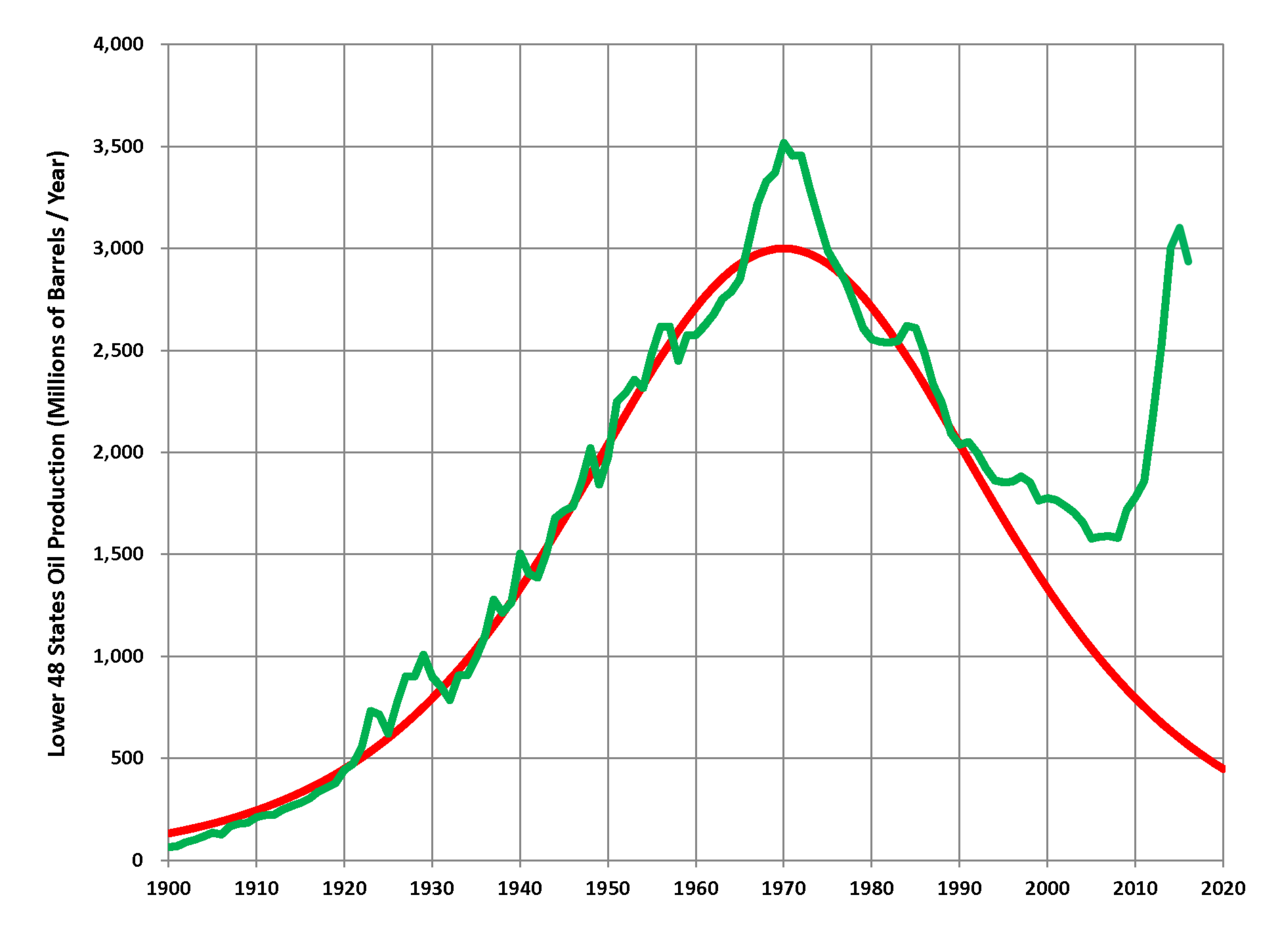
SPS would be useful for powering things out in space. Jeff Bezos claims he is going to put a bunch of industry in orbit, so he will need a lot of power.
project Orion technology is not suitable for earth launch. however, for interplanetary and especially interstellar travel it would be fine. it is the only technology currently known that would permit travel to neighboring stars within a human lifetime. stars that have a high probability of earth like planets.
Given that there were tens of thousands of nuclear warheads produced over the past 70 years, for interplanetary and interstellar travel why not? the solar wind would quickly sweep the solar system clean of the fallout, as would the larger galactic cosmic wind in deep space.
Oh, yes: If you read the literature, you will learn that the system concept was established to be workable from Earth surface to space…but they also had a back-up plan for using a chemical booster to get it above the atmosphere before engaging the fission detonation drive. After that, who cares? Space is radioactive anyway (check your dosimeter).
for my part I’d be happy to see the tens of thousands of nuclear weapons produce over the past 70 years used to fuel an interstellar mission rather than leave them on earth.
Those tens of thousands of warheads produced over the last 70 years get recycled, not stored. It’s their nature to rapidly decay. As to the use in an interstellar spacecraft. Just what material do you propose to use as the surface they work against? Ablative perhaps? How many tons per explosion x how many explosions? this isn’t a concept worth talking about.
Nope. Totally practical.
Then, when we are totally reliant on SBSP and could not live without it:
http://www.smh.com.au/technology/sci-tech/catastrophic-avalanche-of-space-junk-could-wipe-out-satellites-within-years-20160531-gp8415.html
and
I think the natural way of creating large Solar Power Satellites in space is simply to get rid of most of the material lifted from the earth. Capturing one small asteroid in space radius 10 m to simplify calculations would provide 16000 tons of material assuming a density of 4g/cm³.
We are in the middle of a very fast development of 3D printing technology where melting non-metallic powdered material to form ceramic structures or direct printing of metals is possible. The end result is that most of the captured mass could be used and the amount of waste probably would be fairly small.
The value of the small 10 m radius asteroid would be roughly $16 000 000 000 at today’s lifting cost. Of course the price of material in space would drop extremely fast after the first capture.
This means that the first step in building large structures in space is to develop the technology to capture the raw material already there and also to develop the technology for processing the raw material.
I have a strong feeling that mankind will never build any much larger structures than the International Space Station from components lifted from the ground. Big structures will be built using some form of 3D printing technology where even the printing machinery is made in space and only critical microelectronics is lifted from the ground.
Where do you propose to get the energy for this space printing not to mention getting an asteroid into Earth orbit or lifting all the gear into orbit? Just put nukes on Earth (like the French) and deal with the waste.
Solar powered ion rocket. Sure it will take years to move the asteroid into earth orbit. But it will be cheap.
Probably the easiest starting point would be nuclear. Think a highly enriched high temperature military reactor adopted for space use. A high temperature reactor provides process heat directly for some material processes … no need to use electricity to produce heat. When there is an excess of silicon solar cells can be produced. High power means large surfaces to get rid of heat are needed.
Capturing a small asteroid has been studied for many years. If you know the orbit of the asteroid you can nudge it slowly to enter a new orbit that allows it to be captured by the Earth/Moon system. Very little energy is needed for this if capture times of years or decades are acceptable. Complications are of course that the asteroid may be tumbling. Initially only very small masses of perhaps a few tonnes will be captured but later surely technology will be developed to capture fairly big ones. Capturing near Earth asteroids and using them for material will with time clean the near Earth space from dangerous asteroids … but this time is probably far in the future. Today even small ones would be very interesting.
It is interesting to notice that there are classes of technology that becomes very much easier to handle in space where there is an almost perfect vacuum available for free with no need for any pressure vessel. If it is correct that the Bussard Polywell scales proportional to R⁵ and only a very light container is needed then things could be interesting.
For 3D printing of large structures lack of power means slow speed. On the other hand 3D printing in microgravity allows design of extremely light structures that would be impossible to create down on earth but still strong enough. Think printed structures as light or lighter than Bigelow’s modules but printed in place.
Lars, don’t let them greens know about
Capturing a small asteroid has been studied for many years.
____________________________________
You can’t ruin the asteroid belt ‘environment’, destabilizing by freely mass reduction : that whole thing will shotgun the solar system.
Instead of Mars, I think the next big task is we should design and build a tug, a small cabin, big nuclear power source, and a wall of ion drives that would move a small moon (figuratively of course) and attachment points to mount it.
If you’re concerned about warming in excess of natural variability, why would you want to pump extra energy into the system?
Good point as far as it goes. However fossil fuels and nuclear fission (and ultimately fusion) also pump extra energy into the system. Whether that could be a problem depends on the magnitude of the added energy relative to the solar radiation hitting the earth. If the additions are trivial relative to the total solar contribution, that might not be a drawback.
Surface-based sourcing–wind, tidal, photovoltaic, etc.–just moves the existing solar inputs around. If the economics were not so ridiculous now, and in the conceivable future in terms of the limits imposed by the laws of physics, they might be be better in this respect (absent serious unintended consequences of the shifts).
Fuels and nuclear are already in the system just stored in a condensed form. This is approach defeats the whole idea of reducing the amount of energy retained by our atmosphere, in theory we could return to a preindustrial albedo and capture enough external solar energy to overheat the world if we enlarge the area and duration of solar absorption.
While surface based technologies such as wind and tidal are attempts to focus diffuse “free energy”, solar applications are an attempt to increase the energy harvested from the sun. The portion of these solar projects that increases the amount of energy retained in the biosphere obviously contributes to AGW but it is not politically appropriate to take this into consideration.
Adds energy but the Gang Green (I note in another thread a query about who coined the GG term – I confess it was I probably ~ year ago on this site.) at least couldn’t multiply it by 3 if it isn’t attended by CO2.
Well lets see, all of this supposed Global Warming is caused by the surplus of 1.5w/m^2;
The Earth’s radius is 6,371,000m, A = π * r^2, A = 1.27516117977e+14;
The surplus energy = 1.27516117977e+14m^2 * 1.5w/m^2 = 1.91274176966e+14w;
TOA insolation = 1366 W/m^2, 1.91274176966e+14w/1366 W/m^2 = 140,025,019,740 m^2.
When the Greens start talking about mining the astroid belt for material to putting 150,000 Km^2 of photovoltaic panels in orbit, we’ll know they are serious.
Many Greens would reject a viable energy solution no matter what it was. They don’t want cheap energy. They want it to be expensive so it acts as a limitation to population growth. Of course, they don’t want to limit their own access to energy any more than Leonardo DiCaprio wants to stop flying on private jets. They just want it to be scarce for the rest of us.
Don’t forget that jet aircraft flying in the stratosphere leave jet contrails (cirrus-type clouds) which are warming (since they are at very low temperatures, e.g. 220 K, and so emit very low Stefan-Boltzmann T^4 infrared emission to outer space, which at energy balance means a warmer surface temperature for the Earth). These clouds are formed from the water vapor produced by the combustion of hydrocarbon jet fuels, not from natural water vapor in the stratosphere (the saturated vapor pressure of water is very low at -53 Celsius) condensing around nuclei in jet exhaust. These contrails are warming even when they are formed over areas covered by low-lying clouds (e.g. cumulus clouds) in the troposphere, not just over cloud-free surface (land and ocean) areas. So Leo et al. ought to be flying in the rougher weather in troposphere, but that would mean slower speeds, bumpier rides, and less fuel efficiency (i.e. burning even more fossil fuels which produce unwanted CO2). Or just shutting up and staying at home, within bicycling distance of all destinations (electric cars must have their batteries recharged by electric power generated mostly by non-solar or non-windmill sources).
Leonardo DiCaprio
===========
what? you mean his jet isn’t solar powered? flying above the clouds would seem a perfect application for solar, to demonstrate just how practical the technology is. take off is no problem, just us a long extension cord. landings you should be able to glide in like the space shovel.
1 solar flair and sizzle
lol flare!
Yes, but the sun can flare with flair.
I also seen a cooky story somewhere about taking power from the VA belt.
Soon as they figure out how to protect astronauts from the particles.
Oh, they solved that before the moonshots! Didn’t anyone tell ya?
They didn’t solve the danger from particles, they lived with it, and dodged the bullets (so to say). Of course the danger wasn’t exactly publicized, was it? Neither were the risks inherent in the Space Shuttle program, for which the design engineers expected a “loss of hull” every 200 launches. They weren’t really wrong, were they?
brians356 June 1, 2016 at 12:46 pm wrote: “They didn’t solve the danger from particles, they lived with it, and dodged the bullets (so to say). Of course the danger wasn’t exactly publicized, was it? Neither were the risks inherent in the Space Shuttle program, for which the design engineers expected a “loss of hull” every 200 launches. They weren’t really wrong, were they?”
The engineers were fairly close. There were two shuttle loses during the program. One, Challenger in 1986, was lost through human error, when the bureaucrats at NASA ignored the engineers pleas to postpone the launch because the outside temperature was too cold for safety. The bureaucrats decided to launch anyway, and Challenger and its crew died.
The other Space Shuttle that was lost was Columbia in 2003, which was a legitimate accident.
So, NASA accomplished 133 space shuttle launches, with one legitimate accident, and one huge screwup.
Make that 135 total Space Shuttle launches, rather than 133.
thousands of tons at thousands per kilogram is still just billions of dollars, in line with costs of some other solar projects.
Can you say “SpaceX”? Try $100/kg in a year or so, $10/kg within a decade.
I saw Elon Musk on tv yesterday, and he said every time he recovered the SpaceX launch vehicle intact, it saved him $37 million dollars.
He said the previous way of operating in space was like operating an airline and throwing the entire aircraft away after each flight.
So instead of throwing $37 million away every launch, like they used to do it, SpaceX is saving that money and passing the savings on to the customers.
The SpaceX booster is supposed to be able to be reused within a matter of hours after recovery, according to the claim.
I’m not sure any have been reused yet. It will be interesting to see how they hold up in service.
2x the efficiency for 100x the cost does not seem very compelling to me.
Aye, there’s the rub.
Where did you learn your economics? Hey we’re saving the planet!!
SpaceX is developing re-usable launchers, with the goal of reducing costs by a factor of 100 or more.
Surely it must be cheaper and easier to get geothermal from the ground. Also a lot less to go wrong.
Probably not, except in very favourable geological circumstances. A geothermal station in Southampton, England, constructed at a cost of several million dollars, maintenance cost who knows, produces just about enough electricity to run the local shopping centre.
https://en.wikipedia.org/wiki/Southampton_District_Energy_Scheme
I wonder how many city rate payers know about this? Having lived in the area, Portsmouth, Southampton city council should spend money on more important issues.
It produces a little more than you are suggesting:
If the cost suggested by you is right, then it is several orders of magnitude cheaper than putting solar panels in space.
All sites have the potential to produce geothermal energy, but obviously some sites are more suitable than others both from the technical and economical standpoints. Southampton (and I lived there as a student) is not one of the places that springs to mind as being best suited for the venture.
Vast solar arrays in space is presently the province of science fiction, and it is probable that in the future there will be better and cheaper Earth bound options.
Eric,
that claim is wrong and a serious misrepresentation of both the Wikipedia article and the
facts. As Wikipedia states it is a geothermal heating system that does not produce any
electricity but rather supplies heat to over 1000 local homes (mostly council house) plus
the civic building and a local shopping Mall.
He was on the board of that geothermal company, which received at least AU$90mil in grants. Well I guess if you work only 3 days per week at AU$180k/yr you just have to find ways to pad out your income.
geothermal
=========
for the most part geothermal stations have proven to be short lived. as you remove heat from the ground, it is only replaced slowly, and the region around the pipes cools and the whole station loses efficiency.
so in the long run, the power station is limited by the thermal conductivity of the rocks, which is typically quite low.
Classic example of this is Rotorua in New Zealand.
The Southampton scheme (see above https://wattsupwiththat.com/2016/05/31/there-is-a-way-to-make-renewables-viable/#comment-2227297) has been going for 30 years.
Efficiency could be improved by launching the Southampton geothermal station into orbit and burning money for heat.
There are a few intangible advantages to geothermal energy, some of them not being perceived as advantages in some quarters. High on the list is independence: there are some corporations, administrations and governements that would not like to see groups of people completely energy self-sufficient… it might be worth a few kilometers of pipes in the ground…
There is enough junk in space as it is.
This is what Kirk Sorensen (whose expertise I – as an outsider – hugely respect) has written and said many times over on SBSP:
https://spacesolarpower.wordpress.com/2007/08/10/technical-discussion-on-power-beaming-engineers-take-note/#comment-781
Kirk Sorensen:
“I was involved with space solar power back when I was a grad student at Georgia Tech. We were doing work on super-lost space transportation systems to enable the deployment of space solar power satellites. The primary question to us was: how cheap does the “ride” have to be for SSP to make sense economically? So we had a big cost model where we made all kinds of incredibly optimistic assumptions about SSP technology: 50% efficient arrays with no radiation degradation, %0.25/kW*hr electricity costs in niche markets, giant carbon taxes on all our competition, no problems with power beaming or side-lobes, and free land for all the rectennas we’d ever want.”
“The real eye-opening moment came for me when my colleague, who was doing the cost modeling, typed in “zero” as the launch cost, and then proceeded to show me how the economic case STILL didn’t “close”. Now zero’s a pretty good number, bounding all kinds of cases like moon mining, asteroid mining, maglev launch from the ground, anything. It never gets better than zero. And SSP still couldn’t make an economic argument even at that number.”
—
In addition to Kirk Sorensen’s words, may I add my personal short list of “ideas” that will not die, but will never see the light of day:
1. Economic fusion reactors! In our lifetime!
2. Helium-3 fusion
3. Helium-3 fusion ON THE MOON.
4. Cold fusion
5. SBSP in our lifetime
6. Economic SBSP in our lifetime
If you like these things, fine, go ahead and dream about them. But if people professionally work on such things and create the illusion that one of these ideas is “the next big thing” and start wasting resources on it, then I get somewhat unsettled.
As much as I want progress, and technology, and space travel, I am afraid Kardashev will have to wait some more…
I’m not suggesting that SBSP is a good idea, its way too expensive. I was more interested in exploring a means by which reliable renewable power could be delivered for a price we could hypothetically afford.
An interesting diversion, Eric. If a greenie and a politician get wind of it, they’ll have a billion blown on it by morning.
See: http://fusion4freedom.us. Check out fusion news section. The issue is not science but rather the lack of proper funding and cohesive management. It gets down to the definition of fusion in our lifetime; i.e., proof of concept in controlled environment producing sustained reaction (or contentious pulsed) versus a commercialized “fusion reactor on-line” and “our lifetime” meaning what generation? I refer to the above website because it is mine and has been developed over the last 8 years.
Depends on what Sorensen assumed for his baseline. If you assume a totally Earth-launched system constructed by hand, using 1980’s materials, he may be right. However, we’ve made a bit of progress since then, in materials and in robotics.
Gotta think through the energy cost of all the aluminum that has to be electrochemically smelted for the production of rocket fuselages. (And also for solid rocket propellant, if that is used.) I have often wondered if the net energy balance of a solar power satellite was actually positive, when such system costs have to be included.
What century are you in again? http://www.spacex.com/news/2016/05/27/thaicom-8-mission-photos
Dear Paul,
I worked on reusable launch vehicle designs in the 90s. In our EELV proposal, we put forward a reusable propulsion module. But there was a maximum number of flights expected, then we would start over with a new-manufacture module. I’m in the industry and I have been following SpaceX (cheer-leading) for quite a while, but Musk still needs to establish that a stage can be re-flown reliably, much less how many flights he can get out of a stage. And he has yet to put forward a reusable upper stage (generally not worth doing, at this point). At the flight rates needed to establish an SPS infrastructure, there would still be a large production of fuselages needing aluminum. So the upshot of your response is that you don’t know the answer. (And, if you are familiar with the work of von Braun, the notion of fully-reusable space launchers was published in the mid-20th-century.)
The bit that concerns me is the microwave beam pointed at earth. You just need a half competent Blofeld type to hijack it and point it at a high population density area….
Although the launch expense makes me no fan of the concept, my understanding is that the radiation would be rather diffuse. A proposed system envisioned by the proponents I represented back in the ’80s had a receiving-antenna peak power density of 230 W/m^2, falling to 1 W/m^2 at the site perimeter. (At 40 deg latitude the antenna would be a 13 km x 10 km ellipse within a site providing a 1-km-wide peripheral margin. Sixty such antennas spaced about 300 km apart were proposed for the continental U.S.)
Not insignificant, but probably tolerable for short intervals of misdirection.
Microwave beams from phased arrays are steered and shaped–and focused–by phase delays across the face of the transmitter array. There is no physical limit to the size or distribution of the delays; it is all software. The beam can be focused to a diffraction-limited profile. Beware. At close range (within a thousand kilometers?), it will easily be a killer if so directed. This thing has all the functionality of a weapon system, except an active tracking mode. Might not be hard to do, considering radar is just a microwave beam that pulses and listens.
In the book “Fallen Angels” they used SBSP microwave beam to keep the crashed Astronauts from freezing as they trekked across the Glaciers just north Montreal, after the Greens stopped Global Warming and started the next ice age.
Great plan. No more rain on the solar panels, just 56,000 mph dust particles blowing through it. Sounds like a go.
“No more rain on the solar panels, just 56,000 mph dust particles blowing through it. “
Just like every other telecom bird in GSO, really. For comparison, the ISS in “space-junk-crowded” LEO is working on its second decade with the largest (total comb. area) set of panels in orbit, not without some problems of course but they’re still plenty viable. Another set of solar wings between friends (albeit great big ones) is not really anything special or risky, per se.
In terms of orbital considerations, I’d be more concerned about the great blazing beam of microwaves that everyone in a lower orbit is going to have to navigate in order to avoid winning the “First Casualty Award (Space-Based Bug Zapper: Jigga-Watt class)” ~_^
Yeah, all these panels and no transmission losss for just 4 guys; how many panels to power a city on earth?
The beam density is actually lower than the background levels. Don’t forget, that beam is a km in diameter, at the SPS.
Eric, I suggest you take up science fiction instead of climate science.
Is there a difference?
you can be sure:
the people’s democratic republic – neither democratic or a republic.
xxxxxx science – junk science for arts students – no science involved.
the amount of junk science over the past 60 years is staggering. 2 favorites:
1. cholesterol is always found at the site of circulatory damage. Thus cholesterol causes heart disease the same way firemen cause fires and policemen cause crime.
2. removing salt from the diet of dangerously overweight people lowers their blood volume and the risk of heart attack. thus we should remove salt from the diet of healthy people, the same way we should give digitalis to people without heart disease, because it helps some people with heart disease.
These hugely illogical health recommendations have been adopted by governments nearly worldwide, in spite of a mountain of evidence that not only are the conclusions wrong-headed they are dangerous.
In large part, the more a government supports a scientific conclusion, the more likely the conclusion is wrong. Because without “official” government support, wrong-headed ideas would give way to better ideas. Consider the role of the Church in keeping the earth at the center of the universe for 1500 years.
Most of the scientific marvels we enjoy started as science fiction ;-).
How about a space based solar array with storage and laser to propel the proposed light interstellar probes?
There is also a Japanese project to build a solar energy belt on the moon: http://www.shimz.co.jp/english/theme/dream/lunaring.html
The idea is to build the facility from the moons natural resources by robots. I think its a lot easier and feasible than a solar facility in orbit. After all the moon has lots of rock and silica to make solar panels out of. Of course the moon’s solar facility would still suffer from the day-night cycle (a day on the moon is about a month long though). Also easier to build big lasers and masers to transfer the energy back to Earth on the moon than in orbit.
Once the moon facility is working one could launch orbital solar colector from the moon at a lower cost than from Earth since the moon is a lot smaller than Earth.
why not just live on the moon?
Too hot
For the moon, two connected very big “tanks”, one buried in the ground, the other on the surface with a turbine in the middle of the joining pipe. Hot sun heats the hell out of the gas in the surface tank (plus 200C), pressure pushes the gas into the buried tank in the day and at night, the terrific cooling (-200C) of the surface tank causes the gas movement to reverse – both halves of the cycle turning the central turbine.
Makes we wonder if a “double acting solar panel” could be designed to generate power day and night. Anyone know of a way of using “cold” to generate power?
Boil water, use resultant high pressure steam to spin a turbine on it’s way to a lower pressure, cold-er condenser. For different temperatures you can substitute different fluids with appropriate latent heat, cost, press/temp relationships and thermal efficiency. Hard to beat water, though.
NOT “easier” to build big lasers, etc. Work out the calculations for the beam size and the transmission distance. Lots of ignorance on this page.
Renewable sources of energy favoured by eco-loonies are boomeranging back strait into their faces
http://cdn.phys.org/newman/csz/news/800/2016/secondonlyto.jpg
Forest-destroying palm oil powers cars in EU: report
http://phys.org/news/2016-05-forest-destroying-palm-oil-powers-cars.html
Greens are loons. In the press release is the answer to fossil fuels: nuclear. Leave it to a fanatic to suggest nuclear rockets to launch solar panels into space to add far greater levels of EM-spectrum energy than what the earth already gets.
/smh
Here’s an idea! Use the nuclear on the ground to generate power!
Yeah, nuclear on the ground is the way to go.
Ha! That’s crazy talk!
Much cheaper to put solar panel on your roof than in low earth orbit, even with higher efficiency of space panel.
The Orion rocket still needs a propellant. Atomic explosion in space only produces heat and radiation, not thrust. The thrust will come from the propellant. The advantage of nuclear is higher temperature and pressure of the propellant. But not too high as it could melt the rocket itself. Conventional hydrogen fuel already burns at 3200 C. You can’t go much higher than that without risking the rocket, even if nuclear explosion can reach 100 million C
Read the Orion link. The reaction mass was to be the bomb casing + polystyrene. The instantaneous temperature on the pusher plate was extremely high, but they discovered that a thin spray of oil protected the pusher plate from ablation, after someone’s fingerprints were preserved on a metal sphere placed near ground zero of a live nuclear test.
The challenge is how to convert the intense heat of nuclear explosion into thrust. Heating any propellant to high temperature will not automatically generate high thrust. Any material under extremely high temperature > 10,000 K will be ionized. The ions will generate thrust but also extreme heat. Think of a plasma torch. It vaporizes metal plates but you can hardly feel the thrust.
Read the book about the project. Some of the cleverest minds of the 20th century worked on the design.
Can I still use the nuclear rocket to put the panels on my roof?
What could possibly go wrong when we have solar powered multi gigawatt lasers in orbit? I hope they don’t get metres and yards mixed up.
As a lefty with a touch of green this idea strikes me as daft, not because of my politics, but for all the reasons well set out above. If a country wants to reduce it’s carbon footprint, or use less fossil fuels, there is a way. And that is to focus a bit more on domestic generated power. People like myself and Anthony have been doing this for a while with excellent results. This is not about beliefs, it’s just good economics. I get most of my hot water from solar, as well as most of my electricity. The investment in a German wall mounted battery also makes the system much better at filling the gaps when its cloudy. In this way we could substantially reduce our need for centrally generated power. And yes, it’s initially expensive, but nowhere near as pricey as daft ideas like sending panels into orbit or getting the Chinese to build nuclear power stations.
Please subsidize me so I can put a solar panel out my condo window and find the space for that German battery. I prefer the deposit in euros in my bank in Spain.
I get my water from the neighbour’s faucet. That’s the true greenie-lefty way!