Guest post by David Middleton
Featured image borrowed from ExxonKnew
In my previous post on this subject, we examined some of the documents which supposedly proved that ExxonMobil and the oil industry in general “had the underlying knowledge of climate change even 60 years ago.” This is funny for at least two reasons:
- Oil companies employ a lot of sedimentary geologists and two of the primary components of sedimentary geology are 1) paleogeography and 2) paleoclimatology. So the oil industry has “had the underlying knowledge of climate change” for a very long time.
- ExxonMobil’s (Humble Oil back then) underlying knowledge of climate change was that “the theory that climatic variations are effected by variations in the CO2 content [was becoming] very questionable.”
One of the most damning documents was the 1968 Robinson Report for the American Petroleum Institute (API).
In 1968, scientists with the Stanford Research Institute reported to the American Petroleum Institute about their research on atmospheric pollutants of interest to the industry. Summarizing the available science, the scientists saved their starkest warnings for carbon dioxide (CO2). They cautioned that rising levels of CO2 would likely result in rising global temperatures and warned that, if temperatures increased significantly, the result could be melting ice caps, rising sea levels, warming oceans, and serious environmental damage on a global scale.
One of the reproduced pages from this damning report referenced Möller (1963) as the source of a 1-7 °F rise in temperature due to a 25% rise in atmospheric CO2…

F. Möller
Abstract
The numerical value of a temperature change under the influence of a CO2 change as calculated by Plass is valid only for a dry atmosphere. Overlapping of the absorption bands of CO2 and H2O in the range around 15 μ essentially diminishes the temperature changes. New calculations give ΔT = + 1.5° when the CO2 content increases from 300 to 600 ppm. Cloudiness diminishes the radiation effects but not the temperature changes because under cloudy skies larger temperature changes are needed in order to compensate for an equal change in the downward long-wave radiation. The increase in the water vapor content of the atmosphere with rising temperature causes a self-amplification effect which results in almost arbitrary temperature changes, e.g. for constant relative humidity ΔT = +10° in the above mentioned case. It is shown, however, that the changed radiation conditions are not necessarily compensated for by a temperature change. The effect of an increase in CO2 from 300 to 330 ppm can be compensated for completely by a change in the water vapor content of 3 per cent or by a change in the cloudiness of 1 per cent of its value without the occurrence of temperature changes at all. Thus the theory that climatic variations are effected by variations in the CO2 content becomes very questionable.
Thus the theory that climatic variations are effected by variations in the CO2 content becomes very questionable.
This was priceless!!! So I spent $6 to rent the paper for 48 hours. Here are some highlights:
In this case, we must distinguish between the assumptions that the water vapor content (in cm l.e.) remains unchanged in spite of heating (cooling) of the atmosphere and that it increases (decreases). Constant absolute humidity means that the relative humidity (f) decreases from 75 to 70.34 per cent with a 1° or lowered by 4.66 per cent per deg. According to the above-mentioned calculations, an increase in CO2 from 300 to 600 ppm gives us a temperature change ΔT = +1.5° for Δf = -4.66 per cent per deg, and a temperature change ΔT = +9.6° for Δf = 0.
[…]
We recognize that for Δf = 0.8 per cent per deg the temperature change becomes infinite. Very small variations effect a reversal of sign or huge amplifications.
It is not too difficult to infer from these numbers that the variation in the radiation budget from a changed CO2 concentration can be compensated for completely without any variation in the surface temperature when the cloudiness is increased by +0.006 or the water vapor content is decreased by -0.07 cm l.e.
[…]
These are variations in the cloudiness by 1 per cent of its value or in the water vapor content by 3 per cent of its value. No meteorologist or climatologist would dare to determine the mean cloudiness or mean water content of the atmosphere with such accuracy; much less can a change of this order of magnitude be proved or its existence denied. Because of these values the entire theory of climatic changes by CO2 variations is becoming questionable.
So, way back in 1963, the entire oil industry knew exactly what we know today:
The entire theory of climatic changes by CO2 variations is questionable.
Oddly enough, both water vapor content and relative humidity have declined over recent decades. If I cross plot relative humidity (RH) at 600 mb against HadCRUT4 I get a Δf = -4.72 percent per degree C. This yields a climate sensitivity of about 1.4 °C per doubling of CO2 concentration.
Reference
Möller, F. (1963), On the influence of changes in the CO2 concentration in air on the radiation balance of the Earth’s surface and on the climate, J. Geophys. Res., 68(13), 3877–3886, doi:10.1029/JZ068i013p03877.
As a reviewer, if you are critically evaluating a paper, it is important to fact check references if you are unfamiliar with them. It is surprising how often people misquote references, at times completely reversing a conclusion or observation made by the referenced author. I suspect that sometimes this is just an honest mistake, but I have discovered instances where it was clearly fraud through checking other papers by the subject author which revealed similar ‘discrepancies’. Yes, there is dishonesty in science, but if a reviewer doesn’t catch it prior to publication, the damage often goes undetected.
David Middleton – I love slam-dunks! I would be delighted to refund that $6 ‘pub’ rental fee you had to spend – several times over, actually. Do you have a tip jar somewhere?
Had I actually forked up the $38 to “buy” a copy of the paper, I would have posted screencaps… I wonder if the Center for International Environmental Law paid for any of the material they screencapped?
here’s a tip. how to get past the paywall:
https://sci-hub.io/10.1029/JZ068i013p03877
Have I not said that nth^1,000 times? CO2’s impact on the lower atmosphere is immeasurable. The dry deserts and Antarctica offer the best control for CO2 driven warming. ?w=700
Clearly the Journal of Geophysical Research and Moller are “deniers,” and should face the wrath of the Climate McCarthyites.
James Hansen Knew – and Predicted Global Cooling
In 1971, Hansen was part of the global cooling consensus
I’ve re-written the feedback calculation according to what can be determined now and I have moved the warming rate scenario to the “surface” rather than the “tropopause.”
I’m using the data-to-date which indicates that water vapor increases by about 4.5% per 1.0C (rather than the global warming theory which estimates it at 7.0% per 1,0C – the data just does not show this type of increase so far) and I’ve got cloud feedback at Zero (rather than the global warming theory which has it at +0.7 W/m2 per 1.0C increase – there is just no evidence that cloud albedo is falling – the best estimate right now is that it is Zero – if it were the big positive feedback used by the theory, there is no way the cold ice ages could have happened because the Earth would have clouded up so much that it would have been far, far colder that it was).
And I’ve moved the calculations to the “surface” (which does away from the lapse rate feedback because the troposphere is not warming as fast as the surface apparently – the lapse rate feedback is a very big negative one – nothing like the small negative one used in the global warming theory – it is so big in fact, that we have to move all the calculations to the surface instead of the troposphere as is used as the initial warming spot to be concerned about in the theory – the troposphere “hotspot” is NOT there – the hotspot is at the mid-latitudes and northern high latitudes (and not the southern high high latitudes)).
So for the surface, if we have forcing from CO2 of 5.35 ln(400ppm/280ppm) and another 0.3 W/m2 from the other greenhouse gases like methane, N20 and CFCs, we should have seen an increase in temperature from these GHGs alone of 0.41C.
Feedbacks from water vapor should have increased that by another 0.16C (including the feedback on feedback effect).
All together, what we have seen so far in terms of the calculated GHG forcing and the water vapor feedback at 4.5% per 1.0C should have produced a temperature increase of 0.57C so far. (taking into account how they have mucked around with the actual surface temperature record, the 0.57C seems to be a very good approximation).
With doubled CO2 (and 0,5 W/m2 from the other GHGs), we should see a temperature rise of only 1.1C at the surface according to this calculation model.
[global warming theory is really based on taking every assumption to the maximum impact. They are all carefully tuned to produce 3.0C per doubling. The scientists know they would be out of a job if they came back now and said “using the accurate feedbacks rather than the max ones which we used to do, there is only 1.1C of warming from doubled CO2 – and yes we mucked around the temperature record to keep us on track.]
BE, my own ‘road to Rome’ was different, and landed in a slightly different place. But classed by the great divide ‘worry, mitigate’ vs. ‘no worry, adapt when/if’ looks like we landed in the same result..
RCP 8.5, lather, rinse, repeat… Same as it ever was for the Gorebots.
DM, yup. And reality is closer to RCP4.5 than 6.0. RCP 8.5 is beyond impossible.
In the present atmosphere water is about 15 times stronger GH gas than CO2. The figure below illustrates this. Water is the key element in the GH phenomenon – not CO2.
Another illustration about the effects of clouds in the GH phenomenon.
So almost everything is depending on water:
1) The portion of water in the GH phenomenon is 82 %, CO2 11%,
2) The global temperature depends 70 % on the oceans.
3) The cloudeness changes could compensate the small changes of CO2 warming.
So, the guy in the image quotes from a book of fiction about what Exxon did or did not know about climate in the 60’s?
Many of us consider that “book of fiction” to be gospel…Which makes the words of the minister viscerally offensive.
Monty Python rules.
The gospel as written in the book of Cyril.
Hmmm … in the category of Anachronistic Fallacy; They did not ‘know’/could not have known (with an degree of certitude) it at the time they are accused or ‘supposed’ to have known “it”.
Wow, this accusation is like a disease. Suncor is inoculating themselves:
http://app.tmxmoney.com/news/cpnews/article?locale=EN&newsid=18TB602&mobile=false
Well… in the engineering world phrases like;
“The entire theory of ……..is questionable”
Equate to; “don’t plan on using that to accomplish anything useful anytime soon”
Oh, and also: “don’t bet your retirement money on that crazy scheme”
So the smart folks at Exxon made the smart play, surely they must be punished for wisdom among fools…
They must be made to suffer for their wisdom so they don’t repeat it and continue providing any useful products for the world…
Cheers, KevinK
I hope the author or WUWT has contacted EXXON/MOBILE with this information. The level of dishonesty from the political left is astounding. The truth and justice mean nothing to them. They have a misguided agenda and nothing will stop them from forcing it upon society. The left wing doesn’t produce any goods and services, they rely on looting/suing/rent seeking other industries to survive.
I tried to send the following message using Exxon’s online ĉontact form, but when I cliĉked “send” nothing happened.
Message:
I have been following the attempts by a group of AGs to harass Exxon with RICO investigations and find this a disturbing indication of ignorance of American economic history and the contribution of the petroleum industry to modern civilization. That and political opportunism.
Let us hope that the courts quash the extant subpoenas and that Exxon does not have to defend itself from RICO charges.
I trust Exxon is planning for the worst scenario.
I am therefore following up a suggestion to make available to Exxon’s legal team two documents cited at this URL.
https://wattsupwiththat.com/2016/04/18/smoke-fumes-part-deux-exxon-knew-the-entire-theory-of-climatic-changes-by-co2-variations-is-questionable/
The more important peer-reviewed paper is available on Wiley’s web site.
MÖLLER, Fritz. On the influence of changes in the CO2 concentration in air on the radiation balance of the earth’s surface and on the climate. Journal of Geophysical Research, 1963, 68.13: 3877-3886.
I sent the following email to Exxon:
“I just wanted to say that I fully support your current legal challenge in the courts against the government investigation, of which I have read
You are probably aware already but there is a very fine article on the website Whats Up With That (“Exxon Strikes Back Against the Climate Witch Hunt”) which is showing much support in the comments for your action.”
I had a reply from “End Consumer & Customer Care Assistant
Customer Service, Fuels & Lubricants, EAME” saying they appreciated my comment.
I used Snail Mail. Sent them a letter of support last night.
Warmists are claiming that it took academia several human generations and hundreds of billions in funding to catch up to what energy companies like ESSO (not Exxon) had discovered by the mid-1950s?
Even more astounding is that the “fact” that the geniuses at ESSO supposedly discovered Climate Change without the benefit of digital computers, let alone climate models.
WHERE ARE THE NOBEL PRIZES FOR THOSE GENTLEMEN!
Also, if the scientists at ESSO were that much more advanced than the rest of the world back then, what else must they have discovered in the mean time? They probably have the secrets of immortality and time machines by now!!
They probably have the secrets of immortality and time machines by now!!
No. But they still have the 100 mpg carburetor off of a 1976 Cadillac that they accidentally put on a production unit and had to steal back from my friend’s Dad’s friend’s uncle..
From the Robinson Report:
That is highly unlikely. Here’s a link to a graph showing the relationship between water content, relative humidity, and temperature. Here’s a link showing the relationship between the heat of evaporation and temperature for water.
Note that if we go from 15 deg. to 25 deg. C (288 – 298 K) the mass of water in the air doubles. For that temperature difference, the heat of evaporation is roughly constant. That means that the energy required to keep a constant 100% relative humidity doubles when we go from 15 to 25 deg. C.
As far as I can tell, given that I am not a meteorologist, Robinson didn’t adequately question the constant relative humidity assumption. Am I missing anything?
Here is the graphs of relative humidity measurements since 1948:
It is very obvious that the RH has not been stable and thus the IPCC’s assumption of the constant RH is not correct. Why IPCC do not accept this fact? There must be a very good reason. The obvious reason is that the assumption of the constant RH duplicates the temperature effects of GH gases. A funny thing is that indirectly IPCC admits that water is about 15 times stronger than CO2. IPCC reported that the global temperature increased 0.76 C from 1750 to 2005 and 50 % of this was caused by water. I have calculated by the means of the spectral analysis that the increase of water content from 2.6 prcm (precipitated water in centimeters) to 2.66 prcm causes the temperature increase of 0.38 C. So the water content increase by 2.3 % has the same warming effects as the CO2 increase of 35 % (from 280 ppm to 379 ppm).
Two clicks from here:
http://insideclimatenews.org/content/Exxon-The-Road-Not-Taken
There’s a long, long tail a-winding …
It’s pretty obvious the fossil fuel industry is still 60 years ahead of the AGW zealots. If they are that smart, maybe we should listen to them.
I’m pleased to see someone addressing the effects of temperature change on absolute and relative humidity, and the implied influence on cloud cover. AFAIK, exactly NONE of the ‘global circulation models’ so much vaunted by the warmists can accommodate vertical flow – as in convection.
Warmed air becomes less dense. This makes it buoyant. Gravity pulls more on the denser, cooler air aloft, and the vertical flows begin – both upward and downward – resulting in convection cells. The size of the convection cells (<10 km, often about 1 km) is typically far smaller than the geographic resolution of the computer models (typically between 250 and 600 km), so the convection cells CAN'T be modelled.
Of course, convection is incompatible with the physics of greenhouses (the roof of a greenhouse prevents convection as a means of heat loss), so greenhouse warming cannot occur.
In addition, when an ascending column of moist air rises, it cools with altitude. When it reaches an altitude where it has cooled to its dew point, it makes cumulus clouds, which block further heating. A negative feedback mechanism…
“When it reaches an altitude where it has cooled to its dew point, it makes cumulus clouds, which block further heating. A negative feedback mechanism…”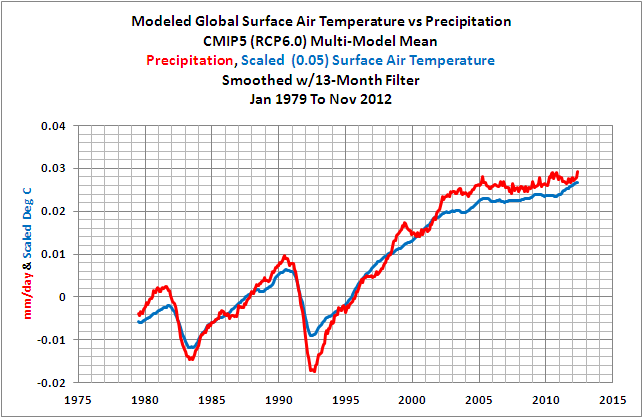
Not only that, when it condenses at altitude it also releases the latent heat that evaporated it on the ground, a further increase to the negative feedback. The more rain that falls – the more latent heat released high up above the majority of the GHG’s.
It seems to me that precipitation puts the brakes on warming
Note the unhighlighted segment of the 1968 Robinson Report:
“For atmospheric calculations, Moller’s model is still a relatively simple one and has not included all of the possible major interactions occurring in the atmosphere. For this reason it is likely that Moller’s calculations overestimate the effects on temperature of an increase in CO2. More comprehensive models are in development and should be available shortly.”
Still waiting…
“Oddly enough, both water vapor content and relative humidity have declined over recent decades. If I cross plot relative humidity (RH) at 600 mb against HadCRUT4 I get a Δf = -4.72 percent per degree C. This yields a climate sensitivity of about 1.4 °C per doubling of CO2 concentration.”
That might be right, in theory, given the numbers are right. Key word, in theory!
That will require everything else is constant, which it never is.
More warming leads to more convection and more water vapor which leads to more convection etc. etc. etc. = Net 0 °C