From the UNIVERSITY OF COLORADO AT BOULDER

“Upside-down rivers” of warm ocean water threaten the stability of floating ice shelves in Antarctica, according to a new study led by researchers at the University of Colorado Boulder’s National Snow and Ice Data Center published today in Nature Geoscience. The study highlights how parts of Antarctica’s ice sheet may be weakening due to contact with warm ocean water.
“We found that warm ocean water is carving these ‘upside-down rivers,’ or basal channels, into the undersides of ice shelves all around the Antarctic continent. In at least some cases these channels weaken the ice shelves, making them more vulnerable to disintegration,” said Karen Alley, a Ph.D. student in CU-Boulder’s Department of Geological Sciences and lead author of an analysis published today in Nature Geoscience.
Ice shelves are thick floating plates of ice that have flowed off the Antarctic continent and spread out onto the ocean. As ice shelves flow out to sea, they push against islands, peninsulas, and bedrock bumps known as “pinning points.” Contact with these features slows the flow of grounded ice off the continent. While ice shelves take thousands of years to grow, previous work has shown that they can disintegrate in a matter of weeks. If more ice shelves disintegrate in the future, loss of contact with pinning points will allow ice to flow more rapidly into the ocean, increasing the rate of sea level rise.
“Ice shelves are really vulnerable parts of the ice sheet, because climate change hits them from above and below,” said NSIDC scientist and study co-author Ted Scambos. “They are really important in braking the ice flow to the ocean.”
The features form as buoyant plumes of warm and fresh water rise and flow along the underside of an ice shelf, carving channels much like upside-down rivers. The channels can be tens of miles long, and up to 800 feet “deep.”
When a channel is carved into the base of an ice shelf, the top of the ice shelf sags, leaving a visible depression, or “wrinkle”, in the relatively smooth ice surface. Alley and her colleagues mapped the locations of these wrinkles all around the Antarctic continent using satellite imagery, as well as radar data that images the channels through the ice, mapping the shape of the ice-ocean boundary.
The team also used satellite laser altimetry, which measures the height of an ice shelf surface with high accuracy, to document how quickly some of the channels were growing. The data show that growing channels on the rapidly melting Getz Ice Shelf in West Antarctica can bore into the ice shelf base at rates of approximately 10 meters (33 feet) each year.
The mapping shows that basal channels have a tendency to form along the edges of islands and peninsulas, which are already weak areas on ice shelves. The team observed two locations where ice shelves are fracturing along basal channels, clear evidence that basal channel presence can weaken ice shelves to the point of breaking in vulnerable areas.
Ice shelves are thick floating plates of ice that have flowed off the continent and out onto the ocean. As ice shelves flow out to sea, they push against islands, peninsulas, and bedrock bumps known as “pinning points”. Contact with these features slows the ice flowing off the continent. If ice shelves disintegrate in the future, loss of contact with pinning points will allow ice to flow more rapidly into the ocean, increasing rates of sea level rise.
While no ice shelves have completely disintegrated due to carving by basal channels, the study points to the need for more observation and study of the features, said co-author… “It’s feasible that increasing ocean temperatures around Antarctica could continue to erode ice shelves from below.”
###
The study, “Impacts of warm water on Antarctic ice shelf stability through basal channel formation,” was led by University of Colorado Boulder Ph.D. student Karen Alley, who worked with coauthors Ted Scambos of NSIDC and Matthew Siegfried and Helen Fricker of Scripps Institute of Oceanography. Their work was funded in part by NASA and the U.S. Geological Survey.
I like the ideas, but the weak point is that the “pinning points” are really holding all that much ice back. The power of a glacier is enormous, and these are humongous. A “pinning point” is something they will just plow aside, or grind over.
Even NASA admits that the Antarctic ice sheet is growing and the increase in total ice volume is causing lowering of sea level. Studies have recently shown a coincidence of high geothermal heat flow beneath the same parts of the much smaller West Antarctic ice sheet that are supposed to be warmed by sea water.
Most of the West Antarctic ice sheet is thicker than the depth below sea level so it will remain grounded and the two tiny outlet glaciers attracting so much attention aren’t going to have any significant effect on the overall ice sheet (and certainly none at all on 90% of Antarctic ice contained in the East Antarctic ice sheet).
From time to time, large chunks of ice shelves break off and float away (with great predictions of coming doom by alarmists and the news media), but history has shown that in a few years they are back again.
Weeds in my garden and ice in Antarctica — who knew?
Do you have supporting links for the statement that total ice volume is growing in Antarctica?
Do you have a search engine?
Alan, as a matter of fact I do. Mine shows that the volume of Antarctic ice is shrinking, not growing.http://www.reuters.com/article/us-science-antarctic-idUSKBN0MM2J720150326
Chris the link you give supporting the ice shrinking is over a year old but there have been two recent reports of it growing and one them by one of those US agencies which tries to promote the whole CAGW theory which surprised me.
Pity that you couldn’t find the sea ice page. you won’t find much evidence there for declining Antarctic ice. Your linked article even stated that there isn’t enough evidence to link climate change with Antarctic sea ice change. Nice try, though.
http://wattsupwiththat.com/reference-pages/sea-ice-page/
Pity that you don’t know the difference between ice extent and ice volume. The sea ice page doesn’t cover Antarctic ice volume. Nice try, though.
Oh, and Easterbrook’s point was that Antarctic ice volume was growing. That was what I was disputing. Why are you bringing in a discussion of the cause of the decline? That’s not what we were discussing. Nice try at deflection, though.
Here’s one–there are several others. Just search Climate Depot
http://www.express.co.uk/news/science/616356/What-global-warming-Nasa-Antarctic-ice-INCREASING-135BILLION-TONNES-year
Chris. reuters.com ?? The best you could find was MSM ??
The key paper is by Jay Zwally et al., referred to here:
http://www.nature.com/news/gains-in-antarctic-ice-might-offset-losses-1.18486
This one study does say that ice mass is increasing. Other studies say it is shrinking. All studies say that the rate of ice flow is increasing. The Zwally paper says that this is more than counter-balanced by increasing precipitation due to warmer waters. Zwally also says that if current trends continue, the ice will soon start losing mass.
If Zwally is right (and that is not certain), sea contributiuons to sea level rise from elswhere is occuring faster than we thought. If the contribution from the Antarctic is actually negative, the measured rise must be coming from somewhere else.
In reversal, Obama admin to block oil drilling in Atlantic http://www.kfvs12.com/story/31473028/in-reversal-obama-admin-to-block-oil-drilling-in-atlantic
Absolutism to the point of the absurd. This one woman
just discovered underside scouring of ice plates by warm water. It’s been known since lakes and bays showed the same effect from the beginning of time,
and the source of the energy is known to be natural, there’s no manmade heating of oceans there.
The oceans are miles deep. The temperature of the planet = warmer the deeper in crust/outer mantle/inner mantle one goes. Ocean water is a tremendous heatsink and saps energy out of the surface of the earth at a gigantic rate by virtue of the two being affixed in tight thermal bond with each other.
It’s why water is to this day the preferred liquid to place alongside hot cylinders of an internal combustion engine.
If you have already gotten yourself somehow convinced mankind can even make oceanic temperatures blip I’m sure it took a lot of work. You can spam all the fake logic you want, but there’s one reason, and one reason only, the planet surface isn’t much, MUCH hotter:
the water soaking the surface of the planet pulled into liquid-to-solid level thermal conduction,
the air hastening the cooling of what water’s not sitting on cooling.
And mankind couldn’t even make a thermometer blip in that energy relationship.
At any given moment the earth itself is generating temperature from within.
Sunlight is delivering energy to the surface,
and mankind is hardly a flea on a freight train in oceanic warming, sandwiched between those two.
“…….While no ice shelves have completely disintegrated due to carving by basal channels, the study points to the need for more observation and study ”
But really, guys, what more needs to be known about how sea-ice melts from the bottom?
Clearly this is just another instance of ‘Send Money Or The Globe Gets It’ ?
This is a good example of the logical fallacy “we’ve just looked for and found this for the first time so it must have only just started happening”.
If ice shelves were not eroded in Antarctica through natural processes, these shelves would have steadily grown and extended north and hit South America, Africa and Australia long ago. I am not too sure what this paper is really suggesting, but to discount that ice shelf erosion is not a natural process seems to indicate that those who authored this paper lack a basic intellectual capacity to reason. Or, I suppose they could be climate alarmists and this would explain such a lack.
And the rate of growth is nothing short of remarkable: Ross Ice Shelf in the Antarctic expands with the average speed 2.5 meters a day!
The adjective “vulnerable” needs to be much more liberally sprinkled onto the ice in order to float further financing in my opinion.
This is what warming looks like after drinking that spiked green kool-aid.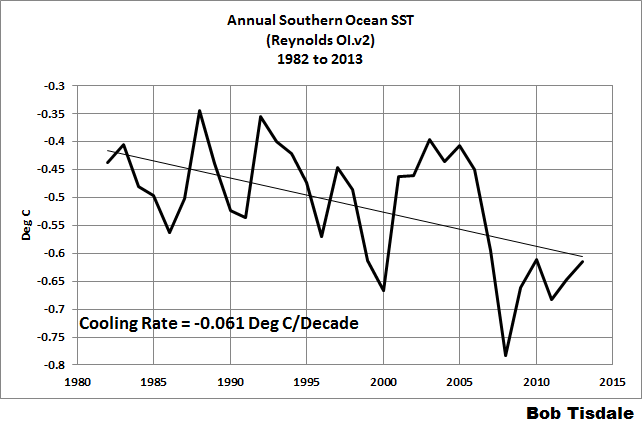
Can I refer you to this from the article….
“The features form as buoyant plumes of warm and fresh water rise and flow along the underside of an ice shelf, carving channels much like upside-down rivers. The channels can be tens of miles long, and up to 800 feet “deep.””
In other words, it is waters at depth that are the the cause of the melt channels and not surface waters.
See…
http://www.cesm.ucar.edu/events/ws.2015/presentations/crosswg/deser.pdf
and
http://www.atmosp.physics.utoronto.ca/SPARC/pdfs/26%20Tue/Session%202/2_2_Heywood.pdf
RWturner,
You have to do it like Toneb, and look at it upside down…
“It’s feasible that increasing ocean temperatures around Antarctica could continue to erode ice shelves from below …”.
============================
Diagram showing circum-Antarctic ocean temperatures at selected depths, using Argo-data:
http://www.climate4you.com/images/ArgoCircumAntarcticSince200401%2055S-65S.gif
Seen a report on an Aussie warmist show “catalyst” on the Antarctic ice shelf melt a while back ,when the camera was panning the shoreline they passed a polar bear WUWT .
That was a member of the Sea Leopard and Polar Bear Co-evolution Alliance. You can always spot them by their “Coexist” and “Bernie” bumper stickers.
From the study: ““Ice shelves are really vulnerable parts of the ice sheet, because climate change hits them from above and below,” said NSIDC scientist and study co-author Ted Scambos.”
Is there any evidence that human-caused global warming/climate change has caused an increase in the water temperature around the Antarctic continent? Or in the temperture of the air above it?
I think these scientists are assuming too much.
Am I mistaken in thinking that women climate scientists, who used to be a small minority, are popping up in ever larger numbers? WUWT? I guess the feminist glaciologists are working faster than I thought.
http://wattsupwiththat.com/?s=gender+based+glaciology
This is neither here nor there regarding the claims of the article, but I just had the privilege of spending three weeks in Antarctica and one day we passed through what seemed like an iceberg superhighway, with a chain of huge tabular icebergs, some larger than city blocks, extending to the horizon. Photos don’t do justice to the experience of seeing these in real life. This photo was taken from Gourdin Island, so I believe these icebergs probably came from the Weddell ice shelf.
http://i.imgur.com/BYcwuE1.jpg
Well I should hope so. If the ice shelf keeps piling up like it has been, those poor pitiful barely surviving Adelie penguins will never make it back to the ocean.
In summer 2009, the Norwegians directly measured water temperature under the Fimbul icesheet and found it was about two degrees C colder than the ice sheet freezing point. (also in 2005 & 2008).
In a University of Tasmania thing at ‘The Conversation’ entitled: Tipping point: how we predict when Antarctica’s melting ice sheets will flood the seas I commented (Here: https://theconversation.com/tipping-point-how-we-predict-when-antarcticas-melting-ice-sheets-will-flood-the-seas-56125 )
“I notice that the authors assert; “Melting beneath ice shelves is the main source of Antarctic ice loss” and [they] link to a paper. However, there are no seawater temperature data in that paper.
In summer 2009 the Norwegian Polar Institute bored through the Fimbul ice-shelf and found seawater temperatures under the ice at close to the freezing point of seawater (salinity dependent). That is about two degrees colder than the freezing point of freshwater (ice-shelves) and it was summertime. They also reported:
“The temperatures are very similar to temperature data collected by elephant seals in 2008 and by British Antarctic Survey using an autosub below the ice shelf in 2005.”
To confirm that “Melting beneath ice shelves is the main source of Antarctic ice loss” and to assess whether it is on the increase, it would be necessary to have seasonal time-series data which apart from being logistically difficult would require time-travel into the past. See:
http://www.npolar.no/en/news/2009/2009-12-11-ocean-beneath-fimbul-ice-shelf-is-cold.html”
List of and locations including satellite photos and eruption details (follow the links) of Volcanoes in Antarctica.
I hate using Wiki links grrr
https://en.wikipedia.org/wiki/List_of_volcanoes_in_Antarctica
Antarctica sees earthquakes too, they had some in 2010 and March 2011.
isn’t there also at least one active Volcano under the western ice sheet?
“Two earthquake swarms struck beneath the researchers’ feet in January 2010 and March 2011, near the Executive Committee Range in the Marie Byrd Land region of the continent. As the researchers later discovered, the tremors — called deep, long-period earthquakes (DLPs) — were nearly identical to DLPs detected under active volcanoes in Alaska and Washington. The swarms were 15 to 25 miles (25 to 40 kilometers) below the surface.”
Active Volcano Discovered Under Antarctic Ice Sheet
http://www.livescience.com/41262-west-antarctica-new-volcano-discovered.html
Earthquakes deep below West Antarctica reveal an active volcano hidden beneath the massive ice sheet, researchers said today (Nov. 17) in a study published in the journal Nature Geoscience.
They do not quantify the word ‘warm’ when discussing Antarctic Sea water. The Antarctic Oceans typically runs about -2° C due to the salinity of the salt water, but would need to warm above 0°C to melt the fresh water ice that forms the ice shelves. The Antarctic Circumpolar Current, which extends from the surface to the sea floor in a circle around the continent, effectively blocks the warmer waters of the Atlantic, Pacific, and Indian oceans from ever reaching Antarctica.