UPDATE (April 15, 2016): I discovered an error in the model-data comparison and model-data difference graphs (Figures 10 and 11) that impacted only the January 2016 value. The error has been corrected.
# # #
Guest Post by Bob Tisdale
We recently discussed the February 2016 El Niño-related upsurges in the RSS and UAH lower troposphere temperature (TLT) data in the post March 2016 Update of Global Temperature Responses to 1997/98 and 2015/16 El Niño Events. Not to be outdone, the GISS Land-Ocean Temperature (LOTI) data showed a +0.21 deg C jump in global land+ocean surface temperatures from January to February 2016…tacked on to the +0.24 deg C jump from September to October 2015.
# # #
This post provides an update of the values for the three primary suppliers of global land+ocean surface temperature reconstructions—GISS through February 2016 and HADCRUT4 and NCEI (formerly NCDC) through January 2016—and of the two suppliers of satellite-based lower troposphere temperature composites (RSS and UAH) through February 2016. It also includes a model-data comparison.
INITIAL NOTES:
The NOAA NCEI product is the new global land+ocean surface reconstruction with the manufactured warming presented in Karl et al. (2015). For summaries of the oddities found in the new NOAA ERSST.v4 “pause-buster” sea surface temperature data see the posts:
- The Oddities in NOAA’s New “Pause-Buster” Sea Surface Temperature Product – An Overview of Past Posts
- On the Monumental Differences in Warming Rates between Global Sea Surface Temperature Datasets during the NOAA-Picked Global-Warming Hiatus Period of 2000 to 2014
Even though the changes to the ERSST reconstruction since 1998 cannot be justified by the night marine air temperature product that was used as a reference for bias adjustments (See comparison graph here), and even though NOAA appears to have manipulated the parameters in their sea surface temperature model to produce high warming rates (See the post here), GISS also switched to the new “pause-buster” NCEI ERSST.v4 sea surface temperature reconstruction with their July 2015 update.
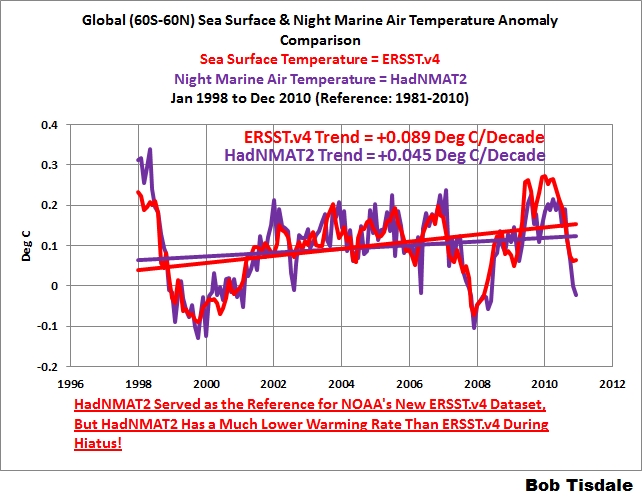
The UKMO also recently made adjustments to their HadCRUT4 product, but they are minor compared to the GISS and NCEI adjustments.
We’re using the UAH lower troposphere temperature anomalies Release 6.5 for this post even though it’s in beta form. And for those who wish to whine about my portrayals of the changes to the UAH and to the GISS and NCEI products, see the post here.
The GISS LOTI surface temperature reconstruction and the two lower troposphere temperature composites are for the most recent month. The HADCRUT4 and NCEI products lag one month.
Much of the following text is boilerplate…updated for all products. The boilerplate is intended for those new to the presentation of global surface temperature anomalies.
Most of the update graphs start in 1979. That’s a commonly used start year for global temperature products because many of the satellite-based temperature composites start then.
We discussed why the three suppliers of surface temperature products use different base years for anomalies in chapter 1.25 – Many, But Not All, Climate Metrics Are Presented in Anomaly and in Absolute Forms of my free ebook On Global Warming and the Illusion of Control – Part 1 (25MB).
Since the July 2015 update, we’re using the UKMO’s HadCRUT4 reconstruction for the model-data comparisons.
GISS LAND OCEAN TEMPERATURE INDEX (LOTI)
Introduction: The GISS Land Ocean Temperature Index (LOTI) reconstruction is a product of the Goddard Institute for Space Studies. Starting with the June 2015 update, GISS LOTI uses the new NOAA Extended Reconstructed Sea Surface Temperature version 4 (ERSST.v4), the pause-buster reconstruction, which also infills grids without temperature samples. For land surfaces, GISS adjusts GHCN and other land surface temperature products via a number of methods and infills areas without temperature samples using 1200km smoothing. Refer to the GISS description here. Unlike the UK Met Office and NCEI products, GISS masks sea surface temperature data at the poles, anywhere seasonal sea ice has existed, and they extend land surface temperature data out over the oceans in those locations, regardless of whether or not sea surface temperature observations for the polar oceans are available that month. Refer to the discussions here and here. GISS uses the base years of 1951-1980 as the reference period for anomalies. The values for the GISS product are found here. (I archived the former version here at the WaybackMachine.)
Update: The February 2016 GISS global temperature anomaly is +1.35 deg C. It jumped noticeably since January 2016, a +0.21 deg C increase.

Figure 1 – GISS Land-Ocean Temperature Index
NCEI GLOBAL SURFACE TEMPERATURE ANOMALIES (LAGS ONE MONTH)
NOTE: The NCEI only produces the product with the manufactured-warming adjustments presented in the paper Karl et al. (2015). As far as I know, the former version of the reconstruction is no longer available online. For more information on those curious adjustments, see the posts:
- NOAA/NCDC’s new ‘pause-buster’ paper: a laughable attempt to create warming by adjusting past data
- More Curiosities about NOAA’s New “Pause Busting” Sea Surface Temperature Dataset
- Open Letter to Tom Karl of NOAA/NCEI Regarding “Hiatus Busting” Paper
- NOAA Releases New Pause-Buster Global Surface Temperature Data and Immediately Claims Record-High Temps for June 2015 – What a Surprise!
And recently:
- Pause Buster SST Data: Has NOAA Adjusted Away a Relationship between NMAT and SST that the Consensus of CMIP5 Climate Models Indicate Should Exist?
- The Oddities in NOAA’s New “Pause-Buster” Sea Surface Temperature Product – An Overview of Past Posts
- On the Monumental Differences in Warming Rates between Global Sea Surface Temperature Datasets during the NOAA-Picked Global-Warming Hiatus Period of 2000 to 2014
Introduction: The NOAA Global (Land and Ocean) Surface Temperature Anomaly reconstruction is the product of the National Centers for Environmental Information (NCEI), which was formerly known as the National Climatic Data Center (NCDC). NCEI merges their new “pause buster” Extended Reconstructed Sea Surface Temperature version 4 (ERSST.v4) with the new Global Historical Climatology Network-Monthly (GHCN-M) version 3.3.0 for land surface air temperatures. The ERSST.v4 sea surface temperature reconstruction infills grids without temperature samples in a given month. NCEI also infills land surface grids using statistical methods, but they do not infill over the polar oceans when sea ice exists. When sea ice exists, NCEI leave a polar ocean grid blank.
The source of the NCEI values is through their Global Surface Temperature Anomalies webpage. Click on the link to Anomalies and Index Data.)
Update (Lags One Month): The January 2016 NCEI global land plus sea surface temperature anomaly was +1.04 deg C. See Figure 2. It dropped (a decrease of -0.08 deg C) since December 2015.

Figure 2 – NCEI Global (Land and Ocean) Surface Temperature Anomalies
UK MET OFFICE HADCRUT4 (LAGS ONE MONTH)
Introduction: The UK Met Office HADCRUT4 reconstruction merges CRUTEM4 land-surface air temperature product and the HadSST3 sea-surface temperature (SST) reconstruction. CRUTEM4 is the product of the combined efforts of the Met Office Hadley Centre and the Climatic Research Unit at the University of East Anglia. And HadSST3 is a product of the Hadley Centre. Unlike the GISS and NCEI reconstructions, grids without temperature samples for a given month are not infilled in the HADCRUT4 product. That is, if a 5-deg latitude by 5-deg longitude grid does not have a temperature anomaly value in a given month, it is left blank. Blank grids are indirectly assigned the average values for their respective hemispheres before the hemispheric values are merged. The HADCRUT4 reconstruction is described in the Morice et al (2012) paper here. The CRUTEM4 product is described in Jones et al (2012) here. And the HadSST3 reconstruction is presented in the 2-part Kennedy et al (2012) paper here and here. The UKMO uses the base years of 1961-1990 for anomalies. The monthly values of the HADCRUT4 product can be found here.
Update (Lags One Month): The January 2016 HADCRUT4 global temperature anomaly is +0.89 deg C. See Figure 3. It decreased (about -0.11 deg C) since December 2015.

Figure 3 – HADCRUT4
UAH LOWER TROPOSPHERE TEMPERATURE ANOMALY COMPOSITE (UAH TLT)
Special sensors (microwave sounding units) aboard satellites have orbited the Earth since the late 1970s, allowing scientists to calculate the temperatures of the atmosphere at various heights above sea level (lower troposphere, mid troposphere, tropopause and lower stratosphere). The atmospheric temperature values are calculated from a series of satellites with overlapping operation periods, not from a single satellite. Because the atmospheric temperature products rely on numerous satellites, they are known as composites. The level nearest to the surface of the Earth is the lower troposphere. The lower troposphere temperature composite include the altitudes of zero to about 12,500 meters, but are most heavily weighted to the altitudes of less than 3000 meters. See the left-hand cell of the illustration here.
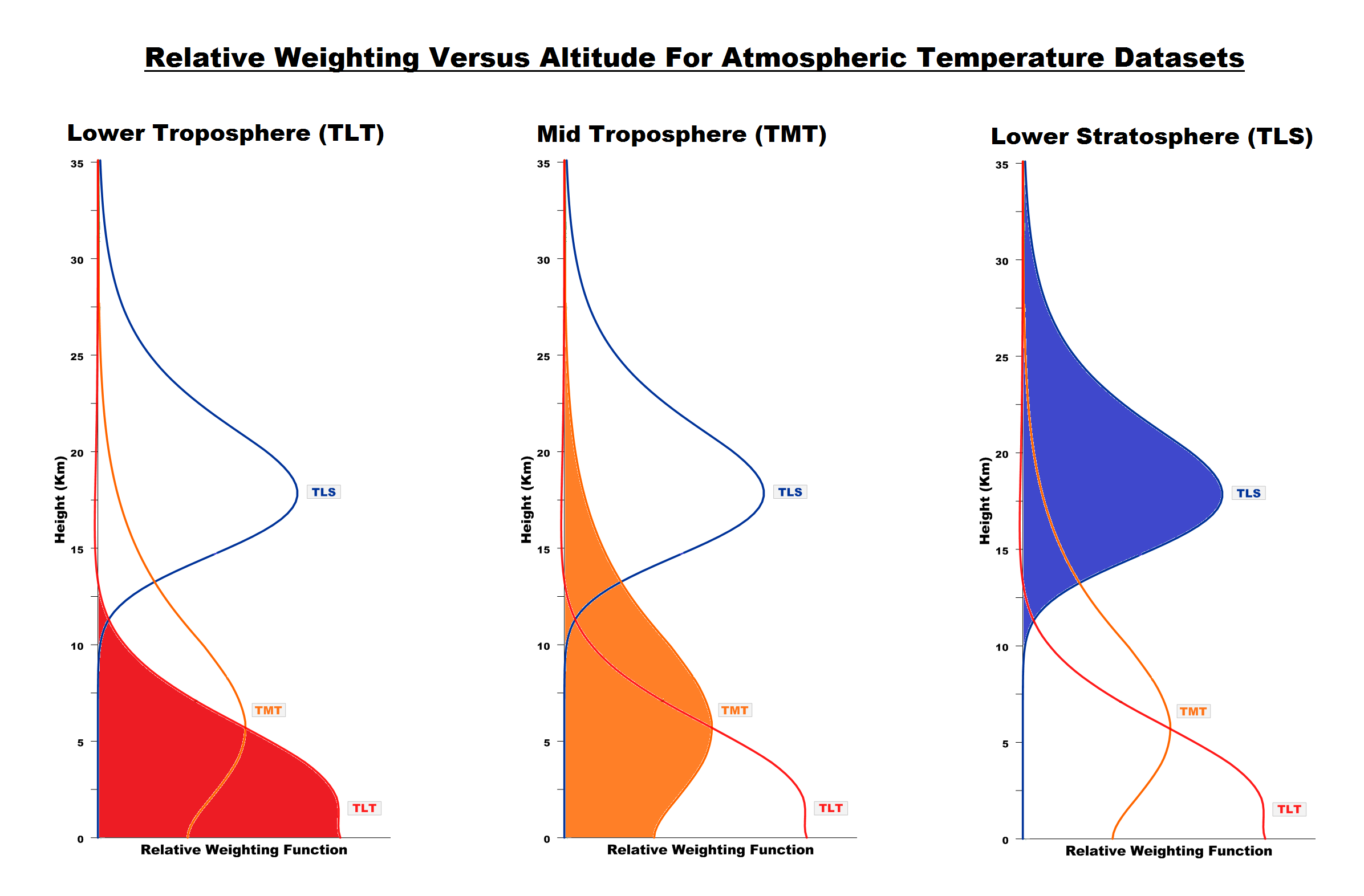
The monthly UAH lower troposphere temperature composite is the product of the Earth System Science Center of the University of Alabama in Huntsville (UAH). UAH provides the lower troposphere temperature anomalies broken down into numerous subsets. See the webpage here. The UAH lower troposphere temperature composite are supported by Christy et al. (2000) MSU Tropospheric Temperatures: Dataset Construction and Radiosonde Comparisons. Additionally, Dr. Roy Spencer of UAH presents at his blog the monthly UAH TLT anomaly updates a few days before the release at the UAH website. Those posts are also regularly cross posted at WattsUpWithThat. UAH uses the base years of 1981-2010 for anomalies. The UAH lower troposphere temperature product is for the latitudes of 85S to 85N, which represent more than 99% of the surface of the globe.
UAH recently released a beta version of Release 6.0 of their atmospheric temperature product. Those enhancements lowered the warming rates of their lower troposphere temperature anomalies. See Dr. Roy Spencer’s blog post Version 6.0 of the UAH Temperature Dataset Released: New LT Trend = +0.11 C/decade and my blog post New UAH Lower Troposphere Temperature Data Show No Global Warming for More Than 18 Years. The UAH lower troposphere anomalies Release 6.5 beta through February 2016 are here.
Update: The February 2016 UAH (Release 6.5 beta) lower troposphere temperature anomaly is +0.83 deg C. It jumped (an increase of about +0.29 deg C) since January 2016.

Figure 4 – UAH Lower Troposphere Temperature (TLT) Anomaly Composite – Release 6.5 Beta
RSS LOWER TROPOSPHERE TEMPERATURE ANOMALY COMPOSITE (RSS TLT)
Like the UAH lower troposphere temperature product, Remote Sensing Systems (RSS) calculates lower troposphere temperature anomalies from microwave sounding units aboard a series of NOAA satellites. RSS describes their product at the Upper Air Temperature webpage. The RSS product is supported by Mears and Wentz (2009) Construction of the Remote Sensing Systems V3.2 Atmospheric Temperature Records from the MSU and AMSU Microwave Sounders. RSS also presents their lower troposphere temperature composite in various subsets. The land+ocean TLT values are here. Curiously, on that webpage, RSS lists the composite as extending from 82.5S to 82.5N, while on their Upper Air Temperature webpage linked above, they state:
We do not provide monthly means poleward of 82.5 degrees (or south of 70S for TLT) due to difficulties in merging measurements in these regions.
Also see the RSS MSU & AMSU Time Series Trend Browse Tool. RSS uses the base years of 1979 to 1998 for anomalies.
Note: RSS recently release new versions of the mid-troposphere temperature and lower stratosphere temperature (TLS) products. So far, their lower troposphere temperature product has not been updated to this new version.
Update: The February 2016 RSS lower troposphere temperature anomaly is +0.97 deg C. It jumped (an increase of about +0.31 deg C) since January 2016.

Figure 5 – RSS Lower Troposphere Temperature (TLT) Anomalies
COMPARISONS
The GISS, HADCRUT4 and NCEI global surface temperature anomalies and the RSS and UAH lower troposphere temperature anomalies are compared in the next three time-series graphs. Figure 6 compares the five global temperature anomaly products starting in 1979. Again, due to the timing of this post, the HADCRUT4 and NCEI updates lag the UAH, RSS and GISS products by a month. For those wanting a closer look at the more recent wiggles and trends, Figure 7 starts in 1998, which was the start year used by von Storch et al (2013) Can climate models explain the recent stagnation in global warming? They, of course, found that the CMIP3 (IPCC AR4) and CMIP5 (IPCC AR5) models could NOT explain the recent slowdown in warming, but that was before NOAA manufactured warming with their new ERSST.v4 reconstruction.
Figure 8 starts in 2001, which was the year Kevin Trenberth chose for the start of the warming slowdown in his RMS article Has Global Warming Stalled?
Because the suppliers all use different base years for calculating anomalies, I’ve referenced them to a common 30-year period: 1981 to 2010. Referring to their discussion under FAQ 9 here, according to NOAA:
This period is used in order to comply with a recommended World Meteorological Organization (WMO) Policy, which suggests using the latest decade for the 30-year average.
The impacts of the unjustifiable adjustments to the ERSST.v4 reconstruction are visible in the two shorter-term comparisons, Figures 7 and 8. That is, the short-term warming rates of the new NCEI and GISS reconstructions are noticeably higher during “the hiatus”, as are the trends of the newly revised HADCRUT product. See the June 2015 update for the trends before the adjustments. But the trends of the revised reconstructions still fall short of the modeled warming rates during the hiatus periods.

Figure 6 – Comparison Starting in 1979
#####

Figure 7 – Comparison Starting in 1998
#####

Figure 8 – Comparison Starting in 2001
Note also that the graphs list the trends of the CMIP5 multi-model mean (historic and RCP8.5 forcings), which are the climate models used by the IPCC for their 5th Assessment Report.
AVERAGE
Figure 9 presents the average of the GISS, HADCRUT and NCEI land plus sea surface temperature anomaly reconstructions and the average of the RSS and UAH lower troposphere temperature composites. Again because the HADCRUT4 and NCEI products lag one month in this update, the most current average only includes the GISS product.

Figure 9 – Average of Global Land+Sea Surface Temperature Anomaly Products
Just in case you’re having trouble see the differences, here’s a .gif animation cycling between the two.

Animation 1
MODEL-DATA COMPARISON & DIFFERENCE
Note: The HADCRUT4 reconstruction is now used in this section. [End note.]
Considering the uptick in surface temperatures in 2014, 2015 and now 2016 (see the posts here and here), government agencies that supply global surface temperature products have been touting “record high” combined global land and ocean surface temperatures. Alarmists happily ignore the fact that it is easy to have record high global temperatures in the midst of a hiatus or slowdown in global warming, and they have been using the recent record highs to draw attention away from the growing difference between observed global surface temperatures and the IPCC climate model-based projections of them.
There are a number of ways to present how poorly climate models simulate global surface temperatures. Normally they are compared in a time-series graph. See the example in Figure 10. In that example, the UKMO HadCRUT4 land+ocean surface temperature reconstruction is compared to the multi-model mean of the climate models stored in the CMIP5 archive, which was used by the IPCC for their 5th Assessment Report. The reconstruction and model outputs have been smoothed with 61-month running-mean filters to reduce the monthly variations. The climate science community commonly uses a 5-year running-mean filter (basically the same as a 61-month filter) to minimize the impacts of El Niño and La Niña events, as shown on the GISS webpage here. Also, the anomalies for the reconstruction and model outputs have been referenced to the period of 1880 to 2013 so not to bias the results. That is, by using almost the full term of the data, no one with any common sense can claim I’ve cherry picked the base years for anomalies with this comparison.

Figure 10 (CORRECTED)
It’s very hard to overlook the fact that, over the past decade, climate models are simulating way too much warming and are diverging rapidly from reality.
Another way to show how poorly climate models perform is to subtract the observations-based reconstruction from the average of the model outputs (model mean). We first presented and discussed this method using global surface temperatures in absolute form. (See the post On the Elusive Absolute Global Mean Surface Temperature – A Model-Data Comparison.) The graph below shows a model-data difference using anomalies, where the data are represented by the UKMO HadCRUT4 land+ocean surface temperature product and the model simulations of global surface temperature are represented by the multi-model mean of the models stored in the CMIP5 archive. Like Figure 10, to assure that the base years used for anomalies did not bias the graph, the full term of the graph (1880 to 2013) was used as the reference period.
In this example, we’re illustrating the model-data differences in the monthly surface temperature anomalies. Also included in red is the difference smoothed with a 61-month running mean filter.

Figure 11 (CORRECTED)
The greatest difference between models and reconstruction occurs now.
There was also a major difference, but of the opposite sign, in the late 1880s. That difference decreases drastically from the 1880s and switches signs by the 1910s. The reason: the models do not properly simulate the observed cooling that takes place at that time. Because the models failed to properly simulate the cooling from the 1880s to the 1910s, they also failed to properly simulate the warming that took place from the 1910s until 1940. That explains the long-term decrease in the difference during that period and the switching of signs in the difference once again. The difference cycles back and forth, nearing a zero difference in the 1980s and 90s, indicating the models are tracking observations better (relatively) during that period. And from the 1990s to present, because of the slowdown in warming, the difference has increased to greatest value ever…where the difference indicates the models are showing too much warming.
It’s very easy to see the recent record-high global surface temperatures have had a tiny impact on the difference between models and observations.
See the post On the Use of the Multi-Model Mean for a discussion of its use in model-data comparisons.
MONTHLY SEA SURFACE TEMPERATURE UPDATE
The most recent sea surface temperature update can be found here. The satellite-enhanced sea surface temperature composite (Reynolds OI.2) are presented in global, hemispheric and ocean-basin bases.
RECENT RECORD HIGHS
We discussed the recent record-high global sea surface temperatures for 2014 and 2015 and the reasons for them in General Discussions 2 and 3 of my recent free ebook On Global Warming and the Illusion of Control (25MB). The book was introduced in the post here (cross post at WattsUpWithThat is here).
“This is only the global average surface temperature and it’s only one measure of the climate system – and it’s a very fickle measure.
There’s an over-emphasis on the surface air temperature.” – Prof Matt England
http://www.theguardian.com/environment/planet-oz/2016/mar/03/did-global-warming-really-slowdown-have-a-large-injection-of-nuance-and-a-side-order-of-abuse
~ ~ ~
Michael Mann: “I’ve always consider the satellite record the least reliable of all instrumental temperature observations”
http://www.climatecentral.org/news/what-to-know-februarys-satellite-temp-record-20091
. . .
Where to from here?
Mark M,
From that wild-eyed ‘Climate Central’ link:
…satellites are also seeing blazing heat in the Arctic… the Earth continued its record-blazing hot streak… all the excitement about the satellite spike… Watch out! Satellite data shows Feb setting crazy heat records. ‘Whopping,’… the surface temperature data analyzed and reported by NASA, NOAA and others is viewed as the gold standard…
Anyone who writes that kind of breathless propaganda is appealing to the scientific dimwit crowd. ‘Blazing heat in the Arctic’?? That’s emotion, not science.
And almost everyone quoted has been quoted before — in the Climategate emails, where they openly discuss hijacking the peer review process, dodging taxes, jeopardizing the careers of anyone who doesn’t toe the runaway global warming narrative, and in general, practicing pseudo-science.
Both their blog readers can believe that nonsense if they want; but most knowledgeable folks don’t.
This is all fine and dandy and you have done a considerable amount of work in this presentation, but……
How can this have any meaning when all the data has been altered and does not reflect the real world?
If you came to these graphs and commentary boards quite fresh you might say something like this, just looking at the plots and not knowing what they were about:
1. There seems to be a thing here that there are five ways of measuring.
2. Looking at the longest run of data all seem to agree that this thing is somewhere between 1 and 2
3. But taking a rough average this thing seems to be a bit less than 1 and a half.
4. If you take three of the data sets namely blue, red, brown (something to do with the “surface” of this thing) then “this thing is somewhere between 1 and 2 but probably a bit less than one and a half” seem to be indicated pretty much however you cut the data.
5. If you take two of the data sets namely green and orange (something to do with the “lower troposphere” of this thing) then if you choose to focus on shorter period of times then you might wonder if this thing might be zero after all.
6. But then again when you look at Figure 9, and especially the animation, the issue seems to be that the 1998 “troposphere” data point is creating this perception when you look at just some of this data.
7. But reassuringly for all, on returning to figure 6 of the whole thing, where all five data sets are shown in their fullest form, this data suggest that this thing seems to be somewhere between 1 and 2, and probably a bit less than one and a half.
I know there is a lot of debate around all of this – feel free to tell me i am naive, but i am not quite as naive as my language suggests – but in essence that’s what this data shows when you look at if fresh…?
Within 1 year La Nina will be here and UAH temperatures will be back down to 0.2 or less.
The pause will live on.
The noise being made by the “it’s worse than we thought” crowd will be replaced with the sound of crickets.
Hi wallensworth,
Using the UAHV6beta5 product, anomalies of 0.2 or even 0.1 will not be sufficiently low to produce a non-positive linear trend in the next year. In fact, assuming next month drops down to +0.45, or the next 2 months drop down to +0.22 each, then every month for the rest of the year could drop down to anomalies of 0.0 and the linear trend would still be positive. If the anomaly drops down to +0.33 for the next 3 months, then anomalies for the rest of the year could drop to -0.18 and still not remove the positive trend.
ENSO projections for the next few months show us returning to ENSO-neutral in the June/July timeframe, so it seems highly unlikely that we will see anything approaching such precipitous drops by August, never mind before then. La Nina conditions are likely starting in the August/September timeframes, but even if a resulting La Nina is deep, it is unlikely to be _that_ deep: for some context, there have only been 22 months with zero or negative anomalies in the past 10 years. There have only been 5 months with anomalies of -0.18 or less in the past 10 years. Having 7 of them line up in a row would be… improbable.
And I meant to make clear – assuming we are taking about the period beginning with the 1997/1998 El Nino, using the UAHV6beta5.
It would be very interesting to see the land based data sets broken down by region. Why does the 15/16 El Nino show up like the 97/98 El Nino DID at the time it was measured.
Any bets on how many years until the 15/16 Nino is adjusted downward in order to hide subsequent cooling?
RWturner,
It seems like you have the adjustment trend backwards: between UAH 5.6 and UAH6.0beta5, every single month from March 2008 to December 2015 has been adjusted downwards/cooler, whereas all but 3 months between 1997 and 2001 inclusive (so 57 out of 60 months) were adjusted upwards/warmer. There doesn’t seem to be a trend of adjusting the UAH 97/98 values downwards whatsoever…
Or are you suggesting that those adjustments were invalid, and that Spencer and Christie will fix those values by reversing their previous corrections?
Nope, but I will bet good money that a few short years from now we’ll be hearing about the ‘pause’ that started in 2015/16.
Regarding whether conditions will move to la Nina or neutral over the coming year, 8 different institutes make predictions. Most predict ENSO neutral to the end of the year. The graph at this link only shows the BoM multi-model ensemble (region 3.4).
http://www.bom.gov.au/climate/enso/#tabs=Outlooks
For the near future, most of the institutes predict ENSO neutral (region 3.4). You can see the mean predictions for July for the 8 institutes at this link.
http://www.bom.gov.au/climate/model-summary/#tabs=Pacific-Ocean
Canadian and French institutes are the two predicting la Nina conditions later in the year. Various others (Japan, UK, US, EU, Australia) predict neutral.
More details here: http://www.bom.gov.au/climate/model-summary/#tabs=Models
So you’re saying the Groundhog was right.