From the “yes, but satellite data is good enough when they want to scream the Arctic is melting” department comes this powerful takedown of recent claims about the satellite temperature data being inferior to surface temperature data.
I was traveling yesterday, so could not cover this live. Dr. Christy said in testimony:
‘When you look at the United States record of extreme high temperatures you do not see an upward trend at all. In fact, it’s slightly downward. That does fly in the face of climate model projections.
I’ll say.

Here is the video of his testimony:
And his written testimony is here: U.S. House Committee on Science, Space & Technology, 2 Feb 2016
Testimony of John R. Christy, University of Alabama in Huntsville.
The full video of all testimony is here:
Bingo!!! How many million times have I pointed this out, in fact it is pointed out in my previous post. The AGW theory as defined requires creating energy. There is no way for CO2 to warm the atmosphere above the temperature of a radiating body. There is absolutely no way, other than by causing combustion or a nuclear reaction where energy is changed in form, for CO2 to warm the atmosphere above the radiating body. There is no way for CO2 to cause a record high daytime temperature. CO2 captures radiated energy, that is the key, radiated. How can a cooler body warm a warmer body? It can’t. If it can, we have just solved the problem of all our energy issues. We could use the arctic ice to warm the globe. Once again, someone please explain to me how CO2 can cause a record high daytime temperature. If no one can explain that simple fundamental concept, AGW is pure nonsense. Even the climate alarmists example of Venus doesn’t have the atmosphere of Venus warmer than the surface.
Nowhere does the atmosphere warm above the surface of Venus.
https://en.wikipedia.org/wiki/Atmosphere_of_Venus#/media/File:Venusatmosphere.svg
co2islife February 5, 2016 at 9:06 am
3. A radiating body cannot raise the temperature of an absorbing body above its own temperature. CO2 absorbs and emits electromagnetic radiation with a wavelength centered around 15 microns. This is equivalent to the IR radiation from a heat source at a temperature of -80 c. It could therefor only raise the temperature of the earth to -80 c.
Bingo!!! How many million times have I pointed this out, in fact it is pointed out in my previous post.
And it was wrong every time you said it, a photon arriving at an absorber carries no information about the temperature of its source. 15 micron radiation melts steel!
Once again, you fail to grasp the concept. The earth is 15°C. The earth radiates IR around 10µ. You will never see the atmosphere above the earth be greater than the radiating body unless it is due to energy changing form or convection. Please explain how CO2 can warm the atmosphere greater than the radiating earth? If you can do that you just invented a perpetual motion machine of unlimited energy. A 13°C item could warm the atmosphere to 15°C, and on and on and on, so that you could have a ice cube power an internal combustion engine. Normally you have a very very hot cylinder of high pressure, and it expands to exhaust low pressure low temperature. CO2 in your theory would allow cold air to expand as heat is created from a lower temperature body.
Thanks Richard, I’m not ignoring that at all. A photon gets absorbed by a molecule, the electrons get sent to a higher more excited orbital. As far as CO2 goes, not only are the electrons sent into a higher orbital, it also causes a “horizontal” vibration. You are using the term energy, I used the term heat. Point is, there is x amount of energy and the amount of energy absorbed and re-emitted can’t be above the amount of the energy originally emitted.
http://www.patarnott.com/atms749/images/normalModes.gif
https://youtu.be/ef2w5JYGZRU
Not sure what your point is. There are x number of photons in a wavelength, and energy is absorbed by a molecule, that energy send electrons into higher orbits and causes a vibration. That energy is then re-emitted as the orbitals return to their normal state. What am I missing?
https://youtu.be/ef2w5JYGZRU
https://youtu.be/KabPQLIXLw4
Here is another graphic. The warmest temperature is always the radiating body. There is no way for the atmosphere to warm above the radiating body using the GHG effect. Never will you see a night time temperature where the atmosphere is warmer than the earth unless it is due to convection of some other method where warm air is transported in. Once again, how can CO2 cause a record daytime temperature?
http://www.ambrosevideo.com/resources/documents/AtmosphereTemperatureGradiant.jpg
Never will you see a night time temperature where the atmosphere is warmer than the earth unless it is due to convection of some other method where warm air is transported in.
Absolute rubbish! On still clear nights you get ‘nocturnal inversions’ caused by radiation heat loss from the surface which conduction’s unable to compensate for. Put an insulated bowl of water out at night in the Sahara and you can make ice!
See for example: http://www.weatheronline.co.uk/reports/wxfacts/Inversions.htm
“In the troposphere, the weather-sphere, inversions cause an increase in stability and tend to limit the upward growth of cloud, preventing further upward convection. When particularly strong, with high potential temperatures that suppress small-scale convection in the layers beneath them, they are often termed capping inversion. The lowermost layer of air frequently becomes an inversion layer known as surface inversion. The condition results, for example, from radiation cooling of the ground and the air above. This usually occurs when there is strong nocturnal radiation, after a clear, dry and starry night, called radiation night.”
You either failed to understand the concept and/or ignored this quote, “unless it is due to convection of some other method where warm air is transported in.”
1) CO2 can’t explain temperature inversions, which is the basis of all these posts.
2) The temperature of the atmosphere never gets above the peak temperature of the radiating body.
3)
Moving around hot air isn’t evidence of AGW, and it isn’t caused by CO2.
co2islife:
You are ignoring certain facts.
The radiation to the Earth originates from the surface of the Sun which is much hotter than the surface of the Earth.
A photon does not know from what it was emitted or the temperature of the emitter.
A photon from the surface of the Earth does not raise the temperature of a GHG molecule that absorbs it (temperature has no meaning in this case) but raises the internal energy of the molecule.
The absorbed energy of GHG molecules is released to (a) other molecules by collisions so warming them and (b) by emission of photons in random directions.
Half of the photons emitted from GHG molecules go down and are absorbed by the surface of the Earth where they add to the energy and, therefore, they increase the temperature of the surface of the Earth.
The energy radiated from the Earth eventually ends up in space which is much colder than the surface of the Earth.
The Sun is the hottest body and space is the coldest.
Richard
Thanks Richard, I am aware of that. My point is that unless energy is changed in form, you can’t warm the GHG molecule above the energy level of the radiating body.
Thanks Richard, I am aware of that. The earth however has a temperature of 15°C. That requires a lot of photons being carried in the 8µ to 12µ EM range. CO2 emits much lower energy between 13µ and 17µ. If the earth radiates the energy content contained between 8µ to 12µ, and CO2 emits back 13µ and 17µ., where is the warming?
Thanks Richard, I am aware of that. My problem is with the conservation of energy. 1) That radiation occurs in a 360° Sphere. How can a molecule that loses part of its energy through kinetic transfer and part of its energy through radiation of a lower energy warm something? How do you reach a record high by diffusing energy at lower levels.
Thanks Richard, I am aware of that. Once again, how does a fraction of 13µ and 17µ. warm something that emits 100% of 8µ to 12µ. That is creating energy.
Thanks Richard, I am aware of that. Space is transparent to IR and Visible light. Energy is not converted from EM energy to thermal energy in the vacuum of space, it simply passes through. There is no energy loss or gain, or is it ever changed in form. That concept doesn’t apply to the GHG effect where everything revolves around Energy being changed in form. IR is emitted, IR is Absorbed, molecules are excited, collide and re-emit radiation at a lower energy level. If I have a body that emits at 8µ to 12µ and re-emits at 13µ and 17µ, where is the warming? Once again, the surface emits 100% of its radiation relevant to the GHG up into the atmosphere. In reality it is like a giant mirror where no light passes through, all light travels in one direction, away from the mirror. The atmosphere however sends radiation in a complete sphere, with only a small fraction of the radiation being sent back to the mirror/surface. For the GHG to actually warm the atmosphere you would have to be able to put a mirror in a room, close the door, turn off the lights, and room would grow brighter and brighter as more light is sent back to the mirror than is reflected. As far as I know, that is impossible.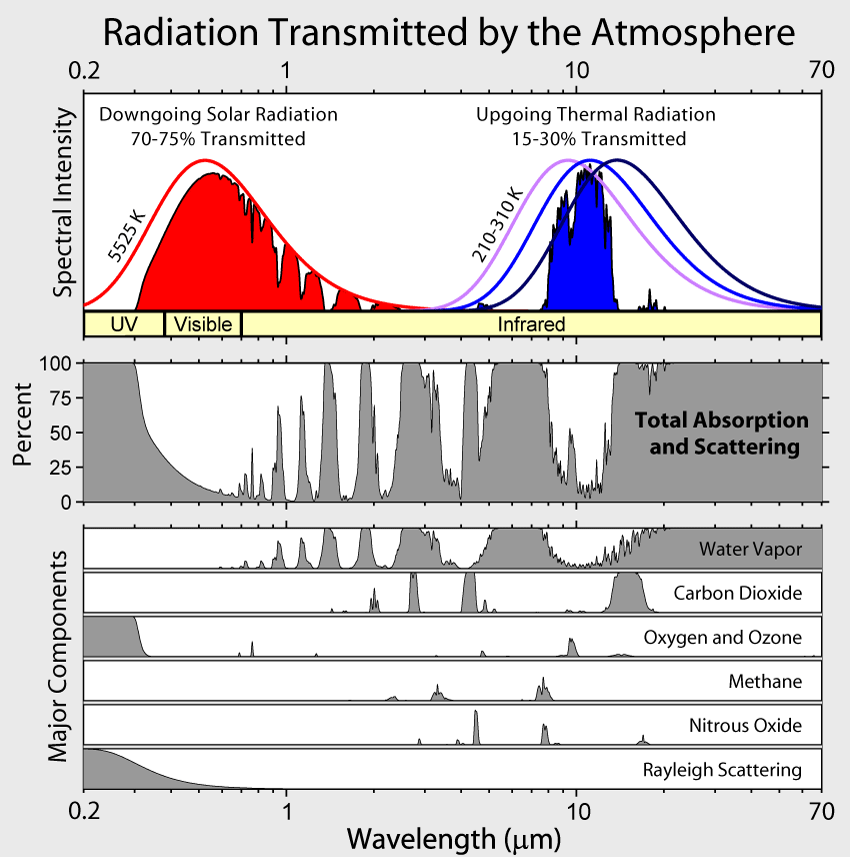
Once again, staying within the concepts outlined by the GHG effect, how can CO2 cause a record high daytime temperature? Please explain it using this chart.
As a F/U to my other post. Look at the W/M^2 measurements on these charts:
CO2 emitting at 15µ has energy of around 0.9W/M^2/Steradian/Wavelength
http://www.spectralcalc.com/blackbody_calculator/plots/guest1293514885.png
The Earth emitting at 10µ has energy of over 8. The relative energy levels aren’t even in the same ball park.
http://www.spectralcalc.com/blackbody_calculator/plots/guest1249635647.png
co2islife:
You say you are aware of the facts I listed for you but your reply says you are ignoring them.
For example, in response to my first fact which was
you reply
My point was that absorbtion of a photon by a GHG molecule does NOT “warm” the molecule at all: it raises the internal energy of the molecule. Your reply ignores that.
And your wrong assertion that I have quoted here also ignores that I pointed out
to which you have replied
Well, if you are “aware of that” how do you think the photon ‘knows’ when – according to your (untrue) assertion – it can or cannot add energy to the GHG molecule?
co2islife, you say you are aware of the facts I listed for you which you are ignoring, so why are you ignoring them?
Richard
[snip – there’s no need to clutter up this blog with comments and opinions you’ve left on other blogs. Not only is your comment long, and self-serving, it’s mostly not about anything besides your own viewpoints expressed elsewhere. It sets a bad precedent, and we simply aren’t interested -mod]
Your blog, your rules. I’ll not cross-post again.
WUWT, please commission a series of articles that detail the quantum physics behind the GHG effect. Clearly from the above posts there is some confusion as to how all this works together to cause the atmosphere to warm. Here are some questions that may be worth exploring:
1) CO2 absorbs LW-IR between 13µ and 18µ. Once CO2 absorbs that radiation it goes into an excited state. The orbitals go into higher orbits, and the electrons vibrate in a horizontal manner. When the electrons fall from a higher orbital to a lower orbital they release energy. If the electron does not fall all the way back to the normal state, the emitted radiation is of less energy that was originally absorbed. If the CO2 molecule is vibrating and hits another molecule transferring some kinetic energy, the remain energy in the CO2 molecule will be less than the original excited state, so the remaining emitted energy will be less than what was absorbed. Bottom line, an excited CO2 molecule can lose energy either through re-emitting the energy, or through conduction. How can that result in warming?
2) The earth emits at 8µ to 12µ, CO2 absorbs between 13µ and 17µ. The energy is measured in W/M^2/Sr/µ
W=Watts, that is simply energy/time or Joules/Second
M^2 = simply the area over which the Watts are distributed
Sr= steradian or a 3D angle. The longer the distance from the sun, the fewer steradians define the earth.
µ is simply the wavelength.
Put all that together and you see that the longer the wavelength, the fewer W/M^2.
IR between 13µ and 17µ has 0.9W/M^2/sr/µ and 8µ to 12µ has 8.25W/M^2/sr/µ That is almost a 10x difference between the energy emitted by the earth and the energy emitted by CO2.
3) Putting all this together, how can CO2 cause a record high daytime temperature? Using this chart and spectralcalc http://www.spectralcalc.com/blackbody_calculator/blackbody.php How can CO2 result in a record high daytime temperature? Why, if CO2 is the cause, can you fry an egg in the direct sunlight, but not the shade, given that both locations have 400ppm CO2?
This video does a great job differentiating between the impact of IR vs Visible and UV light on a molecule.
https://youtu.be/DJI518yTr2c
Here is another video discussing radiation:
https://youtu.be/48eE9ToxB6k
It appears that IR is absorbed by CO2, which then gets activated, and than the excited molecule then bumps into other molecules like pool balls and converts that radiative energy into kinetic energy/thermal energy. If that is the case, how would CO2 ever cause a record high daytime temperature? There is no way for CO2, which only absorbs a fraction of of the IR ever cause warming above the temperature of the radiating body?
http://www.luc.edu/faculty/dslavsk/courses/phys478/classnotes/heating-atmosphere.pdf
Here are a few other issues that might be worth exploring.
1) At the top of the atmosphere looking down, there is clearly a reduction in the outgoing radiation at the 13µ and 17µ wavelengths.
2) If the earth is a perfect black body, which it isn’t, what happened to that energy?
3) Was that IR changed in form radiative EM energy to thermal/kinetic energy? Was that energy used to move molecules around in space?
4) How does that process ever end? What happens to that kinetic energy over time? Does it dissipate, change in form? Does it eventually result in emitting IR at a longer wavelength?
5) How is IR created? Does the molecule simply stop vibrating and emit the photon like an electron changing its orbital does?
6) If you run MODTRAN looking down from 0.5 or 1km, you see that CO2 has very little effect, the CO2 really doesn’t impact things until you are much higher in the atmosphere. Ground measurements are on the ground, that seems to be measuring something other than the impact of CO2, namely convection, conduction. IR doesn’t seem to come into play until higher up in the atmosphere. Using MODTRAN it is clear why the alarmists want to use ground measurements instead of satellite. Ground measurements aren’t measuring the impact of CO2, they are measuring the heat generated through conduction and convection.
7) At 0.5km looking down, changing CO2 from 400ppm to 0ppm only alters the outgoing radiation by less than 0.32W/M^2. Changing the ground temperature by 1°C alters it by over 5W/M^2. Clearly CO2 has an immaterial impact close to the ground, especial when H2O and more visible light are added to the mix.
This video explains how IR radiation is created. It is just like electrons going to higher orbitals, and then falling back to the ground level.
https://youtu.be/9HfJNnoRMPA
WUWT, if possible, please commission a series of articles to address the quantum physics other physics underlying the GHG effect.


1) In this graphic, it is a MODTRAN result looking down from 0.1km, with 400ppm. This is the area where all ground based temperature stations are located.
2) This is the same MODTRAN calculation with 0.00ppm CO2. Clearly CO2 doesn’t impact the lower 0.1km much. All that is radiated makes it through the first 0.1km of the atmosphere.
3) This is a Spectralcalc Blackbody with a temperature of 15°C. Note the 8.25W/M^2/sr/µ Light at the 10µ is packed with a lot more energy than longer wavelengths.
4) This is the same Spectralcalc for 15µ Note the less than 1.2 W/M^2/sr/µ
In this graphic from 70km up, clearly the radiation around 15µ is not making it to outerspace. What happens to that energy that is “trapped” in the atmosphere? Is it being converted to kinetic/thermal energy? Is used in some chemical reaction? Eventually gets re-emmited at a different wavelength? Is the energy changed in form? Can radiative energy be converted to conductive energy, and if it does, how does that mechanical kinetic energy ever leave the atmosphere?
Any insight to those above questions would be greatly appreciated.
co2islife February 7, 2016 at 6:30 am
WUWT, if possible, please commission a series of articles to address the quantum physics other physics underlying the GHG effect.
Sorely needed judging by all the errors/misunderstandings of the subject contained in this post.
1) In this graphic, it is a MODTRAN result looking down from 0.1km, with 400ppm. This is the area where all ground based temperature stations are located.
2) This is the same MODTRAN calculation with 0.00ppm CO2. Clearly CO2 doesn’t impact the lower 0.1km much. All that is radiated makes it through the first 0.1km of the atmosphere.
No, by looking at the first 100m you’re looking through an essentially isothermal region of the atmosphere. The first 100m absorbs most of the IR in the CO2 absorption band but the CO2 molecules in that region of the atmosphere also emit IR in that band, which is why you see no net change over such a small altitude difference (Kirchoff’s Law). The emission you see is not from the surface though.
3) This is a Spectralcalc Blackbody with a temperature of 15°C. Note the 8.25W/M^2/sr/µ Light at the 10µ is packed with a lot more energy than longer wavelengths.
No it is not, at 10µm Spectracalc gives a spectral radiance of 8.11452 W/m2/sr/µm whereas at 15µm, at the same temperature, Spectracalc gives a spectral radiance of 5.81948 W/m2/sr/µm. However if you take a 1µm wide band centered at each wavelength at 10µm you get 8.1 W/m2/sr ,whereas at 15µm you get 8.7W/m2/sr. If you integrate over the CO2 band from 13-18µm you get a band radiance of 27.7684 W/m2/sr out of a total of 124.178 W/m2/sr or about 22% of the total.
4) This is the same Spectralcalc for 15µ Note the less than 1.2 W/M^2/sr/µ
No it isn’t, it’s at a temperature of -80ºC, we’re comparing emissions from the earth’s surface, not the dark side of the moon!
In this graphic from 70km up, clearly the radiation around 15µ is not making it to outerspace. What happens to that energy that is “trapped” in the atmosphere? Is it being converted to kinetic/thermal energy? Is used in some chemical reaction? Eventually gets re-emmited at a different wavelength? Is the energy changed in form? Can radiative energy be converted to conductive energy, and if it does, how does that mechanical kinetic energy ever leave the atmosphere?
Unlike your earlier MODTRAN calculation this is looking down from 70km where the temperature and concentration of CO2 are much different. At a certain altitude the CO2 concentration drops sufficiently low that it now allows the emitted IR from that altitude to escape to space, however at such a low temperature (~210K) you’d expect a band radiance of about 1.3W/m2/sr.
The difference between the two values indicates how much energy has been transferred to the atmosphere.
Since this would result in the atmosphere heating up, more emissions result from the surface and lower atmosphere, to achieve balance losses at the other wavelengths (window) must increase.
This may help explain some of the gaps in the atmospheric radiation.
http://my.telegraph.co.uk/reasonmclucus/reasonmclucus/3887971/Earth_Is_Not_a_Black_Body/
It would nice to see a series of articles addressing all the issues I’ve raised above, tying Quantum Physics, Newton’s 1st Law/Conservation of Energy, Newton’s 2nd Law Entropy and Heat Transfer, Blackbody radiation, how the earth isn’t a black body and its impact on MODTRAN and using Spectralcal how much energy is contained in the 10µ and 15µ bands, and is that enough to warm the oceans?
Bingo, I knew something didn’t pass the stink test with the climate models. Energy is being changed in form all throughout the system. Algae die and trap solar radiation for millions of years. Coal is trapped solar radiation. Evaporation, conduction, convection, latent, potential, kinetic energy all are ignored in the climate models, they all focus on radiation, and assume 100% of re-radiated as a 300°K blackbody. If the earth isn’t a black body, their conclusions are all wrong. WUWT, addressing the blackbody issue would make for a very interesting series of articles.
One last question about the quantum physics of the GHG effect. Assume a CO2 molecule that has a very tight spectral band because of it not having a bipole, and therefor only 3 main vibration patterns consistent with photons of energy 2.7µ, 4.3µ and 15µ collides with an H2O molecule that has countless vibrational patterns and a bipole. Part of the energy from the excited CO2 molecule would be converted to kinetic energy when the H2O molecule is moved, but some of that energy may also cause a vibration of the H2O molecule. That vibration would eventually emit a longer wavelength than what the CO2 molecule would have emitted had it not transferred the energy to the H2O molecule. What if 2 excited CO2 molecules simultaneously collide with a H2O molecule and transfer all their energy to the H2O molecule. Would the H2O molecule then not be able to emitt a shorter wavelength than either of the 2 excited CO2 molecules? WUWT, a series of articles on the quantum physics of the GHG effect would be very interesting and informtive. I doubt most climate scientists have thought through all those issues.
Both CO2 and H2O have three vibrational modes but because CO2 doesn’t have a permanent dipole only two of its bands are IR active. The most likely collision partners for an excited CO2 molecule are N2 and O2 and the energy transferred can excite translational, vibrational or rotational modes. Emissions will only occur if one of the internal energy levels is excited and an allowed transition can occur to a lower state. Near simultaneous collisions can result in higher energy levels being excited. By the way IR and microwave is due to vibration and rotation of bonds, electrons have nothing to do with it, that’s UV radiation.
From these two graphics, it is clear H2O absorbs as much IR as CO2 at the 15µ wavelength. That may be why there is a pocket in the atmosphere, because the globe, which is 70%+ H2O isn’t emitting that wavelength, ie the globe isn’t a black body.
http://i4.photobucket.com/albums/y104/weisseluft/CO2FTIR.gif
http://webbook.nist.gov/cgi/cbook.cgi?Spec=C7732185&Index=1&Type=IR
Here’s a comparison of the 15micron band of CO2 and the corresponding region of the H2O spectrum:
http://i302.photobucket.com/albums/nn107/Sprintstar400/H2OCO2.gif
This is the image that didn’t appear in the previous post: ?w=1000&h=&crop=1
I’ve never seen an adequate explanation from Christy or Spencer, of exactly which balloon indices are shown in that graph they keep showing: https://science.house.gov/sites/republicans.science.house.gov/files/documents/HHRG-114-SY-WState-JChristy-20160202.pdf
The graph says “NOAA,” but NOAA’s web site presents NOAA’s RATPAC-A as NOAA’s radiosonde index that is appropriate for looking at global trends: https://www.ncdc.noaa.gov/data-access/weather-balloon/radiosonde-atmospheric-temperature-products-accessing-climate
And RATPAC-A well matches surface trends and not RSS or UAH: https://tamino.wordpress.com/2016/01/15/drift/
The graph says it uses the “UKMet” balloon data from about 1978, but the UKMet’s web site says its global index contains data only from 1997 forward: http://catalogue.ceda.ac.uk/uuid/f2afaf808b61394b78bd342ff068c8cd
So Christy’s graph must be using only the European UKMet index: http://badc.nerc.ac.uk/data/radiosonde/
RAOBCORE goes up to only 2011, I don’t know if it’s global, and its authors warn that its homogenization can be biased by satellites. Obviously it’s inappropriate to validate the satellite indices with a balloon index that can be biased by those very same satellite data: http://www.univie.ac.at/theoret-met/research/raobcore/
RICH uses only other radiosondes for homogenization, but I believe has the same limited time span and possibly limited geographic span as ROBCORE: http://www.univie.ac.at/theoret-met/research/raobcore/
RATPAC is a homogenized and extrapolated bastard child of NOAA that they invented because the actual weather balloon data sets weren’t showing what NOAA wanted.
The satellites do not need some homogenized extrapolated NOAA trash. They have real time real loc readings and can only be calibrated by real time real loc readings.
Funny how the literature never mentions CO2, they always point to H20,
http://www.theweatherprediction.com/habyhints/19/