
From the PRINCETON UNIVERSITY and the department of 97% consensus and 911 Trutherism comes this study that I’d put zero stock in for two reasons: 1) Author William Anderegg, forerunner of the widely debunked 97% consensus meme and Pieter Tans, keeper of the official CO2 record and an avowed 911 “truther”. 2) Besides, the study itself is nothing new, as biologists, farmers, botanists, and greenhouse operators have known for decades that warmer temperatures increase plant growth. In this case, they are arguing for a positive feedback that will put leave more CO2 in the atmosphere. Given a fixed amount of biomass, that “might” be true, but satellite remoste sensing studies have shown that the planet is greening, and biomass is increasing thanks to increased CO2.
Next!
Warm nights could flood the atmosphere with carbon under climate change
The warming effects of climate change usually conjure up ideas of parched and barren landscapes broiling in a blazing sun, its heat amplified by greenhouse gases. But a study led by Princeton University researchers suggests that hotter nights may actually wield much greater influence over the planet’s atmosphere as global temperatures rise — and could eventually lead to more carbon flooding the atmosphere.
Since measurements began in 1959, nighttime temperatures in the tropics have had a strong influence over year-to-year shifts in the land’s carbon-storage capacity, or “sink,” the researchers report in the journal Proceedings of the National Academy of Sciences. Earth’s ecosystems absorb about a quarter of carbon from the atmosphere, and tropical forests account for about one-third of land-based plant productivity.
During the past 50 years, the land-based carbon sink’s “interannual variability” has grown by 50 to 100 percent, the researchers found. The researchers used climate- and satellite-imaging data to determine which of various climate factors — including rainfall, drought and daytime temperatures — had the most effect on the carbon sink’s swings. They found the strongest association with variations in tropical nighttime temperatures, which have risen by about 0.6 degrees Celsius (33 degrees Fahrenheit) since 1959.
First author William Anderegg, an associate research scholar in the Princeton Environmental Institute, explained that he and his colleagues determined that warm nighttime temperatures lead plants to put more carbon into the atmosphere through a process known as respiration.
Just as warm nights make people more active, so too does it for plants. Although plants take up carbon dioxide from the atmosphere, they also internally consume sugars to stay alive. That process, known as respiration, produces carbon dioxide, which plants step up in warm weather, Anderegg said. The researchers found that yearly variations in the carbon sink strongly correlated with variations in plant respiration.
“When you heat up a system, biological processes tend to increase,” Anderegg said. “At hotter temperatures, plant respiration rates go up and this is what’s happening during hot nights. Plants lose a lot more carbon than they would during cooler nights.”
Previous research has shown that nighttime temperatures have risen significantly faster as a result of climate change than daytime temperatures, Anderegg said. This means that in future climate scenarios respiration rates could increase to the point that the land is putting more carbon into the atmosphere than it’s taking out of it, “which would be disastrous,” he said.
Of course, plants consume carbon dioxide as a part of photosynthesis, during which they convert sunlight into energy. While photosynthesis also is sensitive to rises in temperature, it only happens during the day, whereas respiration occurs at all hours and thus is more sensitive to nighttime warming, Anderegg said.
“Nighttime temperatures have been increasing faster than daytime temperatures and will continue to rise faster,” Anderegg said. “This suggests that tropical ecosystems might be more vulnerable to climate change than previously thought, risking crossing the threshold from a carbon sink to a carbon source. But there’s certainly potential for plants to acclimate their respiration rates and that’s an area that needs future study.”
###
This research was supported by the National Science Foundation MacroSystems Biology Grant (EF-1340270), RAPID Grant (DEB-1249256) and EAGER Grant (1550932); and a National Oceanic and Atmospheric Administration (NOAA) Climate and Global Change postdoctoral fellowship administered by the University Corporation of Atmospheric Research.
William R. L. Anderegg, Ashley P. Ballantyne, W. Kolby Smith, Joseph Majkut, Sam Rabin, Claudie Beaulieu, Richard Birdsey, John P. Dunne, Richard A. Houghton, Ranga B. Myneni, Yude Pan, Jorge L. Sarmiento,? Nathan Serota, Elena Shevliakova, Pieter Tan and Stephen W. Pacala. ” Tropical nighttime warming as a dominant driver of variability in the terrestrial carbon sink.” Proceedings of the National Academy of Sciences, published online in-advance of print Dec. 7 2015. DOI: 10.1073/pnas.1521479112
Article quotes:
But, but, but, ….. global temperatures are not rising and never have been rising.
But their “fuzzy” math calculated “global average temperatures” have been rising ….. and the reason for their “rising” is, to wit:
And the above noted “result” is directly due to interglacial climate change …. and has nothing whatsoever to do with the “junk science” claims of anthropogenic climate change.
And atmospheric CO2 is not a cause or factor regarding said “rising nighttime temperatures” ….. simply because the nighttime temperatures in desert environments have not been rising …. and for sure not “significantly faster”.
Not in Deserts, nor anywhere else. If you compare daily rising temps to the following night falling temps since 1940 it’s down slightly (cools more at night than warmed the prior day), but with uncertainty it’s basically 0.0F+/-0.1F, since 1940.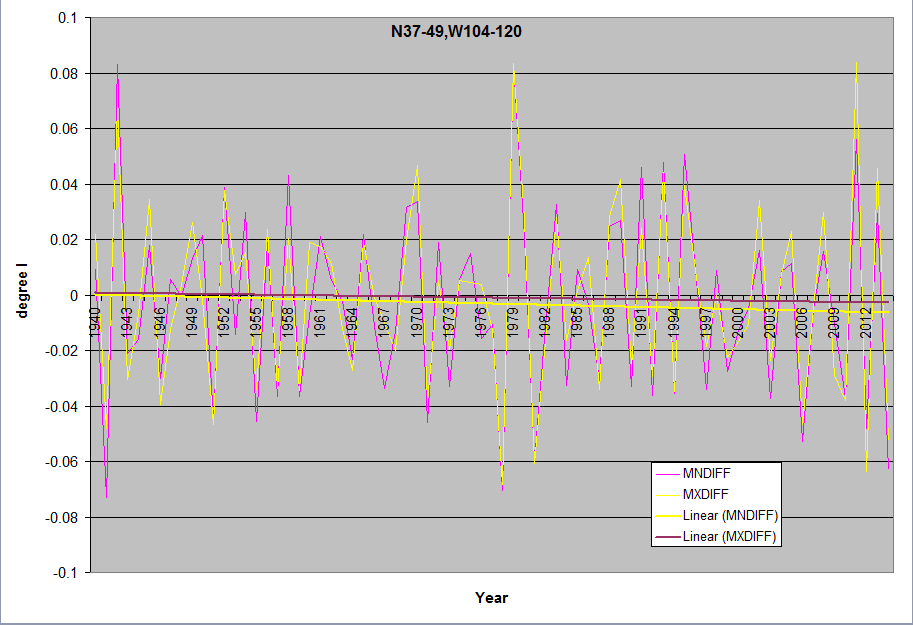

https://micro6500blog.wordpress.com/2015/11/18/evidence-against-warming-from-carbon-dioxide/
There are also IR temps from over night showing the difference between grass, concrete and asphalt. You can easily see a 15-20F difference between grass and asphalt in the middle of the night.
And here’s a chart of just SW US Deserts.
The difference between today’s rising temp, and tonight’s falling temp.
And then if you take the derivative of the daily change in temps due to the changing seasons, you can see how surface temps change as the length of the day changing through the year.
Annual average low temperatures have been getting cooler in most of the U.S., according to NOAA.
In CONUS and Alaska, only 14 Atlantic states plus California and Washington trended warmer average lows from 2000 through 2014. The other 33 states trended cooler (by as much as −1.33°F/decade in Alaska and −1.06°F/decade in Minnesota).
Only in the far western states were 2014 average lows above their 15-year averages, and only in California and Washington did the “hottest year ever” change the trend from negative to positive. In the rest of the country, average lows in 2014 were below average for the period.
“Plants lose a lot more carbon than they would during cooler nights.”
Well then if the daytime temperatures are the same, much against claims in the alarmosphere, we will have warmer mornings and warmer evenings (because of a smaller drop each night), during which time the CO2 subtraction by plants will be increasing. The claim is that CO2 emissions were reduced by cooler night time temperatures, ergo warming the nights produces a higher average daytime temperature because the air doesn’t have to heat up as much.
With an increased daytime temperature, the growing will be faster, starting earlier than before. This should have been discussed before passing review as it offers a very different conclusion, albeit it less alarming one.
Further, there is no doubt at all that the daytime growth rate is generally higher because of CO2 fertilisation. Supposedly this warmer nighttime is not attributable to solar effects, but to CO2, so the plants would be growing faster and faster if the CO2 keeps rising (which it seems to be doing). What is the daily gain from CO2 alone, and what is the gain from warming the heads and tails of each day? Will this more than offset any putative increase in CO2 loss during the night?
These questions are so obvious they should have been put to the authors before passing review.
Who reviewed this paper?
And one should not ignore the fact that CO2 emissions from microbial decomposition of dead biomass occurs 24 hours per day, rain or shine, especially when temperatures are above 60F.
Thus, given the fact that nighttime temperatures are not cooling off as much (per se increasing) then the aforesaid microbial outgassing of CO2 will greatly exceed the nighttime emissions of CO2 by green plant biomass.
And the above combined Summertime outgassing of CO2 is what discredits and/or disproves the CAGW warminist’s explanation of/for the Keeling Curve’s +-6 ppm bi-yearly cycling of atmospheric CO2.
Ignorance of the biology makes for plenty of “junk science” believers.
“They found the strongest association with variations in tropical nighttime temperatures, which have risen by about 0.6 degrees Celsius (33 degrees Fahrenheit) since 1959.”. Isn’t that 1.08 Farenheit not 33…
One other issue with this atmospheric CO2 argument that you may want to commission an article on.
1) CO2 is 400 PPM all the way up to 80km, water vapor tapers up to 10km.
2) Temperature in the troposphere follows H2O exactly, and shows no relationship to CO2.
http://www.physicalgeography.net/fundamentals/images/atmslayers.gif
3) Once again, CO2 is 400ppm all the way up to 80km, if CO2 were the cause of the warming there would be a constant temperature gradient up to 80km. 0 to 10km is dominated by H2O, 10 to 20km transition to O3, 20 to 50km O3, 50 to 80km is cooled by CO2, 80 to 100km warmed by O2 and N2.
According to every book I’ve read about the atmospheric levels, none blame CO2 for the temperature gradient of the troposphere, they all tie it to H2O. How then do we now blame it on CO2?
“They found the strongest association with variations in tropical nighttime temperatures, which have risen by about 0.6 degrees Celsius (33 degrees Fahrenheit) since 1959.”
Am I the only one who sees something wrong with that?
0.6 degrees Celsius (33 degrees Fahrenheit)
That is most likely due to H2O. If there is a CO2 signature it will be in the deserts and/or Antarctica. The control would be the areas with the lowest H20. All areas have 400 ppm CO2, not all areas share the same H20. That is basic science 101.
“an avowed 911 “truther”.”
Google “BBC reports Solomon Brothers collapse (building 7) before it collapsed”
That goes to his credit not against it.
“they also internally consume sugars to stay alive.”
There has to be two sides of that coin. Whatever they consume at night would have to be replenished during the day. Else growth and respiration would slow.
Dr Salsby addresses the C12 C14 issue:
https://youtu.be/rCya4LilBZ8?t=26m55s