Ocean pipes ‘not cool,’ would end up warming climate
![otec_mode_06_animation[1]](https://wattsupwiththat.files.wordpress.com/2015/03/otec_mode_06_animation1.gif)
Washington, D.C.–To combat global climate change caused by greenhouse gases, alternative energy sources and other types of environmental recourse actions are needed. There are a variety of proposals that involve using vertical ocean pipes to move seawater to the surface from the depths in order to reap different potential climate benefits. A new study from a group of Carnegie scientists determines that these types of pipes could actually increase global warming quite drastically. It is published in Environmental Research Letters.
One proposed strategy–called Ocean Thermal Energy Conversion, or OTEC–involves using the temperature difference between deeper and shallower water to power a heat engine and produce clean electricity. A second proposal is to move carbon from the upper ocean down into the deep, where it wouldn’t interact with the atmosphere. Another idea, and the focus of this particular study, proposes that ocean pipes could facilitate direct physical cooling of the surface ocean by replacing warm surface ocean waters with colder, deeper waters.
“Our prediction going into the study was that vertical ocean pipes would effectively cool the Earth and remain effective for many centuries,” said Ken Caldeira, one of the three co-authors.
The team, which also included lead author Lester Kwiatkowski as well as Katharine Ricke, configured a model to test this idea and what they found surprised them. The model mimicked the ocean-water movement of ocean pipes if they were applied globally reaching to a depth of about a kilometer (just over half a mile). The model simulated the motion created by an idealized version of ocean pipes, not specific pipes. As such the model does not include real spacing of pipes, nor does it calculate how much energy they would require.
Their simulations showed that while global temperatures could be cooled by ocean pipe systems in the short term, warming would actually start to increase just 50 years after the pipes go into use. Their model showed that vertical movement of ocean water resulted in a decrease of clouds over the ocean and a loss of sea-ice.
Colder air is denser than warm air. Because of this, the air over the ocean surface that has been cooled by water from the depths has a higher atmospheric pressure than the air over land. The cool air over the ocean sinks downward reducing cloud formation over the ocean. Since more of the planet is covered with water than land, this would result in less cloud cover overall, which means that more of the Sun’s rays are absorbed by Earth, rather than being reflected back into space by clouds.
Water mixing caused by ocean pipes would also bring sea ice into contact with warmer waters, resulting in melting. What’s more, this would further decrease the reflection of the Sun’s radiation, which bounces off ice as well as clouds.
After 60 years, the pipes would cause an increase in global temperature of up to 1.2 degrees Celsius (2.2degrees Fahrenheit). Over several centuries, the pipes put the Earth on a warming trend towards a temperature increase of 8.5 degrees Celsius (15.3 degrees Fahrenheit).
“I cannot envisage any scenario in which a large scale global implementation of ocean pipes would be advisable,” Kwiatkowski said. “In fact, our study shows it could exacerbate long-term warming and is therefore highly inadvisable at global scales.”
The authors do say, however, that ocean pipes might be useful on a small scale to help aerate ocean dead zones.
###
A video abstract of the paper is available here:
The Carnegie Institution for Science is a private, nonprofit organization headquartered in Washington, D.C., with six research departments throughout the U.S. Since its founding in 1902, the Carnegie Institution has been a pioneering force in basic scientific research. Carnegie scientists are leaders in plant biology, developmental biology, astronomy, materials science, global ecology, and Earth and planetary science.
Basically, it would cause a drought especially if these stupid things were planted offshore California. HAHAHA.
rain causes drought. dry spells only happen after it has rained. 100% sure. find a drought, you will find it rained beforehand.
That certainly needs to be studied. It seems a major breakthrough in understanding climate change. I’m sure grant money would be available.
Eugene WR Gallun
Don’t worry they would last to the first good storm like the one built in Norway that was rated at 600Mw and the first storm it vanished without trace into deep water.
These things will end up like the giant wind farms built in Hawaii in the 80s. And like the current wind farms will be in the next 10 or 20 years.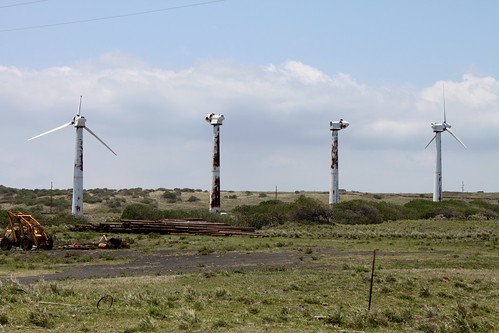
I’m sure a small scale grant would be useful as well….
Unintended consequences. Who knew? Next thing you know some crazy scientist might realize that wind farms disrupt climate in unintended ways as well.
My thoughts exactly. To get electricity from the wind, it must give up some of its energy. Energy that was going somewhere else before you took with the wind turbine. On a large scale interesting things could happen.
Well let’s see now, if average wind circulation winds slow (from windmills) then there should be less ocean evaporation and fewer clouds, ergo more warming! The same could be concluded by modeling reduced ground evaporation because of solar power! Hey, where do I get my modeling grant funding check!
I had that very thought when I saw a photo earlier today of a long line of offshore wind turbines. Knowing how getting upwind of a racing sailor can really cause his boat to lose power (and having been roundly cursed for doing so) I’m wondering how much wind the last turbine in a row of twenty turbines actually gets.
[Very little. 40% to 60% of the front row of turbines, depending on spacing at that wind direction. .mod]
I do remember seeing that ground temperatures under the wind farms was several degrees higher that open areas.
There was s story on the BBC a few years back that some Indian farmers were complaining there was a local change climate caused by the erection of a wind farm ( their village was in the lee of this ) which was causing their crops to fail. This was ridiculed by the Indian Government and in therefore they did not receive any compensation.
Then there is the famous photo of the windfarm in the ocean producing huge “con” trails behind each turbine…..
@ur momisugly Paul Mackey March 20, 2015 at 3:00 am
“Then there is the famous photo of the windfarm in the ocean producing huge “con” trails behind each turbine….. ”
Do you mean this one of Horns Rev wind farm west of Denmark….
http://ict-aeolus.eu/images/horns_rev.jpg
Well they will certainly damage local fauna .. From what I have read many raptors fall prey to the spinning turbines. This could result with a raise in animal populations which will affect the entire food chain.
If cooler water suppresses cloud development.
Then doesn’t it follow that warmer water would enhance cloud development.
Is there any model that assumes more clouds from a warmer ocean?
So I guess that the generator is hooked up to drive the pumps, eh? 😉
so cooling due to ocean up-welling causes warming. and here we thought it was CO2.
Oh boy. They are fighting a computer model with another computer model, and lost.
It is time to turn off the lights?
Warming the planet would actually be a good thing! But this sounds like a bad idea. If commercial graphene becomes available ideas like this will look like some of the crazy ideas for flight throughout history.
http://www.nature.com/nnano/journal/v9/n5/full/nnano.2014.56.html
Groan. Now cooling the surface causes warming. I suppose we had to expect this because these last two winters, we have learned that warming causes cooling. QOTD: “I understand this perfectly well, but it may be to nuanced for others”.
Anyway, OTEC has been around forever and always does a crash and burn because of its’ horrible thermodynamic efficiency.
Basically everything causes warming. The good news is that this makes climate modeling very easy – you just write a program: printf(“It causes warming\n”); printf(“We’re all going to die horrible deaths\n”);
Keith Willshaw
You assert
Yes. That is what I said the OTEC system does.
How can it do what it does with a simple pump “more cheaply with a simple pump”?
Richard
TonyL
You say
Sorry, but that is a misunderstanding.
Firstly, OTEC can only be used in the few coastal places where the land plunges to the ocean deeps (e.g. Hawaii and parts of India): in most coastal places the land is attached to continental shelf.
Secondly, OTEC does have poor thermodynamic efficiency for the electricity generation mentioned in the above article, but the system developed and demonstrated in Hawaii in the 1990s is not for that. The Hawaiian OTEC system only provides sufficient electricity to operate the pumps which lift cold water to the surface height. This cold water can then be used as coolant for air conditioning (A/C) systems. Using this ocean water coolant is much more efficient and much cheaper than using a power system to operate conventional A/C.
Thirdly, the Hawaiian OTEC system is community cooling similar in principle to the community heating provided by cogeneration, and some societies have cultural resistance to such provisions.
I visited and studied the Hawaiian OTEC cooling system and I was impressed by its potential for use in its few niche markets.
Richard
The Hawaii OTEC plant was a bust. It produced 50kW of electricity for a capital cost that ran into millions of dollars and a running cost that would have bankrupted any commercial provider. If all you want is the cold deep water for cooling that can be recovered much more cheaply with a simple pump.
Keith Willshaw
My reply to your post is in the wrong place. Sorry.
This link jumps to it.
Richard
Simple pump = Simple pump
OTEC = Lots of infrastructure, planning, maintenance, financing, maintenance, coordination, maintenance.
Of course with the community OTEC system there is also necessary management. This provides income/job opportunities for those that are good at managing. And then there are also jobs for those that manage the managers. And don’t forget the coordinators & organizers ….. The benefits of the shared community systems are too many to list.
DonM
I wrote
You have replied
QED
Richard
If cooling the ocean surface results in fewer clouds and subsequent warming, then warming the ocean surface results in more clouds and subsequent … cooling.
Hmmm…. That sounds like some sort of regulator mechanism. I wonder where I saw that recently…?
OTEC was a phase within stage one of the “eight easy steps” to saving the planet and colonizing the universe as outlined in this book: http://www.amazon.com/The-Millennial-Project-Colonizing-Galaxy/dp/0316771635 (summarized here
http://en.wikipedia.org/wiki/The_Millennial_Project:_Colonizing_the_Galaxy_in_Eight_Easy_Steps#The_steps_of_the_project)
The idea is not only getting energy, but the minerals from the lower ocean, are transported up the pipe, and used as feedstock to build atolls supporting other industries…
Pity this proves it won’t work, the universe is doomed, and we’re all gonna die, instead.
Oh well. ‘nother beer?
Mega-genius idea ahead!
We can use the generator to drive the pumps. (Max old boy, you’re brilliant.)
If that doesn’t work (how could it not), can’t we all just get on one side of the earth and push it a little farther from the sun?
Drats. Mark and Two Cats beat me to it … again.
They always make a feline to the right answer.
[Ouch. .mod]
I’m starting to suspect there is a third cat.
Mod, that’s okay. Here is the fate that awaits Mark 😉
(… btw, I adore cats …)
We had the same idea: perpetual motion from the ocean – cold fusion (well, wet fusion).
btw Max: my cats liked that video 🙂
ongoing perpetual logical fallacy production:
Mark and two Cats
March 19, 2015 at 10:56
pm
We had the same idea:
perpetual motion from
the ocean – cold fusion
(well, wet fusion).
____
not at all. That’d be consumption of accumulated energie with the oceans as accumulators.
____
don’t fall at any chance. But ….
correct me if you’re /sarc
Hans
“If that doesn’t work (how could it not), can’t we all just get on one side of the earth and push it a little farther from the sun?”
No, no, everyone [on] one side would have to jump up and down at the same time (resonance).
mod: “one one” should be “on one”
[yes, but you would need a “rolling jump” as the earth turns on its axis to ensure all of the impulse from one side of the earth jumping up (pushing down) is reinforced by the next kilometer of people (all on the same longitude of course) all jumping simultaneously. That would create the resonance needed by the time the first longitude got back to its reference point 24 hours later. At 1000 km/hr (at the equator), and an average jump of 1/2 meter per person …
Now, are you needing the earth to move ahead in its orbit, behind in its orbit, “out” more, or “in” more? .mod]
Just build very tall pedestals – one centered on the north pole and the other on the south pole – with very large turbines at the top of each pedestal, turning in sync with the earth’s rotation and opposing each other in the direction to straighten up the axial tilt of this spinning top! Now go calculate the height of the towers and the required horsepower to accomplish this within – say 1000 years. We wouldn’t want to make the change over too short a time, as there might be some serious quakes, slopping of oceans in their basins, etc. What would the computer models predict for global temp. under this scenario?
I like that, similar to satellite reaction wheels, only REALLY big. Only problem I see is that it would seriously screw up continental drift.
Talk about your unforeseen consequences!
Max Photon said: “If that doesn’t work (how could it not), can’t we all just get on one side of the earth and push it a little farther from the sun?”
Maybe if everyone, at exactly solar noon every day, jumped up and down for a minute, the earth would move away from the sun. If it gets too cold, we jump at midnight. Heck, the Chinese could move the earth all by themselves.
Where are the calculations about energy retrieved compared to energy expended to drive the pump? This looks like just another free energy machine – I get spam eMails all the time wanting me to build or invest in such wonderful devices. To me it just looks like another scam where the cats eat the rats and the rats eat the cats.
If you program a computer to tell you that the laws of physics no longer apply that is what it will tell you. How difficult is this to understand?
How freakin’ big is this gonna have to be?
Well, the prototype reaches from the sea surface to -4200 meters, and is capable of powering the animated GIF in the opening post.
This reminds me of something I’ve pondered – Could the combined effect of the heat exchange of all the air conditioning systems on the planet be having a similar impact on surface temperatures, at least on a localized level?
Russell
No. And yes.
Confused you yet? 8<)
yes. The "local effect" of ALL power consumption in and around a local city or town IS an effect – and is part of the Urban Heat Island measurement of local temperatures rising as you approach, drive through, and leave any developed area. The air conditioning "load" starts with the electric power consumed by the compressor and fans of the HVAC units in every house and office and store, then adds to the lights and local resistance heaters and computers and modems and TV's and microwaves and the rest of "life as we know it" .. That electric load is ADDED to the "heat load" caused by asphalt and concrete (parking lots, streets, building walls, sidewalks, highways, bridges, etc.) and to the local "removal of trees and grasslands" … (And, in truth, most liberal "urbanites" who live inside large cities really are ignorant of just how LITTLE an area their " concrete playground" of multi-story buildings and solid streets actually covers!) Asphalt and heat reflections from buildings usually are larger than direct (electric) and indirect (HVAC and heat) loads in UHI measurements.
So, UHI is a very real influence on today's measured land-based temperature record. HVAC and lights and heating is a part – but only a part! – that UHI effect.
Checking some data for New York City, due to having their own power supply it may be higher than your idea.
I could never understand how UHI was minimized. If you look at New York City as an example.
Area, including water 468.9 sq mi ( 2,590,000 sq m)
Power used (2008) 54,869 GW-hr
(http://www.nyc.gov/html/planyc2030/downloads/pdf/progress_2008_energy.pdf)
Watts/sq m = 2,416 total. The Mayor says 80 percent is used by buildings and therefore 100 percent ends up as heat loss. So the forcing is 1,933 W/Sq M
The file also remarks that the city has seen a 23 percent increase in the last 10 years, which is close to the increase showing up in the charts.
http://wattsupwiththat.com/2010/02/26/a-new-paper-comparing-ncdc-rural-and-urban-us-surface-temperature-data/#comment-329553
Well it should be updated a little. Clarifying the 80 percent used by buildings was for lighting and heat, so by next day at the same temperature it was all turned to waste heat. I heard later that Reliability concerns require that 80% of the City’s peak load be met with in-City resources under a mandate from the New York State Reliability Council and the New York Independent System Operator.
The original calculation would now be 54,869 GW-hr / year * 1.0 x 1.00E+09 W/GW x 8760 hr/yr = 6,263,600,000 W-hr / hr. that divided by 2,590,000 m^2 = 2418 W / m^2 each hour. But if you take at least 60 percent of power generated in the city generates 40 percent excess waste heat to convert to electrical power = 2418 x (1+ .24) = 3000 W / m^2 of extra energy being dumped in the air of New York City. And that is from electrical power alone, doesn’t include all the vehicle waste heat.
So does 3,000 w / m^2 raise the temperature more than 100 ppm CO2?
Not much other that the small amount of heat pickup from the compressor and outdoor fan motor the majority of your heat is just being moved from indoors to out … it was already present
Heat released to atmosphere from energy use by mankind is increasing all of the time and like you this is something I have oft pondered upon.
As a layman, albeit with a sound science background from school (a long time ago) it seems logical to me that:
1. this must have some effect on global temperature – even if the effect is only measureable as localised UHI within any connurbation; (Having said that I suspect that the earth’s complex natural thermostat controls that, returning excess heat in one form of energy or another to space)
2. it makes no real difference how that heat energy released to atmosphere is generated be it fossil fuel, nuclear or renewable – it is the only anthropogenic influence on temperature or the global energy balance;
If, as seems the case from empirical evidence, that CO2 has very limited or no real effect on global temperatures then the only conceivable area that might be of concern is the level of energy use and release by mankind; although again empirical evidence suggests that has no measurable effect other than localised UHI.
Do renewable energy sources avoid an increase to earth’s energy balance ? I suspect not for a variety of reasons.
The effect of Air Conditioners are global when they put a weather station 10 feet away, otherwise it’s local.
“Since more of the planet is covered with water than land, this would result in less cloud cover overall, which means that more of the Sun’s rays are absorbed by Earth, rather than being reflected back into space by clouds.” Wait a minute – that is a negative feedback. What sort of a climate model is this?
“Over several centuries, the pipes put the Earth on a warming trend towards a temperature increase of 8.5 degrees Celsius”. OK, now my BS detector is clanging.
This article should provide a link to the paper, or at least a reference.
Ha Ha ha ha ha ha….
Sure, just order up some pumps with a 1/2 mile vertical head capacity (how high a pump can pump), yeah the catalogs are just chock full of those babies, NOT.
There is a limit to how high a pump can pump, it’s the physics, turns out a 1/2 mile high column of water weighs just a wee bit.
Not a problem, we’ll just add pumps as necessary, say about one every 200 vertical feet ought to do it, so 1/2 mile = 5280 feet / divided by 2 (carry the three…), divided by 200…. I get about 13 pumps distributed along the height of the pipe, yeah that should work.
Of course they will have some of the super duper polished pipe with no drag induced against the flow of the water, and 100 percent efficient pumps so the pumps do not give off any heat, and of course some superconducting underwater cables so there are no resistance losses….
And of course it’s all under seawater, no corrosion problems likely there….. Last 50 years, ha ha, probably more like 50 days….
Ha ha ha….
Rube Goldberg is probably sorry he didn’t come up with stuff as wacky as these “Climate Engineers”….
Cheers, KevinK.
Funny, isn’t it? They can calculate the climate a hundred years out, but not how to pump water a kilometer.
The devil is in the details.*
* (Devil not included.)
Don’t forget the critters that live in the oceans, even at the proposed depths.
How does one clean a Kraken out of a pump?
Posiden might get a bit irritated if you go sucking his pets into a giant vacuum cleaner.
And he IS god of the sea and earthquakes..
One should clean a Kraken out of a pump with apologies.
For the other sea critters, baleen filters them out very efficiently. Getting the baleen trade up and running would create a demand for harpoons, and therein lies an investment opportunity.
Yep – you can tell no engineers were consulted about this idea or they would have known it wouldn’t work, let alone for 50 years!
xyzzy11
It does work, and the pumping is around a cycle (as much water goes down as up) so the water is circulated and not lifted. Most energy loss is turbulence and friction in the pipes.
It is useless for electricity generation but useful for A/C in the very few places where it can be used.
Please see my above post that is here.
Richard
There is also the density difference to add to the pump work load. From this chart, it looks like about 3 grams per liter from a thousand meters up to the surface, not negligible, but still doable. Running the cooling pipe back down as suggested (but not illustrated in the diagram) would help, and the heat exchanger won’t be 100% efficient, so we wouldn’t warm the coolant water to the full 3 grams difference.
I read their statement that they didn’t bother to calculate the energy required to move the water and wondered why they wouldn’t start there and realize that doing this on any sort of scale is more or less impossible. Preventing the pumped fluid from changing temperature quickly to the outside-of-the-pipe temperature by itself would be a mind-boggling endeavor. I don’t think there’s a material that will both survive the salt in the ocean and will be thermally isolated enough to keep the in-pipe “cold” water from heating up while not getting split pipe segments because of the pressure differences between different water temperatures. Pretty much every joint in that pipe column is going to start blowing higher-density cold water into the warmer waters above their source depth.
Perhaps a double-wall column with an air pocket?….No. That would get crushed at depth. Hm. Quite an interesting engineering issue.
Though, there are good submersible water supply pumps that can function down to 2,000 feet if you have a small enough pipe diameter….but I think that makes the thermal isolation issues harder and would reduce the amount of energy this could muster.
Jacketed stainless steel piping with insulating vacuum (or Aerogel at $500/cubic centimetre – heh) in the annular space with a varying external pipe wall thickness to resist higher pressure down below.
There, I’ve solved everything! Where’s my cheque?
I like where you’re going! But using a thicker wall requires either casting the steel with an increasing thickness over a span (e.g. crossing all joints), which I do not believe has ever been done to this scale. Assuming that you would simply increase the thickness in each joint, you would need to change your connection style as you’d create a structural weakness by having a cleft in each thread joint as the pipe column descended. I think that any manufacturer would recommend moving to a welded joint, which has a lot of issues by itself.
On the other hand, while a vacuum would solve the heat transfer issue I’m not certain how to deploy a joint-by-joint vacuum without having an outer and inner structure joined within each joint. Since it’s stainless steel, the temperature would easily become uniform throughout the steel and transfer to the contained fluid. I would think that enough steel to both counteract the crushing force from both outside and inside would easily transfer temperature changes through the body without having to worry about the vacuum.
KevinK,
If I pull a bucket of water out of the sea, the hole in the sea fills itself in. If I pulled that bucket of water out of a 2′ diameter standing pipe inserted ten feet deep with an opening at the bottom, water would flow into the bottom end of that pipe and up the pipe to fill the bucket hole at the surface. The power to move water up the pipe would come from static pressure at the 10 foot depth. My work load to pull up the bucket filled with water remains the same. That is merely a matter of the weight of the bucket and its water, and the height I wish to lift it.
While not weighing in on the advisability of building an OTEC system, I just want to point out the pumping energy involved would be that of lifting water only 10-20 feet if the system was built on a seashore. If the system was mounted on a barge or within the hull of a ship, the pumped height would be even less.
No matter how the system was built, energy required to pump the cold water sourced at depth would not exceed the energy required to pump the warm surface water.
SR
Stevan Reddish just answered this, but you might not have read his response in sufficient detail. Here’s a shorter one that says about the same thing.
It’s essentially a closed, all water loop. The pressure needed for the pump is just that to overcome friction and the slightly different density of the water. They’re not pumping water to half a mile uphill.
If you ever hike down to the bottom of the Grand Canyon, be sure to note the water pipe that’s carrying water from the north rim to the south rim. No pump involved, but there’s some pretty high pressure in that pipe.
While I agree in part to your criticism, you forget the source water has that same column of water sitting on it. You are pumping from a highly pressurized source medium (100’s of atmospheres) to a destination that is at 1 atmosphere (maybe 3atm if you are down below at 20 meters) All you really have to do with such a pump is impart motion on the water and the pressure differential should counteract your head height. Now if you are trying to move it out of the water column to an altitude of 1000m, I agree that would be a rare pump indeed.
I do wonder though, would the water get colder as it was depressurized? Could it freeze? 4C at 100 atm (3200 ft ~1000m) to ?C at 3 atm (64ft ~20m). I should be able to do this with an estimate of the partial derivative of temperature with respect to pressure for sea water. (Found it – the water would cool about 7C in transit of 1000m depth making it -3C when it reached the surface which is indeed below the freezing point of seawater.)
I am more worried with the thermal efficiency, as it seems to be trying to get something for nothing and that never works. They always under estimate the losses and overestimate the gains.
” just order up some pumps with a 1/2 mile vertical head capacity”
It’s a closed system, so there would be no head pressure, just frictional losses to overcome. The same concept as a radiant heating circulator that can pump 8 GPM, up 2 stories, on ~40 Watts of power.
If you use an evaporative cooling tower, the water will be turned into gaseous form at a very low altitude, 10’s of meters, and being lighter than air it will rise to great altitudes without additional energy input; we just need to build more nuclear power plants to go with the cooling towers.
Kevin, If the pipes are in the sea from top to bottom as opposed to out of the sea 1/2mile above, the head is essentially just the friction of the pipe(?)
Kevin, if water is pumped from a one mile vertical pipe the head requirement is the friction loss within the piping plus the head to the heat exchanger. I designed an offshore thermal energy plant just for the hell of it, and it works. There’s a positive energy output, but the system requires a high voltage cable from a floating plant to the shore.
An alternative would be to install the plant on the beach and lay a huge set of pipes on the sea floor. I suppose this would work if the slope was really steep? But I can’t recall such a steep drop.
I have an additional comment about the article: the amount of fossil fuels we have is finite. Therefore anything which works for 50 years would be fine and dandy. By 2065 we won’t have that much oil to kick around. Furthermore, it seems the whole exercise is kind of stupid. I also disagree with the geo engineering putdown. I see a need to learn to understand how to solve problems such as warming, and ocean ph changes, and in the far future we will have to deal with an ice age.
@ur momisugly KevinK.- We can tell…. you’re not an engineer, you know little about physics & nothing about fluid dynamics or seawater corrosion problems.
You are emulating climate scientists, by giving us a string of meaningless maths.
It could be done with low head pumps, as you only need to overcome the the friction of the pipe as you have a low static head…”it’s the physics”.
Nb: there are deep well pumps that will pump a head of up to 12,000 feet (3.7 km), ‘ it’s the mechanical design’ !!
To add a few more raindrops to this parade, was the roughness coefficient of the pipe based on a smooth pipe, or a fully-fouled pipe? If a smooth pipe, then marine fouling (barnacles, etc.) would cause enough friction loss to overcome any net energy production. I recall the fouling calculation when looking at first-generation OTEC proposal. The only solution was copper or similar toxic antifouling surface.
Neil, it depends on the water intake point. Water rising from a mile down may not have anything in it to worry about. And it’s fairly easy to pig it. They just need to design a huge pig launcher and pump a large pig down the pipe.
Perhaps these carbonutters should stick a pipe up their collective asses… just saying.
OK. Yeah. Right. Sure. Uh-uh. (Do four positives make a negative, if three lefts make a right turn and two negatives make a positive?)
They argue that “sea ice would be melted” if their scheme were implemented because “clouds would be affected ” in fifty years. ??? The total electric energy needed by ALL of humanity would not be created ANYWHERE near the limited areas of sea ice now – nor in fifty years.
They argue that “clouds would be affected ” claiming they would be deceased since cold air is denser than warm air – which is true. And “sea breezes” and “land breezes” reverse every 12 hours as the land heats up (everywhere) faster than the sea in the day, and cools faster than the sea in the night skies of darkness. Their pipe dreams will not change that.
They are assuming “cold deep water” are available near the shore – but the entire north American Atlantic coast, All of the Baltic coasts off of Europe, all of the Mediterranean coasts, most of the Asian coasts, and most of the African coastlines – where people need electricity – are shallow continental shelves NOT available with handy-California-type deep cold water offshore!
So … They could develop these, and not find anyplace where they could work where electricity is needed.
Except where a 200 – 300 mile underwater electric extension cable is available… That would further increase losses.
Let’s post it over at Eng-Tips in the process engineering forum.
Piper Paul
But I’m torn in choosing the proper forum and industry:
Heat Transfer and Fluid Dynamics,
Mechanical Engineering,
Electric Power, Transmission, and Distribution,
Electric Motors and Generators,
Corrosion Engineering,
Mechanical Engineering,
Machines and Machining Engineering,
Metal and Metallurgy,
Structural Engineering,
Ocean and Ocean Facilities,
Pipelines, Piping and Fluid Mechanics,
Pump engineering,
Power and Controls,
Energy Conversion,
Engines and Turbines,
…
Who would find the biggest problems, weakest link, and fastest failure modes?
Or just put it in directly into “Engineering Failures and Disasters?”
8<)
RACookPE1978
March 19, 2015 at 9:11 pm
For power production + quite a few.
Maybe, as richardscourtney says, it’s useful in a few specific locales for air conditioning. Great.
But running Gore-bull industry . . . . I think not, actually.
Auto
Are there any sane people left in institutions of learning? Then again to institutionalise someone was to send them to a jail or an asylum and it increasingly looks like most of the “in crowd” should be in one or the other.
SO colder makes it warmer….
Unintended consequences always abound when one tries to play “with a natural control.”
Gyro Gearloose.
What kills me about these geo-engineering is that nobody does the simple math up front.
Area of earth is 510,000,000 km^2
Call it 500,000,000,000,000 m^2
To cool the earth by one quarter of one degree, you need approximately 1 w/m2.
I really don’t care what it is, or how it works. Someone has to turn it on. That’s a lot of watts. Better pray that
a) it does what they think it does when they turn it on
b) that its really easy to turn off if it doesn’t
c) that who ever is running it doesn’t get mad at their neighbour and do something stupid
d) that their neighbour doesn’t decide to pre-empt stupid….
And a hazard to navigation? argo buoys, fish, whales.
Once upon a time, The Carnegie Science Institution of Washington D.C. established the Geophysical Laboratory and from there was established the American Geophysical Union for the promotion of Geophysics and publishing results of Geophysical research.
Today, the ‘CEO’ McEntee and her ilk of the A”G” Earth and space science U have spoiled the well and ravaged the land.
[trimmed. Keep it up and you will be banned. .mod]
Yup, just another perpetual motion machine of sorts.
All that cold water is at the bottom of the ocean for a reason… it’s more dense (i.e. heavier) than the water at the surface. If you run the numbers, I guarantee that it will take more energy to get that water up to the heat-exchanger system than you can ever gain from the temperature difference.
Don’t they teach thermodynamics anymore?