![CMIP5-90-models-global-Tsfc-vs-obs[1]](https://wattsupwiththat.files.wordpress.com/2013/10/cmip5-90-models-global-tsfc-vs-obs1.jpg?quality=83)
COLLEGE PARK, Md. — An analysis of changes to the climate that occur over several decades suggests that these changes are happening faster than historical levels and are starting to speed up. The Earth is now entering a period of changing climate that will likely be faster than what’s occurred naturally over the last thousand years, according to a new paper in Nature Climate Change, committing people to live through and adapt to a warming world.
In this study, interdisciplinary scientist Steve Smith and colleagues at the Department of Energy’s Pacific Northwest National Laboratory examined historical and projected changes over decades rather than centuries to determine the temperature trends that will be felt by humans alive today.
“We focused on changes over 40-year periods, which is similar to the lifetime of houses and human-built infrastructure such as buildings and roads,” said lead author Smith. “In the near term, we’re going to have to adapt to these changes.”
See CMIP run
Overall, the Earth is getting warmer due to increasing greenhouse gases in the atmosphere that trap heat. But the rise is not smooth — temperatures bob up and down. Although natural changes in temperature have long been studied, less well-understood is how quickly temperatures changed in the past and will change in the future over time scales relevant to society, such as over a person’s lifetime. A better grasp of how fast the climate might change could help decision-makers better prepare for its impacts.
To examine rates of change, Smith and colleagues at the Joint Global Change Research Institute, a collaboration between PNNL and the University of Maryland in College Park, turned to the Coupled Model Intercomparison Project. The CMIP combines simulations from over two-dozen climate models from around the world to compare model results.
All the CMIP models used the same data for past and future greenhouse gas concentrations, pollutant emissions, and changes to how land is used, which can emit or take in greenhouse gases. The more models in agreement, the more confidence in the results.
The team calculated how fast temperatures changed between 1850 and 1930, a period when people started keeping records but when the amount of fossil fuel gases collecting in the atmosphere was low. They compared these rates to temperatures reconstructed from natural sources of climate information, such as from tree rings, corals and ice cores, for the past 2,000 years.

Taken together, the shorter time period simulations were similar to the reconstructions over a longer time period, suggesting the models reflected reality well.
While there was little average global temperature increase in this early time period, Earth’s temperature fluctuated due to natural variability. Rates of change over 40-year periods in North America and Europe rose and fell as much as 0.2 degrees Celsius per decade. The computer models and the reconstructions largely agreed on these rates of natural variability, indicating the models provide a good representation of trends over a 40-year scale.
Now versus then
Then the team performed a similar analysis using CMIP but calculated 40-year rates of change between 1971 to 2020. They found the average rate of change over North America, for example, to be about 0.3 degrees Celsius per decade, higher than can be accounted for by natural variability. The CMIP models show that, at the present time, most world regions are almost completely outside the natural range for rates of change.
The team also examined how the rates of change would be affected in possible scenarios of future emissions [link to RCP release http://www.pnl.gov/news/release.aspx?id=779]. Climate change picked up speed in the next 40 years in all cases, even in scenarios with lower rates of future greenhouse gas emissions. A scenario where greenhouse gas emissions remained high resulted in high rates of change throughout the rest of this century.
Still, the researchers can’t say exactly what impact faster rising temperatures will have on the Earth and its inhabitants.
“In these climate model simulations, the world is just now starting to enter into a new place, where rates of temperature change are consistently larger than historical values over 40-year time spans,” said Smith. “We need to better understand what the effects of this will be and how to prepare for them.”
###
This work was supported by the Department of Energy Office of Science.
Reference: Steven J. Smith, James Edmonds, Corinne A Hartin, Anupriya Mundra, and Katherine Calvin. Near-term acceleration in the rate of temperature change, Nature Climate Change March 9, 2015, doi: 10.1038/nclimate2552.
There is no pause. You need 30 years to find a climate trend. BTW, global warming theory does not depend on computer models. The theory was first advanced by Svante August Arrhenius in 1896. The first digital computer was, perhaps, the ABC machine of 1937, and the first computer climate model was Plass’s column model of 1956, if I’m not mistaken.
The suggestion that climate scientists don’t know basic math, physics, chemistry, etc. is a little unlikely, if you think about it. Any time you think an entire field of science is wrong because of something simple and obvious that all its practitioners missed, it is more likely that whatever you’re thinking is simple and obvious is not so at all. Example: “If evolution is true, why are there still apes?”
Please don’t be daft. The pause is the discrepancy between the climate models and the actual climate.
No serious person disputes the existence of the pause or tries to claim that the models predicted ti.
Scottish Sceptic,
are you trying to redefine the “pause”? The pause traditionally referred to the slowdown in the average global surface temperature for the last 15 years or so.
The IPCC AR5 report uses the term “hiatus” not “pause” to describe the slowdown. I think they make it pretty clear what they are talking about.
BP Levenson,
Where are you getting your misinformation from? Even the IPCC admits to the “pause”.
You seem to be fairly new here. I advise you to just lurk for a while, until you’re up to speed. Otherwise you will get ripped to shreds with comments like that.
While you’re lurking, study this for a while.
dbs: Where are you getting your misinformation from? Even the IPCC admits to the “pause”.
BPL: I don’t. As I said, you need 30 years to tell a climate trend. That was decided, from empirical evidence, by the World Meteorological Organization back in 1935. Do you know how to tell when you have an adequate sample size for a trend?
Barton Paul is an sks troll. I’m actually surprised he’d venture into the lions den.
BP Leverson:
You are a rather dim upstairs. The WMO was founded in 1950, as an agency of the UN.
Oh, yes, BP, the website of the WMO is where I got this information.
How laughable, 30 years to get a trend.
So how come CAGW was based on warming from 1985 to 2005 at the most then?
Or can’t you read a graph?
A period that was no different to the one earlier in the Century.
Barton Paul Levenson: “Do you know how to tell when you have an adequate sample size for a trend?”
2000 is too short, hm? Well, then how about 1860: http://www.woodfortrees.org/plot/hadcrut4nh/from:1860
There is a sinusoidal up and down with a slight increase over that time span. Funny, though, how most scientists reject the idea that 30 years is a good reference point and instead start looking at 1979 and forward, instead of either the whole data set or even just the whole of the reliable data set and instead concentrate on the last tiny portion.
The theory of CAGW is hinged on the relationship of CO2 and Temperatures. Without both moving in lockstep, CAGW has been disproven. CO2 has increased readily over this same time frame, but in the last 15-18 years, temperatures have not increased readily. In proper science, they would have found a mechanism outside of CO2 as the dominant driver and moved on with actual science. Instead, political and commercial interests have intervened to keep the broken record playing the same 12 seconds of the same 48s. “We will burn by 2100. We must change the world’s social structure to avert this.”
On top of that, recent research suggests that the “warming” of the 1980s and 1990s may have been because of marked differences between the old-style mercury and new-style electronic temperature measurement devices: http://www.hager-meteo.de/aktuelle%20berichte.htm
A lot more research is needed before you can decide that we are warming. All of the Sky Is Falling reports by both sensationalist media and those that stand to benefit by government spending on all of this “social conversion” is extremely premature, since we stopped bothering with actual science around the Second Assessment Report from the IPCC.
Remember you said this. No future claims from you for anything climate related of LESS than 30 years! LOL.
The WMO was founded in 1950.
The 30 years for climate is understood by me but what would falsify the models? According to two sources 15 years and 17 years. We are into the 18th year of no surface warming. NULL POINT.
” Do you know how to tell when you have an adequate sample size for a trend?”
Yes. You perform a statistical analysis to determine the autocorrelation and distribution of the data, verifying that it fits a stationary model. Then, you compute the likelihood of the statistic you have identified given those statistics.
You, or your sources, have clearly not done any of this. If you had, you would be taking into account the ~6 decade cyclical correlation in the data, and would never, ever, suggest that 30 years was enough to evaluate the statistical significance of a trend in the face of that.
Oh look a new Warmist Troll.
Very brave coming on here, believing that he can tell us what to think.
ACO: Oh look a new Warmist Troll.
Very brave coming on here, believing that he can tell us what to think.
BPL: Who is that trip-trapping upon my bridge?
He’s usually giving Tamino a little [snip. Sorry, that’s a no-no. ~mod.]
Don’t feed the troll.
Would be great if we could actually welcome dissenting views on here and have some genuine debate with them. Ad hominem treatment of people with opposing views doesn’t fit to well with the notion of authentic scepticism. The collision of opinion can only benefit us . . The idea that the “pause” might be too short to tell us anything significant – though hardly original – seems worthy of serious consideration to me.
jim hogg,
I’m with you. I’ve seen nothing in BPL’s comment that was out of line. He’s not trolling, but he’s clearly been fed misinformation. If he’s an SkS reader, that would fully explain it. Instead of being skeptical of their ‘carbon’ scare like a good skeptic should, he’s swallowed their Narrative hook, line, and sinker.
Mr. Levenson should accept the widely-held “consensus”: global warming stopped, anywhere from ten to 18+ years ago, depending on the database used. Even the IPCC now admits to the “pause” [which means that global warming has stopped; same-same].
That fact has thrown the alarmist crowd into fits of consternation. Nobody predicted that global warming would stop! The almost universal consensus was that global warming would either continue as usual, or it would accelerate. Instead, it stopped completely.
As I pointed out above, Dr. Phil Jones himself was the one who designated “fifteen years” [his words] as the time necessary to establish whether global warming has stopped. It has now been longer than that. As CO2 continues to rise, global warming should be accelerating. But it’s not.
This is what irritates scientific skeptics so much: if and when facts change, skeptics will change their minds. But not the climate alarmist crowd! Instead, they dig in their heels, and cherry-pick any factoid that might rescue their man-made global warming [MMGW] conjecture. But they rescue it at the expense of their credibility. Their confirmation bias is unassailable, and their minds are closed tight to new information.
And what happens if/when global warming remains in stasis after twenty years? After thirty years? Will folks like Levenson come up with ever more incredible excuses?
So I have a question for Mr. Levenson:
At what point will you admit that you were flat wrong in your MMGW conjecture?
Pick a date. Take a stand! Because constantly pushing your time frame out is religion, not science.
There’s your challenge, Mr. Levenson. At what year will you admit that you were wrong all along? Or will you never admit it?
Now be kind, obviously a new entry into the climastrologist arena with a bent toward personal theories like 30 years required to disprove AGW. Unfortunately at present unable to provide sane reasoning, code, modeling or math to backup.
Definitely a pause and most climate scientists confirm that. There are scores of studies that explain or account for the pause, these written by those who embrace AGW.
Also, 30 years to make a climate trend? Where did you get that? No AGW type would agree with you.
Stealey gave you good advice.
He got from the climate means. Each Met off uses a different ‘climate’ period to fiddle their data. That period is usually 30yrs. As has already been mentioned, Santer et al proposed 15 yrs later to become 17 yrs and no doubt soon to become 20 yrs as the point at which climate modelers ‘would have to rethink their models’. Sadly, no such luck§ Too much big oil money at stake.
Thirty years to make trend means we have seen no warming trends (a twentynine year warming trend does not count as a trend). Our sci-fi writer will have trouble convincing his comrades in the movement of his point of view.
Stephen Richards,
Let’s start with what Santer, et al. (2011) actually says:
We compare global-scale changes in satellite estimates of the temperature of the lower troposphere (TLT) with model simulations of forced and unforced TLT changes. While previous work has focused on a single period of record, we select analysis timescales ranging from 10 to 32 years, and then compare all possible observed TLT trends on each timescale with corresponding multi-model distributions of forced and unforced trends. We use observed estimates of the signal component of TLT changes and model estimates of climate noise to calculate timescale-dependent signal-to-noise ratios (S/N). These ratios are small (less than 1) on the 10-year timescale, increasing to more than 3.9 for 32-year trends. This large change in S/N is primarily due to a decrease in the amplitude of internally generated variability with increasing trend length. Because of the pronounced effect of interannual noise on decadal trends, a multi-model ensemble of anthropogenically-forced simulations displays many 10-year periods with little warming. A single decade of observational TLT data is therefore inadequate for identifying a slowly evolving anthropogenic warming signal. Our results show that temperature records of at least 17 years in length are required for identifying human effects on global-mean tropospheric temperature.
It should be blindingly obvious to any thinking person generally familiar with statistics that when looking for a weak long-term signal in the midst of a bunch of high-amplitude “noise”, the more samples over a longer period of time the better.
Also note that it is not strictly required to find a signal only on rising or falling segments of some trend. In fact, it’s quite nice when multiple cycles with many signals are available to do the detection:
http://upload.wikimedia.org/wikipedia/commons/5/53/MilankovitchCyclesOrbitandCores.png
The sawtooth pattern of rising and falling temperatures is a signature effect of a system which is disposed to move more rapidly in one direction than the other. Very clearly, over the past 800 kyrs the planet prefers to warm up more quickly than it cools even when the orbitally-driven insolation cycles are symmetric. The lag of CO2 behind temperature AFTER an insolation peak is a really big hint that it, and IR active species like water vapor and methane work as advertized by 19th century physicists …
http://www.brighton73.freeserve.co.uk/gw/paleo/400000yearslarge.gif
… they reduce the rate of heat loss from the system even as other forcings are dropping off the cliff. Such as the aforementioned 60-ish year cycle of internal variability:
http://3.bp.blogspot.com/-MW_NJp28Udc/VNS3EAEqpOI/AAAAAAAAAUs/hjhuLZFkdoM/s1600/hadcrut4%2Bhiatuses.png
Each successive cycle cools less rapidly than the one previously — AND — very much like in the Antarctica ice core records, the rate of warming on the upside of the internal variability cycle is a bit steeper and goes a tad higher than the one previously.
mod, dangit, I missed the closing italics tag if you’d be so kind.
mp: Also, 30 years to make a climate trend? Where did you get that? No AGW type would agree with you.
BPL: As I said, that’s what the WMO (or its predecessor, as someone pointed out the modern name dates from 1950) decided in 1935. The way you find the proper period is by taking the standard deviation of a number of consecutive time series points starting from the present. When the figure stabilizes (maximizes), you’ve reached an adequate sample size. For mean global annual temperature the figure is actually 45 years, but they decided to go with 2/3 of that for arcane statistical reasons.
The reason I say there’s no pause is as follows. In statistics, to see whether a trend exists in time series data, you don’t just compare the beginning and end points. You need to use all the points. In fact, you need to regress your series against time and see if the slope is statistically significant. That’s what Phil Jones meant when he said there was no “statistically significant” warming for 15 years. If you make it 20 years, the slope does cross the threshold of significance, and if, as I do, you use all 165 years of data, the slope is significant at orders of magnitude past the 99.9% confidence level.
If you look at the history of temperature for the last century and a half, you’ll see that there have been many such “pauses.” They are statistical artifacts. What you want to look at is the overall trend, and that is upward–and accelerating.
Barton Paul Levenson commented
BPL, are you a statistician? If you are I’d love to get your help with the temp data I’m working with.
But, you mentioned slope, This:
http://www.science20.com/sites/all/modules/author_gallery/uploads/543663916-global.png
Is the slope of about 90 million daily station records, that I average the day over day difference between min and max temps, then calculated the slope of this average from spring to fall, and fall to spring. Which captures the rate the worlds temp stations evolve during the year, both as it warms and as it cools, for min, mean, and max temps as specified in the NCDC Global Summary of Days data.
Oh I see. That explains why the Warmist illuminati have come up with 66 -and- counting excuses for “the pause” (which is actually a halt, but you can’t tell Believers that).
Wouldn’t “Warmist Illusionati” be a better term?
People like Barton Paul Levenson insist there is no pause. They have convinced themselves that there is no pause even when the likes of Trenberth say there is a pause. You have to wonder about the mental state of some Warmists, you really do.
“The theory was first advanced by Svante August Arrhenius in 1896.”
… ,discarded by mainstream science for decades only to be resurrected by green scientivists in the 1990’s. CO2 concentration in the atmosphere evolves with temperature, not the other way around. While the theory has already failed again, only an extended period of decline in temperature with a concomitant decline in the rate of increase of CO2 concentration will finally convince latter-day cargo-cultists. Whether that happens is largely a matter of pot luck unfortunately.
BPL: “The theory was first advanced by Svante August Arrhenius in 1896.”
AJB: discarded by mainstream science for decades only to be resurrected by green scientivists in the 1990’s. CO2 concentration in the atmosphere evolves with temperature, not the other way around.
BPL: Well, no. Angstrom and Koch thought they had disproved it by the “saturation” argument they advanced in 1901, but high-altitude observations during World War II shot that down. The theory was revived mainly by the work of Gilbert Plass in the 1950s, quickly backed up by findings by Hans Suess, Roger Revelle, and others. That global warming was a serious short-term problem became evident in the late 1980s.
And in 1966 Revelle wrote “People’s attitude toward the rise of CO2 should probably contain more curiosity than apprehension.”
Then you say: “That global warming was a serious short-term problem became evident in the late 1980s”
Evidenced by what? The temperature went up and CO2 followed; no evidence of causality. However during the temperature “hiatus” period the rate of increase of CO2 has also flat lined, despite accelerated use of fossil fuels. CO2 concentration does indeed appear to evolve as the integral of temperature, lagged on a wide range of timescales. Not the other way around.
Please don’t come back with mass-balance arguments, you don’t have isotopic data for the 96% of annual CO2 exchange from natural sources and sinks. Whichever way you cut it, the current underlying positive trend cannot be due entirely to the 4% human induced CO2 contribution.
It’s good to see that your are going against the consensus! LOL. 1975 to 1998 was less than 30 years too!
Ok That’s pretty comprehensive, but Levenson will not be handing you the cigar. He needs 50 yrs of cooling before he gives up his religion.
Stephen,
I occasionally update the quotes to include the most recent hiatus quotes. I also include the earliest references I can find – from Phil Jones. It shows that in 2009 at least one of their number had their eyes on the no warming trend and thought it important enough to say 15 years of no warming before getting worried. Obviously Barton Paul Levenson disagrees with Jones. What Barton Paul Levenson needs to ask himself is why Jones would be concerned about worry? Shouldn’t Jones be happy? These things convince me that we are dealing with a bunch of rent seekers.
Wrong about what? Here is something that the climastrologists are wrong about – surface warming projections, the central line is where the IPCC thought it would go, and it hasn’t. WRONG!
http://www.energyadvocate.com/gc1.jpg
No, not “ all its practitioners” only a select group. Your logic seems to be that “I believe this and many climate scientists also believe it therefore what we believe is the entire field of this science.” Lousy logic and also quite wrong. Contrary to what you may have heard, there is a very wide range of QUALIFIED scientific opinion on this topic. If you believe the “97%” business or that this is “settled” then you are sadly uninformed and a willing victim of blatant propaganda.
BTW, are you in fact, Barton Paul Levenson, SF writer? Your English here is impeccable so I will assume so, but logic and research, not so much. That or perhaps you’re here to spread more propaganda. Good luck with that one.
Mr. Layman here.
30 years? Shouldn’t that be at least 60 years just to get a baseline then multiples of 60 years to actually get a climate trend?
But you’re running from what the models “projected” (going all the way back to Hansen) and what has actually been observed. The models are melting.
Do you do any target shooting? If your sight is off the tiniest bit, you’ll miss the bullseye no matter how steady your aim is. The further away the target, the further from the bullseye.
Bugger, and here I was thinking I’d lived through two (and a bit) climate cycles.
Dear Barton,
Thanks so much for sharing. It is truly appreciated.
Babsy
BPL, I think you’ll find there’s a bit more to it than that. Thanks for the laugh though anyway.
The need for 30 years didn’t seem to bother Hanson much. After a 40 year cooling trend, he testified to congress about a warming trend less than 10 years in.
If it’s good enough for Hanson, it’s good enough for me.
Because nothing says SCIENCE! quite as well as a good old double standard.
By the 1950’s they had precise measurements of atmosphere CO2 and enough data to project a global trend. By the 1960’s they had calculated the experimental radiative forcing of CO2 to exquisite precision using computers.
Knowing all the basic items that every modern Alarmists cites as the foundation of Global Warming ideology, in 1965 the alarmists released a report that made several predictions. First, global CO2 levels would rise 25% by the year 2000. They nailed this, even underpredicting it a bit. Second, that this would cause temperatures to rise by 7 degrees. Third, this would cause sea levels to rise by 10 feet, putting NYC and DC underwater. They did include some hand-waving style text to say that this was not the only possibility, but when they talked to policy makers, the alarmist numbers ended up in the report written by Daniel Patrick Moynihan now found in the Nixon White house archives.
Not only this, after making this prediction, they then went on to predict what would happen after the year 2000. They said that it would take roughly 200 years to melt down all the major glaciers on earth, raising sea levels by an additional 200 feet. They didn’t give any “error bars” for this prediction, suggesting it was they best guess. By my math, that comes out to another 1 foot per year of sea level rise after the year 2000. So not in 2015 they predicted that sea levels would be 25 feet higher, due to a runaway greenhouse effect.
By my count 1965 -> 2015 is more than your 30 year window, so I guess you will now accept that the foundations of Global Warming science have in fact been scientifically falsified due to their utter failure to predict either temperatures or sea levels, despite good estimation of atmospheric CO2.
Below is the reality. What incompetent fools they are. They in addition have no clue about the historical climatic record.
http://coacheshotseat.com/coacheshotseatblog/wp-content/uploads/2009/12/GreenlandIceCores15000.png
You reckon temps today are just slightly above the Little Ice Age??
Here’s the reality…
http://s12.postimg.org/o8fm48rm5/gisp2.jpg
Good!
From GEOPHYSICAL RESEARCH LETTERS, VOL. 38, L21501: 2011
The current decadal average surface temperature (2001–2010) at the GISP2 site is −29.9°C. The record indicates that warmer temperatures were the norm in
the earlier part of the past 4000 years, including century long intervals nearly 1°C warmer than the present decade (2001–2010).
That ridiculous graph comes from SkS.
The Greenland temperature hasn’t reach the levels recorded in the late ‘30s before human influence could have been a factor.
Why doesn’t your silly graph show that?
http://appinsys.com/globalwarming/RS_Greenland_files/image023.gif
Martin; ZERO of the peaks in your long term trend show multi decadal variability. Their resolution is at best 100 years, during which time they easily could have been one to two degrees warmer for some decades.
I will not look for the quote now, but in the climate gate emails the conclusion was that if they (THE “TEAM” WORKING FOR THE “CAUSE”) did their very best proxy, ignored Michael Mann defending the indefensible, they would still know “fuck-all” about less then 100 year variability, and they should then publish and retire.
That chart just looks faked. As if somebody spliced an incompatible temperature source onto the tail-end of an ice-core temperature series.
Please identify your source.
Martin says. “You reckon temps today are just slightly above the Little Ice Age??
Here’s the reality…
===================================
Martin, it is poor science to link a daily resolution thermometer to a study with no resolutions finer then 100 years. Your graph tells us nothing about decadal flux.
http://wattsupwiththat.com/2015/03/09/laughable-modeling-study-claims-in-the-middle-of-the-pause-climate-is-starting-to-change-faster/#comment-1879234
We are so lucky that we are this time! (2015)
Some idiots liked it better in 1810.
But, But….Greenland is not the world
The past 100 years has been one of the MOST stable climatic periods over the past 20,000 years! They are uninformed fools.
That’s the irony…the global warming establishment uses the most stable and coldest period of the entire interglacial (the little ice age) as one way to show how “unusual” this completely normal/harmless level of variation is.
“Taken together, the shorter time period simulations were similar to the reconstructions over a longer time period, suggesting the models reflected reality well.”
Written by Susan Bauer, radiochemist at the Pacific Northwest National Laboratory (http://www.pnnl.gov/news/release.aspx?id=4171) where the money used to be in nuclear science, but the climate of incentives is always changing, and Mary Beckman, science writer with a point of view (https://twitter.com/sciwriter). But of course neither would ever let economic or political considerations affect her scientific and/or journalistic judgment. Only knuckle-dragging denialists do that.
ROFLMAO
I can “model” last week’s lottery numbers pretty darn well if I can just run the historical record through my “reanalysis machine. What does that tell me about my skill in hitting next week’s numbers?
Correction: My Susan Bauer link was to an article she wrote about radiochemist Sue Clark, not herelf. Susan Bauer is in the Marketing Department (?!) of the PNNL. Almost as bad, when you think about it.
“.. suggesting the models reflected reality well.” + http://www.pnl.gov/news/images/photos/20150306114807782.png
Define “well”? In 2005 that chart shows a global rate of 0.2 per decade while reality shows it is virtually zero.
“This work was supported by the Department of Energy Office of Science.”
Because oil money corrupts, but gub’mint money does not.
Or something.
MM: In 2005 that chart shows a global rate of 0.2 per decade
BPL: You can’t really use one year to tell what’s happening in a decade. For that matter, you can’t use a decade to tell what’s happening in climate, which normally requires a minimum sample size of 30 years.
” which normally requires a minimum sample size of 30 years.”
Did it warm for 30 years?
Exactly.
The IPCC was founded in 1988 because of a warming trend of less than thirty years.
Barton Paul Levenson clearly thinks that the founding of the IPCC and the accompanying alarm about the magnitude of CO2’s effect was based on an error.
So we can find common ground.
Wasn’t it the eminent climate scientist Dr Ben Santer who said it was 17yrs?
Arch-Warmist Dr. Phil Jones said that 15 years is sufficient.
I wrote: ” In 2005 that chart shows a global rate of 0.2 per decade”
Barton Paul Levenson – “You can’t really use one year to tell what’s happening in a decade. For that matter, you can’t use a decade to tell what’s happening in climate, which normally requires a minimum sample size of 30 years.”
I’m not using one year (and who said 30 years? , Santer said 17). But okay, OLS rates per decade 1995 to 2015, HadCRUT3 OLS =.07, HadCRUT4=.09, UAH =0.10, RSS= 0.03 Average = 0.072 … the model is saying a rate roughly 3X of reality even using your 30 year number! Fail …
“You can’t really use one year to tell what’s happening in a decade. For that matter, you can’t use a decade to tell what’s happening in climate, which normally requires a minimum sample size of 30 years.”
You can’t use any rigid timeframe. The climate system is fundamentally chaotic and evolves over timescales from hours to millennia. What you should be tracking is rate of change on a basis that eliminates known regularity like seasons.
Your 30 years was plucked out of thin air. Its origins are in “climate normals” as used for weather forecasting to provide a backdrop against which to say things like “it’s about normal for the time of year”. Beyond that it has no meaning. You cannot average chaos or apply linear regression over some fixed timescale and pretend it has predictive skill. Chaotic evolution following random events is not noise.
Ask instead what the 1991 Pinatubo and Hudson eruptions might have to do with the 1998 El Nino.
Why don’t we just ask Barton to share his technical analysis supporting his 30-year stuff?
I’m sure he’d by glad to share it with us. Otherwise, we might think he plucked it out of thin air.
CJ: Why don’t we just ask Barton to share his technical analysis supporting his 30-year stuff?
I’m sure he’d by glad to share it with us. Otherwise, we might think he plucked it out of thin air.
BPL: Gladly. Start here:
http://bartonlevenson.com/30Years.html
http://bartonlevenson.com/NoWarming15Years.html
Laughable. Don’t you think it rather odd that the SD plot has the same major inflection points as the sample plot? I guess there’s one born every minute, the SD for that is a straight line 🙂
Here you go Barty, please update your noddy WEB page accordingly:
http://www.climate4you.com/NormalClimateNormalPeriod.htm
http://www.ncdc.noaa.gov/data-access/land-based-station-data/land-based-datasets/climate-normals/1981-2010-normals-data
“A better grasp of how fast the climate might change could help decision-makers better prepare for its impacts.”
And just how many of these “decision -makers” have asked for such a study or will even read it?
So what was the point of this study?
Next year’s money.
Seems odd to me that PNNL are studying climate change. Do you folks know why PNL was established, in essence? To spend $billions studying the migration of the Hanford Site’s underground radioactive plumes towards the Columbia River. Of course the supercomputers and collection of eggheads there must justify their existence, I suppose, by saving the planet. (I happened to once do some contract work in PNLs computer lab, so the veil was lifted slightly, as it were.)
Some good work has come out of the PNNL but the search for grant money seems to have corrupted this institution as well. Sadly, the powers at PNNL have convinced our local paper to stop printing any editorials from the unbelievers. Only one side of the story in this town!
The great Pacific is getting ready to chastise us, just you wait and see. The missing heat is hiding beneath the Garbage Patch, lying in wait. Thermal runaway will start any day now! /sarc
In all seriousness, yes, the great Pacific will chastise us but it won’t have a whit to do with heat, missing or otherwise.
“Overall, the Earth is getting warmer due to increasing greenhouse gases in the atmosphere that trap heat. But the rise is not smooth — temperatures bob up and down.”
When the bobbing up and down stopped after the big El Niño in 1998, the proposed CO2-caused rise was overwhelmed by “natural” causes, not man-made causes.
Then natural causes are at least as powerful as man-made causes.
And, it looks like these natural cooling causes are against us; cool is bad, very bad.
“They compared these rates to temperatures reconstructed from natural sources of climate information, such as from tree rings, corals and ice cores…”
Note the “such as.” Can we rule out the possibility that they used proxies (including some corals) that record only decadal averages and filter out short term temperature variability? If so, their paper is “worse than we thought.”
“proxies (including some corals) that record only decadal averages ” or averages over even longer periods. Tree rings integrate climatic influences over several decades. And nobody has proved so far that tree rings measure temperature and only temperature with the precision of better than 10 degrees.
IOW: Dendrochronology =/= Dendroclimastology
“The Earth is now entering a period of changing climate that will likely be faster than what’s occurred naturally over the last thousand years,”
Wait, wait, so we are JUST NOW entering that period? Because several times in the past, the alarmists claimed that climate was ALREADY changing faster than what’s occurred naturally over the last thousand years. Was that just a lie?
The climate scientists are aware the planet cyclically warms and cools. They are also aware that a senior Nature editor was fired for attempting to publish a paper comparing past cyclic warming to current warming. Question asked in the rejected paper. Does the current global warming reflect a natural cycle? If the answer is yes, cooling is possible.
Climate scientists are also aware that a paper that used a standard analysis technique (standard analysis in other fields of science, climate science due to climate wars has its own special unwritten rules) indicates the climate models are fundamentally flawed and they are aware that the leading climate journals would not publish the fact, that a basic analysis technique supports the assertion that the climate models are fundamentally flawed. Lesson learned: Papers that support CAWG are published, papers that support the assertion that there is no CAWG (planet resists rather than amplifies forcing) and that there are fundamental errors in the general circulation models are suppressed and/or ignored.
The general circulation models (GCM) in question do not currently match reality which indicates there is one or more fundamental problems with the models.
http://wattsupwiththat.files.wordpress.com/2012/09/davis-and-taylor-wuwt-submission.pdf
Greenland ice temperature, last 11,000 years determined from ice core analysis, Richard Alley’s paper. William: As this graph indicates the Greenland Ice data shows that have been 9 warming and cooling periods in the last 11,000 years.
http://www.climate4you.com/images/GISP2%20TemperatureSince10700%20BP%20with%20CO2%20from%20EPICA%20DomeC.gif
http://wattsupwiththat.com/2015/02/24/are-climate-modelers-scientists/
7K YBP we narrowly averted an extinction event. At such a low level of CO2, if any or a combination of the other photosynthesis factors (light, T, etc) were to be impeded, an extinction would happen for sure.
How we know they’re full of it: ” The more models in agreement, the more confidence in the results.”
1) Why are they using 1979-1983 average as the baseline? That’s a pretty narrow window.
2) Why does the plot stop at 2012 ?
Good questions Michael.
Perhaps nothing important has happened since 2012?
/cynic /sarc
Recently read Ayn Rand’s ” The Fountainhead”. There’s one part of it where the fascist/socialist/totalitarian antagonist pronounces that to achieve “selflessness” one must stop “thinking and just feel…”
That pretty wells sums up the whole Alarmist cause to me…. Don’t think… just feel….
Trouble with that (for the alarmist cause) is that we’re all beginning to feel colder.
If you want a really scary thought, look at what Robin says regarding Common Core’s impact on America’s children: http://www.invisibleserfscollar.com/ “Don’t Think, Feel” is a pretty good condensation of the philosophy.
@ur momisugly spetzer ( and I wish everybody would reply with that : @ur momisugly … name ) I read that; That is one scary subject Glad I am not going to school any more and my grandchildren are not in the public system either.
“Barton Paul Levenson March 9, 2015 at 10:35
BPL: You can’t really use one year to tell what’s happening in a decade. For that matter, you can’t use a decade to tell what’s happening in climate, which normally requires a minimum sample size of 30 years.”
Hello Barton
I agree with you that it is much better to look at longer periods to get a view of what is happening..
Here is the temperature record from 1850, which does indeed show an ongoing positive trend.
http://www.woodfortrees.org/plot/hadcrut3vgl/from:1850/to:2013/compress:12/plot/hadcrut3vgl/from:1850/to:2013/trend/plot/hadcrut3vgl/from:1850/to:2010/trend/offset:0.4/plot/hadcrut3vgl/from:1850/to:2010/trend/offset:-0.4/plot/hadcrut3vgl/from:1850/to:2010/scale:0.00001/offset:-2
The record shows a long term warming trend of about 0.05C per decade, which would give us about a 0.5C increase for the 21st century, which I find it hard to believe that anyone would find alarming.
Alarmists and the IPCC seem to believe that something dramatic and catastrophic occurred round about 1950 when Man and his actions perturbed the climate .
What exactly do you find alarming about this temperature record?
Perhaps cognitive dissonance is at work here? If so, I find it helps if you verbalise exactly what it is about the actual factual temperature record that you find so alarming and then to write it down for future reference
Also try to convince the rest of us that something really did happen around about 1950 that is visible in the factual record to you but apparently not to the rest of us.
Perhaps you will discover that it is not the actual facts that alarms you, but the speculations of others.
Did the speculators prediction that the temperature trend of the 21st century would be 4-5 times that of the 20th century alarm you? I suppose it would if your fears are largely based on ‘faith’ in their speculations and not the observed facts to date.
It might further help if you could write down what facts would cause you to change your mind about CAGW. If you cannot think of any then you are no longer dealing in science and just have faith.
There are innumerable examples of speculators predictions being wrong.
Did the speculators predictions about Antarctic sea ice quoted in the IPCC report alarm you?
“A reduction in Antarctic sea ice volume of about 25-45% is predicted for a doubling of CO2, with sea ice retreating fairly evenly around the continent (Gordon and O’Farrell, 1997). This CSIRO model assumes a 1% yr-1 compounding increase of CO2, corresponding to global warming of 2.1°C. Using a similar but modified model that has a higher albedo feedback and predicted global warming of 2.8°C, Wu et al. (1999) calculate a reduction in mean sea-ice extent of nearly two degrees of latitude, corresponding to 45% of sea-ice volume. These estimates do not represent the equilibrium state, and sea ice can be expected to shrink further, even if GHGs are stabilized.”
When this prediction turned out to be spectacularly wrong and Antarctic sea ice actually significantly increased did it shake your ‘faith’ at all? Or did you implicitly believe the speculators ‘past posted’ explanations that they actually knew this was going to happen all along?
What about the 2009 peer reviewed and published paper by those well regarded NASA and GISS speculators Lean and Rind, which talked about ‘the pause’.
They assured us that actually temperatures were going to suddenly increase dramatically over the next five years at a rate far in excess of what the models had predicted. This caused the Guardian to print the following headline and story.
http://www.theguardian.com/environment/2009/jul/27/world-warming-faster-study
Of course it turned out to be complete bollocks but hey ho, there is always another grant to be obtained, paper to be written and approved of by speculator peers, always another newspaper headline to be supplied. I see the Guardian is currently running another big alarmist speculation campaign. Perhaps someone should ask them to explain why they have published complete bollocks like this in the past.
Perhaps we shouldn’t disturb their ‘faith’ too much though, they could have a collective breakdown if that happened.
By the way do you still believe that the temperature trend as actually observed and not speculated about will lead to the destruction of mankind in the next thirty to forty years? I believe you have predicted many times that mans food production will collapse by about 2050 and that more than 90% of the worlds population will die off due to starvation and wars.
Of course since you started making these predictions world food production has continued to increase but still I don’t like to spoil a good tale!
Alan
The one good thing about idiots such as Levenson is that they very entertaining.
The sad thing is that he is a good example of the average joe public.
Well now, Stephen, they do give us some comic relief from the otherwise droll sciencey stuff here.
/grin
Climate scientist as the data shows time and time again (which has been posted yet again today ) refuse to acknowledge the data because does back up their asinine AGW THEORY.
perhaps the DOE has hired the ex Iraqi information minister of gulf war 2 fame to disseminate their information?
Here is more data which shows the REALITY of the state of the climate and the trend of the climate since the Holocene Optimum some 8000 years ago. In a word the temperatures are in a DOWN TREND.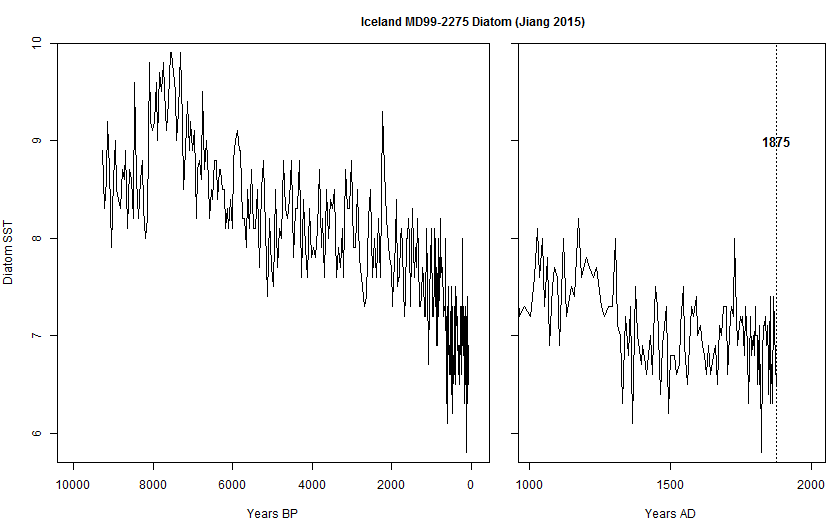
More data which shows since the Holocene Optimum from around 8000BC , through the present day Modern Warm Period( which ended in 1998) the temperature trend throughout this time in the Holocene, has been in a slow gradual down trend(despite an overall increase in CO2, my first chart ), punctuated with periods of warmth. Each successive warm period being a little less warm then the one proceeding it.
My reasoning for the data showing this gradual cooling trend during the Holocene ,is Milankovitch Cycles were highly favorable for warming 10000 years ago or 8000 BC, and have since been in a cooling cycle. Superimposed on this gradual cooling cycle has been solar variability which has worked sometimes in concert and sometimes in opposition to the overall gradual cooling trend , Milankovitch Cycles have been promoting.
Then again this is only data which AGW enthusiast ignore if it does not fit into their scheme of things. I am going to send just one more item of data and rest my case.
http://www.murdoconline.net/wordpress/wp-content/uploads/2011/01/gisp2-ice-core-temperatures.jpg
Barton Paul Levenson March 9, 2015 at 10:34 am:
“Do you know how to tell when you have an adequate sample size for a trend?”
So far as climate change is concerned this gentleman is right to ask this question imv. Those who are justifiably sceptical of the AGW “science”/knowledge, should perhaps be sceptical of their own beliefs too. We don’t know if the “pause” disproves the AGW thesis or not. It might just be a wee bit too early to tell . . The climate “system” is, for us at this moment, unfathomably complex, and our focussed awareness of it is incredibly brief. Neither side of the debate is even close to having all the answers. Question everything might be a sensible approach. And calling the guy “dim” because his opinion differs from the “consensus” on here doesn’t look too clever . .
jim hogg
March 9, 2015 at 12:31 pm
We don’t know if the “pause” disproves the AGW thesis or not.
Well, that may be correct Jim, just as the warming in the 1990’s didn’t prove AGW.
However, the fact remains: we haven’t found anything that proves the AGW concept either.
And the burden of proof is on them.
What is clear is the CAGW (AGW if you prefer) hypothesis did not account for “the pause”.
Time for them to go back to the drawing board and leave my wallet alone.
Jim Hogg
The problem with “questioning everything” is there’s a whole lot of everything (probably an infinite amount of everything; I’m worried this estimate might be wrong…).
Seems to me the scientific method offers a pretty good way out of this mess by requiring proponents of a theory to (1) state the theory; (2) predict something falsifiable based on the theory; (3) sit around for a while to see what various collections of accurate & real (not model) data say about the predictions.
Jim,if you want to sit around worrying about everything, go right ahead; just don’t take my tax dollars to fund such a solipsistic scheme.
Pretty dim to make a public assertion that he can provide only ludicrous support for, as in his claim concerning the WMO. See my comment above.
With all the data presented today and in the past how could any one take AGW theory seriously? If you still do it amounts to the blind following the blind.
SDP
Warmest could care less what educated skeptics think.
The target audience is the 80%+ of the population that cannot or will not perform critical thinking. The real danger is the follow-on group of politicians who are more than willing to use the confusion to raise taxes and increase their control of your life.
“All the CMIP models used the same data for past and future greenhouse gas concentrations, pollutant emissions, and changes to how land is used, which can emit or take in greenhouse gases. The more models in agreement, the more confidence in the results.”
Well, the more CMIP models in agreement, the more confident we can be that the methodology of those models is incorrect since they don’t model this planets observations.