*Based on the Linear Trend
Guest Post by Bob Tisdale
A new study funded by the US Geological Survey (USGS) was introduced with the USGS press release Ocean Warming Affecting Florida Reefs – Increased Temperatures Spell Trouble for Corals. The press release was included in yesterday’s post Claim: Ocean Warming Affecting Florida Reefs at WattsUpWithThat. The study compares sea surface temperatures from a century ago to recent values, see Figure 1, as measured at lighthouses in the Florida Keys, but it fails to illustrate or discuss that temperatures reached similar levels during the mid-20th Century…or the fact that sea surface temperatures for that part of the Florida Keys show no warming in 80+ years.
The paper being discussed is Kuffner et al. (2014) A Century of Ocean Warming on Florida Keys Coral Reefs: Historic In Situ Observations. My Figure 1 is their Figure 2. It shows the sea surface temperatures measured at two lighthouses in the Florida Keys during two periods: recent multidecadal periods and multidecadal periods about a century ago. There’s obviously some missing data…a lot of missing data.
Hmmm. That’s odd. Why would they fail to illustrate most of the data? Could they simply have cherry-picked two time periods—per lighthouse—so they could make alarmist claims about coral reefs? Notice how there are different periods shown for the two lighthouses. Odd.

Figure 1
The warming period in the early 20th Century is missing…and so is the mid-20th Century cooling period…and so is much of the warming period in the late 20th Century.
To confirm our suspicions, let’s see what the sea surface temperature data from one of the normal sources have to say.
As we can see in the map here (Figure 1 from Kuffner et al. (2014)), those two lighthouses in the Florida Keys aren’t too far apart. NOAA’s ERSST.v3b data and the UKMO’s HADSST3 data are presented in 5-degree longitude by 5-degree latitude grids. Those are way too large for our purposes. That leaves us with the UKMO HADISST data, which are presented in 1-degree longitude by 1-degree latitude grids. In the map linked above, I’ve highlighted the coordinates of 25N-26N, 81W-80W. That’s the teeny-tiny region we’re looking at in this post. And we’ll call that teeny-tiny region the Northeast Florida Keys.
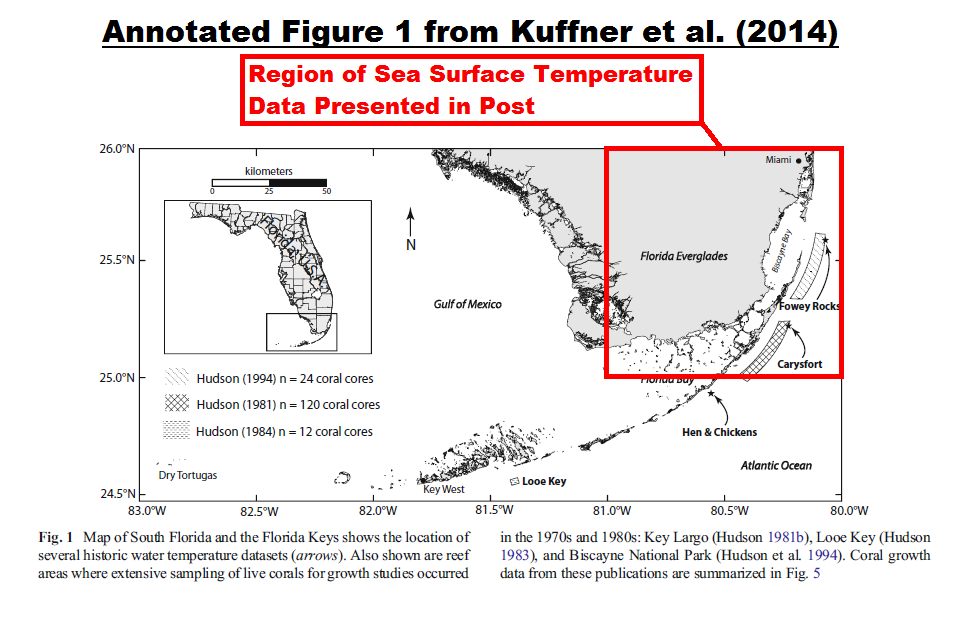
Feel free to choose one of the other sea surface temperature datasets and/or expand the grid size. The results are not going to be too different from what follows.
Let’s start with anomalies. Figure 2 illustrates the HADISST-based sea surface temperature anomalies for the Northeast Florida Keys (25N-26N, 81W-80W). There appears to be a multidecadal signal in the data. The sea surface temperatures there appear to have cooled from the 1880s to the early 20th Century, then warmed until the 1940s. Thereafter, they cooled until about 1980 and then warmed to early 2000s. In recent years, there were a number of very cool months in the Northeast Florida Keys.

Figure 2
I’ve smoothed the data with a 121-month running-mean filter (centered) in Figure 3 to help confirm those multidecadal variations. Oddly, Kuffner et al. (2014) didn’t bother to mention that it seems as though the sea surface temperatures of the Northeast Florida Keys may have already begun another multidecadal cooling period.

Figure 3
Let’s see how many decades we can go back in time and still not show any warming there. Based on the linear trend, the data for the Northeast Florida Keys reveal the sea surface temperature anomalies show no long-term warming or cooling in more than 8 decades. See Figure 4.

Figure 4
Yet, somehow, we’re supposed to believe manmade greenhouse gases are causing harm to the coral in recent years.
Further to this, Kuffner et al. (2014) focused on August, which is the warmest month of the annual cycle in sea surface temperatures for the Northeast Florida Keys. And they listed sea surface temperatures (thresholds) that were stressful (29 deg C) and very stressful (30 deg C) to the corals. Curiously, the Kuffner et al. (2014) Figure 2 (my Figure 1) shows that sea surface temperatures are above the 29 deg C stress threshold nearly every year, even back in the late 1800s. It even showed that there were occasional excursions above the 30 deg C very-stressful threshold in the early data.
My Figure 5 presents the HADISST-based August sea surface temperatures for the Northeast Florida Keys. It confirms that coral have had to deal with sea surface temperatures that are said to be stressful almost each and every year, and that sea surface temperatures regularly reached and exceeded levels that are said to be very stressful in the 1940s, 50s and 60s…and, if the early data are believable, on occasion, they were above very stressful levels in the late 1800s and early 1900s.

Figure 5
Why do I have the funny feeling that, in the not too distant future, Secretary of State Kerry and President Obama will be claiming manmade global warming hurts baby corals in the Florida Keys?
SOURCE
Data presented in this post are available through the KNMI Climate Explorer.
Even the “magnitude” claim is misleading. It is similar to global average ( which is surprising in view of the stability of the areas bordering the tropics) but the rise in hadISST for the same location is about half what they derive from the difference between the separate lighthouse records that are not cross-calibrated.
http://climategrog.files.wordpress.com/2014/09/floridakeys1.png
Greg, the warming is not similar to the global average. The global average sea surfaces have warmed over the past the 80 years. The sea surfaces of the Northeast Florida Keys have not.
Any thoughts/conjecture on why Florida Keys would be stagnant in a warming SST world?. Aren’t the Gulf and shallow waters supposed to warm faster?
This tastes like a simmering rebuttal for publication in that ‘revered’ journal? 😉
Are the complete records of the lighthouse available? If they match the 1 degree L and L of the SST record for the entire period, then a charge of scientific fraud is not out of the question.