*Based on the Linear Trend
Guest Post by Bob Tisdale
A new study funded by the US Geological Survey (USGS) was introduced with the USGS press release Ocean Warming Affecting Florida Reefs – Increased Temperatures Spell Trouble for Corals. The press release was included in yesterday’s post Claim: Ocean Warming Affecting Florida Reefs at WattsUpWithThat. The study compares sea surface temperatures from a century ago to recent values, see Figure 1, as measured at lighthouses in the Florida Keys, but it fails to illustrate or discuss that temperatures reached similar levels during the mid-20th Century…or the fact that sea surface temperatures for that part of the Florida Keys show no warming in 80+ years.
The paper being discussed is Kuffner et al. (2014) A Century of Ocean Warming on Florida Keys Coral Reefs: Historic In Situ Observations. My Figure 1 is their Figure 2. It shows the sea surface temperatures measured at two lighthouses in the Florida Keys during two periods: recent multidecadal periods and multidecadal periods about a century ago. There’s obviously some missing data…a lot of missing data.
Hmmm. That’s odd. Why would they fail to illustrate most of the data? Could they simply have cherry-picked two time periods—per lighthouse—so they could make alarmist claims about coral reefs? Notice how there are different periods shown for the two lighthouses. Odd.

Figure 1
The warming period in the early 20th Century is missing…and so is the mid-20th Century cooling period…and so is much of the warming period in the late 20th Century.
To confirm our suspicions, let’s see what the sea surface temperature data from one of the normal sources have to say.
As we can see in the map here (Figure 1 from Kuffner et al. (2014)), those two lighthouses in the Florida Keys aren’t too far apart. NOAA’s ERSST.v3b data and the UKMO’s HADSST3 data are presented in 5-degree longitude by 5-degree latitude grids. Those are way too large for our purposes. That leaves us with the UKMO HADISST data, which are presented in 1-degree longitude by 1-degree latitude grids. In the map linked above, I’ve highlighted the coordinates of 25N-26N, 81W-80W. That’s the teeny-tiny region we’re looking at in this post. And we’ll call that teeny-tiny region the Northeast Florida Keys.
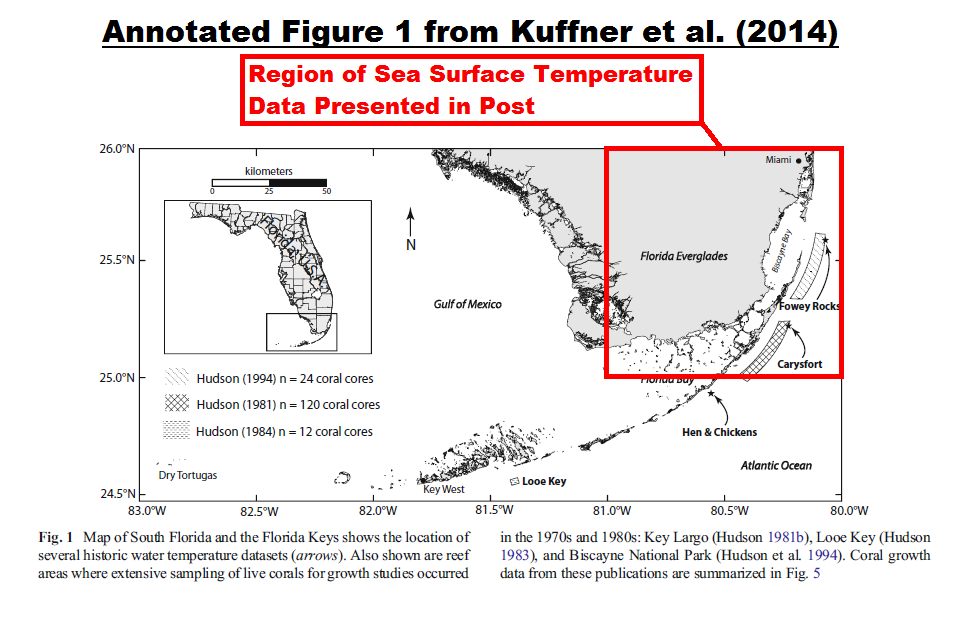
Feel free to choose one of the other sea surface temperature datasets and/or expand the grid size. The results are not going to be too different from what follows.
Let’s start with anomalies. Figure 2 illustrates the HADISST-based sea surface temperature anomalies for the Northeast Florida Keys (25N-26N, 81W-80W). There appears to be a multidecadal signal in the data. The sea surface temperatures there appear to have cooled from the 1880s to the early 20th Century, then warmed until the 1940s. Thereafter, they cooled until about 1980 and then warmed to early 2000s. In recent years, there were a number of very cool months in the Northeast Florida Keys.

Figure 2
I’ve smoothed the data with a 121-month running-mean filter (centered) in Figure 3 to help confirm those multidecadal variations. Oddly, Kuffner et al. (2014) didn’t bother to mention that it seems as though the sea surface temperatures of the Northeast Florida Keys may have already begun another multidecadal cooling period.

Figure 3
Let’s see how many decades we can go back in time and still not show any warming there. Based on the linear trend, the data for the Northeast Florida Keys reveal the sea surface temperature anomalies show no long-term warming or cooling in more than 8 decades. See Figure 4.

Figure 4
Yet, somehow, we’re supposed to believe manmade greenhouse gases are causing harm to the coral in recent years.
Further to this, Kuffner et al. (2014) focused on August, which is the warmest month of the annual cycle in sea surface temperatures for the Northeast Florida Keys. And they listed sea surface temperatures (thresholds) that were stressful (29 deg C) and very stressful (30 deg C) to the corals. Curiously, the Kuffner et al. (2014) Figure 2 (my Figure 1) shows that sea surface temperatures are above the 29 deg C stress threshold nearly every year, even back in the late 1800s. It even showed that there were occasional excursions above the 30 deg C very-stressful threshold in the early data.
My Figure 5 presents the HADISST-based August sea surface temperatures for the Northeast Florida Keys. It confirms that coral have had to deal with sea surface temperatures that are said to be stressful almost each and every year, and that sea surface temperatures regularly reached and exceeded levels that are said to be very stressful in the 1940s, 50s and 60s…and, if the early data are believable, on occasion, they were above very stressful levels in the late 1800s and early 1900s.

Figure 5
Why do I have the funny feeling that, in the not too distant future, Secretary of State Kerry and President Obama will be claiming manmade global warming hurts baby corals in the Florida Keys?
SOURCE
Data presented in this post are available through the KNMI Climate Explorer.
Bob, thanks so much for doing this….
…mind if I forward it now?
Easy on the excitement and the rants folks, I think Bob may have made blooper getting the data. Wait for a bit of peer review before you start shouting too loud.
Greg,
If you think he made a blooper, state your case. Do part of the peer review. Drive by trolling is a nuisance.
It was not “drive by ” I’d already checked the data and plotted and posted a full comment below. I put this at the head with the hope that it would stop people sounding off with the usual smart, sarcastic comments without checking.
Of no avail.
Now I’ve had time to write it up, I’ve also posted what the data does look like and with a less distorting filter than the crappy running mean.
[Graph removed at Greg’s request. He used the wrong coordinates.]
Again, see my comments below for more detail.
Anthony, you may like to get Bob to check his data. This is a pretty damning article and may be mistaken.
See my reply to you below. There’s no error on my part, Greg.
And here’s a link to the output graph directly from the KNMI Climate Explorer, Greg.
http://climexp.knmi.nl/ps2pdf.cgi?file=data/ihadisst1_-81–80E_25-26N_n_0p19812010a.eps.gz
Same as my Figure 2 above.
Crap, no, it’s my mistake. Apparently I’d keyed in -81E but “80” E without the negative.
KNMI returns a file name with a “minus” added in to indicate “to” so I didn’t see the error when I checked back.
ihadisst1_-81-80E_25-26N_n.txt
Apologies to Bob.
MODS, I’ve removed the erroneous graph from my WP to stop it propagating further, so you may like to remove the links in my posts below.
[The erroneous graphs were removed with the note [Graph removed at Greg’s request. He used the wrong coordinates.] Bob Tisdale
Interesting set of comments from Greg Goodman (presumably also “Greg”):
“I think Bob may have made blooper”
“Wait for a bit of peer review”
“Crap, no, it’s my mistake”
To my mind, that follows proper scientific process – and kudos to Greg, that last statement is never an easy one to make. If only certain others would do the same…
Every one of these Alarmist reports which can be easily debunked and/or shown to be blatant cherry picking reminds me of a funny show on Animal planet “Finding Bigfoot”. They become more convinced that Sasquatch exists every week , they spend millions of dollars looking for proof, yet they never produce any credible scientific evidence. Bigfoot and Global Warming follow the same belief system.
Finding Bigfoot is much more fun though, ” listen, I heard a howl”
” listen, I heard a howl”
And you don’t hear howls from the Warmists?
Why would any journal publish such a paper with those big gaps of data missing?
Because: AGENDA
It is appalling that crap studies like this pass peer-review and get published.
Is there any study out there not cherry picking data to prove a predetermined point ?
Believe none of what you hear and only half of what you see : Benjamin Franklin
Good job Bob. Definitely exposes the “Ocean Warming Affecting Florida Reefs” study for what it is, a load of cr@p. But they will probably still get a government grant.
“But they will probably get ANOTHER government grant.”
There…fixed it for ya 🙂
Jim
The two lead authors, Kuffner and Lidz, don’t need government grants. They work for the USGS and are already funded by the taxpayer’s dime.
No federal agency is immune from global warming—–the message directive that is.
Wow! Just wow!
Are they really being this blatant?
After this article, it’s time to bring in the homogenization filters. Obviously the data can’t be correct.
Can someone persuade the Miami Herald to run this article? I’m sure Bob would give his permission.
Quite frankly if this was presented as an essay for a journalism class in the 1950’s, it would have gotten an A+. It is short, very understandable and well documented.
This year Bob would have been expelled from school for this.
I am amazed at the utter ham-handedness of the attempt to hide falsifying data. To create graphs screaming to be investigated… it boggles my mind.
Thank you Bob for this concise and devastating critique. Sadly (as my wife constantly points out) it is the study, not the critique, that will make it to the mainstream media.
There used to be a concept of honor and shame in science. Someone caught falsifying or grossly manipulating data would have been shunned in a past age. I wonder how or if we can ever bring that back. Still, thank you for fighting the good fight.
Not that I quarrel with the questions regarding cherry picking of dates of temperature records at two lighthouses…
But is HADISST at 1×1 deg gridding for the period 1870 to 1980 to be given any credibility at all? It is a figment of imagination via some computer gridding Al-Gore-ithm (h/t Pamela Grey) to support some other contention.
OK, I guess there is nothing wrong with using one government agency’s pack of fibs to contest the claims of another government agency’s fibs.
Where is the raw data from those lighthouses?
I forgot to mention the increasing variance in later time periods (heteroscedasticity) of the HADISST is a big red flag that the early parts of the record are woefully undersampled and the missing data * fabricated * by some other AlGoreIthm.
Have a look at
National Data Bouy Center – Station FWYF1,
at http://www.ndbc.noaa.gov/station_page.php?station=fwyf1
Bob, can I suggest you check out that data again. I went to the same source and the end of their automatic plot does not look like yours. I downloaded the data an plotted it and it does not look like yours.
It seems roughly like the general global record except that there’s the double dump in the middle.
The difference between pre-1990 and the last few years is less than 0.6 deg C so there is something to be looked at but you do have a problem with your data.
Did you put -81 to -80 E into climexp ?? If you put -80 to -81 you went all the way around !.
BTW , get beyond running means it grossly distorts, try successive 121,90 and 68 running means instead of the simple 121 mo you did.
I’ll check back later, but I think there’s a blooper here.
Regards, Greg.
Greg,
Thanks, I apologize for my earlier comment. I see you have done the peer review work. mea culpa
Greg says: “Bob, can I suggest you check out that data again. I went to the same source and the end of their automatic plot does not look like yours.”
My data and graphs are fine, Greg. I suggest you check yours. Look at the title blocks of my graphs again, Greg. Figure 5 presents the August values, and the Climate Explorer would not show those. And Figures 2 through 4 present monthly anomalies. The reference years are the defaults.
Greg says: “Did you put -81 to -80 E into climexp ?? If you put -80 to -81 you went all the way around !.”
I always double- and triple-check. FYI, here are the first few lines of the Climate Explorer output for the sea surface temperatures:
# using minimal fraction of valid points 0.00
# SST [C] from Hadley Centre SST data set HadISST1
# cutting out region lon= -81.000 -80.000, lat= 25.000 26.000
And here’s the same for the anomalies:
# ./bin/plotdat anomal ./data/ihadisst1_-81–80E_25-26N_n_0p.dat
# using minimal fraction of valid points 0.00
# SST [C] from Hadley Centre SST data set HadISST1
# cutting out region lon= -81.000 -80.000, lat= 25.000 26.000
Greg says: “I’ll check back later, but I think there’s a blooper here.”
And I believe you’ll find the blooper was on your part.
Regards
Peter, the data set used by Bob matches the data set used in the study. So Bob’s graph cherry picked to those dates, would have agreed with the report, not contradicted it. (savy?)
Surface T is in general a good indicator of water anomalies at common coral depth. As the two different sets match for the time periods in the study, your objection is without merit.
Also Peter, did you read the abstract? “The magnitude of warming revealed here is similar to
that found in other SST datasets from the region and to that
observed in global mean surface temperature”
Peter asks, “And why does Bob throw this stuff around re 19th century data gaps at the two light houses”
Because the paper is based o…
“The new analysis compares water temperatures during two time periods a century apart at two of Florida’s historic offshore lighthouses – Fowey Rocks Lighthouse, off Miami, and Carysfort Reef Lighthouse, off Key Largo, Florida. The first period included data from 1879 to 1912, while the second period spanned from 1991 to 2012. Temperatures at a third area, a reef off Islamorada, Florida, were also monitored from 1975 to 2007.”
So Peter, does it matter what is in the supplemental if their conclusions are based on these two periods only? What did you find in the supplemental? Did the missing SST pattern follow the 1 degree grids that Bob used, as the two periods in question did?
Peter, further, looking at the supplemental, they only cover the dates mentioned by Bob, so not certain of your point.
Curiously I noticed the following..
Data Set 1… January 1 1879 to 12-31-1912 Fowey Rocks Lighthouse, off Miami, and Carysfort Reef Lighthouse, off Key Largo, Florida. The first period included data from 1879 to 1912, Online Resource 1: Electronic spreadsheet (Microsoft Excel file) of ocean temperature data collected by lighthouse keepers in the Florida Keys from tables published in Vaughan
(Info on T reading method and water depth of sensor???)
Data Set two 1975 to 2007 record appears to be missing the first 27 days of January, a cold month? Electronic spreadsheet (Microsoft Excel file) of underwater temperature data collected by J. H. Hudson and J. S. Anderson from a selection of sites in the Florida Keys. (XLSX 598 kb)
(Water depth reading of four meters at Hens & Chickens Reefs co 25 degrees 56.0 N / 80 degrees 35.5 W )
Data set three…1991 to 2007 (Begins August 1st 1991, so missing first 8 months) Online Resource 3: Electronic spreadsheet (Microsoft Excel file) of ocean temperature data compiled from the National Data Buoy Center (NDBC) observation site at Fowey Rocks Lighthouse
(water depth reading one meter below the surface)
So questions. The authors use three different locations, at three different water depths for the sensors, with different methodologies of arriving at daily means and partial years missing from two of the data sets. ( All I can say is good luck with arriving at accurate comparisons)
…and looking at the Old records, there is data missing at the light houses.
Cherries Flambe for the Kool-aid drinkers. The title of the press release is all that matters to the true-believers. Any data that is included, is just further proof, of what they already know.
I emailed the authors asking the questions you pose here. I won’t hold my breath.
Al Gore must curse the day he invented the internet. Another day , another kicking for an alarmist claim.
I am sure frequency of hurricanes has no affect on these results.
Interestingly, the unusually cold snap in Q1 2010 drove Gulf water temperatures off of Sarasota to 51 degrees F, causing death from hypothermia to large numbers of fish. The same cold snap damaged coral reefs on the gulf side of the keyes. That doesn’t seem to get discussed.
Among other inconvenient truths.
Bob,
Can you please NOT smooth the data when creating your plots? There’s a ton of information in all the fluctuations that gets lost by smoothing (which is a terrible filter by the way).
Thanks
If you don’t like smoothing, don’t look at it. Mr Tisdale put it in a separate figure you can disregard if you want. To me the smoothing helps to visualize what’s going on in all those fluctuations.
In the absence of error bars on the measurements, which is a hallmark of climate data, the fluctuations are all you have to judge whether there is a genuine trend or just random noise. Frankly, I have a hard time believing that the data in Figure 2 was measured to 0.01 C or even 0.1 C.
Smoothing random noise will also produce trends. Try it, create a time series by generating a few thousand random numbers uniformly distributed between -1 and 1 and smooth the series. You’re guaranteed to see all sorts of trends, just like smoothed climate data.
Paul Linsay, the only graph with smoothed data in this post is Figure 3. If you’d like to look at that data without the smoothing, scroll all the way up to Figure 2…directly above it.
Bob, please see my reply above to Chris4692. Frankly, there is never any justification for smoothing data, or even drawing a curve through it, unless you have a theory that predicts what the data should do and you are doing a comparison. Just a grumpy old physicist sounding off about how climate science ruins scientific morals, among other things.
Did the authors of the paper explain why they picked just those periods to analyze?
Did they claim the data was unavailable?
I just went back and reviewed the paper quickly. I suspect the authors are seeing the impact of the 2010 cold snap and blaming it on warming.
“What’s interesting is that the temperature increase observed during this recent 32-year period was as large as that measured at the lighthouses spanning 120 years,” said Kuffner. “This makes it likely the warming observed at the lighthouses has actually occurred since the 1970s.”
Porky #1
the temperature increase observed during this recent 32-year period was as large as that measured at the lighthouses spanning 120 years
There is no warming over 120 years.
Porky #2
the warming observed at the lighthouses has actually occurred since the 1970s
Twice the warming occurred from 1905-1945 (40 years) than occurred from 1980-200 (20 years). In both periods warming was at the same rate.
” temperatures that are said to be stressful”
————————-
Has anyone shown what temperatures are good for corals and which are not, rather than just making it up?
Thanks, Bob. A very clear presentation of your powerful rebuttal of Kuffner et al. (2014).
I live very near to the Fowey Rocks site and watch the NWS-NOAA temperatures at http://www.ssd.noaa.gov/goes/east/wfo/mfl/flash-rb.html
The readings seem to be consistently too high but normal in the local climatology.
Same thing appears to happen with the air temperatures; it feels colder than the figures from the NWS-NOAA, WeatherBug and Intellicast. My personal thermometer agrees with my feelings, not the published figures.
Maybe it is too shaded and protected from the wind?
NWS-NOAA sea surface temperatures at the linked page.
What effect does the many various canals built in the everglades over the years have on the supposed temperature change?
Water from the very shallow but extensive Everglades always gets warmer from the Sun.
Some say that clouds warm what’s beneath them, in Florida it seems like it’s the opposite way. Wonderful shade they bring!