Rebuttal to Chen and Tung (2014) highlighted in “Cause for ‘The Pause’ #38 – Cause of global warming hiatus found deep in the Atlantic Ocean”
Numerous scientific papers have reported the hiatus in global surface warming will end with the next El Niño event. But according to a new paper by Chen and Tung published today online in ScienceMag (link to paper follows), that’s not going to happen because the multidecadal variations in ocean heat sequestration at depth in the Atlantic and Southern Oceans will suppress surface warming for a decade or two more. Additionally, unlike many other papers of its kind, Chen and Tung (2014) indicate a lessening in ocean heat sequestration to depth (the reverse of what we’re seeing now) was responsible for the accelerated warming during the latter part of the 20th Century.
Looking at Chen and Tung (2014) in a different light, they went looking for Trenberth’s missing heat, and, not surprisingly, they found it in the same ocean heat content reanalysis (ECMWF ORAS-4) used in Balmaseda et al. (2013), which Trenberth co-authored.
The paper is Chen and Tung (2014) Varying planetary heat sink led to global-warming slowdown and acceleration. The abstract reads (my boldface):
A vacillating global heat sink at intermediate ocean depths is associated with different climate regimes of surface warming under anthropogenic forcing: The latter part of the 20th century saw rapid global warming as more heat stayed near the surface. In the 21st century, surface warming slowed as more heat moved into deeper oceans. In situ and reanalyzed data are used to trace the pathways of ocean heat uptake. In addition to the shallow La Niña–like patterns in the Pacific that were the previous focus, we found that the slowdown is mainly caused by heat transported to deeper layers in the Atlantic and the Southern oceans, initiated by a recurrent salinity anomaly in the subpolar North Atlantic. Cooling periods associated with the latter deeper heat-sequestration mechanism historically lasted 20 to 35 years.
Basically, Chen and Tung (2014) are saying that the vast majority of the human-induced global warming signal can be found in the ocean temperature and salinity data (and reanalysis) for the oceans to depths of 1500 meters. (There’s nothing new about that.) They are also clarifying that naturally occurring variations (that last for multiple decades) in where that ocean heat is sequestered (shallow or deeper layers of the oceans) impacts the rate of global warming at the surface. (There’s nothing new there, either.) During the “latter part of the 20th century” there was “rapid global warming as more heat stayed near the surface” and “[i]n the 21st century, surface warming slowed as more heat moved into deeper oceans.” While this proposal is not new, Chen and Tung (2014) are arguing against El Niño and La Niña as the primary cause and saying the variations in sequestration are occurring in the Atlantic and Southern Oceans…the result, primarily, of Atlantic meridional overturning circulation, with which the Atlantic Multidecadal Oscillation (AMO) is associated. The last little tidbit of value is the time periods of similar past cooling periods, 20 to 35 years, and that’s important because the current hiatus has not lasted that long yet.
Unfortunately, the Southern Ocean is one of the key regions in Chen and Tung (2014). There is so little long-term subsurface temperature and salinity data that far south that any reanalysis of the Southern Ocean before the ARGO floats were deployed (around 2003) has to be viewed as fantasy.
DATA AND REANALYSIS
Chen and Tung (2014) relied on the JMA ocean heat content data (Ishii and Kimoto) along with the COBE sea surface temperature data and on the ORAS-4 Reanalysis from ECMWF. As you’ll recall, a reanalysis is the output of a computer model that uses data as one of its inputs, so it’s not data. We discussed the curious behavior of the ECMWF reanalysis in the post Trenberth Still Searching for Missing Heat. The ECMWF ORAS-4 is forced by volcanic aerosols and ENSO to give it features that do not exist in data. Also see Willis Eschenbach’s post Why Reanalysis Data Isn’t…
Would the results of Chen and Tung (2014) be different if they had used another reanalysis of subsurface temperatures and salinity?
CHEN AND TUNG COMMENT ON OTHER PROPOSED REASONS FOR HIATUS
Chen and Tung (2014) discussed a number of the proposed explanations for the slowdown in surface warming. To these, they stated (my boldface):
Response to solar cycle changes was found to be small (40, 41). The aerosol cooling should have a signature in subsurface ocean (42), and yet it is not seen, perhaps suggesting that the proposed radiative effects may be too small. The second involves ocean heat sequestration: The present work follows the original proposal of Meehl et al. (5, 24) regarding global deep-ocean heat sequestration. However, our observational result does not support their Pacific-centric view. The duration of the cooling periods in the CCSM4 model they used is typically 10 years, with one rare 15-year hiatus in 375 years and none over 15 years. The current hiatus already lasted over 15 years using their definition of hiatus as periods with zero trend. Comparing that model with observation, we found that model’s Atlantic has too little variability with too high frequency (fig.S7 versus Fig. 6). This artifact appears to be attributable to a new overflow parameterization scheme in CCSM4 in the Denmark Strait and Faroe Bank Channel (31).
CHEN AND TUNG CONCLUSIONS
They write:
The fact that the global-mean temperature, along with that of every major ocean basin, has not increased for the past 15 years, as they should in the presence of continuing radiative forcing, requires a planetary sink for the excess heat. Although the tropical Pacific is the source of large interannual fluctuations caused by the exchange of heat in its shallow tropical layer (3), the current slowdown is in addition associated with larger decadal changes in the deeper layers of the Atlantic and the Southern oceans. The next El Niño, when it occurs in a year or so, may temporarily interrupt the hiatus, but, because the planetary heat sinks in the Atlantic and the Southern Oceans remain intact, the hiatus should continue on a decadal time scale. When the internal variability that is responsible for the current hiatus switches sign, as it inevitably will, another episode of accelerated global warming should ensue.
So according to Chen and Tung (2014), an El Niño will only cause a temporary surge in global warming but not impact the multidecadal hiatus. But data contradict them. We know that strong El Niño events are a primary cause of global surface warming. Sunlight-produced warm waters released from below the surface of the western tropical Pacific during strong El Niño events (like ones in 1986/87/88, and 1997/98 and 2009/10) are then distributed to adjoining ocean basins in the wakes of those El Niños, and those El Niño residuals cause blatantly obvious upward steps in the sea surface temperatures of the South Atlantic, Indian and West Pacific Oceans. For more information on how strong El Niños cause those upward shifts, see the illustrated essay The Manmade Global Warming Challenge (42mb pdf).

However, in some respects, the sea surface temperature data for the North Atlantic do agree with Chen and Tung (2014). That is, the surface of the North Atlantic had been warming at a much higher rate than the rest of the global oceans during the satellite era (about 3 times faster)…until about 11 years ago. Since January 2003, the surface of the North Atlantic has been cooling, while the warming has slowed drastically for rest of the global ocean surfaces. (See the graph here.) So the North Atlantic has suppressed global warming for the past 11 years.

And, of course, the sea surfaces of the Southern Ocean show cooling for the entire satellite era, with a big step down in 2006-08.
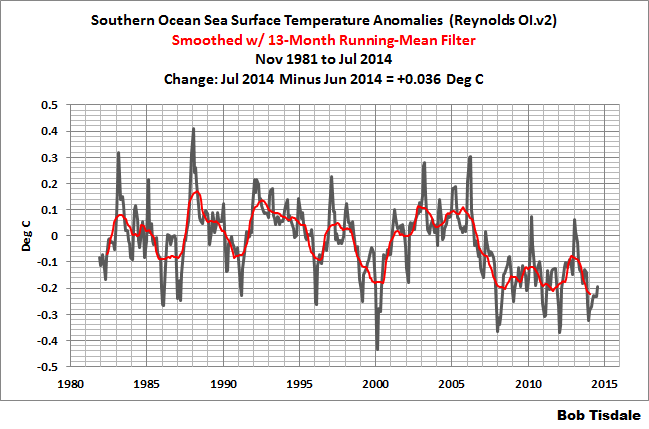
Last, according to Chen and Tung (2014), hiatus periods due to the sequestration of ocean heat to depth in the Atlantic and Southern Oceans can last 20 to 35 years. And they note the current hiatus period has already lasted 15 years. That indicates we’ve got another 5 to 20 years more to go with the current hiatus.
CLOSING
Over the past few years, we’ve seen more and more papers that admit natural variability contributed to the warming from the mid-1970s to the turn of the century and suppressed the warming in the 21st Century. When will the climate science community admit they’d tuned their models to a naturally occurring upswing in the warming of global surfaces from the mid-1970s to the turn of the Century, and as a result their projections of future global warming are way too high? (Answer: Probably not in my lifetime.)
Bob Tisdale,: I wasn’t necessarily talking about the one this year, which we haven’t seen yet.
the authors were specifically addressing the next El Niño: The next El Niño, when it occurs in a year or so, may temporarily interrupt the hiatus, but, because the planetary heat sinks in the Atlantic and the Southern Oceans remain intact, the hiatus should continue on a decadal time scale.
Wake up recent posters it is the sun that caused it !
90% of the energy is missing.
Wunsch and Heimbach (2014) is the only study to look at the total global ocean heat content uptake and they have calculated the number as +0.2 W/m2/year. [They further note that Balmaseda/Trenberth 2013 use of the reanalysis data (and therefore the Chen and Tung 2014) cannot possibly achieve an error rate approaching +/- 0.1 W/m2 as they claim].
http://ocean.mit.edu/~cwunsch/papersonline/heatcontentchange_26dec2013_ph.pdf
Meanwhile the IPCC says that the radiative forcing is supposed to be +2.30 W/m2/year in 2013.
http://www.pik-potsdam.de/~mmalte/rcps/index.htm#Download
So, 0.235 W/m2/year showing up, 2.30 W/m2/year supposed to be showing up (or at least, identifiable, as in some could be just re-emitted back to space but nobody seems to be able to show this either). Therefore, 90% is missing
Gee, doesn’t that mean that models calibrated against the warming phase, when ocean currents were (unknown to scientists) boosting the rate of rise in temperature, have grossly overestimated global warming?
“Ocean currents transport heat from the equator to the poles through a heat- and saline-driven process called thermohaline circulation. Warm water moves from the equator northward along the ocean surface and eventually cools. As it cools, it becomes dense and heavy and sinks. This cold water then moves south along the lower part of the ocean and rises near the equator to complete the cycle.”
The description here is dynamically ludicrous! Poleward transport is wind-driven, persists independently of seawater density, and is orders of magnitude more rapid than THC. The latter process is responsible mostly in forming cold, hypersaline, bottom-water, which, as such, cannot rise anywhere near the surface in tropical waters “to complete the cycle.” Eminent oceanographers (e.g., Wunsch) have debunked this “great conveyor belt” myth, but it doggedly persists in the minds of wannabes and scientific amateurs.
RE: Mosher, 12:36 pm..
Bob, I actually may have to agree with Mosher on this one, at least in part. El Nino is merely a release mechanism of heat, not a cause. The cause is prior heating of the oceans my solar…maybe a bit of semantics, but as said…correlation is not causation.
Fred Berple says:
“or the radiative theory is wrong. that water vapor provides a negative, not positive feedback. that as you add CO2, H2O is decreased by an equal mass, before any warming can take place.”
First I’ve heard of that theory. Maybe more likely that increased cloud cover is a negative feedback?
“””””…..Bill Illis says:
August 21, 2014 at 4:48 pm
90% of the energy is missing.
Wunsch and Heimbach (2014) is the only study to look at the total global ocean heat content uptake and they have calculated the number as +0.2 W/m2/year. …..”””””
Bill, when they calculate these numbers, are they just calculating total solar energy that enters the oceans, below the surface layers, where evaporation removes energy, or do they also figure out by some as yet un-described means, what fraction of that total solar energy is turned into ocean bio-mass, rather than wasted as “heat” ??
And how do they actually measure the EMR to bio-mass conversion.
The heat isn’t missing, if it simply does not exist.
“””””…..Grant says:
August 21, 2014 at 6:42 pm
Fred Berple says:
“or the radiative theory is wrong. that water vapor provides a negative, not positive feedback. that as you add CO2, H2O is decreased by an equal mass, before any warming can take place.”
First I’ve heard of that theory. Maybe more likely that increased cloud cover is a negative feedback?…..”””””
I agree, any CO2 atmospheric heating, which occurs (which I don’t dispute) results in MORE water in the atmosphere (per Wentz et al), and that results in negative feedback due to cloud increase.
More water vapor in the atmosphere means more solar spectrum radiant energy, that never reaches the deep ocean storage bin, so it results in net cooling.
Water is never a positive feedback.
Chen and Tung 2014 are correct.
Recently I have made several posts arguing that since most climate heat is in the ocean, redistribution of ocean heat and in particular changes in deep vertical mixing can account for climate changes.
With several newly published papers including Chen and Tung 2014 falling into line with this view, its nice to see some growing acceptance of this ocean centric paradigm. Its the only game in town if you think about it seriously.
Here is a repeat of a recent exchange with db:
phlogiston on August 19, 2014 at 2:11 pm
dp says:
August 19, 2014 at 8:36 am
How can El Niño warm the earth? Any energy released from an El Niño event is energy that is already here, not new energy trapped by hellish republican sweat shops churning out SUV’s by the billions. Like moving cash from one pocket to the other has no affect on your wealth, moving energy from one place to another in the Earth system does not change the energy balance between the planet and the universe.
Spot on. Consider how many orders of magnitude more heat is in the oceans compared to the atmosphere. Eventually folks will realise the profound error of into thinking that climate warming must mean gain of energy by the earth as a whole. Why? With near freezing water at the bottom of all the world’s oceans, all it takes for climate cooling is an increase in deep vertical mixing in the oceans, integrated globally. All it takes for climate warming is a decrease in the same deep mixing. Yes – its just moving money from one pocket to another. But it changes climate as experienced by people living on land surfaces.
Climate can move upward and downward in temperature just from changes in ocean deep vertical mixing, with zero change in global energy budget. (There is evidence that Arctic bottom water is warmer during ice ages for instance.) Again, considering the ocean’s heat budget, climate on at least decadal timescales should be considered adiabatic.
phlogiston on August 21, 2014 at 11:48 pm
Tung and Chen are right with the paradigm that changes in heat distribution in the ocean are a major source of climate change. However they are wrong to mix it up with the flawed dogma that heat is being gained by the earth as a whole by co2. The former is based on good thermodynamics and real data. The latter is a fiction of simplistic computer models that fatally exclude nonlinear thermodynamics.
Co2 really is the spare prick at the wedding. It is not responsible for any climate change. Its all the oceans under weak nonlinear astrophysical forcing.
There seems to be some lack of clarity as to whether we are talking about total heat in the system or GASTA in these comments.
El Nino will release heat into the atmosphere – warming.
But it’s not clear that it will increase the total heat in the system. That depends on how the heat is reorganised – which affects the rate it is re-emitted out.
Right?
From mothcatcher
Phlogiston – I find your perspective compelling. The heat storage capacity of the oceans must be huge. Can we have some figures, relative to the heat content of the atmosphere and land surface? Of course, the many factors that will regulate the interchange will be complex and obscure, and, reading the range of current papers, quite possibly beyond the ability of present understandings to disentangle, but we might get an idea of the likely inertia that the oceans may impart to any real or imagined forcings..
more soylent green! says: “But do GHG cause el Ninos?”
The linear trend of the average of the NINO3.4 region sea surface temperature anomalies from the ERSST.v3b, the Kaplan and HADISST reconstructions (graph on the right) shows no long-term warming of the east-central equatorial Pacific.
http://bobtisdale.files.wordpress.com/2014/03/figure-5.png
Also, see Ray & Giese (2012) “Historical changes in El Niño and La Niña characteristics in an ocean reanalysis”
http://www.agu.org/pubs/crossref/2012/2012JC008031.shtml
They concluded:
“Overall, there is no evidence that there are changes in the strength, frequency, duration, location or direction of propagation of El Niño and La Niña anomalies caused by global warming during the period from 1871 to 2008.”
Regards
M Courtney:
At August 22, 2014 at 1:29 am you say and ask
Yes, right. But the reorganisation of the existing heat across the Earth’s surface – with no change to total heat in the system – will also affect the rate heat is re-emitted out with resulting change to GASTA.
Coincidentally, I again explained this on WUWT as recently as yesterday in another thread, and that explanation is here.
Richard
NO, but the next La Nina will bring an end to the plateau in surface temperatures.
Paul Mankiewicz says: “Bob, I actually may have to agree with Mosher on this one, at least in part. El Nino is merely a release mechanism of heat, not a cause. The cause is prior heating of the oceans my solar…maybe a bit of semantics, but as said…correlation is not causation.”
Hi Paul. I’ve been presenting ENSO processes here at WUWT and at my blog for more than 5 years. I’ve documented those processes with data, carrying the relationship between ENSO and global sea surface temperatures far beyond the “correlation is not causation” phase. I’ve used data to document my understandings of ENSO: sea surface temperature data, sea level data, ocean currents data, ocean heat content data, depth-averaged temperature data, warm water volume data, sea level pressure data, cloud amount data, precipitation data, the strength and direction of the trade winds data, etc. I have presented the effects of ENSO on each of those variables in past posts. And since cloud amount for the tropical Pacific impacts downward shortwave radiation (visible light) there, I’ve presented and discussed that relationship as well.
Solar? See the discussion under the heading of THE ENERGY SOURCE THAT FUELS ENSO-RELATED WARMING in the post:
http://bobtisdale.wordpress.com/2013/01/25/untruths-falsehoods-fabrications-misrepresentations/
And there’s always the overall presentation in the essay linked in the post:
http://bobtisdale.files.wordpress.com/2013/01/the-manmade-global-warming-challenge.pdf
Regards
1sky1 says: “Eminent oceanographers (e.g., Wunsch) have debunked this “great conveyor belt” myth, but it doggedly persists in the minds of wannabes and scientific amateurs.”
Hi 1sky1. Do you have a link to the Wunsch paper that debunks the “great conveyor belt”.
Cheers
Eric Worrall says: “Gee, doesn’t that mean that models calibrated against the warming phase, when ocean currents were (unknown to scientists) boosting the rate of rise in temperature, have grossly overestimated global warming?”
Are you sure that climate scientists did not know they were tuning models to a naturally occurring upswing in surface temperatures?
Matthew R Marler says: “the authors were specifically addressing the next El Niño…..”
And I’ll stand by my earlier comment that we haven’t seen an El Nino event yet this year.
DavidR says: “Maybe it’s just me, but I still don’t see how stored ocean heat can cause net warming of global atmosphere without a corresponding net loss in global ocean heat content.”
First, consider the heat storage capacities of the ocean and atmosphere. Also, while the tropical Pacific is releasing heat from ocean to atmosphere during an El Nino, the North Atlantic and Indian Oceans are gaining heat in response to El Nino-caused changes in atmospheric circulation which allows more sunlight to penetrate and warm those oceans to depth. As a result, an ENSO index (NINO3.4 SSTa) correlates very poorly with the NODC’s depth-averaged temperature anomalies for the top 700 meters and 2000 meters. We can’t use the NODC OHC data for that analysis, because their ocean heat content data for the top 2000 meters are only available in pentadal form. Luckily, their vertically averaged temperature data are available in annual form.
For the period of 1955 to 2013, the correlation coefficient (0-year lag) for NINO3.4 SSTa (Kaplan SST) and the NODC vertically-averaged temperature data for the depths of 0-2000 meters is -0.14. Horrendous! It gets slightly worse for 0-700 meters. For the period of 1955 to 2013, the correlation coefficient (0-year lag) for NINO3.4 SSTa (Kaplan SST) and the NODC vertically-averaged temperature data for the depths of 0-700 meters is -0.12.
The sampling for older subsurface temperature data is terrible, so let’s look at the ARGO era. For the period of 2003 to 2013, the correlation coefficient (0-year lag) for NINO3.4 SSTa (Kaplan SST) and the NODC vertically-averaged temperature data for the depths of 0-2000 meters is -0.34. Still pretty awful. And it’s again worse for the depths of 0-700 meters. For the period of 2003 to 2013, the correlation coefficient (0-year lag) for NINO3.4 SSTa (Kaplan SST) and the NODC vertically-averaged temperature data for the depths of 0-700 meters is -0.29.
The correlations get a little better for the ARGO era if we lag the NINO3.4 data by a year, but we’re still talking correlation coefficients in the neighborhood of -0.5.
I first presented those correlations in a recent response to a comment by David Appell at my blog here:
http://bobtisdale.wordpress.com/2014/07/20/lewandowsky-and-oreskes-are-co-authors-of-a-paper-about-enso-climate-models-and-sea-surface-temperature-trends-go-figure/#comment-19719
I think I’ll have to prepare a post about it.
I wonder why the dismissal of ENSO as a mechanism. If CO2, as the climate obsessed have claimed, is the control knob, then that means something else is the heater. We are in a pause as long or longer than the allegedly unprecedented heating, and CO2 is still creeping up. It is reasonable to focus on the heating mechanism, because the control knob is not working as predicted. Bob seems to focus on the mechanism and appears to be making valid points about it. Certainly better than those who have claimed we are in a massive dangerous climate crisis with all sorts of unusual things happening, all controlled by the wicked control knob, CO2.
Bob,
You might want to check out Jennifer Marohasy’s blog. She is working on some things that could be of interest to you.
BBC all over this story and very obviously deliriously happy to quote Tung warning of another, higher, warming plateau:-
http://www.bbc.co.uk/news/science-environment-28870988
Bob Tisdale says:
August 22, 2014 at 2:38 amHi 1sky1.: “Do you have a link to the Wunsch paper that debunks the “great conveyor belt”.”
It’s a comment Carl Wusch allegedly made in an interview for the “Great Global Warming Swindle” documentary.
Let’s clear something up:
Climate models are all “control volume” equations. Think of an invisible envelope around the entire heat-trapping system known as “earth,” including the atmosphere. Actual global warming means that heat input through the envelope exceeds heat output through the envelope. (CO2 can do that based upon basic physics by reducing heat output while heat input remains constant, so can some other things.) Nothing else matters for global warming on a centennial or millenial scale. However, surface warming in a given time interval is affected by capacitance within the system, what Bob calls “charge-discharge oscillation.” El Ninos, ENSO, etc. are all capacitance phenomena that have no bearing on global warming as defined above, but they most certainly can cause trends in decadal climate. That being said, if we want to understand the significance of the recent surface (or ocean or whatever) warming and how that will affect temperature trajectory in the future, we need to understand the role of capacitance. So Bob’s work is really important, but it does not impinge upon basic AGW theory.