By Andy May
My previous post was a discussion about an important paper by Elizabeth Wong and Peter Minnett. The paper discusses the interaction between the thermal (or electromagnetic) skin layer (TSL) on the ocean and the bulk ocean. The TSL is only about 10 microns thick on average, although the thickness and temperature profile through it and under it changes throughout the day and night. Virtually all greenhouse gas (GHG) infrared radiation (IR) is absorbed in the TSL, whereas over 99% of solar shortwave radiation (SW) passes right through it and is absorbed deeper in the ocean (the “bulk ocean”) in the tropics under clear skies (Wong & Minnett, 2018).
As Nick Stokes explained in a comment, in his view (also the mainstream position) is that both GHG IR and solar SW “simply add” in passing energy to the ocean. The ocean temperature then adjusts to the radiation by changing its temperature overall to balance the total IR and SW incoming radiation to match the outgoing energy at an infinitesimally small ocean surface. He claims that the TSL is so thin, it must act the same as this infinitesimally small surface; and the fact that it absorbs all the GHG IR and only 0.049% of the solar SW makes no difference.
The TSL, at least according to Wong and Minnett, reacts to absorbed IR by changing its temperature and its shape, thus also its size and volume. Thus, it has mass and it changes both the amount of its mass, temperature, and shape to balance the incoming IR with the energy leaving (through evaporation, outgoing IR, and sensible heat). We don’t really know how it reacts to SW, Wong and Minnett did not try and measure that since the SW absorbed in the TSL is very small. There will be some changes in the TSL through changing SW, since their measurements were based on the incoming radiation on cloudy periods versus clear periods. More clouds, less SW to the ocean and more IR. However, I can accept that the amount of absorbed SW in the TSL is very small, so the changes probably don’t matter much.
Wong and Minnett explicitly say that IR does not directly affect the bulk ocean and the interaction between the TSL and the bulk ocean is minimal. The key quote is:
“incident IR radiation does not directly heat the upper few meters of the ocean.”
SW does directly heat the bulk (penetration to ~1-10 m or more). IR is confined to the TSL.
The TSL directly interacts with the atmosphere only, this is also the layer that releases water vapor through evaporation. Changes to the overall upper ocean temperature gradient, caused by the changing temperature and mass within the TSL, can affect bulk ocean temperature and ocean heat content according to Wong and Minnett.
As noted above, the mainstream view emphasizes total flux balance at the ocean surface (the “boundary”) without splitting hairs on the depth of penetration of IR and SW. This is a very common assumption in general circulation climate models (GCMs). But Wong & Minnett refute this idea: The TSL-atmosphere interaction dominates, with minimal direct TSL-bulk mixing. IR’s bulk ocean effect is via gradient changes, not direct heating.
SW and IR both affect the TSL but IR is almost entirely absorbed in the TSL, so IR dominates the absorption and SW adds only a tiny fraction (~0.05% perhaps in the tropics under clear skies). The two forms of radiation do not affect the bulk ocean in the same way (Watt per Watt). SW affects the bulk ocean directly and any influence that IR has on the bulk ocean is indirect and small.
The TSL is not a massless surface or interface. Further its volume changes with changes in radiation, as well as its temperature and total mass. It adjusts itself to keep surface energy exchanges stable. Part of why I wrote the post was to do a very thorough analysis of Wong and Minnett, a very important paper. Nick Stokes comment helps in that regard by bringing up the boundary condition idea. It took me a while to figure out what he was saying, but once I did it was very thought provoking.
Conclusions
This is a classic clash between macro-scale modeling (Nick: fluxes add, boundary balances everything) and micro-scale observations (Wong & Minnett: penetration depths matter, IR and SW aren’t equivalent). Nick’s explanation is consistent with basic thermodynamics but underplays the TSL’s unique role in “gating” IR effects—it’s not a passive boundary or infinitesimally small interface; it actively reshapes to help buffer the bulk ocean. Separating direct/indirect effects is valid, especially in climate contexts where we can question if IR back-radiation (e.g., from GHGs) heats oceans like SW does. Per the paper, IR does contribute to ocean heat content indirectly, but the mechanisms differ, potentially affecting evaporation rates and stratification in ways climate models probably miss.
Works Cited
Wong, E. W., & Minnett, P. J. (2018). The Response of the Ocean Thermal Skin Layer to Variations in Incident Infrared Radiation. Journal of Geophysical Research: Oceans, 123(4). https://doi.org/10.1002/2017JC013351
Interesting concept, TSL viewed as a boundary layer. I wonder if the energy absorbed in the very thin layer causes H2O to change phase, moving from liquid to gas?
It sure seems like it would. Add heat to water and evaporation rate goes up. That additional heat can come from below (e.g. a stove burner) or from above (hold an acetylene torch over a water puddle) or from the side.
I agree, Tim. It is well known that either warming a body of water or subjecting it to wind increases the evaporation rate. Adding any energy to the surface of water bodies, whether it be absorption of IR or the kinetic energy of wind, imparts thermal and kinetic energy to the water molecules, allowing the molecules to acquire sufficient energy to meet the minimum necessary latent heat of evaporation, and transition from the liquid phase to the vapor phase.
Not only does the TSL capture all the GHG IR, but it is also the layer where evaporation originates.
Thank you, Andy, for this wonderful post. It’s so interesting to think about the small layer of water molecules being energized by IR. It appears to me that it’s possible most of the energy that’s gained in this thin layer of water molecules could be released in the phase change process that occurs from moving H2O from liquid state to the gaseous state. It could be that all of that IR energy is just breaking the electrostatic bonds of the water molecules and launching them into the air side of the boundary.
Yes, I’ve pointed this out several times. This is a key factor in increasing buoyancy of the lower atmosphere which drives enhanced convection. The net result of this action is a reduction in high altitude water vapor which allows more energy to pass through into space.
The interesting thing is that if IR energy input to the TSL largely results in enhanced evaporation, this would tend to reduce any temperature gradient, which in turn would reduce input to the bulk ocean. It just struck me that people tend to overlook how incredibly complex the structure of liquid water is, which should impact any model dealing with air-water interactions in the top micron of the ocean (e.g., Chaplin, M.F., 2000. A proposal for the structuring of water. Biophysical chemistry, 83(3), pp.211-221.).
The enormous potential for heat transport via evaporation within and on the TSL acts as a buffer for temperature.
All very confusing. Odd things seem always to happen at solid-liquid or solid-gas interfaces. It seems to me that the boundary layer of the water is also the boundary layer of the air just above. At any point, the water must always be in exact temperature/evaporation/humidity equilibrium with the air immediately above unless disturbed. Air flow could be a disturbance if the “new” air has less or more water vapor in it than that just before at that point. Ditto IR radiation. IR would serve to increase the temperature of the first few molecules of water closest to the surface more than anything below. Increased temperature of those molecules should lead to more evaporation or IR emission at that point. Overall, it seems clear that evaporation and IR emission is what causes the surface layer to be notably cooler overall than the water beneath, night time, day time and all the time as shown in your chart. If this is what is happening, is not there some clever experimental apparatus that could make the necessary measurements in a lab?
I don’t know, but it would be nice. Wind does increase evaporation (Yu, 2007).
Yu, L. (2007b). Global Variations in Oceanic Evaporation (1958–2005): The Role of the Changing Wind Speed. J Climate, 20, 5376-5390. https://doi.org/10.1175/2007JCLI1714.1
And the relative humidity of the air immediately above the boundary layer also affects the rate of evaporation. Therefore, there must be a gradient above the boundary, with the liquid water being 100% saturated and the air immediately above changing from <100% for the vapor phase, to much less than 100% for the extant temperature. As the lighter air rises, the lapse rate insures that the water becomes less saturated initially, and then starts to become more saturated as the air cools. Eventually, the rising air reaches an altitude where the water vapor starts to condense out as water droplets (clouds). What complicates things are the states of under-saturated, saturated, and super-saturated if condensation nuclei are rare.
Something I have been intending to explore is the role of bacteria in actively inhibiting the liquid-to-solid phase change, but haven’t gotten around to.
I dealt with all this years ago here and elsewhere and came to the same conclusion as Wong and Minnett.
The essential point is that the phase change of a liquid to a gas takes up more energy than is required to initiate the process.
Check out a description of the enthalpy of evaporation.
Thus all downward IR increases evaporation within the skin layer with nothing left over to penetrate the ocean bulk.
The enthalpy of evaporation increases under higher atmospheric pressure and decreases under lower atmospheric pressure but is always more than 1 whatever the pressure.
It is therefore atmospheric pressure that determines the temperature achievable by the oceans at a given level of solar input and atmospheric pressure.
CO2 plays no part in that.
She isn’t Wong , even for a Minnett …./s
😉
Well done! I am not worthy, oh great master!
The heat required to evaporate a gram of water is about 6.8 times the heat required to fuse a gram of ice, which is one of the hundreds of anomalous behaviors that the marvelous substance we call water has. It turns out that all of the hydrogen bonds must be broken to liberate water molecules into the gas phase, but only a small fraction of those bonds must be broken to liquefy ice. This has led to the hypothesis that liquid water is composed of two varieties of molecular clusters, one high density and one almost crystalline low density (ice like). The thermodynamic cross over point where the low density clusters are favored over the more squashed and disordered high density/ form occurs at about 4C. Below that temperature, further cooling decreases density. Isn’t that cool?
I’m not a religious man, but I do sometimes marvel at the fine tuning of the universe.
“More clouds, less SW to the ocean and more IR.”
I can understand the ratio of IR to SW going up but not that there would be *more* IR. The ratio would go up because of less SW.
Clouds emit IR.
I don’t think clouds emit more energy than they block. Again, all that changes is the ratio of IR to SW, not total energy.
SW is diminished with cloud cover. The temperature of the cloud (water) emits IR. Therefore, the ratio is changed.
Particularly clouds above the freezing level, by definition composed of ice particles. Everything above absolute zero emits IR.
That is not the important point. What is important is that clouds emit IR and block SW. The ratio of energy blocked versus emitted varies with the cloud, its height, and temperature.
I was just pointing out that it is the ratio of IR to SW that increases and not that total IR increases. Those clouds will also block some of the sun’s IR as well as the sun’s SW.
True, I agree the ratio changes, but also total IR increases (usually) when cloud cover increases, since clouds emit IR, or at least the water vapor in them emits IR.
I can see total energy changing because clouds reflect large amounts of energy, not absorb it. Total energy and ratio both change.
My suggestion is that you educate yourself on electro-magnetic fields before repeating climate physics where radiant energy can pass from high potential to lower potential. It does not happen.
All the so-called measurements of downwelling long wave use pyrgeometers. These are an inference device calibrated to the S-B equation. They are measuring loss of radiant energy not incoming radiation. They do not work without power. They are indicative of the transmissibility of the path from the surface to space.
Pyrgeometers are an invention for climatology not for general physics. They are not measuring radiant power flux as their scales indicate. They are measuring the reduction in loss of radiant energy due to the target sky being above 0K and assuming black body emissivities. They use the S-B equation for calibration.
You can make a pyranometer without a power source because it actually measures incoming radiatint power not power loss.
So from the perspective of this article, I cannot see any value in speculating about the absorption of an imaginary radiant energy penetrating a surface. It is imaginary so does not exist.
From my reading, they are calibrated and certified in-house. NDIS won’t certify them.
When I considered pyranometers some years back I came to the conclusion that they do not register downward radiation at all.
They measure optical depth at height which means that they register the temperature along the lapse rate slope at the height of a predetermined optical depth.
That is why they register a higher temperature from a cloud base than from open sky. The cloud or any other radiative material in the vertical column by changing the optical depth brings down the height at which the temperature is measured and because of the lapse rate slope the higher that temperature becomes.
They do not measure downward IR directly at all.
It is simply assumed that the downward IR from a temperature at a given height would be the IR that inevitably emanates from that temperature.
I think you mean pyrgeometers in this instance because pyranometers measure solar radiation upward and downward traveling. Now, as to whether or not pyrgeometers measure downward travelling radiation, these instruments operate on a first law balance of energy flows onto and away from the thermopile. If they simply ignored downward travelling radiation, or in fact turned upside down ignored upward travelling radiation, you’d have trouble with the first law analysis of the instrument, probably measure results at odds with the Stefan-Boltzmann law, and couldn’t get it calibrated.
I’m going to assume that when you say “downward” travelling radiation you actually mean they don’t register radiation that comes from a source at temperature lower than their thermopile. But this ascribes to the instrument a sort of clairvoyance — how does it know what the temperature of the source of radiation is? All the instrument registers is energy falling on its thermopile, or heat flowing into the thermopile by conduction from its base. It doesn’t know temperature.
A cooling medium changes temperature in the refrigeration cycle from liquid to gas.
Does the temperature of water vapor change when it evaporates from seawater?
Is there a difference between evaporation from saltwater or freshwater?
What changes is the latent heat in the water vapor. Latent heat isn’t measured by temperature.
Is the volume of water molecules the same as water vapor molecules?
If water molecules expand during evaporation, should the temperature of water vapor molecules change?
The heat energy input that pushes the molecule past the surface tension appears as latent heat in the water vapor, not sensible heat.
I searched and found information about the temperature of water molecules changing during evaporation. Evaporative cooling occurs at the water surface.
Water molecules expand 1000 times during evaporation and contain the same amount of heat.
This means that the amount of heat decreases in relation to the volume, but the water molecules gain more kinetic energy and get a higher temperature?
I found these texts when I searched:
When liquid water evaporates, the water molecules that leave the liquid have a higher kinetic energy (higher temperature) than the average, while the remaining liquid water molecules have lower average kinetic energy, resulting in a lower temperature for the remaining liquid. This is known as evaporative cooling.
While an individual water molecule retains the same size in both states, water vapor (gas) occupies a much larger volume than the same amount of liquid water. Water vapor molecules are far apart and move freely, whereas liquid water molecules are closely packed, making vapor less than 1/1000th the density of liquid water.
The answer is in your text. What does temperature measure? What are you measuring when you find the temperature of a volume of air? How does the water vapor in that volume affect the temperature of that volume of air?
I’m trying to visualize the process. What I’m getting at in the visualization is that water is so efficient at absorbing IR radiation that the water molecules on the surface reflect a portion and absorb the entire other portion.
That’s the reason why IR radiation cannot pass through water.
The surface water molecules absorb so much IR energy that they expand 1000 times to water vapor.
Is this interpretation of the process correct?
Evaporation is governed by the partial pressure of water in the air (water content). The way I visualize it is a water molecule is literally pushed into the low partial pressure air by the energy contained in the water around it. That energy goes into breaking the bonds and not into temperature change of the molecule. Since energy is conserved everything around the molecule drops in temperature.
The reflectance varies with the wavelength of light and the angle of incidence for liquid water and crystalline H2O (ice); it has strong absorption features in the IR. Individual molecules (water vapor) do not have the dependence on the angle of incidence because there is no surface to reflect from. Fresnel’s equation describes the reflectance of a substance in the liquid and solid phase, based on the complex refractive index (CIR). I’m not sure what happens to the refractive index in the vapor phase, but I suspect that the low density will result in less net slowing of photons, leading to a small apparent CIR, dependent on the molar fraction of the water vapor per unit volume.
But latent heat, (the energy absorbed/released in evaporation/condensation) itself, varies with temperature and pressure, directly with temperature and inversely with pressure.
Heat is measured by the value known as enthalpy. And enthalpy *does* depend on temperature and pressure. But what determines the pressure? It isn’t just temperature.
(hint: humidity)
PV = nRT or P = (nRT)/V That is, pressure is determined by the number of moles per unit volume at a given temperature.
No, the temperature of the water vapor itself does not significantly change during the moment of evaporation from seawater (or any water). The water vapor produced by evaporation is generally at approximately the same temperature as the liquid water surface from which it evaporates.
These faster-moving molecules leave, so the vapor they form initially carries roughly the same average kinetic energy (and thus temperature) as the liquid was at the surface. The escaping molecules retain thermal energy consistent with the liquid’s temperature.
Water vapor is not all about kinetic energy of motion. Vaporization is created when the tension between H2O molecules caused by the hydrogen atoms is broken. Energy absorbed is used to break those bonds between molecules and does not raise the temperature (sensible temperature) of the water vapor. That means that the water vapor remains at the same temperature as the water it came from. It also means that the absorbed energy is removed from the water, that is, it is cooled.
This is a complicated process with different energy inputs and outputs. One cannot forget that water also radiates over a much broader spectrum that CO2. That means if some CO2 radiation is absorbed, much of it disappears through the atmospheric window limiting the temperature change from “back radiation”.
One cannot also dismiss the fact that if the ocean is a hot body and the atmosphere is a cold body, there simply cannot be a transfer of heat into the water either by radiation or conduction.
Nick Stokes cannot simply wave this mechanism away by claiming an energy imbalance. The radiation values have different spectrums for water and CO2. One must take this into account. The “balance” may be the same, but the effects are not.
Lots of physics here that is being ignored. As usual, these processes need more measurements and gradients applied to understand the underlying actions. Do you realize how hard it is to find gradients for the different processes of heat in the oceans? Most of what I could find is nothing more than verbal descriptions in vague terms about what occurs.
Great comment, thanks. This was quite good:
Pretty much the same as what Wong and Minnett write about.
Putting “heat” in italics is helpful to distinguish it from energy. That difference makes these conversations difficult.
The cooling medium changes temperature when passed through the expansion valve. The pressure change initiates the temperature change.
Story Tip
Heating with nuclear power: Company has discovered a loophole in the nuclear phase-out law – and intends to exploit it.
A German nuclear power manager wants to build new nuclear power plants in Germany with support from Estonia. His trick: Only plants for electricity generation are legally prohibited. Therefore, he is focusing on reactors that supply heat for households and industry.
It is no ‘trick’, but an obvious way to avoid a stupid law. The German ‘greenies’ will simply reword the law. One of the great idiocies of the green movement is that thermal plants lose 2/3 of the energy generated as waste heat. They (IEA, OWiD, etc.) then magnify the output of intermittent renewable energy (IRE), dividing by 1/3, as if IRE wastes nothing.
How did people understanding NOTHING get in charge?
“The only thing necessary for the triumph of evil is for good men to do nothing” — John Stuart Mill
Does evaporation only create water vapor or can oxygen and hydrogen also be created?
Not enough energy to break the bond. Degassing occurs, but that’s a different thing.
Is it possible that evaporation to oxygen and hydrogen can occur during thunder and lightning strikes in the sea?
Is the electromagnetic skin affected by electricity?
I wouldn’t have a clue. Lightning strikes on water are very local.
Electric discharges in thunderstorms create Ozone (O3) from oxygen (O2) in the air. Those that discharge energy into surface water can create all sorts of local chemical reactions.
I believe the current understanding is that lightning can create OH and HO2 radicals along with other Nitrogen and Oxygen oddities such as Ozone but no notable H2 and O2 gasses
It would properly be called “dissociation,” not evaporation. Evaporation is a change of state from liquid to gas, without any energetic REDUX taking place.
Thunder does not strike. Thunder is the noise created when lightning passes through the atmosphere.
Lightning can dissociate H2O, but there are a myriad of conditions that need to be present.
A black body requires all the energy entering and leaving a system to do so by radiation.
Entering ISR EMR can reflect, pass through or absorb. The albedo reflects 30% of the ISR with an emissivity of 0.3. The Earth is effectively opaque so 70% is absorbed.
1,368 / 4 = 342 *.7 = 239.4 – 80 = 160 TFK_bams09
First balance system.
Leaving/upwelling 160 W/m^2 energy net to the surface does so by: 17% sensible, 80% latent and 63% LWIR. Emissivity of 0.39 is not a BB & balance is closed.
Second balance system.
396 BB S-B calc at 16 C upwelling is not real.
333 “back” radiation from the unreal 396 is not real.
63 net duplicated upwelling is not real.
396 fills the denominator of the theoretical emissivity: 63/396=0.16 which is used to correct IR readings.
Don’t like my numbers?
Better have some of your own.
Hmmm, 17%+80%+63%=150%, and if 396 and 333 aren’t “real”, then one must conclude that light from the Sun is not “real heat” either. Yet your confusion could be resolved by merely accepting that “photons” aren’t “heat” until they are absorbed. Thus only 396-333=63 is “heat” in classical caloric sense. And at surface the evaporation+convection+63 watts (of Net IR) are equal to the absorbed sunlight. Check a few of those Energy budget Sankey diagrams.
I really tire of seeing those energy imbalance graphics.
They assume solar energy is distributed on the planet as if the planet were a flat map.
They ignore propagation speeds. EM is c. Thermal is ~ 1/2 speed of sound. They do not include thermal energy flowing into the ground as surface rises only later to flow to the surface slowing its cooling one the light is off.
No, this graphic models Earth as a sphere suspended in a pail of warm poo and evenly heated in all directions. This is Fourier’s model which even Pierrehumbert says is no good.
17+80+63=160
There are two power flux balances depicted on TFK_bams09 graphic: a real one (160=17+80+63) originating from the Sun and the second (396=333+63) an imaginary calculated theoretical BB surface at 16 C. One of the 63s is missing violating GAAP. I suggest keeping the real & trashing the imaginary.
BTW you dodged my points.
1 cooler not warmer. yes/no
2 The graphics do not balance and violate Lot. yes/no
3 The surface cannot radiate “extra” energy as a BB. yes/no
The graphic you provided is missing the imaginary GHE loop.
Sort of my point.
“A black body requires all the energy entering and leaving a system to do so by radiation.”
Not exactly true. The Ideal Black Body Model defines it that way.
In practice, thermal energy will alter the surface temperature. The reality is the black body radiation is part of the energy balance phenomenon where the surface is constantly trying to achieve energy equilibrium with its surroundings above and below.
Radiation from a surface does not come from the surface/interface. It comes from just under the surface. Which means there are total internal reflection effects.
The interaction of light and matter includes optical effects like-refractive index, reflectance etc.
Non-transparent objects have a refractive index also. When light from a lower refractive index interacts with a higher RI surface therb is specular reflection. When light comes from a higher to lower RI, then at some point there is total internal reflection.
This is observable with salt ponds, mirages and radio waves that ‘bounce’ off the ionosphere.To my way of thinking, this is the reason that TSL is ‘hotter’ than the underlying water.
As I am not writing a paper, my terminology might suck.
Night and day temperature cycles from (sub) surface….IR is merely a proxie of its “temperature” and whatever 15um single spectrum CO2 IR has in store is a minnow in this 20C daily swing.
I’m not sure what the connection is between my comment and your response.
IR is not a “proxy” for temperature. It is a radiative consequence of the S-B Law.
With correct emissivity.
The paper states –
All rather confusing, as different people may well draw different inferences. As usual, pseudoscience at its finest! The answer to any criticism is “You are stupid, because you didn’t understand what we were saying.”
Hotter water floats on colder water. The oceans are heated from beneath. The surface water heats in sufficient sunlight, cools in its absence. No complicated mathematics required.
I believe Mr. May’s data says that the TSL is always colder than the underlying water, night and day, but never hotter.
That seems counterintuitive to me. I will look into it.
The TSL is cooler than the underlying water on average. It loses heat to atmosphere through radiation, evaporation, and conduction. There are rare exceptions though, like when warm air overlies a cold ocean at night.
Is not the effect confirmed by the pool effect? When leaving a pool on a hot summer’s day the water on your skin (and some adsorbed within) evaporates and you feel cooler despite the sun. After some time the effect terminates, misery returns and back into the pool.
“It comes from just under the surface.”
That is understandable for transparent/translucent solids and liquids. However, for opaque materials (‘metallic’ to ‘semi-metallic’ reflection) the path length is very short. One can calculate the depth of penetration from the imaginary component of the ‘complex refractive index,’ which is commonly called the “extinction coefficient.”
Something that is commonly overlooked when talking about theoretical Black Bodies, is that the complex refractive index of real world materials, and hence reflectivity and emissivity, varies with wavelength, and not always smoothly. That is to say, at some wavelengths, terrestrial materials may have large extinction coefficients and behave as though they are opaque; at other wavelengths they are transparent. The relationship between the index of refraction (real) and the extinction coefficient (imaginary) is quite convoluted. The opaque mineral magnetite (Fe3O4) has intermediate values for the real component(RI) and low values for the imaginary component and a reflectance of about 20%; however, the metal silver has a very small real component and a large imaginary component and a reflectance of about 98%. It is a not a simple problem. That is probably why talking about Black Bodies requires a lot of hand waving.
I don’t have a full-blown theory developed. It is more of a ‘that’s interesting’, based on what I’ve gleaned while trying to learn things.
It’s good to see that someone understands what I’m getting at. The shortness of paths may not be a major issue. When dealing with materials in the natural environment, other things also come into play. I’m not interested in pure metals, they don’t tend not to lie around on the surface.
My comment was meant to create questions about the veracity of accepted things in climate science.
There is a general acceptance of climate models and acceptance of sensors from satellites that are correlated to some readings planetside, without any understanding of the underlying effects.
I just wanted to point out that there are other things that may need to be added to the narrative.
Sometimes cages need to be rattled.
Need to note that H2O does not emit IR exclusively. Ignoring the complexities of different materials emissions, the theoretical Black Bodies, including H2O, emit full spectrum EM with the associated intensity distributions based on the surface temperature.
It is not just IR that is involved in any of this. IR = heat is a claim that is used to place the “blame” on CO2. Satellites, for example, monitor microwaves to get atmospheric temperature data.
You need to distinguish between surface heating and heat retention. The majority of ocean heating is due to heat retention. It is impossible to neat oceans below 100m from the surface through radiation. So ocean heat content increase in past decades is due to heat retention. That is a result of increased precipitation depressing the thermocline. It is slowing heat loss rather than increasing heat uptake – that difference matters.
And the evidence for this is clear with the majority of the ocean heat in the CERES era being in high advection zones
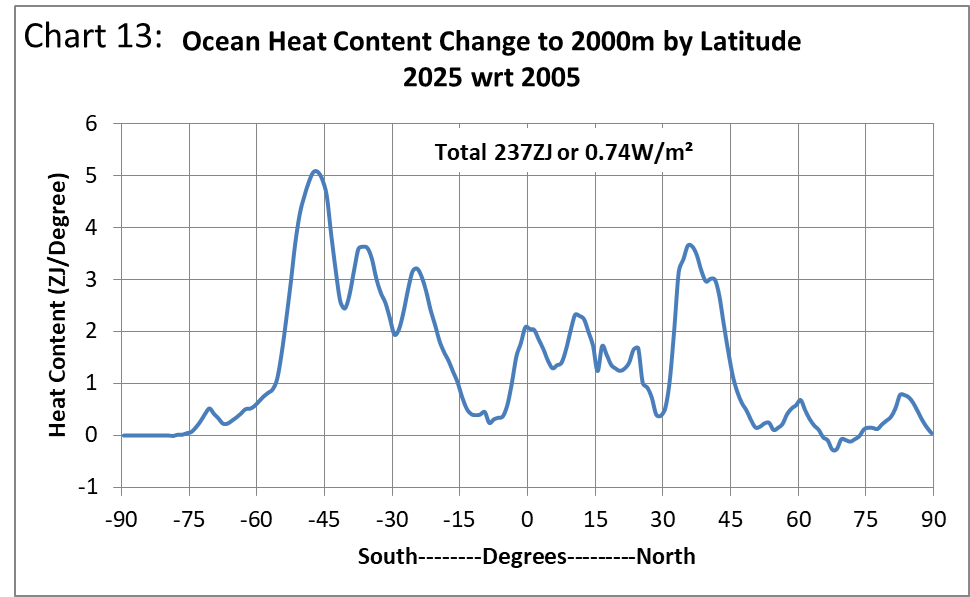 ?resize=768%2C473&quality=75&ssl=1&_jb=closest
I am forecasting that there will be a reversal in the trend of heat advection in the Southern Hemisphere in the 2030s after the next solar maximum. That will reduce the heat uptake in the Ferrel cell region of the SH.
With any of your speculation on imaginary radiation impacts of GHGs, you have to be able to determine why there are peaks in ocean heat uptake around 45 degree latitude and how radiant heat does anything below 100m let alone 2000m where more heat is being retained.
Andy,
“He claims that the TSL is so thin, it must act the same as this infinitesimally small surface; and the fact that it absorbs all the GHG IR and only 0.049% of the solar SW makes no difference.”
Yes, no difference. I’ll repeat the basic heat transfer analysis. Heat fluxes at the 2D surface must balance, absolutely. Down IR is what it is. Outflow of SW heat is long term fixed. The two other main fluxes are IR up and evaporation. These both depend on surface T. So T adjusts to keep the balance.
A bit more on SW heat. SW penetrates to a depth of a few m, being converted to sensible heat along the way. That sensible heat is then conducted (turbulent) to the surface, where it almost all has to leave (else the oceans would boil). That is the flux that adds to down IR in the flux balance. It isn’t actual SW radiation affecting the surface, but the equivalent heat conducted from below. I call it SW heat flux.
That SW heat flux has short term elasticity. If the surface T rises a lot, the near surface T gradient diminishes, or even reverses, and so does the flux. This may last a few hours, but is transient. The retained heat warms the water until the SW flux gets through. It has to.
I read Minnett’s paper in more detail. He is an oceanographer, but seems a bit shaky on heat transfer analysis, which is why he thinks the TSL gradients matter. As evidence of the shakiness:
“Given the mean vertical temperature gradient of the TSL, heat typically flows from the ocean to the atmosphere, therefore heat from the absorption of longwave radiation will be conducted upward, back to the sea surface.”
“The smaller vertical gradient at subskin depths impedes the transfer of heat from the mixed layer into the TSL.”
Just wrong. He doesn’t understand the linearity, and linear superposition, which is why he makes such a meal of the analysis. Heat from down LW is not swept along with the upflow. It would independently be conducted downward. There is no impeding.
The surface analysis is sufficient on a multi-day scale. It doesn’t help to try to resolve the fluxes below the surface, especially as superposition doesn’t give a unique answer anyway.
“Heat fluxes at the 2D surface must balance, absolutely.”
Why? This is, as usual, trying to analyze heat fluxes as instantaneous, in and out. The ocean represents a heat sink. It takes time for incoming heat to change the gradient associated with that heat input. That incoming heat just doesn’t instantaneously get changed into outgoing heat .
Heat transfer is a TIME function. You have to integrate everything over time in order to see total heat in and heat out. That also means you need functional relationships for the heat in and heat out that you can integrate. You can’t just pick a time, t1, and say all heat fluxes must balance at time t1!
“Heat fluxes at the 2D surface must balance, absolutely.”
If there is a nett gain or loss at the surfae, where can it go?
Take the top 1 micron. An imbalance of 1 W/m2 inward would heat it at a rate of 0.25°C/sec. That can’t last long. And what about the top nanometer? 250°C/sec!
The 2D surface is the limit of thin layers.
Wrong Nick. Your balance only applies to massless surfaces. It does not apply to the TSL which has mass.
Your assertion of absolute balance at the “2D surface” aligns with simplified energy budget models (cartoons) over relevant timescales, with surface temperature (T) as the adjusting variable. However, in the real world this idealized model is implausible.
Your 2D balance idea is an approximation that can work for long-term averages but glosses over how the TSL’s mass and structure make IR and SW non-fungible. IR absorption (mostly in the top 10 μm) steepens the upper gradient while flattening the lower one, reducing the bulk-to-skin heat transfer and effectively “trapping” heat below without any direct downward flow—consistent with Wong & Minnett’s findings. Although this is not the only process at work, it is part of it.
SW, penetrating deeper, bypasses this. If imbalances persisted without adjustment, your micron-scale heating rates show it’d be catastrophic, but the TSL’s response (gradient curvature changes) enforces balance dynamically, not statically.
That is, the TSL is not a mathematical surface, it is a real and adjustable layer.
Andy,
“IR absorption (mostly in the top 10 μm) steepens the upper gradient while flattening the lower one,effectively “trapping” heat below without any direct downward flow”
So what happens to that “trapped” heat. It’s a lot of heat to park in a very small volume. Something is going to get very hot.
I see Willis below reminding us that he sorted this out for us fifteen years ago.
You and Minnett seem to share the fallacy that temperature gradients and profiles, transient or not, change the properties of the medium. They do not. If IR changes, the surface fluxess just propagate through in an additive way.
“SW, penetrating deeper, bypasses this.”
There are two ways of accounting for SW and its heat at the surface You can add the SW flux entering a,d the SW flux leaving, and the resulting heat (an equal flux) coming up from below. Or since the SW passes through without effect, the radiant flows cancel, and you can just leave them out. The latter is my perference.
You need to get on top of linear analysis and superposition.
“They do not. If IR changes, the surface fluxess just propagate through in an additive way.”
This doesn’t happen instantaneously. Your “resulting heat” coming from below happens through a conductive gradient. It takes *time* for the heat to transfer, it doesn’t happen instantaneously.
“You can add the SW flux entering a,d the SW flux leaving, and the resulting heat (an equal flux) coming up from below.”
That flux from below doesn’t have to be equal to anything radiative at any instant in time. If it was the temperature of the ocean wouldn’t change at all! It would remain in equilibrium, no temperature increase and no temperature decrease.
You’re describing a mathematical view of the net result (ie overall warming) and that’s not physics. Try describing exactly where the energy goes in terms of the molecules because that’s reality.
“If there is a nett gain or loss at the surfae, where can it go?”
Again, there is no instantaneous “net” flow that has to balance. That’s the problem with *all* of the so-called radiative heat balance theories. There has to be a balance over time but not at any specific instance in time. The surface is a mass. Therefore conduction heat transfer has to be considered as well as radiative heat transfer. Conductive heat transfer results in a gradient forming between two locations and it forms in all three physical dimensions.
W/m^2 is joules/sec-m^2. It is *not* °C/sec. Joules and temperature are two different things. There is a functional relationship between the two but they aren’t equal.
It doesn’t matter how thin the layers are, gradients form when the layers are at different temperatures, meaning heat transfer occurs. That gradient defines the speed of heat transfer, a gradient with a lower slope transfers heat at a slower rate than one with a higher slope. That heat transfer takes *time*. It’s what defines a heat *sink*!
I’ll repeat, you simply can’t pick a point in time and say that all radiative fluxes must balance. That simply isn’t representative of the real world.
Hi Nick (and Tim),
At the core of this discussion is the empirical evidence from Wong and Minnett (2018) that the thermal skin layer (TSL) actively adjusts its temperature profile T(z)—specifically its curvature and gradient—to accommodate both the warmer bulk ocean below and varying incoming downward IR from above.
The TSL is not a static, infinitesimally thin plane where fluxes must instantaneously and rigidly balance as if it were a pure 2D boundary. Instead, it’s a thin (~10–100 μm) but finite conductive layer where volumetric absorption of IR (exponential decay per Beer-Lambert) reshapes the entire profile. When downward IR increases (e.g., cloudy vs. clear conditions in their M-AERI data), the gradient flattens near the base of the TSL, reducing the upward molecular conduction from the bulk without requiring downward conduction or large storage in the layer itself. This throttling sustains surface losses (evaporation, sensible heat, outgoing IR) while retaining more solar-heated water below—directly evidenced by larger shallow ΔT (top 0.1 mm) and stable bulk-to-skin ΔT at low winds (<2 m/s), with minimal compensation in turbulent fluxes.
Tim’s emphasis on time-dependent gradients, conductive heat transfer rates, and the distinction between instantaneous flux imbalance and longer-term balance aligns well here: the TSL’s profile adjustment is precisely what allows a persistent (though small) reduction in upward heat supply over time, acting as an effective thermal bottleneck or “sink” regulator for the upper ocean.
The observations drive this—not abstract boundary assumptions. How does a strict flux-continuity or simple-additive view explain these specific profile changes in the data?
Best,
Andy
Great post Andy.
After obtaining a new weather station it became obvious that over land at least, that energy absorbed by land is not instantaneously released into the atmosphere warming it. There is a 2 – 3 hour delay. I can’t imagine that there isn’t a similar action going on in the ocean.
Stokes seems to be ignoring real-world time lags.
“The TSL is not a static, infinitesimally thin plane where fluxes must instantaneously and rigidly balance as if it were a pure 2D boundary.”
You do *not* have to have instantaneous and rigid *flux* in/out balance at a 2D boundary. That implies a permanent equilibrium at all time points. You can’t get more non-physical.The in-flux on each side of the boundary must be the same. The out-flux on each side of the boundary has to be the same. But that does not imply that the net flux across the boundary is zero, i.e. balanced. What it implies is that the net flux is the same on both sides of the boundary, nothing more.
“The surface is a mass”
The surface is not a mass.
Of course it is a mass. Even if it were just one molecule thick it would be a mass. And that mass acts according to physical laws.
The surface of the ocean is no different than the surface of the water in a large pot. Point the output from an infra-red heater to the surface of the water in the pot. The in-flux from the heater into the water and the out-flux from the surface of the water into the air WILL NOT BALANCE instantaneously.
Have you looked up “thermal inertia” yet?
“is no different than the surface of the water in a large pot”
OK, so what is the mass of the surface of water in a large plot? In kg?
“OK, so what is the mass of the surface of water in a large plot? In kg?”
Red herring. The mass per unit area would be the same if the physical makeup of the water (salinity, temperature, etc) is the same. The physical processes would be the same for both. The values of the gradients may differ because of the mass of water below the surface in each being different but the physical processes will be the same.
“The surface is not a mass.”
Only in a model construction where the surface is defined as the boundary. The Ideal Black Body Model assumed a zero thickness surface.
One square meter of pure water 10 microns deep has a mass of 10 grams at 25 C and sea level atmospheric pressure. That’s mass.
Yes. And 20 microns deep has mass 20 grams. Or 1 micron deep has mass 1 gram. Those are 3D volumes. But the 2D surface has no mass.
“But the 2D surface has no mass”
It actually makes no difference at all whether it has mass or not. You are just throwing up a red herring.
Even with no mass the energy flow across a 2D boundary does *NOT* have to match at all points on the timeline. You, yourself, have admitted that there is a divergence that can be calculated on each side of the boundary. If the in/out flows were “balanced” that calculated value would always be zero. There would be no need to calculate the divergence value, it would always be zero. Equal in/out implies equilibrium thus no divergence.
Once again, you are trying to have it both ways. Divergence is non-zero and it is zero. Both can’t be true except in your cognitive dissonance universe.
There are probably few if any things that are truly in equilibrium all the time. Insolation varies sinusoidally. That is, it is always changing. Photons traveling through water only have about 3/4ths the speed they do in a vacuum. While they are still fast, their effects are not instantaneous. So, there is a finite delay that increases with depth. Everything is playing ‘catch up,’ trying to equilibrate.
“Everything is playing ‘catch up,’ trying to equilibrate.”
You nailed it!
Hi Nick,
You call the paper’s conduction description “just wrong,” claiming linearity allows independent downward conduction of IR heat without “impeding” upward flow. However, the paper explicitly addresses nonlinearity: The TSL profile is clearly exponential due to IR decay, not linear, so superposition doesn’t apply straightforwardly (“the exponential profile of emission and absorption…”). Heat from IR absorption is conducted upward back to the surface (sustaining losses), not downward:
The mean gradient (warmer bulk to cooler surface) drives net upward flow, but IR addition modifies the profile to reduce the net flux from below—effectively retaining heat in the bulk without violating Fourier’s law.
Linear approximations work for thick layers but fail in the TSL’s sub-millimeter scale, where volumetric effects dominate.
Don’t ignore the paper’s empirical evidence. Your theoretical arguments fail to explain the data that Wong and Minnett gathered. If the theory can’t explain the observations, the theory is wrong, not the observations.
Andy,
“However, the paper explicitly addresses nonlinearity”
Heat flow is linear. That has nothing to do with temperature profiles. It has to do with whether solutions can be added, as they can.
“IR addition modifies the profile to reduce the net flux from below”
Net flux, yes. But it is just the sum of the SW flux and a flux due to IR. You can analyse it that way if you like. Linear superposition.
“Linear approximations work for thick layers but fail in the TSL’s sub-millimeter scale, where volumetric effects dominate.”
That makes no sense. Heat transfer, at least by conduction, is linear on all scales. And that does not mean linear temperature gradient.
You can actually relate the scale to time to return to equilibrium. The formula is t0= L*L/D, where L is a length scale – (thickness) and D is the diffusivity – 1e-6 in the laminar layer. So for a 10 micron layer, the time scale is 0.1 millisec.
“Your theoretical arguments fail to explain the data that Wong and Minnett gathered.”
In what way? W&M fuss a lot about transient temperature differences. but how does this affect OHC accumulation.
Hi Nick,
To your points:
Heat flow is linear and additive as you say, but that is not my point or the point made by Wong and Minnett. The temperature gradient in the TSL is curved due to the Beer-Lambert law. This is not a minor detail; it is why linear temperature gradient assumptions fail. In thicker ocean layers a linear temperature assumption might get close, but not in the TSL.
These linear assumptions fail in the TSL because it is so thin that volumetric effects dominate. The paper’s mechanism isn’t “impeding” flow in a non-physical way but reshaping the TSL profile so the net upward conduction decreases without violating thermodynamics. Superposition holds mathematically, but the physical outcome (reduced net flux from below) arises because the TSL’s response is active and profile-dependent. Your framing of IR and SW as a “simple sum” of fluxes doesn’t fully account for this curvature adjustment in such a thin layer.
The paper’s empirical evidence from M-AERI cruises (NAURU99 and AMMA06) shows statistically significant correlations at low winds (<2 m/s): increased downward IR leads to larger temperature drops across the top 0.1 mm (ΔT_skin-0.1mm) and a higher fraction of the total drop in that shallow layer (ΔT_0.1mm/ΔT_5m ~0.5), while the bulk-to-skin drop (ΔT_skin-5m) remains stable. This is direct evidence of a profile adjustment to IR, reducing conduction from below without commensurate increases in turbulent losses (latent/sensible) or outgoing IR (R² ~0.01 for those correlations).
Your theoretical superposition explains net flux but doesn’t address why these specific ΔT patterns emerge or why IR doesn’t proportionally boost surface emission/turbulence as the data show. If the approach treats IR and SW as fully additive without distinguishing penetration depths, it overlooks why the TSL “gates” IR effects differently—the observations indicate penetration matters: IR’s shallow absorption forces TSL reshaping, while SW heats deeper, making them non-equivalent for OHC pathways.
How does a flux-only additive view reconcile these low-wind patterns?
Boundaries are always a bitch.
Andy,
“Heat flow is linear and additive as you say, but that is not my point or the point made by Wong and Minnett. The temperature gradient in the TSL is curved due to the Beer-Lambert law. This is not a minor detail; it is why linear temperature gradient assumptions fail.”
I say it over and over, but again linear heat transport does not mean linear temperature gradients. If you look in any text book of linear heat flow, you’ll see gaussian profiles, error functions etc. However, you’re right that Minnett is also muddled here.
Internal heat sources are part of linear heat analysis, and can have any shape, as in the exponentials of Beer’s Law. It doesn’t change the properties of the medium, or obstruct other heat flows. The point of linear superposition is that you could simply solve the flow generated by SW and by DLR independently, and add the results. They do not interfere with each other.
“increased downward IR leads to larger temperature drops across the top 0.1 mm“
Yes, of course. Exactly what linear heat analysis would predict as the response to an increased heat source from DLR absorption.
“ doesn’t address why these specific ΔT patterns emerge or why IR doesn’t proportionally boost surface emission/turbulence as the data show”
The surface analysis doesn’t, of course. That is because the specific heat patterns do not change the amount of heat that is transmitted downwards. But you can work them out if you want to. The thinness of the laminar TSL does not subvert the analysis; it simplifies it.
Nick,
You are bypassing the central point of Wong and Minnett (W&M) and going off on a textbook tangent. What you write is mostly technically correct but completely ignores the data and analysis that W&M report and my post is all about. There is no need to continue this discussion unless you address the observations and the analysis they present. Sidestepping the point of the post and their paper gets no one anywhere, it just muddles the water.
You downplay the paper’s central claim: the TSL’s extreme thinness, molecular regime, and curved (exponential-influenced) profile mean DLR doesn’t behave like a bulk heat source. The adjustment isn’t just a minor perturbation — it’s the mechanism by which DLR indirectly affects bulk heat content without direct penetration or equivalent efficacy to SW (watt-for-watt). Superposition holds mathematically, but the physical outcome (reduced upward conduction from below due to profile curvature) is what Wong & Minnett use to explain observed ocean heat content increases tied to greenhouse gas forcing. You have yet to address their observations and just spout textbook stuff. Not worth my time.
First rule of science: Do not ignore the data!
OK, Andy, you are relying on the 2018 paper. Here is the 2026 update (no Wong this time):
“An Updated Treatment of the Oceanic Cool Skin in the COARE Bulk Flux Algorithm”
Effect reduced.
Thanks for the link, I’ll have a look at it. I doubt there was a significant change.
It seems about halved. But there is a clue to what is going on in the 2018 paper, sec 3.1, where they say
“The highly nonlinear T(–z) (e.g., Liu et al.,1979) poses a problem in solving equation 3 as the equation becomes highly ill conditioned (Eyre, 1987; Rodgers, 2004). To overcome this issue, Wong and Minnett (2016a, 2016b) used the Truncated Singular Value Decomposition (TSVD) regularization technique combined with an iterative method to obtain physically reasonable boundary values for the first-guess profile required in the regularization technique.”
“Ill conditioned” is Nature’s way of telling you that there is no unique answer to be found this way. And “regularization” is the maths way of saying, well, you have to choose this one. It may have a basis, but is basically arbitrary. Do it a different way and you get a different answer. Which seems to have happened.
“Heat flow is linear.Heat flow is linear.”
So what? The slope of the temperature gradient is not a constant. It changes over time.
“Net flux, yes. But it is just the sum of the SW flux and a flux due to IR. You can analyse it that way if you like. Linear superposition.”
Linear superposition implies instantaneous balance. The physical world doesn’t work that way. If it did you would never see any temperature changes in anything.
“Heat transfer, at least by conduction, is linear on all scales. And that does not mean linear temperature gradient.”
Of course it means linear temperature gradients, at least in solids. In a liquid you also have to consider convective flow. Conduction + Convection doesn’t have to be linear. But that also means that there won’t be any instantaneous balance because both conduction and convection are *TIME* functions.
“the time scale is 0.1 millisec”
Where does convection come into play?
“ W&M fuss a lot about transient temperature differences. but how does this affect OHC accumulation”
It means you can’t just say that all radiative fluxes balance at every instance in time.
“I’ll repeat the basic heat transfer analysis. Heat fluxes at the 2D surface must balance, absolutely.”
It sounds like you are confusing a control volume boundary surface with a control volume itself.
Your assumption of the 2D surface requires no depth, hence no physical particle, hence no mass to actually act upon..
A control volume boundary has no ‘requirement” to balance either energy or mass flux, but they must balance across the Control volume.. In other words, energy in may be different than energy out, indicating a change in energy stored within the volume.
Qstored= Qin-Qout is the basic thermodynamic analysis of a control volume. .
If you want to model TSL as a boundary, then the ocean at some depth below the surface becomes the volume that the fluxes act on, energy fluxes both radiant and conductive act on all volume surface, not just TSL.This applies as well for mass convection(water is usually assumed to be in-compressible so what mass evaporates through the TSL boundary must enter the volume )
Gino,
“It sounds like you are confusing a control volume boundary surface with a control volume itself.”
No. For a control volume, flux, stress, mass flow are necessarily continuous across the surface, which is my proposition. It’s true that the control volume can grow in energy content, at a rate proportional to its volume, or mass. But that is the subsidiary point here. The control volume would be the 10 micron TSL. It can have increasing energy content, but not much, else a huge change in T. So the flux change across the TSL may not be zero, but must be very small. However the fluxes across the boumdary are still exactly continuous. The gradients associated with energy accumulation are internal.
Nick,
This is fair in a mathematical sense (the heat equation is linear, fluxes continuous), but it somewhat sidesteps the paper’s key insight: the TSL isn’t passive. Volumetric IR absorption actively reshapes the entire profile within the layer, altering the gradient at its base and thus the flux supplied from the sub-TSL bulk. Superposition of fluxes holds, but because IR is exponentially absorbed (not uniformly or at a point), the resulting T(z) curvature means the effective conductive supply from below is reduced to compensate—exactly what the M-AERI spectral data show in low-wind regimes (larger shallow ΔT, stable bulk-to-skin ΔT, no big turbulent compensation).
We keep circling the same core issue: boundary idealization vs. explicit micro-scale physics. The data favor the latter for explaining the observed TSL behavior under varying IR. Data and observations rule!
I would suggest the core issue is the persistence in using an idealization that doesn’t match the observed explicit micro scale physics.
Andy,
This is all dealt with in engineering design of heat sinks. Boundaries exist between the source and the sink and the sink and the next layer, usually air but not always.
Heat flow across a mass is not linear. It is diffusion at the beginning. If the sink becomes isotropic, either after time or because it is small enough to short out the diffusion process, linear treatment may be possible. However, SW heating the ocean occurs over a large volume.
As I said before, reradiation of “back radiation” occurs over the entire spectrum of water which vastly diminishes any effect on temperature. That is not a linear process due to Planck curves. You can’t just add total fluxes and arrive at a correct answer.
Andy,
what is going on here is that I’m saying you can get everything you need by balancing fluxes at the surface. In doing that, I treat incoming IR as dumping it’s heat at the surface. That works.
Minnett wants to analyse what goes on in the top 10 μ. He finds that instead of coming to a sudden stop, IR drops off exponentially as it is converted to sensible heat (Beer’s Law), and instead of infrared radiating directly from the surface, it radiates from within this 10 μ. But conservation laws says it comes to exctly the same thing, which is why others don’t bother with that analysis. The fact that the process of absorbing the IR and radiating the IR leads to steep gradients in that layer makes no difference to other fluxes (linearity, superposition). There is nothing special about the TSL except that fluid flow is laminar (and continues to be further down).
Wong & Minnett’s paper explicitly challenges that equivalence and simplicity. Their hypothesis (and empirical test using cloud-induced increases in downwelling IR, analyzed via high-resolution temperature profiles from sea-surface emission spectra) is that incident IR does not directly heat the upper ocean bulk — it’s absorbed almost entirely in the top micrometers (the TSL), so it doesn’t penetrate like shortwave. Instead:
They present evidence from correlations: as incident longwave rises, the temperature drop across the skin-to-0.1 mm becomes more negative, while the ratio of gradients approaches unity (indicating curvature adjustment/compression vertically, with higher gradient near the top and lower at the bottom). This is not just “steep gradients” as a minor byproduct — it’s the mechanism modulating bulk heat flow.
Your “balancing fluxes at the surface works” view treats the TSL as effectively transparent or equivalent to a bulk surface sink/source, where superposition lets you add IR like any other term without changing net transmission downward. But the paper argues the thinness, molecular conduction dominance, and exponential absorption profile make the response non-equivalent to simple surface dumping: the profile curvature change specifically reduces conductive supply from below, an indirect retention effect that’s asymmetric to shortwave (which heats deeper directly).
Conservation holds, of course — energy isn’t created or destroyed — but the paper’s point is that the detailed TSL physics matters for where the energy ends up (more retained below the TSL vs. immediately balanced at the interface). Others “don’t bother” with this level because bulk models approximate it away, but Wong & Minnett use observations to show why that approximation misses the ocean heat content response to greenhouse forcing.
The gradients and curvature do make a difference to other fluxes (specifically, reducing upward conduction from bulk), which is why the paper bothers with the micro-scale analysis.
Your response restates a macroscopic linear-flux view without addressing the observed curvature adjustments or why surface emission/turbulence doesn’t proportionally increase despite added IR. You are just saying the same thing over and over and the paper’s data refutes it. I suggest you read the paper more carefully. You’ve obviously missed something.
Andy,
All those dot points are true in the surface analysis. Nothing extra is gained by trying to resolve the 10 μ. It just isn’t a scale that you need to be intersted in.
One important thing to remember is that you can’t label sensible heat. No experiment will tell you where it came from. So when the 5cm gradient responds to raised DLR, diminishing, you can analyse that as the SW flux dropping because of the raised surface temperature, or the SW flux continuing, with an added conductive flux from the DLR. No experiment can tell the difference. But one says warming was due to SW, one to DLR. It’s a pointless argument. The fact is that by either mechanism, extra heat from DLR will produce equivalent extra heat in the sea. JUst as the surface analysis said.
You’re not recognising all the processes, and the critical one here is evaporation. Latent heat of evaporation isn’t really counted in the fluxes is it, its separate and means you risk having your thinking go awry.
No, evaporation is counted in the balance – I mentioned it many times as one of the temperature dependent fluxes that goes into the balance at the surface.
“Balance”, yes. Fluxes, no.
I don’t think I understand what you mean by balance. The surface is pretty much always going to have un unbalance of energy passing through it.
Having a 1W/m2 imbalance, say downward, is common. Your example of suggesting that energy causes a 250C temperature increase in the top nm isn’t far wrong because that’s where much of it is absorbed for that case.
Of course the actual energy will go into increased evaporation rate, not extreme heat.
But perhaps I’m wrong. From a physics perspective (not maths) how do you see that case?
“Having a 1W/m2 imbalance, say downward, is common.”
Not at the surface. Flux is a vector – directional. Suppose you had 160 W/m2 SW into the sea, and nothing else. That is 160 W/m2 into the surface, and 160 W/m2 leaving. Balance at the surface, even though the sea is warming rapidly.
“Of course the actual energy will go into increased evaporation rate, not extreme heat.”
Yes. But flux of LH is part of the accounting.
“how do you see that case?”
I gave earlier a more ancient paradox. You’re pushing a car to accelerate it, successfully. Your hands hurt – surely a force imbalance. But no, Newton says that action and reaction (at a surface) are equal and opposite. No ifs and buts. No net force on the surface. But still, it moves.
By “leaving”, you mean continuing downward into the bulk. That’s fair for SW.
But that argument doesn’t work cleanly for LW energy which doesn’t “continue downwards”.
Its largely absorbed in the first 10um and you need to describe where the energy goes next, not in terms of maths, rather in terms of physics, energy and molecules.
You can say it went through the very, very surface (whatever that is) but then understanding comes from physics, not maths.
TTTM,
“LW energy which doesn’t “continue downwards”.
No, so its a one way contribution to the flux balance, like upward IR and evap. That is what has to balance.
It isn’t really different from SW, except for scale. SW passes through the TSL, continues for a few m, then the sensible heat returns to the surface. At the surface, you can count it as 3 fluxes, but since the actual SW is unchanged on passing through, I would count it as one.
Down IR penetrates a few mm, is converted to sensible heat, which returns to the surface. You can similarly regard that return as the flux to the surface if you like. The only difference is the space scale and time (millisec instead of hours)
Upward IR also starts within that few mm, and acts as a heat sink there.
You can, if you like, add in a further conductive heat flux from the down IR into the liquid below. That will induce a temperature gradient, which while it lasts will reduce the SW up by a similar amount. As I said above, you can’t label heat, so there is no point in arguing about which of these scenarios is true. They both have the same effect.
I must be slow. What is the 160W balancing against in your 160W SW example?
More like the order of nm for much of the energy.
None of your explanation has recognised the inevitability that a portion, probably large, of the LW energy will be absorbed by the molecules “at the surface” giving them energy to evaporate and that reduces any “flux” you want to exist and your argument turns to energy balances, not flux balances.
And IMO that’s why you need physics, not maths for understanding.
160 W enters the surface as SW;160 W leaves as SW down; 160 W returns as sensible heat.
You equate fluxes at any surface, but mostly it’s trivial. Why the air-sea interface matters is that there are four at least fluxes that terminate or originate there, and these have to be balanced. You can regard down IR as terminating at the surface, or penetraing a few mm and returning by thermal conduction. Same result. You can do the same with SW. The only difference with SW is time lags of a few hours, leading to diurnal effects. The end result is the same. Short and long term, surface flux has to balance.
“You equate fluxes at any surface”
you do *NOT* equate fluxes. You equate heat in and heat out. They are not the same thing.
Eventually. But you definitely cant say that is a balance because UV energy, for example, goes 10s of meters down and takes considerable time to leave.
So there is no instantaneous balance. And the way I see it, its not a “balance” at all but you certainly express it as a tendency towards equilibrium.
I still dont understand what the importance of your argument is. In one sense its trivial, but in another its inadequate to describe the process of ocean warming.
Minnett tried in terms of temperature gradients and (IMO) his experiment and explanation failed.
Arguing in terms of maths and “balances” is no better and arguably worse.
“So there is no instantaneous balance.”
Yes, there must be. The time varying return of te 160 W/m2 will be reflected in a varying SST, so the changes in evap and upward IR compensate immediately.
Here’s an anology. Suppose you have a football ground with one entrance, and you draw a line across the perimeter to count people crossing. You want to know how many people are in the ground.
There are four fluxes re that line – people arriving from out, people leaving to in, people arriving from in, people leaving to out. That balances perfectly at all times, unless people linger on the line. And the number who might do that is negligible vs crowd size.
Now suppose there is an entry area and then a line of turnstiles. You can perform the same balance on the turnstiles. And the influx of people might be less. People are turned away for no ticket, etc.
But at the outer line, they are picked up in the leaving flux, so your estimate of the numbers inside is still the same. There is a small temporary error for people that may linger in the area before the turnstiles.
This seems simpler than the ocean case, because there is no conversion crossing the line. But OK, suppose wombats arrive, and are converted to people in the entry area, etc. It really doesn’t change the arithmetic if you do it carefully.
Only in a world where there is no evaporation. But that’s another complication.
From your analogy, the people “lingering” in the line is literally the length of the line. If lots want to leave, the line out is long. If people want to come in, their line is long.
The “balance” is that, lets say, only 5 people can go through the gate per second.
That gate capacity is analogous to temperature for outbound radiation but not for inbound radiation, temperature doesn’t come into it for SW.
Now its possible to make the gate wider, but that takes time because builders need to become involved. In the world of oceans, increased temperature can increase outbound radiation but that involves conduction and convection increases and that’s not instantaneous.
So, again, I can see what you’re trying to say, but I cant see the relevance to understanding how the oceans warm.
What Nick is saying about heat in and heat out balancing at any point in time means that people arriving to the game would have to balance with people leaving the game at all points in time. Meaning that there would never be anyone left to watch the game. People arriving would have to just turn around and immediately leave.
Forget about evaporation, you are trying to argue actual physical process with someone that is not concerned with physical reality at all.
Nick is trying to treat the earth as a perfect reflector. What comes in gets immediately reflected back out. The physical reality is that the earth is *not* a perfect reflector. Period. Exclamation point.
What matters is the HEAT (joules) involved. And that is the integral over time and area of the flux-in and flux-out. Since the time interval for flux-in is not equal to the time interval for flux-out, flux-in and flux-out simply cannot ever be in balance at all points in time. Since the flux-in and flux-out functional relationships are time-varying there can be two points in time where they balance, i.e. their cross-over points but that’s it.
Nicks argument basically highlights the failure of climate science in its stubborn insistence in using “averages” instead of actually using the physical functional relationships. It’s why trying to use a diurnal mid-point temperature as a metric for “climate” is doomed to fail.
Actually thinking about your analogy a bit more might have helped me understand the basis of the misunderstanding.
From an analogy point of view, the gate/turnstile part of the analogy only applies to outbound traffic. Inbound people just jump the wall.
From the wall’s point of view there can be seen a net crossing of people but looking at the turnstiles just doesn’t help you understand the numbers and there is certainly no “balance” there.
NO, there doesn’t have to be. Earth takes in a certain level of joules/sec-m^2 during the day meaning it gets “x” amount of joules (heat). It loses a certain level of joules/sec-m^2 24 HOURS PER DAY thus losing “y” amount of joules. What has to balance is the amount of joules, i.e. x = y. That means that flux-in and flux-out WILL NEVER BE BALANCED.
If flux-in and flux-out were the same then the earth would lose FAR MORE HEAT per day then it takes in during the daytime since it radiates 24 hours per day. Either that or the flux-out would have to be zero at night! The conclusion is that flux-in and flux-out can never be balanced at any point in time. Only the integrals over time and surface of the flux-in and flux-out can be considered for “balance” purposes.
If the gates to the football ground was only open for an hour to in-bound traffic prior to the game time but was open 24 hours per day for out-bound traffic then there does *NOT* have to be balance perfectly at all time. People could linger on the football grounds after the game to have a picnic, socialize, etc before leaving.
What you have done in your example is INTEGRATE the flux-in (people arriving over time) and the flux-out (people leaving over time) and say that they must balance over time. But you refuse to do the same for heat flux-in and heat flux-out. You just say that flux-in and flux-out have to balance at all times. In essence if people arriving and people leaving were to be in balance then there would be no one there to watch the game! People coming in would have to turn around and leave immediately.
“So there is no instantaneous balance.”
You are correct. What has to balance is HEAT. And flux is *not* heat.
Flux is joules/sec-m^2. Heat is just joules. You have to integrate flux over both area and time in order to know the actual total joules involved, meaning the heat involved.
Climate science fanatics like Nick can’t seem to grasp that the Earth loses heat 24 hours per day. It never stops. Heat in only lasts for about 12 hours, i.e. “daytime”. Flux out does *not* have to equal flux in for there to be a heat balance.
If flux-in was to be equal to flux-out for all points in time, i.e. balanced, the Earth would lose MUCH MORE HEAT than it takes in. Either that or heat loss during night hours would have to be zero!
“That will induce a temperature gradient, which while it lasts will reduce the SW up by a similar amount.”
Meaning the flux in and flux out won’t be balanced.
You are still trying to have it both ways! Pick one and stick with it.
The surface flux will still be balanced.
“The surface flux will still be balanced.”
No, it will *NOT*. It can’t be. Earth receives flux-in only part of the day but it emits flux-out ALL DAY. If the surface flux-in and surface flux-out were balanced the Earth would sooner or later wind up being a frozen ball since it would lose far more heat per day than it takes in.
Jeeesh! Put away your AGW bible. It’s wrong. Even a first grader can figure out that the surface flux cannot be balanced at all points in time.
If you have car1 traveling at 10mph for 1 hour and car2 travelling at 10mph for 2 hours the distance travelled for each simply cannot be equal.
Yet you are trying to claim that the distance travelled will be the same.
“Not at the surface. Flux is a vector – directional. Suppose you had 160 W/m2 SW into the sea, and nothing else. That is 160 W/m2 into the surface, and 160 W/m2 leaving. Balance at the surface, even though the sea is warming rapidly.”
You *still* have not grasped the time dimension associated with heat flow. 160W/m^2 in does *NOT* mean 160W/m^2 leaving.
If that 160 W/m^2 in lasts for 12 hours (e.g. daytime) but the heat out lasts for 24 hours the flux in and flux out will *NOT* balance. The mass will have an additional 12 hours to lose the heat input during the first 12 hours.
It doesn’t matter if it is water or land. Flux in and Flux out do *NOT* have to balance. Heat in and heat out have to balance. But heat in and heat out are TIME functions.
From post:”… I treat incoming IR as dumping it’s heat at the surface.”
Unless you can show the temperature of what is producing the IR and that its temperature is higher than that of the surface there is no heat dumping going on.
Its not it’s.
“For a control volume, flux, stress, mass flow are necessarily continuous across the surface, which is my proposition.”
Good. Continuous yes, absolutely balance no. Also, by necessity, those fluxes are assumed to be evenly distributed throughout the control volume. The surface of a control volume has no properties, it is only a position at which things are calculated.
“It can have increasing energy content, but not much, else a huge change in T. So the flux change across the TSL may not be zero, but must be very small.”
Disagree with your assumption. IR absorption is non linear and the large delta T you mention is actually observed in still water so from a radiant stand point the flux difference is NOT small across the TSL.
Worse, since this region is a boundary between two different fluid regimes, mass flux is also large and non linear. That means that conduction/convection as well as latent heat transfer is non linear. Mass flux dominates radiative flux in that TSL activity, and latent heat dominates sensible heat in the mass convection/conduction world.
Gino,
“Continuous yes, absolutely balance no. Also, by necessity, those fluxes are assumed to be evenly distributed throughout the control volume. “
Continuous means absolute balance. It means the value dosn’t change as you go through the surface.But on one side it is incoming to the surface, on the other outgoing, hence balance.
Control volumes work by conservation rules, for example the Gauss divergence theorem. You know the values on the surface, so you know the average of the divergence of the value on the interior. Usually a low order polynomial is assumed to do the math.
“mass flux is also large and non linear”
What does non linear mean here? A flux is just a flux.
“Continuous means absolute balance:
NO. Continuous means no discontinuities, no break points. It does *not* mean absolute balance.
Heat flow in and out can be continuous but balance may not exist. A perfect example is the point on the daytime time line where solar insolation is maximum versus the point on the daytime time line where the surface temperature is maximum. The temperature curve is continuous but heat in/heat out are *not* in balance since max temp is *not* the same point in time as max insolation.
” It means the value dosn’t change as you go through the surface.But on one side it is incoming to the surface, on the other outgoing, hence balance.”
Incoming and outgoing do *NOT* have to be in balance. That incoming heat encounters a mass with thermal inertia from the conduction and convection into the mass over time. Over time the heat in and heat out should balance but the key words are “over time”. Go look up the term “thermal conductivity”.
“You know the values on the surface, so you know the average of the divergence of the value on the interior.”
Gauss’ divergence theorem does *not* require balance between in and out heat at any point in time. When heat flows into a mass the net flux will be inward, meaning the object will heat up over time based on its thermal inertia. This means the divergence is positive inside the mass. As the temperature rises the outward flux increases until you reach equilibrium, i.e. divergence in the mass is zero.
This is why the max solar insolation and maximum surface temperature happen at different times during the day. The thermal inertia of the earth, be it land or ocean, means it takes TIME for the out flux to match in flux.
You have to *integrate* the in and out flux OVER TIME to determine overall balance. You simply cannot just say that in/out flux balance at all points on the time line.
BINGO!
“Gauss’ divergence theorem does *not* require balance between in and out heat at any point in time.”
Of course not. As I said, it tells that the surface integral of flux gives the average value of divergence on the interior.
“Of course not. As I said, it tells that the surface integral of flux gives the average value of divergence on the interior.”
If divergence ≠ 0 then there is no balance between in and out. You keep saying the in and out have to balance and then say that divergence doesn’t have to equal zero. You can’t have it both ways.
Flux is (joules/sec)/ m^2. It is the value of “joules” that tells you the heat. You can’t just integrate the flux over a surface, that doesn’t give you total joules. You have to also integrate over time to get total joules, i.e. total heat. It is TOTAL HEAT in and out that determines OHC, not instantaneous flux balance.
Averages do *not* tell you much about physical processes. The average diurnal temperature (or more correctly the mid-point temperature) doesn’t tell you much about the actual physical processes associated with climate. Average divergence doesn’t tell you much about the physical processes involved in creating the divergence values. Averages are *NOT* good predictors of the future. It’s why it was agricultural science that found the growth in growing seasons and not climate science. The same thing applies here as far as the ocean surface thermal processes are concerned.
“Continuous means absolute balance”
No. The fluxes are continuous functions in the mathematical sense, but the ability to store and discharge within the control volume means the surface fluxes are not always balanced (in vs out). The word you are looking for is ‘uniform’ across the control surface.
“It means the value dosn’t change as you go through the surface”
You keep trying to give a control surface properties. A control surface is only an area in space where you measure or calculate something. If your layer has depth or material properties then it is not a surface it is a volume.
Non linear means the flux through a surface is not uniform and varies with more than a multiple of a single variable and is therefore not evenly distributed across the control volume (a requirement for control volume analysis). In other words, the flux varies with time and position in an unpredictable manner. This is why boundary layer analysis is such a PITA. Since mass moves in and out of a control volume in a variable and unpredictable manner, the heat flux (rate) into and out of the control volume becomes unpredictable(variable within the CV itself) as well due to latent and conductive heat transfer.
The only time your basic assumptions hold is if there is no mass convection, and in those cases you do see a large and exponential temperature gradient in the water ‘skin’ layer.
Gino
“ the ability to store and discharge within the control volume”
I said the fluxes must balance at the surface. That is not a volume.
“The word you are looking for is ‘uniform’ across the control surface.”
No, continuous. I don’t know what you mean by uniform, but a guess it means at least continuous derivative. Not required here.
Uniformity indicates that the entire control surface experiences the same value at the same time step, also that the volume has uniform or homogeneous properties., Inflow is not required to balance with out flow at any particular control surface, nor over the entire control volume, but those flows are required to be uniform otherwise your model will will produce inaccurate results. This is the importance of grid scale.
This is different in that a a simple continuous function does not need to be spatially uniform anywhere. You can have continuity without uniformity.
Gino,
“Uniformity indicates that the entire control surface”
You keep coming back to the notion of cells in a grid. The surface here is the ocean/air interface. And only that surface.
“You can have continuity without uniformity.”
That’s all that is required. Flux balance.
You can’t calculate flux balance without the assumption of uniformity. Your ‘flux is flux’ approach requires a uniform application of that flux over the region of the calculation, essentially that the of effect of radiation is constant over a given region. As I noted above, continuity does NOT imply uniformity.
Andy is pointing out that the boundary layer is NOT a uniform environment. Even though water has a surface, the ocean/air interface is NOT a calculable surface. my previous posts have pointed out how radiant energy is only a portion of the flux through the chaotic boundary layer. Not only that, the material within the boundary layer itself actually changes it’s behavior based on the input. It responds differently to the fluxes applied to it, especially in comparison to the the bulk areas above or below it. That variability is a specific example of it’s non-uniformity.
The only way to address this is by gridding down the applicable calculation area until you can reasonably approximate uniformity (Finite Volume Analysis). If you cannot do that your calculations become less and less certain compared to variability of the system you are trying to measure.
Calculating a flux balance without uniformity through the surface and volume is patently wrong.
“Calculating a flux balance without uniformity through the surface and volume is patently wrong.”
Assuming uniformity also implies equilibrium. The flux in and flux out at the ocean surface is never at equilibrium. The ocean surface is always either cooling or warming thus flux in and flux out will never be balanced. There will always be some kind of net flux in or out.
Nick’s “balance” is basically saying the flux-in is continuous at the surface boundary, there is no discontinuity at the boundary. The same for flux-out. That does *not* imply that flux-in equals flux-out.
The fluxes do *not* balance at the surface, be it 2D or 3D. Balance implies equilibrium, i.e. net flux = 0. Because of thermal inertia and thermal conductivity it takes TIME for an equilibrium to be reached at the surface boundary. That means that divergence is not zero. Since the atmosphere and the ocean itself is always changing it becomes almost impossible for an equilibrium to be reached at the surface boundary.
Continuous does *not* imply balance between flux-in and flux-out. It only implies that the flux-in does not see a discontinuity at the surface boundary. Same for flux-out. It does not imply that flux-in and flux-out are equal and in balance so that the net flux = 0.
Heat fluxes at the 2D surface must balance, absolutely.
Only over time. Heat flux describes the amount of heat flowing across a boundary. You forget that the ocean is a heat sink, that means it can store heat for a length of time. It is how the OHC rises and falls.
More heat can flow in, than what flows out over a given amount of time. You are a mathematician, write a gradient for the heat flow from the ocean to the atmosphere. What thermal conductance do you apply to that gradient? Better yet, show the gradient from the ocean to the atmosphere. How much of the resulting radiation is absorbed by CO2?
Here is something you miss entirely. Part of the SW energy absorbed by the ocean goes into sensible heat. That is, the molecules move faster and create pressure. The way to deal with that is a diffusion gradient just as with any liquid or solid. Another part of the energy goes into latent heat. That heat works to loosen the hydrogen bonding between molecules. It adds to the speed with which hot water rises due to buoyancy. It will never be seen as sensible heat but it does exist.
Your whole description is “back of the envelope” supposition with no attention to actual heat and energy flows.
One of the things that plays into the surface of water acting as a solid surface is the cohesion effect of water. Related to capillary action. Allows spiders to walk on the surface.
Is it really a ‘classic clash’? Or is a dead-end exploration of the minutiae that can be detailed in any exploration of a phenomena like this, an exploration that adds little or no new insights into what is happening with the macro phenomena?
It is clear to me that IR must affect the temperature of the bulk ocean. Here are a variety of arguments to support that claim.
Comments invited.
w.
See my comment below.
Because energy is also lost low in the atmosphere when DLR occurs, you’ve created an energy imbalance which brings the 2nd Law into play. Because the energy absorbed in surface skin will participate in conductive transfers, DLR energy (except for evaporation) simply gets conducted right back into the atmosphere.
Willis. This has nothing to do with the post. Your comment, which somehow includes the AGW theory about IR-active gases, is a distraction. As a commenter on this post, I find it irrelevant what the source of IR is.
Willis’s comment is spot on.
You see any IR as AGW connected. I guess, when your mindset is a hammer, everything becomes a nail
Hello Willis,
Not sure whether I commented on that at the time but your contention ignores the fact that the phase change of water from liquid to gas has an enthalpy of more than 1 so the phase change requires more energy than is needed to initiate it and so there can be no surplus to heat the bulk ocean.
Your thunderstorm hypothesis actually relies on that phenomenon by showing the net outcome in terms of enhanced convection instead of a higher surface temperature.
Hi Willis,
No argument with your comment, but that is not the issue that either Wong and Minnett or I are raising. Of course, DLR (downwelling longwave radiation) affects OHC and ocean temperature. The question is does it affect OHC and bulk ocean temperature as much or more than solar radiation? I contend that DLR has less of an effect Watt-per-Watt than solar due to the difference in penetration depth, Nick and the IPCC say the effect is additive and thus the same.
What are the components in the DLR? AGW theory requires that upward IR gets blocked (i.e. retained) by CO2 in the atmosphere but that downward IR from CO2 passes freely through the atmosphere and adds to surface warming. As Planck laid out, CO2 is a reflective object, it can only return what has already been lost. If the atmosphere does also block downward IR from CO2 then CO2 can only return part of what has already been lost. It just means slower cooling. It doesn’t mean the ocean heat will increase, it just won’t decrease as fast.
HL_ocean + HG_CO2 = total heat loss ≤ 1 where HL_ocean is heat lost from the ocean and HG_CO2 is returned heat from CO2.
CO2 only emits at specific frequencies and the 15 micro is not heat. The words being tossed around like heat, thermal, etc without agreed definition can get to no agreed end point.
There are no gases in the atmosphere that emit thermal radiation to the ground.
Usually more in the water than a shark. As one with considerable time, mostly interested in the living system, looking at and measuring in estuarine and marine surfaces, it does seem complex meaning that we just don’t understand it very well. Lots of life is attracted there, slowly and rapidly, also locally. Exponential difference in oxygen above the surface. As maybe more than a historical note is Woodcock’s long interest, including bubbles, a few here.
Woodcock, A. H. 1941.Surface cooling and streaming in shallow fresh and salt waters. J. Mar. Res. 4(2):153-160. 1944. A theory of surface water motion deduced from the wind-induced motion of the Physalia. J. Mar. Res. 3:196-205. 1975.Thermals over the sea and gull flight behavior. Bound.-Layer Meteor. 9:63-68.
Thanks Andy and commenters for a fascinating discussion. What’s amazing to me is how the CAGW hucksters demand that the earth’s “climate science is settled”, while from this, it is clear that the science of the energy flux through 70+ percent of the earth’s surface is clearly not yet “settled”.
You are very welcome and thanks for the very important reminder.
Andy is still missing one key element of what happens with downwelling IR. These events take energy out of the lower atmosphere. This is important.
Yes, these events also increase energy of the surface which creates an imbalance. What does the 2nd Law tell us about an energy imbalance?
The 2nd Law is constantly trying to reach equilibrium between the lower atmosphere and the surface. This energy movement will influence conductive energy flow. It will increase the flow from the surface to the atmosphere compared to what it would be with less downwelling IR.
This essentially negates any downwelling IR effects on the surface except for evaporation which occurs immediately.
I know you are using English words. Unfortunately, to me, they do not make sense.
He means that convection changes as necessary to neutralise radiative imbalances which was an established scientific fact before the climate farrago.
Not convection, it is conduction which neutralizes the immediate energy imbalance (between the Earth’s surface and the atmosphere) caused by increases in downwelling IR from CO2.
As a side effect of more downwelling energy striking the oceans, we will also see an increase in evaporation and enhanced convection. That’s a second step that also needs to be understood, but is not what I was discussing here.
Do you understand conduction of energy between the surface to the atmosphere? It is caused by kinetic energy transfers which occur when an atmospheric gas molecule strikes the surface. Energy can be moved in either direction. All atmospheric molecules participate. It is not limited to radiative gases like CO2 and CH4. Trillions and trillions of these conductive events are occurring every second.
For example a nitrogen molecule (N2) striking the surface can either gain kinetic energy from warmer surface or lose energy to a cooler surface. Each individual collision can move a small amount of energy.
These conduction events are occurring constantly on Earth. Due to the bidirectional nature of the energy transfers, only a small amount of net energy gets moved. As a result, this energy transfer mechanism is often ignored. But it is real with the total energy transferred back and forth much larger than the net energy transfer.
Andy has been explaining the effects of downwelling IR on the oceans which is part of Earth’s surface in my more basic description. What I’m saying is there are two steps to this process:
1) Downwelling IR from an increasing CO2 concentration in the atmosphere will move energy from the atmosphere to the surface. This process takes energy out of the atmosphere and adds it to the surface. This cools the atmosphere and warms the surface.
As a result of this new energy imbalance,
2) More of those ongoing conductive energy transfers will move energy from the warmer surface to the atmosphere. This will increase the overall conductive energy flow from the surface to the atmosphere. This will negate the radiative energy imbalance.
I understand heat conduction. I also understand that air is a poor conductor of heat, and water is marginally better. You can look this up in tables, freely available on the internet.
When I go to the beach and go in the ocean I always come out with a slight oily feel to my skin. I wonder how much of the oceans surface is in fact even water. I think this discussion may be meaningless because the it’s quite possibly a very rare ideal case that is being discussed.
I think these discussions are extremely important.
Forensic examination of all aspects of the “CO2 controls climates” conjecture is ultimately what will underpin the “enlightenment” that is sorely needed.
Dirty sea water?
Salt water is stickier than fresh water.
If the boundary layer (aka TSL) between ocean and atmosphere is a few microns thick, then it seems axiomatic that that surface is actually rather larger than the surface area of ocean would imply, as the air immediately above the “surface” tends (in any sort of wind) to have a large number of small water particles in it.
This layer of water droplets (not vapor) can be many meters thick, and in a significant wind becomes quite visible (“sea smoke”).
Accounting for the presence of this layer would seem to present a difficulty for modelers.
The TSL does cause problems in many climate models, if not all of them. The models can never seem to get the SST right, especially in the tropics.
https://andymaypetrophysicist.com/2022/03/13/comparing-ar5-to-ar6/
This paper, https://doi.org/10.1038/s41561-024-01570-7, brings up a separate, but equally important issue.
Hi Andy. I think you are understating the thickness of the TSL, here. It is not 10 micrometers but is stated in the referenced paper as 0.01cm or 0.100mm which is 100 micrometers. This gives to the TSL even more mass.
While the paper is complex enough for me to take more time than I have taken so far to fully absorb, one thing they fail to consider is this: there is net evaporation from each surface area of the ocean. The boundary is therefore one in which mass passes through it — a problem demanding a control volume analysis. This brings up two issues: 1) how does the mass leaving the TSL get replaced? 2) What consequences are there for temperature profile within the TSL?
The answer to 1) is that there is a persistent flow of mass from below the TSL in order to maintain mass balance.
Issue 2) is this. When I looked at such things in the past, such as in my M.Sc. (1978) research on heat transport by combined conduction and convection in geothermal problems, one dimensional mass transfer opposite to the temperature gradient will steepen the near surface temperature profile to look essentially like the TSL profile that Wong and Minnett show follows from radiant transfer.* In other words, unless I am reading things wrong. it appears there are multiple heat transport mechanisms capable of producing the same temperature result — perfect confounding.
This is a lot like my explanation of the so-called upper boundary in the atmosphere often invoked to explain the GHE. There is no layer boundary. The upper boundary is a complex surface that can extend downward at times nearly to the surface. This boundary has equivalent complexity.
*-As long as there is sufficient transport at a surface to maintain something like a constant temperature.
Very nice Andy. Everyone seems to agree the TSL is 10 microns thick. My understanding is that a hair is 50 microns so the TSL is one fifth the thickness of a hair. Wouldn’t the TSL have to become thicker if it were heating(?) the water below? I can see where we can discuss the TSL in calm waters but the ocean is rarely calm. What happens to the TSL during rain storms or high winds especially hurricanes? Last how long would it take for all the added energy(?) in the TSL to move back into the atmosphere once the atmosphere is cooler than the ocean?
The TSL thickness varies a lot and so does the temperature gradient. It varies with weather, latitude, time of day and wind speed. This was a main point of the paper.
In a comparison between UV-A (315–400 nm) and IR (780 nm-1mm), which type of radiation warms the ocean water the most?
UV-A has lower energy but can penetrate the ocean surface. IR has higher energy but cannot penetrate the ocean surface.
I found the following texts when I searched for information.
Solar UV-A (315–400 nm) is long-wave, non-ionizing radiation making up over 90% of the UV reaching Earth’s surface, as it is not filtered by the ozone layer.
The water surface can reflect and scatter, but in calm conditions, high levels of UV-A penetrate into the upper, highly productive layers.
Daily maximum values for UV-A have been recorded between 16.5W/m2 and 93.9W/m2 depending on location, season, and atmospheric conditions.
In the clearest oceanic waters (e.g., South Pacific Gyre), 10% of the surface irradiance (Z10%) for UV-A (380 nm) can reach depths as great as 110 meters.
In typical open ocean waters, 10% UV-A levels are commonly found in the range of 8 to 46 meters.
The sun provides about 340W/m2 average incoming solar IR energy.
IR radiation is absorbed within the first 1–100 micrometers (µm) of the surface.
“UV-A has lower energy but can penetrate the ocean surface. IR has higher energy but cannot penetrate the ocean surface.”
This is exactly backwards, UV contain much more energy than IR. Other than that I think you have it correct.
Your first question is addressed in the paper and Wong and Minnett (and I) think that solar warms the bulk ocean the most, IR adds some by retarding the loss of solar energy (absorbed deeper), but not as much as solar. Others disagree, as you can see in the comments.