By Andy May
Solar radiation penetrates oceans to depths of 10-100 meters (depending on wavelength and water clarity), directly heating the ocean mixed layer. Greenhouse gas (GHG) infrared (IR), being longwave, is absorbed in the top ~10 microns (the thermal or electromagnetic skin layer or “TSL”), where it influences temperature gradients, evaporation, and conduction. The TSL lies on top of the mixed layer and has a different temperature. Below the TSL, especially in the daytime or in the presence of very light winds, there can develop a temperature gradient between it and the “foundation” temperature or the mixed layer temperature (see figure 1). The vertically nearly constant mixed layer temperature is maintained by turbulence and convection and follows overlying air temperature trends (although not the actual air temperature) by a few days to a few weeks, or even longer, depending upon the season and latitude. Higher latitudes respond slower and lower latitudes quicker; wind speed has a large effect on the lag.
Besides changes in atmospheric temperature, the mixed layer also responds to changes in ocean dynamics (currents, etc.), the changes in ocean dynamics also vary by season and latitude and can play an important role in multiyear and multidecadal changes (think ENSO, the AMO, and the PDO, etc.) in mixed layer temperature (Patrizio & Thompson, 2021). Changes in ocean dynamics and the mixed layer’s higher heat capacity cause it to smooth out the more rapid changes in the lower atmosphere and in the TSL. The interaction between the atmosphere and the mixed layer is not just from the atmosphere to the mixed layer, but works in both directions (Patrizio & Thompson, 2021).
The mainstream view
The mainstream view is that GHG IR warms the TSL, which reduces conductive heat loss from the mixed layer, causing total ocean heat content (OHC) to rise. It is clear that both OHC and surface temperatures have been rising in recent decades, but is this warming due to man-made GHGs? Figure 1 is a cartoon from GHRSST (Minnett & Kaiser-Weiss, 2012) showing the electromagnetic skin layer or TSL where all GHG IR is absorbed.
Wong & Minnett (2018) show IR adjusts the thermal skin layer’s curvature, reducing molecular conduction from the mixed layer below. They studied the rate of downwelling IR on clear days versus cloudy days and found that increased downwelling IR (due to clouds) flattens the TSL gradient. This lowered net upward ocean heat flux and caused more absorbed solar heat from deeper in the water column to accumulate in the upper ocean rather than escaping. Their analysis of spectra and profiles supports modulation of upper OHC via this mechanism. But their data is qualitative and not quantitative, we don’t know how much ocean warming is from the warming of the atmosphere in recent decades and how much is from an increase in heat from absorbed man-made GHG IR in the TSL.

Captured GHG IR in the TSL is mostly retained because the only way it can get out is through molecular conduction, as emitted radiation, or evaporation. Energy flux is net upward into the atmosphere. Some TSL emitted radiation will go downward into the mixed layer but in net it will be to the cooler (on average) atmosphere. The atmosphere shares thermal energy with the mixed layer through convection, turbulence, and, to a lesser extent, conduction. This happens through wind and precipitation. It is a much slower process than GHG IR absorption in the TSL, as discussed above.
There are two processes
There are two processes at work. One is energy in the TSL is sent to the atmosphere as discussed above. The other is warming or cooling of the mixed layer by the atmosphere. The latter involves mixing the air with the mixed-layer water through waves and turbulence as they attempt to reach equilibrium. The relative importance of these two mechanisms is unknown and the subject of furious debate within the climate community.
Is there a significant difference between the two? Only in the perception of the cause. We know that changes in solar radiation directly affect the mixed layer energy content and temperature. If additional GHG IR absorbed in the TSL changes the temperature profile of the upper ocean, it can achieve the same result but will be perceived to be an anthropogenic effect. Both processes may be at work, but which is stronger? The IPCC special report on the ocean and cryosphere (IPCC, 2022) asserts that 90% of the extra heat in the climate system has been absorbed by the oceans, but assumes that all the extra heat is anthropogenic and it does not speculate as to the process involved in getting the heat into the ocean, it could be either process or both.
The Critical view
Critics argue IR can’t meaningfully heat the mixed layer because it doesn’t penetrate to its upper surface; instead, it mostly enhances evaporation which cools the ocean surface. Data shows mixed effects. In calm conditions, IR can warm the skin by 0.1-0.3°C, but wind mixing dissipates this quickly. Wind also enhances evaporation (Yu, 2007b). The TSL temperature is little affected by turbulence, but greatly affected by GHG IR.
The critics note that the TSL on the ocean surface captures all GHG radiation. The mechanism for heat transport within this layer is molecular conduction and not turbulence (Soloviev & Lukas, 2014) & (Wong & Minnett, 2018). The direction of heat flow is normally from the ocean to the atmosphere, so heat from absorbed longwave radiation is conducted upward to the sea surface and then eventually into the atmosphere. However, as shown by Wong and Minnett, IR warms the ocean surface which should slow mixed layer cooling somewhat by reducing the rate of mixed layer heat content loss.
We don’t really have enough data to be sure which of the two processes dominates. The key assumption feeding the consensus opinion that increasing ocean heat content (OHC) is due to additional greenhouse gas warming is that solar input into the climate system is constant. Thus, they reason, if OHC is increasing, it must be additional greenhouse gases via the process of elimination. This opinion is based on models and not demonstrated fact.
It is reasonable to assume that if the additional GHG IR is trapped in a ~10-micron layer at the top of the ocean, it will be quickly returned to the atmosphere. Is this more or less than the thermal energy, of solar origin, that a warmer TSL partially traps in the mixed layer? I don’t know and I’ve seen no measurements that quantify the relative amounts.
How accurately is OHC known?
Analyzing the Wong and Minnett study is complicated by the fact that OHC trends are not known very accurately. This is true even today with ARGO floats and accurate buoys. Even less is known about OHC before 2005, which was when the ARGO floats became widespread enough to provide good data on the upper 2,000 meters of the oceans. Below 2,000 meters there is very little data. Prior to 2005, our information is mostly just about a small part of the mixed layer, just a few centimeters to a few meters below the surface. It may be many decades before we have enough data to determine reasonable trends in OHC to a reasonable depth. Trends in upper ocean temperatures can change in cycles of over 60 years, as in the case of the AMO (May & Crok, 2024). Other multidecadal ocean oscillations are discussed here.
Solar Variability
We have just come out of the longest solar grand maximum (SGMx) in over 5,000 years, could it be the cause of the additional ocean heat content, or part of it? The consensus claims the change in TSI during the 20th century SGMx is small and we are on the downside of it anyway. However, changes in TSI are not the only way solar activity affects our climate (Lean, 2017), (Scafetta, 2023), & (Haigh, 2011). The world is warmer than 100 years ago, and the mixed layer tends to stay in tune with atmospheric temperature, but should we assume that atmospheric temperature and the mixed layer are warmer due only to additional greenhouse gases? I think not.
The temperature difference across the TSL is between 0.1K during high wind speeds (>7 m/sec) to 0.6K during low wind speeds (<2.5 m/sec) (Wong & Minnett, 2018). The TSL is always present except for momentary breaks caused by breaking waves and rainfall. Restoring the TSL after disruptions takes only a few seconds. There seems to be no mechanism for the IR thermal energy to get into the mixed layer, except in small amounts due to molecular conduction. The strong temperature gradient through the TSL exists due to the poor efficiency of heat transfer by molecular conduction (Wong & Minnett, 2018).
Discussion
Heat losses from the ocean surface through evaporation and radiation originate within the TSL. There will be an increase in retained OHC due to a higher TSL temperature, as Wong and Minnett show in their paper. But their study does not preclude an increase in retained OHC if the atmosphere is warmer, regardless of why the atmosphere is warmer. We don’t know the ratio of the two. The consensus and the IPCC hold that 90% of the excess OHC is due to GHGs (IPCC, 2022, pp. 9,83), but I’ve seen no data to support this proportion or how much of the 90% is due to each process described above. Just because GHGs are increasing and surface temperatures are increasing does not mean all the warming is due to GHGs, solar variability must be considered as well.
The argument that 90% of the OHC increase observed recently is due to additional man-made greenhouse gas IR warming the TSL seems flimsy in my opinion. Wong and Minnett’s implication that the observed increase in upper ocean heat content is due to more being trapped beneath the TSL is also weak. It is just as likely that a warming atmosphere, due to increased evaporation and radiation from the TSL, and a variable sun, is causing the mixed layer to warm. I’m not skeptical of the Wong and Minnett data or their analysis, I just don’t think their conclusions or the IPCC’s conclusions follow from them.
Download the bibliography here.
This post benefited from discussions with Grok and Dave Burton, but I don’t think either of them agree with me. Any mistakes are mine alone.
Downwelling IR is as bogus as caloric and luminiferous ether.
It is a real thing, but I agree the one-dimensional energy flow diagrams we see are certainly bogus. They draw their pictures as if atmospheric convection didn’t exist or matter. Local thermal equilibrium exists on a scale of a meter or so, but not on a scale of hundreds of kilometers. The winds on the surface are net absorbers of radiation emitted by the surface, but the winds at the tropopause are net emitters of radiation, that violates Kirchoff’s law, where each layer of the atmosphere is required to emit as much as it absorbs. That does not happen.
Kirchoff: emissivity = absorptivity
Just balance.
System cannot emit more than it absorbed.
But it can emit less.
And when kinetic heat transfer processes are involved, it does.
Conduction + convection + advection + latent + radiation = 100%
The kinetic four predominate over the ocean which is why ocean BB emissivity is on the order of 0.15.
Hmmm…no emissivity of sea water is about .97….you can’t just redefine it to suit your new “Schroeder”physics.
He found the hidden heat in the ocean.
I’m not redefining it, I’m applying emissivity correctly.
The kinetic processes carry most of the heat load radiation picks up the remaining.
BTW my experiment demonstrates how this is.
We need to add the first law in there, I kind of combined the first law and Kirchoff into one thing. Either way, assuming the atmosphere from bottom to top is in thermal equilibrium is foolish and this is the flaw in all one-dimensional energy balance diagrams. I have no problem with assuming that a one-meter cube of atmosphere is in thermal equilibrium, but hundreds of cubic kilometers, no way.
Thanks Andy by bringing up thermal equilibrium. Shroeder physics assumes the entire system is in equilibrium (“System cannot emit more than it absorbed.” Equilibrium is often assumed to simplify calculations but must be verified. And with large atmospheric systems it is rarely (if ever) justified.
Meaningless word salad. If air absorbs radiation from hotter matter, its temperature rises. If hotter than its environment, it is emitting more radiation than it receives, and cools.
Air, like anything else, heats in sunlight, cools in its absence.
Supposed “back radiation” is just the IR emitted by an atmosphere which is well above 0 K. Hot enough to be gaseous, even.
Obviously, “climate scientists” are ignorant and gullible if they believe otherwise.
Andy, good summary, but I would like to point out a couple of things.
The far IR absorbed by CO2 near the surface is only supplied by the top layer (not necessarily just the TSL). If the water is warmer than the atmosphere then CO2 “back radiation” will not warm the surface. All that can happen is more evaporation.
If the ocean radiates at a Planck distribution, then reabsorbed IR from CO2 will be radiated across the whole distribution, minimizing the amount sent back up at CO2’s frequency. CO2 simply doesn’t have the mass to move a lot of heat at any point in time.
Entropy is a bitch. It can’t be fooled.
Gradients, gradients, gradients. That’s all we learned in engineering. A flat radiation diagram is a joke. You touch on that briefly.
“Gradients, gradients, gradients.”
Yes, Jim. Keep those in mind, and now please tell us what you think the magnitude of the Poynting vector inside a closed box would be. If you can’t do that, then sit down and stay in your lane. It isn’t physics, remember? It’s engineering.
Jim Gorman wrote, “If the water is warmer than the atmosphere then CO2 “back radiation” will not warm the surface. All that can happen is more evaporation.”
That’s incorrect. It sounds like you’ve been listening to someone who is terribly confused about the laws of thermodynamics. (Postma? PSI?)
Nearly all the downwelling LW IR is absorbed, and absorbing radiation HAS TO warm the water, because energy is conserved. (Apparently only about 2% of downwelling LW IR is reflected away by seawater, mostly at very small angles of incidence.)
Absorbing radiation always warms whatever absorbs it, regardless of its initial temperature, and regardless of the temperature of whatever emitted that radiation. The molecule absorbing a 15 µm photon has no way of knowing what the temperature was of the molecule which emitted the photon!
Of course that doesn’t necessarily mean that the temperature of the recipient of that additional energy is rising; it might just cool more slowly than it otherwise would have, of energy is there are other energy fluxes at work, as well. “Warms,” in this context, means “makes warmer than it otherwise would have been,” or “increases its heat content.”
Absorbing LW IR does not cause evaporation, either (except, indirectly, by warming the water, since warmer water evaporates a bit more rapidly than colder water).
Even if the water were initially at 100 °C the absorption of an incoming LW IR photon still would not deliver nearly enough energy to evaporate even one water molecule. The energy of a 15 µm LW IR photon (from CO2) is less than 1/5 the amount of energy needed to evaporate a single water molecule, when the water is already at 100°C.
“That’s incorrect. It sounds like you’ve been listening to someone who is terribly confused about the laws of thermodynamics. (Postma? PSI?)”
You, on the other hand, are hallucinating. And extremely confused yourself.
“Nearly all the downwelling LW IR”
What downwelling LW IR?
““Warms,” […] means […] increases its heat content”
There is no such thing in physics as “heat content”. Do you mean temperature?
“that doesn’t necessarily mean that the temperature of the recipient of that additional energy is rising”
Well, the Google AI tells us that “When an object warms up, its temperature increases”. Indeed, a six-year-old child could tell us that, too. Do you mean something else by “warms”? It sure sounds like it. But what could that be?
“Cool more slowly”
No, that can’t be it, because that’s another way to say “lose thermal energy”, or “decrease temperature”, which is not the same as “warm up”, or “gain thermal energy”, or “increase temperature”. Indeed, these two phenomena are opposites.
Sit down, Dave. Physics is obviously not your field, nor science, nor even logic, and you are making a tragic and reprehensible mess of all three simultaneously. Bravo!
“It [downwelling infrared power] is a real thing,”
No it isn’t. Show us, please.
You also shouldn’t write the phrase “Energy flux is net”. There is no such thing in physics. Energy only flows in one direction at a time, according to the Second Law. There is neither “gross heat” nor “net heat” (or “work”, or “power”).
Strictly speaking energy emitted by a body or molecule goes in all directions at once, it doesn’t flow in one direction only. This is why the SB equation has T^4. Heat only goes in one direction since it is a function of net energy transfer and represents the net transfer of thermal energy per the second law.
Net energy flux is a very common shorthand in atmospheric physics.
“Strictly speaking”
Except that most of what you wrote is not, in fact, “strictly speaking” at all. Let’s see:
“energy [i.e. the capability to do work] emitted by a body or molecule goes in all directions at once”
True, with the clarification I’ve added for you.
“Heat [i.e. the transfer of energy] only goes in one direction”
Also true.
“it is a function of net energy transfer”
No, strictly speaking, that statement is not only false, but not even well-defined. “Heat” means “energy flow”, i.e. “transfer” or “expenditure” (also called “work”, and note the lack of the word “net” in any of these definitions), and this phenomenon is, strictly speaking, a function of an entropy gradient. In thermodynamics, this generally means a temperature gradient. You’re not a physicist, are you?
“Net energy flux” or “net energy transfer”
No, strictly speaking, there is no such thing in standard physics. That is because there is no such thing as “gross energy flux” either. If you would like to sell us the concept of “gross energy flux”, please show us the definition in the textbook, and some examples of how to measure it, so that we can assure ourselves that you are not just hallucinating. Thank you!
“atmospheric [radiation] physics”
Ah yes, a branch of applied hallucination aimed at swindling oodles of grant money out of gullible funders. Well, if that’s what floats your boat, then have at it, by all means. I prefer actual science, myself. The kind I can define and measure and replicate. You know, like they taught us in school? Remember?
Steve,
“Heat” is defined as the transfer of energy due to a temperature difference. I don’t see your problem with what I wrote.
Regardless of your comment, terms like **net radiative flux**, **net energy flux**, or **net radiation** are extremely standard in atmospheric science, climate modeling, and radiative transfer theory.
I see these phrases all the time.
“net radiative flux”
This is my problem with what you wrote, Andy. Strictly speaking, there is no such thing in physics.
“atmospheric science, climate modeling, and radiative transfer theory. ”
All of these “sciences” trade on hallucination. None of them are based on real physics. That’s my issue.
“I see these phrases all the time.”
Of course you do. Just not from physicists. Because that’s not how physics works. Strictly speaking.
This is not just a matter of “preference”, or “formality”, either. You can tell that these “scientists” are hallucinating because they can’t measure what they’re talking about. And they can’t even define it properly either. That’s not how science works, is it? Can we do better?
No answer, Andy? You’re just going to swallow a phrase like “net energy flux” (i.e. “net energy transfer” or “net work”) without being able to define the corresponding “gross work” at all, never mind in a way that either a physics textbook or a measuring instrument would agree with? And that’s fine with you? Is that really how they do “science” where you come from? You’ve never actually studied physics, have you?
Remember, when at war, the very last thing you want to do is allow the enemy to define the terms of battle. Because then you will lose. Climatistas have been defining their own fake terms of battle for decades. Are we just going to let them get away with it?
Yes!!
It is easily measured.
So was cold fusion.
No it isn’t.
Another aspect you might wish to add you your critique:
Downwelling solar EMI has reflection and absorbion numbers assigned.\
Why does the reflected solar EM not have the same effects? Same atmosphere. Same frequencies?
Just another flaw with that “flat earth” model.
Excellent job Andy, very informative.
No, it really wasn’t. Andy isn’t a physicist, and therefore doesn’t know what terms like “work” or “radiation” mean. If you think you’re going to learn physics properly from someone like that, I have a bridge I’d like to sell you.
What if earths energy imbalance doesn’t even “drive” global temperature changes. Temperature changes also appear to be largely local and skew global averages, hardly a well-mixed radiative influence either.
Temperature is a function of the kinetic heat transfer processes, radiation is a function of that temperature.
More kinetic cools as does radiant which just tags along.
I don’t believe in the IPCC tipping point theory.
If the Earth gets 5 degrees warmer, the climate zone expands.
If the Earth gets 5 degrees colder, the climate zone shrinks.
The temperature in the climate zone is regulated by water vapor and cloud formation.
See the expansion and contraction of the climate zone historically.
“The key assumption feeding the consensus opinion that increasing ocean heat content (OHC) is due to additional greenhouse gas warming is that solar input into the climate system is constant.”
Cloud cover is not constant, it decreased from 1995 with the warming of the AMO, coincident with the rise in OHC from 1995.
I wish to thank Andy May for proper writing technique. The first time he uses any acronym he defines it. This is how you write when you wish to communicate to everyone, not just ones educated in a particular field of study.
Everyone does not count.
Do the homework.
Andy writes to communicate with everyone. You don’t want to communicate with everyone. Are you a ‘Lubos’, who only wanted ‘special people’ on his blog?
No.
But “everyone” needs to get up to speed and quit relying on the “experts” & talking heads to be right and/or honest.
They can be quite easily, neither.
If I had a PhD I, too, could know everything about everything and not be mistaken about any of it and nothing but absolute truth untainted by filthy lucre would pass my lips.
This site already promotes “special” people.
If some poster does not have at least one PhD and volumes of esoteric handwavium they are dismissed as unqualified.
Let’s get back to the science.
Dispute those points.
Hmmm…..they seem to balance…..surface nets to zero….sky nets to zero….TOA nets to zero….so other than your failure to understand “back radiation”, your points seem invalid…so invalid on all points. Here’s an FYI on your point 1.
Nicholas is not the one who doesn’t understand “back radiation”, DMac. You are an engineer, remember? Not a physicist. Sit down and stay in your lane.
Thanks.
You are happy to accept praise, Andy, but criticism is completely off the table, isn’t it? Do you know what we call people like that? Certainly not “scientists”. Not where I come from.
“Solar radiation penetrates oceans to depths of 10-100 meters (depending on wavelength and water clarity)”
About a third of the solar radiation reaching the surface is in the near infrared, which is absorbed in the top 2 meters.
That IR comes from the Sun not hocus-pocus “back” IR.
If you don’t understand ‘back IR’ ISN’T hocus-pocus, you should study it more. At surface there is about 160 watts of solar heat entering the soil and ocean….20 watts of convective heat leaving, 80 watts of evaporation, and 60 watts of Infrared radiation upward to the sky….approximately….
That net radiation results from the Stephan Boltzmann equation with a ground temperature of 288 K, Thot, and a sky mosaic temperature of 255K, Tcold, and isn’t so far off for net planetary emission to outer space for a first approximation, not to mention surface temperatures that vary 20 degrees from day to night, sunlight that varies from 1360 to 0 watts from equator to pole, IR transparency in the atmospheric window, clouds that cover 60% of the sky, and so on…
You missed a component at least for soil. Some amount is diffused into the surface to a depth depending on the value of insolation. The soil acts as a heat sink, delaying diminishing radiation. The is a long delay between max insolation and max temp. The heat sink has something to do with this.
Imaginary 333 “back” radiation originates w an imaginary 396 BB surface which is really^3 not possible.
Cold to warm without work violates LoT2.
Net radiation is caloric type rubbish.
S-B hocus-pocus factor needs emissivity
396*0.16=63
255 K is the 30% albedo.
Remove the GHE & 30% albedo goes with it and Earth bakes in 394 K solar wind.
Really Nicholas ?….18C surfaces with emissivity of .96 which is +/-.02 from 90% of all material’s surfaces including seawater and mountain rocks…works out to 391 watts/ sq.M on my Stephan Boltzmann spreadsheet.
A mathematical fiction. How are you planning to measure that, DMac? So that we know you aren’t just hallucinating?
Not just weak, Andy, completely idiotic.
The free ocean’s surface is the hottest, because hot water floats on colder water. As you point out, sunlight doesn’t even effectively penetrate more than 100 m or so into the depths. And of course, sunlight affects water like other matter – warms it if it’s cold. Warm water doesn’t magically remain where it was – becoming warmer, it expands – and rises!
No “heat trapping”. The oceans are warmed from beneath – causing chaotic convection currents. Luckily, water is at its densest above freezing point, otherwise oceans and lakes would freeze right through.
By the way, IR radiation from CO2 is at exactly the same frequencies as the atmosphere surrounding it. Unexcited gases in a dark room cannot be distinguished from each other by virtue of their radiating frequencies due to temperature. No, photo spectrometry requires an external light source.
All matter above 0 K emits IR. Unexcited frequencies are dependent on temperature. No GHE. Adding CO2 to air does not make thermometers hotter.
The TSL is micrometers thick, so it has negligible heat capacity.
Also, its temperature closely tracks the water temperature beneath (within a fraction of a degree).
So ocean heat content cannot increase without heat content increasing beneath the TSL.
Most of the sunlight which is absorbed by the oceans is absorbed in the top 1 meter. Very little makes it down to 100 meters.
The oceans are not warmed from beneath. Temperatures in the abyss are very, very stable, and very cold.
I don’t know what you mean by, “IR radiation from CO2 is at exactly the same frequencies as the atmosphere surrounding it.”
CO2 absorbs and radiates around 15 µm. N2, O2 and Ar do not.
Here’s a plot of the absorption/emission lines (from Prof. Happer):
Michael wrote, “No GHE…”
That’s wrong. CO2 in the atmosphere carves out a big notch in Earth’s emission spectrum, which I’ve marked in green, here:
Absorbing outbound radiation in the atmosphere, which otherwise would have escaped to space, obviously warms the atmosphere. The (poorly-chosen) name for that is the “greenhouse effect.” It a real thing, though it doesn’t work the way actual greenhouses work.
Dave, I admire your taking this opportunity turn MF’s nonsensical misinterpretations into a learning opportunity for newbies and sometimes perusers of WUWT….
Absorbing outbound EM radiation does not heat the atmosphere. That which is absorbed is re-emitted with estimates ranging from nanoseconds to 100s of nanoseconds.
Furthermore, what is emitted from the valence state change is emitted with spherical geometry. This is known as scattering.
In point of fact, when discussing EM waves, there is a kinetic element, sometimes referred to as photonic pressure, that does affect atmospheric molecules, all of them. Since it is outbound, it offsets some of the inbound EM kinetic wave front pressure thus cooling the atmospheres.
E = m v
Momentum
If one knows E and v, one can calculate m.
KE = 1/2 m v^2
Kinetic energy
Very small, but real.
Optical depth is 1/exp function, so yes, most in the upper and much less in the lower.
Sparta Nova 4 wrote, “Absorbing outbound EM radiation does not heat the atmosphere. That which is absorbed is re-emitted with estimates ranging from nanoseconds to 100s of nanoseconds.”
That is incorrect. Absorbing radiation always warms whatever absorbed it.
At 1 atm and moderate temperatures, a CO2 molecule which has been vibrationally excited with with 82.7 meV of energy (e.g., by absorbing a 15 µm LW IR photon) will transfer that energy to another air molecule by collision within just a few nanoseconds.
Alternately, it can give up the energy by emission of another 15 µm photon, but the average time for that to occur is about one second.
Those continual, rapid, collisional exchanges of energy are why the various gases in the atmosphere stay at the same temperature, even if some are absorbing and/or emitting radiation and others are not.
Most of the time when a CO2 molecule is vibrationally excited with with 82.7 meV of energy, it is through collisional transfer from another air molecule.
If you want to learn about this, I strongly recommend Prof. Happer’s UNC Physics lecture:
https://sealevel.info/learnmore.html?0=physics#brief
That is incorrect. Absorbing radiation always warms whatever absorbed it.
That is incorrect. The valence absorption does not create kinetic energy at the molecular level.
“various gases in the atmosphere stay at the same temperature,”
That is incorrect. Temperature is the average kinetic energy of molecules impacting the thermometer.
“the average time for that to occur is about one second.”
That is incorrect. The timing of valence emission is based on quantum probabilities.
Try to not conflate thermal energy (aka kinetic energy) with electromagnetic energy. Reference Eunice Foote, who discovered this in ~1850.
I’ve seen those reports. They are wrong.
The mean velocity of molecules in the atmosphere is ~171 m/s. This does not define the distribution, just the average. The gap between molecules at sea level mean free path is ~ 0.1 microns. That calculates to about 0.5 nsec. But higher altitudes, air density is lower and molecules can travel 1000 m between collisions.
The vibration models state the assumption that valence bands act as springs. While there most likely is some atomic jitter within a molecule, it is not resonance as implied with the spring model.
Since we can not measure the exact location of an electron in a molecule and can only speculate on the “orbit” there is no method to test any of this nor prepare a null hypothesis test.
The kinetic diameter of CO2 is ~ 330 picometers. Given the mean free path of 100,000 picometers, and kinetic motion can be in any spherical direction, the odds of a CO2 module striking another molecule is remote. It does happen, but not happen every “few nanoseconds.” It also misses in the assessment that not all interactions are direct contact. One has to consider the glancing blow and the near miss as well.
I read, but did not bookmark 2 physic papers that put the emission time in the range of 100 psec to 10 nsec.
If the residence times are what are claimed (1.1 seconds) CO2 lasers would not work.
When I read some of these papers and see the word thermalization being abused, I know the report is bogus.
The average time between molecular collisions in the atmosphere at sea level (T=25ºC, P=1atm) is about 0.1 nsec so collisions take place about 10^10 per second, with a mean free path of about 60 nm. The radiative lifetime of a vibrationally excited CO2 molecule (15μm) is about 1 sec, meaning that near the Earth’s surface an excited CO2 molecule is more likely to lose its excess energy by collisions.
You don’t appear to understand how a CO2 laser works, hint it has nothing to do with the 010 energy level radiative lifetime in air!
“All matter above 0 K emits IR.”
False. Not IR. At those temperatures is would be uW.
Approximately 6% of incoming solar radiation is reflected away from by the ocean (mostly when the angle of incidence is small), and the remainder is absorbed. About half of the absorbed solar radiation is absorbed in the top 1 meter of ocean.
Only about 2% of downwelling LW IR is reflected away. The remainder is absorbed in the top few micrometers of the ocean, the “TSL.”
The depth at which the radiation is absorbed matters if you’re a scuba diver trying to see under the water. But it does not matter at all w/r/t heating effect and ocean heat contact, because the constant churning of the ocean quickly distributes the heat.
Radiation absorbed at a depth of 0.5µm in the TSL of the ocean has exactly the same warming effect as radiation absorbed at 0.5m depth.
Because slightly more sunlight is reflected away than LW IR, sunlight has slightly less warming effect than LW IR.
Essentially all of the energy which the oceans loses is lost in the “upward” direction: mostly to the air, though some of it in the form of radiation which passes through the atmosphere to outer space through the “atmospheric window.” That upward-directed energy ALL comes from the top few-micrometer-thick TSL “skin layer.” None of that outward-bound energy given up by the sea comes from farther down.
Yet nobody ever makes the mistake of contending that that means the COOLING effect of that upward (emitted) LW IR radiation + evaporation + convection cannot decrease the temperature or heat content of the rest of the ocean.
It is equally wrong to think that the WARMING effect of downward (absorbed) LW IR radiation into that same micrometer-thick skin layer cannot increase the temperature or heat content of the rest of the ocean.
Some people speculate that absorbed energy from LW IR photons might just trigger immediate evaporation, and so fail to heat the water below. That is wrong, because LW IR photons don’t have enough energy to evaporate even one water molecule.
The energy carried by a photon is inversely proportional to its wavelength, λ:
E = hc/λ
where:
h = Planck’s constant, 6.62607015e-34
c = velocity of light in a vacuum, 2.99792458e8
h·c = 6.62607015e-34 × 2.99792458e8 = 1.9864459e-25
For LW IR from CO2, the wavelength is 15 µm = 1.5e-5 meters, so:
E = hc/λ = 1.9864459e-25 / 1.5e-5 = 1.3242973e-20 J
That’s not enough to evaporate even one molecule of water.
Water has molecular weight 1 + 1 + 16 = 18 (well, actually 18.015 g/mol). So one mole of water weighs 18.015 grams, and contains Avogadro’s number of molecules, 6.0221408e+23.
So, one gram of water is (6.0221409e+23 molecules/mol) / (18.025 g/mol) = 3.3409936e+22 molecules/gram.
540 “small calories” (gram calories) are required to evaporate one gram of 100°C water, plus one cal per degree to raise it to 100°C from its starting temperature.
So if the water starts at 100°C, to evaporate it requires (540 calories / g) / (3.3409936e+22 molecules / g) = 1.6162856e-20 calories per molecule. 1 J = 0.239006 cal, so that’s 6.76253e-20 J
That’s (6.76253e-20 / 1.3242973e-20) = 5.1 times the energy available from a single 15 µm electron.
More realistically, if the water starts at 25°C, 540+75 = 615 cal / g is needed to evaporate it, which is a little over 5.8 photons per molecule.
So when a water molecule absorbs a LW IR photon, it does not evaporate.
The fact that the depth of absorption does not matter is why ERB / EEB diagrams never bother to distinguish between LW IR (which is absorbed in the TSL) and visible light (which penetrates beyond the TSL). This one is from Lindzen, 1990:
The numbers are presented as percentages of averaged TOA solar insolation: 100% is roughly 340.5 W/m². (That’s 1/4 of about 1362, because a sphere has 4× the area of a circle of same radius.)
These are the biggest fluxes at the surface:
Solar radiation absorbed at the Earth’s surface (mostly in oceans): 46
LW IR absorbed at the surface (mostly in oceans): 100
LW IR emitted from the surface (mostly in oceans): 115
Latent Heat Flux (evaporation, mostly from oceans): 24
(More recent ERB diagrams differ only slightly from that 1990 diagram.)
Note that average downwelling LW IR is double solar radiation!
That often amazes people, because they forget about things they can’t see.
All GHG IR is absorbed in the TSL (the top 10 microns), that layer is unaffected by turbulence per Wong and Minnett. Churning only matters and has an effect in the mixed layer which is untouched by the GHG IR. Thus:
Is false, at least according to their measurements and analysis.
Andy wrote, “the TSL (the top 10 microns)… is unaffected by turbulence per Wong and Minnett.”
I think you’ve misunderstood Wong & Minnett. I searched their paper, trying to find what you’re referring to, and I don’t think it is there.
In the Introduction they say:
“The objective of this study is therefore to understand and provide an explanation of how increasing levels of anthropogenic GHGs in the atmosphere, which raises the amounts of incident longwave radiation on the ocean surface, causes the upper OHC to rise.”
They obviously did not agree with people who misinterpret their paper as implying that LW IR doesn’t warm the ocean.
They reported that their measurements refute the notion that LW IR absorbed in the TSL does not warm the ocean. Here’s an excerpt, with two relevant bits highlighted:
They reported finding that:
“the heat from the absorbed additional IR is not immediately returned to the atmosphere through the upward fluxes of LH, SH, and LWout.”
That means LW IR which is absorbed by the TSL of the ocean heats the ocean, just as absorption of solar radiation does, only in slightly different places.
Terminology note:
IR = infrared radiation, in their case longwave infrared (LW IR) from clouds
LH = latent heat, i.e. evaporation.
SH = sensible heat, i.e. conduction & convection.
LWout = longwave IR emissions from the water
When there’s an increase in LW IR absorbed in the TSL, there are only two possibilities:
Wong & Minnett reported that “there is no immediate, observable increase in surface heat loss associated with increased absorption of incoming IR radiation from the atmosphere.”
That means the energy is retained in the ocean. In other words, Wong & Minnett confirm that radiation absorbed at a depth of 0.5µm in the TSL of the ocean has exactly the same warming effect as radiation absorbed at 0.5m depth, (at different locations).
Because the TSL is only micrometers thick, it has negligible heat capacity of its own. Since it doesn’t emit the heat upward, it must be losing the heat downward.
In other words, the energy is retained in the water beneath the TSL.
For the TSL to not share that energy with the water beneath it would also require it to have extraordinary thermal insulating properties. AFAIK, no material exists which is an effective thermal insulator when just a few micrometers thick.
Over micrometer distances, anything is a wonderful conductor of heat.
Over long distances, still water is not a wonderful conductor of heat, but moving water is—and water in the ocean is almost always moving. The fact that the temperature of the TSL remains very nearly the same as the temperature of the water beneath it (within a fraction of a degree), even when there are large net energy fluxes (in either direction), means that heat is readily transported between the TSL and the churning water beneath.
In fact, the water molecules of the TSL are constantly being exchanged with water molecules beneath, thanks to Brownian motion (diffusion) and turbulence.
You can’t see heat diffusing and mixing in the ocean, but look how fast squid ink spreads:
“I searched their paper, trying to find what you’re referring to, and I don’t think it is there.”
It is in there twice, at least, on pages 2476-77. See attached.
The part that SHOULD be highlighted is “at submillimeter scales.” What they’re saying in that second sentence is what I said: “Over micrometer distances, anything is a wonderful conductor of heat.”
But over long distances, moving water (turbulence) is the main heat transport mechanism.
Their third sentence might contain a typo. It only makes sense if you change “longwave” to “shortwave.” Heat from the absorption of longwave radiation starts at the sea surface, so it can’t be “conducted upward, back to the sea surface.” It’s heat from the absorption of shortwave radiation which starts farther down.
Their 4th sentence (“raises questions… suggests…”) doesn’t make sense as written, since the “upper submillimeter” contains so little water that it cannot hold much heat. That, too, might be a typo. Perhaps they meant “heating” instead of “heat.” That would make sense: the heating effect of absorbed LW IR is, indeed, concentrated in the upper submillimeter, but of course the energy doesn’t stay there.
Perhaps they’re sometimes using a different definition from the one we’re using. When I say “heat” (as a noun) I mean “heat content” (as in “ocean heat content”). But there are two common definitions of “heat.” It can mean either “heat content” or “heat flow.”
Here’s the American Heritage Dictionary, showing both definitions:
https://www.ahdictionary.com/word/search.html?q=heat
Here’s the Cambridge dictionary:
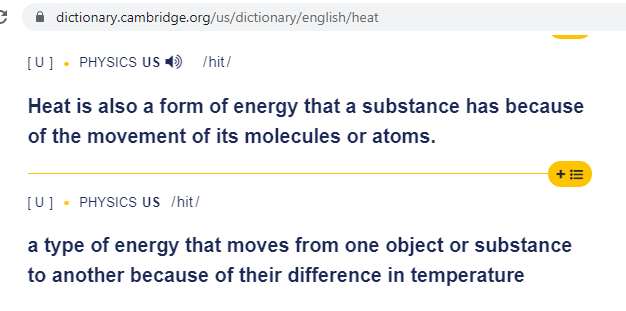
1. Heat content is synonymous with thermal energy:
https://web.archive.org/web/20230308091122/https://www.ccmr.cornell.edu/wp-content/uploads/sites/2/2017/03/Heat-Thermal-Energy-Reading.pdf
https://dictionary.cambridge.org/us/dictionary/english/heat#:~:text=Heat%20is%20also%20a%20form%20of%20energy%20that%20a%20substance%20has%20because%20of%20the%20movement%20of%20its%20molecules%20or%20atoms
2. Heat flow is refers to a net change (movement) of that thermal energy, i.e., net thermal energy flux.
https://dictionary.cambridge.org/us/dictionary/english/heat#:~:text=a%20type%20of%20energy%20that%20moves%20from%20one%20object%20or%20substance%20to%20another%20because%20of%20their%20difference%20in%20temperature
This is not a typo, and it makes perfect sense. I agree with their statement that the absorbed LW should make its way back to the surface from within the TSL. Obviously, you do not. Their idea makes perfect sense, but it can’t be proven.
I agree with it also. I understand you disagree with it, which is fine, but it makes perfect sense to me.
Andy, the TSL is the surface.
Absorption of LW IR is said to occur in the top 10-20 µm. Heat cannot move any higher without escaping into the atmosphere, because it’s already at the very top of the sea surface.
What’s more, Wong & Minnett report that it does NOT escape into the atmosphere. They say that the rate of LW IR emissions is unaffected by the rate at which LW IR is absorbed.
That means LW IR energy absorbed in the TSL does not go up. Going up would mean leaving the water, and it doesn’t leave the water.
What’s more, it doesn’t stay in the TSL.
Because the TSL is so thin, it has negligible heat capacity. Things with negligible heat capacity heat up and cool down _FAST,_ if they’re thermally isolated from everything else.
So, if the heat which the TSL absorbs from downwelling LW IR stayed in the TSL, then its temperature would soar anytime incoming LW IR exceeds outgoing LW IR, and its temperature would plumet anytime outgoing LW IR exceeds incoming LW IR.
But that doesn’t happen. The TSL’s temperature never differs from the temperature of the water immediately beneath it by more than a fraction of a degree, even when incoming and outgoing LW IR fluxes are wildly different.
That means the TSL is not thermally isolated from the water beneath. Its temperature tracks the temperature of the water beneath because heat freely moves back and froth between them.
Dave, I think you misread parts of the paper.
They do not say that, in fact they say the opposite:
What they do say is that they found no dependence between LW radiation out of the TSL and the incoming radiation, which means that the temperature in the TSL goes up and down during the day, which we already knew. It is also true, as they found, that latent and sensible heat transfer to the air is independent of incoming IR, this is a little surprising, but OK, I can believe that.
But no heat flows into the deep ocean; it all goes out to the atmosphere.
Thus, this statement from your comment is also incorrect:
It is isolated, that is a main point of their paper.
Turbulence does not affect the TSL and neither does convection. The TSL is the same layer that evaporates to the atmosphere. I don’t disagree with Wong and Minnett’s data or analysis, but I do disagree with their conclusions as stated in the post, their conclusions and speculations make no sense. They also provide no data on heat loss from the TSL, that is speculation on their part.
Wong and Minnett also say that the TSL is almost always present. Breaking waves and precipitation can disrupt it, but it is fixed in seconds.
Total nonsense, like all one-dimensional energy flow diagrams.
You forget that radiation emitted to space is completely independent of energy captured in the lower atmosphere from the surface. This is because they are separated from each other by the troposphere in which energy transport by convection dominates. And convection is controlled by the weather.
Kirchoff’s law requires that if a body is at equilibrium (an assumption for the energy diagrams to work) a material’s emissivity must equal its absorptivity. The first law says that there is no energy gain or loss. That is not the case in the lower atmosphere or the upper atmosphere. In the lower troposphere the energy absorbed is greater than energy emitted and in the upper troposphere that is reversed and the energy emitted is greater than the energy absorbed. If Kirchoff’s law and the first law are violated the energy diagrams are BS, sorry.
Lindzen 1990 shows that, “average downwelling LW IR is double solar radiation!”
Andy responded, “Total nonsense, like all one-dimensional energy flow diagrams.”
Prof. Lindzen was not wrong, the diagram is two-dimensional (not one), and it is certainly isn’t “nonsense.” Prof. Lindzen never writes nonsense.
It shows global averages, and the numbers are about right.
The fact that LW IR absorbed at the surface averages about twice the solar radiation absorbed at the surface is not reasonably disputable, because those energy fluxes are easily measured.
Of course, because they vary wildly from place to place and time to time, computing accurate global sums or averages is a lot harder than measuring at a single location. But lots of people have worked it out reasonably well, and there’s no legitimate dispute about the approximate values. The numbers which Lindzen cited 36 years ago were from MacCracken 41 years ago, and they’re only slightly different from the latest IPCC and NCA numbers.
Of course, the picture is incomplete without also considering energy fluxes in the opposite direction. On average, as shown in the ERB diagrams, the Earth’s surface emits a lot more LW IR than it absorbs, so net LW IR fluxes have a cooling effect.
Note that, for the ocean, all those emissions come from the “skin layer,” i.e., the top few µm. Likewise, all the convective and evaporative cooling occurs at the skin layer.
Yet nobody contends that that means that the emissions, convection & evaporation have very little cooling effect on the ocean. So it is quite strange that some people think that absorption of radiation in the skin layer must have little warming effect.
How about you, Andy? Do you acknowledge that emissions of radiation from the skin layer, and convective & evaporative heat loss from the skin layer, cool the ocean? If so, how can you doubt that absorption of radiation by the skin layer warms the ocean?
The Earth energy flow / radiation balance (“ERB” or “EEB”) diagrams are very useful, but they are not perfect. I have some complaints about them.
My #1 complaint is that many of them fail to include reasonable confidence intervals, a problem which is sometimes exacerbated by showing exaggerated precision for the individual fluxes.
Some recent ones also show very exaggerated “energy imbalance” figures.
This one from NASA is perhaps the worst offender. Its one advantage over many others is that it quantifies energy loss though the 10 µm “atmospheric window.” (Artistically, it’s pretty nice-looking, too, except for a weird typography problem with the letter “l.”) But it shows the various fluxes with absurd precision and no confidence intervals at all, and it shows an energy imbalance figure which is double a realistic estimate:
(NASA also has a newer one here, in shocking psychedelic / pop-art colors, which is better in some ways but worse in others.)
Nevertheless, despite my complaints, I find ERB diagrams very useful. Except w/r/t the issues I’ve mentioned, they are not misleading, unless misunderstood, e.g., by forgetting that the figures are averages (one of Postma’s many errors). For instance, that “100%” (340.5 ±0.5 W/m²) figure for TOA solar flux (in the Lindzen/MacCracken diagram) is a global average of local instantaneous fluxes which vary from zero to 400%.
Surprisingly, one of the better ERB diagram is NCA4’s FIgure 2.1, which I annotated with a purple box and footnote, here:
It does have defects. I dislike the fact that they renamed “thermals (conduction/convection)” to “sensible heat,” which will confuse some people, and it unfortunately doesn’t even try to quantify the 10 µm “atmospheric window” heat loss. But at least it has reasonable CIs.
AR6’s version is much worse:
Its major faults are that its imbalance figure is way too high (even higher than NASA’s) with a much too narrow CI, it calls thermals/conduction/convection “sensible heat,” and it doesn’t even try to quantify the “atmospheric window” heat loss.
The most important thing to understand w/r/t ocean heating & cooling is that it does not matter at what depth radiation is absorbed or emitted. That’s why none of the ERB diagrams distinguish between fluxes absorbed at different depths. Energy absorbed in the top 10 µm has exactly the same effect on ocean heat content as the same amount of energy absorbed a meter down.
This quote is at the root of our disagreement on energy flow diagrams. I consider them dangerously misleading and you find them useful.
1) Satellite measurements are not very accurate or helpful in making these things because they only see emissions and input, not what happens in the atmosphere with the energy.
2) “EEI” or the Earth energy imbalance is not measured, it is inferred from changes in the OHC. The measurements are only good to plus or minus several W/m2, and anyway the EEI is not static it changes constantly and very significantly both globally and locally.
3) Clouds vary a lot and make the largest difference.
4) Due to warming, OLR is increasing, this alone invalidates the GHE hypothesis and the energy diagrams. Underlying the idea of the energy diagrams is the hypothesis that OLR stays the same when Earth warms, but that is not true.
Energy flow diagrams whether from Lindzen or Trenberth are dangerous oversimplifications of a complex system.
More here:
https://andymaypetrophysicist.com/2024/12/17/climate-models-clouds-olr-and-ecs/
Also see:
https://andymaypetrophysicist.com/2025/02/01/energy-and-matter/
First, here’s a comparison of some key figures from Lindzen 1990 and NASA 2014 ERB diagrams.
Let’s see if I can format a table in a comment here… This is an experiment.
First, I’m going to try embedding an HTML table. (It looks okay on my website, here.)
Then I’m going to try formatting it as an old-fashioned PRE block. IIRC, that used to work pretty well on WUWT, in olden days.
Last, I’ll just embed an image.
As you can see (if any of those attempts worked!), the numbers really haven’t changed much.
1990 / 1985
Lindzen / MacCracken2014
NASADescription100%100.0% = 340.4 W/m²TOA incoming solar46%48.0% = 163.3 W/m²surface heating from absorbed solar radiation24%25.4% = 86.4 W/m²surface cooling from evaporation115%117.0% = 398.3 W/m²LW IR emissions from the surface100%100.0% = 340.3 W/m²absorbed downwelling “back radiation”15%17.0% = 57.9 W/m²surface cooling from net LW IR fluxes (398.2−340.3)7%5.4% = 18.4 W/m²surface cooling from convection & conduction
1990 / 1985 | 2014 |
Lindzen / MacCracken | NASA |
———————-|———————|—————————————-
100% | 100.0% = 340.4 W/m² | TOA incoming solar
46% | 48.0% = 163.3 W/m² | surface heating from absorbed solar radiation
24% | 25.4% = 86.4 W/m² | surface cooling from evaporation
115% | 117.0% = 398.3 W/m² | LW IR emissions from the surface
100% | 100.0% = 340.3 W/m² | absorbed downwelling “back radiation”
15% | 17.0% = 57.9 W/m² | surface cooling from net LW IR fluxes (398.2-340.3)
7% | 5.4% = 18.4 W/m² | surface cooling from convection & conduction
Conclusions: the image looks fine, of course; the PRE block is acceptable; the embeded HTML table is a complete failure.
Second, to your points. We agree on most, but disagree about those diagrams.
0) I think the ERB diagrams are highly informative. They are not inherently misleading, though they all have some issues (which I’ve already discussed).
Of course you have to remeber what they represent, which is global averages, over the entirety of the Earth. Since 71% of the Earth is covered with ocean, the figures are not wildly different from ocean averages, but they ARE usually wildly different from instantaneous fluxes at any given time and place.
1) Satellite measurements are the source of the best data we have for TOA fluxes. They also give us measured spectra from Earth’s radiative emissions, which give a lot of insights into the impacts of GHGs, clouds, etc. There’s a lot of information to be gleaned from diagrams like this one:
2) I agree. Earth’s “energy imbalance” is not measured. It is inferred, and the radiative flux measurements are nowhere near precise enough to determine it by comparing incoming and outgoing fluxes.
I also agree that it changes constantly, but that doesn’t matter so much. What matters is the average.
I built an online calculator / spreadsheet, where you can calculate your own estimates of Earth’s radiative energy imbalance and ECS climate sensitivity, from other evidence, here:
https://sealevel.info/radiative_imbalance_calc.html
When I plug in my best estimates, I calculate a radiative energy imbalance of about 0.33 W/m², and ECS of 1.48 °C / doubling of CO2.
Why don’t you see what you get? Just adjust the values in the yellow cells, then press the Tab key [↹] to recalculate.
OHC numbers are also very questionable, especially prior to about 20 years ago when the Argo floats were deployed. To trust the numbers they report for the 20th century, you have to believe that the temperature profiles of all the Earth’s deep oceans, to depths of 1/2 mile or even more, were known precisely enough to calculate averages accurate to within a few hundredths of a degree, despite having almost no measurements. (Even now, with Argo fully deployed, the data are very sparse.)
3) I agree. Clouds are the “elephant in the living room” that people in the climate industry like to pretend isn’t there:
https://sealevel.info/feedbacks.html#clouds
4) Increases in GHGs cause decreases in OLR, which result in radiative imbalance, adding heat, which warms the Earth, which increases OLR, until equilibrium is restored. (It’s a “negative feedback loop,” which stabilizes temperatures, and it’s why “climate tipping points” are nonsense.)
If OLR is increases without anything else changing, then the Earth (as a whole, including atmosphere) should cool as a result. If OLR is increasing without the temperature of the Earth falling, then something else has to be balancing that increase: presumably absorbed solar radiation.
If absorbed solar radiation is increasing, then reflected solar radiation (shortwave) should be decreasing. (ChatGPT says it is, but ChatGPT is often wrong.)
Your diagrams are only showing about +1 to +1.5 W/m² durable trend in OLR, which is only about 0.4% to 0.6% of the total, and it’s from data spliced together from multiple disparate satellite missions. So I’m not sure how much to trust it. Do you trust it?
“Increases in GHGs cause decreases in OLR, which result in radiative imbalance, adding heat, which warms the Earth, which increases OLR, until equilibrium is restored. (It’s a “negative feedback loop,” which stabilizes temperatures, and it’s why “climate tipping points” are nonsense.)”
Since 1990 OLR has been increasing steadily according to HIRS, CERES, and ERBE at TOA. Since 1990 GHGs have been increasing. Thus, I think I can safely say your statement is false.
See here for the details, and the attached plot.
https://andymaypetrophysicist.com/2024/12/17/climate-models-clouds-olr-and-ecs/
I would add the plot invalidates the GHG hypothesis. In the plot, the purple line is HIRS OLR, CERES OLR is the green line, and ERBE OLR is the light blue line. The GISS global temperature anomaly is the yellow line.
Just an item of note. The acquisition accuracy of CERES envelops the estimated emissions imbalance.
True, actually the uncertainty in the readings is many times the probable energy imbalance as determined from OHC.
A consistent trend, from three independent satellites over 30 years, of course I trust it, who wouldn’t? I don’t trust the absolute values, but the trend yes.
And ChatGPT is correct, reflected shortwave radiation from Earth has been decreasing for at least 30 years, I suspect this is the main reason for the warming we’ve seen. This is due to decreasing cloud cover. Albedo has decreased over 0.5%, increasing absorbed SW by ~2 W/m2. The satellite data is consistent (although it does not match) with Earthshine measurements.
See here:
https://agupubs.onlinelibrary.wiley.com/doi/full/10.1029/2021GL094888
I wrote, “Conclusions: the image looks fine, of course; the PRE block is acceptable; the embedded HTML table is a complete failure.”
CORRECTION: The PRE block initially looked acceptable: it was in a monospace font, so that the columns lined up. But now it doesn’t!
Ugh! Somehow it has gotten converted from monospace back to the default font. I don’t understand how that happened.
115 BB & 100 “back” are bogus.
There are 2 -15% one of which has gone missing.
They’re not “bogus,” Nicholas, they are based on measurements. The fact that your eyes cannot see LW IR radiation doesn’t mean that it does not exist.
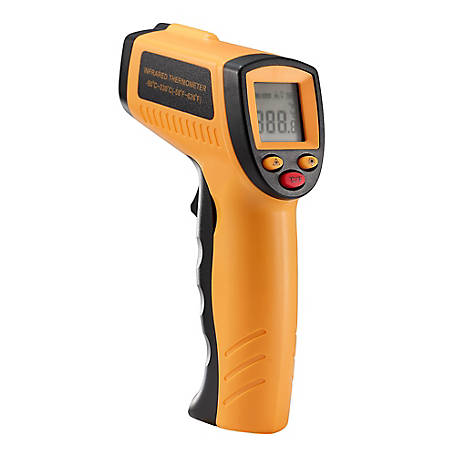
Have you never used one of these? How do you think it works?
Dave,
IR detectors work in the main atmospheric window; thus they cannot “see” downwelling IR. They must work in a window because otherwise they would be useless and see nothing. Their spectrum is from about 8 to 14 micrometers. What you see when you point them to the sky is scattered emissions from the surface. Clouds scatter surface IR so you see them, the rest is due to particulates and condensed water. What you do not see are any GHG emissions. GHGs do not scatter surface radiation.
More here:
https://andymaypetrophysicist.com/2025/02/01/energy-and-matter/
Andy, My point was that IR thermometers work by absorbing LW IR radiation: the stuff which Nicholas thinks is “bogus,” or cannot be absorbed, or something.
IR thermometers come in many types, with 8-14 µm being the most common sensitivity range, but not the only one. They need to read wavelengths which are strongly emitted in the target temperature range.
Sensitivity in other ranges does not make IR thermometers useless or see nothing, but using the atmospheric window range avoids distortions from emissions in the air between the IR thermometer and the object of interest, enabling accurate readings from farther away.
For use cases in which the thermometer is expected to be close to the target it really doesn’t matter much.
Yes, I have one.
And with a little tweaking can spoof it into displaying temperature and flux that clearly do not exist.
Pointed into the sky it produces nothing but open loop noise.
Reposted power point.
It is designed and calibrated to deliver a comparative and referenced temperature assuming the target is BB.
It infers power flux by assuming an emissivity for that temperature, assuming BB assumes wrong.
Manual advises operator to use black tape or paint to mimic BB or insert known emissivity.
Emissivity of TFK_bams09 is 63/396=0.16.
And the correctly measured 396/333/63 GHE loop vanishes.
On this we completely disagree. Where energy is absorbed, whether in the oceans or in the atmosphere matters greatly, and this is the central flaw in the energy diagrams, they hide that important point with a central assumption that the whole climate system is in thermal equilibrium when it isn’t.
The energy imbalance constantly changes by location and in time. I suppose that one could choose a time period carefully that showed it in a near balanced state but change the time period and the imbalance will change, maybe by a lot.
In climate science and physics there are many places where equilibrium is assumed and no one gives it a thought, but equilibrium is rare.
Part of this is ignoring latency, energy transfer speeds. EM is c. Atmospheric thermal is ~ 1/2 speed of sound. Conduction is even slower.
Those “flat earh” energy imbalance charts do not express in J and therefore ignore latencies.
82 + 21+ 1st 56 = 159
Solar balance is closed.
398 BB = 2nd 56 + 342 “back”
2nd 56 is MIA.
Imaginary calculation, duplicates 56 & “back” violates LoT 2.
398 fills the denominator of the emissivity ratio: 56/398=0.14
Nicholas wrote, ““back” violates LoT 2“
(by which he means that downwelling LW IR radiation violates the 2nd Law of Thermodynamics)
That’s wrong. LW IR “backradiation” is readily measured, and its existence and absorption do not violate the 2nd Law of Thermodynamics.
I presume you “learned” that from Postma or PSI, right?
It’s wrong. Unless you like being confused, I recommend that you stop reading their twaddle. It’s basically poison for your brain.
To learn true things instead of false things you need better sources. Here are some:
Roy Spencer:
Anthony Watts:
Steve Carson:
Judith Curry:
Will Happer:
and more:
All of these graphics are trash.
Bravo!
Dave Burton, the only Energy Flow Diagram that matters is from ERBE:
Energy reflected from the earth’s surface
Oversimplification.
It ignores energy transfer rates. EM is much faster than latent or convection or conduction. Without latencies included, no valid calculation of imbalance is possible.
It is good that this over simplified model achieves input output balance, except the earth’s energy system, coupled and chaotic, never achieve equilibrium.
Proof? Weather.
Sparta, I agree that for simplicity, the range of frequencies is as usual assumed to be the average of visible light. As you correctly imply, the energy content of electro-magnetic radiation is hugely different between SW solar and LWIR. But yes the model represents an theoretical equilibrium which never lasts because of numerous factors that upset it up and down, cloudiness being a major example.
No BB/”back”/duplicate GHE loop.
I don’t know who ERBE is, but he’s wrong. And very silly.
ERBE’s diagram shows the equivalent of 64% of incoming solar “radiated to space from clouds and atmosphere,” but zero radiated back to the ground from clouds and atmosphere. How does he imagine that the clouds and atmosphere are convinced to radiate only upward?
The Earth Radiation Budget Experiment is part of NASA scientific directorate. People can decide who is wrong and silly.
This graphic has 115% (1.15*342=393) of ISR upwelling from the surface.
How did they write that and keep a straight face?
This is the surface radiating “extra” GHE energy as a BB which is flat not possible.
Nice set of calculations most Physics majors can understand.
It is very difficult to understand or measure the Physics, with turbulent surfaces.
This graphic is trash. It does not balance & violates LoT.
And Kirchhoff’s law.
Kirchoff: emissivity = absorptivity.
Just a balance. Cannot emit more than it absorbed. Can emit less when kinetic processes are involved.
Kirchhoff: Energy cannot be created out of nothing, which is was the mis-named “back radiation” appears to do.
Andy,
“The mainstream view is that GHG IR warms the TSL, which reduces conductive heat loss from the mixed layer, causing total ocean heat content (OHC) to rise.”
That is an incomplete view of the mainstream view. The key is heat flux balance at the surface. About 160 W/m2 of sunlight penetrates to some depth, and almost all has to return and be reemitted from the surface (the small imbalance is what actually warms the ocean) . About 340 W/m2 comes from the down IR. Those fluxes do not depend on surface temperature. Then there is the upward IR emission, and the evaporative/conductive flux, both of which do depend on T. Balance is obligatory, so T adjusts to modify the latter fluxes until balance.
The penetration of IR is a red herring – the net flux in the water is upward. But if not for the down IR, the surface T would settle at a much lower value.
Further discussion here
Ah blast from the past. Peter Minnett is the only scientist I’ve ever directly gone to, to get a paper and he sent me a copy of “Radiometric measurements of ocean surface thermal variability”
Hi Nick,
I don’t disagree with much in your comment or blog post, but my post was not about the total radiation, it was about the effectiveness of the solar versus IR in the ocean.
Balance is not obligatory and does not exist, there is always an imbalance. Typically, the magnitude of the imbalance is estimated using OHC, which is also not known very accurately, but is more accurate than the radiation estimates from the surface and satellites. The actual imbalance changes constantly and by location, but is small, below our ability to measure it accurately.
Lower level (below a few hundred meters) GHG IR varies a lot and is a combination of scattered surface emissions and emitted radiation from clouds and GHGs, but this part of the atmosphere is a net absorber of radiation and nearly all the radiation is thermalized. The heat generated by captured surface IR is mostly transported to a higher altitude via latent and sensible heat where it can be emitted to space. The higher atmosphere is a net emitter, and it is separated from the surface by convection.
Thus, averages and totals are misleading and not helpful, when combined with assumptions about equilibrium they are almost criminally misleading.
Well, thanks for the clarification explaining the mechanism for a GHE process (GHG IR) that does not exist, but it misses my points.
Correct am I or not?
Hmmm, yeah, you’re NOT correct….and restating your wrongness doesn’t make it less wrong…
Like I said, I do not like those diagrams and pay little attention to them. I’m not sure what you question is, can you rephrase it?
ABSTRACT:
Earth is cooler with atmosphere/water vapor/30% albedo not warmer.
Ubiquitous RGHE heat balance graphics don’t plus violate GAAP and LoT.
Kinetic heat transfer processes of contiguous atmospheric molecules render a surface BB impossible.
FACTS & EVIDENCE:
FACT 1: Remove the Earth’s atmosphere or even just the GHGs and the Earth becomes much like the Moon, no water vapor or clouds, no ice or snow, no oceans, no vegetation, no 30% albedo becoming a barren rock ball, hot^3 (400 K) on the lit side, cold^3 (100 K) on the dark. At Earth’s distance from the Sun space is hot (394 K) not cold (5 K).
That’s NOT what the RGHE theory says.
EVIDENCE:
RGHE theory says “288 K (15 C) w – 255 K (-18 C) w/o = a 33 C colder ice ball Earth.” 255 K assumes w/o case keeps 30% albedo, an assumption akin to criminal fraud. Nobody agrees 288 K is GMST plus it was 15 C in 1896. 288 K is a physical surface measurement. 255 K is a S-B equilibrium calculation at ToA. Apples and potatoes.
Nikolov “Airless Celestial Bodies”
Kramm “Moon as test bed for Earth”
UCLA Diviner lunar mission data
JWST solar shield (391.7 K)
Sky Lab golden awning
ISS HVAC design for lit side of 250 F. (ISS web site)
Astronaut backpack life support w/ AC and cool water tubing underwear. (Space Discovery Center)
FACT 2: The GHGs require “extra” energy upwelling from a surface radiating as a BB.
EVIDENCE:
According to TFK_bams09 atmospheric power flux balance, numerous clones and SURFRAD the GHGs must absorb an “extra” 396 BB/333 “back”/63 2nd net W/m^2 LWIR energy upwelling from the surface allegedly radiating as a BB. These graphics & data tables contain egregious arithmetic and thermodynamic errors.
FACT 3: Because of the significant (60% per TFK_bams09) non-radiative, i.e. kinetic, heat transfer processes of the contiguous participating atmospheric molecules the surface cannot upwell “extra” energy as a near Black Body.
EVIDENCE:
As demonstrated by experiment, the gold standard of classical science.
For the experimental write up see:
https://principia-scientific.org/debunking-the-greenhouse-gas-theory-with-a-boiling-water-pot/
Search: Bruges group “boiling water pot” Schroeder
CONCLUSION:
No RGHE, no GHG warming, no CAGW or mankind/CO2 driven climate change.
Nick Schroeder, BSME CU ‘78
Colorado Springs
Nschroeder48@aol.com
ACRONYMS & DEFINITIONS
RGHE: Radiative GreenHouse Effect
GAAP: Generally Accepted Accounting Principles
LoT: Laws of Thermodynamics
BB: Black Body: A thermodynamic system that absorbs ALL incoming energy and emits ALL that energy by radiation alone. Only possible in a vacuum.
CAGW: Catastrophic Anthropomorphic Global Warming
GHGs: GreenHouse Gases, all of them including water vapor
K: Celsius degree units on the Kelvin scale used for serious science (No such thang as a Kelvin unit)
hot^3: hot cubed, i.e. hot*hot*hot
cold^3: cold cubed, i.e. cold*cold*cold
albedo: Ice, snow, clouds, etc. that reflect incoming solar radiation thereby cooling the Earth
C: Celsius degree units on the Celsius scale
UCLA: Univ of CA LA
JWST: James Webb Space Telescope
HVAC: Heating, Ventilation, Air Conditioning
F: degrees Fahrenheit on the F scale. Not useful for formal science.
ISS: International Space Station
Space Discovery Center: Colorado Springs
TFK Trenberth-Fasullo-Kiehl, UCAR climate scientists responsible for GHE budget concept
UCAR: Univ of CO Atmos Research
SURFRAD: NOAA network of stations that measure the surface radiation budget and aerosols over the Earth’s land surface.
LWIR: Long Wave Infra-Red radiation.
CO2: Carbon Dioxide
BSME: Bachelor of Science Mechanical Engineering
CU: University of Colorado, Boulder
RGHE theory apparently isn’t what you think it is. If you learned that at CU, you should ask for your money back…..if for nothing else, them allowing your bizarre interpretation that somehow the Planck curve allows back radiation to “heat” something instead of interpreting it as being a lesser emission of photons.
“.. your bizarre interpretation that somehow the Planck curve allows back radiation to “heat” something instead of interpreting it as being a lesser emission of photons.”
Not my interpretation. Where did I even mention Planck?
You avoided my 3 points and changed subject to some esoteric handwavium.
The 396 BB is imaginary.
The 333″back” is imaginary
The 63 duplicate is imaginary.
Bickering over how they heat is pointless.
So, what is it then?
RGHE was not a BFD in 1978.
I figure my BSME was worth $3 E6 gross, a very good investment.
Andy,
“Balance is not obligatory”
Balance at the surface is obligatory, because there is no zero mass. And net flux into the surface would change the temperature by an infinite amount.
Because surface balance determines temperature, it is pointless to ask whether SW or IR is more effective. They simply add at the surface; must be matched by the upfluxes, and so T must vary to ensure that matching upflux.
This is true but where Minnett gets it wrong with his experiment (looking at T as a function of DLR) is where he describes
and then
With reference to the SST diagram, the surface temperature is warmer than the 5cm temperature which is the depth his experiment measured. So he thinks cloudy conditions increase DLR and therefore decrease energy loss [leaving the ocean warmer.]
But what he fails to consider is that under cloudy conditions the sun is no longer warming the ocean at depth and so convection and conduction decrease as the energy is radiated away and the “difference between the 5 cm and the skin temperatures” reduces as a result.
So whilst its true increased GHGs warm the ocean as a first order approximation, his experiment didn’t show that at all.
“But what he fails to consider is that under cloudy conditions the sun is no longer warming the ocean at depth and so convection and conduction decrease as the energy is radiated away and the “difference between the 5 cm and the skin temperatures” reduces as a result.”
No, that is the wrong way around. When the sky is cloudy, the 5cm T is higher than with clear sky, relative to skin. Less SW would move it the other way.
No, my understanding was that its a relative temperature between surface and 5cm depth, not an actual temperature.
Specifically he says
…and his graph reflects the difference.
If we balance, why is the temperature not constant? It isn’t constant at any time scale, is it? I’m sure you could pick a starting point and an ending point that would balance, but what does that mean? When has the temperature ever been constant? When has energy in ever matched energy out? Maybe never?
OLR is increasing, exactly with temperature (see attached), that tells you two things:
1) The input and the output do not balance, or the sun is changing with temperature.
2) The so-called greenhouse effect is not working as predicted.
Details here:
https://andymaypetrophysicist.com/2024/12/17/climate-models-clouds-olr-and-ecs/
This post also explains the attached plot.
I assume he means over time? Because obviously T doesn’t vary instantaneously to an equilibrium figure.
I assume that also, but what time period? I don’t think it balances over any time period unless you simply cherry pick two points that are the same, which is always possible. Throughout history temperature has changed indicating an imbalance.
Andy
“If we balance, why is the temperature not constant?”
Again, you’re missing the point. We balance heat fluxes at the surface. That doesn’t say anything about constancy of temperature anywhere.
This is a basic tool of analysis in science. Take mechanics and Newton’s 3rd law – action and reaction are equal and opposite. ie no net force at a point. That doesn’t mean nothing can move. But it’s basic in mechanics, as you’d remember from systems of pulleys etc.
Or electricity – Kirchoff’s Law. Current into a circuit node adds up to zero. Same basic reasoning – the point has zero capacitance, so net current would in mean infinite voltage change immediately. But amplifiers still work.
So in heat transfer – fluxes at a surface have to balance. That is where analysis begins.
“The input and the output do not balance”
Yes, at the surface they do balance. What happens if down IR increases, say, is that either the upflow of heat to the surface has to reduce, or the upflux to air has to increase. Initially the near surface region does warm. That lowers the T gradient that brings heat from below. This accumulates for a little which, raising T in the mixed zone. But as that warms, the heat flux from below goes back to where it was, and the surface T settles to whatever value makes the evap and up IR balance.
This happens within a diurnal cycle, which is what Minnett’s paper is about. It is the underlying mechanics which allow you to say that the higher down IR increases OHC. But a key thing is that at all stages, and at all relevant time scales, heat fluxes across the surface are in balance.
That makes no sense. If heat flux moves between two bodies, the temperature of each body changes. You are assuming a state of thermal equilibrium or, at least, quasi-equilibrium. In reality EEI is positive and temperatures are increasing. There could be many causes for this state, but it is happening, thus the world is not at equilibrium, I’m not sure it ever has been.
“That makes no sense. If heat flux moves between two bodies, the temperature of each body changes”
Yes in order to establish equilibrium (balance heat fluxes), that’s how the system works.
Nick,
The only way your comment makes sense is if you are referring to an infinitely thin surface with zero heat capacity. Making that unreal assumption, it is true. But that is not the discussion we are having here or in the post. the TSL is not a massless interface.
Andy,
The rate of change of temperature of a region is basically flux imbalance divided by thermal inertia. So a near zero thickness layer (you spoke of 100 microns) can only tolerate a very small flux imbalance. And so on.
But you spoke of the mainstream view. I’m telling you you have it wrong, and explaining how the matter should be analysed. Once you have balanced fluxes at the surface, th rest follows. And that is why it makes no sense to argue about whether SW or IR are more effective. They simply add in this region, and the temperature has to adjust so the evap and IR losses match these inputs. It is a boundary condition. A universal notion in continuum mechanics.
Of course, the relative contributions of IR and SW was the whole point of the post and Wong and Minnett. You seem to be saying that I’m correct and for heating the bulk ocean, SW is more important. Obviously, they both work to warm the TSL. Or maybe you are saying we can never know which is more important or that it doesn’t matter. It’s hard to tell what you are saying actually, you need to be clearer.
Nick,
I’m still trying to figure out what you are saying and failing. This sentence is very confusing:
The TSL, at least according to Wong and Minnett, reacts to IR by changing its temperature and its shape, thus its size and volume. We don’t really know how it reacts to SW, they did not try and measure that, although some of the changes in the TSL had to be through changing SW, since their measurements were the properties on cloudy periods versus clear periods. More clouds, less SW to the ocean and more IR.
They explicitly say that IR does not directly affect the bulk ocean and the interaction between the TSL and the bulk ocean is minimal.
The TSL directly interacts with the atmosphere only. Changes to the overall temperature gradient caused by the changing temperature in the TSL can affect bulk ocean temperature according to their analysis. If you think I “have it wrong,” you need to explain how. What you wrote seems to agree with all that.
If you think I “have it wrong,” it’s likely because you accept the mainstream view, which emphasizes total flux balance at the ocean surface (the “boundary” in your comment) without splitting hairs on IR and SW penetration (common in GCMs). But Wong & Minnett refute this idea: The TSL-atmosphere interaction dominates, with minimal direct TSL-bulk mixing. IR’s bulk effect is via gradient changes, not direct heating.
If you think SW and IR both affect the TSL, they do but IR is almost entirely absorbed in the TSL, where SW goes deeper. In the TSL, IR dominates the absorption and SW adds only a tiny fraction (~0.05% perhaps under clear skies). If you think they both affect the bulk ocean in the same way (Watt per Watt) they do not. SW affects the bulk ocean directly and any influence that IR has on the bulk ocean is indirect.
If you are saying the TSL is a massless surface, it isn’t. Further its volume changes with changes in radiation, as well as its temperature. It adjusts itself to keep surface exchanges stable (your point from earlier). Like I said, what you have written is very confusing and inconsistent. Part of why I wrote this post was to do a very thorough analysis of Wong and Minnett, which is an important paper, otherwise I would not be pressing you on this. Usually, I can count on you to press the consensus view.
Andy,
The surface relations are basic in continuum analysis because of the absolute requirement for balance. The fluxes must add to zero, and the temperature must adjust to make that happen. What drives that is the sum of the incoming SW and IR. The outgoing fluxes adjust accordingly, via the surface T on which they depend.
In the medium term (diurnal, say, or Minnett’s time scales) the upflux in water from absorbed SW heat returning to the surface can vary, and that is part of Minnett’s concern. If the down IR increases (cloud) then surface T rises, and is warmer than the water a meter or so below. That creates a downward flux which runs counter to the upward flux of SW heat. But it is temporary; the water below warms until it falls into line with the surface. That is that hour/day time scale.
You say the TSL has mass. OK, but how much? 100 μ – that is 0.1 kg/sq m. Suppose a net inward flux of 1 W/m2 – that would warm it by about 23°C per hour. So even that small imbalance is incompatible with observed behaviour. But of course you could apply the same analysis to the top 1 μ.
Thanks for clarifying, that makes more sense to me. I’ve prepared an answer here:
https://andymaypetrophysicist.com/2026/02/27/is-the-ocean-surface-a-boundary-condition/
It will also appear on WUWT soon.
It “rises” relative to the 5cm depth. But when there is cloud, the whole “hook” flattens out as it heads towards the more vertical temperature profile seen at night. Relatively speaking T rises but that is an artefact of the whole conditions. And with that specific opposing argument, Minnett’s argument falls apart.
Does the ozone layer block parts of the IR spectrum?
Is there an increase in IR radiation at the sea surface if the ozone layer is thin and has large ozone holes?
Hunga Tonga-Hunga Ha’apai Water Vapor Injection into the stratosphere in 2022 reduced the ozone layer globally by 2-10%.
Did IR radiation at the sea surface increase after the Hunga Tonga-Hunga Ha’apai volcanic eruption?
https://agupubs.onlinelibrary.wiley.com/doi/full/10.1029/2023JD039298
Ozone does absorb some IR and Hunga Tonga must have had some effect on surface IR, but I don’t know how much, and I don’t have a reference. Hunga Tonga’s injection of water vapor into the stratosphere increased downwelling IR and the greenhouse effect, warming the surface. It also decreased outgoing IR. I think all the effects were small globally, but enhanced at the poles.
I searched and got varying answers. It seems that it was the water vapor that affected the IR radiation the most.
The water vapor reflected the IR radiation towards space. The water vapor reflected the IR radiation back towards the earth. The water vapor absorbed the IR radiation and sent it out in all directions.
The sea temperature was higher in 2023-2024. Could the sea temperature increase have been due to the Hunga Tonga-Hunga Ha’apai volcanic eruption in 2022.
I think some of the warming since the eruption was due to Hunga Tonga, I’m not sure how much.
There is empirical proof of the fluxes by which the sea surface is warmed by the sun and in turn warms the air.
An Investigation of Turbulent Heat Exchange in the Subtropics
James B. Edson
“One can think of the ocean as a capacitor for the MJO (Madden-Julian Oscillation), where the energy is being accumulated when there is a net heat flux into the ocean (here occurring to approximately November 24) after which it is released to the atmosphere during the active phase of the MJO under high winds and large latent heat exchange.” Link to Edson paper is below:
https://apps.dtic.mil/sti/tr/pdf/ADA617687.pdf
My synopsis with addtional evidence is:
https://rclutz.com/2015/05/10/empirical-evidence-oceans-make-climate/
Forgot the money graph from that study: Figure 7
In ‘Farthest North’ Fridtjof Nansen describes the temperature distribution he found in Arctic waters.
“These temperatures of the water are in many respects remarkable. In the first place the temperature falls…from the surface downward to a depth of 80 metres, after which it rises to to 280 metres, falls again at 300 metres then rises again at 326 metres then falls to rise again at at 450 metres then falls steadily down to 2000 metres, to rise more slowly at the bottom”
The differences were not huge but show things are more complicated than one might think.
Indeed, the sensible heat loss in Arctic winter ranges 200-400 Wm2. As the diagram clearly shows, except for a short time in high summer, the energy flow is from the water heating the air.
I’ve commented on this topic before. Andy has the basics about right. Simply put, downwelling IR (DWIR) from increases in CO2 molecules does not warm the surface.
The study based on clouds is not valid for CO2 radiation. Clouds are blackbody radiators and absorb all upwelling IR frequencies including the atmospheric window. Trying to apply findings based on clouds to CO2 shows the desperation coming from climate pseudoscientists.
The one area I think Andy missed is the effect of conduction. This energy transport mechanism is continually ignored due to the low values associated with its net effect. However, the total energy transport is much higher. The fact it works both ways is then dismissed.
Conduction is the primary mechanism which carries energy from DWIR back into the atmosphere. Here’s a typical flow description for an N2 molecule.
1) The N2 molecule collides with a CO2 molecule exciting that molecule to emit a photon towards the surface. The vast majority of photons which reach the surface originate within the first few meters of the atmosphere due to saturation.
2) The photon is absorbed by the surface.
3) This energy transport has cooled the atmosphere just above the surface and warmed the surface. This creates an energy imbalance.
4) Conduction events may occur whenever an atmospheric molecule strikes the surface. All atmospheric molecules participate. The direction of net energy flow is determined by the 2nd Law.
5) Since energy is constantly being moved back and forth between the surface and the atmosphere via conduction, this energy change is treated no differently. The equivalent amount of energy gets conducted back into the atmosphere. It most likely would occur when another N2 molecule strikes the surface.
6) This eliminates the energy imbalance. It’s very close to … nothing happened.
There is one caveat to this scenario. The DWIR photon may strike an H2O molecule and induce evaporation. This takes some energy away from the surface (cooling). The energy involved is then removed from having any temperature effects until condensation occurs. This cooling will now lead to more energy being conducted from the atmosphere to the surface. This shares the cooling effect with the atmosphere.
The net effect at the surface of DWIR is cooling! Good thing increasing CO2 also absorbs a little more energy to counter this cooling effect.
What happens to the new water vapor molecule is another story.
Except photons are not particles. Photons are a mathematical construct, a quantum of energy that depends on the frequency.
EM radiation is a wave front, or a field if you wish. A photon is a small quantity of energy in that wave front.
Changing CO2 concentration changes the specific heat capacity of air. This results in a change in the J of thermal energy needed to raise a mol of air 1C. This is also affected by the ideal gas law, so one has to run the calculations via integral calculus for the entire column of air. Averaging does not cut it.
I didn’t say a photon was a particle. Not sure where you got that. I also was limiting the discussion to DWIR and its effects.
“exciting that molecule to emit a photon towards the surface.
Establishing a vector infers a particle. That was the basis of my comment.
I choose to not debate that a N2 collision with CO2 can cause the CO2 to emit a photon. I do contend that not every collision results in EM emission. The CO2 molecule must first have a valence electron in an elevated energy state and once that photon is emitted, there are none left.
Consider the ration of N2 to CO2. ~ 2000 to 1 and the number of collisions that can have a photonic emission is limited.
Given the nature of EM emissions, which are spherical, I disagree that the photon emitted has a earthward vector.
Correct. People forget that photons do not exist in space, but only when energy interacts with an atom or molecule. Energy, in space, is a wave in all directions.
Radar was a very good education.
So was EO IR sensors.
I agree. You can only look at photon emissions statistically. I also didn’t say CO2 emitted photons are all headed towards Earth. But, since this entire article is discussing DWIR, that was the case of interest. Context is your friend.
My example was to show why CO2 DWIR will not cause any warming.
The point to which I agree.
“I do contend that not every collision results in EM emission. The CO2 molecule must first have a valence electron in an elevated energy state and once that photon is emitted, there are none left.”
Before the collision the CO2 molecule is in the ground vibrational state, if a neighboring molecule collides with it and transfers the correct amount of kinetic energy from the right direction the CO2 molecule can be excited to the first vibration state. That excited state will lose the excess energy by either collisions or will emit a photon.
“Given the nature of EM emissions, which are spherical, I disagree that the photon emitted has a earthward vector”.
EM emissions are directional not spherical, a single photon is emitted in a random direction, the average of multiple emissions is spherical.
Only a small fraction of N2 molecules carry enough excess energy to excite a CO2 molecule’s vibrational energy level. Fifteen micron IR photons emitted by the surface will excite the vibrational level via absorption, the fate of that excited level can be to emit an IR photon (GH emission) or because of the long radiation lifetime of the molecule the energy can be transferred via collisions to neighboring N2/O2 molecules, thereby heating the atmosphere. Either way the IR emitted by the surface does not reach outer space.
Water molecules absorb the IR radiation and send it out in all directions.
Are IR radiation absorbed by water molecules and sent out in all directions to other water molecules up to 100 meters deep?
Or does some of the IR radiation pass through water molecules without being absorbed up to 100 meters deep?
Most energy absorbed by water vapor molecules is not re-emitted, it is thermalized through collisions with neighboring molecules and turned into sensible heat, at least near the surface. Once you get above the local clouds, water vapor emits radiation to space, but again some of the emissions are captured by neighboring water molecules and turned into sensible heat. This is why there is often a temperature inversion above the clouds. Above about 5km, most emissions go to space.
Sorry, I expressed myself unclearly. I was thinking about water molecules in the ocean. You wrote about IR radiation penetrating 100 meters deep in the ocean.
Can IR radiation penetrate 100 meters of ocean without colliding with any water molecules?
IR does not penetrate the ocean surface. Some solar radiation can penetrate to 100 meters, especially blue light.
Now I understand. I missed that you wrote about different light spectra.
TSL IR evaporation also occurs on land as when dew on leaves and grass evaporates in the morning. I searched and found the following text:
IR light is highly effective at increasing leaf surface temperature, which promotes the evaporation of dew and moisture (transpiration) from the plant canopy.
Without doing radar skin depth calculations, I can not automatically agree with your statement.
Optical depth calculations demonstrate how much energy how deep.
One thing I get from reading the comments.
We do not yet understand how all of this works and we cannot agree on many of the basics.
Until we have a definition of Optimum Climate, we cannot determine if what is happening is good or bad. Politics aside.
I do applaud the science discussions.
geologic (e.g. mantle plumes) or endogenous changes (e.g. bio or chem) seem more likely to drive ocean trends
dogs wag tails, not the other way around
the mantle is orders of magnitude more massive than the oceans, which is 300x more massive than the atmosphere
anyways paleo record is clear: CO2 rises after the oceans warm, not before
placing Man at the center of climate is as silly as placing him at the center of the universe
The hubris of mankind is only exceeded by his stupidity and ignorance. With noted exceptions.
Andy:
“OLR is increasing, exactly with temperature (see attached), that tells you two things:
DLR is also increasing …..
“Decadal variation of longwave downwelling and net radiation as observed at the surface with implication for climate sensitivity: Based on pyrgeometer and pyranometer measurements”
Atsumu Ohmura
https://www.sciencedirect.com/science/article/pii/S2950630124000036
“Abstract
The direct cause of the ongoing warming is considered due to the increase in the atmospheric absorption and emission of longwave radiation by enhanced greenhouse gases. Decadal change of longwave downwelling radiation was investigated based on 22 stations for 24 years data from 1998 to 2021, obtained in the Baseline Surface Network (BSRN) and Surface Radiation Budget Monitoring (SURFRAD) measurements. The longwave downwelling radiation has been increasing at all sites. The least square regression analysis showed the mean increasing rate of +0.215 Wm−2/a, of which 46% is due to greenhouse gases and the remaining 54%, to temperature increase (including water vapor feedback). Scaling the present result with respect to [CO2], the increasing rate excluding temperature effect is +0.05 Wm−2/ ppm CO2……”
—————————————————————————————————————
OLR is increasing, exactly with temperature (see attached), that tells you two things:
1) The input and the output do not balance, or the sun is changing with temperature.
It’s that the output and input don’t balance, as the GHE theory has it.
2) The so-called greenhouse effect is not working as predicted.”
It’s working as predicted from 2014 at least ….
https://pmc.ncbi.nlm.nih.gov/articles/PMC4250165/
“Shortwave and longwave radiative contributions to global warming under increasing CO2 (2014)
Aaron Donohoe”
“Abstract
In response to increasing concentrations of atmospheric CO2, high-end general circulation models (GCMs) simulate an accumulation of energy at the top of the atmosphere not through a reduction in outgoing longwave radiation (OLR)—as one might expect from greenhouse gas forcing—but through an enhancement of net absorbed solar radiation (ASR). A simple linear radiative feedback framework is used to explain this counterintuitive behavior. It is found that the timescale over which OLR returns to its initial value after a CO2 perturbation depends sensitively on the magnitude of shortwave (SW) feedbacks. If SW feedbacks are sufficiently positive, OLR recovers within merely several decades, and any subsequent global energy accumulation is because of enhanced ASR only. In the GCM mean, this OLR recovery timescale is only 20 y because of robust SW water vapor and surface albedo feedbacks. However, a large spread in the net SW feedback across models (because of clouds) produces a range of OLR responses; in those few models with a weak SW feedback, OLR takes centuries to recover, and energy accumulation is dominated by reduced OLR. Observational constraints of radiative feedbacks—from satellite radiation and surface temperature data—suggest an OLR recovery timescale of decades or less, consistent with the majority of GCMs. Altogether, these results suggest that, although greenhouse gas forcing predominantly acts to reduce OLR, the resulting global warming is likely caused by enhanced ASR.”
“(A) Idealized response of global mean radiation at the TOA to an instantaneous GHG forcing (green dots) assuming no SW feedback and a radiative adjustment e-folding time of 20 y. The green line shows the OLR response (anomaly from preindustrial), and the shaded green area shows the LW energy accumulation. (B) The same as in A but in response to an instantaneous SW forcing (red dots), with the red line showing the ASR response. In this case, the net energy accumulation is the difference between the SW energy accumulation (the shaded red area) and the LW increase (the hatched green area, where the hatching indicates that the LW response leads to a cooling of the climate system). (C) The ensemble average radiative response in the CMIP5 4× CO2 simulations. The shaded area represents the energy accumulation by SW (red) and LW (green) anomalies, and the hatched area indicates energy loss by enhanced OLR. The dashed red and green lines show the predicted ensemble average ASR and OLR responses from the linear feedback model (Eqs. 1 and 2). (D) The same as in C but for the CMIP5 ensemble average radiative response in the 1% CO2 increase per year simulations (with linear increase in forcing as shown by dotted lines).”