Guest Post by Willis Eschenbach
Recently there have been a number of accusations and bad blood involving myself, David Evans, Joanne Nova, Lord Christopher Monckton, and Leif Svalgaard. Now, I cannot speak for any of them, but on my part, my own blood ended up mightily angrified, and I fear I waxed wroth.
However, I see no point in rehashing the past. What I want to do is to return to the underlying scientific questions. In that spirit, I apologize sincerely and completely for wherever I put in “something extra” in the previous discussion. In Buddhism, there’s a concept called “something extra”, and one is enjoined to avoid putting in “something extra”.
It is explained in the following way:
If I say “I am angry” that is simply a true statement.
But if I say “You made me angry”, that is something extra.
So I ask any and all of you to please accept my sincere apologies for whatever what I said that was something extra, so that we can move past this difficult time and get back to discussing the science. Both sides have legitimate grievances, and I am happy to make the first move to get past all of them by apologizing to all of you for whatever my part was in the bad blood. I hope that the other participants accept my apology in the spirit of reconciliation in which it is offered, and that we can move forwards without rancor or recriminations.
Regarding the science, let me go back to the original question, and see what I can do in the way of making my claims in a more Canadian manner. I’ll start by looking at the recent record of the “TSI”, the total solar irradiance:
 Figure 1. Monthly total solar irradiance as measured by the CERES satellite. Vertical blue line shows mid-2004.
Now, if you don’t like the data from the CERES satellite, here’s the SORCE satellite data:
 Figure 2. Daily total solar irradiance as measured by the SORCE satellite. Vertical red line indicates mid-2004. SOURCE
Note what is happening in both graphs after mid-2004 (vertical lines in both plots). As in every solar cycle, the TSI declines somewhat, and bottoms out. Then, it starts to rise again. And by the end of the datasets, in both cases the TSI is higher that it was in 2004.
So what was the scientific dispute all about, the discussion that underlies all of the bad feelings?
It revolved around the following graph from David Evans, referenced by both Leif Svalgaard and Lord Monckton, showing the basis of his predicted upcoming global cooling :
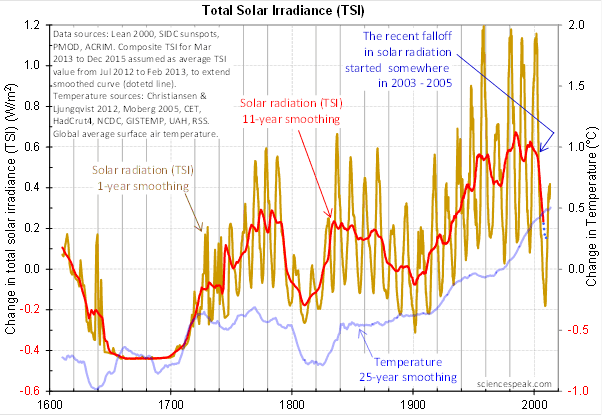
 Figure 3. David Evan’s graph of TSI (gold line), along with a centered 11-year moving average of the TSI data (red, with dotted blue extension), and a 25 year unspecified smooth of temperature, presumably a trailing average (blue line). (Click to enlarge)
Now, as you can see, the bright red line basically falls off the edge of the earth around 2004. The note says “The recent falloff in solar radiation started somewhere in 2003-2005″.
However, a look at both the SORCE and the CERES data shows no such “falloff in solar radiation”, neither precipitous nor otherwise. In fact, both datasets agree that by 2013 the TSI was well above the level in mid-2004.
Since there is no fall in the underlying data of any kind, why does the red 11-year average line show abrupt cooling starting around 2004?
The answer lies in the various problems with the graph.
• The TSI data is a splice of three datasets, with two of them showing the post-2000 period. This is a huge source of potential error in itself. However, it gets worse.
• One of the spliced datasets is the Lean TSI reconstruction, an outdated dataset that the authors of the reconstruction themselves admit is inaccurate.
• Another is the PMOD dataset. It is known to be reading low by 0.2 W/ms at the solar minimum, introducing a spurious apparently strong recent “cooling” where none exists.
• The 11-year centered average is an extremely bad choice for a filter for sunspot/TSI data. Because the solar cycle varies both longer and shorter than 11 years, at times the 11-year average actually reverses the sense of the data, converting peaks into valleys and valleys into peaks. Look at the period from 1760-1800 in Figure 3, for example. What is happening is that the frequency data is getting strongly aliased into the amplitude data. As a result, the average can end up far from the reality, particularly at the ends of the dataset.
For another example, look at the period just after 1740 in Figure 3. The 11-year average takes a huge vertical jump … but meanwhile back in the real word, the TSI itself is not rising at all. It is falling. Clearly, the large vertical jump in the red line is totally spurious.
• The TSI data has had about 900 days of “data” added to it using an arbitrarily chosen value. This is shown by the blue dots which indicate a continuing drop in the temperature.
So regarding the question of why the red line is acting so strangely, the answer is that we have a perfect storm of spliced data, bad data, arbitrary “data” added to the spliced bad data, and an extremely poor filter choice.
And as a result, the red line doesn’t represent reality in any shape or form. There is no precipitous drop in TSI starting around 2004. It doesn’t exist. Sure, the 11-year average says clearly that there is a huge drop starting around that time … but the actual data says something entirely different, as shown in Figures 1 and 2.
Now, in the heat of the moment Leif described the red line as being “almost fraudulent”. I think this was an over-reaction, but perhaps an understandable one. After all, if the red line were flipped over vertically it would make a lovely hockeystick, and if someone claimed warming was coming based on that hockeystick, people would call them alarmists … and calling someone an alarmist is certainly a close relative of calling them “almost fraudulent”.
However, my guideline is, never ascribe to malice what is adequately explained by error and misunderstanding. So I do not call their red line fraudulent, nor did I do so in the original discussion. Instead, I say that it is an error resulting from a misunderstanding. In any case, let me suggest that we leave out all ascription of motive and intent, that goes nowhere, and that we return to the science.
A more scientifically neutral description of the red line is that it is highly inaccurate and potentially misleading, because the apparent drop starting in 2003-2005 is simply an artifact of a combination of bad data and bad filtering.
Finally, to the degree that David Evans’ model predicts future cooling based on the red line, it is already falsified.
That is what I was trying to say, and I believe (subject to correction) that was what Leif was pointing out as well.
In closing, I will endeavor in this thread to keep my comments on as scientific a basis as possible, to avoid any personal references, and to not ascribe motive or intent. I request that everyone do the same. Many toes have already been stepped on in this discussion. Let’s see if we can simply discuss the science.
My best to all,
w.
VERY IMPORTANT: It is important in general, and in this discussion in particular, that you QUOTE THE EXACT WORDS THAT YOU DISAGREE WITH. Note that this doesn’t mean just referencing their entire comment. Quote the exact words of their comment that you think are in error, and tell us why you think those words are wrong. If you do not quote the exact words that you disagree with, none of us will know what you are referring to … and out of such misunderstandings grows animosity and misunderstanding.
Finally, please don’t delve into the rights and wrongs of what has happened in the previous discussions. I am not interested in the slightest in ascribing blame or responsibility. I have accepted my own responsibility for my own actions and apologized for wherever I was over the line. What I or the others did in the past is a blind alley, so please confine your comments to the science, and as the saying goes, “Let the dead past bury its dead”.
Mark says” First, data decimation by averaging does not cause aliasing. Second, the 11 year boxcar is a valid filter function for the intended purpose which is to completely suppress 11 year periodicity with the minimum length impulse response. That other frequencies are not so well dealt with seem to me to be beside the point of the analysis…”
1. A running average does not decimate, you have exactly the same time resolution as before.
2. ‘other frequencies’ are not beside the point, they are what are causing the inversions and the steep drop. That is the drop on which Dr Evans is basing his prediction and which he is putting up as a falsifiable prediction. Hardly ” beside the point of the analysis”.
richard verney says: “For example, I see instances when they become out of sync, there are some examples when the amount of relative change between the two is not similar etc. In fine detail, correlation begins to breakdown”
See my post just above:
http://wattsupwiththat.com/2014/07/16/mending-fences/#comment-1687851
Agnostic says: “…but I can’t see what is wrong with their conclusion given they think the data is alright.”
There’s two parts to this as Willis explains. One is the data, the second is the filter aberrations.
The steep drop is not there, and should not be there in 11y low-passed data, whatever it’s source:
http://climategrog.wordpress.com/?attachment_id=983
MikeUK said:
Interesting point – if true, then when combined with the WE patented thermostat hypothesis, then there should be a correlation between TSI and time-of-onset of tropical thunderstorms.
If such a correlation is found, then the notch filter becomes redundant.
Anyone have the data on that (Willis?)
It will not be “Ice Age”. It will be very harsh winters in the mid-latitudes. If the sun’s magnetic field will weaken summer will be short.
MikeUK said: ” Solar effects could well be having a measurable effect on tropical temperatures, but at the same time very little effect on the median”
“could well be having ” , or may be not. Try producing something to back it up rather than meaningless hand-waving comments.
Tropics are particularly resistant to changes in radiative flux, as Willis has pointed out.
There is a detectable change in the tropics to Mt Pinatubo which shows that the values IPCC modellers use for scaling volcanic effects has been _under played_ to make the models work whilst maintaining high sensitivity.:
http://climategrog.wordpress.com/?attachment_id=884
Despite that the change in tropical SST does match Mt P but is so small it’s just down at the noise level.
This implies that tropical climate is very insensitive to radiative change.
This is empirical verification of Willis’ hypothesis, in the topics.
At this stage of the game, I think most skeptics agree that CO2 running the climate is a defunct theory. That being the case and given the establishment investment in the CO2 rules over all, we’re the only ones actually looking for alternative theories.
The notch theory may or may not be correct, in whole or part; it’s still a very new idea even though David and Jo have put a lot of time into it. We can refine or rationally reject it by a process of cool thought and civil debate amongst ourselves. If they won’t do the blue skies science, it’s incumbent on us to do it.
Thank you Willis for being a big enough man to start moving the debate back onto that track, and ignore the various trolls dressed up in skeptic clothing.
Thank you again.
Pointman
Your postscript is just an overly long nag. It hippie kid focuses on buffoons as if they matter.
Shortened: “Only attack me in detail, friend.”
Mike UK “Another point: global mean temperatures are actually the MEDIAN of all the data, ”
I think you are mistaking what hadSST3 median means. It is not the median of the temps, it is the median of various “bias corrections” schemes. The times series, in general, are gridded means.
Please correct me ( with specific references to what you are referring to ) if that’s not what you meant.
“However, it gets worse.”
Isn’t that ‘something extra’? 😉
What was surprising was the claim by Svalgaard that all the data is bad anyways so why bother and, by extension, why bother with graphs, charts, equations, and already falsified. Strange area, this climate stuff.
Still, if this is all Ouija board parlor games, I prefer the Ouija with a firm prediction verifiable within a couple of years than withing a couple of decades or a couple of centuries. After all, it’s all guesses anyway.
Willis, I don’t know the ins and outs of this spat, but do know that David and Jo appear to have been distressed by the vehemence of your, and Leif’s, response. To the extent that David has proposed a theory that you disagree with surely any disagreements can be expressed in language that requires no apology. And that’s the root of the problem, you appear to have responded emotionally and you now appear to be apologising while continuing to use “robust” language to those who disagree with you.
An apology is best accompanied by humility and it isn’t humble to apologise and say you don’t know what offence you’ve caused as though the person you’re apologising to is somehow to blame
I know you don’t care what anonymous contributors have to say, but I don’t care that you don’t care, I only care that you get to read my opinion in the hope that it will bring a little self-reflection.
“O, wad some Power the giftie gie us to see oursels as others see us!”
Sorry if I’ve caused any offence. (see what I mean)
my wife and i have fights all the time and the worst thing to say i i apologize for whatever i did to make you mad. we both agree its not really an apology. good luck sincerely hope you all can mend fences.
Mr Eschenbach says it was “understandable” that another contributor had accused Dr Evans of being “almost fraudulent”. It was not “understandable”. It was irresponsible and inappropriate. It was based on a failure on the part of that commenter to realize that Dr Evans’ plainly-labeled graph showed 11-year smoothing. There was no basis whatsoever for accusing Dr Evans of being “almost fraudulent”, and the person who made that allegation and regrettably failed to withdraw it is now in considerable trouble over it. There are plenty of fraudsters in the climate scam, but Dr Evans is most certainly not one of them. Minimum standards of courtesy in scientific discourse are expected, and the entirely unjustifiable allegation that Dr Evans might have been guilty of a serious criminal offense fell well below those standards. Let there be no more repetition of any such nonsense.
Mr Eschenbach says the TSI data has had about 900 days of “data” added to it. No, it has not. This matter has been repeatedly explained to Mr Eschenbach both privately and publicly, and he must now desist from saying that any data, whether with or without quotation marks, have been added to the 11-year smoothing. The blue dots at the end of Dr Evans’ solid red 11-year smoothing are not in any way part of the smoothing. They are merely an indication that the precipitous drop shown over the previous few years is unlikely to continue – a point that Mr Eschenbach himself would presumably not disagree with, since he has made such a stramash about the fact that TSI today is higher than it was in 2004 (though he seems strangely silent on the fact that TSI today is at the peak of the current solar cycle, and the 2004 TSI was appreciably after and below the peak of the previous solar cycle).
Mr Eschenbach, in criticizing Dr Evans for having shown a graph with 11-year smoothing, fails to show in his own graphs the full 5.5-year period before the 2004 start-date for the drop in 11-year-smoothed TSI.
For good measure, he continues to criticize Dr Evans for having used Dr Lean’s reconstruction of TSI, but takes no account of the fact that the sudden drop in the 11-year-smoothed data of which he complains is evident not just in Dr Lean’s dataset but in multiple TSI datasets, as Dr Evans has show in his detailed reply to the points made by Mr Eschenbach and another commenter here.
And Mr Eschenbach seems to have failed to apologize to Dr Evans for having unjustifiably likened him to Mr Mann, who, after a decade and a half, has still failed to produce the complete code and data by which he contrived his hokey-stick graph in 1998. Dr Evans has now made his model and his method fully and publicly available, as he had said he would, and I should have hoped that a proper apology from Mr Eschenbach would have made some mention of that fact.
The moral is that greater civility all round would be advisable, and that it is foolish and unscientific to criticize a scientist’s research until all the details of that research have been made available, have been studied, and have been understood.
There are plenty of grounds on which one might legitimately question whether we are about to see a sharp fall in global mean surface temperature. Not the least of these is that temperature over the past million years has departed from the million-year mean by little more than +/- 1%, inferentially because the atmosphere is sandwiched between two vast heat-sinks. Given the near-perfectly thermostatic behavior of the climate, a five-year drop in 11-year-smoothed TSI may not, on its own, be enough to overcome the inertia in global temperature and cause cooling.
I should be surprised to see a substantial cooling over the coming decade, but I should not be surprised to see a little cooling. Nor should I be surprised to see a little warming. But I can see no basis at all for the unjustifiable hostility that Dr Evans’ suggestion of forthcoming cooling has provoked.
Greg, my first point was that aliasing artefacts come from inappropriate resampling (decimation). An averaging boxcar does not do that -ever.
It is not correct to say the boxcar caused that drop as the last boxcar point did not use extrapolated data -or am I wrong? I think your prediction of a smaller drop depends on cycle 25 being the same as 24 but what if (say) 25 is lower again -in that case the low pass filtered drop will be larger than you currently think and we may say it started in 2004?
On the issue of a fall off in TSI starting around 2003, I can see it in the temperature data for my state of Queensland, Australia. More here… http://jennifermarohasy.com/2014/06/cooling-temperature-trend-establishing-across-northeastern-australia/
Paradoxically, the decline of UVC radiation can reduce the amount of ozone and increase the UVB and UVA radiation on the surface.
“The passage of two large sunspot groups in late October 2003 caused a decrease in TSI larger than any short-term decrease in the 34-year TSI composite. ”
http://spot.colorado.edu/~koppg/TSI/TSI_Oct2003.png
NOAA/GOES reported peak X-ray (0.1-0.8 nm) values from the X17 flare at 11:10 UT on 28 Oct. 2003. The TIM measured a significant and sudden increase in TSI slightly prior to this, putting the TSI peak nearly in phase with the hard X-rays (as indicated by the derivative of the softer GOES X-rays). The abruptness of this increase and the following gradual decrease are typical of flares observed at EUV and X-ray wavelengths.
(Kopp et al., AAS 2004; Woods et al., 2005)
http://spot.colorado.edu/~koppg/TSI/28-Oct-2003_Flare.png
http://oi57.tinypic.com/jqg961.jpg
SORCE/TIM and TCTE/TIM agree very well on an absolute scale. They were both calibrated independently at the component level 10 years apart.
http://spot.colorado.edu/~koppg/TSI/SORCE_TCTE.jpg
The solar observations from the Total Irradiance Monitor (TIM) are discussed since the SOlar Radiation and Climate Experiment (SORCE) launch in January 2003. The TIM measurements clearly show the background disk-integrated solar oscillations of generally less than 50 parts per million (ppm) amplitude over the ∼2 ppm instrument noise level. The total solar irradiance (TSI) from the TIM is about 1361 W/m2, or 4–5 W/m2 lower than that measured by other current TSI instruments. This difference is not considered an instrument or calibration error. Comparisons with other instruments show excellent agreement of solar variability on a relative scale. The TIM observed the Sun during the extreme activity period extending from late October to early November 2003. During this period, the instrument recorded both the largest short-term decrease in the 25-year TSI record and also the first definitive detection of a solar flare in TSI, from which an integrated energy of roughly (6 ± 3) × 1032 ergs from the 28 October 2003 X17 flare is estimated. The TIM has also recorded two planets transiting the Sun, although only the Venus transit on 8 June 2004 was definitive.
http://link.springer.com/chapter/10.1007%2F0-387-37625-9_8
Willis asks: “” I don’t understand what “technically true in a sense” even means regarding observational data. ”
Jo replies: It’s true in the sense of a strawman.
It is not true regarding 11 year smoothed data which is the conversation is about. I don’t know why you keep repeating the strawman as if it is in reply to us. You are wrong. What can I say that I have not already said?
As for calling it a spurious fall? No. Rather, it’s an obvious fall. Everyone can see that the latest solar cycle is a lot smaller than the previous ones.
The graph we provided in response to you shows a fall in smoothed TSI in all the main data sets — we did not splice that data. That graph for the fourth time.
http://jonova.s3.amazonaws.com/graphs/solar-radiation/tsi-datasets-ls.gif
Why 11 years? Well it was to look for a particular feature. The first point about the smoothing is that we already have the data so no need to guess, why not use a 14 year smoothing in the middle of a 14 year long solar cycle and 11 year smoothing in the centre of an 11 year cycle, with a slide from 14 to 11 as the transition takes place?
The rather obvious problem arising from applying an 11 year smoothing to a 14 year cycle are caused by the method, not the data. If you want ‘insight’ into the mechanism(s) don’t let the tool spoil the work.
If there was only one data point per year some rounding is needed but you get the idea. If there is something to be learned from cycle-length smoothing, fine, smooth based on the cycle length.
Use a cycle-length filtering approach and apply the same filter to the temperatures in lock step. Have a look at the relationship. Shift the temperature data one year and repeat. Shift again. Etc.
The smoothing from a 14 year to an 11 year cycle (remember we already know what the cycle lengths are) would be 14 years of points in the centre of the 14 year cycle. The next point would be smoothed
14-(14-11)*(1/((14+11)/2)) years of points. [1]
The next point plotted would be smoothed
14-(14-11)*(2/((14+11)/2)) years of points. [2]
After 12.5 years it would have 11 year smoothing. Then look ahead and repeat the process in principle.
A prediction of the next cycle length could be used to guess the coming temperature. If there is a lag, it should be easily spotted.
Since this has 1/2 to do with TSI lets see if the experts can explain this. https://twitter.com/NJSnowFan/status/489589302335389697/photo/1
I believe recent solar spikes has shown an effect on southern hemisphere sea ice growth and global temps at the poles like no other solar cycle in satellite history.
Since solar cycle #24 is a weak cycle, what I consider static in an active cycle has been removed and activity spikes in TSI have been showing up with a lag time of 4 to 7 days.
Also the big TSI spike at the end of December 2013 was followed by the polar vortex dropping down and recently one in the beginning of July with another polar vortex(many are still disputing it is one or not, Would make a great new post) dropping down that has set many new record low temps this week.
Thanks..
Stephen Wilde says
My view is that force x is the effect of wavelength and particle variations having a different effect on ozone amounts at different heights and at different latitudes.
Henry says
Hi Stephen, I have stated several times that you can pair the deceleration of maximum temps. with declining solar polar magnetic fields. I suspect a [small] shift to the left of the chi type distribution of TSI, not affecting total TSI much, releasing [somewhat] more of the UV (C) and X-ray.
Since we cannot measure these changes in TSI it becomes really silly to keep referring to it
ie. I am saying TSI is a waste of time.
http://wattsupwiththat.com/2014/07/16/mending-fences/#comment-1687708
I invite you to look at my latest [updated] results
http://blogs.24.com/henryp/files/2013/02/henryspooltableNEWa.pdf
;;;;////
which btw clearly also suggest there is no room for any man made global warming or even earthly variables, (it looks like minima is [apparently] controlled solely by the sun)
I have also analysed results of ozone [remember: this is only one of many compounds formed TOA by the sun’s ultra sw radiation to protect us from that [harmful] radiation]
Both NH and SH.
NH: On the best polynomial fit it showed general declining trend from 1951 and a general increasing trend from 1995. On the SH there are no results before 1980, but here too the graph available from the SS showed an inclining trend from 1995…..
This was exactly according to my own finding for the decrease in maximum temperatures.
http://blogs.24.com/henryp/2012/10/02/best-sine-wave-fit-for-the-drop-in-global-maximum-temperatures/
The heat coming through the atmosphere [that makes it to the bottom] behaves like an A-C wave.
Note that a full solar cycle is the so-called Hale cycle of 22 years.
2 of these cycles make a half Gleissberg cycle. Every half Gleissberg cycle we are back to the beginning……
Hence my insistence that something switched on the sun in 1972 and it will/must switch back in 2015-2016. We are looking at an electrical switch?
The whole system works like a clock, to protect life…..against overheating. The brighter the sun, the cooler the earth. Amazing, is it not?
When apology is no apology?
When accompanied with an excuse
Willis Eschenbach says:
July 16, 2014 at 11:37 pm
Santa Baby says:
July 16, 2014 at 11:34 pm
“If I say “I am angry” that is simply a true statement.
But if I say “You made me angry”, that is something extra.”
No one can make you angry but yourself?
Yep. Simple fact. Buddha said that we always have one choice in life, to dig it or bitch about it. Not in those words, of course, but that was his message. The external circumstances are given, but our own response to those circumstances is … our own.
w.
————————–
I have found a good portion of people are outright hostile to this notion, however logically sound it may be. Perhaps emotional self responsibility is a little scary or, maybe… dissapointing?
C of M: “but takes no account of the fact that the sudden drop in the 11-year-smoothed data of which he complains is evident not just in Dr Lean’s dataset but in multiple TSI datasets”
Of course, because at least half the problem is the filter itself.
JoNova:
“As for calling it a spurious fall? No. Rather, it’s an obvious fall. Everyone can see that the latest solar cycle is a lot smaller than the previous ones.
The graph we provided in response to you shows a fall in smoothed TSI in all the main data sets — we did not splice that data. That graph for the fourth time….”
This is like no one is refuting temperatures have rising since 1900 ! Sure SSN has dropped since the last cycle. So if you use a filter that truly removes the circa 11y variability you will get a smooth decline , not a fall off the cliff.
If you filter out the high frequencies, how can you have a sudden change ?!
For the forth ( or more ) time:
http://climategrog.wordpress.com/?attachment_id=983
https://climategrog.wordpress.com/2013/05/19/triple-running-mean-filters/