Guest Post by Willis Eschenbach
Recently there have been a number of accusations and bad blood involving myself, David Evans, Joanne Nova, Lord Christopher Monckton, and Leif Svalgaard. Now, I cannot speak for any of them, but on my part, my own blood ended up mightily angrified, and I fear I waxed wroth.
However, I see no point in rehashing the past. What I want to do is to return to the underlying scientific questions. In that spirit, I apologize sincerely and completely for wherever I put in “something extra” in the previous discussion. In Buddhism, there’s a concept called “something extra”, and one is enjoined to avoid putting in “something extra”.
It is explained in the following way:
If I say “I am angry” that is simply a true statement.
But if I say “You made me angry”, that is something extra.
So I ask any and all of you to please accept my sincere apologies for whatever what I said that was something extra, so that we can move past this difficult time and get back to discussing the science. Both sides have legitimate grievances, and I am happy to make the first move to get past all of them by apologizing to all of you for whatever my part was in the bad blood. I hope that the other participants accept my apology in the spirit of reconciliation in which it is offered, and that we can move forwards without rancor or recriminations.
Regarding the science, let me go back to the original question, and see what I can do in the way of making my claims in a more Canadian manner. I’ll start by looking at the recent record of the “TSI”, the total solar irradiance:
 Figure 1. Monthly total solar irradiance as measured by the CERES satellite. Vertical blue line shows mid-2004.
Now, if you don’t like the data from the CERES satellite, here’s the SORCE satellite data:
 Figure 2. Daily total solar irradiance as measured by the SORCE satellite. Vertical red line indicates mid-2004. SOURCE
Note what is happening in both graphs after mid-2004 (vertical lines in both plots). As in every solar cycle, the TSI declines somewhat, and bottoms out. Then, it starts to rise again. And by the end of the datasets, in both cases the TSI is higher that it was in 2004.
So what was the scientific dispute all about, the discussion that underlies all of the bad feelings?
It revolved around the following graph from David Evans, referenced by both Leif Svalgaard and Lord Monckton, showing the basis of his predicted upcoming global cooling :
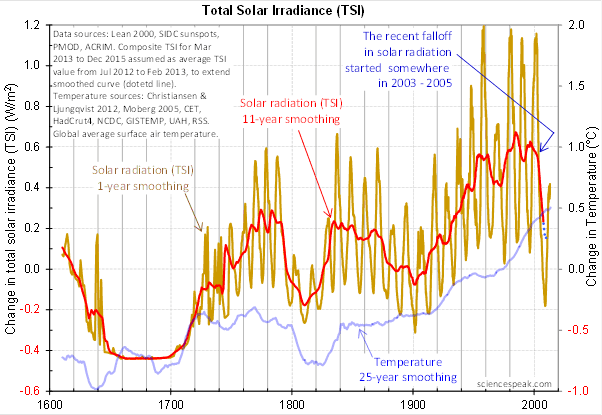
 Figure 3. David Evan’s graph of TSI (gold line), along with a centered 11-year moving average of the TSI data (red, with dotted blue extension), and a 25 year unspecified smooth of temperature, presumably a trailing average (blue line). (Click to enlarge)
Now, as you can see, the bright red line basically falls off the edge of the earth around 2004. The note says “The recent falloff in solar radiation started somewhere in 2003-2005″.
However, a look at both the SORCE and the CERES data shows no such “falloff in solar radiation”, neither precipitous nor otherwise. In fact, both datasets agree that by 2013 the TSI was well above the level in mid-2004.
Since there is no fall in the underlying data of any kind, why does the red 11-year average line show abrupt cooling starting around 2004?
The answer lies in the various problems with the graph.
• The TSI data is a splice of three datasets, with two of them showing the post-2000 period. This is a huge source of potential error in itself. However, it gets worse.
• One of the spliced datasets is the Lean TSI reconstruction, an outdated dataset that the authors of the reconstruction themselves admit is inaccurate.
• Another is the PMOD dataset. It is known to be reading low by 0.2 W/ms at the solar minimum, introducing a spurious apparently strong recent “cooling” where none exists.
• The 11-year centered average is an extremely bad choice for a filter for sunspot/TSI data. Because the solar cycle varies both longer and shorter than 11 years, at times the 11-year average actually reverses the sense of the data, converting peaks into valleys and valleys into peaks. Look at the period from 1760-1800 in Figure 3, for example. What is happening is that the frequency data is getting strongly aliased into the amplitude data. As a result, the average can end up far from the reality, particularly at the ends of the dataset.
For another example, look at the period just after 1740 in Figure 3. The 11-year average takes a huge vertical jump … but meanwhile back in the real word, the TSI itself is not rising at all. It is falling. Clearly, the large vertical jump in the red line is totally spurious.
• The TSI data has had about 900 days of “data” added to it using an arbitrarily chosen value. This is shown by the blue dots which indicate a continuing drop in the temperature.
So regarding the question of why the red line is acting so strangely, the answer is that we have a perfect storm of spliced data, bad data, arbitrary “data” added to the spliced bad data, and an extremely poor filter choice.
And as a result, the red line doesn’t represent reality in any shape or form. There is no precipitous drop in TSI starting around 2004. It doesn’t exist. Sure, the 11-year average says clearly that there is a huge drop starting around that time … but the actual data says something entirely different, as shown in Figures 1 and 2.
Now, in the heat of the moment Leif described the red line as being “almost fraudulent”. I think this was an over-reaction, but perhaps an understandable one. After all, if the red line were flipped over vertically it would make a lovely hockeystick, and if someone claimed warming was coming based on that hockeystick, people would call them alarmists … and calling someone an alarmist is certainly a close relative of calling them “almost fraudulent”.
However, my guideline is, never ascribe to malice what is adequately explained by error and misunderstanding. So I do not call their red line fraudulent, nor did I do so in the original discussion. Instead, I say that it is an error resulting from a misunderstanding. In any case, let me suggest that we leave out all ascription of motive and intent, that goes nowhere, and that we return to the science.
A more scientifically neutral description of the red line is that it is highly inaccurate and potentially misleading, because the apparent drop starting in 2003-2005 is simply an artifact of a combination of bad data and bad filtering.
Finally, to the degree that David Evans’ model predicts future cooling based on the red line, it is already falsified.
That is what I was trying to say, and I believe (subject to correction) that was what Leif was pointing out as well.
In closing, I will endeavor in this thread to keep my comments on as scientific a basis as possible, to avoid any personal references, and to not ascribe motive or intent. I request that everyone do the same. Many toes have already been stepped on in this discussion. Let’s see if we can simply discuss the science.
My best to all,
w.
VERY IMPORTANT: It is important in general, and in this discussion in particular, that you QUOTE THE EXACT WORDS THAT YOU DISAGREE WITH. Note that this doesn’t mean just referencing their entire comment. Quote the exact words of their comment that you think are in error, and tell us why you think those words are wrong. If you do not quote the exact words that you disagree with, none of us will know what you are referring to … and out of such misunderstandings grows animosity and misunderstanding.
Finally, please don’t delve into the rights and wrongs of what has happened in the previous discussions. I am not interested in the slightest in ascribing blame or responsibility. I have accepted my own responsibility for my own actions and apologized for wherever I was over the line. What I or the others did in the past is a blind alley, so please confine your comments to the science, and as the saying goes, “Let the dead past bury its dead”.
Willis Eschenbach says:
July 17, 2014 at 5:04 pm
I meant that we have no evidence of an accumulated effect over decades, not over months.
w.
———————
The oceans have been accumulating about 0.4 * 10^22 joules/year of energy over at least 4 decades now. Then, we have the slow energy accumulation which occurred as the last ice age was ending which lasted for 7,000 years.
So, the Earth can and does accumulate and drawdown energy.
Let’s say, the Sun was 4 W/m2 lower in the Maunder Minimum and the Little Ice Age. As it rose back up to todays levels over a few hundred years, the oceans and land slowly warmed up, equilibrating to the new high solar insolation levels.
Let’s say the oceans/land were accumulating 0.3 * 10^22 joules/year of energy over this period (a similar rate to what they have been accumulating in the last 4 decades).
Over 300 years, the oceans warm 0.4C, not unlike what is assumed to have occurred. I think that is a physically reasonable explanation.
Golly, if this is Willis’ idea of “mending fences” I’d hate to see what is his idea of blowing them up is.
He claims to apologise, while leaving out the essential element of saying what he is apologising for. This is a standard trick … “if anything I said offended you…” etc.
Then, when people call him on it, he discounts their opinions because (even though he admits that they may have good reasons for it), they do not use their real names.
Then, a couple of them come out with their real names. Suddenly, it’s not their anonynminity, it’s that they are the “apology police”.
Then, he denies that using a “nym” means that he discounts what people say, after spending several rants, here and on other posts, saying the opposite.
Accusing Evans of being just like Michael Mann was a bridge too far for a lot of people. Utterly scurrilous.
And yes, the New Hemingway, the great literary stylist, your use of “wroth” was both pretentious and grammatically illiterate.
Suggest that you stick to the travelogues in future – although I notice that they are not getting as many comments as the recent (and far more interesting and relevant) one on wine corks.
Is “sval” does not mean the Danish “swallows”?
Name Abbreviation Wavelength range
(in nanometres) Energy per photon
(in electronvolts) Notes / alternative names
Ultraviolet A UVA 400 – 315 nm 3.10 – 3.94 eV long wave, black light, not absorbed by the ozone layer
Ultraviolet B UVB 315 – 280 nm 3.94 – 4.43 eV medium wave, mostly absorbed by the ozone layer
Ultraviolet C UVC 280 – 100 nm 4.43 – 12.4 eV short wave, germicidal, completely absorbed by the ozone layer and atmosphere
Near Ultraviolet NUV 400 – 300 nm 3.10 – 4.13 eV visible to birds, insects and fish
Middle Ultraviolet MUV 300 – 200 nm 4.13 – 6.20 eV
Far Ultraviolet FUV 200 – 122 nm 6.20 – 10.16 eV
Hydrogen Lyman-alpha H Lyman-α 122 – 121 nm 10.16 – 10.25 eV spectral line at 121.6 nm, 10.20 eV
Extreme Ultraviolet EUV 121 – 10 nm 10.25 – 124 eV ionizing radiation, completely absorbed by the atmosphere
Vacuum Ultraviolet VUV 200 – 10 nm 6.20 – 124 eV strongly absorbed by atmospheric oxygen, though 150–200 nm wavelengths can propagate through nitrogen
hunter says:
July 18, 2014 at 4:26 am
Anonymity is actually good: It allows the ideas to flow without risk to the one making the idea.
Sharing ideas should not be at the cost of one’s job, social harassment, or worse.
Anonymity is a part of the right to privacy and frankly it raises warning flags when any group or person demands that there be no anonymity or they will reject (or worse) the one pushing the idea as well as the idea itself.
==============
Well said.
I don’t care who makes a point. Either the point is valid or it is not. The fact that there is or is not a name attached to a point is totally irrelevant. One should play the ball (the point made) and not the man (the person making the point).
Ren, thanks for the info. on UV light .
The net work of the solar magnetic field can cause a further drop in TSI regardless of if sunspots are present or not.
http://www.bing.com/search?q=solar+magnetic+network+and+tsi&form=DLRDF8&pc=MDDR&src=IE-SearchBox
Vey informative article.
The Hermit
As much as 1%? It’s interesting.
Event probabilities 18 Jul-20 Jul
Class M 01/01/01
Class X 01/01/01
http://www.swpc.noaa.gov/forecast.html
Bill Illis said:
“Let’s say, the Sun was 4 W/m2 lower in the Maunder Minimum and the Little Ice Age”.
Hi Bill.
Better to say that the proportion of solar energy reaching the surface was 4Wm2 lower in the Maunder minimum.
That brings you into line with the suggestion from many of us, including David Evans, that some solar characteristic other than simple TSI changes global cloudiness and albedo.
When Willis Eschenbach said, “I fear I waxed wroth”, he was being neither pretentious nor ungrammatical. Johanna is incorrect on both counts. He was using the Anglo-Saxon adjective “wroth”, which is to the noun “wrath” what “angry” is to “anger”. And this apparent archaism, like so many Anglo-Saxon usages, is still in quite frequent use in Britain today. It will be found, for instance, in the Jeeves stories of P.G. Wodehouse.
Bill Parsons wins the laurel wreath for best comment in this thread. He writes: “‘I fear I waxed wroth.’ Who is ‘Wroth’?”
The Hermit says:
July 18, 2014 at 6:48 am
This is a bit off-topic, but the sunspot number for the day has dropped to 0:
That seems like it would be a very rare occurrence during a solar maximum year. Is it a rare as it would seem?
For weak cycles this happens. A good example is cycle 14.
Bill Illis says:
July 18, 2014 at 6:51 am
Let’s say, the Sun was 4 W/m2 lower in the Maunder Minimum
Except that there is no evidence for such a large difference. It is much more likely that the difference is smaller than 1 W/m2.
ren says:
July 18, 2014 at 7:00 am
Is “sval” does not mean the Danish “swallows”?
Svalgaard means ‘swallow yard’
Date: Thu, 17 Jul 2014 05:04:56 +0000 To: johnson_nc5@hotmail.com
Changes in ozone due to a decrease of UV radiation.
http://www.esrl.noaa.gov/gmd/odgi/odgi_fig3.png
I never said a single word about anonymous posters being “unworthy of [my] consideration”. Please quote what you object to…
…
However, call me crazy, but I refuse to take advice regarding the manner in which I should take responsibility for my own words…
I don’t pay attention to people who sit on the sidelines with nothing to lose…
why should I pay any attention to your opinion about public apologies?…
So you’ll excuse me if I discount your opinion …
Nor is it a judgement on anonymity…
I fear your opinions on the manner in which I should take responsibility for my words is of little interest to me…
…
This is all in one post… god Anthony, get rid of this lunatic. Even the travelogues are pedantic and self-serving, and (imo) just clutter up this blog.
Why would one make a PUBLIC apology and then waste so much breath on those who he claims to not care about? Nuts. Just apologize personally to those involved and get on with the science.
Your target audience used to be people like myself, who may not have the scientific credentials to understand it all, but want to keep up with the discussion and learn things. When I was first interested in climate, I would read Real Climate and WUWT, among others, and quickly saw the difference in tone and inclusiveness. The quality of this blog has really declined, and I don’t think you will be reaching (or impressing) as many new-comers as you might once have.
Some here are stuck on Evans’ graph depicting a set of TSI data series that he has smoothed with an 11-year box car filter. They all demonstrate an apparent drop in TSI. These folks are believing this graph of a statistical maneuver over what the raw unfiltered data and the running averaged data is showing. So let me offer a suggestion on how to take the rose colored glasses off. To Steve as well as others.
Steve from Rockwood says:
July 18, 2014 at 4:12 am
“Wouldn’t it have been more informative to deconstruct Jo Nova’s graph?
http://jonova.s3.amazonaws.com/graphs/solar-radiation/tsi-datasets-ls.gif
Sure looks like a sudden drop in TSI in recent years.”
This issue of applying a statistical maneuver that seems to show your a-priori bias (IE it shows what you think is happening) is a normal part of research but it can result in a type I error (false positive, as in yes there is an affect when actually there is not), or a type II error (false negative, as in no there is no affect when actually there is).
In biased research, done sometimes without knowledge of statistical artifacts or undo bias, the researcher continues to apply statistical maneuvers to the data until he/she gets an analysis that supports his/her belief about observed phenomena. This can lead to a type I error. Or the opposite happens, the researcher applies a statistical maneuver that is not capable of finding regular signals inside noise. This can lead to a type II error. Notice that I said, “done sometimes without knowledge of statistical artifacts or undo bias”. The key here is to understand the motives of the researcher. Most often the motives are good but the understanding of statistics and the power of their own bias is very poor. Sometimes the motives are not good and the researcher tries to make such errors on purpose.
It is not good to be over-enthusiastic about finding evidence for a new paradigm, or the reverse, refuting someone’s suggested new paradigm.
Notice that the Evans’ graph takes different data series and smoothes them with an 11 year box car filter. If you were to take the same derived and number of noisy random raw data sets, obtained from white noise, and smoothed them with an 11 year box car filter, I wonder if you would get the same kind of sudden change at the ends? I am thinking yes.
If that were the case, you would have to say that the graph’s depiction of TSI decrease was an artifact of the statistical maneuver, not an actual TSI measurement.
The warning here is to thoroughly know the ins and outs of the statistical maneuver you are applying. I audited a graduate level introductory course in statistics (often done when your course load is full and your bank account is empty). It was enough of an education to know one should reverently enter into the world of statistics. Get an independent opinion from an expert statistician before you show your work in public. If you don’t you could be showing us your dirty underwear instead of what you think is a shiny new invention.
The Hermit says:
July 18, 2014 at 6:48 am
This is a bit off-topic, but the sunspot number for the day has dropped to 0:
That seems like it would be a very rare occurrence during a solar maximum year. Is it a rare as it would seem?
For weak cycles this happens. A good example is cycle 14.
http://www.leif.org/research/SC14-and-24.png
Yellow = daily values
Pink = 27-day means
Black = Yearly means
lsvalgaard means “farm swallows”. I greet.
Agnostic says:
July 18, 2014 at 12:41 am
Thanks for the question, Agnostic. I asked 1) over at JoNova’s blog in one of the 11 posts, 2) in the post here on “Notch model finally released, and 3) on this thread. If you want to find them, google “out-of-sample” in those locations, I can’t be bothered. This nonsense has consumed too much of my time already.
w/.
Steve from Rockwood says:
July 18, 2014 at 4:12 am
Sure looks like a sudden drop in TSI in recent years.”
No, there is no such ‘falling off a cliff’ drop: TSI now is higher than in 2003-2005 contrary to Evans’ claim [on which his whole edifice is built: http://www.leif.org/research/TSI_Composite_Kopp-with-TCTE.jpg
T Control says:
July 18, 2014 at 8:16 am
The quality of this blog has really declined
You are right about that, especially after that WUWT has been hijacked by Monckton and his ilk, sycophants, and minions.
TSI was off by .15% during the 2008-2010 lull more declines to come going forward.
IMF got down to around 4.0 that will also be lower going forward.
Well, Chris, if you can find a single person in a British pub (the few that are left) who has a clue what “waxing wroth” means, good luck.
“Waxing sick” might just rate, except that hardly no-one knows what “waxing” means, unless it relates to body hair removal.
Since P G Wodehouse died 40 years ago, and much as I love his work (I’m giving you beans here), his idioms are not exactly relevant to contemporary discourse.
Arthur Brown, who performed on a flaming cross in the 1960s, knew about “waxing wroth.”
Could I put in a bid for “waning meekth?”
Sorry if I’ve offended anyone, which I may have done. It’s my “passionate” personality.
I apologise in advance. But as to specifics – who are you, the Apology Police?
Pamela Gray says:
July 18, 2014 at 8:20 am
Notice that Mr. Evans stops his 11 year centered moving average (red line) 5 1/2 years before the end of his data, therefore there are no end effects.
After that, in order to answer the question “what happens if the current low solar activity continues?” He extends his data set with the average of a portion of the most recent data to produce the blue dots that give so many here so much consternation. Mr Evans describes what he is doing in his analysis. It’s only necessary to read what he says and to accept what he says rather than trying to impute some nefarious motive to have a very good idea of what he is actually doing.
Below I made a list of climatic factors which favor cooling. I am in agreement and many in the scientific community (as was evidenced during the recent climatic summit ) are in agreement with the points I am trying to make about the climatic system of the earth using current /historical data to back it up with not to mention many recent new research papers.
This current solar situation we are now in is going to make matters much clearer going forward.
Climate factors all favor coolng on balance
1.Climate Factors Colder Overall When Viewed Objectively
2.Milankovitch Cycles- favorable for glaciation presently and for the next 4000 years.
3.Solar Activity – favorable for colder temperatures post 2005 and continuing until at least 2030.
Solar activity will be high favorable for cooling once the weak maximum of solar
cycle 24 ends, Will be in the very near future.
4.Ocean/Land Arrangements- highly favorable for glaciation and colder temperatures presently
and well into the future.
5.Solar Secondary Effects- neutral for cooling during the weak maximum of solar cycle 24 will
become highly favorable going forward when solar cycle 24 maximum
ends.
6.Lunar – neutral. I don’t see a strong connection with this factor hence neutral.
Commentary welcomed.
7.CO2 – unknown. Higher then when past glaciations were initiated through
Milankovitch Cycles but unknown if glaciation would have occurred
back then if CO2 concentrations would have been higher.
8.Ice Dynamic – unfavorable ,since most of the large ice sheets form the last N.H.
ice age are gone. Still Greenland is a source.
9.Earth Magnetic Field- neutral but will be heading toward favorable as this keeps weakening
gong forward into the future.
10.When one looks at this picture presented in the above I think it is safe to say the climate is not heading for warmer times but rather toward colder times and the possibility of a return to glacial conditions sometime in the not very distant future is possible.(0- next 4000 years )
What doesn’t kill you, improves you. This solar business has been simmering in genteel fashion for quite some time and was overdue for a hard workout. The over-enthusiastic and poorly supported biased comments are made much more clear under the glaring light and bolded statements than under soothing candle light and soft whispers. Each camp seems over tolerant of its population of biased research, no matter the degrees held or peer reviewed status of the researcher. It all has the rancid taste of gamesmanship to me.
I give no quarter to either side of the CO2 or Solar driver debate with natural intrinsic variability in the middle. Why? We haven’t fully understood or investigated the middle. How then can we begin to cheerlead these outside influences, let alone recommend policy?????
I say rankle on about the speculations, proposals, and papers but leave the personal ad hominems behind. There is enough in just the CO2 and Solar “work” to tear apart.