Guest Post by Willis Eschenbach
Recently there have been a number of accusations and bad blood involving myself, David Evans, Joanne Nova, Lord Christopher Monckton, and Leif Svalgaard. Now, I cannot speak for any of them, but on my part, my own blood ended up mightily angrified, and I fear I waxed wroth.
However, I see no point in rehashing the past. What I want to do is to return to the underlying scientific questions. In that spirit, I apologize sincerely and completely for wherever I put in “something extra” in the previous discussion. In Buddhism, there’s a concept called “something extra”, and one is enjoined to avoid putting in “something extra”.
It is explained in the following way:
If I say “I am angry” that is simply a true statement.
But if I say “You made me angry”, that is something extra.
So I ask any and all of you to please accept my sincere apologies for whatever what I said that was something extra, so that we can move past this difficult time and get back to discussing the science. Both sides have legitimate grievances, and I am happy to make the first move to get past all of them by apologizing to all of you for whatever my part was in the bad blood. I hope that the other participants accept my apology in the spirit of reconciliation in which it is offered, and that we can move forwards without rancor or recriminations.
Regarding the science, let me go back to the original question, and see what I can do in the way of making my claims in a more Canadian manner. I’ll start by looking at the recent record of the “TSI”, the total solar irradiance:
 Figure 1. Monthly total solar irradiance as measured by the CERES satellite. Vertical blue line shows mid-2004.
Now, if you don’t like the data from the CERES satellite, here’s the SORCE satellite data:
 Figure 2. Daily total solar irradiance as measured by the SORCE satellite. Vertical red line indicates mid-2004. SOURCE
Note what is happening in both graphs after mid-2004 (vertical lines in both plots). As in every solar cycle, the TSI declines somewhat, and bottoms out. Then, it starts to rise again. And by the end of the datasets, in both cases the TSI is higher that it was in 2004.
So what was the scientific dispute all about, the discussion that underlies all of the bad feelings?
It revolved around the following graph from David Evans, referenced by both Leif Svalgaard and Lord Monckton, showing the basis of his predicted upcoming global cooling :
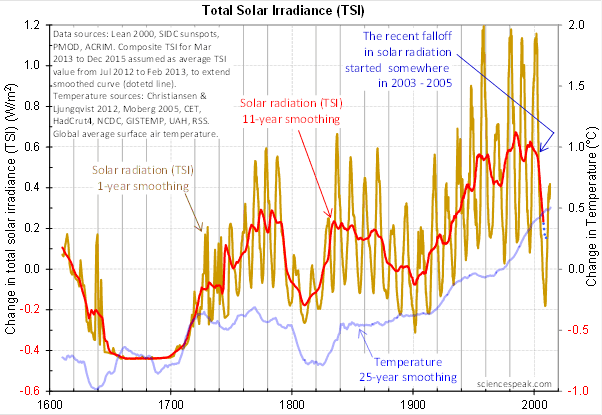
 Figure 3. David Evan’s graph of TSI (gold line), along with a centered 11-year moving average of the TSI data (red, with dotted blue extension), and a 25 year unspecified smooth of temperature, presumably a trailing average (blue line). (Click to enlarge)
Now, as you can see, the bright red line basically falls off the edge of the earth around 2004. The note says “The recent falloff in solar radiation started somewhere in 2003-2005″.
However, a look at both the SORCE and the CERES data shows no such “falloff in solar radiation”, neither precipitous nor otherwise. In fact, both datasets agree that by 2013 the TSI was well above the level in mid-2004.
Since there is no fall in the underlying data of any kind, why does the red 11-year average line show abrupt cooling starting around 2004?
The answer lies in the various problems with the graph.
• The TSI data is a splice of three datasets, with two of them showing the post-2000 period. This is a huge source of potential error in itself. However, it gets worse.
• One of the spliced datasets is the Lean TSI reconstruction, an outdated dataset that the authors of the reconstruction themselves admit is inaccurate.
• Another is the PMOD dataset. It is known to be reading low by 0.2 W/ms at the solar minimum, introducing a spurious apparently strong recent “cooling” where none exists.
• The 11-year centered average is an extremely bad choice for a filter for sunspot/TSI data. Because the solar cycle varies both longer and shorter than 11 years, at times the 11-year average actually reverses the sense of the data, converting peaks into valleys and valleys into peaks. Look at the period from 1760-1800 in Figure 3, for example. What is happening is that the frequency data is getting strongly aliased into the amplitude data. As a result, the average can end up far from the reality, particularly at the ends of the dataset.
For another example, look at the period just after 1740 in Figure 3. The 11-year average takes a huge vertical jump … but meanwhile back in the real word, the TSI itself is not rising at all. It is falling. Clearly, the large vertical jump in the red line is totally spurious.
• The TSI data has had about 900 days of “data” added to it using an arbitrarily chosen value. This is shown by the blue dots which indicate a continuing drop in the temperature.
So regarding the question of why the red line is acting so strangely, the answer is that we have a perfect storm of spliced data, bad data, arbitrary “data” added to the spliced bad data, and an extremely poor filter choice.
And as a result, the red line doesn’t represent reality in any shape or form. There is no precipitous drop in TSI starting around 2004. It doesn’t exist. Sure, the 11-year average says clearly that there is a huge drop starting around that time … but the actual data says something entirely different, as shown in Figures 1 and 2.
Now, in the heat of the moment Leif described the red line as being “almost fraudulent”. I think this was an over-reaction, but perhaps an understandable one. After all, if the red line were flipped over vertically it would make a lovely hockeystick, and if someone claimed warming was coming based on that hockeystick, people would call them alarmists … and calling someone an alarmist is certainly a close relative of calling them “almost fraudulent”.
However, my guideline is, never ascribe to malice what is adequately explained by error and misunderstanding. So I do not call their red line fraudulent, nor did I do so in the original discussion. Instead, I say that it is an error resulting from a misunderstanding. In any case, let me suggest that we leave out all ascription of motive and intent, that goes nowhere, and that we return to the science.
A more scientifically neutral description of the red line is that it is highly inaccurate and potentially misleading, because the apparent drop starting in 2003-2005 is simply an artifact of a combination of bad data and bad filtering.
Finally, to the degree that David Evans’ model predicts future cooling based on the red line, it is already falsified.
That is what I was trying to say, and I believe (subject to correction) that was what Leif was pointing out as well.
In closing, I will endeavor in this thread to keep my comments on as scientific a basis as possible, to avoid any personal references, and to not ascribe motive or intent. I request that everyone do the same. Many toes have already been stepped on in this discussion. Let’s see if we can simply discuss the science.
My best to all,
w.
VERY IMPORTANT: It is important in general, and in this discussion in particular, that you QUOTE THE EXACT WORDS THAT YOU DISAGREE WITH. Note that this doesn’t mean just referencing their entire comment. Quote the exact words of their comment that you think are in error, and tell us why you think those words are wrong. If you do not quote the exact words that you disagree with, none of us will know what you are referring to … and out of such misunderstandings grows animosity and misunderstanding.
Finally, please don’t delve into the rights and wrongs of what has happened in the previous discussions. I am not interested in the slightest in ascribing blame or responsibility. I have accepted my own responsibility for my own actions and apologized for wherever I was over the line. What I or the others did in the past is a blind alley, so please confine your comments to the science, and as the saying goes, “Let the dead past bury its dead”.
http://www.mdpi.com/2076-0787/3/3/299/pdf
“And there are those who still believe in this project. They excoriate others who obstruct and obscure this pure guiding light of rationality—a position adopted, for example, by Naomi Oreskes and Erik Conway in their recent book Merchants of Doubt”
Willis says
“It’s just what happens when you decide to become anonymous—you lose credibility.”
Maybe better than losing ones job?
ren says:
July 17, 2014 at 10:33 pm
lsvalgaard what is your model changes the TSI with a further decrease in solar activity? Probably since 2003, nothing will change? All evenly?
As solar activity can’t be less than nothing, TSI can’t be less than when we had no solar activity, e.g. in 2009
just exactly what do you mean ‘does not take responsibility for your words’?
i want to see palsied parsing twist that nonsense into an objet d’art
did you ever work the dunk tank at the carnival?
Willis’s basic problem seems to be this: “The 11-year smooth shows a drop in 2003-2005. The actual satellite data, despite going back well before 2003-2005, shows no such drop.”
The problem seems to be that Willis thinks that the 11 years has something to do with the solar cycle. (And so he may be disappointed when the result of that smoothing isn’t similar to the solar cycle.) I took a quick glance at joannenova’s website and this is my interpretation:
(1) TSI has an influence on earth’s average temperature. (2) The influence lasts for about 11 years and is roughly constant for those 11 years. (3) Then the influence roughly drops to zero. Given those assumptions, an 11-year square filter is perfectly approporiate. And it’s not unheard of for physical systems to exhibit this sort of behavior. A handful of resisotrs and capacitors can make a nice approximation. Or a collection of pipes of various lengths and diameters, with fluid flowing through them, will do as well.
I’m too busy to debate this, and it seems like it’s been well hashed already anyway. A good reference is Statistical Theory of Signal Detection by Carl W. Helstrom. This is the book the CAGW crowd should have used. It seems to me that there will never be enough data to confirm the (statistical!) theories we’re talking about, at least in our lifetimes. What’s needed is a model so precise that it’s good enough to predict next year’s rainfall. Then you will start nailing down its accuracy. Right now we don’t even know if there will El Nino in six months.
@Willis:
Finally, I asked some weeks ago for the results of the out-of-sample tests that Joanne had said were already done at that time. They still have not been revealed. I asked again in the previous thread for those tests. No reply. I asked in this thread for those test results … nothing.
Where did you “ask” for the results of the out-of-sample tests? I know you have mentioned it here.
Have you emailed Dr Evans directly to ask for them?
lsvalgaard
Can you provide data (in watts) what was the amount of UV radiation up to 120 nm in 2001 and 2013?
Sorry, whether Svalbard is a Dutch name?
Apologies have varying weights. There are two kinds of weight; absence of either or both leaves conversational fluff or ploys.
Repair Acceptance of responsibility for past actions and damages, including reparations, restitution, or amends. The intent is here to undo past harm.
Reform Commitment to avoid repetition, an implicit or explicit promise to act differently “going forward”.
Anything else is an attempt to at least temporarily gain the benefits of true apology without doing the necessary work.
Indian Ocean
Latitude 10N to 10S
Longitude 50E to 100E
Sea Surface Temperature:
http://www.esrl.noaa.gov/psd/cgi-bin/data/timeseries/timeseries1.pl
Spectral components
5 & 5.6 years at 6% & 3.6% (ENSO)
11.0 years at 4% (Sunspot cycle)
22.0 years at 3.7% (Solar magnetic cycle)
All other components below 2.4% bar one at 8.6yr @ur momisugly 3%
(graph available but no link will be posted unless requested by AW)
Will Nitschke says:
“I’m not entirely sure why Bill Illis’s point is inconsistent with your ideas on a thermostatically controlled climate system. A thermostatically regulated climate would suppress cyclical ups and downs, yet this would not rule out a possible gradual shift in the the thermostats preferred setting over time, perhaps.”
I think there is fairly good evidence that tropics have quite strong -ve f/b which provide pretty good thermal regulation. However, tropical climate, specifically tropical storms , that Willis refers to explain the phenomenon, does not apply globally. Though due to the major ocean gyres there is a degree of mixing which allows the tropics to help stabilise adjacent regions.
This I demonstrated with the following series of graphs ( follow the links in text ):
http://climategrog.wordpress.com/?attachment_id=310
This would mean that the planet is not totally immune to variations in radiative budget. Here is the tropical reaction to Mt Pinatubo:
http://climategrog.wordpress.com/?attachment_id=884
That seems a more reasonable idea that a strong thermal control with shifting “preferred settings”.
Wouldn’t it have been more informative to deconstruct Jo Nova’s graph?
http://jonova.s3.amazonaws.com/graphs/solar-radiation/tsi-datasets-ls.gif
Sure looks like a sudden drop in TSI in recent years.
Willis,
Thanks. Your reply does fulfill what I predicted in the post.
My rephrasing of your point was accurate, and you repeated it in your reply.
Your obsession with “skin the game” is interesting.
Do you likewise reject any book written pseudonymously?
Best wishes,
‘hunter’
I hope it is now very clear to all that Dr Evans has neither been “almost fraudulent” nor “fabricated” any data, and that he is not guilty of “bad intent”. Allegations of this sort have no place in civilized scientific discourse. If a fraud had been perpetrated, the appropriate place to talk about it would have been at the police station. Certain commenters here have wilfully persisted in trying to blacken Dr Evans’ name either by outright allegations of fraud or fabrication or by the repellent and near-equally damaging device of pretending that such baseless allegations were “understandable”, or that “bad intent” seemed to be indicated when, plainly, it was not.
One of these commenters ingeniously persists in trying to give the impression that Dr Evans had fabricated 900 days’-worth of data, when Dr Evans has been entirely explicit about his having merely given an indication, that formed no part of the dataset upon which the smoothed TSI curve had been plotted and was differentially marked on his graph, that the fall in TSI shown by the 11-year smoothing was about to come to an end. This was entirely innocent, and the fact that a commenter persists in moaning about it does not in any way alter its blamelessness. That commenter has been altogether too eager to find fault pettily where none exists.
That commenter also seems not to understand how 11-year smoothing works. In order to establish a data point on an 11-year-smoothed curve, it is essential to have 5.5 years’ data either side of that point. Including those data makes it plain how the 11-year smoothing correctly shows a sharp decline. Omitting some of those data, as that commenter did, had the effect (one hopes inadvertently) of falsely concealing the basis on which the fall in 11-year-smoothed TSI had been determined. For those who may not have followed the TSI record, the peak of the previous cycle was noticeably above the peak of the present cycle. The decline in TSI, therefore, appears to be continuing, as several solar physicists have predicted. If it continues thus to decline, it is possible that the reduction in TSI over a long enough period may overwhelm the warming signal from greenhouse gases and cause cooling. Dr Evans thinks that is likely, and he is in good company in thinking that, though it is above my pay-grade to determine whether he is right, except by waiting and seeing.
That commenter has continued vexatiously to complain that Dr Evans has not published his full model and, in particular, that he has not published the basis for his parametrizations. He says he has asked for that information, but stops short of saying he has written to Dr Evans and asked for it politely. Certainly, he cannot have examined the model very closely before complaining, for the parametrizations are sufficiently explained in the material that has already been released.
Nor do I, with an admittedly limited understanding of modeling, understand why that commenter is asking for “the code” associated with the parametrizations. Not all parametrizations require code. Frankly, if that commenter genuinely wishes to obtain these and other details of Dr Evans’ work, rather than trying to blacken his name by demanding them very publicly and impolitely here, in a malevolent and carping tone, his first port of call is surely Dr Evans himself.
However, if I were Dr Evans I should be most disinclined to reply unless and until that commenter had published – here and at Jo Nova’s excellent website – an unreserved, unqualified and full apology for and retraction of all remarks he had made in support of the allegations that Dr Evans had acted “almost fraudulently” or had “fabricated” data or had unreasonably withheld it. Dr Evans is under no legal, contractual, moral, or other obligation to supply anything to anyone who has behaved with such persistent and inexplicable rudeness and malevolence as that commenter has.
That commenter has unwisely accused me of having attempted to convince him that, in regard to Dr Evans’ project, “all is revealed”. That commenter has a rule that his words must be cited accurately. What is sauce for the goose is sauce for the gander. I had in fact explicitly stated that further material was to be released. Indeed, it would probably have been released long before now if that commenter, who has behaved lamentably throughout, had not diverted Dr Evans into having to provide replies to his stream of venomously-expressed and ill-founded allegations.
That commenter says he is not in a position to falsify Dr Evans’ work. In that, at least, he speaks the truth. In attempting to falsify it he would be as much out of his depth as me. He would, however, be at a further disadvantage, since his persistence in maligning Dr Evans in the most intemperate tone indicates that he bears a vicious and unreasoning grudge against him, for reasons that I cannot fathom and in which no one but that commenter is in the least interested. Yet he persists in maintaining that he has not mounted a campaign against Dr Evans. Well, it is apparent to an increasing number of commenters here that that is exactly what he has done. He must forthwith desist.
That commenter further falsely states that Dr Evans had “flatly refused” to make his data and code available. This is an outright falsehood. Dr Evans has repeatedly stated that he will make everything available, and has made the greater part of it available already, which would give any reasonable observer some confidence that the remainder will be made available just as soon as Dr Evans is ready.
That commenter further complains that Dr Evans has not published what the commenter thought he was going to publish. He suggests, for instance, that Dr Evans had not originally included the influence of the bomb-tests in his work, but had included it subsequently. In fact, the bomb-tests were included in the work long before Dr Evans made any part of it public, and I can find nothing in what he has published to date to give anyone a reasonable excuse for assuming that he had not included it all along.
In any event, since Dr Evans had invited comments on his approach before he published his full model, he would surely have been well within his rights to take account of those comments that were constructive, rather than artfully malicious, before finalizing and publishing his work. There is nothing in the least unreasonable in that, and it has long been the practice among true men of science rather than amateurs with a grudge. It is my own practice to consult relevant experts, and sometimes to consult more widely, before submitting papers for publication in the learned journals. That way, errors that might otherwise have been submitted are eliminated at the earliest possible stage. Where on earth is the harm in that?
That commenter finally presumes to give me legal advice. With respect, that is not a matter for him, nor am I aware that he has legal qualifications. I had not until recently realized the extent to which websites all over the place were accusing me of falsehoods and fabrications of which I was not guilty. One of these accusations was so effective that even our kind host here was initially taken in by it. However, unlike the commenter who has made such an uncommon nuisance of himself here, he quietly investigated the allegation in question, found it to have been entirely unmeritorious, and was good enough to publish the results of his researches. It will now be necessary for me to have that and other libels retracted and apologized for, so that no one else is taken in.
My recommendation to the commenter who has so thoroughly lost his temper here is that should now back off for a week or two of reflection, and then bring his campaign against Dr Evans to an end with a proper apology.
Finally, I should myself apologize to those who must be baffled by the intrusive prolixity of these exchanges. However, Dr Evans is a good friend, who has been working patiently on his theory for many years and, after much thought, has decided to publish it in outline first and then in detail. In due course, once he has taken the voices, I expect he will submit a series of papers to the reviewed journals, where they will be subjected to the well-established process of scrutiny by suitably-qualified scientists both before and after publication. I have intervened here only in an attempt to restrain the persistent and perplexing calumnies that have been directed at him, so that he gets a fair chance to publish without his name having been baselessly blackened. Geld verloren, nichts verloren. Mut verloren, alles verloren.
Anonymity is actually good: It allows the ideas to flow without risk to the one making the idea.
Sharing ideas should not be at the cost of one’s job, social harassment, or worse.
Anonymity is a part of the right to privacy and frankly it raises warning flags when any group or person demands that there be no anonymity or they will reject (or worse) the one pushing the idea as well as the idea itself.
Extreme example: The USSR and its obsession with controlling debate. Anonymity was criminalized. Do people feel better knowing that the NSA can at will strip away any privacy a person has in their communications?
People lose their *jobs* over this climate debate.
Willis is sort of bullet proof (or so he thinks) in this- by the way that is a metaphor, so please let’s not get into hysterics- but not all of us are.
Does that make us less sincere or credible?
ren says:
July 18, 2014 at 1:31 am
Can you provide data (in watts) what was the amount of UV radiation up to 120 nm in 2001 and 2013?
The total amount is very small 0.005 W/m2 with a variability of 100% from minimum to maximum, so less from one maximum to the next. But all of this radiation is completely absorbed by the atmosphere above 100 km, so is not important for the climate.
Sorry, whether Svalbard is a Dutch name?
Svalgaard is a Danish name.
lsvalgaard says:
”The graph shows a full solar cycle [12 years]. Each year is plotted separately, so there are 12 curves [on top of each other].”
Ok, the title didn’t really convey the content to me, that’s all.
”Actually not, the difference is enormous [almost 100 W/m2] as the date where we are farthest from the Sun varies from July [now] to January [during a glaciation].”
Not what? Look, we know the NH gets warmer in its summer than the SH gets in its summer even though it receives almost 100 W/m2 less energy. When this less energy is in NH winter we get glacial conditions (most of the time). The difference between the glacial and interglacial is only about 10K (rounding up) from an “enormous” TSI variation. Yet I’m to believe a paltry 3.7 W/m2 causes a 3K increase in temperature. Not buying it.
lsvalgaard
Thank you very much.
Sorry, I meant the Svalbard archipelago near Norway.
ren says:
July 18, 2014 at 5:30 am
Sorry, I meant the Svalbard archipelago near Norway.
Svalbard is Old-Norse and means some like ‘the cold coast or shore’. The Dutch name was Spitsbergen.
– – – – – –
Leif,
Speaking of Danish . . . I still owe you another bottle of Danish aquavit in appreciation for receiving an ongoing detailed solar education over many years from you here at WUWT . . .
(Anth0ny gets occasional paypal donations from me , you get aquavit. You have the better deal I think)
I’ll bring it over in the fall.
The education continues . . .
John
http://www.solen.info/solar/polarfields/polar.html
Polar fields as of July still not reversing at all. Ren what is your take on this?
For my part I think this is very significant and is pointing to weak conditions going forward.
Ren the UV light fluctuations as pointed out by Joe D’Aleo and many others play a major role in the atmospheric circulation pattern by promoting blocking.
This was evident in the 2008-2010 solar lull and evident in the past during the Maunder and Dalton minimums.
Historical data shows us the true story . Look for much more blocking to establish itself as this decade proceeds in response to this prolonged solar minimum, and very low UV light readings.
Notice how there is yet to be a temperature graph produced which shows the range of global temperatures INCREASING during a prolonged solar minimum period or the range in global temperatures DECLINING during a period of prolonged maximum solar activity.
Guess what the same thing is going to happen once again going forward into this decade. Global temperatures will be falling in response to weak solar conditions and the associated secondary effects.
What is being missed by many read below.
The point is the temperatures of earth will always vary even when solar output is constant, due to random, chaotic climate changes within the climate system of the earth. What solar variability determines is what range the temperatures of the globe will be in ,not the random temperature changes up/down once the climate is in a given climate regime.
Next one has to take into the account the initial state of the climate. How close to glacial if in interglacial and vice versa, which will determine how much of an influence GIVEN solar variability will have on the climate. Given solar variability effect on the climate , will always vary depending on what the initial state of the climate is at the time the sun is exhibiting variability. This is why solar/climate correlations tend to get obscure at times. The climate system has much noise in the system and unless solar activity changes from a distinct prolonged active to a distinct prolonged minimum phase of activity solar/climate trends are hard to see. The initial state of the climate again also obscuring the solar/climate connection at times.
This is why this period of time is so great. We have switched from an very active sun last century to a very quiet sun post 2005 and the given state of the climate is such that it should respond to solar variability to one degree or another.
Look for exciting times ahead including the winter of 2014-2015 .
http://www.ustream.tv/recorded/49739795
A must listen from the latest climate summit . Great information.
https://www.google.com/?gws_rd=ssl#q=lockwood+implicatins+of+recetn+low+solar+activity
This study confirms past studies on solar variability. Great read.
As Willie Soon has pointed out TSI data is not reliable. End of story.
This is a bit off-topic, but the sunspot number for the day has dropped to 0:
http://www.spaceweather.com/archive.php?view=1&day=18&month=07&year=2014
That seems like it would be a very rare occurrence during a solar maximum year. Is it a rare as it would seem?
Hopefully it’s not CO2’s fault. 😉