Guest Post by Willis Eschenbach
Recently there have been a number of accusations and bad blood involving myself, David Evans, Joanne Nova, Lord Christopher Monckton, and Leif Svalgaard. Now, I cannot speak for any of them, but on my part, my own blood ended up mightily angrified, and I fear I waxed wroth.
However, I see no point in rehashing the past. What I want to do is to return to the underlying scientific questions. In that spirit, I apologize sincerely and completely for wherever I put in “something extra” in the previous discussion. In Buddhism, there’s a concept called “something extra”, and one is enjoined to avoid putting in “something extra”.
It is explained in the following way:
If I say “I am angry” that is simply a true statement.
But if I say “You made me angry”, that is something extra.
So I ask any and all of you to please accept my sincere apologies for whatever what I said that was something extra, so that we can move past this difficult time and get back to discussing the science. Both sides have legitimate grievances, and I am happy to make the first move to get past all of them by apologizing to all of you for whatever my part was in the bad blood. I hope that the other participants accept my apology in the spirit of reconciliation in which it is offered, and that we can move forwards without rancor or recriminations.
Regarding the science, let me go back to the original question, and see what I can do in the way of making my claims in a more Canadian manner. I’ll start by looking at the recent record of the “TSI”, the total solar irradiance:
 Figure 1. Monthly total solar irradiance as measured by the CERES satellite. Vertical blue line shows mid-2004.
Now, if you don’t like the data from the CERES satellite, here’s the SORCE satellite data:
 Figure 2. Daily total solar irradiance as measured by the SORCE satellite. Vertical red line indicates mid-2004. SOURCE
Note what is happening in both graphs after mid-2004 (vertical lines in both plots). As in every solar cycle, the TSI declines somewhat, and bottoms out. Then, it starts to rise again. And by the end of the datasets, in both cases the TSI is higher that it was in 2004.
So what was the scientific dispute all about, the discussion that underlies all of the bad feelings?
It revolved around the following graph from David Evans, referenced by both Leif Svalgaard and Lord Monckton, showing the basis of his predicted upcoming global cooling :
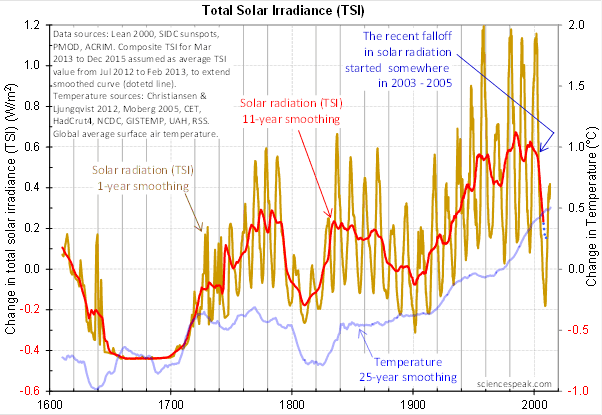
 Figure 3. David Evan’s graph of TSI (gold line), along with a centered 11-year moving average of the TSI data (red, with dotted blue extension), and a 25 year unspecified smooth of temperature, presumably a trailing average (blue line). (Click to enlarge)
Now, as you can see, the bright red line basically falls off the edge of the earth around 2004. The note says “The recent falloff in solar radiation started somewhere in 2003-2005″.
However, a look at both the SORCE and the CERES data shows no such “falloff in solar radiation”, neither precipitous nor otherwise. In fact, both datasets agree that by 2013 the TSI was well above the level in mid-2004.
Since there is no fall in the underlying data of any kind, why does the red 11-year average line show abrupt cooling starting around 2004?
The answer lies in the various problems with the graph.
• The TSI data is a splice of three datasets, with two of them showing the post-2000 period. This is a huge source of potential error in itself. However, it gets worse.
• One of the spliced datasets is the Lean TSI reconstruction, an outdated dataset that the authors of the reconstruction themselves admit is inaccurate.
• Another is the PMOD dataset. It is known to be reading low by 0.2 W/ms at the solar minimum, introducing a spurious apparently strong recent “cooling” where none exists.
• The 11-year centered average is an extremely bad choice for a filter for sunspot/TSI data. Because the solar cycle varies both longer and shorter than 11 years, at times the 11-year average actually reverses the sense of the data, converting peaks into valleys and valleys into peaks. Look at the period from 1760-1800 in Figure 3, for example. What is happening is that the frequency data is getting strongly aliased into the amplitude data. As a result, the average can end up far from the reality, particularly at the ends of the dataset.
For another example, look at the period just after 1740 in Figure 3. The 11-year average takes a huge vertical jump … but meanwhile back in the real word, the TSI itself is not rising at all. It is falling. Clearly, the large vertical jump in the red line is totally spurious.
• The TSI data has had about 900 days of “data” added to it using an arbitrarily chosen value. This is shown by the blue dots which indicate a continuing drop in the temperature.
So regarding the question of why the red line is acting so strangely, the answer is that we have a perfect storm of spliced data, bad data, arbitrary “data” added to the spliced bad data, and an extremely poor filter choice.
And as a result, the red line doesn’t represent reality in any shape or form. There is no precipitous drop in TSI starting around 2004. It doesn’t exist. Sure, the 11-year average says clearly that there is a huge drop starting around that time … but the actual data says something entirely different, as shown in Figures 1 and 2.
Now, in the heat of the moment Leif described the red line as being “almost fraudulent”. I think this was an over-reaction, but perhaps an understandable one. After all, if the red line were flipped over vertically it would make a lovely hockeystick, and if someone claimed warming was coming based on that hockeystick, people would call them alarmists … and calling someone an alarmist is certainly a close relative of calling them “almost fraudulent”.
However, my guideline is, never ascribe to malice what is adequately explained by error and misunderstanding. So I do not call their red line fraudulent, nor did I do so in the original discussion. Instead, I say that it is an error resulting from a misunderstanding. In any case, let me suggest that we leave out all ascription of motive and intent, that goes nowhere, and that we return to the science.
A more scientifically neutral description of the red line is that it is highly inaccurate and potentially misleading, because the apparent drop starting in 2003-2005 is simply an artifact of a combination of bad data and bad filtering.
Finally, to the degree that David Evans’ model predicts future cooling based on the red line, it is already falsified.
That is what I was trying to say, and I believe (subject to correction) that was what Leif was pointing out as well.
In closing, I will endeavor in this thread to keep my comments on as scientific a basis as possible, to avoid any personal references, and to not ascribe motive or intent. I request that everyone do the same. Many toes have already been stepped on in this discussion. Let’s see if we can simply discuss the science.
My best to all,
w.
VERY IMPORTANT: It is important in general, and in this discussion in particular, that you QUOTE THE EXACT WORDS THAT YOU DISAGREE WITH. Note that this doesn’t mean just referencing their entire comment. Quote the exact words of their comment that you think are in error, and tell us why you think those words are wrong. If you do not quote the exact words that you disagree with, none of us will know what you are referring to … and out of such misunderstandings grows animosity and misunderstanding.
Finally, please don’t delve into the rights and wrongs of what has happened in the previous discussions. I am not interested in the slightest in ascribing blame or responsibility. I have accepted my own responsibility for my own actions and apologized for wherever I was over the line. What I or the others did in the past is a blind alley, so please confine your comments to the science, and as the saying goes, “Let the dead past bury its dead”.
Willis,
You write a lot of good stuff, but like a lot of writers you can be quirky and raw. Many writers use pen names. Tom Paine used a pseudonym. Our host apparently changed his name. Certainly our President did. I chose the name ‘hunter’ when I started posting on that internet thingy nearly 15 years ago as a play on words. I liked to hunt as a kid, I like to hunt for truth. And at the time I had recently been a prosecution witness in a murder trial. I was trying to be a bit lower profile since the convicted defendant was found to be asking his pals to look me up for a chit chat. But the internet beckoned and I wanted to post but not be hunted down, as it were. I stuck with my handle out of habit. Now I am in an industry that has taken a strongly different stand from mine on climate. And I have had clients stop doing business with me. I don’t need to face a career limiting situation over expressing my thoughts and so I stick with my long time handle.
You keep repeating your assertion that those who use handles are unworthy of your consideration. Frankly that only makes you look weak. Play the ideas, not the man, to paraphrase a saying. But I doubt if you will change, since you are a writer, quirky and raw.
Respectfully,
hunter
Willis: ” What good are his promises to reveal everything, when he has simply revealed some new, changed incarnation of the work and has not revealed what was originally asked for?”
Well I think that was the point of asking for comments before releasing the model. Like an open source equivalent of passing a draft around to a few colleagues for comments before submitting a paper. The delay was likely because he was considering some of the comments and maybe trying to improve it.
I see no reason to berate him for changing some things, nor for not releasing anything in earlier versions that he now judges to be flawed.
I was actually disappointed he did not address some of the key issues , like the filter, that I posted about several times at JoNova’s. Mind you, if he took my advice he’d bin the current model and start again. It’s obviously his choice whether he does that now ( or later 😉 ).
Bob Weber says:
July 17, 2014 at 7:35 pm
The relevance to this post: TSI varies continually. It is lower today as SSN and F10.7 is low, compared to a week ago
Irrelevant for the topic. TSI is now higher than it was 2003-2005, contrary to Evans’ claim. That cycle 24 would be low is as I predicted a decade ago [that it would be the weakest in a century]. Furthermore all the solar indicator vary just like the sunspot number [or inversely for cosmic rays] so you can use any one of them as your solar activity indicator. There is nothing special about F10.7.
ABJ “SmoothRegularTS() above which *is* a simple box-car? ”
Thanks, and Willis confirmed that the data is padded by infilling with an average value. The padding trick was marked on the graph itself, IIRC.That was dotted where appropriate and seems above board . This is what I’d concluded by eye when this was first published a few weeks back .
I’ve seem enough of the sort of distortions that running means produce and the various ways people fudge the end of the data instead of cutting off when it runs out, that I can usually suss what’s been done.
I think the 9y lunar plus the long term solar shown here:
http://climategrog.wordpress.com/?attachment_id=981
plus the volcano effect producing an extra 1.8 W/m^2 at the end of 20th c. would all add up to a more convincing alternative non AGW model.
http://climategrog.wordpress.com/?attachment_id=955
There may even be some room for CO2 element in such a model but without the unwarrented amplification fudges.
Hey, lunar plus solar plus AGW, there’s something for everyone ( to hate ). That should be sufficient to ensure nobody in this bipolar mess accepts it even if it fits perfectly. LOL.
I wonder what the attorneys to “Lord Monckton,” “Christopher Lord Monckton” etc advise him regarding his chances in a defamation lawsuit over his characterization of me as a “troll.”
Christopher, I hear ya. Don’t EVA call me Pammy. Pam is the proper shortened version of Pamela. Let it be Pam or Pamela, the latter being a more languid version, if there is such a thing for anyone by that name. And if need be, “Pamela Sue!” to get my attention when I’m in trouble. We must get these things right mustn’t we.
LOL! The English are so funny!
Terry Oldberg says:
July 17, 2014 at 9:08 pm
No worries mate!
At best one could only claim he misspelled because you only have one “L” in TeRryOLberg.
Driving the point home: http://www.climatedepot.com/2014/07/17/the-sun-has-gone-quietsolar-cycle-24-continues-to-rank-as-one-of-the-weakest-cycles-more-than-a-century/
As I previously mentioned, F10.7 is used because it’s got a data record going back before the satellite era. Also because many other parameters are tied to it, and because people all over the world can and do make their own homemade solar radio receivers to monitor solar activity for various purposes. We can stay on the ground and measure solar activity by it’s radio emissions.
From http://lasp.colorado.edu/data/sorce/tsi_data/TSI_TIM_Reconstruction.txt –
1998.5 1361.1838
1999.5 1361.4072
2000.5 1361.6130
2001.5 1361.5530
2002.5 1361.5834
2003.5 1361.0274
2004.5 1360.9153
2005.5 1360.7460
2006.5 1360.6647
2007.5 1360.5636
2008.5 1360.5324
2009.5 1360.5516
2010.5 1360.7969
2011.5 1361.0680
2012.5 1361.2332
2013.5 1361.2924
A problem I see right off is the 2003.5 TSI figure is at the half-year mark, like every year, so making any statement about whole years 2003-2005 with these numbers is dicey right from the get go. TSI peaked in late 2001, and started to drop at the beginning of 2002, as did F10.7 [see http://oi57.tinypic.com/jqg961.jpg (thank you ren!)]
From page 33, you say, “The models assume that TSI is ‘riding’ on a background given by the solar cycle average of the Group Sunspot Number.” Why did they assume that?
“This assumption has been invalidated by the last decade’s observations.” How? Just curious.
Leif, how do you go from LEIF2007 in red on page 34 (lower left), from your http://www.leif.org/research/SSN/Svalgaard14.pdf , which has a Maunder Minimum TSI baseline of 1,365.6, down to the MM floorat 1,360.15-ish from your plot on page 33? Why did you change it? From http://lasp.colorado.edu/home/sorce/data/tsi-data/#plots , the same spot on the curve is now adjusted to about 1,360 [LASP is showing a slowly varying background in their plot.] Why is your MM baseline different than [their MM baseline]?
How does reconstructing the SSN record take out the slowly varying background rise you say didn’t happen? Where did the idea there was a rise come from? Ground TSI measurements?
Today’s TSI is what I want to know, as the SSN=11, and F10.7=92; and I’ll bet TSI dropped over the past week after peaking with the SSN@256, SF@201. Where is the best daily TSI info?
Oops, bad cut and paste: From page 33 of http://www.leif.org/research/SSN/Svalgaard14.pdf , you say, …
Another one, “Why is your MM baseline different than yours?” is supposed to be “Why is your MM baseline different than THEIRS?” Hey it’s after midnight here – and I’m hitting the hay.
Reinforcement: http://iceagenow.info/2014/07/record-cold-u-s-plains-midwest-south/
Bob Weber says:
July 17, 2014 at 9:16 pm
As I previously mentioned, F10.7 is used because it’s got a data record going back before the satellite era. Also because many other parameters are tied to it, and because people all over the world can and do make their own homemade solar radio receivers to monitor solar activity for various purposes. We can stay on the ground and measure solar activity by it’s radio emissions.
So does many of the other solar indicators. The SSN even goes WAY further back and people all over the world can and do make their own count.
Leif, how do you go from LEIF2007 in red on page 34 (lower left), from your http://www.leif.org/research/SSN/Svalgaard14.pdf , which has a Maunder Minimum TSI baseline of 1,365.6, down to the MM floorat 1,360.15-ish from your plot on page 33? Why did you change it? From http://lasp.colorado.edu/home/sorce/data/tsi-data/#plots , the same spot on the curve is now adjusted to about 1,360 [LASP is showing a slowly varying background in their plot.] Why is your MM baseline different than yours?
All TSI baselines have been adjusted down by about 5 W/m2. The early measurements were contaminated by scattered light that let extra light into the sensor.
How does reconstructing the SSN record take out the slowly varying background rise you say didn’t happen? Where did the idea there was a rise come from? Ground TSI measurements?
The idea of adding a background given by the running 11-yr average SSN seems to have two sources: 1) to explain a solar influence [because without the background, the reconstructed TSI did not match the temperature record], and 2) it was thought that the many tiny magnetic bipoles that erupt each day and presumably add a contribution to TSI varied with the solar cycle. Modern research [e.g. Hagenaar, 2008] shows that this assumption is wrong and that the eruption rate is constant, hence does not provide a solar-cycle varying background.
Today’s TSI is what I want to know
http://lasp.colorado.edu/data/sorce/tsi_data/daily/sorce_tsi_L3_c24h_latest.txt
and my graphs: http://www.leif.org/research/TSI-SORCE-Latest.png
http://www.leif.org/research/TSI-SORCE-Cycle-24.png
I reckon the title of this post should be changed to:
Performing A Very High Dive Into A Small Dry Barrel, by Willis Eschenbach.
Joking aside, this is really ugly stuff being put on display here at WUWT.
What’s with all the in-fighting?!
Leif – thanx for all of that. Right now SSN=0 !!!!!!!! We made it! F10.7=89. Nice and cool…
lsvalgaard what is your model changes the TSI with a further decrease in solar activity? Probably since 2003, nothing will change? All evenly?
http://www.spaceweatherlive.com/en
WIllis, it seems that the smoothing code is in some cases a red herring. If you work back from where the graphs are drawing their data from you can see that much of the 11-year smoothing is actually done in spreadsheet formulae. Simple centred running means using =AVERAGE(). See the graph at about row 3829 col AJ on the “Comp Solar” sheet as an example.
Now look at the one with the blue dots at about Row 3856 Col AA that caused all the consternation in the first place. That is using computed values. If you put break points in the two routines I noted and click one of the Compute buttons at the top of the page you’ll see they are called several times. By using the step out button on the debug toolbar you can follow the call tree back up to the code invoked by the button. You can also see what’s in that time() array by enabling the Locals Window. Now all we have to do is figure out where it’s coming from and to what end. Not tonight, I can only take so much unstructured VB in one sitting! It might help if we knew what was meant by an “irregular” time series. I have a horrible feeling we’ll end up with straight box-car again regardless.
“Terry Oldberg says:
July 17, 2014 at 7:29 pm
Greg Roane:
Thanks for sharing. You gave a partially but not completely accurate description of the scientific method. Under this method a conjecture is falsifiable and tested to see if it is falsified by the evidence. In climatology, supposedly scientific conjectures are not falsifiable thus not being truly scientific. These pseudo-scientific conjectures provide governments with their pseudo-scientific arguments for regulation of carbon dioxide emissions.”
According this:
http://www.mdpi.com/2076-0787/3/3/299/pdf
“2. The Plan
For more than 25 years the conventional view has been that an international political solution to climate change can be negotiated if driven by the engine of science. That is, if a strong enough scientific consensus on the causes and consequences of anthropogenic climate change could be forged and sustained, then the compelling force of such rationality would over-ride the differences in worldviews, beliefs, values and ideologies which characterise the human world. Such a scientific consensus would bring about the needed policy solutions. This is the “If-then” logic of computer programming, the conviction that the right way to tackle climate change is through what Dan Sarewitz at Arizona State University has called “The Plan” [8]. And there are those who still believe in this project. They excoriate others who obstruct and obscure this pure guiding light of rationality—a position adopted, for example, by Naomi Oreskes and Erik Conway in their recent book Merchants of Doubt [9].
From the vantage point of 2014 we can now see that the credibility of such a narrative hinged on a set of circumstances peculiar to the late 1980s and early 1990s. These included: (i) the belief in the ‘end of history’ and the triumph of (neo-)liberal democracy; (ii) the seeming continued marginalisation of religion in public life; and (iii) the emergence of a globalised environmental science. This latter enterprise secured its first big success in 1987, when the predictive power of the newly minted Earth System science was co-opted by the Montreal Protocol on Substances that Deplete the Ozone Layer. It was the convergence of these circumstances in the years around 1990 that helped fashion the conventional climate change project—“The Plan”—and allowed it to surge forward with optimism.
At the time it seemed entirely reasonable that with one of the last “enemies” of progressive Enlightenment liberalism having been swept away (i.e., communism), a new irrepressible world order would emerge. And it would be one that would now fully exploit the predictive power of fruitful globalised science.”
Climate science was politicized to promote “progressive Enlightenment liberalism” and a new irrepressible world order?
george smith says
In order to be able to piece together a picture of what planet earth’s atmosphere etc does, to affect our weather / climate, you need to know what you have to begin with for that system to work with.
henry says
I figured out that what happens with the ultra-ultra short wave (USW)
[which seems to vary and no one can really measure that variation – mostly because USW destroys anything that you want to measure it with]
at the TOA is interesting but way too complicated for anyone here to understand [completely]. They think that they know it all from just observing ozone but that is not true. There is a lot of other stuff going on up there. For example, above the oceans relatively more peroxides are formed from the USW, that also absorb, re-radiate and subsequently back radiate. There are also nitrogenous compounds being formed from the USW + N2 + O2. Now, all that THERE is Trenberth’s missing energy.
So I am saying let us measure the red stuff only:
http://en.wikipedia.org/wiki/File:Solar_Spectrum.png
i.e. that what we actually get on our head
Does not that makes things easier?
It is kind of very odd that I can correlate deceleration of warming with the deceleration of the solar magnetic field strengths and the simultaneous increase in ozone. We could probably use [average] ozone concentration [over time] as a proxy for USW [over time]
but TSI as such is just a waste of time.
Ugh, really? Же старое дерьмо, другой день.
Tom in Florida says:
July 17, 2014 at 7:11 pm
Well said.
I have no skin in this one. But I am learning a lot about a great many things. For that I thank all. Some of this is how the sausage can get made sometimes, And a lot of that involves skin thickness. I see Willis’ apology, understand what he said, looked past any hints of acrimony, and have looked past a lot of the acrimony in the relevant comments. As Viscount Monckton, I have no expertise in this area, but I admit a heightened sensitivity to Willis’ concern for full and proper disclosure. I couldn’t agree more with Willis that after Climategate, in particular, credibility is transparency. OK, so maybe somebody got it wrong, admit it, Your credibility takes no hit. Of the 3 ways humans acquire knowledge learning from mistakes is probably the most valuable. Especially when it comes to discovery, of everything, including misprision.
However all should take note that these days, at the first sign of obfuscation, such as not providing full access to your materials and methods, I reach for my “hairy eyeball”. Which, interestingly enough, it is my opinion that every personality involved in this little bug-tussle does, and often does very well. But we all have our quirks and moments, don’t we?
One last thought I would ask each to take to heart. It actually isn’t possible for anyone to insult anyone else. Although you can transfer the power to be insulted to someone of your choosing.
This is proof that solar activity strongly influences UV radiation.
http://oi60.tinypic.com/1692551.jpg
http://jonova.s3.amazonaws.com/graphs/solar-radiation/pmod-tsi-data-svalgaard-box.gif
http://journal.frontiersin.org/Journal/10.3389/fenvs.2014.00019/abstract
Climate science was politicized to promote “progressive Enlightenment liberalism” and a new irrepressible world order. And it would be one that would now fully exploit the predictive power of fruitful globalised science.(predictive power of globalized policy based science)
hunter says:
July 17, 2014 at 7:53 pm
Thanks, hunter, but I never said a single word about anonymous posters being “unworthy of [my] consideration”. Please quote what you object to.
As to “play the ideas, not the man”, I totally agree regarding scientific claims, as they are independently verifiable or falsifiable. I don’t care in the slightest who makes the scientific claim. The only issue is whether it is true or not.
However, call me crazy, but I refuse to take advice regarding the manner in which I should take responsibility for my own words, from a man such as yourself who (for whatever reason valid or not) declines to take responsibility for his own words. Since you don’t take responsibility for your words, why should I believe anything you say about how I take responsibility for mine?
This has nothing to do with worthiness. It has to do with having skin in the game. I don’t pay attention to people who sit on the sidelines with nothing to lose, who can walk away from their own words, and who are not the person to whom I’m apologizing, when they want to opine on the fine points of making a public apology. You and they take absolutely no responsibility for what you say, you can avoid a public apology any time you want by just changing your alias … so why should I pay any attention to your opinion about public apologies?
This doesn’t mean that you are wrong for using an alias. I’m sure you have valid reasons, there are many of them—job, clients, family, safety concerns, they are all good reasons.
It is simply that when you embrace anonymity, you avoid taking responsibility for your words, and as a result, you lose credibility. It’s not my rules. It’s the nature of responsibility.
For example, people on this thread are busting my chops, perhaps correctly, perhaps not, for things I said months ago. I can’t walk away from that. I have to either defend what I said, or admit I was wrong, or apologize, as the case turns out.
You are under no such obligation. You could turn up tomorrow posting as “fisher” and no one would know the difference.
So you’ll excuse me if I discount your opinion about my apology for whenever I was over the top. It’s not personal in the slightest. Nor is it a judgement on anonymity. It is a consequence of the fact that you do not take responsibility for your words, so I fear your opinions on the manner in which I should take responsibility for my words is of little interest to me.
Again, this is not a value judgement on you in the slightest, you sound like a good guy.
It’s just what happens when you decide to become anonymous—you lose credibility.
Best regards,
w.
Focus is what is right and what is wrong. Not who is right and who is wrong?
@Willis Eschenbach
“Thanks, Bill. Sorry for my lack of clarity. I meant that we have no evidence of an accumulated effect over decades, not over months.”
My impression was that your cyclical pattern analysis did not defect an effect over years rather than decades. Did I miss something?
I’m not entirely sure why Bill Illis’s point is inconsistent with your ideas on a thermostatically controlled climate system. A thermostatically regulated climate would suppress cyclical ups and downs, yet this would not rule out a possible gradual shift in the the thermostats preferred setting over time, perhaps.