 As a follow up to Bob Tisdale’s excellent post today, I just had to post this one from NOAA where they are so confident that the El Niño will happen, they expect the atmosphere to “get on board” with their predictions. The hubris is strong with this one…
EN…SO
By Emily Becker of NOAA CPC
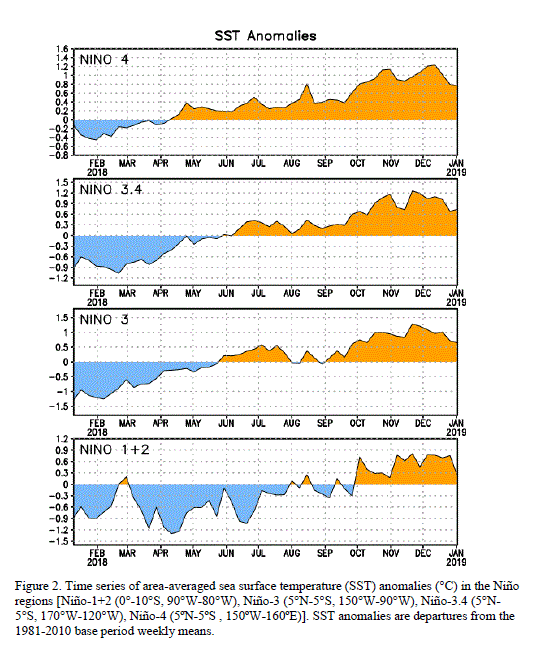
Forecasters at the Climate Prediction Center haven’t declared El Niño conditions, even though the Niño3.4 index is currently around 0.5°C above normal, and has been for the past two months. What’s the hold up? In short, we’re waiting for the atmosphere to respond to the warmer sea-surface temperatures, and give us the “SO” part of ENSO.
SO what? The Southern Oscillation, that’s what. The Southern Oscillation is a seesaw in surface pressure between a large area surrounding Indonesia and another in the central-to-eastern tropical Pacific; it’s the atmospheric half of El Niño. Since ENSO is a coupled system, meaning the atmosphere and ocean influence each other, both need to meet the criteria for El Niño before we declare El Niño conditions.
During average (non-El Niño) times, the waters of the western tropical Pacific are much warmer than in the east/central area (Figure 1). As warmer water extends out to the east during an El Niño, it warms the air, causing it to rise (lower pressure) (Figure 2). In turn, there is less rising motion (higher pressure) near Indonesia, due to the relatively cooler waters and overlying air.
Figure 1. Average state of ocean temperatures, rainfall, pressure, and winds over the Pacific during ENSO-neutral conditions. Figure 2. Generalized state of the ocean and atmosphere during El Niño conditions. NOAA image created by David Stroud.
The pressure changes influence the wind patterns. The average (non-El Niño) state of the atmosphere over the tropical Pacific features convection and rainfall over Indonesia, low-level easterly winds (the trade winds that blow from east to west), and upper-level westerly winds (Figure 1). These are the basic components of the Pacific Walker Circulation.
During El Niño, the system shifts: we see weaker trade winds over the Pacific, less rain than usual over Indonesia, and more rain than usual over the central or eastern Pacific. During some El Niño events, the trade winds along the equator even reverse, and we see low-level westerlies… but not every time. In fact, every El Niño is different, and both the ocean and atmospheric characteristics vary quite a lot from event to event–but that’s a topic for another post!
This difference from average air pressure patterns across the Pacific is measured a few different ways. One is the Southern Oscillation Index (SOI), which is based on a long record of pressure measured by two stations: one in Darwin, Australia (south of Indonesia) and the other in Tahiti (east-central tropical Pacific) (Figure 3). A negative SOI indicates Darwin’s pressure is higher than average and Tahiti’s is lower than average: El Niño conditions. (I keep saying “higher than average” because we’re not just comparing Darwin’s pressure to Tahiti’s, but rather comparing the anomalies at each. Imagine comparing the price of a gallon of water to that of a gallon of gas. A negative index is if the price of the water goes up, and the gas goes on sale. The gas may still cost more than the water, but it’s the relative changes in the two prices that matter.)
A second way we describe the air pressure anomalies over the tropical Pacific is the Equatorial Southern Oscillation Index (EQSOI). The EQSOI is based on pressure differences between two regions located on the equator (Figure 3). The SOI is monitored because it has a very long record available, stretching back to the 19th century; the EQSOI depends on satellite observations, which means it is a shorter record, but it gives a better picture of what’s happening right along the equator.
Figure 3. Two ways of measuring the Southern Oscillation: the SOI and the EQSOI. Both depend on comparing the strength of pressure anomalies in different parts of the Pacific basin. Map by NOAA Climate.gov.
As of the end of June, both the SOI and the EQSOI are at +0.2 (they have trended downward over the past few months), and the wind patterns are roughly average over the tropical Pacific, with some slight weakening of the trade winds toward the end of the month. There is increased convection in the central Pacific, but also some over Indonesia… all of which says we’re still waiting for the atmosphere to get dressed in its El Niño clothes and come out to play.
However, we think it’s likely that the atmosphere will get on board soon, and we’re still predicting El Niño, with about a 70% chance that conditions will be met in the next few months, and around an 80% chance by this fall. If you’re interested in how the ocean and atmospheric conditions are evolving, CPC has weekly updates available.
Thanks to David Stroud for his help with this post.
source: http://www.climate.gov/news-features/blogs/enso/en-so
Poor Climatists! In addition to their problems “communicating” climate change to the peasants, they can’t seem to “communicate” climate change to Gaia. Why, oh why is she being so stubborn? It must be incredibly frustrating for them.
Reminds me of the commercial of the guy in the boat waiting for his friends (they are all at some sale). His mantra is “Any second now, any second”.
leo smith ,you will find people like cynical scientist are completely out of their depth when they leave the comfort of sks . they always forget there is not a moderator ready to jump on comments that expose the warming meme.
the fact these people rely on moderation to dig them out of the many,many holes they dig themselves when attempting argue with people pointing out the obvious is lost on them.
however,even the most avid warmist must get bored talking to the same 3 or 4 people on sks and decide to venture out ,before retreating to their moderated havens after yet another beating about the head with reality.
It sounds like the atmosphere is on board. It’s the ocean temps that aren’t.
@Patrick Guinness: the latitude of Chelyabinsk is 55° 9′ 15″ N. Having lived several years at a similar latitude in Labrador I’d opine that a little snow in July is not so freaky. Records show that such latitudes typically have some amount of snow in every month of the year. I well remember postponing a Canada Day fishing trip because of 4 inches of snow – unusual granted, but not “freaky”.
“That said, both methods indicated that solar UV output was lower in the recent “exceptional” solar minimum than in previous minima. “This behaviour is found in open solar flux – and is mirrored by cosmic rays – but not in sunspot number,” said Lockwood.
The finding indicates that “top-down” solar effects due to long-term changes in the amount of ultraviolet radiation emitted by the sun could be a bigger factor in tropospheric variations than previously believed. Many climate models consider only the “bottom-up” effects of the Sun’s visible and infrared emissions, which are much more stable over time.
The team believes that including this “top down” effect should help reduce uncertainty in the prediction of weather variability from year to year in Europe and western Asia, where jet-stream-blocking events are more common. “A top-down climate effect that shows long-term drift, and may also be out of phase with the bottom-up solar forcing, would mean that climate-chemistry models that have sufficient resolution in the stratosphere would become very important for making accurate regional/seasonal climate predictions,” write the researchers in their paper in Environmental Research Letters (ERL).”
http://environmentalresearchweb.org/cws/article/news/43667
Polar vortex over Australia.
http://earth.nullschool.net/#current/wind/isobaric/10hPa/orthographic=135.03,-43.55,481
Not enough taxation, obviously.
The ‘good news’ is that should El Niño turns out to be bust , we will be told this proves nothing and we doomed anyway , the bad news is that should El Niño lead to hotter weather we will be told this proves AGW and we doomed anyway.
The best news is that no matter what happens with El Niño if largely has no effect on people’s lives .
Why don’t they just adjust the data until it shows an El Nino. Improved science communication; just make it happen in the data. Keep the trillions rolling. They’re just printed anyway. Who still works for currency.
This chasing El Nino from all the “experts” is really funny to watch. As Leroux explained, it is the distortion of boreal hemisphere circulation that induces the event (colder air coming from the arctic, powerful MPHs encroaching into the other hemisphere in the Pacific) and for this summer pressures have been quite reasonable -below or around 1030hPa compared with 1035hPa last year), i.e. no really powerful MPHs coming out of the Arctic. Meanwhile austral circulation is intense (Terre Adelie coldest June on record), pushing the Meteorological Equator northward. As long as this situation continues, you can kiss good bye to your pet child…
A further decrease in solar activity means more changes in ozone and blocking the southern polar vortex. It will be cold in Australia.
http://soho.nascom.nasa.gov/data/realtime/hmi_igr/1024/latest.html
http://www.cpc.ncep.noaa.gov/products/stratosphere/strat_a_f/gif_files/gfs_t50_sh_f00.gif
Perhaps the atmosphere is getting bored with their “predictions”.
Let’s see what happens over the Antarctic.
http://arctic.atmos.uiuc.edu/cryosphere/antarctic.sea.ice.interactive.html
http://www.cpc.ncep.noaa.gov/products/precip/CWlink/blocking/real_time_sh/500gz_anomalies_sh.gif
You guys have to understand. NOAA promised the administration that a super el nino was coming that would bake the globe. That is why the administration rolled out these EPA regulations they have been sitting on for 4 years. Instead we are getting an arctic breakout in the middle of the summer and likely headed to a la nina. Heads will roll for this at NOAA and they know it. Valery Jarret will have blood for this.
Oh, oh…. Things aren’t lookin’ good for the “Super 2014 El Niño” :
http://www.bom.gov.au/climate/enso/monitoring/nino3_4.png
Oops…. Lookin’ more like El Nada with each passing week.
The poor warmunistas just can’t seem to catch a break these days…
What’s next? A summer Arctic Vortex event?…. LOL!…. Oh, wait a minute… Never mind…
If they don’t get a real El Nino soon, the consensus will just change the definition, adjust the data, and declare one anyway.
To add to the link reference by Samurai, the BOM forecast has been steadily scaled back over recent weeks and is now looking somewhat comatose. Cue Dead Parrot sketch. 🙂
http://www.bom.gov.au/climate/enso/index.shtml#tabs=Outlooks
Bottom line:
Even if an El Niño on the grandest scale happens….. next month….. next year….. when-EVER,
…. THEY STILL HAVE
NO EVIDENCE
(absolutamente nada)
THAT THE HEAT RELEASED
WAS CAUSED BY
HUMAN CO2.
AGW IS DEAD — has been for years.
No REAL resurrection is possible.
http://earth.nullschool.net/#current/wind/surface/level/orthographic=-157.12,-2.64,512
If El Nino does bring higher temperatures, will that constitute the atmosphere getting on board? Not even close. For that temperatures would have to rise, lastingly, to the level which they should already have reached according to the models.
If the oceans say El Nino and the atmosphere does not warm significantly, that is actually an interesting result.
Looking at the data since 1950, the atmosphere has proven a distinctly poor team player. (I recommend disciplinary action, with an eye towards eventual termination. And there is also the matter of the missing heat: was it misappropriated?)
That’s been my suspicion too.
Meanwhile, the AMO is set to plunge further and that supposedly uncorrelated fusion ball is set for a long sleep. So much for short-term whipping boys to lean on.
The weather is perfect, the season unclear. ‘Thank you for not co-operating’ John Ashbery (1983)