The SkepticalScience animation The Escalator has been around for a couple of years, and it has appeared in dozens of their posts and in blog posts by other carbon dioxide-obsessed alarmists. Their intent with The Escalator animation was to show that the instrument temperature record includes many short-term absences of global warming, while, in their minds, manmade greenhouse gases caused the long-term trend of global warming. With Kevin Trenberth now saying strong El Niño events caused global warming to occur in steps, SkepticalScience needs to revise their escalator animation. The steps are not only how skeptics view global warming…one of the leading ENSO and global warming researchers is now presenting global warming in El Niño-caused big jumps, and he also has written in at least two peer-reviewed papers that El Niños are fueled by sunlight.
So here’s my suggested replacement for SkepticalScience’s The Escalator. For lack of a better title, we’ll call it…
THE TRENBERTH GLOBAL WARMING STAIRCASE
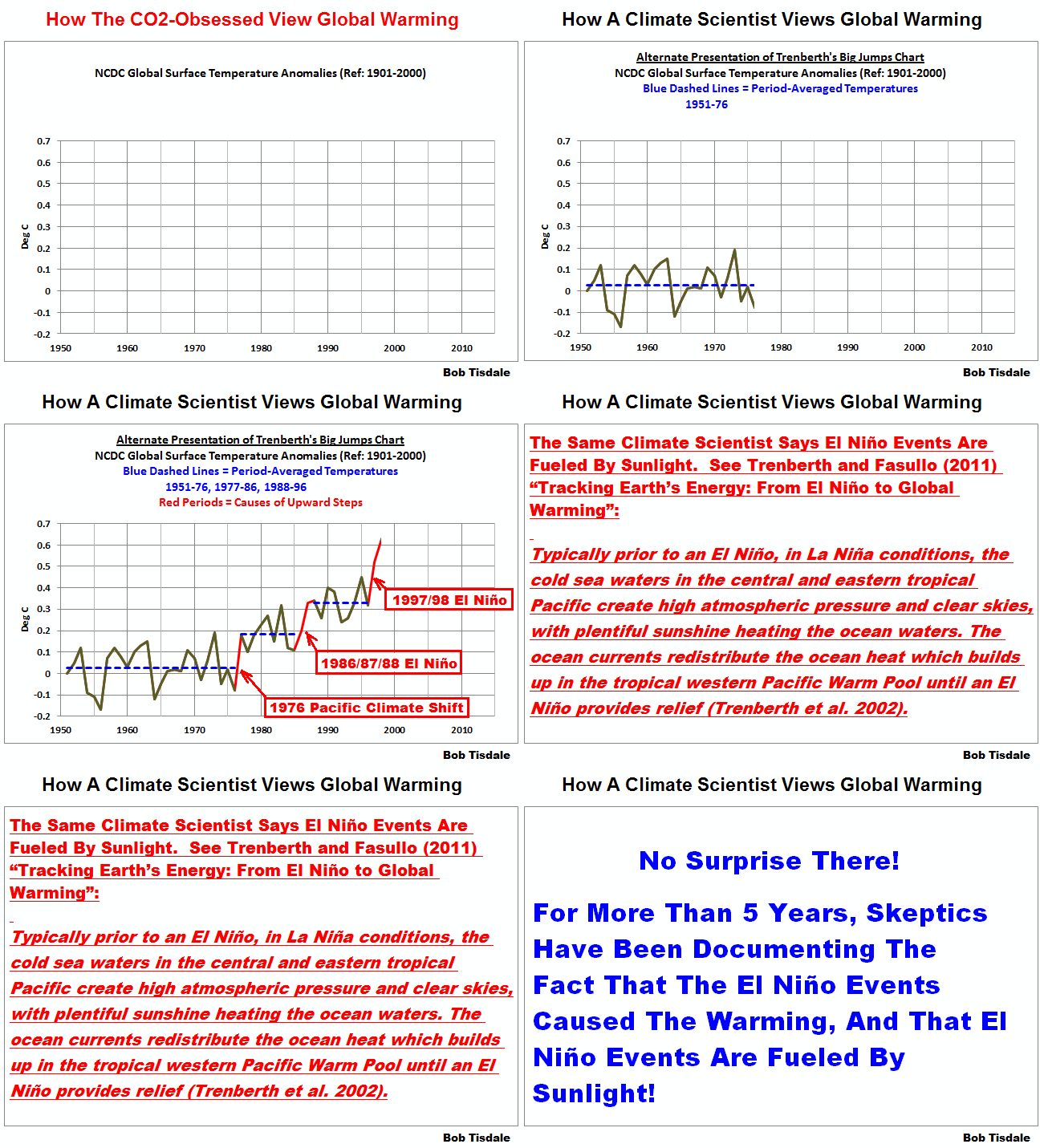
Feel free to link it anywhere you like…especially where the CO2-obsessed have presented the SkepticalScience animation “The Escalator”.
For more information about Kevin Trenberth’s discussion of the how the warming of global surface temperatures occurred “instead of having a gradual trend going up, maybe the way to think of it is we have a series of steps, like a staircase” or in “big jumps” see the following posts. The first post also includes quotes from and links to the papers where Trenberth states that sunlight provides the warm water for El Niños:
- The 2014/15 El Niño – Part 9 – Kevin Trenberth is Looking Forward to Another “Big Jump”
- Open Letter to the Royal Meteorological Society Regarding Dr. Trenberth’s Article “Has Global Warming Stalled?”
If this topic is new to you, see the free illustrated essay The Manmade Global Warming Challenge (42MB). And if you’d like more information, my ebook Who Turned on the Heat? is available. It goes into a tremendous amount of detail to explain El Niño and La Niña processes and the long-term aftereffects of strong El Niño events. Who Turned on the Heat? weighs in at a whopping 550+ pages, about 110,000+ words. It contains somewhere in the neighborhood of 380 color illustrations. In pdf form, it’s about 23MB. It includes links to more than a dozen animations, which allow the reader to view ENSO processes and the interactions between variables.
I’ve lowered the price of Who Turned on the Heat? from U.S.$8.00 to U.S.$5.00. Some readers spend more on a cup of coffee. Please buy a copy. You might even learn something. A free preview in pdf format is here. The preview includes the Table of Contents, the Introduction, the first half of section 1 (which was provided complete in the post here), a discussion of the cover, and the Closing. Take a run through the Table of Contents. It is a very-detailed and well-illustrated book—using data from the real world, not models of a virtual world. Who Turned on the Heat? is only available in pdf format…and will only be available in that format. Click here to purchase a copy. Thanks. Book sales and tips will hopefully allow me to return to blogging full-time once again.
mpainter says: “There have been El Ninos in the past. If El Ninos mean stepwise warming, then we should have had such stepwise warming in the past…..”
There’s evidence that they occurred in response to the 1918/19/20 El Nino and the 1939/40/41/42 El Nino.
Pointman, the troll William Connolley has been voicing his limited grasp of reality over at Pierre Gosselin’s NoTrickZone:
http://notrickszone.com/2014/05/28/computer-tea-leaves-hocus-pocus-models-yield-very-reliable-robust-signals-for-year-2100-german-scientists-claim/
rgbatduke, once again, thanks for your insightful comments on this thread. Regarding the interrelationship between ocean heat content and surface temperatures, I would suggest investigating the unadjusted UKMO EN3 ocean heat content data as well as the much-adjusted NODC ocean heat content data.
Regards
My sincere thanks to all those who purchased copies of “Who Turned on the Heat?” in response to this blog post.
Cheers
I always come back to the same thoughts when reading your pieces Bob, if El Ninos cause the temp to go up and La Ninas don’t bring it down, and the temp is going up step-wise always!!!
What is your point?! How is it ever going down?! And why is that any different than saying that
CO2 extra warming(which I disagree with, except for the nominal amount that basic science says) is causing the step rises through the El Ninos?! You offer. it seems, no explanation as to where
the extra heat comes from in the El Nino steps(solar?) and how it will ever come down. Your method means that the temp will never come down and only rise it appears to me!?
Latitude says: “so, what’s the Atlantic doing?”
It had been helping the upward trend…
http://bobtisdale.files.wordpress.com/2014/05/03-area-weighted-comparison.png
…but it too has not warmed for about a decade. It will be interesting to see how the North Atlantic responds to the upcoming El Nino.
The above graph is from this post:
http://bobtisdale.wordpress.com/2014/05/26/changes-to-the-monthly-sea-surface-temperature-anomaly-updates/
Regards
rgbatduke, regarding Trenberth, I think you might find that Trenberth and Fasullo (2011)…
http://www.cgd.ucar.edu/staff/trenbert/trenberth.papers/ISSI_fulltext.pdf
….is a follow-up to his travesty email, inasmuch as he notes in that paper that they still cannot track the heat associated with ENSO events…which is what was discussed in his follow-up email to the travesty email.
“How is it possible for anyone passing beyond Groundlevel at University anywhere not to have learn what it takes to present valid arguments that can lead up to a sound conclussion?”
Lol.
Bob Tisdale says:
May 29, 2014 at 3:19 pm
…but it too has not warmed for about a decade. It will be interesting to see how the North Atlantic responds to the upcoming El Nino.
====
Thanks Bob
What Mosher is saying, and I agree with, is that El Niño is descriptive of a weather pattern and not a cause (as in a new heat source) for global warming. The fact that it occurs and that the surface temperatures go up globally on average are automatic.
Bob is describing the mechanism of heat transfer that occurs during this process (not new heat creation).
Both are right and both views are helpful in looking at the the weather pattern.
Mosher believes the CO2 influence is causing an upwards inevitable rise in temperatures without regard to the checks and counterbalances present in the earth’s climate stability ie that rising CO2 may lead tofeedbacks in clouds etc that restore a balance albeit with more CO2 in the atmosphere.
Hence he cannot a accept that the temperature rise has stalled and is reversing.
Hence his comment.
He did not disagree with you.
Bob as soon as I get over my aversion to credit cards on line and develop some internet skills I will buy a copy. You should send one to Mosher gratis but he may already have bought it.
Please continue your work.
Ps no El NIno yet is there ?
The 30-yr PDO warm/cool cycles explain some of the staircase rise of global temps since the end of the Little Ice Age, as there is a 100% correlation between PDO warm/cool cycles over the past 163 years and 30-yr PDO warm/cool cycles:
http://www.woodfortrees.org/plot/hadcrut4gl/from:1850/to:1880/plot/hadcrut4gl/from:1850/to:1880/trend/plot/hadcrut4gl/from:1880/to:1921/plot/hadcrut4gl/from:1880/to:1921/trend/plot/hadcrut4gl/from:1921/to:1943/plot/hadcrut4gl/from:1921/to:1943/trend/plot/hadcrut4gl/from:1943/to:1976/plot/hadcrut4gl/from:1943/to:1976/trend/plot/hadcrut4gl/from:1976/to:2004/plot/hadcrut4gl/from:1976/to:2005/trend/plot/hadcrut4gl/from:2005/plot/hadcrut4gl/from:2005/trend
I think a fairly good case (though far from perfect) could be made that the general 163-yr upward trend can be attributed to simple LIA recovery (1280~1850–the coldest climatic event in 10,000 years) and the strongest 63-year string (1933~1996) of solar cycles in 11,400 years (Solanki et al), with perhaps around 0.2C of the total 0.75C of global warming since 1850 attributable to CO2 forcing (Lindzen Choi et al).
It’s interesting to note that the RSS global warming temp trend ended the same year the 63-yr string of strong solar cycles ended. I know the logic fallacy dangers of post hoc, ergo propter hoc, however, there is also pretty good correlation/causal hypotheses/experiments (Svensmark et al/CERN’s CLOUD experiment) that suggest the four Grand Solar Minima of the Little Ice Age (Wolf, Sporer, Maunder and Dalton) contributed to the severity/duration of the LIA, and the current 18-yr “Pause” (TM) experienced since the end of the 63-year strong solar cycles.
With the collapse of the Umbral Magnetic Field, there is good reason to believe that the next solar cycle could well be the start of a new Grand Solar Minimum.
If there is a Grand Solar Minimum from 2020 as some suggestand global temps continue to fall, despite record CO2 emissions, I think the CAGW hypothesis will end up in the shredder.
There will be a natural spike in global temps during the coming El Nino, however, if the subsequent 2016/17 La Nina leads the resumption of the flat/falling global temp trend from 1996, it will be over 20 years with little to no global warming trend, the CAGW projections will be well outside 2 standard deviations from reality, the projections will be well outside CAGW’ 95% confidence parameters and this stupid CAGW scam can, for all intents and purposes, be tossed in garbage bin.
“May you live in interesting times” (famous Confucian curse…)
Ooops. First paragraph should read, “…100% correlation between 30-yr PDO warm/cool cycles over the past 163 years and global warm/cool temp trends.”
Sorry for not proof reading my posts.
Bob
So you still do not understand that ENSO can’t work just one way, up up up, when there is no long term trend in ENSO.
Robert Brown says:
“but there is no way that the addition of literally thousands of sampling stations would not reduce the error bars. In fact, reduce them by a factor of (wait for it) order \sqrt{1000} \approx 31 ”
I generally like your posts but if you add a drum roll to a statement, give it just one more proof read.
Adding whatever number of sampling points will not reduce anything by a __factor__. Simple example, you have 1000 noisy data points and you “add” another 1000. The noise is not reduced by a __factor__ of sqrt(1000) but by sqrt(2) or the gods of statistics would shit themselves.
You have to increase the number of points by a _factor_ to get the reduction of noise by the \sqrt factor.
angech says: “Bob is describing the mechanism of heat transfer that occurs during this process (not new heat creation).”
Nope. Bob has not only described but he’s documented new heat generated by ENSO. Additionally, did you read the quote from Trenberth and Fasullo in the animation above.
holts7 says: “You offer. it seems, no explanation as to where the extra heat comes from in the El Nino steps(solar?) and how it will ever come down.”
Actually, I have explained many times the processes through which La Nina events permit more sunlight than normal to enter and warm the tropical Pacific, recharging (replenishing) the heat released and redistributed by ENSO. In fact, it was even mentioned in the animation above in the quote from Trenberth and Fasullo and further discussed in a post about 2 weeks ago:
http://bobtisdale.wordpress.com/2014/05/13/answer-to-the-question-posed-at-climate-etc-by-what-mechanism-does-an-el-nino-contribute-to-global-warming/
Regarding coming down, I present data. If and when ENSO shifts to an unknown mode so that global surface temperatures step down in response to it, I’ll be happy to present it.
norah4you says: “Some people like the article author never ever learn basic Theories of Science…”
I’m sure you’re aware that climate science in general is filled with fallacies of logic.
Additionally, his was a simple blog post to present an animation, nothing more, nothing less.
lgl says: “So you still do not understand that ENSO can’t work just one way, up up up, when there is no long term trend in ENSO.”
You’re trying the “no long term trend in ENSO” argument, lgl? How boring for a troll like you! What part of ENSO acting as a chaotic, naturally occurring, sunlight-fueled, recharge-discharge oscillator can’t you grasp? I’ve documented that fact a multitude of times here.
Have a good day.
SAMURAI says: “The 30-yr PDO warm/cool cycles explain some of the staircase rise of global temps since the end of the Little Ice Age…”
The problems: the PDO is an aftereffect of ENSO and there is no mechanism through which the PDO could cause a change in global temperatures:
http://bobtisdale.wordpress.com/2014/04/20/the-201415-el-nino-part-5-the-relationship-between-the-pdo-and-enso/
Regards
Trenberth et al., are making it up as they go along.
On a slightly O/T but related point, something occurred to me a few days ago that some of the more technical people here might be able to answer.
Has anyone (or could anyone) run climate models uder the following conditions:
With natural variability calibrated so that [i]with current anthropogenic forcing estimates[i] they accurately produce current conditions Then, using the same calibration, with no antropogentic forcing.
In other words, given current temps, what do the models say the world would be like if we never had burnt all that fossil fuel? No idea if it would even be possible but, if it was, then could we find ourselves faced with a choice between “the models are obviously faulty” or “without CO2 we’d be headed to extreme cold”?
You have to increase the number of points by a _factor_ to get the reduction of noise by the \sqrt factor. . There are other reasons it might have been more or less than this number, as well — if they had 50 “sites” in 1955, but they consisted of 50 sites at only 5 locations, spread out within a few hundred miles of one another, the sites are hardly independent or randomly selected and might constitute only 5 “iid” samples as far as stats are concerned. Of course the same thing can be true (and is, to at least some extent) with the ARGO floats — they aren’t either uniformly distributed or randomly distributed, so even 4000 floats might not make up 4000 iid samples.
I’m aware of that and I’m sorry I wasn’t sufficiently clear. I was assuming — possibly incorrectly — that there were only a handful of contributing measurements back in 1955 (as in literally — perhaps 4 or 5, maybe 10 or 20). Hence my statement about ORDER of
None of which should detract from the central point, which is that even if the number of “independent” sampling sites only went up by a factor of 100 (and it is my strong recollection that for most of the pre-Argo period, N was indeed never much greater than 50, with a lot of site correlation) there should be at least an order of magnitude reduction in the error bar between 1955 and the present. Its absence makes me wonder how they compute the error in what is supposedly a 3D kriging of sparse samples.
At that point we could go a step further and note that measurements of heat content can only be derived quantities from measurements of ocean temperature in depth (0 to 2000 meters according to the figure title). The entire data set including ARGO thus suffers from my incomprehension of how they can krige temperature in planetary oceans to that depth from only a 4000 — let alone 40 — sites to five or six significant digits absolute, using instrumentation that is likely not accurate to more than 3 or 4 digits on a good day with a tail wind for the first (pre-transistor) half of the record. How exactly did they measure the ocean temperature at 1 km of depth back in 1955? With a mercury thermometer (who read it)? With a thermocouple (who adjusted and normalized it, how were the results transmitted and tube-amplified, how did they handle the heat generated by the tube-driven apparatus)?
Remember, in 1955 electronics was still at the green screen radar level and kids were still listening to The Shadow on radio for electronic entertainment. It’s not that they couldn’t make precise measurements — oh, wait, yes it is. At least not without enormous expenditure. And who was funding this, way back then? So add in instrumental error to the error that ought to be reduced and I suspect you can easily find an additional order of magnitude — Ask Anthony about the error levels in MODERN WEATHER STATION apparatus using solid state electronics, and whether it suffices to measure something to 5 significant digits. Now re-ask the same question in 1955, concerning a piece of apparatus that has to be backed into a cylinder and then lowered to 200 atmospheres of pressure, from a ship that has junketed a small group of scientists to particular locations that, um, have just the right “scientific appeal”.
rgb
Bob
chaotic, naturally occurring, sunlight-fueled, recharge-discharge oscillator
There is no trend in the output of an oscillator either, it goes up for a while but then down again.
And your recharge-discharge oscillator mantra is also wrong. The tropical ocean warms during rising ENSO. The correlation between ENSO and Pacific ocean heat (energy) is positive, not negative.
http://virakkraft.com/Trop-Pacific-OHC-Nino34.png
@lgl: “The tropical ocean warms during rising ENSO.” Where does the energy come from? CO2?
why then is temperature only going up, and not going down after the El Nino provided relief?