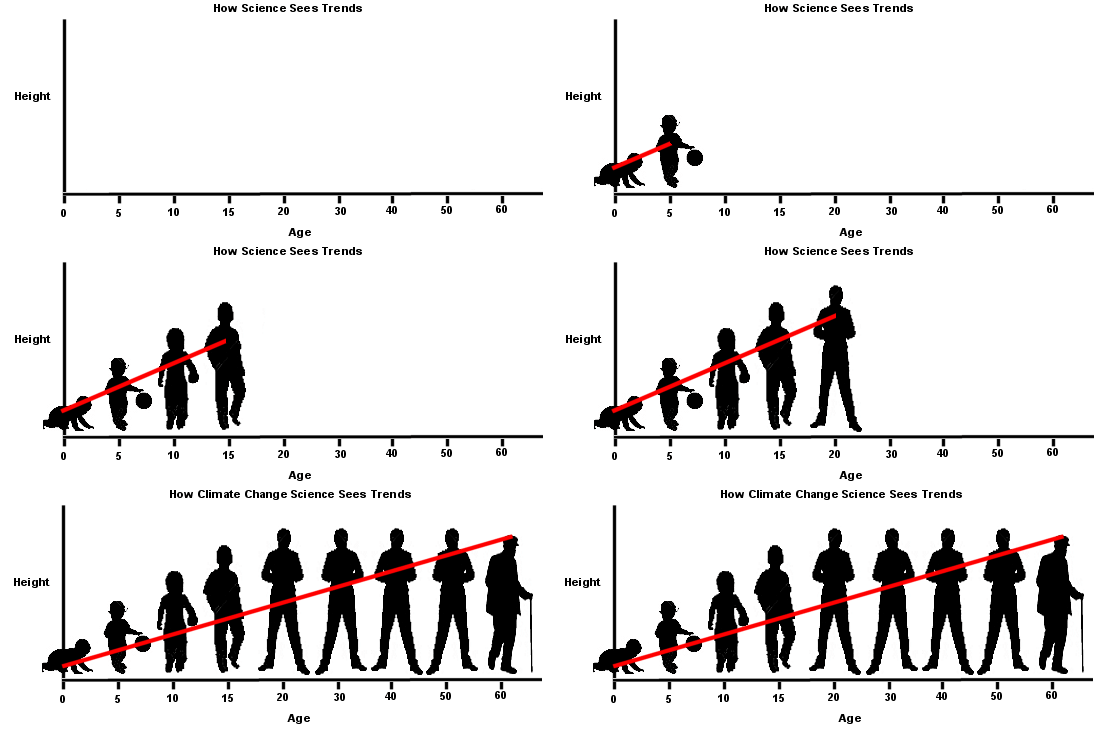
The SkepticalScience animation The Escalator has been around for a couple of years, and it has appeared in dozens of their posts and in blog posts by other carbon dioxide-obsessed alarmists. Their intent with The Escalator animation was to show that the instrument temperature record includes many short-term absences of global warming, while, in their minds, manmade greenhouse gases caused the long-term trend of global warming. With Kevin Trenberth now saying strong El Niño events caused global warming to occur in steps, SkepticalScience needs to revise their escalator animation. The steps are not only how skeptics view global warming…one of the leading ENSO and global warming researchers is now presenting global warming in El Niño-caused big jumps, and he also has written in at least two peer-reviewed papers that El Niños are fueled by sunlight.
So here’s my suggested replacement for SkepticalScience’s The Escalator. For lack of a better title, we’ll call it…
THE TRENBERTH GLOBAL WARMING STAIRCASE
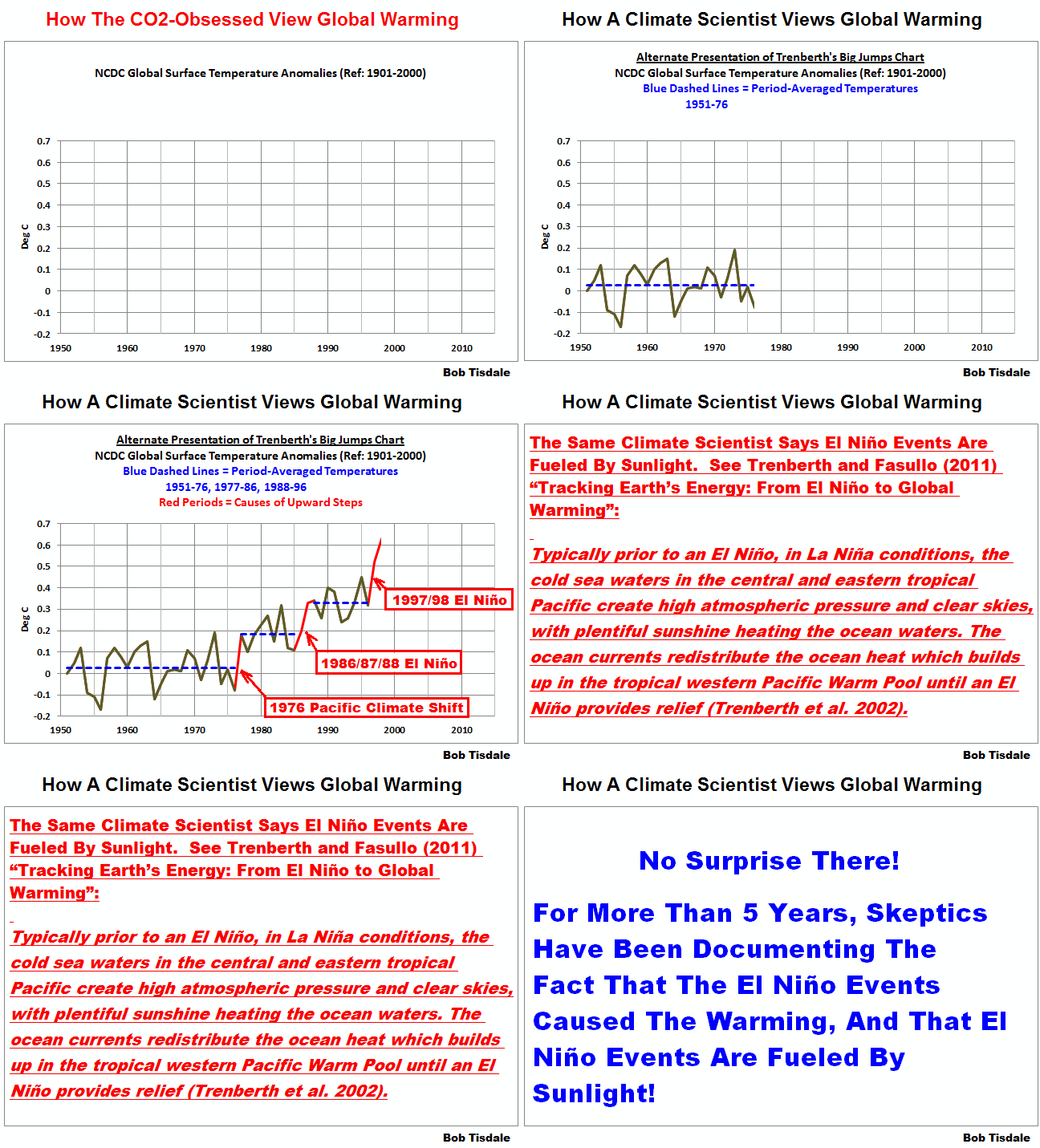
Feel free to link it anywhere you like…especially where the CO2-obsessed have presented the SkepticalScience animation “The Escalator”.
For more information about Kevin Trenberth’s discussion of the how the warming of global surface temperatures occurred “instead of having a gradual trend going up, maybe the way to think of it is we have a series of steps, like a staircase” or in “big jumps” see the following posts. The first post also includes quotes from and links to the papers where Trenberth states that sunlight provides the warm water for El Niños:
- The 2014/15 El Niño – Part 9 – Kevin Trenberth is Looking Forward to Another “Big Jump”
- Open Letter to the Royal Meteorological Society Regarding Dr. Trenberth’s Article “Has Global Warming Stalled?”
If this topic is new to you, see the free illustrated essay The Manmade Global Warming Challenge (42MB). And if you’d like more information, my ebook Who Turned on the Heat? is available. It goes into a tremendous amount of detail to explain El Niño and La Niña processes and the long-term aftereffects of strong El Niño events. Who Turned on the Heat? weighs in at a whopping 550+ pages, about 110,000+ words. It contains somewhere in the neighborhood of 380 color illustrations. In pdf form, it’s about 23MB. It includes links to more than a dozen animations, which allow the reader to view ENSO processes and the interactions between variables.
I’ve lowered the price of Who Turned on the Heat? from U.S.$8.00 to U.S.$5.00. Some readers spend more on a cup of coffee. Please buy a copy. You might even learn something. A free preview in pdf format is here. The preview includes the Table of Contents, the Introduction, the first half of section 1 (which was provided complete in the post here), a discussion of the cover, and the Closing. Take a run through the Table of Contents. It is a very-detailed and well-illustrated book—using data from the real world, not models of a virtual world. Who Turned on the Heat? is only available in pdf format…and will only be available in that format. Click here to purchase a copy. Thanks. Book sales and tips will hopefully allow me to return to blogging full-time once again.
When does it go down? It has been going up since the Little Ice Age.
What made it go up? Good question …
Stephen Richards says: “How does it come down ? Cold PDO ?”
Please advise through what non-existent mechanism the spatial pattern of the surface temperature anomalies in the extratropical North Pacific (the PDO) causes any change in global temperature. The PDO is simply an aftereffect of ENSO and the sea level pressure of the North Pacific.
http://bobtisdale.wordpress.com/2014/04/20/the-201415-el-nino-part-5-the-relationship-between-the-pdo-and-enso/
Next year has the lunar standstill, which apparently has been associated with transient climate disturbance as far back as the Neolithic. Any predictions for the effect of any such 2015 disturbance?
Walt S, in the following post, I assumed the next step in response to the 2014/15 El Nino would be the same as the one that occurred in response to the 1997/98 El Nino. In other words, I simply took the global temperature data from 1998 to 2013, shifted them up 0.2 and 0.3 deg C and inserted them in the time period of 2015 to 2030:
http://bobtisdale.wordpress.com/2014/05/20/the-201415-el-nino-part-9-kevin-trenberth-is-looking-forward-to-another-big-jump/
Bob
Roy Spencer can explain this to you, it’s not difficult. http://virakkraft.com/sinus++.png
hint, drroyspencer.com , november.
Gary Pearse, the staircase went down between 1945 and 1975. Don’t panic.
And what about the cooling in the seventies? I cannot see it in the escalator.
Well someone has to do it, so it may as well be me.
urederra…
That decline was hidden (hide the decline !), or “adjusted” away.l
There have been El Ninos in the past. If El Ninos mean stepwise warming, then we should have had such stepwise warming in the past. But, no, we do not see such. Something different is happening today (that is, the last forty years or so). El Ninos do not explain the circa 1977-97 warming trend, despite the apparent coupling of step-warming with ENSO events.
However, insolation can explain it. The question is whence the increase of insolation? Answer this and we will know the cause of the late warming trend and whether this will resume in the future. CO2 can be eliminated from consideration as a factor in climate.
Thank you Bob
so, what’s the Atlantic doing?
Bob has seen my escalator before, I can’t remember if Anthony has, whatever, feel free to use as your discretion, you might like to display it in the post (depending on browser, you may need to refresh the image).
Albert’s Escalator
Illustrating why escalator’s are embarrassing to climate science, especially if, like Tim Yeo & John Gummer, you think the last decade having record temperatures means anything at all
Robert Brown: The intervals of flat atmospheric temperatures correspond to periods when the ocean was absorbing heat (which almost invisibly increases its temperature). The intervals of rising atmospheric temperatures almost perfectly correspond to periods when the ocean’s heat content was nearly flat. The recent weak cooling trend in the atmosphere corresponds to a time when oceanic heat absorption is gradually increasing. Even the “bobble” in ocean heat content delta in 1982-1983 corresponds almost exactly with a similar “antibobble” in global average temperature in HADCRUT4 (offset by around a year).
Doesn’t that first sentence express what Trenberth is saying is happening now?
Is it possible for that to be happening if the CO2 in the atmosphere is what is driving the overall increase that has occurred?
“I’m not sure why Trenberth muddied the waters of AGW with his stairway to global warming, or if was his intent to muddy them, but he definitely muddied them.”
actually it helps to disabuse people of the notion that warming (of the ATMOSPHERE and upper ocean) will occur in a monotonically increasing fashion.
El nino is a pattern. it does not cause warming it is how the energy imbalance manfests.
Illustrating why escalator’s are embarrassing to climate science, especially if, like Tim Yeo & John Gummer, you think the last decade having record temperatures means anything at all
Well, it means that the last decade had a number of record temperatures (record over the thermometric era, probably not records over the Holocene and certainly not record temperatures outside of the Holocene).
However, another point that is being missed in the discussion is this. If one takes a peek at Figure 9.8a from AR5:
and try to discern all of the little pastel-colored lines that make up the results presented for each of the CMIP5 models, how many of these exhibit a stair-step behavior? Would that be zero? How many of them exhibit the same range of temperature fluctuation around their “smoothed mean” behavior as is observed in the real climate? Would that also be zero? That’s a real question, as one cannot see most of the behavior of individual models in this obfuscating figure, but it is quite certain that MOST of the models have a variance that is between 2 and 3 times the variance observed in the actual climate (with absolutely zero individual models that exhibit “fifteen year intervals without temperature increase”). Would this obvious problem with the variance be a small fraction of the actual problem, because these pastel curves are themselves averages over many perturbed parameter runs for each model and hence the variance is already reduced by a statistical factor from the average variance for the individual runs? It would.
The models presented in figure 9.8a of AR5:
* Spend close some 8 or 9x as much time above the HADCRUT4 GAST estimate as they do equal to or below that estimate (outside of the reference interval — in fact let’s exclude the reference interval from all of the remarks in this list).
* In the rare intervals that the MultiModel Ensemble Mean (and don’t get me started on this statistical abomination) does go below HADCRUT4, it goes barely below. When it is above, it goes way above. To the extent that this mean reflects the general behavior of the already internally averaged underlying models, we can conclude on the basis of these two observations that:
* The p-value for the null-hypothesis “The [number of] models of CMIP5 [that] correctly compute the physics and solve the problem they are attempting to solve is absurdly small. That is, the probability of correct models producing this behavior by random chance is very small (easily less than 0.01), basically zero. There is no reasonable possibility that the climate models presented in figure 9.8a of AR5 or their MME mean are correct and that the deviation between the models and the actual climate outside of the reference interval is due to random chance.
* The individual, already averaged models contributing to the MME mean have variances 2-3 times too large. Since they are already averaged, it is probable that individual model runs exhibit global temperature fluctuations as much as an order of magnitude too large around whatever one imagines constitutes their “mean behavior”. IMO this is strong evidence that they accomplish their forced fit across the reference interval by incorrectly balancing competing dynamics — taking a large warming effect and partially cancelling it with a large cooling effect to produce a much smaller warming effect. Instead of damping temperature fluctuations with dynamic feedback, this effectively amplifies fluctuations by causing much weaker dynamics feedback damping mechanisms to be heavily overdriven and lagged before they can respond.
* And then, yeah, they no not exhibit anything like Hurst-Kolmogorov behavior, a.k.a. “stair stepping”, or the “escalator”. That is, they have a dynamic signature that is completely inconsistent with the actual data. They aren’t even qualititatively correct.
Sadly, I could go on. I sometimes wonder if anybody actually looks at anything but the SPM in the Assessment Reports. I don’t understand how any scientist who looked at this figure would not go “whoa, that’s not right” long before they got around to looking at the right hand end of it, where the model predictions are actively diverging from the observed temperatures, precisely as one would expect if the fit in the reference interval were being extrapolated out of its range of partial validity where the large cancelling terms no longer cancelled.
rgb
Doesn’t that first sentence express what Trenberth is saying is happening now?
Sure. As I said (up above) I think Trenberth is actually a pretty reasonable guy, unafraid to depart from the “party line”. The problem with his assertion is that it doesn’t address whether CO_2 is or isn’t an important factor in the overall warming, it reflect ex post facto explanation of what has happened, it isn’t a prediction for what will happen, yet. Trenberth has basically said that all of the models that neglect this process are badly wrong even if that isn’t exactly how he has framed it.
Note well that this is still a hypothesis. It is by no means a proven fact. The data is very strongly suggestive and convincing, but the hypothesis itself is not quantitatively rigorous. It still doesn’t properly explain how the atmosphere steadily heats when the ocean does not, or how the ocean steadily heats when the atmosphere does not, and AFAIK no models exhibit this particular counterintuitive countervariance but the data does.
This is in fact still more direct statistical evidence that the models have the physics wrong, deeply wrong.
But that also means that I cannot answer your second question about how important CO_2 is in the actual climate or this process. Nobody can, not yet. It is possible, even probable, that it has an overall warming effect and is in fact contributing some step height to the escalator, but the escalator was walking up (and rarely down) long before CO_2 started to increase and existing models cannot and do not predict any of this (as one can easily see from:
OK, I’ve tried to post the graphic from AR5 twice inline twice and it hasn’t worked. Here is a URL:

http://www.phy.duke.edu/~rgb/Figure9.8.jpg
Enjoy.
REPLY: I’ve converted to image for you. – Anthony
>Dave says: May 29, 2014 at 5:48 am
>Personally, I would listen more to what you say if you would discontinue the infomercials >advertising your book.
Dave, you should advertise your book here as well!
I was looking at this: http://www.skepticalscience.com/climate-of-doubt-escalator-updates.html
I wonder why they use a line for the temperature data, and a curve for the ice data. I’d like to see a curve applied to the temperature data.
Steven Mosher says:
May 29, 2014 at 10:50 am
actually it helps to disabuse people of the notion that warming (of the ATMOSPHERE and upper ocean) will occur in a monotonically increasing fashion.
El nino is a pattern. it does not cause warming it is how the energy imbalance manfests.
======
you mean exactly the same way cooling does……
http://www.foresight.org/nanodot/wp-content/uploads/2009/12/histo4.png
Or, play Logical Fallacy Bingo. It’s a lot more fun than reading a dry textbook… (the information included in each card will tell you what they are, as will a mouse hover over the space). I play all the time with postings. Since pointing out the fallacies never seems to affect the probability that the same person will commit them a second time, or third, or fourth, playing bingo is also every bit as useful…:-)
lgl says: “Roy Spencer can explain this to you, it’s not difficult.”
Thanks for you suggestion, lgl. But you’re overlooking the fact that we’ve document with data that the recharge-discharge processes associated with ENSO created the upward steps.
Have a good day.
Steven Mosher says: “El nino is a pattern. it does not cause warming it is how the energy imbalance manfests.”
Wrong. El Nino is part of a chaotic, naturally occurring sunlight-fueled recharge-discharge process that can and does contribute to the long-term warming of the planet:
http://bobtisdale.wordpress.com/2014/05/13/answer-to-the-question-posed-at-climate-etc-by-what-mechanism-does-an-el-nino-contribute-to-global-warming/
Thank you once again for your drive-by comment. You’ve once again shown a complete misunderstanding of a very basic process through which the planet regulates it temperatures.
Gras Albert, thanks for your escalator…