The SkepticalScience animation The Escalator has been around for a couple of years, and it has appeared in dozens of their posts and in blog posts by other carbon dioxide-obsessed alarmists. Their intent with The Escalator animation was to show that the instrument temperature record includes many short-term absences of global warming, while, in their minds, manmade greenhouse gases caused the long-term trend of global warming. With Kevin Trenberth now saying strong El Niño events caused global warming to occur in steps, SkepticalScience needs to revise their escalator animation. The steps are not only how skeptics view global warming…one of the leading ENSO and global warming researchers is now presenting global warming in El Niño-caused big jumps, and he also has written in at least two peer-reviewed papers that El Niños are fueled by sunlight.
So here’s my suggested replacement for SkepticalScience’s The Escalator. For lack of a better title, we’ll call it…
THE TRENBERTH GLOBAL WARMING STAIRCASE
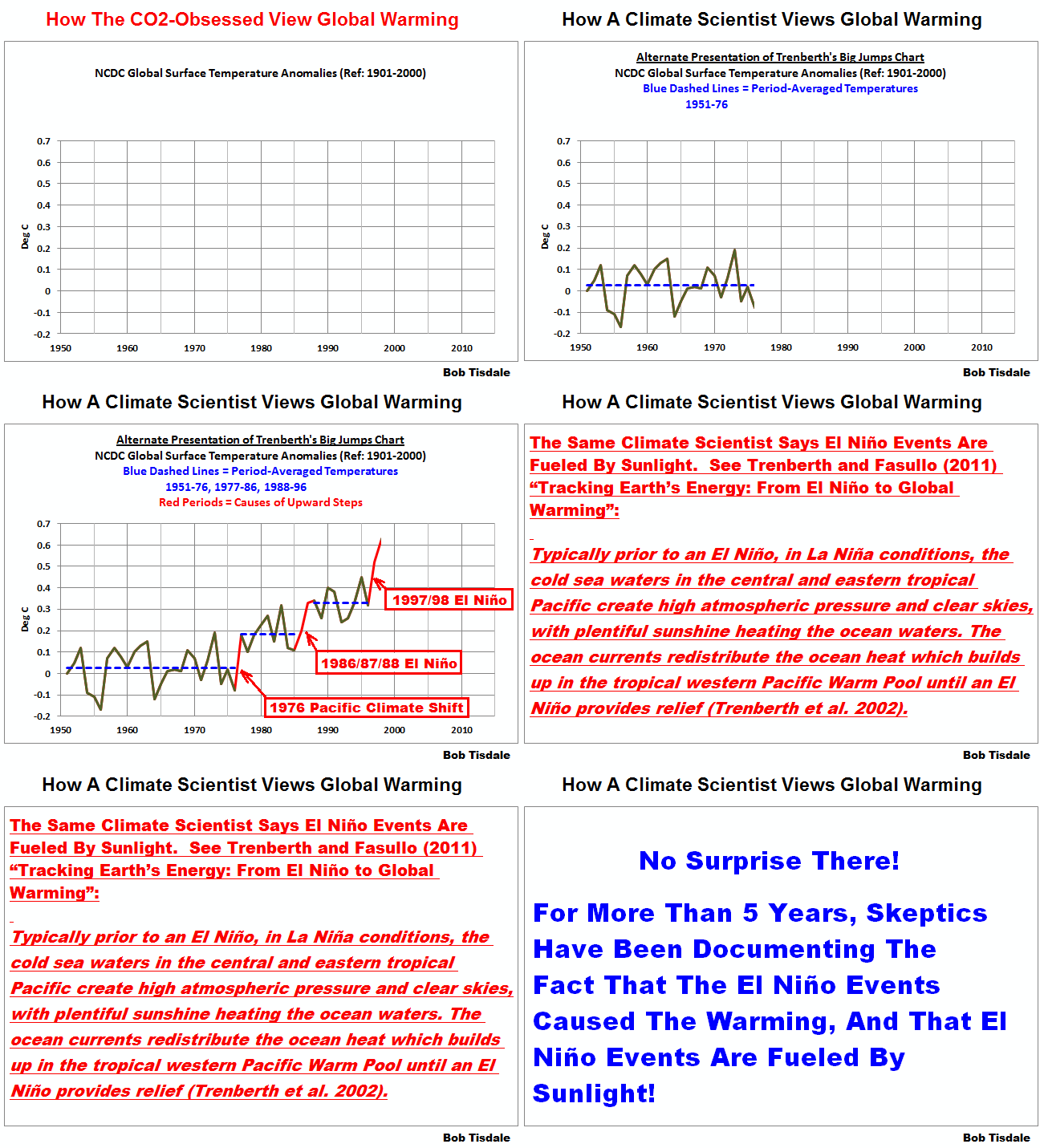
Feel free to link it anywhere you like…especially where the CO2-obsessed have presented the SkepticalScience animation “The Escalator”.
For more information about Kevin Trenberth’s discussion of the how the warming of global surface temperatures occurred “instead of having a gradual trend going up, maybe the way to think of it is we have a series of steps, like a staircase” or in “big jumps” see the following posts. The first post also includes quotes from and links to the papers where Trenberth states that sunlight provides the warm water for El Niños:
- The 2014/15 El Niño – Part 9 – Kevin Trenberth is Looking Forward to Another “Big Jump”
- Open Letter to the Royal Meteorological Society Regarding Dr. Trenberth’s Article “Has Global Warming Stalled?”
If this topic is new to you, see the free illustrated essay The Manmade Global Warming Challenge (42MB). And if you’d like more information, my ebook Who Turned on the Heat? is available. It goes into a tremendous amount of detail to explain El Niño and La Niña processes and the long-term aftereffects of strong El Niño events. Who Turned on the Heat? weighs in at a whopping 550+ pages, about 110,000+ words. It contains somewhere in the neighborhood of 380 color illustrations. In pdf form, it’s about 23MB. It includes links to more than a dozen animations, which allow the reader to view ENSO processes and the interactions between variables.
I’ve lowered the price of Who Turned on the Heat? from U.S.$8.00 to U.S.$5.00. Some readers spend more on a cup of coffee. Please buy a copy. You might even learn something. A free preview in pdf format is here. The preview includes the Table of Contents, the Introduction, the first half of section 1 (which was provided complete in the post here), a discussion of the cover, and the Closing. Take a run through the Table of Contents. It is a very-detailed and well-illustrated book—using data from the real world, not models of a virtual world. Who Turned on the Heat? is only available in pdf format…and will only be available in that format. Click here to purchase a copy. Thanks. Book sales and tips will hopefully allow me to return to blogging full-time once again.
I’m not sure why Trenberth muddied the waters of AGW with his stairway to global warming, or if was his intent to muddy them, but he definitely muddied them.
Trenberth disappoints. (gavin)
This does not add any understanding. It has been noted for years that El Nino spills out heat every few years.
With apologies, slightly OT but a larf.
http://thepointman.wordpress.com/2014/05/29/the-scorning-of-william-connolley/
Pointtman
@Pointman – I dropped a link to it as well over at Joanne Nova’s site. He is haunting her right now.
If I’m permitted to advertise here: I bought Bob’s ebook “Who Turned on the Heat”, one of the best decisions I ever made. Buy it, you have nothing to lose other than your ignorance. I particularly recommend it to Rob Painting and David Appell.
Cream Bourbon says: “This does not add any understanding. It has been noted for years that El Nino spills out heat every few years.”
Apparently, you didn’t bother to read the links. Start here please:
http://bobtisdale.files.wordpress.com/2013/01/the-manmade-global-warming-challenge.pdf
At first I thought that Trenberth was preparing a fall-back position for when the shit hits the fan on the failed CO2 hypothesis, but then I saw someone (sorry, forgot who) suggesting that he was just trying to suggest that pauses were expected, because look, they’ve happened before in a warming world.
Whatever, there may be step changes in global temperature for reasons unknown.
Again, so much for the “settled science”. More evidence that 97% of climate scientist agree is bogus. The real question is: WHAT DO THEY AGREE ON??
As long as they continue to use a conclusion to chase data, they will miss the most interesting data.
Cream Bourbon, better yet, please see the post “Answer to the Question Posed at Climate Etc.: By What Mechanism Does an El Niño Contribute to Global Warming?”:
http://bobtisdale.wordpress.com/2014/05/13/answer-to-the-question-posed-at-climate-etc-by-what-mechanism-does-an-el-nino-contribute-to-global-warming/
Regards
TedM says: “If I’m permitted to advertise here….”
Thank you.
Anthony, here’s something really curious. Kevin Trenberth’s media page at the NCAR website includes links to WUWT posts, under a special heading no less:
http://www.cgd.ucar.edu/staff/trenbert/media.html
I personally love watching that stupid, condescending, staircase animation. It might have seemed like a clever idea to the ironically named Skeptical Science people when they first did it, but now, as that top line gets longer and longer, and starts to tilt downward it is mocking them.
Some people like the article author never ever learn basic Theories of Science. First of all:
Fallacie nr 1 above: Argumentum ab auctoritate
Fallacie nr 2 above: Appeal to fear
Fallacie nr 3 above: Fallacies of Assumtion
not to mention: Fallacy from usage of insound premisses and Ad Hoc
How is it possible for anyone passing beyond Groundlevel at University anywhere not to have learn what it takes to present valid arguments that can lead up to a sound conclussion?
Please read Fallacies in argumentation (English text)
Bob Tisdale says:
May 29, 2014 at 4:23 am
More curious than that – Only the first link goes to WUWT (…/2014/01/31/open-letter-to-kevin-trenberth-ncar/), the remaining 10 all go to various pages at bobtisdale.wordpress.com.
Congratulations seem to be in order.
Bob, the staircase is, however, going up. When does it go down? For those who don’t care where the heat is coming from, could we reach thermageddon just with El NINOS? Something is wrong with this model. If GHG are relatively small in effect, we would have to appeal to the sun to take us to our final end with El NINOS and why would it do that when it appears to even be quieting down or, according to some experts, it is relatively unchanging. How does it come down – that is the missing half of all your stuff. Maybe heating up after the LIA we can expect an equiibrium when sea “catches up”.
How does it come down ?
Cold PDO ?
As long as they continue to use a conclusion to chase data, they will miss the most interesting data.
Sometimes you can make skillful use homogenization to make a true signal simply disappear.
Personally, I would listen more to what you say if you would discontinue the infomercials advertising your book.
Bob, the staircase is, however, going up. When does it go down?
During negative PDO. But with upward pressure form CO2, there is constant mild thumb under the scale, so positive PDO shows double warming and negative PDO is flat.
Net result is about where Otto and Idso put it: a notch over +1.1C per doubling.
Given a certain number of years between “stairsteps” (say 15) between “Super El Niños”, how much rise needs to happen during each Super El Niño to make the IPCC prediction for the year 2100, and what would that stairstep graph look like?
Would they have to be Super _Duper_ El Niños?
Anthony, here’s something really curious. Kevin Trenberth’s media page at the NCAR website includes links to WUWT posts, under a special heading no less: if the gods of statistics have not lost their power and charm. Since there are “thousands” of buoys (the number keeps increasing) error estimates in the present ought to be at least one, more likely two orders of magnitude smaller in the present, assuming that they might have had 50 stations sampling the entire planet back in 1955 and through much of the reported interval. Indeed, there should have been a rapid (nearly discrete) jump in precision when ARGO came online. It’s not there, so I doubt it.
http://www.cgd.ucar.edu/staff/trenbert/media.html
Actually, this is a sign (one among many) that Trenberth is a pretty reasonable guy. He actually reads what “the opposition” has to say (at least about him and his work) and is obviously willing to consider entirely new paradigms. At the very least he is unafraid of bucking the prevailing worldview of the mainstream CAGW/CACC group, and as chairman of GEWEX he has some serious influence. Finding the “missing heat” in the ocean is like asserting that it has all simply gone away never to trouble us again.
On another thread yesterday, a thoughtful reader posted this link:
http://data.nodc.noaa.gov/woa/DATA_ANALYSIS/3M_HEAT_CONTENT/DATA/basin/yearly_mt/T-dC-w0-2000m.dat
It is apparently the annual ocean heat content delta for the NH, SH and the globe for my lifetime (1955-present). It is enormously interesting. Two features I pointed out and will point out again:
a) The error bars are impossible. They are basically unchanged from 1955 to the present at ~0.003-ish (on the scale of the chart, which isn’t given). The assertion that we knew these numbers in 1955 at the same resolution that we know them today is laughable — somewhere in there ARGO came online, and back in the 1950’s we had only the most cursory and enormously, unbelievably sparsely sampled knowledge of the temperature across the depth of the entire water column. Today, with ARGO this is still true, but there is no way that the addition of literally thousands of sampling stations would not reduce the error bars. In fact, reduce them by a factor of (wait for it) order
b) OK, so error reporting sucks, but that is the rule, not the exception, in climate science. At least we can hope that the data themselves are accurate within some precision, or reflect some observed trend. And how very interesting a pattern it is!
From 1955 to 1974, ocean heat content rockets up — I eyeball an “average” annual increase of order 0.15-0.2 (in whatever the units are, again, not given in the 0-2000m data panel itself). In 1975, it is like a switch is thrown, and the rate of increase plummets to be nearly indistinguishable from noise (same order as the error bar) except for 1982/1983 (remember this for a moment). In 1994/1995 the switch flips again, and the ocean’s heat rockets up at the former rate until 2002 when it more than doubles and is still on a slow increasing trend.
Compare that to:
http://www.woodfortrees.org/plot/hadcrut4gl/from:1955/to:2015
and it is almost scary. The intervals of flat atmospheric temperatures correspond to periods when the ocean was absorbing heat (which almost invisibly increases its temperature). The intervals of rising atmospheric temperatures almost perfectly correspond to periods when the ocean’s heat content was nearly flat. The recent weak cooling trend in the atmosphere corresponds to a time when oceanic heat absorption is gradually increasing. Even the “bobble” in ocean heat content delta in 1982-1983 corresponds almost exactly with a similar “antibobble” in global average temperature in HADCRUT4 (offset by around a year).
It would be very, very interesting to look at the correlation of the two data sets (with atmospheric temperature presented as an annual delta to correspond to the delta in oceanic heat) in a scatter plot. I predict that they will produce two distinct regimes — one where the ocean is warming and the atmosphere is neutral to cooling, and one where the ocean is neutral to cooling and the atmosphere is warming with almost nothing in between. Well, with a tiny bit more structure — the post 2000 behavior almost forms a third regime splitting off from the 1955-1974 behavior.
Ordinarily I tend to suspect things like this, because numerology is not science and post hoc ergo propter hoc is a fallacy, but OTOH I “do” statistics, and this sort of (anti)correlation almost always signals either a confounding connection — one variable really is some sort of approximate transform of the other variable — or a really, really serious causal connection (which is confounding, no doubt, but in a good way). I would come dangerously close to believing an assertion like “The ocean and atmosphere countervary in temperature/heat content in steps” even without a mechanism.
But I think that the mechanism itself may be pretty simple. Air pressure alone may be the cause. High pressure systems cool the atmosphere via pressure broadening of the GHGs and reduction of humidity, but let sunlight penetrate into the ocean. Low pressure systems can warm the atmosphere but tend to reflect sunlight and prevent it from penetrating the ocean. The decadal oscillations tend to alter the distribution of high vs low pressure centers both spatially and temporally (but do so in a more or less chaotic fashion, a la ENSO and polar vortices, with decade-scale trends that suddenly jump to a different regime but don’t necessarily repeat in duration or strength or distribution).
Note that GHGs play a role in both warming and cooling in this scenario — the wings in the lower atmosphere have been known to be mostly cooling since the 1950s. Water vapor is complex and works both ways — albedo and as a GHG and as a latent heat transport agent.
Still thinking about it, though.
rgb
Brilliant.
Of course atmospheric CO2 concentration is rising! That is caused by Global Warming and Henry’s Law, a law of physics IPCC has actively concealed and left unrecognized in its tomes. Global Warming is caused by the Sun. IPCC claims not because the Sun doesn’t vary enough for its radiative forcing models. IPCC missed the effect because clouds are a positive feedback to TSI, and IPCC does not know how to model clouds dynamically. IPCC covered up this amplifier, dismissing it in AR4.
The claim above that the rise on the escalator matches man’s emissions is one of IPCC’s fingerprints. That claim is a forgery committed by IPCC’s Chart Junk, as shown in my Journal.
These climatologist know a little about a small branch of science without grasping overarching scientific principles. Causation, the existence of Cause & Effect, requires Causality, the property of science that a Cause must precede its Effects. Even if the rise on the escalator were to match man’s emissions that would not mean that man’s emission were the cause of the separate rise in temperature. (The reverse is a Law of physics.) The climatologists’ claim to that proposition is an active example of the fallacy that correlation establishes cause, a fact known even to laymen. IPCC needs to show the lead-lag relationship between its conjectures about causes and effects, but never manages to do so. The whole shebang of warmists is scientifically challenged.
Gary Pearse says: “Bob, the staircase is, however, going up. When does it go down?”
I report after the fact. I make no predictions.
evanmjones says: “During negative PDO [the staircase goes down?] But with upward pressure form CO2, there is constant mild thumb under the scale, so positive PDO shows double warming and negative PDO is flat.”
Please show me with data that the staircase goes down. Also please show me with data what you’re talking about with “upward pressure form CO2”. What upward pressure?