![480px-Antarctica_6400px_from_Blue_Marble[1]](http://wattsupwiththat.files.wordpress.com/2014/05/480px-antarctica_6400px_from_blue_marble1.jpg?quality=83) From Geophysical Research Letters and the University of Leeds:
From Geophysical Research Letters and the University of Leeds:
Three years of observations show that the Antarctic ice sheet is now losing 159 billion tonnes of ice each year — twice as much as when it was last surveyed. See below for some sanity check calculations on why 159 billion tonnes really isn’t much more than a flyspeck in the scheme of things.
===========================================
Antarctica’s ice losses on the rise
Three years of observations show that the Antarctic ice sheet is now losing 159 billion tonnes of ice each year – twice as much as when it was last surveyed.
A team of scientists from the UK Centre for Polar Observation and Modelling, led by researchers at the University of Leeds, have produced the first complete assessment of Antarctic ice sheet elevation change.
They used measurements collected by the European Space Agency’s CryoSat-2 satellite mission, which carries an altimeter specially designed for this task.
In sharp contrast to past altimeter missions, CryoSat-2 surveys virtually all the Antarctic continent, reaching to within 215 kilometres of the South Pole and leading to a fivefold increase in the sampling of coastal regions where today’s ice losses are concentrated.
Overall, the pattern of imbalance continues to be dominated by glaciers thinning in the Amundsen Sea sector of West Antarctica.
However, thanks to the improved capabilities of CryoSat-2, problem areas such as the rugged terrain of the Antarctic Peninsula can now also be surveyed.
On average West Antarctica lost 134 gigatonnes of ice, East Antarctica three gigatonnes, and the Antarctic Peninsula 23 gigatonnes in each year between 2010 and 2013 – a total loss of 159 gigatonnes each year.
The polar ice sheets are a major contributor to global sea level rise and, when combined, the Antarctic losses detected by CryoSat-2 are enough to raise global sea levels by 0.45 millimetres each year alone.
In West Antarctica, ice thinning has been detected in areas that were poorly surveyed by past satellite altimeter missions.
These newly-mapped areas contribute additional losses that bring altimeter observations closer to estimates based on other approaches.
But the average rate of ice thinning in West Antarctica has also increased, and this sector is now losing almost one third (31%) as much ice each year than it did during the five year period (2005-2010) prior to CryoSat-2’s launch.
Lead author Dr Malcolm McMillan from the University of Leeds said: “We find that ice losses continue to be most pronounced along the fast-flowing ice streams of the Amundsen Sea sector, with thinning rates of between 4 and 8 metres per year near to the grounding lines of the Pine Island, Thwaites and Smith Glaciers.”
This sector of Antarctica has long been identified as the most vulnerable to changes in climate and, according to recent assessments, its glaciers may have passed a point of irreversible retreat.
Launched in 2010, CryoSat carries a radar altimeter that can ‘see’ through clouds and in the dark, providing continuous measurements over areas like Antarctica that are prone to bad weather and long periods of darkness.
The radar can measure the surface height variation of ice in fine detail, allowing scientists to record changes in its volume with unprecedented accuracy.
Professor Andrew Shepherd, also of the University of Leeds, who led the study, said: “Thanks to its novel instrument design and to its near-polar orbit, CryoSat allows us to survey coastal and high-latitude regions of Antarctica that were beyond the capability of past altimeter missions, and it seems that these regions are crucial for determining the overall imbalance.”
“Although we are fortunate to now have, in CryoSat-2, a routine capability to monitor the polar ice sheets, the increased thinning we have detected in West Antarctica is a worrying development. It adds concrete evidence that dramatic changes are underway in this part of our planet, which has enough ice to raise global sea levels by more than a metre. The challenge is to use this evidence to test and improve the predictive skill of climate models.”
Professor David Vaughan of the British Antarctic Survey said: “The increasing contribution of Antarctica to sea-level rise is a global issue, and we need to use every technique available to understand where and how much ice is being lost. Through some very clever technical improvements, McMillan and his colleagues have produced the best maps of Antarctic ice-loss we have ever had. Prediction of the rate of future global sea-level rise must be begin with a thorough understanding of current changes in the ice sheets – this study puts us exactly where we need to be.”
Dr Ian Joughin at the University of Washington, author of a recent study simulating future Antarctic ice sheet losses added: “This study does a nice job of revealing the strong thinning along the Amundsen Coast, which is consistent with theory and models indicating this region is in the early stages of collapse.”
The findings from a team of UK researchers at the NERC Centre for Polar Observation and Modelling, are published in the journal Geophysical Research Letters. Professor Vaughan and Dr Joughin were not involved in the study.
Sanity Check:
From Climatesanity: Conversion factors for ice and water mass and volume
If one cubic kilometer of water (i.e., one gigatonne of water) is spread evenly over the entire 361 million square kilomters, the thickness of the new layer of water will be given by:
1 km³ / 361 x 106 km² = 2.78 x 10⁻⁶ meters = 2.78 microns.
Or, in terms of gigatonnes:
1 Gt x (1 km³/Gt) / 361 x 106 km² = 2.78 x 10⁻⁶ meters = 2.78 microns / Gt
That is, one cubic kilometer of water (i.e., one gigatonne of water) will add less than 3 millionths of a meter to the oceans!
From the press release, we are seeing about 159 billion tons/year of ice converted to meltwater (unless it sublimates), so the effect on sea level would be 159/1000 or 0.159 159 x 3 millionths of a meter, or 477 millionths of meter of sea level rise per year from this. (or in other words 0.47 mm which works out to 47mm/century or ~1.85 inches/century)
For another perspective, a gigatonne of water is approximately one cubic kilometer. Frozen as ice, it would be expanded slightly, but for the purposes of perspective lets just say that is negligible. So, the ice loss per year would be 0.159 cubic kilometers.
According to the British Antarctic Survey BEDMAP2 project:
The derived statistics for Bedmap2 show that the volume of ice contained in the Antarctic ice sheet [is] 27 million km3…
Source: http://www.antarctica.ac.uk/bas_research/our_research/az/bedmap2/index.php
And thanks to those helpful kidz at “Skeptical Science”, we have this graphic depicting a cubic kilometer of ice. John Cook writes in 2010:
A visual depiction of how much ice Greenland is losing
One gigatonne is one billion tonnes. To get a picture of how large this is, imagine a block of ice one kilometre high by one kilometer wide by one kilometre deep (okay, the edges are actually 1055 metres long as ice is slightly less dense than water but you get the idea). Borrowing from alien invasion movies, the scale is well illustrated by comparing a gigatonne block of ice to a famous, historical landmark like the Empire State Building:
![empire_state1[1]](http://wattsupwiththat.files.wordpress.com/2014/05/empire_state11.jpg?quality=83)
OK there are 14 million square kilometers of ice surface in Antarctica, not counting sea-ice. See if you can spot the tops of the 159 of these square kilometer ice blocks from this satellite view
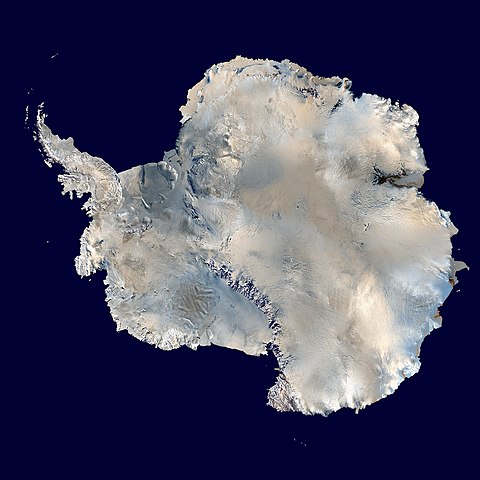
Now imagine just 0.159 159 of those 1 cubic kilometer ice blocks missing each year. Scary, huh? Damian Carrington at the Guardian thinks so:

And so, the loss of 0.159 159 cubic kilometers of ice per year is apparently headline worthy, because at that rate of loss, it would take 169,811 years to lose all the 27 million cubic kilometers of Antarctic ice.
I’m pretty sure we’ll have gone through a few ice ages by then.
(Update: I made an error in the initial post with units, where I conflated kiloton/gigaton in one step, fixed)
Stephen Richards said:
How does ice melt in the interior of antartica? The temp never rises above freezing. Ice ‘lose’ in this context is probably due to ic sliding down to the sea not being replaced fast enough in the interior. The faster slide may be due to the past million years or so of grinding away an easier route to the sea.
Probably due to sublimation. The ice slowly sublimates by changing directly from solid form to vapor form. This can occur even at temperatures below freezing.
Regrettably, I neglected to include the word <anomaly in my post immediately prior. The lines should read: “…reported global sea ice anomaly…” and “…Global sea ice anomaly before May 15…”
All apologies- this is my 2nd cup of coffee this morning, so that excuse won’t work.
” Billy Liar says: May 20, 2014 at 1:18 am
No need to worry, Antarctica’s loss is Greenland’s gain.
Greenland has gained about 500Gt since 1 September last year. On average it gains 400Gt/year.
Of course, in order to stop it catastrophically building up into an enormously high mountain it has to calve that accumulation every year into the sea via its outlet glaciers – that’s a lot of icebergs.
http://www.dmi.dk/en/groenland/maalinger/greenland-ice-sheet-surface-mass-budget/”
And so the net balance with calving is a loss of 200GT per year. Again, another very small number.
“The calving loss is greater than the gain from surface mass balance, and Greenland is losing mass at about 200 Gt/yr.”
“This study does a nice job of revealing the strong thinning along the Amundsen Coast, which is consistent with theory and models indicating this region is in the early stages of collapse.”
Well, that at least explains all those useless models, maybe they should take up the catwalk instead !
‘Professor David Vaughan of the British Antarctic Survey said: “The increasing contribution of Antarctica … – this study puts us exactly where we need to be.”’
My god (and not your’s) does that sound like a credit card commercial from days past: ‘It’s everywhere you wanna’ be.’ I’d say it’s time to let the copyright infringement lawsuits fly.
Aw, what the heck, might as well join ’em: Climate scientists, politicians, and lawyers; they’re everywhere you’re gonna’ be.
Need error bars and longer string of data. There is absolutely no way to classify this study as anything but a single snapshot in time. To compare it with “the last 5 years” is totally inappropriate science. This kind of garbage science-by-media is meant to sway political opinion and move public emotions, not advance scientific knowledge.
Joel O’Bryan says:
May 20, 2014 at 1:52 am
> In the US system.
…
> 1 Terra = 10^12
> 1 Trillion = 10^12
Tera, not Terra!
Sanity check required at WUWT!
– you divided by 1000 when you shouldn’t have!
It’s 0.43mm / year
Mike Jonas says:
May 20, 2014 at 4:10 am
“0.5mm/year. Not at all trivial.“. So what is trivial? Well, I reckon anything under, say, 1 foot per century is trivial. So how much is 0.5mm/year? It’s 2 inches per century.
This is only dangerous to the few Rip Van Winkles who fall asleep on the beach for 50+ years, I guess. The water will inexorably rise 0.5mm a year and they will inevitably drown before they wake.
If we put up an 8″ concrete curb around any susceptible building would we not be safe for 4 centuries?
As Geoff notes above:
159 gigatonnes = 159 km3.
According to Wikipedia, the Antarctic ice sheet = 26,500,000 km3
Therefore, the loss is equal to 0.0006% per year. If your satellite is accurate enough to measure that, well, that’s pretty impressive.
Time to melt at a constant pace: 170,000 years.
I am further hard-pressed to understand the mechanism of loss. Temperatures are ordinarily well below zero, with the coldest ever temperature of -135 deg C recorded in Antarctica just this past December. Surface temperatures should have minimal effect on temperatures at the base of the glaciers.
I would add that annual precipitation is reported as 166 mm per year, representing a volume of 23 Gt over the continent as a whole.
I’m not a big fan of the Cryosat’s. I waded through their raw data once and the numbers change by so much from orbit to orbit for the same area that it just looks random to me. High orbits can do this for single satellites.
For the Arctic sea ice thickness (which was Cryosat2’s primary mission), it has only been able to make estimates for a few months out of the year (and that is after months and months of data analysis). The mission controllers were looking to expand the mission into other areas given how poor the data was.
I would also be interested to see if they used the new glacial isostatic rebound models produced by GPS stations which showed that the vertical uplift from ice age rebound is only about half of what the previous models used.
On the ESA website, there is a very good image of what Cryosat2 found for elevation changes which could probably be added to the headpost.
Basically, not much happening except for a few areas gaining about 1 metre per year with west Antarctica coastal areas losing +1 metres/year.
http://www.esa.int/var/esa/storage/images/esa_multimedia/images/antarctica_s_ice_loss/14529671-1-eng-GB/Antarctica_s_ice_loss_node_full_image.jpg
The West Antarctic Ice Sheet has been in existence for over 30 million years, so I doubt if it is going to disappear soon:
http://wattsupwiththat.com/2013/09/04/more-settled-science-the-west-antarctic-ice-sheet-is-20-million-years-older-than-thought/
And there was a paper published in 2008 (although I have not read it), that said the snow accumulation in Western Antarctica has more than doubled since 1850.
Thomas, E.R., Marshall, G.J. and McConnell, J.R. 2008. A doubling in snow accumulation in
the western Antarctic Peninsula since 1850. Geophysical Research Letters, 35, LO1 706,
doi:10.1029/2007GL032529
I think my house is safe for a while.
“Or, in terms of gigatonnes:
1 Gt x (1 km³/Gt) / 361 x 106 km² = 2.78 x 10⁻⁶ meters = 2.78 microns / Gt
That is, one cubic kilometer of water (i.e., one gigatonne of water) will add less than 3 millionths of a meter to the oceans!
From the press release, we are seeing about 159 billion tons/year of ice converted to meltwater (unless it sublimates), so the effect on sea level would be 159/1000 or 0.159 x 3 millionths of a meter, or 0.477 millionths of meter of sea level rise per year from this.”
As I see it the conclusion is wrong as 159 billion tons of ice melting would add 159 x 3 millionths of a meter or 477 millionths of a meter to sea levels. To me 477 millionths of a meter is 0.000477 metres or 0.477 mm per year.
“or 0.477 millionths of meter of sea level rise per year from this” This conclusion must be wrong to the tune of a factor of 1000 as been pointed out. I don’t understand why this issue is not being addressed in the original text above or prove me wrong.
Glad to hear one of my clan has found employment.
The warmist arithmetic is correct at around positive 0.45 mm/year. That is slightly larger than the estimated ±0.4 mm/yr uncertainty in the GMSL estimate, but the applied glacial isostatic adjustment is a negative 0.3 mm/yr, so we’re back within the uncertainty range.
So, relocate the penguins to Barrow?
Something completely ignored in any articles on the Antarctic glacial balance is that the area of the continent prone to the biggest fluctuation in calving is also the area of highest precipitation. Also there is an equation that is impossible to calculate fully and that is what % of yearly precipitation in that area actually contributed to glacial mass and according to what model (weather/climate etc etc ). Its entirely possible ( and in my view likely ) that an increase in glacial speed would cause an eventually increase in the rate of increase of annual glacial mass contribution. This is because glacial fractures increase as speed increases and in some locations this helps also to increase the rate of mass increase because of several features. So , in a nutshell , I suspect that this short term observation window used for conclusions on glacial “loss” may be of little real use in determining the overall impact and picture as to what is going on…..
I like how on one of these models which calculate 900 years for total west side glacier melt/collapse/catastrophe the climate scientist makes the remark: think likely the collapse could happen within 200 years. Like why not model that? seriously what good is spending all that time crunching data things that make 900 years if 200 years is better…You could just say THAT…Like…yeAh
So, out of the measured rise in sea levels of 2-3mm per year, this study purports to have found 0.4mm. That leaves rather less for the ocean ate my
homeworkheat through expansion.The 159 (American) billion tons of ice per year does worry me because the overall temperature isn’t increasing much, this tells me the ice loss is probably caused by ice falling off the edges. This could accelerate and if we are unlucky it could lead to a much faster sea level rise, say 1 mm per year. This turns out to be 1cm per 10 years, or almost 9 cm by the end of the century. If I were to add the sea level rise caused by water expansion I get as much as 60 cm. This tells me we need to focus on geoengineering to cool the planet because I don’t see much action to stop growing rice, raising cattle, making cement and burning fossil fuels.
Antarctic Sea-Ice Coverage Continues Breaking Records
http://iceagenow.info/2014/05/antarctic-sea-ice-coverage-continues-breaking-records/
As long as this happens i am not going to worry,
Halley VI[edit]
It is a structure which, like Halley V, is jacked up on legs to keep it above the accumulation of snow. Unlike Halley V, there are skis on the bottom of these legs which allows the building to be relocated periodically.
The maths in the article do not add up.
If a gton of water is 13km^3, then 159 gtons = 159Km^3.
It is still trivial, but if the conversions are done poorly, we will lose the argument in distractions.
Steven Kopits says:
May 20, 2014 at 6:16 am
I am further hard-pressed to understand the mechanism of loss.
=========
Steven
I’m not remotely an expert on this, but I think the answer is in the press release where they talk about ice losses being concentrated in the coastal areas. The coastal areas are at relatively high latitudes (for Antarctica) and can warm up to almost sane temperatures in the Antarctic Summer. I checked the temp at McMurdo Station one day this January and found it to be 39F. (Warmer than much of the Eastern US on that particular day). Also if the sun is relativey high in the sky, ice and snow can melt at somewhat subfreezing air temperatures if exposed to direct sunlight.
This post is in serious need of a re-write to correct some basic but critical math errors, which result in a “sanity check” being out 3 orders of magnitude.
This is also a very good example of why we should permanently do away with the long-scale definition of “billions”.
[try doing a refresh -mod]
Drat. make that relatively LOW latitudes (for Antarctica) ….
These numbers relate to GROSS ice loss, which take no account of accumulating snowfall, rendering them almost entirely meaningless.
The NET figures, which are the ones which are actually important, show a somewhat different story :
http://wattsupwiththat.com/2012/09/10/icesat-data-shows-mass-gains-of-the-antarctic-ice-sheet-exceed-losses/