But in fact the catastrophe may have been set in motion by a warm, wet year over Greenland in 1908, resulting in greater snow accumulation. Writing in the journal Weather, Grant Bigg and David Wilton of Sheffield University explain how the snow soaked through cracks in the ice sheet, encouraging excess iceberg calving over the following few years. Soberingly, global warming has increased iceberg hazard greatly in recent decades, making years like 1912 more the norm than the exception.
Yeah, but have a look at what this research actually says and you’ll understand why The Guardian is nothing more than agitprop.
Titanic Sunk During Average Iceberg Year
“more than a century of Atlantic iceberg counts reveals 1912 was an average year for dangerous floating ice.”
Old Coast Guard records are throwing cold water on a long-standing explanation for the loss of the Titanic: the suggestion that the fateful journey took place in waters bristling with icebergs, making 1912 an unlucky year to sail the North Atlantic.
Instead, more than a century of Atlantic iceberg counts reveals 1912 was an average year for dangerous floating ice. The findings also contradict a popular notion that the Jakobshavn Isbrae glacier on Greenland’s west coast birthed the Titanic’s deadly ‘berg. Instead, a computer model suggests that one of the glaciers at Greenland’s southern tip released the iceberg that hit the Titanic on April 14, 1912, drowning more than 1,500 people in the frigid ocean.
“I think the question of whether this was an unusual year has been laid to rest,” said Grant Bigg, an environmental scientist at the University of Sheffield and lead study author, adding, “1912 is not an exceptional year.”
…
According to Bigg, 1912 was a high ice year, but not exceptional compared with the surrounding decades.
In 1912, data shows that 1,038 icebergs moved south from Arctic waters, and crossed the 48th parallel. The Coast Guard records show a slightly higher number of 1,041 icebergs crossed south of 48 degrees north in 1909. Between 1901 and 1920, five years saw at least 700 icebergs drift below 48 degrees north, where they could menace ships.
And, inconveniently according to GISS, it was the third coldest year on record. And, the years following it were still quite cold.
Then there is the fact that radar has been around for about 65 years, though some folks think that ship radar might not help against global warming icebergs. They hide in the deep ocean and then surface right in front of the ships. (Thanks Roy)
Image from the bridge of the Ocean Nova Antarctica Cruise Ship
“””Soberingly, global warming has increased iceberg hazard greatly in recent decades, making years like 1912 more the norm than the exception.”””
Kate should be forgiven for her anecdotal remark. After all tragedy struck close to home, when her colleague Laurence Topham aka Peanut Butter Banana Milkshake Boy, was trapped by icebergs in the Antarctic over last Christmas.
Whose to say those icebergs didn’t come from Greenland? A product of snow soaking through cracks in the ice sheet?
The number one cause of the Titanic sinking was poor judgement by Captain Smith, who continued through known iceberg waters at night rather than heave to until better visibility in the morning. Poor metallurgy in the wrought iron rivets may have contributed to the disaster by opening more watertight compartments than would otherwise have been the case, but that is secondary to poor command judgement.
Almost exactly 100 years later the Costa Concordia, with all the best modern navigation instruments and communication gear was likewise sunk by poor command judgement. It was only the very near proximity to land, the shallower bottom (so the entire hull never submerged), and the warmer water which combined to prevent a much larger loss of life. Underwater pictures of the hull show a ribbon of steel stripped from the hull like opening a coffee tin.
100 years of progress have not altered this simple fact: a large ship moving at speed which encounters an unyielding underwater object will suffer extensive hull damage sufficient to cripple or sink the ship. Icebergs, ships, and other hazards await the careless navigator with a most unpleasant result. Global warming, real or imagined, does not increase this risk one iota.
Eamon Butler
April 28, 2014 12:30 pm
But, did we not have ”dangerous” levels of Co2, above 350ppm, until the 1970s?
John F. Hultquist
April 28, 2014 12:43 pm
Kate (Bless her heart!) had a note that Steven Goddard commented on here: http://stevengoddard.wordpress.com/2014/04/21/guardian-has-a-new-prophet/
The first part of my comment there was
“I wonder if Kate R., of the Guardian has any earth science background?”
I think we now know the answer is none, nada, zero, zip, zilch.
Mac the Knife
April 28, 2014 1:22 pm
With their penchant for alarmism at every perturbation in local weather and their continuing loss of credibility, Global Warming may be what eventually ‘sinks’ The Guardian!
One can only hope…
Reblogged this on Two Heads are Better Than One and commented:
Good grief, what are the “Global Warm-inistas” gonna blame on Climate Change/AGW next? The Civil War, maybe? The Black Death? The Chicago Cubs? …Why not?
jorgekafkazar
April 28, 2014 2:12 pm
John Whitman says: ” ‘The Guardian’ is the Titanic.”
The Guardian is not fit for lining the bottom of my budgie’s cage. The recent addition of Darth Ravilious does not represent an improvement.
Just think of all the disasters that would have been avoided if it hadn’t been for Global Warming?
I mean, think of how much better professional hockey teams would since we all would have learned to ice skate before we could walk?
The US national pastime would have been curling instead of baseball!
We’ve lost so much because it’s not freezing outside.
John Whitman
April 28, 2014 2:58 pm
jorgekafkazar says:
April 28, 2014 at 2:12 pm
John Whitman says: ” ‘The Guardian’ is the Titanic.”
The Guardian is not fit for lining the bottom of my budgie’s cage. The recent addition of Darth Ravilious does not represent an improvement.
– – – – – – – – – – –
jorgekafkazar,
I had to look up budgie and Darth Ravilious.
Sounds like you shouldn’t use ‘The Guardian’ to wrap your fish & chips in either. Well, assuming people do actually wrap their fish & chips in old newspapers, maybe I am a bit outdated.
John
John Whitman
April 28, 2014 3:01 pm
And what or whom is ‘The Guardian’ guarding, exactly?
John
james
April 28, 2014 3:32 pm
AGW can do anything now bow down to your new master.
I served my apprenticeship as a ships engineer – took/sat all the exams – did the “Workshop Experience” plus the necessary sea time afloat – and therefore I consider myself as being a qualified “Ship’s Engineer” – Especially as I have successfully been in charge of “Engines Afloat” (that’s ships at sea) for more than 40 years.
Now then, in the case of the “Titanic” the “Home Office” (Cunard Line) would have published a “leaving and an arrival time” for the ship (Titanic). – They always do!
The Captain of the said ship, is/was the man in charge,
The Captain has got a “choice”. He can, if he likes, make the ship dock late – which is not in accordance with the “Shipping Company’s brochure” or he can make the ship “dock early” which is going to upset all other dockings, i.e make them late.
Either one case is a sacking offence.
So you may say: “who wants to be a “Captain of a ship” under those conditions? – Well, lots of people. You see; an Atlantic Crossing is estimated – in calm waters – to take 12 days – rough waters can extend this to 15 days. The shipping Company then make their brochures arrival times exact. —— And that is why sometimes ships are idling (waiting for this, that and the other – sometimes for hours) before they dock.
lol
And the band played on as HMS Guardian sank below the waves….
Mike T
April 28, 2014 5:21 pm
E.M. Smith wrote: “So once the berg was spotted, they could not turn away fast enough. And once it was hit, the iron fractured instead of bending.” True, but Titanic’s other problem was that she didn’t have watertight compartments, merely tall bulkheads which were progressively overtopped as the bow sank, reaching a point of no return.
UAN
April 28, 2014 10:21 pm
People who ignore history are condemned to repeat it. The truth is it’s irrelevant whether 1912 was a normal year for ice bergs, below average, or the beginning of climate doom.
It was hubris, pure and simple, that sunk the Titantic. The “unsinkable” ship whose captain threw all caution to the wind to set a record crossing of the Atlantic.
The disaster compounded after the collision when ships in the area were slow to respond, when there was no orderly evacuation of the ship, etc.
So in that respect, the disaster was man-made.
But this story also illustrates the failing of history. History has nothing to do with the past, it’s always about what is relevant for the present, and history is spun with lessons the historian, or those referencing history, wants the people of their day to learn today.
Patrick
April 28, 2014 10:44 pm
:Mike T says:
April 28, 2014 at 5:21 pm”
Not only were they not water tight, about half of the first 6 bulkheads topped out as little as 3 metres above the water line. This design change was to accomodate luxury fittings for passengers.
Rhys Jaggar
April 29, 2014 12:19 am
‘Kate started out as a geologist, but after slicing up thousands of rocks for her PhD she realised that she was too impatient to be a scientist, and better suited to being nosy about other people’s research. ‘
A quote from the Guardian writer’s own website Bio.
One wonders whether she also has the patience to do the due diligence on the science of others? Nosiness only gets you so far, one suspects……….
Psalmon
April 29, 2014 6:18 am
The Titanic used to dump 100 tons of coal ash per day into the Atlantic while underway.
Aren’t we lucky technology advanced beyond big boats to fly people back and forth faster, cleaner, and cheaper.
Amazing how that works.
Acknowledgements
This work was funded by the Natural Environmental Research Council (NERC) grant NE/H023402/1. The twentieth century reanalysis data were obtained from the Research Data Archive (RDA), which is maintained by the Computational and Information Systems Laboratory at the National Center for Atmospheric Research (NCAR). The I48N iceberg series comes from http://www.navcen.uscg.gov/pdf/iip/International_Ice_Patrols_Iceberg_Counts_1900_to_2011.pdf
Which leads you to this.
International Ice Patrol’s Iceberg Counts
1900-2011
Donald L. Murphy
Introduction
Each year, the International Ice Patrol (IIP) estimates the number of icebergs that pass south of 48° N, the latitude south of which icebergs are considered a menace to North Atlantic mariners. The dataset (Table 1) extends from 1900, 12 years before the sinking of RMS Titanic, to the present. For several reasons, these iceberg counts do not constitute a rigorous, scientific data set and should be interpreted with great care. For example, IIP’s reconnaissance operations focus on the icebergs closest to the transatlantic shipping routes, and rarely does IIP conduct a comprehensive survey of the area south of 48° N. In addition, the methods of observation have changed radically over the years as new technologies became available to detect and track icebergs. The earliest data were obtained from visual observations from early 1900s sailing vessels, while the recent information is obtained from visual and radar observations from modern ships, aircraft, and satellites……
Observations versus Estimates The earliest counts were simply a total number of icebergs observed south of 48° N. The icebergs were seen by vessels traversing the northwest Atlantic and reported to the U. S. Hydrographic Service or, after 1913, to the Ice Patrol vessel. The details of the counting process are not known, but it is likely that efforts were made to avoid counting duplicate observations. This task is more challenging than it seems. An iceberg’s appearance can change dramatically from day to day and the complex ocean currents make it difficult to predict the movement of an iceberg accurately, even for short periods. As a result, IIP was careful to refer to the monthly iceberg counts as estimates (IIP, 1927)…… http://www.navcen.uscg.gov/?pageName=IIPIcebergCounts
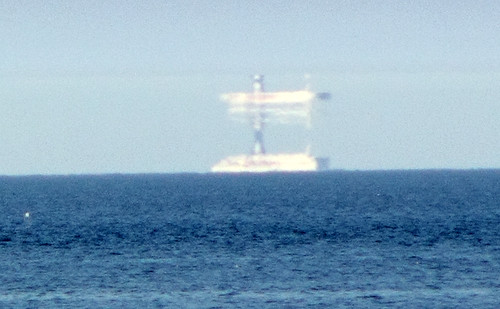
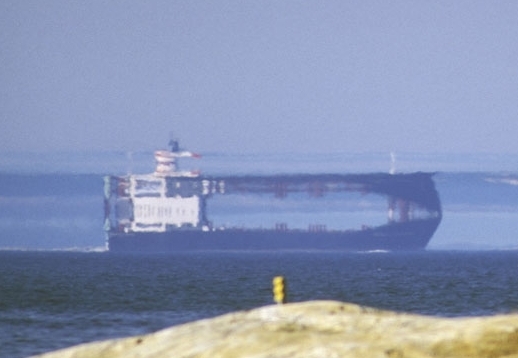
Actually, it was cold weather that caused the sinking. The very cold air under a temperature inversion causes refraction – the opposite of a desert mirage on a hot day.
A hot mirage makes the sky appear lower, within the desert sands. A cold mirage makes a ship or an iceberg rise up above the sea. And the SS Californian was one among many ships that reported “super refraction” that night.
Here is what a cold mirage looks like, with ships floating in the sky: http://farm7.staticflickr.com/6108/6890136342_3b331f1e89.jpg http://images.huffingtonpost.com/gen/52444/original.jpg
You can imagine how confusing this effect would be at night.
Ralph
Mike T says: April 28, 2014 at 5:21 pm “E.M. Smith wrote: “So once the berg was spotted, they could not turn away fast enough. And once it was hit, the iron fractured instead of bending.” True, but Titanic’s other problem was that she didn’t have watertight compartments, merely tall bulkheads which were progressively overtopped as the bow sank, reaching a point of no return.”
Watertight compartments are not required to have a “top” which is watertight. Ships, as was the Titanic, are required to have watertight bulkheads extending from the keel to the bulkhead deck, which is where the watertight bulkheads end. Th Titanic had 15 watertight transverse bulkheads, all extending at least to E deck, and being in excess of BOT requirements. See, for a side elevation should the decks and bulkheads: http://www.titanic-titanic.com/titanic_watertight_compartments.shtml
As I understand it, she was designed so that if the forward four watertight compartments (A, B, C, D) were holed she would float. If compartment E were holed as well she would sink, and did so.
Dudley Horscroft
April 30, 2014 7:51 am
oops, para 2, “elevation should” should read “elevation showing”. And “Th” should be “The”.


http://www.accuweather.com/en/features/trend/titanic_sunk_during_average_ic/25555532
And, inconveniently according to GISS, it was the third coldest year on record. And, the years following it were still quite cold.
Then there is the fact that radar has been around for about 65 years, though some folks think that ship radar might not help against global warming icebergs. They hide in the deep ocean and then surface right in front of the ships. (Thanks Roy)
Tim Ball has a well reasoned analysis:
Titanic Anniversary: Unusual Climate + Extreme Ice Conditions = Tragic Accident
==========================