Just about all indicators are pointing to a moderately strong El Niño for the 2014/15 ENSO season. See the NOAA weekly ENSO update dated March 24, 2014. The subsurface temperature anomalies along the equatorial Pacific associated with the downwelling (warm) Kelvin wave are quite warm. See the cross sections on page 11 of the update:

Figure 1 – Equatorial Pacific Subsurface Temperature Cross Sections
Eventually, some (but not all) of that warm water will rise (be drawn) to the surface.
NOAA also animates those cross sections here.
Weekly NINO3.4 sea surface temperature anomalies (central equatorial Pacific) have crossed zero, from negative to positive, for the first time this year. Unless something unforeseen happens, I would not anticipate them returning to negative values for at least a year, during the transition from El Niño to the trailing La Niña.

Figure 2 – NINO3.4 Sea Surface Temperature Anomalies
Weekly NINO1+2 sea surface temperature anomalies (far eastern equatorial Pacific) are presently quite cool (about -1.0 deg C).

Figure 3 – NINO1+2 Sea Surface Temperature Anomalies
We’ll keep track of the NINO1+2 data because the NOAA/NCEP ENSO forecast (from their CFS.v2 model) now is for a moderate East Pacific El Niño, which are generally stronger than a Central Pacific El Niño (aka El Niño Modoki). The following is page 27 of the NOAA update linked above.

Figure 4 – CFS.v2 ENSO Model Forecast
The NCEP GODAS website produces a number of interesting maps and they produce a monthly ocean briefing.
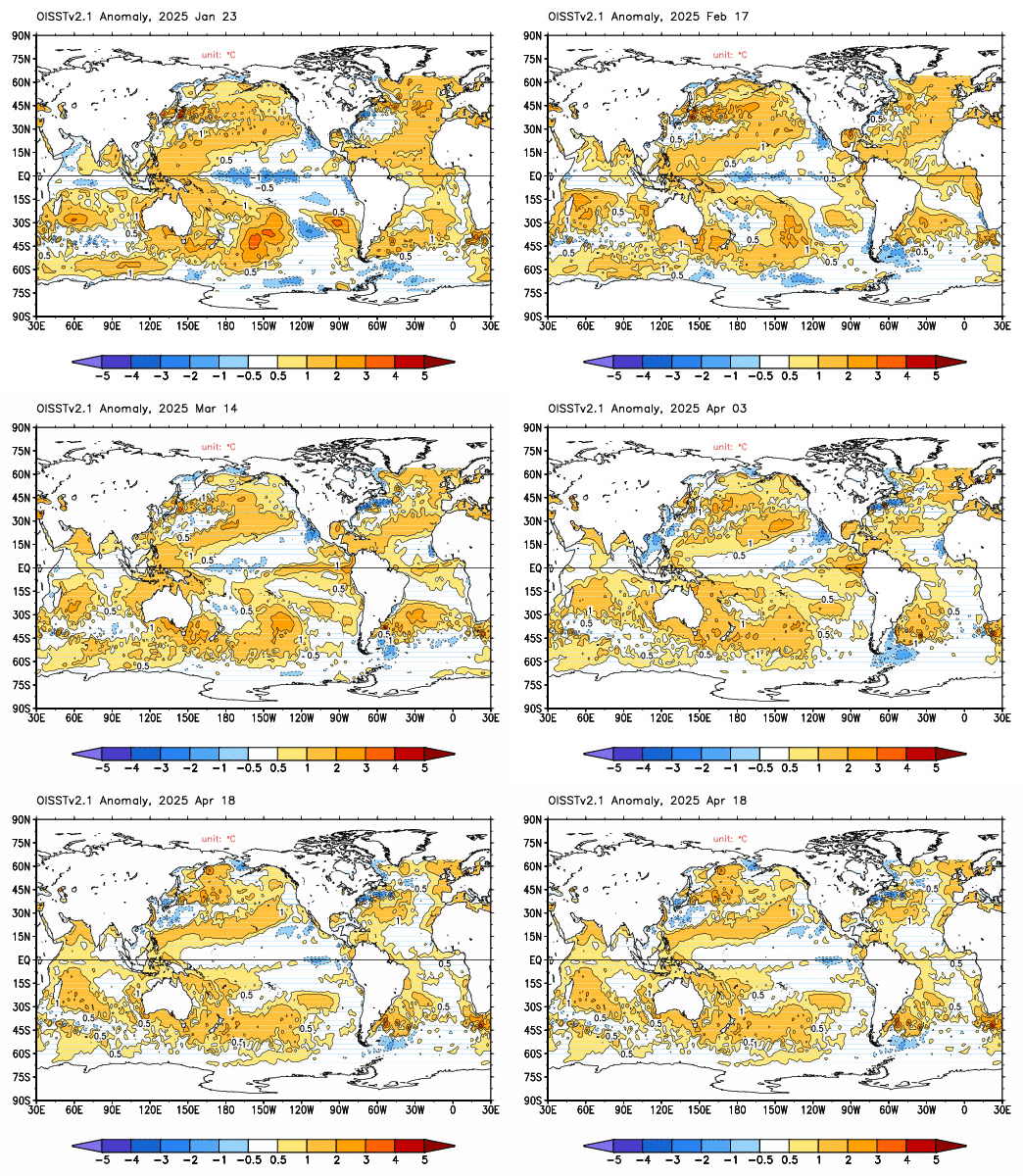
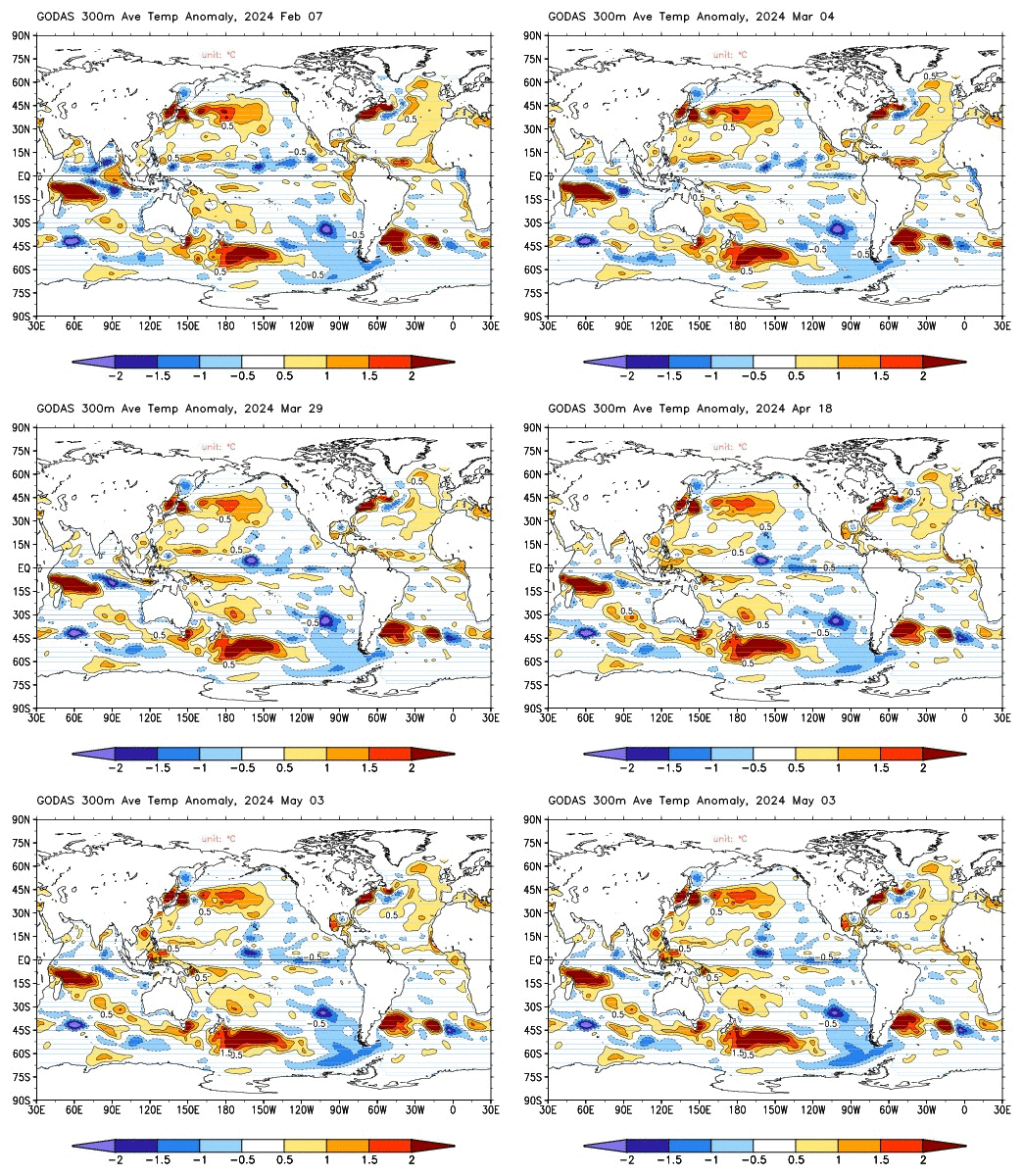
I’ve been downloading the GODAS sea surface temperature maps (see animation here), which are based on the Reynolds OI.v2 data, and their H300 maps (see animation here), the latter of which capture the subsurface temperature anomalies for the top 300 meters (roughly 1000 feet). The NCEP produces the maps on 5-day intervals (with the sea surface temperature maps trailing by about 2 weeks). I’m hoping to continue to download those two sets of maps to produce animations of side-by-side sea surface temperature and H300 maps, not only through the El Niño, but on into the trailing La Niña, so that we can try to keep track of the warm water AFTER the El Niño…
Regards
Hopefully, it will give southwest USA and Texas much needed rainfall next fall-spring.
I cannot see El Nino kicking in until July 2015.
http://www.predictweather.co.nz/ArticleShow.aspx?ID=487&type=home
I doubt that El Nino will kick in before July 2015
http://nz.news.yahoo.com/opinion/post/-/blog/21745961/el-nino-this-year-probably-not/
Better to end the drought and face an increased tropical storm risk in the Gulf than to experience a five plus year drought like in the 1950’s.
It’s looking like a modoki. Temps in ENSO 1 + 2 is dropping. Central Pacific will be warm though. If you look at surface temps. the warm water is retreating (although so is the cold). Trade winds are also picking up strong. It won’t have enough juice.
Oh great! If 2015-16 warms even a little, the alarmists will say… “see, see, the temporary pause is over”…
Nah Jim, the el nino will last until 2015 and then there will be a la nina right after cooling 2015 and 2016.
In debates with warmists for about the last 10 years I was told that the next El Nino would be the one that kicks UAH above the 1998 peak. Since then El Ninos have come and gone but none were more than moderate. The question is how much above will it go? If it is a very strong El Nino, the 13 month running average should hit about 0.55 or 0.15 above the 1998 peak to continue our modest 0.1C or less per decade warming. We need to remember to point that out when the media start going off the deep end.
Lou says:
March 24, 2014 at 3:21 pm
Hopefully, it will give southwest USA and Texas much needed rainfall next fall-spring.
______________________
I’ll second that.
All in favor raise your hand.
It will be interesting to how strong el nino respond in the different weather regime we seem to be in since PDO, AMO, and low solar cycle. I suspect that the heat change will be very different. If the low cloud response to el Nino is smaller, I bet there’s a lot less heat flux from the ocean.
I think the “el Nino” could be much shorter than a year. In fact the west-central Pacific warm water which is facing off against a comparable mass of cool water to the east, could merely serve to “prime the pump” for a much stronger following La Nina.
As Jeff also noted the trades are picking up.
Its high noon at the Equatorial Pacific, interesting to see which way it will go.
Time will tell….. and we will learns a bit more about ‘climate predictability’ or lack thereof.
How much influence does the SOI (Southern Oscillation Index) have on El Niño or La Niña? The SOI has dropped dramatically over the past month or so.
http://www.bom.gov.au/climate/enso/monitoring/soi30.png
“It’s looking like a modoki.”
I agree with this. WeatherBell is going with this too, and those guys have a great track record in this area. It will likely be short-lived, ending quickly perhaps over the coming winter. This would be typical of a cold PDO el nino. (I think it’s nominally warm right now, but won’t last)
I too will be watching to see if the Weatherbell crew is correct. They suggest it will fade away after reaching a modest status, due to different factors being in control when the PDO is cold. They also suggest it will be a Modoki.
Regarding next winter: A so-called “super” El Nino drives warm air right across the USA. A “modest” Modoki brings the cold air down into the east of the USA.
It is a huge difference, (especially in terms of propane prices and heating bills.)
It is not so simple as saying, “An El Nino makes it warmer.”
I wonder with all that antarctic sea ice down under and the winter freeze starting , just how vigorous an el nino can it be? I for one am terrified of the coming winter here in the Noeth east USA. Terrified.
Bob, great work as always. As others have noted above, there is more natural variability at work now than just ENSO. If it arises this year as you suspect, my ‘guess’ is it will have less affect than Warmists hope. Reasons have to do with all the other oceanic counter cycles currently in play. Arctic ice reforming is just one tangible marker. Ironically, California drought is another. See the USGS summary in McCabe et. al., Pacific and Atlantic Ocean influences on multidecadal drought frequency, PNAS 101:4136-4141 (2004).
Highest regards
One would expect a reduction in the hurricane forecasts soon.
BruceC says: “How much influence does the SOI (Southern Oscillation Index) have on El Niño or La Niña? The SOI has dropped dramatically over the past month or so.”
The Southern Oscillation Index is an ENSO index like NINO3.4 sea surface temperature anomalies. The SOI presents one of the atmospheric components of ENSO. It represents the difference between the sea level pressures of Darwin, Australia and Tahiti, and, as such, is related to the strength and direction of the trade winds.
Without any comment: http://www.weatherbell.com/saturday-summary-march-22-2014
Its shaping up to be a large event.
I guess I am hoping that there is enough cool water in the Eastern Pacific to moderate/cool off the water because the last thing the debate needs a large El Nino. But it is what it is.
The equatorial cross-section is now comparable to that which occurred in the early stages of the 1997-98 Super-El Nino.
http://www.cpc.ncep.noaa.gov/products/GODAS/mnth_gif/xz/mnth.anom.xz.temp.0n.1997.04.gif
http://www.cpc.ncep.noaa.gov/products/GODAS/pent_gif/xz/pent.anom.xz.temp.0n.1.gif
Equatorial Upper Ocean Temperature anomalies are rising very rapidly (and this measure leads Nino 3.4 index by 1 to 2 months on a consistent basis).
http://www.cpc.ncep.noaa.gov/products/analysis_monitoring/enso_update/heat-last-year.gif
But the eastern Pacific is a little cooler overall than it was 1997-98. And the Trade Winds have not dropped off as far as they did at this point in the development of the 1997-98 Super-El Nino but they have slowed right down in the last month.
http://s24.postimg.org/kx6e4j851/ENSO_vs_Trade_Winds_Feb14.png
Surface ocean currents are also going backwards now across a large fraction of the tropical Pacific which is part of the ENSO oscillation pattern which leads to a strong El Nino.
http://www.cpc.ncep.noaa.gov/products/GODAS/pent_gif/xy/pent.anom.xy.uv15m.1.gif
Isn’t this the wrong time of year for an El Nino?
Retired Engineer John says:
March 24, 2014 at 5:56 pm
Isn’t this the wrong time of year for an El Nino?
—————————————
80% of ENSO events peak in the November to February period so it is the wrong time of the year.
But there is still the 20% which occur off the typical peak periods and it does take several months for the current conditions to continue developing to reach a peak level.
Overall, the current conditions are about 2 months ahead of the earliest typical ENSO timeline (but it has happened before).
Ericskeptic
and if it does this? http://www.woodfortrees.org/plot/uah/from:1997.1/to:1998.3/mean:3/plot/uah/from:1997.1/to:1998.3/trend
what are you going to say when/if it goes up by .8C to a globally averaged temperature of 1.5C anomaly temp?
btw if you take the average from 1975 to now it is 1.8C/decade not 1C as you say.
“Regarding next winter: A so-called “super” El Nino drives warm air right across the USA. A “modest” Modoki brings the cold air down into the east of the USA.”
I well remember the winter of 97-98. Was taking evening classes in Cambridge MA, and was walking to school in shirt sleeves in February. PLayed golf the whole winter. Personally, I’m rooting for a strong one, as I can’t stand the idea of another cold eastern winter.
I’m headed to Florida Keys next February, so I’m probably screwed either way down there. Moduki would be classic cold southern winter, super duper classice el nino stormy cool.