NASA Reveals New Results From Inside the Ozone Hole – Dec. 11, 2013

NASA scientists have revealed the inner workings of the ozone hole that forms annually over Antarctica and found that declining chlorine in the stratosphere has not yet caused a recovery of the ozone hole.
More than 20 years after the Montreal Protocol agreement limited human emissions of ozone-depleting substances, satellites have monitored the area of the annual ozone hole and watched it essentially stabilize, ceasing to grow substantially larger. However, two new studies show that signs of recovery are not yet present, and that temperature and winds are still driving any annual changes in ozone hole size.
“Ozone holes with smaller areas and a larger total amount of ozone are not necessarily evidence of recovery attributable to the expected chlorine decline,” said Susan Strahan of NASA’s Goddard Space Flight Center in Greenbelt, Md. “That assumption is like trying to understand what’s wrong with your car’s engine without lifting the hood.”
To find out what’s been happening under the ozone hole’s hood, Strahan and Natalya Kramarova, also of NASA Goddard, used satellite data to peer inside the hole. The research was presented Wednesday at the annual meeting of the American Geophysical Union in San Francisco.
Kramarova tackled the 2012 ozone hole, the second-smallest hole since the mid 1980s. To find out what caused the hole’s diminutive area, she turned to data from the NASA-NOAA Suomi National Polar-orbiting Partnership satellite, and gained the first look inside the hole with the satellite’s Ozone Mapper and Profiler Suite’s Limb Profiler. Next, data were converted into a map that shows how the amount of ozone differed with altitude throughout the stratosphere in the center of the hole during the 2012 season, from September through November.
The map revealed that the 2012 ozone hole was more complex than previously thought. Increases of ozone at upper altitudes in early October, carried there by winds, occurred above the ozone destruction in the lower stratosphere.
“Our work shows that the classic metrics based on the total ozone values have limitations – they don’t tell us the whole story,” Kramarova said.

The classic metrics create the impression that the ozone hole has improved as a result of the Montreal protocol. In reality, meteorology was responsible for the increased ozone and resulting smaller hole, as ozone-depleting substances that year were still elevated. The study has been submitted to the journal of Atmospheric Chemistry and Physics.
Separate research led by Strahan tackled the holes of 2006 and 2011 – two of the largest and deepest holes in the past decade. Despite their similar area, however, Strahan shows that they became that way for very different reasons.
Strahan used data from the NASA Aura satellite’s Microwave Limb Sounder to track the amount of nitrous oxide, a tracer gas inversely related to the amount of ozone depleting chlorine. The researchers were surprised to find that the holes of 2006 and 2011 contained different amounts of ozone-depleting chlorine. Given that fact, how could the two holes be equally severe?
The researchers next used a model to simulate the chemistry and winds of the atmosphere. Then they re-ran the simulation with the ozone-destroying reactions turned off to understand the role that the winds played in bringing ozone to the Antarctic. Results showed that in 2011, there was less ozone destruction than in 2006 because the winds transported less ozone to the Antarctic – so there was less ozone to lose. This was a meteorological, not chemical effect. In contrast, wind blew more ozone to the Antarctic in 2006 and thus there was more ozone destruction. The research has been submitted to the journal Geophysical Research Letters.
This work shows that the severity of the ozone hole as measured by the classic total column measurements does not reveal the significant year-to-year variations in the two factors that control ozone: the winds that bring ozone to the Antarctic and the chemical loss due to chlorine.
Until chlorine levels in the lower stratosphere decline below the early 1990s level – expected sometime after 2015 but likely by 2030 – temperature and winds will continue to dictate the variable area of the hole in any given year. Not until after the mid 2030s will the decline stratospheric chlorine be the primary factor in the decline of ozone hole area.
“We are still in the period where small changes in chlorine do not affect the area of the ozone hole, which is why it’s too soon to say the ozone hole is recovering,” Strahan said. “We’re going into a period of large variability and there will be bumps in the road before we can identify a clear recovery.”
Related Links
› NASA Goddard’s Ozone Hole Watch website
“Alan the Brit says: December 12, 2013 at 3:18 am
As I understand it, & I am only a humble Chartered Structural Engineer, the hole is nothing of the kind, that it is actually merely a “thinning”,
Yes:
& that there are several of them but the “lesser spotted variety” don’t get a look in!
Yes, NASA refers to them as “Ozone Mini-Holes”;
http://ozonewatch.gsfc.nasa.gov/facts/miniholes_NH.html
[caption id="" align="alignnone" width="578"]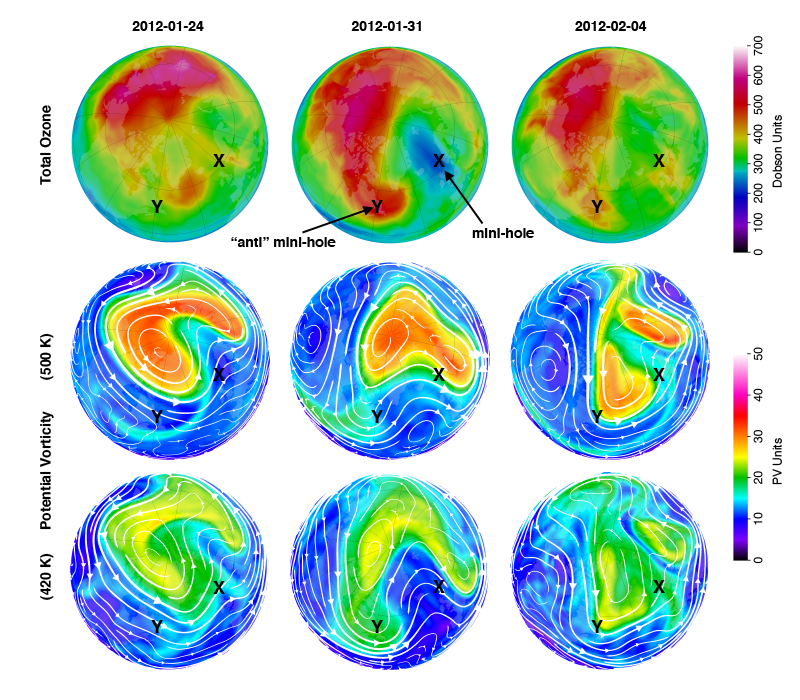 NOAA – National Aeronautics and Space Administration (NASA) Goddard Space Flight Center (GSFC) – Click the pic to view at source[/caption]
Above are:
Also, Polar Vortices and their “Ozone Holes” can split, i.e. in this September 2003 paper, “Ozone Forecasts of the Stratospheric Polar Vortex Splitting Event in September 2002″:
http://www.knmi.nl/~eskes/papers/jas1039_eskes_pp.pdf
Most CFCs were generated in the Northern Hemisphere with its much larger population and industry. So you’d expect a larger hole over the NORTH pole. But by some magical process not yet modelled, or identified by the UN, most of the CFCs generated in the northern hemisphere have filtered downhill, past the equator and down to the south pole where they have wreaked havoc on the south pole ozone.
Is there a new phenomenon where CFC compounds are repelled by the earth’s north pole and attracted to the earth’s south pole?
Gary Pearse says:
December 13, 2013 at 5:54 am
Thank you for that. While it may have some effect in theory, I think the key is from Jim’s site where it says:
“Turbulent mixing thus maintains a homogeneous lower atmosphere.”
Perhaps the effect is noticeable very high up where the molecules are very spread out. Gravity seems to play a role very high up as well, but lower down, other processes dominate.
DocattheAutopsy says: December 11, 2013 at 3:53 pm
Correct me if I am wrong, but didn’t the ozone hole exist in the first satellite records
Yes, the first satellite to measure Ozone concentrations was the Nimbus-7 TOMS Instrument, i.e.:
In support of this assertion they offer these globes that:
[caption id="" align="alignnone" width="578"] NASA – Earth Observatory – Click the pic to view at source[/caption]
[caption id="" align="alignnone" width="578"]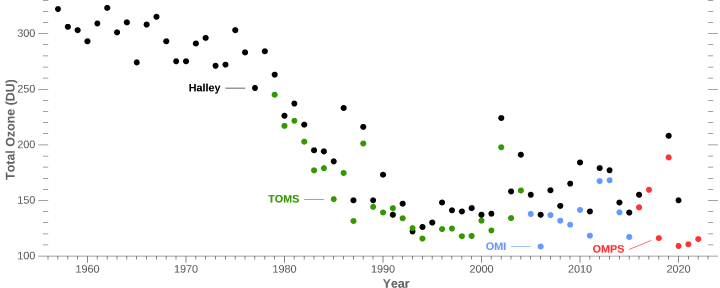 NOAA – National Aeronautics and Space Administration (NASA) Goddard Space Flight Center (GSFC) – Click the pic to view at source[/caption]
Here’s:
[caption id="" align="alignnone" width="578"] The Center for Coastal Physical Oceanography at Old Dominion Universityy – Click the pic to view at source[/caption]
Also, not satellite, but:
[caption id="" align="alignnone" width="578"]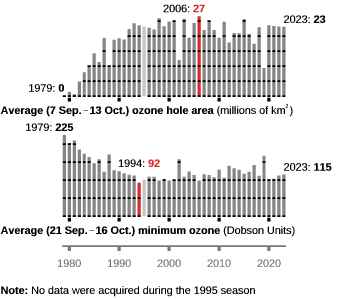 The Center for Coastal Physical Oceanography at Old Dominion Universityy – Click the pic to view at source[/caption]
http://ozonewatch.gsfc.nasa.gov/statistics/meteorology_annual.png
_Jim says:
December 13, 2013 at 11:31 am
re: Phil. says December 13, 2013 at 10:45 am
Post was kinda thin on specifics there Phil .. one resource is sitting behind a paywall.
Unlike all the the posts on here that erroneously assert that no such measurements have been made with no cites to back them up!
scarletmacaw says:
December 13, 2013 at 3:06 pm
Phil. says:
December 13, 2013 at 10:45 am
Thanks for the links. I’m curious as to what they actually say since the first link is an undescribed graph and the second is just an abstract. How were the measurements made in 1975?
The first link appears too smooth to be a graph of actual measurements, so I suspect it is a model.
You’d be wrong.
It doesn’t take much to work back from the fig to the original url:
http://www.epa.gov/ozone/science/myths/heavier.html
“Source: World Meteorological Organization, Scientific Assessment of Ozone Depletion: 1998, WMO Global Ozone Research and Monitoring Project – Report No. 44, Geneva, 1998.”
The paper was not behind a paywall for me but there are these things called libraries where you can access the papers without paying.
As it says in the paper the measurements were made using GC with electron capture detection.
Here’s another paper discussing more recent satellite measurements (figs 6 and 7):
http://www.atmos-chem-phys-discuss.net/12/28733/2012/acpd-12-28733-2012.pdf
‘Thin’ is still thin, Phil, no matter your assertions to the contrary, and adds little to nothing to the discussion; failure to ‘make your case’ with very thin soup is a reflection on Phil, not _Jim.
.
dsystem says:
December 13, 2013 at 8:22 pm
Most CFCs were generated in the Northern Hemisphere with its much larger population and industry. So you’d expect a larger hole over the NORTH pole. But by some magical process not yet modelled, or identified by the UN, most of the CFCs generated in the northern hemisphere have filtered downhill, past the equator and down to the south pole where they have wreaked havoc on the south pole ozone.
Is there a new phenomenon where CFC compounds are repelled by the earth’s north pole and attracted to the earth’s south pole?
If you actually took the trouble to read about the subject you’d learn that due to the colder air PSCs form above the antarctic but not often over the arctic and the heterogeneous reaction with ozone takes place on those. That is why the hole over the antarctic is more significant.
_Jim says:
December 14, 2013 at 10:03 am
_Jim says December 13, 2013 at 11:31 am
Post was kinda thin on specifics there Phil .. one resource is sitting behind a paywall.
Phil. says December 14, 2013 at 6:40 am
Unlike all the the posts on here that erroneously assert that no such measurements have been made with no cites to back them up!
‘Thin’ is still thin, Phil, no matter your assertions to the contrary, and adds little to nothing to the discussion; failure to ‘make your case’ with very thin soup is a reflection on Phil, not _Jim.
Actually I’ve added a website and two papers to the discussion, _Jim has added nothing but two content free comments.
I remeber in the last solar minimum in 2008, there was a huge ozone hole over the Arctic and probably the Antarctic as well. At that time, it was suggested that cosmic rays were the cause. The Montreal Protocol was just a hoax played on the world by Dupont. No need to ban Freon except that Dupont’s patent had run out.
It is interesting to notice how many people have recognized – nay condemned – the ability of a company to benefit from the use of environmental legislation, mandates, and bans in order to sell their own replacement technology.
But the same people cannot understand how AGW falsehoods allow countless companies peddling worthless wares such as CFLs and wind turbines to sell unwanted garbage to unwilling customers.
Do you have something in mind? Just curious what exactly it is you’re driving at. To date, anything pointing in that direction (re: CFCs) has been conjecture with no actual supporting ‘facts’.
.
Eve says December 14, 2013 at 8:12 pm
..
No need to ban Freon except that Dupont’s patent had run out.
What patent, Eve? Everybody says this, no one seems to be able to actually source ‘facts’ for this conclusion.
Call it an Urban Myth then …
.
Is it that Phil cannot read? Proceeds to inflate his own meager contribution?
[trimmed. Mod]
.
@_Jim, my meaning is in the second paragraph, not the first.
“But the same people [making the claims against DuPont] cannot understand how AGW falsehoods allow countless companies peddling worthless wares – such as CFLs and wind turbines – to sell unwanted garbage to unwilling customers.”
MKelly, thanks for the correction. Dobson, of course discovered the annual (and natural) diminishing ozone levels in the polar regions during their respective sunless winters.
But it’s also fair to say that when the TOMS satellite measured the extent and level of ozone depletion in the 70s, there was little common understanding of the scope. Because of the large extent of depletion, there was a wave of popularization and alarmism that did NOT occur when Dobson observed ozone depletion in the 1950s. This is the phenomenon I was describing as ‘discovery.’ Perhaps it was an unfortunate choice of words.
Ironically, when the satellite era “discovery” of the ozone hole became part of the pop culture, pop science almost universally ignored the lessons of Dobson’s research. They immediately began to manufacture an anthropogenic attribution as the cause. Had most atmospheric scientists properly internalized Dobson’s work, at the time of the satellite measurements the so-called “ozone hole” would have been immediately explained to the world as a completely natural, annual event, perhaps somewhat larger than previously thought. The objective process would have been front and center, and policy makers would have been told that ozone levels fall rapidly when ozone is not refreshed by solar UV interactions in the atmosphere. We would not now be stuck with the current sad and stupid state we’re in, in which the CFC myth is still accepted by many people as the cause for the ozone hole.
Phil. says: December 14, 2013 at 2:15 pm
“If you actually took the trouble to read about the subject you’d learn that due to the colder air PSCs form above the antarctic but not often over the arctic and the heterogeneous reaction with ozone takes place on those. That is why the hole over the antarctic is more significant.”
Good news then. We only need to ban CFCs in the Southern hemisphere.
dsystem says:
December 15, 2013 at 1:15 pm
Phil. says: December 14, 2013 at 2:15 pm
“If you actually took the trouble to read about the subject you’d learn that due to the colder air PSCs form above the antarctic but not often over the arctic and the heterogeneous reaction with ozone takes place on those. That is why the hole over the antarctic is more significant.”
Good news then. We only need to ban CFCs in the Southern hemisphere.
As long as you can build a barrier to prevent the N hemisphere air crossing the equator, that might prove to be tricky as well as having unforeseen consequences!
Mickey Reno says:
December 15, 2013 at 6:25 am
MKelly, thanks for the correction. Dobson, of course discovered the annual (and natural) diminishing ozone levels in the polar regions during their respective sunless winters.
But it’s also fair to say that when the TOMS satellite measured the extent and level of ozone depletion in the 70s, there was little common understanding of the scope. Because of the large extent of depletion, there was a wave of popularization and alarmism that did NOT occur when Dobson observed ozone depletion in the 1950s. This is the phenomenon I was describing as ‘discovery.’ Perhaps it was an unfortunate choice of words.
It was the discovery of the increasing depth of the ozone hole starting around 1977 by Dobson’s colleagues led by Farman (using Dobson’s instruments), which was published in 1984 which showed the progressive ‘expansion’ of the ozone hole. NASA the went back and looked at their data and corroborated the British Antarctic Survey results.
Ironically, when the satellite era “discovery” of the ozone hole became part of the pop culture, pop science almost universally ignored the lessons of Dobson’s research. They immediately began to manufacture an anthropogenic attribution as the cause. Had most atmospheric scientists properly internalized Dobson’s work, at the time of the satellite measurements the so-called “ozone hole” would have been immediately explained to the world as a completely natural, annual event, perhaps somewhat larger than previously thought.
Completely wrong, Dobson’s research was taken on board and it was well known that there was a seasonal natural fluctuation, it was the amplification of the seasonal decline that needed to be explained.
The objective process would have been front and center, and policy makers would have been told that ozone levels fall rapidly when ozone is not refreshed by solar UV interactions in the atmosphere. We would not now be stuck with the current sad and stupid state we’re in, in which the CFC myth is still accepted by many people as the cause for the ozone hole.
No after how much you would like it to be it’s not a myth. There are several myths propagated in this thread though, such as: ‘no one has ever actually detected CFCs in the stratosphere’, ‘depletion only occurs , or ever will occur over the sunless winter poles’ (no, it’s in the spring), ‘Proff James Lovelock of Gaia fame and also the inventor of an instrument to measure ozone levels from the ground’, (he didn’t, that was Dobson, Lovelock invented the EC detector, which was used to measure stratospheric ozone), ‘I read that Freon (R-22) was too heavy to make it to the ozone hole and therefore unable to destroy the ozone hole’, and DuPont’s patents ran out!
You’re essentially saying that based on 20-30 years of limited research from the pre-satellite era, scientists understood all possible natural variations in the extent of the ozone hole. And any change from that level of understanding must be anthropogenically caused. Thank you for so nicely equating ozone hole alarmism with climate change alarmism, generally.
I use the word myth advisedly. I’m not claiming chemical reactions between CFCs and ozone don’t happen. I’m saying the evidence that anthropogenic releases of CFCs CAUSE the polar ozone holes are speculative and weak, and that natural variation in the ozone hole’s extent is not well understood. Yet, pop science continues to make the claim that CFCs significantly affect the polar ozone holes without clear evidence that shows clear connections between CFC levels (pre and post Montreal), and the size of the annual ‘holes.’ And, just as in climate change alarmism, future predictions of mitigation are vague, far off, and unmeasurable. Recent research and advocacy on ozone and CFCs offer two mutually exclusive results, on the one hand saying that CFCs will not be eliminated from the atmosphere until 2070, with measurable results probably not possible until 2025, and on the other hand, the Antarctic ozone hole has shrunk drastically in that last couple of years, likely as a result of CFC bans.
“I don’t know” is a perfectly acceptable scientific answer and I suggest ozone hole researchers start practicing saying it. But then, there’s far less research grant money when no crisis exists. Correlations between CFC alarmism and grant money are excellent.
Mickey Reno says:
December 17, 2013 at 8:11 am
Phil writes: … “Completely wrong, Dobson’s research was taken on board and it was well known that there was a seasonal natural fluctuation, it was the amplification of the seasonal decline that needed to be explained.”
You’re essentially saying that based on 20-30 years of limited research from the pre-satellite era, scientists understood all possible natural variations in the extent of the ozone hole. And any change from that level of understanding must be anthropogenically caused. Thank you for so nicely equating ozone hole alarmism with climate change alarmism, generally.
You’re showing you bias here, nowhere did I imply that. The observation of the seasonal decline needed to be explained, there was no requirement that it be due to anthropogenic causes. Subsequent measurements showed a negative correlation between CiO and ozone and the chemical reactions whereby CiO acts as a catalyst in the destruction of ozone were identified. So both a mechanism and a correlation have been experimentally determined. Only about 100,000 tonnes of CFC-11 were produced prior to Farman’s measurements starting in 1956 whereas over 8,000,000 tonnes were produced afterwards prior to 1992, and slightly higher values for CFC-12. So contrary to your assertion there is plenty of evidence of a direct connection between the release of CFCs and the loss of ozone over Antarctica.
Phil, your statement clearly implies what I inferred. And I am biased. I’m biased against assumptions of causality, when only correlations are in evidence. You should be, too.
Mickey Reno says:
December 18, 2013 at 12:58 pm
Phil, your statement clearly implies what I inferred.
Nowhere is this implied: “And any change from that level of understanding must be anthropogenically caused.”, that is your imagination.
And I am biased. I’m biased against assumptions of causality, when only correlations are in evidence.
There are more than correlations in evidence, there is a proven mechanism too.
Thank you for so nicely equating ozone hole alarmism with climate change alarmism, generally.
This is a fabrication by you, I presented scientific facts concerning the observations of Antarctic ozone depletion and made no reference to climate change!
Phil, I don’t dispute that a chemical mechanism exists, which I’ve already stipulated. I don’t even dispute that the mechanism MIGHT be in play over the polar regions. I’m saying that the existence of this process over the polar regions is not proven by a correlation.between the size of the hole and anthropogenic production of CFCs.
You’re dismissing ALL CAUSES of natural variations in the size of the ozone hole, when you don’t know the scope of natural (pre-CFC) variation. Some of those causes may be unknown to us. Some may depend on regional or local wind/weather patterns, some of which are also poorly understood. You have no evidence that makes it scientifically valid to do that. What you have is a hypothesis, ready for actual experiment and testing, and subject to falsification.
As for my claim that CFC alarmism mirrors global warming alarmism, I’ll stand by my statement. The full scope of natural variation is also dismissed far too casually in CAGW (ie. agenda based) science.
Mickey Reno says:
December 19, 2013 at 8:00 am
Phil, I don’t dispute that a chemical mechanism exists, which I’ve already stipulated. I don’t even dispute that the mechanism MIGHT be in play over the polar regions. I’m saying that the existence of this process over the polar regions is not proven by a correlation.between the size of the hole and anthropogenic production of CFCs.
There is far more corroborative evidence than that as outlined above.
You’re dismissing ALL CAUSES of natural variations in the size of the ozone hole, when you don’t know the scope of natural (pre-CFC) variation. Some of those causes may be unknown to us. Some may depend on regional or local wind/weather patterns, some of which are also poorly understood. You have no evidence that makes it scientifically valid to do that. What you have is a hypothesis, ready for actual experiment and testing, and subject to falsification.
On the contrary I have not done that, that’s your assumption. Winds, for example, are known to have an effect. Part of the chemical mechanism is that chlorine radicals are the catalytic agent and that ClO would be expected to be generated as the ozone is depleted. This is exactly what is observed, no ‘natural’ mechanism would do so.
As for my claim that CFC alarmism mirrors global warming alarmism, I’ll stand by my statement. The full scope of natural variation is also dismissed far too casually in CAGW (ie. agenda based) science.
That’s not what you said, you said “Thank you for so nicely equating ozone hole alarmism with climate change alarmism, generally”, thank you for confirming that it was your claim!.