Press Release: Landsat 8 helps unveil the coldest place on Earth

SAN FRANCISCO, CA—Scientists recently recorded the lowest temperatures on Earth at a desolate and remote ice plateau in East Antarctica, trumping a record set in 1983 and uncovering a new puzzle about the ice-covered continent.
Ted Scambos, lead scientist at the National Snow and Ice Data Center (NSIDC), and his team found temperatures from −92 to −94 degrees Celsius (−134 to −137 degrees Fahrenheit) in a 1,000-kilometer long swath on the highest section of the East Antarctic ice divide.
The measurements were made between 2003 and 2013 by the Moderate Resolution Imaging Spectroradiometer (MODIS) sensor on board NASA’s Aqua satellite and during the 2013 Southern Hemisphere winter by Landsat 8, a new satellite launched early this year by NASA and the U.S. Geological Survey.
“I’ve never been in conditions that cold and I hope I never am,” Scambos said. “I am told that every breath is painful and you have to be extremely careful not to freeze part of your throat or lungs when inhaling.”
The record temperatures are several degrees colder than the previous record of −89.2 degrees Celsius (−128.6 degrees Fahrenheit) measured on July 21, 1983 at the Vostok Research Station in East Antarctica. They are far colder than the lowest recorded temperature in the United States, measured at −62 degrees Celsius (−79.6 degrees Fahrenheit) in Alaska, in northern Asia at -68 degrees Celsius (−90.4 degrees Fahrenheit), or even at the summit of the Greenland Ice Sheet at -75 degrees Celsius (−103 degrees Fahrenheit).
Scambos said the record temperatures were found in several 5 by 10 kilometer (3 by 6 mile) pockets where the topography forms small hollows of a few meters deep (2 to 4 meters, or 6 to 13 feet). These hollows are present just off the ice ridge that runs between Dome Argus and Dome Fuji—the ice dome summits of the East Antarctic Ice Sheet. Antarctic bases sit on each of the sites and are generally not occupied during Antarctic winters.
Under clear winter skies in these areas, cold air forms near the snow surface. Because the cold air is denser than the air above it, it begins to move downhill. The air collects in the nearby hollows and chills still further, if conditions are favorable.
“The record-breaking conditions seem to happen when a wind pattern or an atmospheric pressure gradient tries to move the air back uphill, pushing against the air that was sliding down,” Scambos said. “This allows the air in the low hollows to remain there longer and cool even further under the clear, extremely dry sky conditions,” Scambos said. “When the cold air lingers in these pockets it reaches ultra-low temperatures.”
“Any gardener knows that clear skies and dry air in spring or winter lead to the coldest temperatures at night,” Scambos said. “The thing is, here in the United States and most of Canada, we don’t get a night that lasts three or four or six months long for things to really chill down under extended clear sky conditions.”
Centuries-old ice cracks
Scambos and his team spotted the record low temperatures while working on a related study on unusual cracks on East Antarctica’s ice surface that he suspects are several hundred years old.
“The cracks are probably thermal cracks—the temperature gets so low in winter that the upper layer of the snow actually shrinks to the point that the surface cracks in order to accommodate the cold and the reduction in volume,” Scambos said. “That led us to wonder what the temperature range was. So, we started hunting for the coldest places using data from three satellite sensors.”
More than 30 years of data from the Advanced Very High Resolution Radiometer (AVHRR) on the NOAA Polar Orbiting Environmental Satellite (POES) series gave Scambos a good perspective on what the pattern of low temperatures looked like across Antarctica.
“Landsat 8 is still a new sensor, but preliminary work shows its ability to map the cold pockets in detail,” Scambos said. “It’s showing how even small hummocks stick up through the cold air.”
Scambos suspected they would find one area that got extremely cold. Instead they found a large strip at high altitude where several spots regularly reach record low temperatures. Furthermore, dozens of these extremely cold areas reached about the same minimum temperatures of −92 to −94 degrees Celsius (−134 to −137 degrees Fahrenheit) on most years.
“This is like saying that on the coldest day of the year a whole strip of land from International Falls, Minnesota to Duluth, Minnesota to Great Falls, Montana reached the exact same temperature, and more than once,” Scambos said. “And that’s a little odd.”

—Credit: Ted Scambos, National Snow and Ice Data Center
The scientists suspect that a layer in the atmosphere above the ice plateau reaches a certain minimum temperature and is preventing the ice plateau’s surface from getting any colder.
A physical limit
“There seems to be a physical limit to how cold it can get in this high plateau area and how much heat can escape,” Scambos said. Although an extremely cold place, Antarctica’s surface radiates heat or energy out into space, especially when the atmosphere is dry and free of clouds.
“The levels of carbon dioxide, nitrogen oxide, traces of water vapor and other gases in the air may impose a more or less uniform limit on how much heat can radiate from the surface,” Scambos said.
Scambos and his team will continue to refine their map of Earth’s coldest places using Landsat 8 data. “It’s a remarkable satellite and we’ve repeatedly been impressed with how well it works, not just for mapping temperature but for mapping crops and forests and glaciers all over the world,” Scambos said.
“The uses for Landsat 8 data are broad and diverse,” said James Irons, Landsat 8 project scientist at NASA’s Goddard Space Flight Center in Greenbelt, Md. “And Scambos’ work is an example of some of the intriguing science that can be done using Landsat 8.”
In the longer term, Scambos and his team will try to design weather stations and set them up in the area where the record temperatures occur to confirm the data from Landsat 8 and MODIS. Currently, most of the automated weather stations in the vicinity do not work properly in the dead of winter.
“The research bases there don’t have people that stay through the winter to make temperature measurements,” Scambos said. “We will need to investigate electronics that can survive those temperatures.”
Brian H says:
December 9, 2013 at 10:08 pm
timetochooseagain says:
December 9, 2013 at 10:43 pm
The location is at about 10,000 ft elevation, which drops the pressure to about 70% of sea level. This drops the solidification temperature from the -78.5°C Brian reports to about -82°C.
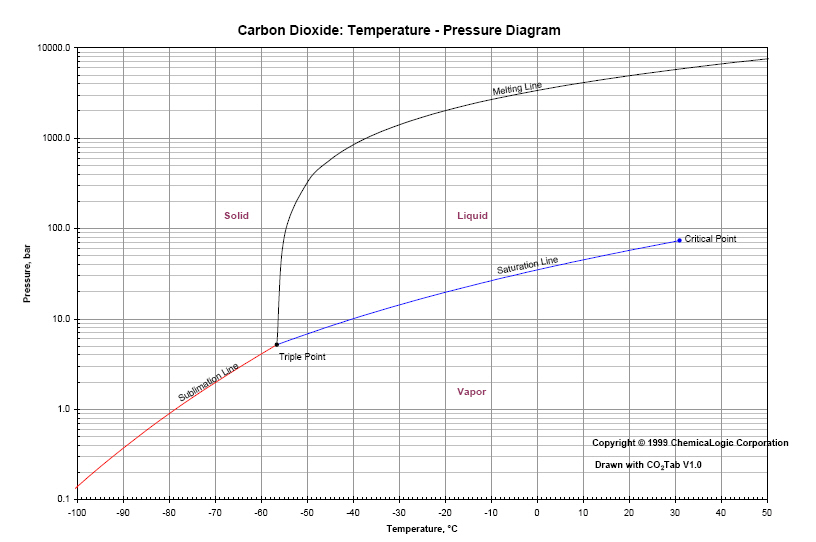
So Brian is still right, if the temperature is correct it’s enough to freeze CO2. I do find it odd that there would be natural CO2 “snow” and “dry ice” at the surface … what a magical world!
w.
<blockquote.Brian H, I believe that figure is for “standard” atmospheric pressure at sea level. Keep in mind this is a high elevation location with significantly reduced surface pressure. I imagine that shifts that number lower. ~timetochooseagain
At ~2.8 km the pressure drops under 700 millibars easily, so work from there?
The value is also for pure CO2, not a mixture with 0.04% CO2 and an accordingly lower vapor pressure.
This story was reported on the BBC breakfast news. I also followed the link provided by DavidS. In both cases there was a total lack of CAGW spin. Is this a first for the BBC?
This is how they try to explain the cold away.
“Just because one spot on Earth has set records for cold that has little to do with global warming because it is one spot in one place”, said Waleed Abdalati, an ice scientist at the University of Colorado and NASA’s former chief scientist
http://news.yahoo.com/cold-dis-comfort-antarctica-set-record-135-8-231816344–politics.html
Patrick says:
December 9, 2013 at 10:28 pm. It’s not Prince Harry’s race. HRH is supporting a team of limbless veterans wounded in our Joint war, sorry, nation-building exercise, in Afghanistan
(cont) would that the scions of America’s Great and Good show as much respect to those wounded in your politicians’ great endeavour.
There was a story out today, before they announced the record that conforms that CO2 transforms from a gas into dry ice at -78.5°C
http://www.weather.com/news/antarctica-sets-cold-record-20131209
However, it won’t be in the Guinness Book of World Records because these were satellite measured, not from thermometers.
http://www.weather.com/news/antarctica-sets-cold-record-20131209
I ran an experiment last night.
my kitchen is now in a real state, food all over the floor, milk bottles standing in the sink and cabbage leaves on the worktop, at least I managed to get all the food out of the fridge, which was a good start.
After 15 minutes the data logger showed -15 inside and there was just enough room, so by sitting sideways I could close the door. even the light went out so it really felt like the antarctic winter.
After an hour or so (I left my watch outside just in case it froze to my wrist) even the oxygen levels had decreased and I found it slightly difficult to breath, (I didnt check the percantage but i imagine it was close to an equivalent 10,000 feet) and terminated this first stage test.
My garage is in a real mess as well now as the chest freezer had to be brought in to play, luckily its a large one and the kitchen fridge fitted neatly inside, (I had to take the hinges off both doors, bolt them together and arrange to close them using gravity.The hole cut in the side to get the cooling coil out can be repaired with a bit of foam after christmas.
Result of test 2.
It was still just as dark which suprised me as I thought it would have been twice as dark, I can fudge that data as its subjective so its ok. Now the temperature came down to minus 33 (thats -15 on the fridge and -18 on the freezer just in case someone asks me to provide the raw data) Now that was cold, my jeans froze solid and I need to remember to leave the silk boxer short off and put some uwarmer clothes on for test 3.
Test 3
my friend has a cold store so we are going to get the fridge and freezer over their next week to continue, will report back but getting down to -90 is going to be a little challenge, I`m now waiting to see if the guiness book of records got my letter asking for funding.
Carpe diem
This merely a local weather variation…..
“The levels of carbon dioxide, nitrogen oxide, traces of water vapor and other gases in the air may impose a more or less uniform limit on how much heat can radiate from the surface,” Scambos said.”
A yes, one must never forget to mention the evil and omnipotent CO2 molecule, which controls Earth’s global: tipping points, warming trends, cooling trends, stasis periods, record cold temps, record warm temps, normal temps, etc., etc., etc.,…
When the CAGW theory finally ends up in the trash bin of history, won’t it be wonderful to read an article on climate that DOESN’T feel the need kowtow to the CAGW gatekeepers?
I’m sure there was a thread a few years ago when someone mentioned it was cold enough to freeze CO2. Something to do with partial pressures meant that it wouldn’t happen on the Earth’s surface if I recall correctly.
Well I’ve got every confidence that their satellite knows its Temperatures very accurately. But I would much rather somebody actually put a Thermometer in that cold depression with the cold air, and read the number.
And at 400 ppm of well mixed CO2 in the atmosphere, and at a high altitude, you can probably count the number of molecules of dry ice on your fingers and toes. Even at 0.1 atmospheres of CO2 vapor pressure, you need to get below -100 deg C.
I really know the answer to this one; ask Phil ! We were ready to start WW-III over CO2 snow mining rights in Antarctica.
So nyet on the carbonic flakes !
PS: the trick to understanding the sublimation transition for CO2, is that at equilibrium, the rate of CO2 molecules (the hot ones) leaving the solid surface is equal to the rate at which atmospheric CO2 molecules crash on the surface and stick. So it’s how many CARBON DIOXIDE molecules are close to the surface and pushing on it. No other molecules in the atmosphere can become dry (CO2) ice, so mox nix what the total atmosphere pressure is; only the CO2 partial pressure matters.
“grumpyoldmanuk says:
December 10, 2013 at 12:08 am”
True however, in Aussie MSM he is the main focus point and not the points you mention, which, is the real reason for the event.
My Real Science comment on this:
Ok, I’m going to approach this new satellite based -91.2°C cold record with caution, as apparently some Russians scientists are: http://rt.com/news/antarctica-temperature-record-questioned-922/
Lol though on this from excerpt from the rt link above: “Kunlun station is season-inhabited for a reason: CO2 transforms from a gas into dry ice at -78.5°C so at such temperatures the human body turns into a frozen statue within a matter of minutes.”
Well there is your geo-engineering solution. Pump air down to Antarctica to sublimate out the CO2 as dry ice.Now we do not need to listen to the eco-Nazis who say we must stop using fossil fuels and return to the stone age, when the technology of the day could only support about 10 million humans.
^Yup, there isn’t enough CO2 for it to freeze until you get a good deal colder than that.
I assume the record is after adjustment and homogenization?
No one uses real data these days.
Presumably this temperature is pre-GISS manipulation.
Once these temperature figures are officially ‘homogenised’, then it’s anyone’s guess what they will end up being.
Hope the prins has his long underwear whit him.
It’s cold out there.
Now i know what it is they put at average 0.6 degrees Celsius a month on top of the average temperature. They need to do this to get global warming. From the year 2000 on they put in total 7.8 degrees Celsius on top of the temperature. In the end it’s snooted out whit the long year average but even then this is absurd.
I was working on a thing to look at what happens if you alter the data so it looks more like reality but for now it wont work because of the messing around whit the data. I can’t simply believe that the average global temperature is 14 degrees. Only chancing the data up cane make it that warm.
CO2 at those temperatures would be dry ice.
Stonyground says:
December 10, 2013 at 12:01 am
In short, YES!
Freezing CO2:
“Partial pressure refers to the amount of force (which is basically equivalent to weight in the Earth’s atmosphere) that the gas exerts in air. At such a low partial pressure, a temperature of less than about -140 C is needed for carbon dioxide gas to be converted to solid carbon dioxide.” etc:
http://www.newton.dep.anl.gov/askasci/env99/env188.htm
The Australian Antarctic resupply ship Aurora Australis arrived back in Hobart 07 Dec three weeks behind schedule after encountering heavy sea ice into and out of Davis base.
Not a skerrick about this on the ABC but don’t we all deserve to know whether this is the new norm?
http://www.antarctica.gov.au/media/news/2013/aurora-australis-back-home-after-delay-in-icy-seas
“It congeals at -109.3°F or -78.5°C!! So they should look for it piling up on that plateau.”
No. That temperature applies for pure CO2 at 1 atmosphere pressure. There is only 0.04 % CO2 in the atmosphere, so the partial pressure is only 0.0004 atmospheres (even less actually because of the altitude) so even -94 degrees is far to warm for CO2 to congeal.
As the Aqua satellite is only 30 years old, and the Landsat 8 was launched only this year, the “coldest ever” statement has surely to be read within that context.