


Image Credits: NASA, BP.Blogspot.com, Wikimedia.org
By WUWT regular “Just The Facts”
NOAA’s State of the Climate In 2008 report found that:
The simulations rule out (at the 95% level) zero trends for intervals of 15 yr or more, suggesting that an observed absence of warming of this duration is needed to create a discrepancy with the expected present-day warming rate.
In 2010 Phil Jones was asked by the BBC;
“Do you agree that from 1995 to the present there has been no statistically-significant global warming?”
Phil Jones replied:
Yes, but only just.
In 2011, the paper “Separating signal and noise in atmospheric temperature changes: The importance of timescale” by Santer et al. moved the goal posts and found that:
Because of the pronounced effect of interannual noise on decadal trends, a multi-model ensemble of anthropogenically-forced simulations displays many 10-year periods with little warming. A single decade of observational TLT data is therefore inadequate for identifying a slowly evolving anthropogenic warming signal. Our results show that temperature records of at least 17 years in length are required for identifying human effects on global-mean tropospheric temperature.
In October 2013, the Remote Sensing Systems (RSS) satellite temperature data set reached a period of 204 months/17 years for which the slope is = -0.000122111 per year. For those not familiar, the RSS satellite temperature data set is similar to the University of Alabama – Huntsville (UAH) dataset that John Christy and Roy Spencer manage. Information about RSS can be found at here and the data set can be found here.
In November 2013, Dr. Robert G. Brown, Physics Department of Duke University wrote on WUWT:
This (17 years) is a non-event, just as 15 and 16 years were non-events. Non-events do not make headlines. Other non-events of the year are one of the fewest numbers of tornadoes* (especially when corrected for under-reporting in the radar-free past) in at least the recent past (if not the remote past), the lowest number of Atlantic hurricanes* since I was 2 years old (I’m 58), the continuation of the longest stretch in recorded history without a category 3 or higher hurricane making landfall in the US (in fact, I don’t recall there being a category 3 hurricane in the North Atlantic this year, although one of the ones that spun out far from land might have gotten there for a few hours). * Links added subsequently
While I must disagree with Dr. Robert G. Brown as to what one can and can’t be make into a headline, I do otherwise agree wholeheartedly. Unfortunately, with mainstream media outlets like PBS are running erroneous headlines like, “UN Panel: ‘Extremely Likely’ Earth’s Rapid Warming Is Caused by Humans” we are stuck reporting on average climate data. Amusingly, it has proven a quite effective method of informing the public and disprove erroneous alarmist claims and headlines, as Dr. Brown’s comment above attests.
For those not too familiar with the “Pause” in Earth’s warming, recommended reading includes: “Over the past 15 years air temperatures at the Earth’s surface have been flat while greenhouse-gas emissions have continued to soar.” The Economist “Global warming stopped 16 years ago, reveals Met Office report quietly released… and here is the chart to prove it.” Daily Mail “Twenty-year hiatus in rising temperatures has climate scientists puzzled.” The Australian “Has the rise in temperatures ‘paused’?” Guardian “On Tuesday, news finally broke of a revised Met Office ‘decadal forecast’, which not only acknowledges the pause, but predicts it will continue at least until 2017.” Daily Mail “RSS global satellite temperatures confirm hiatus of global warming, while the general public and mainstream press are now recognizing the AWOL truth that skeptics long ago identified…global temperatures are trending towards cooling, not accelerating higher” C3 Headlines
In terms of exactly how long the “Pause” has lasted, it depends on the data set and what it is being measured, e.g. in Werner Brozek’s recent article Statistical Significances – How Long Is “The Pause”? he showed that;
1. For GISS, the slope is flat since September 1, 2001 or 12 years, 1 month. (goes to September 30, 2013)
2. For Hadcrut3, the slope is flat since May 1997 or 16 years, 5 months. (goes to September)
3. For a combination of GISS, Hadcrut3, UAH and RSS, the slope is flat since December 2000 or 12 years, 10 months. (goes to September)
4. For Hadcrut4, the slope is flat since December 2000 or 12 years, 10 months. (goes to September)
5. For Hadsst3, the slope is flat since November 2000 or 12 years, 11 months. (goes to September)
6. For UAH, the slope is flat since January 2005 or 8 years, 9 months. (goes to September using version 5.5)
7. For RSS, the slope is flat since November 1996 or 17 years (goes to October)
Here’s what that looks like graphically;

However, to really see the big picture on “Earth’s Temperature” we must take into account many more measurements than just Surface and Tropospheric Temperatures. As such, the following is an overview of many of them. NASA’s Earth Observatory claims that;
“Global warming is the unusually rapid increase in Earth’s average surface temperature over the past century primarily due to the greenhouse gases released by people burning fossil fuels.”
so let us start there…
Global Surface Temperatures:
NASA’s Goddard Institute for Space Studies (GISS) Global Monthly Mean Surface Temperature Anomaly – 1996 to Present:
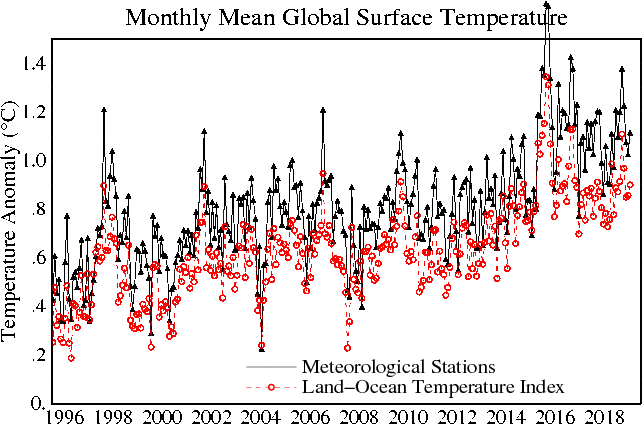
NOAA’s – National Climate Data Center – Annual Global Land and Ocean Temperature Anomalies:

UK Met Office’s – Hadley Center – Climate Research Unit (CRU) Annual Global Average Land and Ocean Temperature Anomaly;

the UK Met Office – Hadley Center – Climate Research Unit (CRU) Monthly Global Average Land Temperature;

and HadCRUT4 Global, Northern and Southern Hemispheric Temperature Anomalies:

The Pause appears to apparent in Earth’s Land and Surface Temperature record. It is important to note that the reason that the IPCC claims to be;
“95% certain that humans are the “dominant cause” of global warming since the 1950s” BBC
is because prior to 1950 Anthropogenic CO2 Emissions from Fossil-Fuels were insufficient to have a significant influence on “Earth’s Temperature”, i.e. Anthropogenic CO2 Emissions from Fossil-Fuels;

and Cumulative Anthropogenic CO2 Emissions from Fossil-Fuels:

In May 2013, the Economist noted that;
The world added roughly 100 billion tonnes of carbon to the atmosphere between 2000 and 2010. That is about a quarter of all the CO₂ put there by humanity since 1750. And yet, as James Hansen, the head of NASA’s Goddard Institute for Space Studies, observes, “the five-year mean global temperature has been flat for a decade.”
Additionally, surface temperature records are burdened with issues of questionable siting, changes in siting, changes in equipment, changes in the number of measurement locations, modeling to fill in gaps in measurement locations, corrections to account for missing, erroneous or biased measurements, land use changes, anthropogenic waste heat and the urban heat island effect. Thus to see the Big Picture of “Earth’s Temperature”, it also helps to look up.
Atmospheric Temperatures:
Since 1979 Earth’s “temperature” has also been measured via satellite. “The temperature measurements from space are verified by two direct and independent methods. The first involves actual in-situ measurements of the lower atmosphere made by balloon-borne observations around the world. The second uses intercalibration and comparison among identical experiments on different orbiting platforms. The result is that the satellite temperature measurements are accurate to within three one-hundredths of a degree Centigrade (0.03 C) when compared to ground-launched balloons taking measurements of the same region of the atmosphere at the same time.” NASA
Here is RSS Global Temperature Lower Troposphere (TLT) – Brightness Temperature Anomaly- 1979 to Present;


and this is the University of Alabama – Hunstville (UAH) Global Lower Atmosphere Temperature Anomalies – 1979 to Present:

Note: Per John Christy, RSS and UAH anomalies are not comparable because they use different base periods, i.e., “RSS only uses 1979-1998 (20 years) while UAH uses the WMO standard of 1981-2010.”
The March UAH Lower Atmosphere Temperature Anomaly was .29 degrees C above the 30 year average and RSS Global Global Lower Troposphere shows a .127 degrees C increase per decade.
When we look at Earth’s “canaries”, i.e. RSS Northern Polar Temperature Lower Troposphere (TLT) Brightness Temperature Anomaly;

appears to have Paused for the last 18 years and RSS Southern Polar Temperature Lower Troposphere (TLT) Brightness Temperature Anomaly;

looks like it has been on Pause for its entire record.
To this point we’ve only addressed the Lower Troposphere Temperatures, the following Temperature Anomaly plots from RSS will increase in altitude as is illustrated here:
Here is RSS Temperature Middle Troposphere (TMT)- Brightness Temperature Anomaly- 1979 to Present;

According to Remote Sensing Systems, “For Channel (TLT) (Lower Troposphere) and Channel (TMT) (Middle Troposphere), the anomaly time series is dominated by ENSO events and slow tropospheric warming. The three primary El Niños during the past 20 years are clearly evident as peaks in the time series occurring during 1982-83, 1987-88, and 1997-98, with the most recent one being the largest.” RSS
Middle Tropospheric temperatures appear to show slow warming overlaid with the El Niño/La Niña Southern Oscillation (ENSO) cycle, including several comparatively large El Niño events. Middle Tropospheric temperatures appear to entered The Pause with the large El Niño in 1998.
Moving higher in the atmosphere, RSS Temperature Troposphere / Stratosphere (TTS) – Brightness Temperature Anomaly- 1987 to Present;

has been in The Pause since records began in 1987, with a trend of just -.004 K/C per decade.
The 1997-98 and 2009 – 10 El Niño events are still readily apparent in the Troposphere / Stratosphere plot above, as is a spike from the 1991 eruption of Mt. Pinatubo. Note that the effect of Mt. Pinatubo is the opposite in the Lower and Middle Troposphere versus the Troposphere / Stratosphere (TTS), i.e. “Large volcanic eruptions inject sulfur gases into the stratosphere; the gases convert into submicron particles (aerosol) with an e-folding time scale of about 1 year. The climate response to large eruptions (in historical times) lasts for several (2-3) years. The aerosol cloud causes cooling at the Earth’s surface, warming in stratosphere.”
Ellen Thomas, PHD Wesleyan University
It is interesting that, incorporating the impact of three significant surface driven warming events, Troposphere / Stratosphere Temperatures (TTS) have been quite stable, however there is a bit of regional variation here, e.g.:
RSS Northern Hemisphere Temperature Troposphere / Stratosphere (TTS) – Brightness Temperature Anomaly- 1987 to Present;

has been increasing by .047 K/C per decade, whereas the RSS Southern Hemisphere Temperature Troposphere / Stratosphere (TTS) – Brightness Temperature Anomaly- 1987 to Present;

has been decreasing by -.039 K/C per decade.
Moving higher still in the atmosphere, the RSS Temperature Lower Stratosphere (TLS) – Brightness Temperature Anomaly – 1979 to Present;

“is dominated by stratospheric cooling, punctuated by dramatic warming events caused by the eruptions of El Chichon (1982) and Mt Pinatubo (1991).” RSS
The eruptions of El Chichon and Mt Pinatubo are readily apparent in the Apparent Atmospheric Transmission of Solar Radiation at Mauna Loa, Hawaii:

“The stratosphere” … “in contrast to the troposphere, is heated, as the result of near infrared absorption of solar energy at the top of the aerosol cloud, and increased infra-red absorption of long-wave radiation from the Earth’s surface.”
“The stratospheric warming in the region of the stratospheric cloud increases the latitudinal temperature gradient after an eruption at low latitudes, disturbing the stratospheric-troposphere circulation, increasing the difference in height of the troposphere between high and low latitudes, and increasing the strength of the jet stream (polar vortex, especially in the northern hemisphere). This leads to warming during the northern hemisphere winter following a tropical eruption, and this warming effect tends to be larger than the cooling effect described above.” Ellen Thomas, PHD Wesleyan University
The Lower Stratosphere experienced “dramatic warming events caused by the eruptions of El Chichon (1982) and Mt Pinatubo (1991).” RSS “The long-term, global-mean cooling of the lower stratosphere stems from two downward steps in temperature, both of which are coincident with the cessation of transient warming after the volcanic eruptions of El Chichon and Mt. Pinatubo.” … “Here we provide observational analyses that yield new insight into three key aspects of recent stratospheric climate change. First, we provide evidence that the unusual step-like behavior of global-mean stratospheric temperatures is dependent not only upon the trend but also on the temporal variability in global-mean ozone immediately following volcanic eruptions. Second, we argue that the warming/cooling pattern in global-mean temperatures following major volcanic eruptions is consistent with the competing radiative and chemical effects of volcanic eruptions on stratospheric temperature and ozone. Third, we reveal the contrasting latitudinal structures of recent stratospheric temperature and ozone trends are consistent with large-scale increases in the stratospheric overturning Brewer-Dobson circulation” David W. J. Thompson Colorado State University
Above the Stratosphere we have the Mesosphere and Thermosphere, neither of which have I identified current temperature time series for, but of note is that on “July 15, 2010” “A Puzzling Collapse of Earth’s Upper Atmosphere” occurred when “high above Earth’s surface where the atmosphere meets space, a rarefied layer of gas called “the thermosphere” recently collapsed and now is rebounding again.”

“This is the biggest contraction of the thermosphere in at least 43 years,” says John Emmert of the Naval Research Lab, lead author of a paper announcing the finding in the June 19th issue of the Geophysical Research Letters (GRL). “It’s a Space Age record.”
The collapse happened during the deep solar minimum of 2008-2009—a fact which comes as little surprise to researchers. The thermosphere always cools and contracts when solar activity is low. In this case, however, the magnitude of the collapse was two to three times greater than low solar activity could explain.
“Something is going on that we do not understand,” says Emmert.
The thermosphere ranges in altitude from 90 km to 600+ km. It is a realm of meteors, auroras and satellites, which skim through the thermosphere as they circle Earth. It is also where solar radiation makes first contact with our planet. The thermosphere intercepts extreme ultraviolet (EUV) photons from the sun before they can reach the ground. When solar activity is high, solar EUV warms the thermosphere, causing it to puff up like a marshmallow held over a camp fire. (This heating can raise temperatures as high as 1400 K—hence the name thermosphere.) When solar activity is low, the opposite happens.” NASA
In summary, “the Pause” is apparent in Earth’s atmospheric record, Lower and Middle Troposphere appear to have warmed slowly, overlaid with the El Niño/La Niña Southern Oscillation (ENSO) cycle, including four comparatively large El Niño events, and tempered by the cooling effects of the eruption of El Chichon (1982) and Mt Pinatubo (1991). Lower and Middle Tropospheric temperatures appear to have paused since the large El Niño in 1998. Tropospheric / Stratospheric temperatures appear to have been influenced by at least three significant surface driven warming events, the 1997-98 El Niño, and the eruptions of El Chichon in 1982 and Mt Pinatubo in 1991, but have maintained a stable overall trajectory. Stratospheric temperatures appear to have experienced two “dramatic warming events caused by the eruptions of El Chichon (1982) and Mt Pinatubo (1991).”, and “unusual step-like behavior of global-mean stratospheric temperatures” which has resulted in a significant stratospheric cooling during the last 30 years. Lastly, “during deep solar minimum of 2008-2009” “the biggest contraction of the thermosphere in at least 43 years” occurred and “The magnitude of the collapse was two to three times greater than low solar activity could explain.”
Ocean Temperatures:
“The oceans can hold much more heat than the atmosphere. Just the top 3.2 metres of ocean holds as much heat as all the world’s air.” Commonwealth of Australia – Bureau of Meteorology
From a surface perspective Hadley Center’s HadSST2 Global Sea Surface Temperature Anomaly;

NOAA’s – National Climate Data Center – Global Sea Surface Temperature Anomaly;

Reynolds OI.v2 Global Sea Surface Temperature Anomaly

all appear to be well into The Pause.
Obviously Sea Surface temperature only scratch the surface, thus changes in Ocean Heat Content are important in understanding “Earth’s Temperature”. Here is NOAA’s NODC Global Ocean Heat Content from 0-700 Meters – 1955 to Present;

and here is the same from Ole Humlum’s valuable climate data site Climate4you.com, NODC Global Ocean Heat Content – 0-700 Meters – 1979 to Present:

It seems apparent from the plots above that Global Ocean Heat has increased over the last several decades, and has not paused per se, however the rate of increase seems to have slowed significantly since 2004.
Sea Level:
“Global sea level is currently rising as a result of both ocean thermal expansion and glacier melt, with each accounting for about half of the observed sea level rise, and each caused by recent increases in global mean temperature. For the period 1961-2003, the observed sea level rise due to thermal expansion was 0.42 millimeters per year and 0.69 millimeters per year due to total glacier melt (small glaciers, ice caps, ice sheets) (IPCC 2007). Between 1993 and 2003, the contribution to sea level rise increased for both sources to 1.60 millimeters per year and 1.19 millimeters per year respectively (IPCC 2007).” Source NSIDC
Global Mean Sea Level Change – 1993 to Present:

Global Mean Sea Level Change Map with a “Correction” of 0.3 mm/year added May, 5th 2011, due to a “Glacial Isostatic Adjustment (GIA)” – 1993 to Present;

While it appears that Sea Level Rise has continued recently;
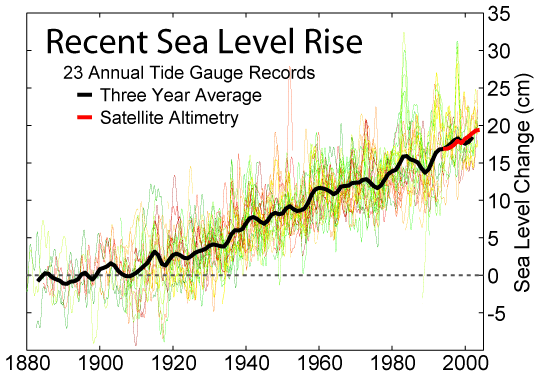
it is important to note that Sea Levels were increasing at a similar pace during the first half of the 20th century, before anthropogenic CO2 emissions were sufficient to have a significant influence on “Earth’s Temperature” and Sea Level:
Snow and Ice:
A proxy often cited when measuring “Earth’s Temperature” is amount of Snow and Ice on Earth. According to the United States Geological Survey (USGS), “The vast majority, almost 90 percent, of Earth’s ice mass is in Antarctica, while the Greenland ice cap contains 10 percent of the total global ice mass.” Source USGA
However, there is currently no generally accepted measure of ice volume, as Cryosat is still in validation and the accuracy of measurements from Grace are still being challenged. Sea Ice Area and Extent are cited as proxies for “Earth’s Temperature”, however there is significant evidence that the primary influences on Sea Ice Area and Extent are in fact wind and Atmospheric Oscillations.
With this said, Global Sea Ice Area;

had it’s largest maximum in 2013, since 1996 and has remained stubbornly average for the entirety of 2013. Antarctic Sea Ice Extent has remained above the 1981 – 2010 “normal” range for much of the last four months;

we had the third most expansive Southern Sea Ice Area measured to date;

and Southern Sea Ice Area has remained above average for almost all of the last two years:

At the other pole Arctic Sea Ice Extent has remained within the 1981 – 2010 “normal” range for the entirety of 2013;

and Northern Hemisphere Sea Ice Area had it’s smallest decline since 2006:

There appears to have been a negative trend in Northern Hemisphere Sea Ice Area and Extent, a positive trend in Southern Hemisphere Sea Ice Area and Extent, thus the resultant Global Sea Ice Area trend appears to be slightly negative. However, in the last 6 years there does appear to be a Pause in Global Sea Ice Area.
In terms of land based data, here is 20 Year Northern Hemisphere Snow Cover with 1995 – 2009 Climatology from NCEP/NCAR;

Northern Hemisphere Snow Cover Anomalies 1966 – Present from NCEP/NCAR;

Northern Hemisphere Winter Snow Extent – 1967 to Present from Rutgers University;

Northern Hemisphere Spring Snow Extent – 1967 to Present:

Northern Hemisphere Fall Snow Extent – 1967 to Present:

While none of the Snow plots offers a global perspective, when looking at the Northern Hemisphere, there appears to have been a slight increase in Winter Snowcover and Snow Extent, a decrease in Spring Snow Extent and no change in Fall Snow Extent over the historical record.
Based on the limited Global Ice and Snow measurements available, and noting the questionable value of Sea Ice Area and Extent as a proxy for temperature, not much inference can currently be drawn from Earth’s Ice and Snow measurements. However, there does appear to be a Pause in Global Sea Ice Area.
Conclusion:
The Pause in “Earth’s Temperature” appears in many of Earth’s observational records, it appears to extend for between 6 – 16 years depending on the data set and what it is being measured.
Additional information on “Earth’s Temperature” can be found in the WUWT Reference Pages, including the Global Temperature Page and Global Climatic History Page
Please note that WUWT cannot vouch for the accuracy of the data/graphics within this article, nor influence the format or form of any of the graphics, as they are all linked from third party sources and WUWT is simply an aggregator. You can view each graphic at its source by simply clicking on it.
Discover more from Watts Up With That?
Subscribe to get the latest posts sent to your email.
davidmhoffer: “He got F/2 for a hemisphere which is exactly the same as F/4 for the sphere.”
Oh? Then the proof I gave of the average height of a hemisphere is invalid and you can show where it went astray. You may do so now. Hint: If, at any point, you could have you would have. Your position is not one of an honest man.
“If you agree that the lit side is F/2 then for the sphere as a whole F remains the same and the lit side plus the dark side comes to 4. ”
If you agree the Earth is round and photons are incident on it, then you agree that the value is 2F/3 for the lit side. In naive average over the sphere that would be F/3.
But at this point should we both agree that there is no proof that reduces the absolutely obvious and pedestrian geometry involved to a condition where we may treat things as if it were a Flat Earth? For if not, then certainly you have such a proof.
The problem here is that you keep agreeing with the 10th grade geometry I’m presenting to you. And indeed it would be ludicrous for you to deny it. But you keep prevaricating about how to get from what unquestionably is to the so far unprovable what you want it be. Which is common nonsense easily found, but still nonsense. It’s magical thinking of the first order.
jquip;
Upthread a self described mathematician has lamented the need to explain the reason to divide by 4 at all. I’ve explained it using simple geometry. Shawnhet has explained the math and shown that it matches precisely the geometry. You’ve admitted that for the lit side it is F/2, the only logical consequence of which is that for the sphere as a whole, F remains the same and area doubles, giving F/4.
Jquip says:
November 17, 2013 at 11:55 am
“Honestly, I don’t see how you get from there from here; so there’s not any manner in which I think I can properly address it to begin with. I understand you’re after a cosine curve, but I can’t fathom how you get from the average height of a hemisphere to the area under a cosine curve. If my notes didn’t clear things up for you, then you’ll need to clear things up for me :P”
Ok, I can see my area under a cosine curve was more of a help than a hindrance. Suffice it to say, that there is nothing at the end of the day about your FcosBAC framework that would produce a difference for the average than the standard deviation.
“What I’ve put forward here is little more than how actual photons hit an actual sphere. The average flux of which can be used to derive T”
Then, why don’t you derive it? You’ve got your FcosBAC framework that is according to you different from the standard one. It seems to me that your whole approach is based on not being able to calculate the average flux at all. If that is the case, all you are left with is your intuition that the standard derivation is wrong.
Cheers, 🙂
davidmhoffer says on November 17, 2013 at 8:36 am;
“O H Dahlsveen;
If my suspicions are completely wrong, which is – of course – very possible, then I am very interested to learn where you do get your numbers from.
>>>>>>>>
I didn’t “get them” from anywhere. I learned how to apply SB — —- — – – —— — etc.
Working out the math to come up with the effective black body temperature of earth is by comparison rather trivial.”
= = = = = = = = == =
Thank you very much for that info “davidmhoffer” I shall print your comment off and learn it, But right now all I can say is that I do have a lot of respect for guys who have “deep or comprehensive knowledge” in the fields of electrics and/or electronics.
For that reason alone I am puzzled as to why you can say: “Working out the math to come up with the effective black body temperature of earth is by comparison rather trivial.”
Yes, maybe it is “trivial” – providing you have got all the right numbers at your disposal, but if you are ignoring “important facts” – two of which are that the Earth is not a true “Black Body” and second, – maybe more importantly; The Earth rotates around its own axis one full turn every 24 hours.
So, IMHO to divide the so called “Solar Constant by 4, is the same as taking a “snapshot” of the Earth in orbit. Fine if you want to find out the “Average Solar Irradiation” for any given second of the day, but useless for anything else. Therefore the ‘numbers’ in your calculus is ‘somewhat lacking’.
The thing not to overlook is that at every second of every day it is 12 o’clock noon somewhere along the Equator – and along the same “vertical line” from pole to pole. Therefore, my friend, the Earth always receives the “FULL WACK” of solar power 24/7.
I know, – there are the hours of no solar irradiation that poke a stick into the spokes of that wheel. – Well not really, because – one theory that may well be correct – says that soon after the solar energy input stops along that said “vertical line” i.e. at night-time, air-convection also stops. The air “collapses in on it-self” (becomes “Down-Welling”) thus it becomes denser and less room is left between the H2O, and also between other GHGas molecules if you like, and the IR energy has greater difficulties in escaping to space.
If you have your cork, toothpick and ball and you give the ball a complete turn before removing it you will find groves instead of small indentations.
@davidmhoffer: “I’ve explained it using simple geometry.”
Yapyapyap. If this is so, you can show where my example went astray. What an honest and knowledgable man does in refutation, is refute. What you have done is continually change your mind about the flat Earth theory. Put up or shut up.
@Shawnhet: “Suffice it to say, that there is nothing at the end of the day about your FcosBAC framework that would produce a difference for the average than the standard deviation.”
Oh? Then show the derivation from one to the other. As you say you can do it, present the math for it. Rather than make yourself a fool with a naked assertion, show me a fool with an argument. As said already, I don’t see how you’re doing it. If you don’t see how you’re doing it either, then we’re both lost and nothing has been shown.
“Then, why don’t you derive it?”
See my post at: November 16, 2013 at 4:54 pm. It’s already been explained. Either you can show how that is invalid, or it has indeed been derived.
Jquip;
Yapyapyap. If this is so, you can show where my example went astray.
>>>>>>>>>>>>>>>>
Shawnhet already did. There’s no need for me to repeat him. The geometry confirms his math.
O H Dahlsveen;
So, IMHO to divide the so called “Solar Constant by 4, is the same as taking a “snapshot” of the Earth in orbit. Fine if you want to find out the “Average Solar Irradiation” for any given second of the day, but useless for anything else. Therefore the ‘numbers’ in your calculus is ‘somewhat lacking’.
>>>>>>>>>>>>>>>>
You are correct. SB Law does no more than that. There are considerable problems with SB Law in terms of understanding the “temperature” of an oblate sphere rotating in space every 24 hours at a 20+ degree inclination in an elliptical orbit. I’m happy to discuss those problems, but there is little value in doing so when the basic application of SB Law is not understood. Once you understand the reason to divide by 4 and accept that it is in fact a proper application of SB Law to do so, we can move onto other issues.
The following is a discussion of the utter madness of calculating a temperature anomaly for the earth as a whole from station data. I wrote it to be an easy read, and most of what is in it applies equally to the mind boggling stupidity of trying to average temperatures as well as you can demonstrate that it is possible to arrive at a lower average temperature on a surface that has gained energy and vice versa.
http://wattsupwiththat.com/2012/08/26/lies-damn-lies-and-anoma-lies/
You may also want to read through this excellent post by Robert G Brown on the complexity of calculating a baseline temperature against which to compare:
http://wattsupwiththat.com/2012/01/12/earths-baseline-black-body-model-a-damn-hard-problem/
Despite his criticisms of 255K as a baseline, Dr Brown has since used that number frequently in discussion because although it is a terrible baseline, the SB Law calculation done properly delivers that value, and so it is of value for general discussion. A more accurate way of calculating a baseline temperature was proposed by Nikolov and Zeller, a methodology that I actually supported, but alas they made really major errors in the rest of their physics and the baby got thrown out with the bath water.
Jquip says:
November 17, 2013 at 2:11 pm
“Oh? Then show the derivation from one to the other. As you say you can do it, present the math for it. Rather than make yourself a fool with a naked assertion, show me a fool with an argument. As said already, I don’t see how you’re doing it. If you don’t see how you’re doing it either, then we’re both lost and nothing has been shown.”
Well, you are actually asking quite a bit here so I’m just going to point the way not walk you through every single step. Luckily I have been able to find something on youtube that directly speaks to this – from the above, the average value of a cosine is 2/pi over the 180 degree arc we are looking at. Frankly, I was trying to keep things simple because actually, to calculate all the points on a (hemi)sphere, you need two angles not one(one each for longitude and latitude). Since you don’t really dispute the ratio of the surface area of the Earth to an Earth-sized disk, I am not sure what we are even talking about.
“See my post at: November 16, 2013 at 4:54 pm. It’s already been explained. Either you can show how that is invalid, or it has indeed been derived.”
What is your average T? You never calculate that you just mention that 2F/3 (which is just a close approximation of my number above). To get the actually correct number you will need to add the second angle.
In any case, if you think that every point in a sphere emits 2F/3 of what it receives – you have just discovered free energy. Just take a flashlight a with a flux of F on a circle the size of a tennis ball on the wall, then take the wall down and replace it with a suspended tennis ball. Guess what, you have increased the total energy by 50%(actually 57%)!!
davidmhoffer: “Shawnhet already did. There’s no need for me to repeat him. The geometry confirms his math.”
Awesome goalpost moving and nice try pushing the burden off on Shawnhet. But now your claim is that the math Shawnhet hasn’t shown shows the same thing as the math you haven’t shown either. But as you so certainly know both then it remains that you can show either or both. And neither has been shown at all. The only thing you continue to produce is dishonesty. And don’t take that badly at all, I wish I got paid to study the climate as well.
Shawnhet: ” Luckily I have been able to find …”
Yes, I know the bit about what the area under a sinusoid is. The problem is how that relates to what we’re talking about. And, separately, how a gaussian distribution does. For that latter, the nearest I can figure is that you assume the distribution provided in my example is a normal distribution; which it is not. But if I take that idea, then I can’t figure out why you think the standard deviation has anything to do with it.
“To get the actually correct number you will need to add the second angle.”
This is probably the sticker then. The average flux being 2F/3 for the lit side, or F/3 for the whole. But 2F/3 is not the single angle. The single angle is just to demonstrate the geometry involved and it’s relation to the height of a hemisphere. eg. On a unit radius the height of a hemisphere at any single point is cos BAC. The incident flux at that same point is F * cos BAC. So it follows that the average incident flux is the average attenuation of F times F; and so the average height of the hemisphere. Draw it out on a page, it helps a lot. But the average height of a unit hemisphere is 2/3, and so the average incident flux is 2F/3 over that hemisphere. As the unlit has no incident radiation by the model, then F/3 for the average whole.
Taking temp from flux, no matter how good or bad the average, is then standard. But by caveat and consideration we need assume no more than that each point as F * cos BAC radiates then same as a consideration of local equilibrium. There’s lots of fun arguments with that which aren’t interesting until the geometry portion is understood.
Oops, I got confused on the last bit above. His approach does not add energy, it is just a reasonably good approximation of my 2/pi number above.
The rest of my post stands (and for those who wish to consider it further) I believe that the precise function that will lead to the correct ratio of the surface flux absorbed by a hemisphere is the integral of cos^2 x over the interval of -pi/2 to pi/2 divided by pi(the length of the interval).
I just can’t figure out a simple to lay it out mathematically that won’t take a half an hour. A quick and dirty double check is to take numbers from a trig table for the Cosine from one to ninety degrees and square them, then take the average of all the squares. The average of that is ~0.5. The correct interpretation of that number is that given a (flat) circle that recieves F in flux on each of its points a hemisphere of the same radius where the flux at any point is given by Jquip’s FcosBAC placed on top of that circle – all the points on that hemisphere will have an average flux of 0.5F.
There are many ways to show this but they all come up with the same answer.
Cheers, 🙂
Jquip, before you dig yourself in too far you do need to reconsider your claims of 2F/3. This is exactly related to the mean temperature of a mass-less Earth with no thermal inertia involved brought up by Nikolov and Zeller and I have numerically integrated it four different ways, others have also checked the math, even Joel Shores found it also correct I believe, 154.3 K mean temperature meaning the true GHE is not 33°C as held by most climatologists but ≈134°C.
Now what you are questioning is the mean point-wise flux, cosine angle and area weight adjusted, a every point on this globe and if you will follow I have to first calculate that to even get to the mean temperature, that 154.3 K using an emissivity of 0.955 and na albedo of 0.12. So I went back into those integration programs and added the two lines to also accumulate and then mean the flux across the globe and it is not 2F/3, it is 340.5 W/m² when the TSI is 1362 W/m² or one fourth. Someone above was trying to queue you to the fact what you are proposing greatly affects mean temperatures but no mean fluxes, point-wise.
You can integrate this by Monte Carlo of randomly but evenly distribute points over the Earth’s surface, cosine and area adjusted of course. or you can take a polar view and integrate per concentric latitude bands, or you can take a mathematically harder computation to take a view over the equator at Greenwich meridian and do just the lit hemisphere per also latitude of tiny bands, any way you get 340.5 W/m² mean flux and 154.3 K described above as the mean temperature on the printouts. If I were you I would stop insisting on something not correct but instead look into why all mean temperature computations using such a mean of flat-earth flux and not point-wise on a sphere are in fact all incorrect and are very misleading.
In fact if you then integrate, same program with different parameters, use 0.30 for the albedo and 0.986 for the emissivity, same TSI, you get 144.55 K which is exactly one-half of the 289.1 K claimed in Trenberth et al’s last paper. If you think deep on that one you should see what I see, a totally opaque and isotropic ‘reflecting’ atmosphere exactly doubles the, get this, the temperature, and THAT is what makes us that huge GHE of greater than 134K since the albedo also changed between those two cases mentioned! I find that so, what to say… illuminating!
If you don’t want to numerically integrate, N&K’s poster/paper has the closed form equation that will feed those same numbers out I mentioned above but much simpler. Guess not many have delved as deep as I into some of these relationships for I’ve been waiting and the same never appears.
Oops. I always want to think Keller and it is Zeller, try N&Z instead of N&K.
Jquip says:
November 17, 2013 at 3:43 pm
Just point of information here, when I say standard derivation I mean the standard derivation of the blackbody temperature of the Earth ie 255K using standard geometric reasoning.
“The incident flux at that same point is F * cos BAC. So it follows that the average incident flux is the average attenuation of F times F; and so the average height of the hemisphere. Draw it out on a page, it helps a lot. But the average height of a unit hemisphere is 2/3, and so the average incident flux is 2F/3 over that hemisphere. As the unlit has no incident radiation by the model, then F/3 for the average whole.”
Since I don’t see this getting resolved any other way -let me get precise here. Your expression F*Cos BAC only describes the values of F along a single line of latitute or longitude. The actual description of the flux at every point of the Earth’s surface is F* Cos BAC * CosDAC – one of each for latitude and longitude. (You are not multiplying the Flux by the attenuation of itself
(that would give you Watts squared as units.) As such, you are looking for the average value of a cos^2 function (or in your terms (2//3)^2 instead of 2/3. The actual number is 0.5 but an easy way of showing that derivation is escaping me at the moment. In my post above this one, I mentioned a quick and dirty way of (using trig tables) going from the cos^2 relationship like you hint at to the average flux values. The correct value is ~0.5F for the lit side of the Earth as compared to a flat disk the size of the Earth getting an average of F.
Cheers, 🙂
Shawnet: “one of each for latitude and longitude. ”
If you define your coordinates in that manner. If you describe the light as intersecting the pole, then Cos BAC is the latitude. Or, as mentioned in the integral for the surface of a hemisphere by the other fellow, an annular ring. It need not be the actual pole that the sphere revolves around, or anything else; it’s just a reference point until we start getting into grey body considerations.
wayne: “If you don’t want to numerically integrate, N&K’s poster/paper has the closed form equation that will feed those same numbers out I mentioned above but much simpler. ”
Oho! I gave up on it before I got to a closed form. As I mentioned earlier, it was ages ago and all three manners come up with significantly different numbers. The 154.3K you mention strikes my memory as absurdly low, but I’ll grant you’re probably right. Deriving T from average flux was much higher than integrating over T, in the same geometric model, to get the average. And thanks for the heads up on N&K, I’ll see if I can turn it up in google.
The question isn’t whether it seems absurd or not, it is whether or not it is an accurate base to start from. That is, is it in the realm of physical laws and geometry or not. As moving away from a black body consideration we then need albedo, conductivity, atmosphere, daylight (and nightime…) and all the other things that slow down absorption and emission both. A take away point about pulling averages off any non-linear description is that it is meaningless and unstable unless you take account of just what sort of non-linearity it is. Standard distributions being not just the gold-standard here, but about the only intelligible place to take an average given its properties and symmetry.
But the convenience with F/4 is that it is close as a postulated airless black body light bulb system to the system we have: An atmosphere covered grey body orbiting its radiation source. But that’s right up there with correlation is not causation in that happy accidents mean very little. For dealing with surface features and climate, it is simply irresponsible to start from the F/4 consideration in every case. As to use it properly, as a global equilibrium case, requires embedding the sun inside the Earth or vice versa. And if we had that, it would be perfect for use. We’d also never need streetlamps, which would save on CO2 production. >->
Jquip, you have some catch up to do since you brought up the though that this is not a flat disk, the Earth is not evenly illuminated, the math all seems wrong. I agree and I now know it is all wrong but for you to understand what I was saying you probably need to read something. Nikolov and Zeller’s ‘Unified Theory of Climate’ was not swallowed well here and I agree it was not complete especially near the end. See this or just search using this site’s search box for ‘Nikolov’.
I was just intregued by their work right at the first of their paper and it addresses exactly what you raised here. Yes, it takes a view more like the moon’s albedo and emissivity and doesn’t allow for any thermal inertia in the soil but it shines some light on that the 33°C ‘greehouse effect’ compared to an Earth without infrared active gases is far, far too low. Yes, you should look into that area of history here, since you are questioning the geometry and the solar radiation you should enjoy the read (there are thousands of comments in multiple posts on their poster/paper)
wayne: “I agree and I now know it is all wrong but for you to understand what I was saying you probably need to read something.”
Ah, beauty; thanks for the link. And yes, we’re all on the same page. Except that: I disagree with the statement at the think “our atmosphere boosts Earth’s surface temperature not by 18K—33K as currently assumed, but by 133K!”. Forgive if I state things you don’t need stated: Specifically, a large misunderstanding about black-body temperatures are that they are not simply ideal, but the coldest possible because they are ideal. And in any condition where emissivity is > 1 – albedo, then the same condition holds in absence of thermal inertia; as less the correction for albedo it functions like a black body. So the bulk of anything we can dream of will have a temperature strictly higher than the black body ideal for no more reason than it isn’t a black body. And that remains true if we do the standard black body construction of an infinitely thin surface backed by a magic mirror.
Such things are why I harp on an accurate base to work from. Which we obviously don’t have;and there’s hardly a reason to shoot in the dark when we don’t have to.
wayne;
I was just intregued by their work right at the first of their paper
>>>>>>>>>>>>>>>>.
Yeah, me to. Too bad they screwed it up so bad in the end that the thing got dismissed in its entirety. That said, I got into some private discussions with a number of physicists. I think it was Joel Shore that pointed out to me that SB Law is still relevant even in an N&Z model. In their model, the larger the temperature swings you deal with (seasonal, latitude, daily) the “colder” an average temperature you get. Conversely, the more uniform the temperature is, the “warmer” an average temperature you arrive at, and the limit you approach as the temperature variance approaches zero is the SB Law value. So SB Law still winds up defining the maximum temperature the surface can be at sans greenhouse effect. But we’d still be WAY better off trending average of fourth root of T rather than T to quantify any energy imbalance that may or may not exist.
Jquip says:
November 17, 2013 at 5:04 pm
“Shawnet: “one of each for latitude and longitude. ”
If you define your coordinates in that manner. If you describe the light as intersecting the pole, then Cos BAC is the latitude. Or, as mentioned in the integral for the surface of a hemisphere by the other fellow, an annular ring. It need not be the actual pole that the sphere revolves around, or anything else; it’s just a reference point until we start getting into grey body considerations.”
You need to have two angles to describe the complete surface of the Earth, there is no way around it. Think about it this way – how much F does a point P1 on the equator get if it is high noon and how much did it get 4 hours before noon. Now how much does point P2 that is directly North of P1 but on the Arctic circle get 4 hours before noon. You can’t describe P1- noon, and P1 noon-4, P2 noon and P2 noon-4 using one angle and if your equation can’t describe the entire surface of the Earth, then obviously it can’t calculate an accurate average F over the entire surface of the Earth.
I had missed the earlier reply to you from See owe to Rich dealing with the annular ring – this was an elegant way of calculating the relationship of average F on the surface to what a hypothetical disk average should be.
At the end of the day, your calculation of 2F/3 is only valid for two small sections of the Earth (directly along the line of the equator and directly along the line of high noon.
Cheers, 🙂
As geran points out, due to the rotation of Earth on its axis (among other causes), an equilibrium temperature is never reached on Earth. A consequence is for the equilibrium temperature to be unobservable.
It follows from the unobservability that quantities which are functions of the equilibrium temperature, including the equilibrium climate sensitivity (TECS), do not exist as scientific concepts. By building TECS into the foundation of their discipline, climatologists have ensured that their discipline is a pseudo-science. A science of climate must be built upon observables, including temperature but not including the equilibrium temperature..
Shawnhet;
At the end of the day, your calculation of 2F/3 is only valid for two small sections of the Earth (directly along the line of the equator and directly along the line of high noon.
>>>>>>>>>>>>>>>>
Not to mention that if correct it would falsify all of Euclidean geometry.
davidmhoffer says:
November 17, 2013 at 8:49 pm
“Not to mention that if correct it would falsify all of Euclidean geometry.”
Heh. Well, who needed that anyways ;)?
BTW, for anyone who is curious, I don’t know why I was having so much trouble with this anyway but here is the average value of cos^2 x (between pi/2 and 0).
Cos^2 x=(1/2 + Cos(2X)/2) by trig identity which integrated gives = 1/2X + sin2x/4 evaluated over the difference between pi/2 and 0 gives (1/2(pi/2)+ sin(pi)/4-1/2(0)-sin(0)/4) all divided by pi/2.
this reduces to pi/4 divided by pi/2 which gives us an average value of cos2 x over the interval of pi/2 and 0 of 0.5. Subbing this into Jquip’s F *cosBAC*cosBAD framework gives an average value of the Flux on the sunward side of a hemisphere of 0.5F where F is the Flux that a flat disk receives on a point on its surface.
Cheers, 🙂
Shawnhet says:
November 18, 2013 at 2:04 pm
>>>>>>>>>
Well thanks for doing the heavy lifting, I suspect that Jquip would not be persuaded by anything less than a mathematical proof. One of the things I learned from studying Einstein’s work was the importance of two things:
1) if you cannot first visualize the problem, you cannot solve it mathematically (except perhaps by luck).
2) keep everything as simple as possible, but no simpler
The simplest way to approach this problem is straight geometry. Area of a sphere verses the area of a disk of the same radius yields a ratio of 4:1 (or for a hemisphere per your math above, 1:2) It is as simple as that. I just couldn’t see the value of getting deep into the math when the only possible answer had to match the geometry. The other trick I learned a long time ago however was to come up with two solutions to the same problem. If you get different answers, one or both are wrong. If you get the same answer, it doesn’t mean with 100% certainty you are right, just you are more likely to be right. One of my first year math classes there was a project to predict the temperature of a bottle of beer sitting in a cold stream at any given point in time based on just two measurements in time. The class as a whole found about 4 different ways of doing it, and upon experimentation, they were all wrong by the same amount as they had all made the same mistake, which was to ignore conductance between the stream bed and the bottom of the bottle.
Confused Photon, please explain, in detail, what makes this a Mickey Mouse analysis. Did you have trouble understanding it? Do you have a legitimate grievance with the overall content, a specific analysis in the presentation or are you resorting to name calling because you don’t agree but don’t have a valid complaint?
If only the billions of dollars of research over the past three decades had resulted in some empirical, scientific evidence that the earth was actually warming incontrollably and that CO2 and man were responsible then all these horrible deniers would probably go away. Imagine the nerve of people who demand evidence before adopting a position.
You may go ahead and call me names now. That will convince people to see things your way. I know your statement ceertainly made me reassess my position. I now see the folly of wanting to have facts and legitimate supporting evidence before making a decision. Thanks for showing me that by simply belittling others without any evidence we nullify the validity of their work.