


Image Credits: NASA, BP.Blogspot.com, Wikimedia.org
By WUWT regular “Just The Facts”
NOAA’s State of the Climate In 2008 report found that:
The simulations rule out (at the 95% level) zero trends for intervals of 15 yr or more, suggesting that an observed absence of warming of this duration is needed to create a discrepancy with the expected present-day warming rate.
In 2010 Phil Jones was asked by the BBC;
“Do you agree that from 1995 to the present there has been no statistically-significant global warming?”
Phil Jones replied:
Yes, but only just.
In 2011, the paper “Separating signal and noise in atmospheric temperature changes: The importance of timescale” by Santer et al. moved the goal posts and found that:
Because of the pronounced effect of interannual noise on decadal trends, a multi-model ensemble of anthropogenically-forced simulations displays many 10-year periods with little warming. A single decade of observational TLT data is therefore inadequate for identifying a slowly evolving anthropogenic warming signal. Our results show that temperature records of at least 17 years in length are required for identifying human effects on global-mean tropospheric temperature.
In October 2013, the Remote Sensing Systems (RSS) satellite temperature data set reached a period of 204 months/17 years for which the slope is = -0.000122111 per year. For those not familiar, the RSS satellite temperature data set is similar to the University of Alabama – Huntsville (UAH) dataset that John Christy and Roy Spencer manage. Information about RSS can be found at here and the data set can be found here.
In November 2013, Dr. Robert G. Brown, Physics Department of Duke University wrote on WUWT:
This (17 years) is a non-event, just as 15 and 16 years were non-events. Non-events do not make headlines. Other non-events of the year are one of the fewest numbers of tornadoes* (especially when corrected for under-reporting in the radar-free past) in at least the recent past (if not the remote past), the lowest number of Atlantic hurricanes* since I was 2 years old (I’m 58), the continuation of the longest stretch in recorded history without a category 3 or higher hurricane making landfall in the US (in fact, I don’t recall there being a category 3 hurricane in the North Atlantic this year, although one of the ones that spun out far from land might have gotten there for a few hours). * Links added subsequently
While I must disagree with Dr. Robert G. Brown as to what one can and can’t be make into a headline, I do otherwise agree wholeheartedly. Unfortunately, with mainstream media outlets like PBS are running erroneous headlines like, “UN Panel: ‘Extremely Likely’ Earth’s Rapid Warming Is Caused by Humans” we are stuck reporting on average climate data. Amusingly, it has proven a quite effective method of informing the public and disprove erroneous alarmist claims and headlines, as Dr. Brown’s comment above attests.
For those not too familiar with the “Pause” in Earth’s warming, recommended reading includes: “Over the past 15 years air temperatures at the Earth’s surface have been flat while greenhouse-gas emissions have continued to soar.” The Economist “Global warming stopped 16 years ago, reveals Met Office report quietly released… and here is the chart to prove it.” Daily Mail “Twenty-year hiatus in rising temperatures has climate scientists puzzled.” The Australian “Has the rise in temperatures ‘paused’?” Guardian “On Tuesday, news finally broke of a revised Met Office ‘decadal forecast’, which not only acknowledges the pause, but predicts it will continue at least until 2017.” Daily Mail “RSS global satellite temperatures confirm hiatus of global warming, while the general public and mainstream press are now recognizing the AWOL truth that skeptics long ago identified…global temperatures are trending towards cooling, not accelerating higher” C3 Headlines
In terms of exactly how long the “Pause” has lasted, it depends on the data set and what it is being measured, e.g. in Werner Brozek’s recent article Statistical Significances – How Long Is “The Pause”? he showed that;
1. For GISS, the slope is flat since September 1, 2001 or 12 years, 1 month. (goes to September 30, 2013)
2. For Hadcrut3, the slope is flat since May 1997 or 16 years, 5 months. (goes to September)
3. For a combination of GISS, Hadcrut3, UAH and RSS, the slope is flat since December 2000 or 12 years, 10 months. (goes to September)
4. For Hadcrut4, the slope is flat since December 2000 or 12 years, 10 months. (goes to September)
5. For Hadsst3, the slope is flat since November 2000 or 12 years, 11 months. (goes to September)
6. For UAH, the slope is flat since January 2005 or 8 years, 9 months. (goes to September using version 5.5)
7. For RSS, the slope is flat since November 1996 or 17 years (goes to October)
Here’s what that looks like graphically;

However, to really see the big picture on “Earth’s Temperature” we must take into account many more measurements than just Surface and Tropospheric Temperatures. As such, the following is an overview of many of them. NASA’s Earth Observatory claims that;
“Global warming is the unusually rapid increase in Earth’s average surface temperature over the past century primarily due to the greenhouse gases released by people burning fossil fuels.”
so let us start there…
Global Surface Temperatures:
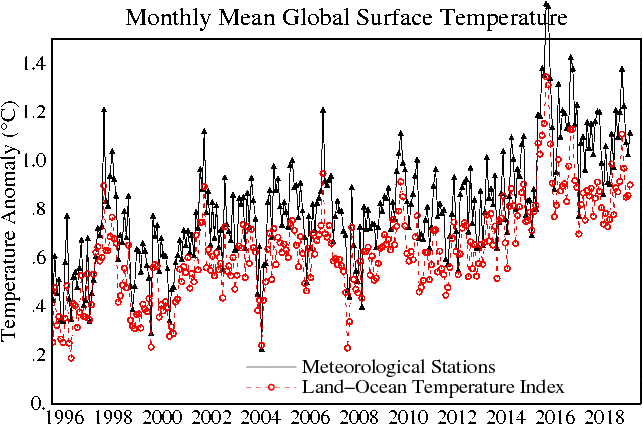
NASA’s Goddard Institute for Space Studies (GISS) Global Monthly Mean Surface Temperature Anomaly – 1996 to Present:
NOAA’s – National Climate Data Center – Annual Global Land and Ocean Temperature Anomalies:

UK Met Office’s – Hadley Center – Climate Research Unit (CRU) Annual Global Average Land and Ocean Temperature Anomaly;

the UK Met Office – Hadley Center – Climate Research Unit (CRU) Monthly Global Average Land Temperature;

and HadCRUT4 Global, Northern and Southern Hemispheric Temperature Anomalies:

The Pause appears to apparent in Earth’s Land and Surface Temperature record. It is important to note that the reason that the IPCC claims to be;
“95% certain that humans are the “dominant cause” of global warming since the 1950s” BBC
is because prior to 1950 Anthropogenic CO2 Emissions from Fossil-Fuels were insufficient to have a significant influence on “Earth’s Temperature”, i.e. Anthropogenic CO2 Emissions from Fossil-Fuels;

and Cumulative Anthropogenic CO2 Emissions from Fossil-Fuels:

In May 2013, the Economist noted that;
The world added roughly 100 billion tonnes of carbon to the atmosphere between 2000 and 2010. That is about a quarter of all the CO₂ put there by humanity since 1750. And yet, as James Hansen, the head of NASA’s Goddard Institute for Space Studies, observes, “the five-year mean global temperature has been flat for a decade.”
Additionally, surface temperature records are burdened with issues of questionable siting, changes in siting, changes in equipment, changes in the number of measurement locations, modeling to fill in gaps in measurement locations, corrections to account for missing, erroneous or biased measurements, land use changes, anthropogenic waste heat and the urban heat island effect. Thus to see the Big Picture of “Earth’s Temperature”, it also helps to look up.
Atmospheric Temperatures:
Since 1979 Earth’s “temperature” has also been measured via satellite. “The temperature measurements from space are verified by two direct and independent methods. The first involves actual in-situ measurements of the lower atmosphere made by balloon-borne observations around the world. The second uses intercalibration and comparison among identical experiments on different orbiting platforms. The result is that the satellite temperature measurements are accurate to within three one-hundredths of a degree Centigrade (0.03 C) when compared to ground-launched balloons taking measurements of the same region of the atmosphere at the same time.” NASA
Here is RSS Global Temperature Lower Troposphere (TLT) – Brightness Temperature Anomaly- 1979 to Present;


and this is the University of Alabama – Hunstville (UAH) Global Lower Atmosphere Temperature Anomalies – 1979 to Present:

Note: Per John Christy, RSS and UAH anomalies are not comparable because they use different base periods, i.e., “RSS only uses 1979-1998 (20 years) while UAH uses the WMO standard of 1981-2010.”
The March UAH Lower Atmosphere Temperature Anomaly was .29 degrees C above the 30 year average and RSS Global Global Lower Troposphere shows a .127 degrees C increase per decade.
When we look at Earth’s “canaries”, i.e. RSS Northern Polar Temperature Lower Troposphere (TLT) Brightness Temperature Anomaly;

appears to have Paused for the last 18 years and RSS Southern Polar Temperature Lower Troposphere (TLT) Brightness Temperature Anomaly;

looks like it has been on Pause for its entire record.
To this point we’ve only addressed the Lower Troposphere Temperatures, the following Temperature Anomaly plots from RSS will increase in altitude as is illustrated here:
Here is RSS Temperature Middle Troposphere (TMT)- Brightness Temperature Anomaly- 1979 to Present;

According to Remote Sensing Systems, “For Channel (TLT) (Lower Troposphere) and Channel (TMT) (Middle Troposphere), the anomaly time series is dominated by ENSO events and slow tropospheric warming. The three primary El Niños during the past 20 years are clearly evident as peaks in the time series occurring during 1982-83, 1987-88, and 1997-98, with the most recent one being the largest.” RSS
Middle Tropospheric temperatures appear to show slow warming overlaid with the El Niño/La Niña Southern Oscillation (ENSO) cycle, including several comparatively large El Niño events. Middle Tropospheric temperatures appear to entered The Pause with the large El Niño in 1998.
Moving higher in the atmosphere, RSS Temperature Troposphere / Stratosphere (TTS) – Brightness Temperature Anomaly- 1987 to Present;

has been in The Pause since records began in 1987, with a trend of just -.004 K/C per decade.
The 1997-98 and 2009 – 10 El Niño events are still readily apparent in the Troposphere / Stratosphere plot above, as is a spike from the 1991 eruption of Mt. Pinatubo. Note that the effect of Mt. Pinatubo is the opposite in the Lower and Middle Troposphere versus the Troposphere / Stratosphere (TTS), i.e. “Large volcanic eruptions inject sulfur gases into the stratosphere; the gases convert into submicron particles (aerosol) with an e-folding time scale of about 1 year. The climate response to large eruptions (in historical times) lasts for several (2-3) years. The aerosol cloud causes cooling at the Earth’s surface, warming in stratosphere.”
Ellen Thomas, PHD Wesleyan University
It is interesting that, incorporating the impact of three significant surface driven warming events, Troposphere / Stratosphere Temperatures (TTS) have been quite stable, however there is a bit of regional variation here, e.g.:
RSS Northern Hemisphere Temperature Troposphere / Stratosphere (TTS) – Brightness Temperature Anomaly- 1987 to Present;

has been increasing by .047 K/C per decade, whereas the RSS Southern Hemisphere Temperature Troposphere / Stratosphere (TTS) – Brightness Temperature Anomaly- 1987 to Present;

has been decreasing by -.039 K/C per decade.
Moving higher still in the atmosphere, the RSS Temperature Lower Stratosphere (TLS) – Brightness Temperature Anomaly – 1979 to Present;

“is dominated by stratospheric cooling, punctuated by dramatic warming events caused by the eruptions of El Chichon (1982) and Mt Pinatubo (1991).” RSS
The eruptions of El Chichon and Mt Pinatubo are readily apparent in the Apparent Atmospheric Transmission of Solar Radiation at Mauna Loa, Hawaii:

“The stratosphere” … “in contrast to the troposphere, is heated, as the result of near infrared absorption of solar energy at the top of the aerosol cloud, and increased infra-red absorption of long-wave radiation from the Earth’s surface.”
“The stratospheric warming in the region of the stratospheric cloud increases the latitudinal temperature gradient after an eruption at low latitudes, disturbing the stratospheric-troposphere circulation, increasing the difference in height of the troposphere between high and low latitudes, and increasing the strength of the jet stream (polar vortex, especially in the northern hemisphere). This leads to warming during the northern hemisphere winter following a tropical eruption, and this warming effect tends to be larger than the cooling effect described above.” Ellen Thomas, PHD Wesleyan University
The Lower Stratosphere experienced “dramatic warming events caused by the eruptions of El Chichon (1982) and Mt Pinatubo (1991).” RSS “The long-term, global-mean cooling of the lower stratosphere stems from two downward steps in temperature, both of which are coincident with the cessation of transient warming after the volcanic eruptions of El Chichon and Mt. Pinatubo.” … “Here we provide observational analyses that yield new insight into three key aspects of recent stratospheric climate change. First, we provide evidence that the unusual step-like behavior of global-mean stratospheric temperatures is dependent not only upon the trend but also on the temporal variability in global-mean ozone immediately following volcanic eruptions. Second, we argue that the warming/cooling pattern in global-mean temperatures following major volcanic eruptions is consistent with the competing radiative and chemical effects of volcanic eruptions on stratospheric temperature and ozone. Third, we reveal the contrasting latitudinal structures of recent stratospheric temperature and ozone trends are consistent with large-scale increases in the stratospheric overturning Brewer-Dobson circulation” David W. J. Thompson Colorado State University
Above the Stratosphere we have the Mesosphere and Thermosphere, neither of which have I identified current temperature time series for, but of note is that on “July 15, 2010” “A Puzzling Collapse of Earth’s Upper Atmosphere” occurred when “high above Earth’s surface where the atmosphere meets space, a rarefied layer of gas called “the thermosphere” recently collapsed and now is rebounding again.”

“This is the biggest contraction of the thermosphere in at least 43 years,” says John Emmert of the Naval Research Lab, lead author of a paper announcing the finding in the June 19th issue of the Geophysical Research Letters (GRL). “It’s a Space Age record.”
The collapse happened during the deep solar minimum of 2008-2009—a fact which comes as little surprise to researchers. The thermosphere always cools and contracts when solar activity is low. In this case, however, the magnitude of the collapse was two to three times greater than low solar activity could explain.
“Something is going on that we do not understand,” says Emmert.
The thermosphere ranges in altitude from 90 km to 600+ km. It is a realm of meteors, auroras and satellites, which skim through the thermosphere as they circle Earth. It is also where solar radiation makes first contact with our planet. The thermosphere intercepts extreme ultraviolet (EUV) photons from the sun before they can reach the ground. When solar activity is high, solar EUV warms the thermosphere, causing it to puff up like a marshmallow held over a camp fire. (This heating can raise temperatures as high as 1400 K—hence the name thermosphere.) When solar activity is low, the opposite happens.” NASA
In summary, “the Pause” is apparent in Earth’s atmospheric record, Lower and Middle Troposphere appear to have warmed slowly, overlaid with the El Niño/La Niña Southern Oscillation (ENSO) cycle, including four comparatively large El Niño events, and tempered by the cooling effects of the eruption of El Chichon (1982) and Mt Pinatubo (1991). Lower and Middle Tropospheric temperatures appear to have paused since the large El Niño in 1998. Tropospheric / Stratospheric temperatures appear to have been influenced by at least three significant surface driven warming events, the 1997-98 El Niño, and the eruptions of El Chichon in 1982 and Mt Pinatubo in 1991, but have maintained a stable overall trajectory. Stratospheric temperatures appear to have experienced two “dramatic warming events caused by the eruptions of El Chichon (1982) and Mt Pinatubo (1991).”, and “unusual step-like behavior of global-mean stratospheric temperatures” which has resulted in a significant stratospheric cooling during the last 30 years. Lastly, “during deep solar minimum of 2008-2009” “the biggest contraction of the thermosphere in at least 43 years” occurred and “The magnitude of the collapse was two to three times greater than low solar activity could explain.”
Ocean Temperatures:
“The oceans can hold much more heat than the atmosphere. Just the top 3.2 metres of ocean holds as much heat as all the world’s air.” Commonwealth of Australia – Bureau of Meteorology
From a surface perspective Hadley Center’s HadSST2 Global Sea Surface Temperature Anomaly;

NOAA’s – National Climate Data Center – Global Sea Surface Temperature Anomaly;

Reynolds OI.v2 Global Sea Surface Temperature Anomaly

all appear to be well into The Pause.
Obviously Sea Surface temperature only scratch the surface, thus changes in Ocean Heat Content are important in understanding “Earth’s Temperature”. Here is NOAA’s NODC Global Ocean Heat Content from 0-700 Meters – 1955 to Present;

and here is the same from Ole Humlum’s valuable climate data site Climate4you.com, NODC Global Ocean Heat Content – 0-700 Meters – 1979 to Present:

It seems apparent from the plots above that Global Ocean Heat has increased over the last several decades, and has not paused per se, however the rate of increase seems to have slowed significantly since 2004.
Sea Level:
“Global sea level is currently rising as a result of both ocean thermal expansion and glacier melt, with each accounting for about half of the observed sea level rise, and each caused by recent increases in global mean temperature. For the period 1961-2003, the observed sea level rise due to thermal expansion was 0.42 millimeters per year and 0.69 millimeters per year due to total glacier melt (small glaciers, ice caps, ice sheets) (IPCC 2007). Between 1993 and 2003, the contribution to sea level rise increased for both sources to 1.60 millimeters per year and 1.19 millimeters per year respectively (IPCC 2007).” Source NSIDC
Global Mean Sea Level Change – 1993 to Present:

Global Mean Sea Level Change Map with a “Correction” of 0.3 mm/year added May, 5th 2011, due to a “Glacial Isostatic Adjustment (GIA)” – 1993 to Present;

While it appears that Sea Level Rise has continued recently;
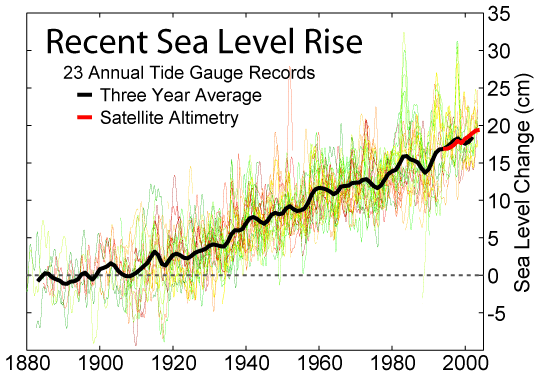
it is important to note that Sea Levels were increasing at a similar pace during the first half of the 20th century, before anthropogenic CO2 emissions were sufficient to have a significant influence on “Earth’s Temperature” and Sea Level:
Snow and Ice:
A proxy often cited when measuring “Earth’s Temperature” is amount of Snow and Ice on Earth. According to the United States Geological Survey (USGS), “The vast majority, almost 90 percent, of Earth’s ice mass is in Antarctica, while the Greenland ice cap contains 10 percent of the total global ice mass.” Source USGA
However, there is currently no generally accepted measure of ice volume, as Cryosat is still in validation and the accuracy of measurements from Grace are still being challenged. Sea Ice Area and Extent are cited as proxies for “Earth’s Temperature”, however there is significant evidence that the primary influences on Sea Ice Area and Extent are in fact wind and Atmospheric Oscillations.
With this said, Global Sea Ice Area;

had it’s largest maximum in 2013, since 1996 and has remained stubbornly average for the entirety of 2013. Antarctic Sea Ice Extent has remained above the 1981 – 2010 “normal” range for much of the last four months;

we had the third most expansive Southern Sea Ice Area measured to date;

and Southern Sea Ice Area has remained above average for almost all of the last two years:

At the other pole Arctic Sea Ice Extent has remained within the 1981 – 2010 “normal” range for the entirety of 2013;

and Northern Hemisphere Sea Ice Area had it’s smallest decline since 2006:

There appears to have been a negative trend in Northern Hemisphere Sea Ice Area and Extent, a positive trend in Southern Hemisphere Sea Ice Area and Extent, thus the resultant Global Sea Ice Area trend appears to be slightly negative. However, in the last 6 years there does appear to be a Pause in Global Sea Ice Area.
In terms of land based data, here is 20 Year Northern Hemisphere Snow Cover with 1995 – 2009 Climatology from NCEP/NCAR;

Northern Hemisphere Snow Cover Anomalies 1966 – Present from NCEP/NCAR;

Northern Hemisphere Winter Snow Extent – 1967 to Present from Rutgers University;

Northern Hemisphere Spring Snow Extent – 1967 to Present:

Northern Hemisphere Fall Snow Extent – 1967 to Present:

While none of the Snow plots offers a global perspective, when looking at the Northern Hemisphere, there appears to have been a slight increase in Winter Snowcover and Snow Extent, a decrease in Spring Snow Extent and no change in Fall Snow Extent over the historical record.
Based on the limited Global Ice and Snow measurements available, and noting the questionable value of Sea Ice Area and Extent as a proxy for temperature, not much inference can currently be drawn from Earth’s Ice and Snow measurements. However, there does appear to be a Pause in Global Sea Ice Area.
Conclusion:
The Pause in “Earth’s Temperature” appears in many of Earth’s observational records, it appears to extend for between 6 – 16 years depending on the data set and what it is being measured.
Additional information on “Earth’s Temperature” can be found in the WUWT Reference Pages, including the Global Temperature Page and Global Climatic History Page
Please note that WUWT cannot vouch for the accuracy of the data/graphics within this article, nor influence the format or form of any of the graphics, as they are all linked from third party sources and WUWT is simply an aggregator. You can view each graphic at its source by simply clicking on it.
JustTheFacts: OK, I concede it to you, this thread is actually valuable for education. First off (well, second chronologically) davidmhoffer has to explain to others that radiative physics has to allow for a 1/4 factor because the area of a sphere is 4*pi*r^2 whereas the area of a disk is 1*pi*r^2. It is disappointing when readers don’t allow for physicists to get even the basic things right. After all, without an atmosphere and an ocean the physics would be relatively straightforward.
And second off, Jquip, whom I am beginning to admire for eloquence if not understanding, needs to understand that greenhouse gases can warm the troposphere whilst cooling the stratosphere. Actually, I can understand his/her quibbling on this point, as it does seem counter-intuitive. But if Nick Stokes, who I believe understands more physics than I do, has references to explanations which I understood on at least one occasion then that is good enough for me. Ultimately of course, this is what separates luke-warm sceptics from dragon slayers: the former believe there is a basic greenhouse effect but hotly dispute the magnitude and even sign of feedbacks, and the latter dispute the basic effect.
Cheers,
Rich.
@geran: No worries, math is hard. Apologies if I stepped on your toes at all.
Jquip;
Following is an experiment I actually performed some 30 years ago to explain to a very distraught first year engineering student why she had just failed her first first term physics exam:
Take a round flat piece of cork. Insert into it any number of tooth picks, I used 10. Insert them such that they are evenly distributed, and vertical when the flat side of the cork is horizontal. Now, take a rubber ball of the same diameter as the cork. Center it over the cork, and press down. The tooth picks in the center of the cork will contact the ball first, but if the ball is sufficiently soft, you will be able to press the ball down far enough, without deforming it, such that each tooth pick makes a tiny dent in the ball. Now remove the ball and observe that
a) the dents from the tooth picks are distributed closer together at the center of the ball than at the edges
b) the number of dents in the ball matches the number of tooth picks exactly
c) the number of dents per unit area of the ball as a whole is precisely 4 times the number of tooth picks per unit area of the flat side of the cork.
c) the number of dents per unit area of the ball as a whole is precisely 4 times the number of tooth picks per unit area of the flat side of the cork.
of course I mean 1/4, not 4.
I should just add that I have ever so slight second thoughts about whether Geran and Jquip between them are arguing over whether some averaging process is illegal, or more correctly put, inaccurate. But then only mathematics can answer, and they don’t specify the integral which they believe to be correct. But probably they aren’t mathematicians – I’m not sure.
So if the Earth had no atmosphere and ocean and seasons and one treated each infinitesimal part of it as having separate temperature and radiation, what would be the mean temperature of the Earth? Well, I _am_ a mathematician, but it’s way too late at night here in England.
Rich.
See – owe to Rich says:
November 16, 2013 at 3:37 pm
I should just add that I have ever so slight second thoughts about whether Geran and Jquip between them are arguing over whether some averaging process is illegal, or more correctly put, inaccurate. But then only mathematics can answer, and they don’t specify the integral which they believe to be correct. But probably they aren’t mathematicians – I’m not sure.
So if the Earth had no atmosphere and ocean and seasons and one treated each infinitesimal part of it as having separate temperature and radiation, what would be the mean temperature of the Earth? Well, I _am_ a mathematician, but it’s way too late at night here in England.
Rich.
>>>>
Ever so well stated Rich. (Now could you translate that into English for us?)
David, if you’ve gone to corks and toothpicks, then you obviously have no interest in discussing science….
davidmhoffer: “Now remove the ball and observe that”
It’s not terribly germane. If the disc model is right, then you can start with the geometrically accurate model and reduce it to the disc and retrieve the same value. The numbers and arguments are all given, so if you’ve got a proof produce it. Or, more to the point, as you’ve been given the whole thing simply show where it is invalid. Otherwise it’s just yapyapyap.
It’s not terribly germane. If the disc model is right, then you can start with the geometrically accurate model and reduce it to the disc and retrieve the same value. The numbers and arguments are all given, so if you’ve got a proof produce it.
>>>>>>>>>>>>>>>>>>>
I just did!
Oddly, when I discuss physics with PhD physicists, I’m apparently a pretty bright guy. When I discuss physics with you, I suddenly become a dolt. Not wanting to be a dolt, I surrender the field.
davidmhoffer says:
November 16, 2013 at 4:24 pm
Oddly, when I discuss physics with PhD physicists, I’m apparently a pretty bright guy.
>>>
So, David, in your world, when are you ever NOT a bright guy?
Oddly, huh…..
davidmhoffer: “I just did!”
No, you did not. Not unless you want to claim that the sun is inside the Earth, or surrounding it as a shell, and that it projects perpendicularly at all points on the surface of the Earth; save one hemisphere. This. Is. Obviously Wrong.
In fact, the sun sits off to one side by about 1AU. A distance large enough that we can consider that the radiation it project at Earth can be considered parallel to the plane of the ecliptic. Now, what is the flux incident on each square meter *on the Earth’s surface* as represented as its inclination from a plane perpendicular to the radiation projected *at it*?
Let me take it slowly then: Draw a line between the center of the Sun and the center of the Earth (Point A) and let the intersection of that line with the surface of the Earth be Point B. Then for any other point on the sunlit surface of Earth (Point C) we have the angle described by ABC. Let ABC be 60 degrees. Then if one unit square of sunlight is incident on a plane at that angle, it will fall on? 2 unit squares. Such that if the flux/m^2 is F then each unit square has F/2 flux/m^2 incident upon it. This is straight up obvious as stating F * Cosine(ABC). You may repeat this freely for any arbitrary point on the sunlight hemisphere.
For finding the average flux/m^2 incident on the surface of that sphere you might recognize that this is *exactly the problem* of the average height of a hemisphere with a unit radius. Go. Now. Google up a picture of the problem and the integrals to use; or just the answer. That is, the average height of the hemisphere of unit radius is the average value of the cosine of ABC for every possible C on that surface. That is your geometrically accurate model. And for our value F it gives 2F/3 as the average incident flux/m^2.
Now find where the above is invalid. Or show how F/2 == 2F/3.
Feh. Didn’t proof read and reversed A and B. Angle is BAC.
Jquip says:
November 16, 2013 at 4:54 pm
Now, what is the flux incident on each square meter *on the Earth’s surface* as represented as its inclination from a plane perpendicular to the radiation projected *at it*?
>>>>>>>>>>>
Your method of computing the flux incident to each square surface meter of a hemisphere will exactly equal the total flux incident to the area of a circle.
Where your method is superior is in actually computing the temperature and black body radiation for a particular square meter.
What equilibrium blackbody temperature do you get with your method?
Genghis: “Where your method is superior is in actually computing the temperature and black body radiation for a particular square meter.”
For a single square meter, sure. For speaking about the average flux per square meter across the surface, sure. (eg. Radiation balance models/graphs) But you get different results from taking T from the average flux and taking the average T from flux per locus. I did it once and long enough ago that I don’t remember the particulars off hand save that both were significantly different from the common TSI/4. But I couldn’t tell you more than that the math was nasty enough that I didn’t chase it further.
Jquip says:
For a single square meter, sure. For speaking about the average flux per square meter across the surface, sure. (eg. Radiation balance models/graphs) But you get different results from taking T from the average flux and taking the average T from flux per locus. I did it once and long enough ago that I don’t remember the particulars off hand save that both were significantly different from the common TSI/4. But I couldn’t tell you more than that the math was nasty enough that I didn’t chase it further.
>>>>>>>>>>>>>>>>
What is wrong with my simple calculation that produces an equilibrium black body radiation of 279K which correlates almost exactly with the average temperature of the ocean? I just divided 1366 by 4 and applied the S-B with absorption equalling emission (Kirchoffs law).
Genghis says:
November 16, 2013 at 7:05 pm
What is wrong with my simple calculation that produces an equilibrium black body radiation of 279K which correlates almost exactly with the average temperature of the ocean? I just divided 1366 by 4 and applied the S-B with absorption equalling emission (Kirchoffs law).
>>>>>
The 1366 must be adjusted by albedo (0.3) to 956 because that is the actual flux reaching Earth’s surface. That figure must be used in the SB equation, producing a SB temperature of 360K. Dividing by four, and leaving out albedo influence gives you the 279K false value. The fact that the Earth averages 288K indicates it has cooling mechanisms at work. If you do the “divide by four” thingy, you are falling for the Warmists mantra. Any correlation with 279K (false value) and average ocean temperature is likely coincidental.
I must retire for the evening, and I see David has done so as well. But, just for the record, he left two questions unanswered:
1) Did he come up with the “divide by 4” thingy all by himself? And, if he did not, where did he get the idea?
2) He stated that when he talked to PhD physicists, he was a “pretty bright guy”. I just wanted to know when he was NOT a “pretty bright guy”. (If he knows when he is “pretty bright”, he should know when he is not “pretty bright”, right?)
Inquiring minds want to know….
geran says:
November 16, 2013 at 7:27 pm
“The 1366 must be adjusted by albedo (0.3) to 956 because that is the actual flux reaching Earth’s surface. That figure must be used in the SB equation, producing a SB temperature of 360K. Dividing by four, and leaving out albedo influence gives you the 279K false value. The fact that the Earth averages 288K indicates it has cooling mechanisms at work. If you do the “divide by four” thingy, you are falling for the Warmists mantra. Any correlation with? 279K (false value) and average ocean temperature is likely coincidental.”
Respectfully, you’re way off here. The reason you are dividing by 4 is because of the geometry of the Earth and not because of some “Warmist” conspiracy. If the Earth was a flat disk you would be dividing by 2.
Rather than getting into a pointless back and forth though let me ask you 2 specific questions – What is the total Energy the Earth as a whole absorbs from the Sun and what is the surface area of the Earth?
Cheers, 🙂
geran says:
November 16, 2013 at 7:27 pm
The 1366 must be adjusted by albedo (0.3) to 956 because that is the actual flux reaching Earth’s surface. That figure must be used in the SB equation, producing a SB temperature of 360K. Dividing by four, and leaving out albedo influence gives you the 279K false value. The fact that the Earth averages 288K indicates it has cooling mechanisms at work. If you do the “divide by four” thingy, you are falling for the Warmists mantra. Any correlation with 279K (false value) and average ocean temperature is likely coincidental.
>>>>>>
Hmm, you can only get that 360K temp directly under the noonday Sun at the equator. It is not even an average temp of the earth, not to mention that it isn’t an equilibrium temperature and you can even get a higher temp than that there because the albedo is less there too.
Also albedo doesn’t matter if emission = absorption, albedo only affects the rate at which equilibrium is reached. And since the Sun has been roasting the Earth on a spit for 4.5 Billion years, equilibrium has long been reached.
Don’t discount the simple direct S-B approach too quickly. It almost completely eliminates the greenhouse affect. Remember the warmers claim it is 255K by some weird calculations that violate Kirchoffs Law.
@Genghis: “What is wrong with my simple calculation that produces an equilibrium black body radiation of 279K”
That’s the textbook answer used by everyone from Thermoguys, to Astronomers, to Climate wonks. geran’s answer to you about albedo is spot on if you’re concerned about ocean temps at all.
@geran: I’ll drop this here before checking out in case you come across it. The 360k you calculate is correct only for solar noon on the plane of the ecliptic. As you note, that’s proper when starting with SB, rather than starting with unobtanium and then asking why SB doesn’t work. For the humor, the flux/4 value passed around in models works for solar noon ranging in latitudes from 52 degrees in the winter to 98 degrees in the summer. Yes, that 82 degrees latitude on the solar midnight side of things.
1) No, it’s the absolutely correct textbook answer for it. Do not pretend otherwise if you’re being graded.
2) I have absolutely no doubt he’s a pretty bright guy when talking to other people trained like he was. They all read the same books, devoured the same ideas, and speak the same shorthand. Speaking to people that don’t read the same books, have the same ideas, or speak the same shorthand always leads to friction in the best case. Doesn’t mean you can’t go have a beer afterwards. Hell, engineers will murder each other over thread counts on a screw and still hang out with cheer.
/hopes-wordpress-doesn’t-eat-the-post-again
See – owe to Rich;
So if the Earth had no atmosphere and ocean and seasons and one treated each infinitesimal part of it as having separate temperature and radiation, what would be the mean temperature of the Earth?
>>>>>>>>>>>>>>>>>>
The moon has no (OK, almost no) atmosphere, no ocean, and with an inclination of only 1.5 degrees, almost no seasons. It gets nearly exactly the same insolation as does earth. So in theory it would make a good proxy to answer your question. Two problems. The first is that it has an albedo of only 0.11, while earth’s is about 0.3. The second is that the slow rotation of the moon combined with the lack of an atmosphere results in very large temperature swings. How you average them can change the number. Here is the diviner data:
http://www.diviner.ucla.edu/science.shtml
Which will give you an approximate value of 260K, though I’ve seen as high as 274K quoted and as low as 250K. There was a pretty good discussion of SB Law in this context by Willis Eschenbach:
http://wattsupwiththat.com/2012/01/08/the-moon-is-a-cold-mistress/
JustTheFacts:
Conventionally, the phrase “global warming” refers to an increase in the observed global average surface air temperature. This being the case, an increase in the global average surface air temperature along a linear trend line is not the “global warming.” Thus, it is not true that the global warming has paused. In your article, however, I find repeated implications that the global warming has paused. In particular:
* a NOAA report asserts that “an observed absence of warming of this duration is needed to create a discrepancy with the expected present-day warming rate” though a linear trend-line has a warming rate but the observed global surface air temperature does not,
* you state that “For those not too familiar with the ‘Pause’ in Earth’s warming…” though this “Pause” does not exist as an observable reality.
* you state that “In terms of exactly how long the ‘Pause’ has lasted, it depends on the data set and what it is being measured, e.g. in Werner Brozek’s recent article ‘Statistical Significances – How Long Is The Pause’? he showed that: 1. For GISS, the slope is flat since September 1, 2001 or 12 years, 1 month. (goes to September 30, 2013)” though this “slope” is the time rate of change of a linear trend line and is not the time rate of change of the observed global average surface air temperature,
* you state that “the Pause” is apparent in Earth’s atmospheric record…” but it is apparent only in unobserved global average surface air temperatures along a trend line.
* You state that “The Pause in ‘Earth’s Temperature’ appears in many of Earth’s observational records…” but fluctuations in the observed global average surface air temperature do not pause. It is only changes in non-observed and non-observable global average surface air temperatures along a linear trend line that pause. To summarize, “Earth’s Temperature” is a misnomer referring to a temperature along a linear trend-line and not to the temperature of the Earth.
Mario Lento:
I’m the Terry Oldberg who repeats a conclusion from the report entitled “An exploratory application of entropy minimax to weather prediction: estimating the likelihood of multi-year draughts in California.” OWRT Contract #14-34-001-8408. Entropy Limited. September 3, 1980. An abbreviated version of this report was published under peer-review by the American Meteorological Society.
In this research, patterns were discovered that made it possible to predict, over periods of between 1 and 3 years and with a statistical significance level of 96%, whether yearly precipitation would be wetter than or dryer than the median at specified precipitation gauges in the Sierra Nevada watershed east of Sacramento California. On the same data, the persistence hypothesis yielded a negligible significance level. The opening line of the Executive Summary of this report states that “Using the concept of entropy has given meteorologists, for the first time, the hope of statistically significant long range weather prediction.” In subsequent research, use of the concept of entropy yielded similar results in all of the far western states of the United States and in reference to global surface air temperatures as well as precipitation.
Jquip says:
November 16, 2013 at 4:54 pm
“Let me take it slowly then: Draw a line between the center of the Sun and the center of the Earth (Point A) and let the intersection of that line with the surface of the Earth be Point B. Then for any other point on the sunlit surface of Earth (Point C) we have the angle described by ABC. Let ABC be 60 degrees. Then if one unit square of sunlight is incident on a plane at that angle, it will fall on? 2 unit squares. Such that if the flux/m^2 is F then each unit square has F/2 flux/m^2 incident upon it. This is straight up obvious as stating F * Cosine(ABC). You may repeat this freely for any arbitrary point on the sunlight hemisphere.”
I’m sorry I’m really having a hard time following your point here. Doesn’t all this at the end of the day give the exact same numbers for the total solar energy absorbed by the Earth as the standard derivation? The area under a cosine curve as you described above is 2 which shows that the average flux hitting a flat disk is F the average hitting the side facing the sun is F/2 which is exactly what the purely geometric solution says.
http://www.vias.org/calculus/07_trigonometric_functions_02_10.html
Is your point that this somehow affects how we should calculate albedo?
Cheers, 🙂
Jquip at 4:54pm said:
“That is, the average height of the hemisphere of unit radius is the average value of the cosine of BAC for every possible C on that surface. That is your geometrically accurate model. And for our value F it gives 2F/3 as the average incident flux/m^2. Now find where the above is invalid.”
It is invalid because the value is F/2 as I shall demonstrate. I just don’t see how to make 2F/3 at all. In 2 dimensions, i.e. a semicircle (why isn’t it hemicircle?) instead of a hemisphere, the answer is 2F/pi, which is close to 2F/3 – but no cigar. In 3 dimensions, first drop a perpendicular from C (the general point on the surface) to AB, meeting at D, where A is the centre of the Earth and B is on the surface with the sun directly overhead. Letting the radius of the Earth be 1, then CD is sin t where t is the angle BAC. Now consider the annulus of all points C where the angle is between t and t+dt. This annulus has area 2 pi sin t dt, and the flux on this is cos t times as much. So the flux is 2 F pi sin t cos t dt and the area is 2 pi sin t dt. We now have to integrate each of these two quantities and then take the ratio, to get total flux divided by total surface area. This gives
int_0^{pi/2} F sin t cos t dt / int_0^{pi/2} sint dt
= [-F cos(2t)/4] / [-cos t] (both limits 0 to pi/2)
= (-(-F/4)-(-F/4)) / (0-(-1))
= F/2. QED
Hope this helps,
Rich.