 (Perturbation Calculations of Ocean Surface Temperatures.)
Guest essay by Stan Robertson, Ph.D., P.E.
1. Introduction
It is generally conceded that the earth has warmed a bit over the last century, but it is not clear what has caused it, nor whether it will continue and become a problem for humanity. There is a possibility that some of the warming has been caused by anthropogenic greenhouse gases, but it is also likely that the sun has been partially responsible. The arguments that are advanced to say that humans caused it and that it will become a serious problem rely on models that have not been validated and positive feedback effects that have not been shown to exist, at least at the hypothesized levels of effectiveness. The apparent weakness in the argument that the sun has been a major contributor is that satellite measurements of Total Solar Irradiance (TSI) have not shown changes large enough to have directly produced the warming of the earth over the last half century. But what about indirect effects? Is it possible that the sun exerts control in some indirect way? In these notes I recapitulate the evidence that this is the case by showing that the variations of TSI cannot provide the energy that is necessary to account for the warming of the oceans during solar cycles.
TSI, as measured above the earth’s atmosphere varies by about 1.2 watt/m2 over a nominal eleven year solar cycle (h/t Leif Svaalgard) primarily at wavelengths shorter than 2 micron. The dominant harmonic variation of TSI would thus have an amplitude half this large, or about 0.6 watt/m2. About 70% of this enters the earth atmosphere. Averaged over latitudes and day/night cycles, about one fourth of this 70%, or ~0.11 watt/m2, on average, enters the upper atmosphere. Since only about 160 watt/m2 of 1365 watt/m2 of incoming solar radiation at wavelengths less than 2 micron reaches the earth surface, the amplitude of short wavelength TSI reaching the earth surface would be only (160/1365)x0.6 = 0.07 watt/m2. However, about half of the difference between 0.11 and 0.07 watt/m2 eventually reaches the earth surface as scattered thermal infrared radiation at wavelengths greater than 2 micron. Thus the average amplitude of TSI reaching the earth surface in all wavelengths would be about 0.09 watt/m2. So the question is, just how much sea surface temperature variation can this produce?
Several researchers, including Nir Shaviv (2008), Roy Spencer (see http://www.drroyspencer.com/2010/06/low-climate-sensitivity-estimated-from-the-11-year-cycle-in-total-solar-irradiance/) and Zhou & Tung (2010) have found that ocean surface temperatures oscillate with an amplitude of about 0.04 – 0.05 oC during a solar cycle. (In fact, all of the ideas that I am presenting here were covered in Shaviv’s work, but it has not gotten the attention that it deserves.) Using 150 years of sea surface temperature data, Zhou & Tung found 0.085 oC warming for each watt/m2 of increase of TSI over a solar cycle. Although not strictly sinusoidal, the temperature variations can be approximately described in terms of a dominant sinusoidal component of variation with an 11 year period. Thus the question to be answered at this point is, can 0.09 watt/m2 amplitude of variation of TSI entering the oceans produce temperature oscillations with an amplitude of 0.04 – 0.05 oC?
The answer to this question depends on the average thermal diffusivity of the upper oceans. That is an unknown, but not unknowable, quantity. Thermal diffusivity is the ratio of thermal conductivity to heat capacity. The upper 25 to 100 meters of oceans are well mixed by waves and shears. These are mixing zones with high thermal diffusivity and correspondingly small temperature gradients. Diffusivities are lower at greater depths. Bryan (1987) has found that thermal diffusivities ranging from 0.3 to 5 cm2/s are needed to account for the temperature profiles below the mixing zone. In my first trial calculations of the energy flux necessary to account for the temperature variations, I tried values of thermal diffusivity in the range 0.1 – 10 cm2/s and found that the TSI variations were generally inadequate to produce the sea temperature variations over a solar cycle. But there was wide variation of calculated energy flux. Larger values of thermal diffusivity required more heat because more was able to penetrate to the depths, but even for 0.1 cm2/s, the required input was double the TSI variations that reach the earth surface. Fortunately, there is a way to constrain both the value of the thermal diffusivity and the heat input. It consists of first matching the measured trends of surface temperatures and ocean heat content over time. Measurements of these were reported by Levitus et al. (2012) and are available from http://www.nodc.noaa.gov/OC5/3M_HEAT_CONTENT/ .
In the calculations described below, I have used the data from 1965 to 2012 for ocean depths to 700 meters. Sea surface temperatures and ocean heat content began to increase after 1965. Only about a third of the increase of heat content occurred at depths below 700 meter. Since little heat migrates below this depth over 11 year solar cycles, it is preferable to use the 0 – 700 m data for the purpose of calibrating the thermal diffusivity
2. Heat Transfer Perturbation Calculations
For the calculation of sea surface temperature and sea level changes, we can treat the variations of radiations entering and leaving atmosphere, lands and oceans as minor perturbations on an earth essentially in thermal equilibrium. Ocean mixing zones, thermoclines and other features of the temperature profiles remain largely as they were while small radiant disturbances produce minor variations of temperature starting from zero, and imposed at each depth. Thus the effects of these disturbances can be modeled as one-dimensional energy flows into a medium at uniform temperature. Such “perturbation calculations” are among the most powerful analysis techniques used by physicists and engineers and are widely used. The energy equation to be solved in this case is:
http://i1244.photobucket.com/albums/gg580/stanrobertson/equation_zpscea297ad.jpg

Where T is the temperature departure from equilibrium at depth , z, and time, t. q is a perturbing radiant flux entering the surface, u the absorption coefficient, c is absorber heat capacity and k its thermal conductivity. The rate of heat transfer by conduction processes is controlled by the thermal diffusivity, which is the ratio k/c.
As a one dimensional heat flow problem, it is straightforward undergraduate level physics or engineering to numerically solve the equation above for the expected changes of surface temperature as surface radiant flux varies. In my calculations, temperature changes were calculated for 1.0 meter increments of depth in the oceans. Two cases were considered. In one
case the surface radiation perturbation was assumed to increase linearly with time. This corresponds to the ocean conditions for the period 1965-2012. In the second case, it was assumed to vary as a cosine function of time with the 11 year period of the solar cycle. The cosine function provides both some positive and some negative variation in the first half cycle, which helps to minimize the transients of the first few years.
I treated q and thermal diffusivity, (k/c), as input parameters that were chosen to provide agreement with the observed sea surface temperature variations and ocean heat content measurements (https://www.ncdc.noaa.gov/ersst/ ). The absorption coefficient, u, was entered in piecewise fashion. Only the deep UV radiations penetrate to depths below 10 meter, but conduction takes energy to much greater depths. For the values of u chosen, only 44.5% of the surface energy flux goes deeper than 1 meter, 22.5% below 10 meter and 0.53% to 100 meter (h/t Leif Svalgaard). Thermal diffusivity of oceans was assumed to be 0.3 cm2/s below 300 m. This accords with Bryan’s estimates below the mixing zone, but little change of results occurred for values as low as 0.1 cm2/s. The required heat inputs are relativity insensitive to the thermal diffusivity below 300 meter. For the shallower depths, thermal diffusivity was varied until trends in accord with observed temperatures and heat content were produced.
It is necessary to maintain an energy balance at the sea surface in approximate equilibrium with the incoming solar radiation. As estimated by Trenberth, Fasullo and Kiehl (2009), about 160 watt/m2 enters the surface, on average. At a mean temperature of 288 oK, the sea surface will emit about 390 watt/m2 of surface thermal infrared radiation at wavelengths longer than about 2 micron, however, about 84% of that is returned as back scattered radiation. The rest of the energy balance is provided by evaporation and thermal convection, which remove about 59% of the heat from the surface. From the standpoint of merely wanting to know how much heat is required to change the ocean surface temperature, it is possible to maintain a proper energy balance without delving into the messy details of evaporation, convection and infrared absorption in the first few millimeters of water. The temperature variations at one meter depth will not be measurably different from those at the surface for the thermal diffusivities of interest here. If we merely want to know what net energy flux entering the surface is required to make the water temperature at one meter depth oscillate with an amplitude of 0.04 – 0.05 oC , then all we need to do is account for the outgoing surface infrared emission and let 41% (160 watt/m2 / 390 watt/m2 = 0.41) escape. At the present 288 oK, the earth radiates an additional 5.42 watt/m2 for each 1 oC increase of surface temperature. In the case of surface temperature being perturbed by 0.04 oC, an outgoing additional 0.22 watt/m2 would be generated and 0.09 watt/m2 was allowed to escape. This nicely balances the amplitude of TSI variations that reach the earth’s surface.
3. Linear heating:
In these calculations, the aim was to find the heat input and thermal diffusivities necessary to account for the observed surface temperature increase (http://www.nodc.noaa.gov/OC5/3M_HEAT_CONTENT/ )Extended Reconstructed Sea Surface Temperature) and the increased ocean heat content (OHC 700) that have been reported by NOAA. Since surface temperatures had not been increasing in the early 1960s, but began to increase in the last half of that decade, I chose to start calculations with linearly increasing heating in 1965. I found that the ocean heat content to a depth of 700 meters was quite sensitive to the thermal diffusivity used. The best results that I have been able to obtain were for a thermal diffusivity of 1 cm2/s to 300 meter depth and surface heat input increasing at a rate of 0.31 watt/m2 per decade. These are shown on the graph below with calculated trends shown by the green and black lines. On a time scale of 50 years, most of the heat accumulates at relatively shallow depths. To better reflect a realistic thermal diffusivity for greater depths, I used a lower value of 0.3 cm2/s below 300 meter. That has little practical effect on a 50 year times scale, but would be necessary if one wanted to extend the calculations for several centuries while surface heating perturbations had time to penetrate to much greater depths.
http://i1244.photobucket.com/albums/gg580/stanrobertson/OHC700_zpsb9e34e91.jpg

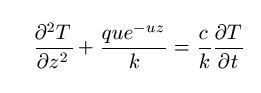
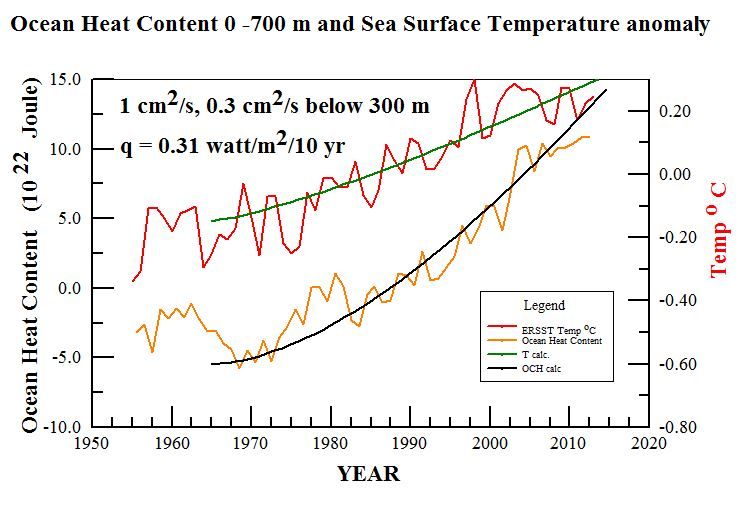
Figure 1. Ocean heat content 0 – 700 meter and surface temperature trends according to NOAA. Blue and green lines show trends calculated for the parameters shown.
These calculations establish some parameters that do a good job of representing the thermal behavior of the upper oceans, however, if one looks closely at the data trends in the graph, it is apparent that both surface temperature and ocean heat content have considerably slowed their rates of increase in the last decade. This makes it unlikely that greenhouse gases are the cause of the rate of heating needed to explain the previous trends because their effects should have become enhanced rather than diminished. It might also be noted that a similar warming trend occurred in the first half of the previous century before anthropogenic greenhouse gases could have contributed significantly. Thus it is more likely that both warming periods had natural origins.
Obtaining simultaneous fits to the ocean heat content and sea surface temperature trends with only two free parameters, thermal diffusivity and surface heating rate, is quite confining. Acceptable, but noticeably worse, fits than shown above, were obtained with thermal diffusivities ranging from 0.8 to 1.2 cm2/s and heat inputs ranging from 0.29 to 0.33 watt/m2. Based on previous calculations for sea level data, I was initially inclined to think that larger thermal diffusivities would be necessary, but larger values let more heat penetrate to greater depths than the amounts of heat reported by Levitus et al. In addition, I was chagrined to learn that most of the variation of sea level that accompanies solar cycles is caused by evaporation rather than thermal expansion.
Solar Cycles:
The process of choosing thermal diffusivity and surface heating rates to accord with observations provides a sound basis for calculating what to expect for the temperature variations during solar cycles. In this case we can use the thermal diffusivity of 1 cm2/s that is required of the ocean heat content results as an input parameter and choose the heat input that is required to produce temperature variations of 0.04 – 0.05 oC amplitude. Producing sea surface temperature variations with an amplitude of 0.04 oC requires a surface heat input of 0.33 watt/m2, as shown below:
http://i1244.photobucket.com/albums/gg580/stanrobertson/solarcycle10_zpsa3b8b0ee.jpg
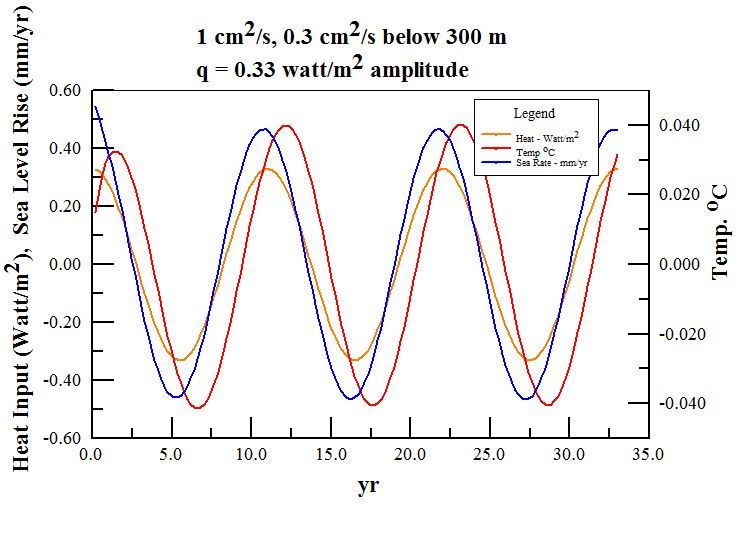

Figure 2. Radiant flux, ocean temperature oscillations, and sea level variations for three solar cycles of eleven years each. The entering flux shown here is the value of q = 0.33 watt/m2 needed to drive the variations of surface temperature of 0.04 oC with ocean thermal diffusivity of 1.0 cm2/s to depth of 300 m. The amplitude of thermosteric rate of change of sea level was 0.47 mm/yr. Temperature lags the driving energy flux by 15 months. The thermal expansion coefficient of sea water used here was 2.4×10⁻⁴/ oC.
I believe that this settles the issue of what is required to produce sea surface temperature oscillations with an amplitude of 0.04 oC. The solar TSI variations that reach the earth’s surface are smaller than the 0.33 watt/m2 needed to account for sea surface temperature variations by a factor of 3.6 for this smallest estimate of sea surface temperature variability.
Although the estimated 0.33 watt/m2 that is required to explain the surface temperature variations is large compared to the amplitude of TSI variations that reach the surface, it is still only about two parts per thousand of the 160 watt/m2 of solar UV/VIS/NIR that reaches the earth surface. There are many possible ways in which the sun might modulate the surface energy flux to this extent. These include modulation of cloud cover and small spectral shifts in the energetic UV that might modulate ozone absorption or produce shifts of the effective sea surface albedo. It would seem to be a fairly direct radiative effect, rather than feedback, since it must vary in phase with the solar cycle.
In summary, my calculations based on energy conservation considerations imply that the sun modulates the ocean temperatures to a much greater extent than can be provided solely by its TSI variations. The great question that desperately needs an answer is how does it do it? It should be easily understood that solar effects would not necessarily be confined to cycles. More likely, the sun has been the driver of the large changes of temperatures of the Roman and Medieval warm period, the Little Ice Age, and the recent recovery from it without requiring large changes of its own irradiance. When we understand how the sun does this, we will have begun to understand the earthly climate.
###
Biographical note:
Stan Robertson, Ph.D, P.E, retired in 2004 after teaching physics at Southwestern Oklahoma State University for 14 years. In addition to teaching at three other universities over the years, he has maintained a consulting engineering practice for 30 years.
References:
Bryan, F., 1987: Parameter Sensitivity of Primitive Equation Ocean General Circulation Models. Journal of Physical Oceanography, 17, 970-985. (PDF available here http://journals.ametsoc.org/doi/abs/10.1175/1520-0485%281987%29017%3C0970%3APSOPEO%3E2.0.CO%3B2
Levitus, S. et al., 2012 World ocean heat content and thermosteric sea level change (0–2000 m), 1955–2010, Geophysical Research Letters, 39, L10603, doi:10.1029/2012GL051106, 2012 http://onlinelibrary.wiley.com/doi/10.1029/2012GL051106/abstract
Shaviv, Nir 2008, Using the oceans as a calorimeter to quantify the solar radiative forcing, Journal of Geophysical Research, 113, A11101 http://www.sciencebits.com/files/articles/CalorimeterFinal.pdf
Trenberth, K., Fasullo, J., Kiehl, J. 2009: Earth’s Global Energy Budget. Bull. Amer. Meteor. Soc., 90, 311–323. doi: http://dx.doi.org/10.1175/2008BAMS2634.1 www.cgd.ucar.edu/staff/trenbert/trenberth.papers/TFK_bams09.pdf , Fig. 1
Zhou, J. and Tung, K. ,2010 Solar Cycles in 150 Years of Global Sea Surface Temperature Data, Journal of Climate 23, 3234-3248 http://journals.ametsoc.org/doi/abs/10.1175/2010JCLI3232.1
Nir Shaviv says:
October 14, 2013 at 2:19 pm
Well, it should be mentioned that their whole analysis has a major flaw.
This is the usual porblem: everybody claims that everybody else’s analysis in flawed…
is that the solar forcing is about 1 W/m^2 over the solar cycle, not 0.17W/m^2 as satellites measure.
The author of the article heading this thread, claims 0.33 W/m2.
“This is the usual porblem: everybody claims that everybody else’s analysis in flawed…”
Well, in this case it is simple… they admitted that they are wrong and they even published an erratum!
“The author of the article heading this thread, claims 0.33 W/m2.”
If one neglects the mixing layer, one will underestimate the amount of heat that goes into the ocean and with it the forcing.
Dr. Shaviv,
We met at the Heartland conference, but you probably wouldn’t remember me. You were very gracious with your interesting explanations regarding our sun and its travels through the galaxy.
Anyway, here is an example of what is wrong with peer review. If you haven’t read it before, it seems to parallel some of the problems you’ve had.
dbstealey, great link!
p.s., I might have recognized your face… certainly not your alias. cheers.
Nir Shaviv says:
October 14, 2013 at 2:44 pm
Well, in this case it is simple… they admitted that they are wrong and they even published an erratum!
Overholt was just incidental to main issue in the paper I linked to: http://www.leif/org/EOS/1303-7314-Cosmic-Rays-Climate-billion-yrs.pdf “We have shown above that the changes in the GCR intensity as the Solar System moves from the IA to the SA of our Galaxy are of the order of 20%. These match roughly the changes in the intensity observed during the 20th century due to centennial effects and due to the 11 year solar modulation. It has been shown that changes at this level cause at most a 0.07C change in the present day mean global temperature (Erlykin et al., 2009b). Therefore, the changes in global temperature due to changes in the GCR intensity as we move from the IA to the SA are likely to be of the same magnitude. We conclude therefore that such changes cannot produce the large changes at the Ice Age epochs of the past 10^9 years as postulated by Shaviv and Veizer (2008).”
http://www.leif.org/EOS/1303-7314-Cosmic-Rays-Climate-billion-yrs.pdf
Leif, if you dig a little into their paper, you will find that they themselves have the answer. They write:
We (Rogers et al., 1988) and Bloemen et al.,(1989) presented evidence for the spectral shape of GCR depending on Galactic latitude and SA, IA intensity differences. Our own work gave a difference of spectral exponent between SA and IA of 0.4±0.2 for the Orion Arm and its neigh- bouring IA.
Clearly then if there is a small variance in the density for cosmic rays at 1 GeV (which is the average CR energy), then at an energy of 15 GeV, which is the typical energy needed to penetrate the atmosphere, the SA/IA contrast will be 15^0.4 = 3 or so. I find from meteorites that it should be larger than 2.5.
As you can see, there is no discrepancy. Their small contrast is simply at an energy which is irrelevant for the CR/climate link.
Good night. I have to wakeup early to teach
Leif Svalgaard: I say that they exist and have just the right size to explain the observed variation.
In that case, why are you claiming to be mystified by what you call an “amplification”? If the indirect effects have “just the right size” to explain that “amplification”, then why are you criticizing the “amplification”? Is it something different that they have just the right size to explain?
Matthew, the paper can be downloaded from http://www.sciencebits.com/calorimeter
lsvalgaard says:
October 14, 2013 at 2:54 pm
Thanks for the link. It looks like a good paper.
Matthew R Marler says:
October 14, 2013 at 3:10 pm
In that case, why are you claiming to be mystified by what you call an “amplification”? If the indirect effects have “just the right size” to explain that “amplification”
IMHO, no amplification is needed: the simple variation of TSI explains the 0.05-0.1C variation in temperature without the need for any mysterious ‘amplification’. And I’m not criticizing, just asking for clarification and explanation. Especially since the ‘experts’ disagree. Shaviv just said the forcing was 1 W/m2, while Robertson said 0.33 W/m2. Does that not puzzle you? And why not?
Nir Shaviv: The bottom line in that analysis (from 2008) is that the solar forcing is about 1 W/m^2 over the solar cycle, not 0.17W/m^2 as satellites measure.
A link to the paper would be welcome. I follow most links and download most available papers.
Nir Shaviv says:
October 14, 2013 at 3:18 pm
As you can see, there is no discrepancy. Their small contrast is simply at an energy which is irrelevant for the CR/climate link.
As I said: everybody claims that other’s papers are junk. BTW at 15GeV the solar cycle modulation is almost absent.
Hocky Schtick: For a start, here’s 50 papers describing potential solar amplification mechanisms
lsvalgaard: without the need for any mysterious ‘amplification’.
lsvalgaard: None of those explain how 3.6 times more heat reach the surface than the variation of what the Sun puts out…Otherwise the climate system would be a nifty energy producer: you put 10 units in and you get 36 out. I want one of those 🙂
lsvalgaard: Especially since the ‘experts’ disagree. Shaviv just said the forcing was 1 W/m2, while Robertson said 0.33 W/m2. Does that not puzzle you? And why not?
I think that the mean “forcing” can’t be estimated from the mean temperatures and other mean quantities like mean insolation and such. The insolation has different effects over land and water; some is absorbed high in the atmosphere and some is reflected. Mean radiation from the Earth surface is proportional to mean [T^4] not [mean T]^4; transport of energy from the surface to the upper troposphere includes convection of warm moist air, and that is not a simple linear function of temperature either, and is wind-dependent. (those things affect the rate of cooling of the Earth, and hence the temperature response to a change in “forcing”, which makes the mean temperature response to a given change in the amount and nature of forcing hard to estimate.)
Nir Shaviv, thank you.
lsvalgaard says: October 14, 2013 at 2:18 pm Hockey Schtick says:
October 14, 2013 at 2:04 pm
What do you specifically claim is a circular argument?
not ‘claim’, just telling. The fit already injects temperature dependent data. But you should know that best. Here is the sunspot integral over the time where we have reasonable data http://www.leif.org/research/SSN-Integral.png
This does not fit ‘almost perfectly’ as your link claims.
1. The sunspot time integral alone explains ~58% of global temperature variability. According to Leif, this means there is no evidence whatsoever of any correlation between sunspots/TSI and global temperature variability. This is before any consideration of lagged 2nd order effects, ocean thermal inertia, or ocean oscillations.
http://hockeyschtick.blogspot.com/2013/08/natural-climate-change-has-been-hiding.html
On the other hand, even if we assume CO2 changes precede & control temperature changes, CO2 only explains ~7.5% of temperature variability. Temperatures, however, lead CO2 on short, intermediate, and long-term timescales, and the cause does not follow the effect.
2. Leif claims using the PDO and AMO in a model of global temperature variability is “a circular argument” that “injects temperature dependent data.” However, “THE PDO DOES NOT REPRESENT NORTH PACIFIC SST ANOMALIES” and “THE PDO DOES NOT REPRESENT DETRENDED NORTH PACIFIC SST ANOMALIES” and “THE PDO DOES NOT REPRESENT VARIATIONS IN THE DELTA T BETWEEN NORTH PACIFIC SST AND GLOBAL TEMPERATURES”
http://wattsupwiththat.com/2009/04/28/misunderstandings-about-the-pacific-decadal-oscillation/
“SO WHAT DOES THE PDO DESCRIBE? The PDO represents a pattern of SST anomalies in the North Pacific. The operative word in that sentence is PATTERN.” – Bob Tisdale
Therefore, use of the sunspot time integral and the PDO & AMO temperature PATTERNs [which are not absolute SST changes] in a model is not based upon a circular argument.
On the other hand, IPCC climate models are based upon the circular argument that CO2 is the “control knob” of global temperature.
Hockey Schtick says:
October 14, 2013 at 4:18 pm
1. The sunspot time integral alone explains ~58% of global temperature variability.
No, it does not ‘explain’ anything. There is a correlation, but not necessary causation. The price of a U.S. postage stamp or the number of pirates also correlates with global warming, but does not explain GW.
2. Leif claims using the PDO and AMO in a model of global temperature variability is “a circular argument” that “injects temperature dependent data.” … The PDO represents a pattern of SST anomalies in the North Pacific.
This is where the circular argument comes in.
On the other hand, IPCC climate models are based upon the circular argument that CO2 is the “control knob” of global temperature.
That somebody else may be wrong does not mean that you are correct.
For the life of me I mistakenly assumed this was Dr. Robertson’s article and thread. Now where did I go so wrong? 😉
lsvalgaard says: October 14, 2013 at 4:25 pm
Hockey Schtick says: October 14, 2013 at 4:18 pm
1. The sunspot time integral alone explains ~58% of global temperature variability.
No, it does not ‘explain’ anything. There is a correlation, but not necessary causation. The price of a U.S. postage stamp or the number of pirates also correlates with global warming, but does not explain GW.
Some progress, at least, in that Leif admits that “There is a correlation, but not necessary causation” between the sunspot time integral and global temperature variability. Sure, even if the correlation was 97% or 100%, Leif could still say the same thing. At least for the Sun, the only significant source of energy to the Earth surface, there are multiple reasons supporting such a causal relationship, unlike for stamps and pirates. Don’t you understand the difference?
Likewise, there is a correlation between solar activity and sunspots, “but not necessarily causation”
The PDO represents a pattern of SST anomalies in the North Pacific.
This is where the circular argument comes in.
That would be true if the PDO represented mean SST anomalies in the North Pacific, but it clearly does not as shown by Bob Tisdale; it represents a PATTERN of cooling in one region vs. warming in another, not mean SST anomalies, and therefore Leif’s claim of a circular argument is incorrect.
Hockey Schtick says:
October 14, 2013 at 5:21 pm
Some progress, at least, in that Leif admits that “There is a correlation, but not necessary causation” between the sunspot time integral and global temperature variability.
A sure sign of a spurious correlation is that the correlation breaks down outside the cherry-picked interval it is first based on. Your particular correlation breaks down if you take it back in time, e.g. to 1850 or 1750.
Likewise, there is a correlation between solar activity and sunspots, “but not necessarily causation”
You are spouting nonsense as sunspots are solar activity.
That would be true if the PDO represented mean SST anomalies in the North Pacific, but it clearly does not as shown by Bob Tisdale; it represents a PATTERN of cooling in one region vs. warming in another, not mean SST anomalies, and therefore Leif’s claim of a circular argument is incorrect.
You impose a wave pattern on the correlation in the sense that PDO is positive for some time, then negative for some time. People claim that temperatures now are lower because we are in the negative phase of PDO, so there is the relation with temperature. As I recall from your detailed ‘analysis’ the solar cycle integral was a VERY minor constituent of the relation. So the end result is a long term trend with an imposed sine wave, that is the circular argument.
A sure sign of a spurious correlation is that the correlation breaks down outside the cherry-picked interval it is first based on. Your particular correlation breaks down if you take it back in time, e.g. to 1850 or 1750.
The ~58% correlation of the sunspot time integral to global temperatures IS FROM 1850.
http://hockeyschtick.blogspot.com/2013/08/natural-climate-change-has-been-hiding.html
So, your claim of cherry-picking is false. The HADCRU global temperature record only goes back to 1850, and the early data is quite sparse, based upon the crude thermometers available, and has been repeatedly adjusted to cool the past and warm the present. Even after all of that, and without considering any 2nd order or lagged effects or ocean oscillations, the correlation is still ~58%.
Likewise, there is a correlation between solar activity and sunspots, “but not necessarily causation” You are spouting nonsense as sunspots are solar activity.
That was simply in response to your nonsense conflating correlation between postage stamps as analogous to solar activity & GW. Sunspots are one manifestation of solar activity, and the causal relationship and proposed mechanisms postulated on the basis of the correlations first found.
As I recall from your detailed ‘analysis’ the solar cycle integral was a VERY minor constituent of the relation. So the end result is a long term trend with an imposed sine wave, that is the circular argument.
No, not true, as has already been pointed out several times above. The sunspot integral explains the majority [~58%] of the observed global temperature variation since the beginning of the record in 1850.
Hello Nir,
I met Jan Veizer at U of Ottawa, introduced by Tim Patterson, circa 2002 and prior to publication of Shaviv and Veizer GSA2003.
I liked your paper then and I still like it now.
I recall some negative screed in EOS circa 2003 that was very upsetting to Jan. I wrote about this in E&E.
I do not know if you have an opinion on this question, but if you do I would very much like to hear your thoughts .
Do you have an estimate as to whether average global temperatures will be warmer, cooler or about the same as today circa 2020-2030, and if so by how much?
Leif says about the same temperature as today and I say cooler, but I’m not sure how much.
Thanks and regards, Allan
Hockey Schtick says:
October 14, 2013 at 7:03 pm
The ~58% correlation of the sunspot time integral to global temperatures IS FROM 1850.
http://hockeyschtick.blogspot.com/2013/08/natural-climate-change-has-been-hiding.html
This is what the integral looks like: http://www.leif.org/research/SSN-Integral.png
Hockey Schtick says:
October 14, 2013 at 7:03 pm
The ~58% correlation of the sunspot time integral to global temperatures IS FROM 1850.
Here is the integral over the past 2000 years [derived from cosmic rays] compared to the average of Temperature Anomalies from Moberg and Loehle: http://www.leif.org/research/Solar-Activity-Integral-and-Temp.png
Here is the integral over the past 2000 years [derived from cosmic rays] compared to the average of Temperature Anomalies from Moberg and Loehle
What is the specific data source/proxy you are using for cosmic rays? From what location(s)? Why did you choose that particular proxy?
Hockey Schtick says:
October 15, 2013 at 10:02 am
What is the specific data source/proxy you are using for cosmic rays? From what location(s)? Why did you choose that particular proxy?
http://onlinelibrary.wiley.com/doi/10.1029/2009JA014193/abstract
Until their revised values come out later this year, this is the best there is covering such a long interval. The cosmic ray intensity has been converted to equivalent heliospheric magnetic field which is also a good proxy for the sunspot number [or rather for ‘real’ solar activity – independent of the counting problems there may be with the sunspot number].
Leif wrote: “As I said: everybody claims that other’s papers are junk. BTW at 15GeV the solar cycle modulation is almost absent.”
a. You said the word junk, not me, and in fact, you mean it and I don’t. I just pointed to a fact that was in THEIR paper which implies that their paper is totally consistent with the picture I am saying, once one realizes that they are not talking at the relevant energies. Suddenly when it doesn’t sit with your world view, you disregard it.
b. The solar modulation at 15 GeV is of order 10%, it is certainly NOT absent. Although the variations at 1GeV are much larger, they are irrelevant for the troposphere because those CRs and their secondaries cannot penetrate deep into the atmosphere.
The more recent work by the same authors [with additional authors] is linked here and shows solar activity in the latter half of the 20th century was at the highest levels of the past 9,000 years. In addition, the paper concludes “generally the agreement between solar forcing and Asian climate is good,” so glad to hear you agree “this is the best there is covering such a long interval.”
http://hockeyschtick.blogspot.com/2013/01/paper-finds-solar-activity-at-end-of.html
Hockey Schtick says:
October 15, 2013 at 12:59 pm
The more recent work by the same authors [with additional authors] is linked here and shows solar activity in the latter half of the 20th century was at the highest levels of the past 9,000 years.
The main authors are members of my team to re-evaluate solar activity and the preliminary conclusion [being written up as we speak] is that the earlier [although recent] paper was faulty in this regard. You can learn more by consulting the discussion of Figures 9 and 10 in http://www.leif.org/research/swsc130003p.pdf and http://www.leif.org/research/Svalgaard_ISSI_Proposal_Base.pdf
Apart from such inconsistencies, the overall accuracy is satisfactory and good enough for integration. And your quote “agreement between solar forcing and Asian climate is good” is curious because of the restriction to Asian [and not global] climate; in addition the cosmic ray record is contaminated by climate itself, so some of the minor wiggles are just circular.
Some of the same authors are also co-authors of http://www.leif.org/EOS/2009GL038004-Berggren.pdf : “A comparison with sunspot and neutron records confirms that ice core 10Be reflects solar Schwabe cycle variations, and continued 10Be variability suggests cyclic solar activity throughout the Maunder and Spoerer grand solar activity minima. Recent 10Be values are low; however, they do not indicate unusually high recent solar activity compared to the last 600 years”
I would be glad if you would keep up with the literature instead of cherry-picking what you like.
Hockey Schtick says:
October 15, 2013 at 12:59 pm
the paper concludes “generally the agreement between solar forcing and Asian climate is good,”
You misquote the paper. The statement is “Though generally the agreement between solar forcing and Asian climate is good, there are also periods without any coherence, pointing to other forcings like volcanoes and greenhouse gases and their corresponding feedbacks.” It seems you must agree with that as you take the paper as support for your ideas.
Nir Shaviv says:
October 15, 2013 at 1:14 pm
The solar modulation at 15 GeV is of order 10%, it is certainly NOT absent.
I think that is an overestimate. In any event it is too small to have any significant effect.