 (Perturbation Calculations of Ocean Surface Temperatures.)
Guest essay by Stan Robertson, Ph.D., P.E.
1. Introduction
It is generally conceded that the earth has warmed a bit over the last century, but it is not clear what has caused it, nor whether it will continue and become a problem for humanity. There is a possibility that some of the warming has been caused by anthropogenic greenhouse gases, but it is also likely that the sun has been partially responsible. The arguments that are advanced to say that humans caused it and that it will become a serious problem rely on models that have not been validated and positive feedback effects that have not been shown to exist, at least at the hypothesized levels of effectiveness. The apparent weakness in the argument that the sun has been a major contributor is that satellite measurements of Total Solar Irradiance (TSI) have not shown changes large enough to have directly produced the warming of the earth over the last half century. But what about indirect effects? Is it possible that the sun exerts control in some indirect way? In these notes I recapitulate the evidence that this is the case by showing that the variations of TSI cannot provide the energy that is necessary to account for the warming of the oceans during solar cycles.
TSI, as measured above the earth’s atmosphere varies by about 1.2 watt/m2 over a nominal eleven year solar cycle (h/t Leif Svaalgard) primarily at wavelengths shorter than 2 micron. The dominant harmonic variation of TSI would thus have an amplitude half this large, or about 0.6 watt/m2. About 70% of this enters the earth atmosphere. Averaged over latitudes and day/night cycles, about one fourth of this 70%, or ~0.11 watt/m2, on average, enters the upper atmosphere. Since only about 160 watt/m2 of 1365 watt/m2 of incoming solar radiation at wavelengths less than 2 micron reaches the earth surface, the amplitude of short wavelength TSI reaching the earth surface would be only (160/1365)x0.6 = 0.07 watt/m2. However, about half of the difference between 0.11 and 0.07 watt/m2 eventually reaches the earth surface as scattered thermal infrared radiation at wavelengths greater than 2 micron. Thus the average amplitude of TSI reaching the earth surface in all wavelengths would be about 0.09 watt/m2. So the question is, just how much sea surface temperature variation can this produce?
Several researchers, including Nir Shaviv (2008), Roy Spencer (see http://www.drroyspencer.com/2010/06/low-climate-sensitivity-estimated-from-the-11-year-cycle-in-total-solar-irradiance/) and Zhou & Tung (2010) have found that ocean surface temperatures oscillate with an amplitude of about 0.04 – 0.05 oC during a solar cycle. (In fact, all of the ideas that I am presenting here were covered in Shaviv’s work, but it has not gotten the attention that it deserves.) Using 150 years of sea surface temperature data, Zhou & Tung found 0.085 oC warming for each watt/m2 of increase of TSI over a solar cycle. Although not strictly sinusoidal, the temperature variations can be approximately described in terms of a dominant sinusoidal component of variation with an 11 year period. Thus the question to be answered at this point is, can 0.09 watt/m2 amplitude of variation of TSI entering the oceans produce temperature oscillations with an amplitude of 0.04 – 0.05 oC?
The answer to this question depends on the average thermal diffusivity of the upper oceans. That is an unknown, but not unknowable, quantity. Thermal diffusivity is the ratio of thermal conductivity to heat capacity. The upper 25 to 100 meters of oceans are well mixed by waves and shears. These are mixing zones with high thermal diffusivity and correspondingly small temperature gradients. Diffusivities are lower at greater depths. Bryan (1987) has found that thermal diffusivities ranging from 0.3 to 5 cm2/s are needed to account for the temperature profiles below the mixing zone. In my first trial calculations of the energy flux necessary to account for the temperature variations, I tried values of thermal diffusivity in the range 0.1 – 10 cm2/s and found that the TSI variations were generally inadequate to produce the sea temperature variations over a solar cycle. But there was wide variation of calculated energy flux. Larger values of thermal diffusivity required more heat because more was able to penetrate to the depths, but even for 0.1 cm2/s, the required input was double the TSI variations that reach the earth surface. Fortunately, there is a way to constrain both the value of the thermal diffusivity and the heat input. It consists of first matching the measured trends of surface temperatures and ocean heat content over time. Measurements of these were reported by Levitus et al. (2012) and are available from http://www.nodc.noaa.gov/OC5/3M_HEAT_CONTENT/ .
In the calculations described below, I have used the data from 1965 to 2012 for ocean depths to 700 meters. Sea surface temperatures and ocean heat content began to increase after 1965. Only about a third of the increase of heat content occurred at depths below 700 meter. Since little heat migrates below this depth over 11 year solar cycles, it is preferable to use the 0 – 700 m data for the purpose of calibrating the thermal diffusivity
2. Heat Transfer Perturbation Calculations
For the calculation of sea surface temperature and sea level changes, we can treat the variations of radiations entering and leaving atmosphere, lands and oceans as minor perturbations on an earth essentially in thermal equilibrium. Ocean mixing zones, thermoclines and other features of the temperature profiles remain largely as they were while small radiant disturbances produce minor variations of temperature starting from zero, and imposed at each depth. Thus the effects of these disturbances can be modeled as one-dimensional energy flows into a medium at uniform temperature. Such “perturbation calculations” are among the most powerful analysis techniques used by physicists and engineers and are widely used. The energy equation to be solved in this case is:
http://i1244.photobucket.com/albums/gg580/stanrobertson/equation_zpscea297ad.jpg

Where T is the temperature departure from equilibrium at depth , z, and time, t. q is a perturbing radiant flux entering the surface, u the absorption coefficient, c is absorber heat capacity and k its thermal conductivity. The rate of heat transfer by conduction processes is controlled by the thermal diffusivity, which is the ratio k/c.
As a one dimensional heat flow problem, it is straightforward undergraduate level physics or engineering to numerically solve the equation above for the expected changes of surface temperature as surface radiant flux varies. In my calculations, temperature changes were calculated for 1.0 meter increments of depth in the oceans. Two cases were considered. In one
case the surface radiation perturbation was assumed to increase linearly with time. This corresponds to the ocean conditions for the period 1965-2012. In the second case, it was assumed to vary as a cosine function of time with the 11 year period of the solar cycle. The cosine function provides both some positive and some negative variation in the first half cycle, which helps to minimize the transients of the first few years.
I treated q and thermal diffusivity, (k/c), as input parameters that were chosen to provide agreement with the observed sea surface temperature variations and ocean heat content measurements (https://www.ncdc.noaa.gov/ersst/ ). The absorption coefficient, u, was entered in piecewise fashion. Only the deep UV radiations penetrate to depths below 10 meter, but conduction takes energy to much greater depths. For the values of u chosen, only 44.5% of the surface energy flux goes deeper than 1 meter, 22.5% below 10 meter and 0.53% to 100 meter (h/t Leif Svalgaard). Thermal diffusivity of oceans was assumed to be 0.3 cm2/s below 300 m. This accords with Bryan’s estimates below the mixing zone, but little change of results occurred for values as low as 0.1 cm2/s. The required heat inputs are relativity insensitive to the thermal diffusivity below 300 meter. For the shallower depths, thermal diffusivity was varied until trends in accord with observed temperatures and heat content were produced.
It is necessary to maintain an energy balance at the sea surface in approximate equilibrium with the incoming solar radiation. As estimated by Trenberth, Fasullo and Kiehl (2009), about 160 watt/m2 enters the surface, on average. At a mean temperature of 288 oK, the sea surface will emit about 390 watt/m2 of surface thermal infrared radiation at wavelengths longer than about 2 micron, however, about 84% of that is returned as back scattered radiation. The rest of the energy balance is provided by evaporation and thermal convection, which remove about 59% of the heat from the surface. From the standpoint of merely wanting to know how much heat is required to change the ocean surface temperature, it is possible to maintain a proper energy balance without delving into the messy details of evaporation, convection and infrared absorption in the first few millimeters of water. The temperature variations at one meter depth will not be measurably different from those at the surface for the thermal diffusivities of interest here. If we merely want to know what net energy flux entering the surface is required to make the water temperature at one meter depth oscillate with an amplitude of 0.04 – 0.05 oC , then all we need to do is account for the outgoing surface infrared emission and let 41% (160 watt/m2 / 390 watt/m2 = 0.41) escape. At the present 288 oK, the earth radiates an additional 5.42 watt/m2 for each 1 oC increase of surface temperature. In the case of surface temperature being perturbed by 0.04 oC, an outgoing additional 0.22 watt/m2 would be generated and 0.09 watt/m2 was allowed to escape. This nicely balances the amplitude of TSI variations that reach the earth’s surface.
3. Linear heating:
In these calculations, the aim was to find the heat input and thermal diffusivities necessary to account for the observed surface temperature increase (http://www.nodc.noaa.gov/OC5/3M_HEAT_CONTENT/ )Extended Reconstructed Sea Surface Temperature) and the increased ocean heat content (OHC 700) that have been reported by NOAA. Since surface temperatures had not been increasing in the early 1960s, but began to increase in the last half of that decade, I chose to start calculations with linearly increasing heating in 1965. I found that the ocean heat content to a depth of 700 meters was quite sensitive to the thermal diffusivity used. The best results that I have been able to obtain were for a thermal diffusivity of 1 cm2/s to 300 meter depth and surface heat input increasing at a rate of 0.31 watt/m2 per decade. These are shown on the graph below with calculated trends shown by the green and black lines. On a time scale of 50 years, most of the heat accumulates at relatively shallow depths. To better reflect a realistic thermal diffusivity for greater depths, I used a lower value of 0.3 cm2/s below 300 meter. That has little practical effect on a 50 year times scale, but would be necessary if one wanted to extend the calculations for several centuries while surface heating perturbations had time to penetrate to much greater depths.
http://i1244.photobucket.com/albums/gg580/stanrobertson/OHC700_zpsb9e34e91.jpg

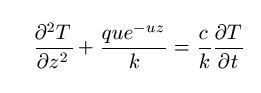
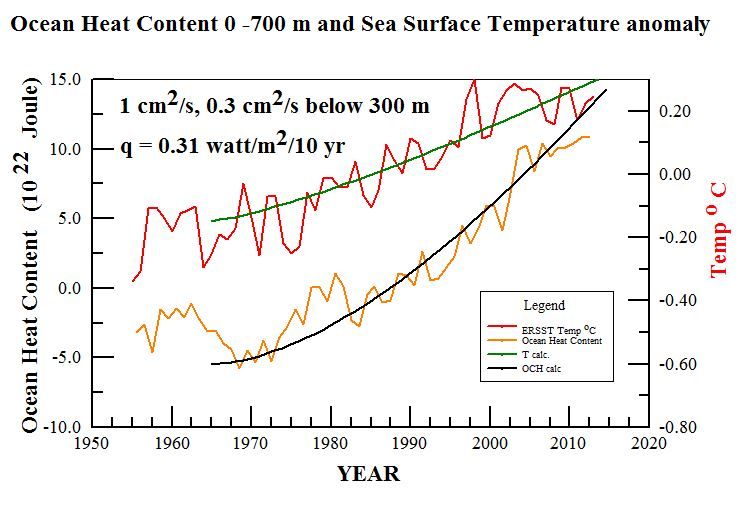
Figure 1. Ocean heat content 0 – 700 meter and surface temperature trends according to NOAA. Blue and green lines show trends calculated for the parameters shown.
These calculations establish some parameters that do a good job of representing the thermal behavior of the upper oceans, however, if one looks closely at the data trends in the graph, it is apparent that both surface temperature and ocean heat content have considerably slowed their rates of increase in the last decade. This makes it unlikely that greenhouse gases are the cause of the rate of heating needed to explain the previous trends because their effects should have become enhanced rather than diminished. It might also be noted that a similar warming trend occurred in the first half of the previous century before anthropogenic greenhouse gases could have contributed significantly. Thus it is more likely that both warming periods had natural origins.
Obtaining simultaneous fits to the ocean heat content and sea surface temperature trends with only two free parameters, thermal diffusivity and surface heating rate, is quite confining. Acceptable, but noticeably worse, fits than shown above, were obtained with thermal diffusivities ranging from 0.8 to 1.2 cm2/s and heat inputs ranging from 0.29 to 0.33 watt/m2. Based on previous calculations for sea level data, I was initially inclined to think that larger thermal diffusivities would be necessary, but larger values let more heat penetrate to greater depths than the amounts of heat reported by Levitus et al. In addition, I was chagrined to learn that most of the variation of sea level that accompanies solar cycles is caused by evaporation rather than thermal expansion.
Solar Cycles:
The process of choosing thermal diffusivity and surface heating rates to accord with observations provides a sound basis for calculating what to expect for the temperature variations during solar cycles. In this case we can use the thermal diffusivity of 1 cm2/s that is required of the ocean heat content results as an input parameter and choose the heat input that is required to produce temperature variations of 0.04 – 0.05 oC amplitude. Producing sea surface temperature variations with an amplitude of 0.04 oC requires a surface heat input of 0.33 watt/m2, as shown below:
http://i1244.photobucket.com/albums/gg580/stanrobertson/solarcycle10_zpsa3b8b0ee.jpg
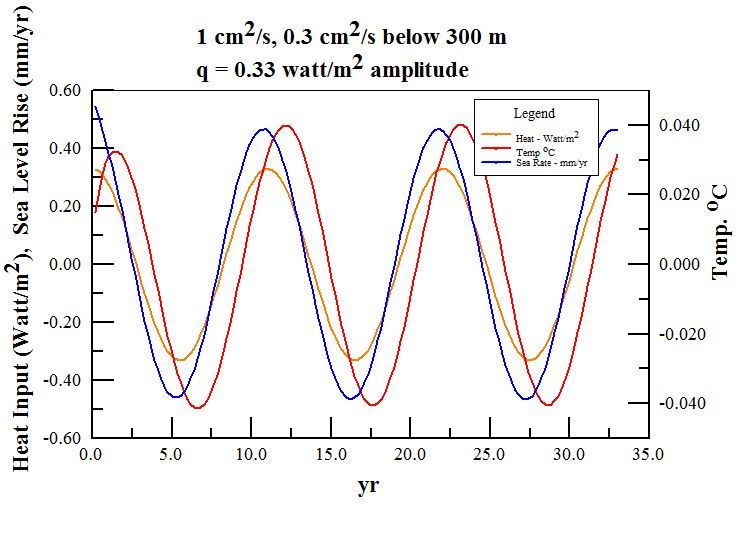

Figure 2. Radiant flux, ocean temperature oscillations, and sea level variations for three solar cycles of eleven years each. The entering flux shown here is the value of q = 0.33 watt/m2 needed to drive the variations of surface temperature of 0.04 oC with ocean thermal diffusivity of 1.0 cm2/s to depth of 300 m. The amplitude of thermosteric rate of change of sea level was 0.47 mm/yr. Temperature lags the driving energy flux by 15 months. The thermal expansion coefficient of sea water used here was 2.4×10⁻⁴/ oC.
I believe that this settles the issue of what is required to produce sea surface temperature oscillations with an amplitude of 0.04 oC. The solar TSI variations that reach the earth’s surface are smaller than the 0.33 watt/m2 needed to account for sea surface temperature variations by a factor of 3.6 for this smallest estimate of sea surface temperature variability.
Although the estimated 0.33 watt/m2 that is required to explain the surface temperature variations is large compared to the amplitude of TSI variations that reach the surface, it is still only about two parts per thousand of the 160 watt/m2 of solar UV/VIS/NIR that reaches the earth surface. There are many possible ways in which the sun might modulate the surface energy flux to this extent. These include modulation of cloud cover and small spectral shifts in the energetic UV that might modulate ozone absorption or produce shifts of the effective sea surface albedo. It would seem to be a fairly direct radiative effect, rather than feedback, since it must vary in phase with the solar cycle.
In summary, my calculations based on energy conservation considerations imply that the sun modulates the ocean temperatures to a much greater extent than can be provided solely by its TSI variations. The great question that desperately needs an answer is how does it do it? It should be easily understood that solar effects would not necessarily be confined to cycles. More likely, the sun has been the driver of the large changes of temperatures of the Roman and Medieval warm period, the Little Ice Age, and the recent recovery from it without requiring large changes of its own irradiance. When we understand how the sun does this, we will have begun to understand the earthly climate.
###
Biographical note:
Stan Robertson, Ph.D, P.E, retired in 2004 after teaching physics at Southwestern Oklahoma State University for 14 years. In addition to teaching at three other universities over the years, he has maintained a consulting engineering practice for 30 years.
References:
Bryan, F., 1987: Parameter Sensitivity of Primitive Equation Ocean General Circulation Models. Journal of Physical Oceanography, 17, 970-985. (PDF available here http://journals.ametsoc.org/doi/abs/10.1175/1520-0485%281987%29017%3C0970%3APSOPEO%3E2.0.CO%3B2
Levitus, S. et al., 2012 World ocean heat content and thermosteric sea level change (0–2000 m), 1955–2010, Geophysical Research Letters, 39, L10603, doi:10.1029/2012GL051106, 2012 http://onlinelibrary.wiley.com/doi/10.1029/2012GL051106/abstract
Shaviv, Nir 2008, Using the oceans as a calorimeter to quantify the solar radiative forcing, Journal of Geophysical Research, 113, A11101 http://www.sciencebits.com/files/articles/CalorimeterFinal.pdf
Trenberth, K., Fasullo, J., Kiehl, J. 2009: Earth’s Global Energy Budget. Bull. Amer. Meteor. Soc., 90, 311–323. doi: http://dx.doi.org/10.1175/2008BAMS2634.1 www.cgd.ucar.edu/staff/trenbert/trenberth.papers/TFK_bams09.pdf , Fig. 1
Zhou, J. and Tung, K. ,2010 Solar Cycles in 150 Years of Global Sea Surface Temperature Data, Journal of Climate 23, 3234-3248 http://journals.ametsoc.org/doi/abs/10.1175/2010JCLI3232.1
Then since it ended at a cliff, let’s take another path. Tell me how you are going to calculate the heat that went into the water to get your dT. I am not ready to think about your dS yet. There has not yet been any mention of evaporation, convection or even outbound thermal IR. With respect to the latter, I would suggest that (396-333)/396=0.159 is the appropriate net fraction of surface thermal IR that makes it out. For a surface at 289 K you would get an additional 5.47 watt/m^2/C out. So tell me what you want for dT and we will have .159×5.42 dT as the NET outgoing thermal IR from the surface.
bones says:
October 22, 2013 at 9:35 pm
I am not ready to think about your dS yet. There has not yet been any mention of evaporation, convection or even outbound thermal IR.
Those things are automatically accounted for by using T = 289 K [the actual observed T] instead of the 255 K we would have without the atmosphere and oceans.
Great! if they are all accounted for, then tell me how large dT was and how much heat went into the water.
bones says:
October 22, 2013 at 9:45 pm
Great! if they are all accounted for, then tell me how large dT was and how much heat went into the water.
dT = 0.072, 0.49 W/m2, obviously.
I thought dT had been measured to be 0.04-0.05C. How did you get 0.072C?
bones says:
October 22, 2013 at 10:08 pm
I thought dT had been measured to be 0.04-0.05C. How did you get 0.072C?
Perhaps your unfortunate choice of amplitude rather than valley-peak range plays a role here. Actually dT has never been measured. Various people claim a variation [v-p] of the order 0.1C or a bit less but with large error bars. dS/S is generally accepted to be 0.1% [1.36 W/m2], so dT/T becomes dS/S/4 = 0.025% which with T = 289K gives dT=0.072C.
Well, I thought that you must have taken 0.1% of 396 watt/m^2 as the increment of outgoing sea surface IR and at 5.47 w/m^2/C, (for 289K surface) that gets 0.072 C. OK, so far you have 0.49-0.39=0.1 w/m^2 as the net IR entering the ocean. Now tell me how much evaporation you are going to subtract, as this also comes off the surface. At that point we will know how much net heat will actually go downward into the water.
bones says:
October 22, 2013 at 10:37 pm
so far you have 0.49-0.39=0.1 w/m^2 as the net IR entering the ocean.
No, we have 0.49 W/m2 impinging on the surface.
Actually, that 0.1 watt/m^2 is net IR plus UV/VIS and we also have to subtract convection losses (so-called sensible heat).
0.49 impinges, 0.39 is outgoing. The difference, less evaporation and convection losses is the NET that enters the water and might get down more than a cm or two.
bones says:
October 22, 2013 at 10:41 pm
Actually, that 0.1 watt/m^2 is net IR plus UV/VIS and we also have to subtract convection losses (so-called sensible heat).
As per Trenberth [who you were happy with], we have 333 W/m2 absorbed by the surface from the atmosphere plus 161 W/m2 from the Sun absorbed by the surface for a total of 494 W/m2. For small changes everything scales linearly, so 0.1% is 0.49 W/m2.
Leif, if you will have a look at Trenberth’s diagram you will see that there is 396 w/m^2 outgoing surface thermal infrared. It emits more than it receives as back radiation. So if you are wanting to say that .333 w/m^2 of thermal IR is absorbed at the surface, you also have to accept that it will radiate .396 w/m^2. That is required of a blackbody with surface temp change of 0.072C.
bones says:
October 22, 2013 at 10:51 pm
you also have to accept that it will radiate .396 w/m^2.
It radiates after it has been heated, so the incoming 0.49 W/m2 heats the surface to increase the temperature as observed. I think this is clear.
I am dying for lack of sleep. Been up too long. I suspect that I will have to wait for you to digest the last exchange. But let me leave another comment or two to consider, I would suggest that of the increment of UV/Vis that enters the ocean, 0.14 w/m^2 (2x my amplitude), the fraction that would be removed by evaporation and convection would be 97/161. That gets another surface heat loss of 0.084 w/m^2, leaving a NET 0.016 w/m^2 to heat the ocean at depths below a few cm. and pleasant dreams to you, too.
bones says:
October 22, 2013 at 11:10 pm
I suspect that I will have to wait for you to digest the last exchange.
I’m fine with what I have explained to you so far. Makes perfect sense.
lsvalgaard says:
October 22, 2013 at 11:10 pm
bones says:
October 22, 2013 at 10:51 pm
you also have to accept that it will radiate .396 w/m^2.
It radiates after it has been heated, so the incoming 0.49 W/m2 heats the surface to increase the temperature as observed. I think this is clear.
——————————————————
Let me ask you to set up the simple first order differential equation that would control the rate of heating of a 25 m deep ocean. It will have a derivative of the temperature change in the right member. You are missing an important point. This process of heating and cooling is cyclical and there is never going to be much of a thermal lag between surface heat inputs and surface temperature. You have to consider that when the temperature change from equilibrium is T, then there will be a net surface radiative heat loss of (5.47T less the back radiation.)
You think that you have a NET 0.49 w/m^2 to heat the water, but that is dead wrong after the first few solar cycle transients are done. On that I really am going to give up for the night. I am pretty sure that you can solve a freshman physics heat problem, so why not give it a try?
bones says:
October 22, 2013 at 11:23 pm
Let me ask you to set up the simple first order differential equation that would control the rate of heating of a 25 m deep ocean.
There are assumptions about thermal diffusion [conduction, mixing, etc] that cannot easily be incorporated. I don’t see how those uncertainties can be overcome in a simple [and non-objectionable] manner, so I doubt the usefulness of such an exercise.
I think that you know what would be reasonable assumptions for 25 m of water with no internal thermal gradients. Humor me, please. It took me far less time to solve the problem than we have spent here in trying to define it.
Bones, you might find this paper rather interesting, found UV varies up to 100% over cycles creating an amplification via ozone. I haven’t read it all yet but you came to mind.
http://www.atmos-chem-phys.net/13/10113/2013/acp-13-10113-2013.pdf
wayne says:
October 23, 2013 at 1:43 am
Bones, you might find this paper rather interesting, found UV varies up to 100% over cycles creating an amplification via ozone. I haven’t read it all yet but you came to mind.
http://www.atmos-chem-phys.net/13/10113/2013/acp-13-10113-2013.pdf
—————————————————————-
Wayne, thanks. I will read it and see how it works out. The basic problem that I pointed out is that there must be some mechanism that modulates the solar energy that reaches the surface because the fraction of intrinsic solar TSI variation that enters the surface is inadequate.
lsvalgaard says:
October 22, 2013 at 11:10 pm
bones says:
October 22, 2013 at 10:51 pm
you also have to accept that it will radiate .396 w/m^2.
It radiates after it has been heated, so the incoming 0.49 W/m2 heats the surface to increase the temperature as observed. I think this is clear.
————————————————-
If you are wanting to say that you have the full effect of 0.49 w/m^2 to heat the water until the surface has heated, I would say that you are wrong. Bearing in mind that we are supposed to be starting from Trenberth’s balanced conditions, you don’t have any fraction of that 333 w/m^2 of downwelling infrared to provide additional heat for the water at the outset. At wavelengths below 2 micron, you have about 161/1365 of the TSI variation that enters the surface. About half of the difference between this amount and the TSI variation that enters the atmosphere can be added. The other half of the difference would be either scattered upward or reradiated to outer space. So what enters the surface is about [161/1365 + (0.7/4-161/1365)/2]x1.2=0.1465 w/m^2. Back radiation, evaporation and convective heat losses must be subtracted from this when the surface temperature changes, and it will change significantly long before the TSI has changed from trough to a peak that is 1.2 w/m^2 higher.
The basic flaw in your thinking is that you are relying on the atmosphere to provide two thirds of the heat to the water. But for even 25 meters of water, the ocean has over ten times the heat capacity of the atmosphere. The atmosphere cannot provide the heat. Any excess heat that it provides to the ocean must come from the fraction of TSI that is absorbed by the atmosphere. (I gave it half, you may quibble if you provide a good reason.) Further, it’s heat capacity is so small in comparison to the oceans that it cannot ever lead or lag ocean temperature by more than seasonal lag.
Bones, I like your approach of this problem very much, it’s like a breath of fresh air and with my limited time it may take quite a while to delve into this as detailed as I wish to do so, so be patient. This climate science posture, their way of looking at radiation to somehow create an impression that two thirds of the energy comes from the atmosphere is so foreign to me, so I usually just ignore it as such. It is primary in temperature differentials, any use of Stefan’s law should be via temperature differentials and never as if all is against the void of space at zero K and an emissivity of one so when I write back later that is the framework I will be using, two-way e/m fields that can cancel effects. The temperature at the surface and the temperature at an altitude of say one hundred meters is what guarantees that so very little real radiation is leaving the surface, mostly through the window, in contrast to common climate science talk.
To me, you amplification must, or it seems at first must, be via albedo or emissivity in some manner and that is where I will attack this to begin with. That is why I thought that article may possibly hold something of value, maybe not, for it seems on first skim that it alters the temperature profiles plus a variance in the depth of absorption in the oceans. Also, to me, UV has the ability to break water vapor covalent bonds and could have some effect there lowering cloud thickness, possible amplification there.
(the “Post Comment” seems to have failed… this may be a duplicate)
wayne says:
October 24, 2013 at 6:15 pm
. . . To me, you amplification must, or it seems at first must, be via albedo or emissivity in some manner and that is where I will attack this to begin with. That is why I thought that article may possibly hold something of value, maybe not, for it seems on first skim that it alters the temperature profiles plus a variance in the depth of absorption in the oceans. Also, to me, UV has the ability to break water vapor covalent bonds and could have some effect there lowering cloud thickness, possible amplification there.
————————————————————-
Wayne, thanks for being appreciative. I agree with you that albedo is the prime suspect in modulating the incoming solar energy. Low level cloud changes would do that nicely. This would fit with changes in ocean evaporation as temperatures change and might also be modulated by cosmic rays. There are already some measurements that show large surface flux variations associated with the solar cycle http://www.atmos-chem-phys.net/11/1177/2011/ .
About that two thirds of the energy impinging on the sea surface coming from the atmosphere: the bulk of it is back scatter that got its start as IR as outgoing radiation from the surface. Only an idiot would consider the atmosphere to be its source. The energy derives from the sun, which heats the surface and allows it to radiate. If not for the backscattering all of that radiation would escape. The atmosphere is pretty well optically thick in the IR beyond about 2 micron. Nevertheless, you can’t do a surface energy balance correctly without considering the backscattered IR.
bones: “… the bulk of it is back scatter that got its start as IR as outgoing radiation from the surface.”
Exactly, nothing more, proper physics of the isotropic nature of the atmosphere’s radiation at every level and definitely not a source. I said that hoping you would realize that I’m in perfect agreement with what you are saying so far. Just wanted you to know I have no strange views of radiation that you see bouncing about the blogs about climate science. I monitor radiosondes very regularly, watch ESRL/ARM stations for long periods, I realize the radiation aspects correctly. But I also said that because I tend to speak in net terms and shy from this seperation into two flows in case you every question something I say later, to me it’s one way, up, except in the most rare cases when the clouds are literally the warmer of the two. Just didn’t want us to get crosswise on that touchy subject right off the bat. 🙂
Was mulling over in my head what I had said earlier and it dawned on me, a mistake… the breaking of hydrogen bonds in clouds… not covalent.