 (Perturbation Calculations of Ocean Surface Temperatures.)
Guest essay by Stan Robertson, Ph.D., P.E.
1. Introduction
It is generally conceded that the earth has warmed a bit over the last century, but it is not clear what has caused it, nor whether it will continue and become a problem for humanity. There is a possibility that some of the warming has been caused by anthropogenic greenhouse gases, but it is also likely that the sun has been partially responsible. The arguments that are advanced to say that humans caused it and that it will become a serious problem rely on models that have not been validated and positive feedback effects that have not been shown to exist, at least at the hypothesized levels of effectiveness. The apparent weakness in the argument that the sun has been a major contributor is that satellite measurements of Total Solar Irradiance (TSI) have not shown changes large enough to have directly produced the warming of the earth over the last half century. But what about indirect effects? Is it possible that the sun exerts control in some indirect way? In these notes I recapitulate the evidence that this is the case by showing that the variations of TSI cannot provide the energy that is necessary to account for the warming of the oceans during solar cycles.
TSI, as measured above the earth’s atmosphere varies by about 1.2 watt/m2 over a nominal eleven year solar cycle (h/t Leif Svaalgard) primarily at wavelengths shorter than 2 micron. The dominant harmonic variation of TSI would thus have an amplitude half this large, or about 0.6 watt/m2. About 70% of this enters the earth atmosphere. Averaged over latitudes and day/night cycles, about one fourth of this 70%, or ~0.11 watt/m2, on average, enters the upper atmosphere. Since only about 160 watt/m2 of 1365 watt/m2 of incoming solar radiation at wavelengths less than 2 micron reaches the earth surface, the amplitude of short wavelength TSI reaching the earth surface would be only (160/1365)x0.6 = 0.07 watt/m2. However, about half of the difference between 0.11 and 0.07 watt/m2 eventually reaches the earth surface as scattered thermal infrared radiation at wavelengths greater than 2 micron. Thus the average amplitude of TSI reaching the earth surface in all wavelengths would be about 0.09 watt/m2. So the question is, just how much sea surface temperature variation can this produce?
Several researchers, including Nir Shaviv (2008), Roy Spencer (see http://www.drroyspencer.com/2010/06/low-climate-sensitivity-estimated-from-the-11-year-cycle-in-total-solar-irradiance/) and Zhou & Tung (2010) have found that ocean surface temperatures oscillate with an amplitude of about 0.04 – 0.05 oC during a solar cycle. (In fact, all of the ideas that I am presenting here were covered in Shaviv’s work, but it has not gotten the attention that it deserves.) Using 150 years of sea surface temperature data, Zhou & Tung found 0.085 oC warming for each watt/m2 of increase of TSI over a solar cycle. Although not strictly sinusoidal, the temperature variations can be approximately described in terms of a dominant sinusoidal component of variation with an 11 year period. Thus the question to be answered at this point is, can 0.09 watt/m2 amplitude of variation of TSI entering the oceans produce temperature oscillations with an amplitude of 0.04 – 0.05 oC?
The answer to this question depends on the average thermal diffusivity of the upper oceans. That is an unknown, but not unknowable, quantity. Thermal diffusivity is the ratio of thermal conductivity to heat capacity. The upper 25 to 100 meters of oceans are well mixed by waves and shears. These are mixing zones with high thermal diffusivity and correspondingly small temperature gradients. Diffusivities are lower at greater depths. Bryan (1987) has found that thermal diffusivities ranging from 0.3 to 5 cm2/s are needed to account for the temperature profiles below the mixing zone. In my first trial calculations of the energy flux necessary to account for the temperature variations, I tried values of thermal diffusivity in the range 0.1 – 10 cm2/s and found that the TSI variations were generally inadequate to produce the sea temperature variations over a solar cycle. But there was wide variation of calculated energy flux. Larger values of thermal diffusivity required more heat because more was able to penetrate to the depths, but even for 0.1 cm2/s, the required input was double the TSI variations that reach the earth surface. Fortunately, there is a way to constrain both the value of the thermal diffusivity and the heat input. It consists of first matching the measured trends of surface temperatures and ocean heat content over time. Measurements of these were reported by Levitus et al. (2012) and are available from http://www.nodc.noaa.gov/OC5/3M_HEAT_CONTENT/ .
In the calculations described below, I have used the data from 1965 to 2012 for ocean depths to 700 meters. Sea surface temperatures and ocean heat content began to increase after 1965. Only about a third of the increase of heat content occurred at depths below 700 meter. Since little heat migrates below this depth over 11 year solar cycles, it is preferable to use the 0 – 700 m data for the purpose of calibrating the thermal diffusivity
2. Heat Transfer Perturbation Calculations
For the calculation of sea surface temperature and sea level changes, we can treat the variations of radiations entering and leaving atmosphere, lands and oceans as minor perturbations on an earth essentially in thermal equilibrium. Ocean mixing zones, thermoclines and other features of the temperature profiles remain largely as they were while small radiant disturbances produce minor variations of temperature starting from zero, and imposed at each depth. Thus the effects of these disturbances can be modeled as one-dimensional energy flows into a medium at uniform temperature. Such “perturbation calculations” are among the most powerful analysis techniques used by physicists and engineers and are widely used. The energy equation to be solved in this case is:
http://i1244.photobucket.com/albums/gg580/stanrobertson/equation_zpscea297ad.jpg

Where T is the temperature departure from equilibrium at depth , z, and time, t. q is a perturbing radiant flux entering the surface, u the absorption coefficient, c is absorber heat capacity and k its thermal conductivity. The rate of heat transfer by conduction processes is controlled by the thermal diffusivity, which is the ratio k/c.
As a one dimensional heat flow problem, it is straightforward undergraduate level physics or engineering to numerically solve the equation above for the expected changes of surface temperature as surface radiant flux varies. In my calculations, temperature changes were calculated for 1.0 meter increments of depth in the oceans. Two cases were considered. In one
case the surface radiation perturbation was assumed to increase linearly with time. This corresponds to the ocean conditions for the period 1965-2012. In the second case, it was assumed to vary as a cosine function of time with the 11 year period of the solar cycle. The cosine function provides both some positive and some negative variation in the first half cycle, which helps to minimize the transients of the first few years.
I treated q and thermal diffusivity, (k/c), as input parameters that were chosen to provide agreement with the observed sea surface temperature variations and ocean heat content measurements (https://www.ncdc.noaa.gov/ersst/ ). The absorption coefficient, u, was entered in piecewise fashion. Only the deep UV radiations penetrate to depths below 10 meter, but conduction takes energy to much greater depths. For the values of u chosen, only 44.5% of the surface energy flux goes deeper than 1 meter, 22.5% below 10 meter and 0.53% to 100 meter (h/t Leif Svalgaard). Thermal diffusivity of oceans was assumed to be 0.3 cm2/s below 300 m. This accords with Bryan’s estimates below the mixing zone, but little change of results occurred for values as low as 0.1 cm2/s. The required heat inputs are relativity insensitive to the thermal diffusivity below 300 meter. For the shallower depths, thermal diffusivity was varied until trends in accord with observed temperatures and heat content were produced.
It is necessary to maintain an energy balance at the sea surface in approximate equilibrium with the incoming solar radiation. As estimated by Trenberth, Fasullo and Kiehl (2009), about 160 watt/m2 enters the surface, on average. At a mean temperature of 288 oK, the sea surface will emit about 390 watt/m2 of surface thermal infrared radiation at wavelengths longer than about 2 micron, however, about 84% of that is returned as back scattered radiation. The rest of the energy balance is provided by evaporation and thermal convection, which remove about 59% of the heat from the surface. From the standpoint of merely wanting to know how much heat is required to change the ocean surface temperature, it is possible to maintain a proper energy balance without delving into the messy details of evaporation, convection and infrared absorption in the first few millimeters of water. The temperature variations at one meter depth will not be measurably different from those at the surface for the thermal diffusivities of interest here. If we merely want to know what net energy flux entering the surface is required to make the water temperature at one meter depth oscillate with an amplitude of 0.04 – 0.05 oC , then all we need to do is account for the outgoing surface infrared emission and let 41% (160 watt/m2 / 390 watt/m2 = 0.41) escape. At the present 288 oK, the earth radiates an additional 5.42 watt/m2 for each 1 oC increase of surface temperature. In the case of surface temperature being perturbed by 0.04 oC, an outgoing additional 0.22 watt/m2 would be generated and 0.09 watt/m2 was allowed to escape. This nicely balances the amplitude of TSI variations that reach the earth’s surface.
3. Linear heating:
In these calculations, the aim was to find the heat input and thermal diffusivities necessary to account for the observed surface temperature increase (http://www.nodc.noaa.gov/OC5/3M_HEAT_CONTENT/ )Extended Reconstructed Sea Surface Temperature) and the increased ocean heat content (OHC 700) that have been reported by NOAA. Since surface temperatures had not been increasing in the early 1960s, but began to increase in the last half of that decade, I chose to start calculations with linearly increasing heating in 1965. I found that the ocean heat content to a depth of 700 meters was quite sensitive to the thermal diffusivity used. The best results that I have been able to obtain were for a thermal diffusivity of 1 cm2/s to 300 meter depth and surface heat input increasing at a rate of 0.31 watt/m2 per decade. These are shown on the graph below with calculated trends shown by the green and black lines. On a time scale of 50 years, most of the heat accumulates at relatively shallow depths. To better reflect a realistic thermal diffusivity for greater depths, I used a lower value of 0.3 cm2/s below 300 meter. That has little practical effect on a 50 year times scale, but would be necessary if one wanted to extend the calculations for several centuries while surface heating perturbations had time to penetrate to much greater depths.
http://i1244.photobucket.com/albums/gg580/stanrobertson/OHC700_zpsb9e34e91.jpg

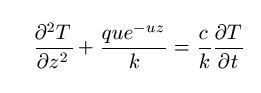
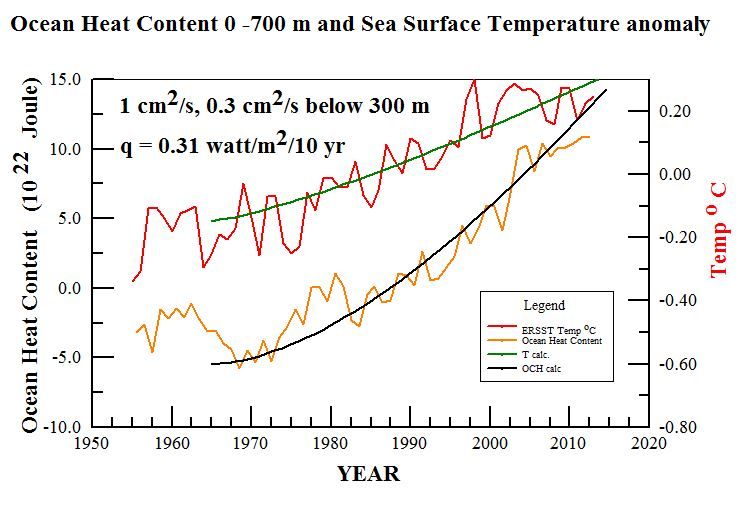
Figure 1. Ocean heat content 0 – 700 meter and surface temperature trends according to NOAA. Blue and green lines show trends calculated for the parameters shown.
These calculations establish some parameters that do a good job of representing the thermal behavior of the upper oceans, however, if one looks closely at the data trends in the graph, it is apparent that both surface temperature and ocean heat content have considerably slowed their rates of increase in the last decade. This makes it unlikely that greenhouse gases are the cause of the rate of heating needed to explain the previous trends because their effects should have become enhanced rather than diminished. It might also be noted that a similar warming trend occurred in the first half of the previous century before anthropogenic greenhouse gases could have contributed significantly. Thus it is more likely that both warming periods had natural origins.
Obtaining simultaneous fits to the ocean heat content and sea surface temperature trends with only two free parameters, thermal diffusivity and surface heating rate, is quite confining. Acceptable, but noticeably worse, fits than shown above, were obtained with thermal diffusivities ranging from 0.8 to 1.2 cm2/s and heat inputs ranging from 0.29 to 0.33 watt/m2. Based on previous calculations for sea level data, I was initially inclined to think that larger thermal diffusivities would be necessary, but larger values let more heat penetrate to greater depths than the amounts of heat reported by Levitus et al. In addition, I was chagrined to learn that most of the variation of sea level that accompanies solar cycles is caused by evaporation rather than thermal expansion.
Solar Cycles:
The process of choosing thermal diffusivity and surface heating rates to accord with observations provides a sound basis for calculating what to expect for the temperature variations during solar cycles. In this case we can use the thermal diffusivity of 1 cm2/s that is required of the ocean heat content results as an input parameter and choose the heat input that is required to produce temperature variations of 0.04 – 0.05 oC amplitude. Producing sea surface temperature variations with an amplitude of 0.04 oC requires a surface heat input of 0.33 watt/m2, as shown below:
http://i1244.photobucket.com/albums/gg580/stanrobertson/solarcycle10_zpsa3b8b0ee.jpg
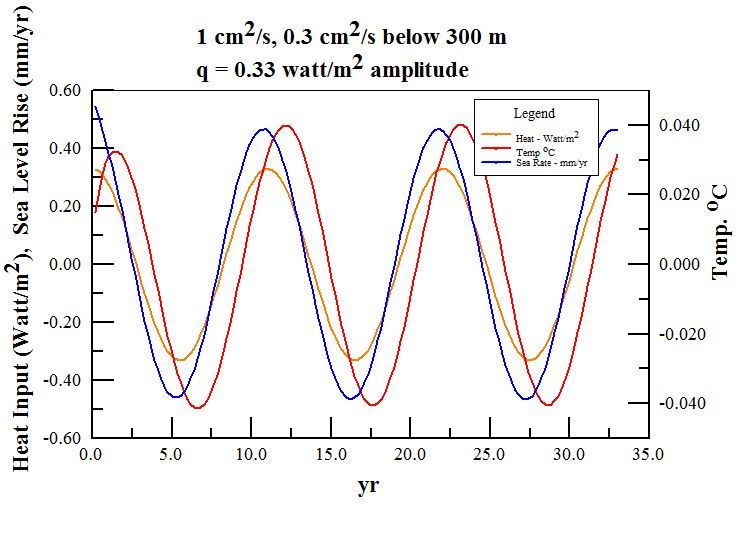

Figure 2. Radiant flux, ocean temperature oscillations, and sea level variations for three solar cycles of eleven years each. The entering flux shown here is the value of q = 0.33 watt/m2 needed to drive the variations of surface temperature of 0.04 oC with ocean thermal diffusivity of 1.0 cm2/s to depth of 300 m. The amplitude of thermosteric rate of change of sea level was 0.47 mm/yr. Temperature lags the driving energy flux by 15 months. The thermal expansion coefficient of sea water used here was 2.4×10⁻⁴/ oC.
I believe that this settles the issue of what is required to produce sea surface temperature oscillations with an amplitude of 0.04 oC. The solar TSI variations that reach the earth’s surface are smaller than the 0.33 watt/m2 needed to account for sea surface temperature variations by a factor of 3.6 for this smallest estimate of sea surface temperature variability.
Although the estimated 0.33 watt/m2 that is required to explain the surface temperature variations is large compared to the amplitude of TSI variations that reach the surface, it is still only about two parts per thousand of the 160 watt/m2 of solar UV/VIS/NIR that reaches the earth surface. There are many possible ways in which the sun might modulate the surface energy flux to this extent. These include modulation of cloud cover and small spectral shifts in the energetic UV that might modulate ozone absorption or produce shifts of the effective sea surface albedo. It would seem to be a fairly direct radiative effect, rather than feedback, since it must vary in phase with the solar cycle.
In summary, my calculations based on energy conservation considerations imply that the sun modulates the ocean temperatures to a much greater extent than can be provided solely by its TSI variations. The great question that desperately needs an answer is how does it do it? It should be easily understood that solar effects would not necessarily be confined to cycles. More likely, the sun has been the driver of the large changes of temperatures of the Roman and Medieval warm period, the Little Ice Age, and the recent recovery from it without requiring large changes of its own irradiance. When we understand how the sun does this, we will have begun to understand the earthly climate.
###
Biographical note:
Stan Robertson, Ph.D, P.E, retired in 2004 after teaching physics at Southwestern Oklahoma State University for 14 years. In addition to teaching at three other universities over the years, he has maintained a consulting engineering practice for 30 years.
References:
Bryan, F., 1987: Parameter Sensitivity of Primitive Equation Ocean General Circulation Models. Journal of Physical Oceanography, 17, 970-985. (PDF available here http://journals.ametsoc.org/doi/abs/10.1175/1520-0485%281987%29017%3C0970%3APSOPEO%3E2.0.CO%3B2
Levitus, S. et al., 2012 World ocean heat content and thermosteric sea level change (0–2000 m), 1955–2010, Geophysical Research Letters, 39, L10603, doi:10.1029/2012GL051106, 2012 http://onlinelibrary.wiley.com/doi/10.1029/2012GL051106/abstract
Shaviv, Nir 2008, Using the oceans as a calorimeter to quantify the solar radiative forcing, Journal of Geophysical Research, 113, A11101 http://www.sciencebits.com/files/articles/CalorimeterFinal.pdf
Trenberth, K., Fasullo, J., Kiehl, J. 2009: Earth’s Global Energy Budget. Bull. Amer. Meteor. Soc., 90, 311–323. doi: http://dx.doi.org/10.1175/2008BAMS2634.1 www.cgd.ucar.edu/staff/trenbert/trenberth.papers/TFK_bams09.pdf , Fig. 1
Zhou, J. and Tung, K. ,2010 Solar Cycles in 150 Years of Global Sea Surface Temperature Data, Journal of Climate 23, 3234-3248 http://journals.ametsoc.org/doi/abs/10.1175/2010JCLI3232.1
I might also add that if you are OK with 0.05 C rather than the 0.04 C that I used for a minimal estimate, it pushes the requirement up to 0.41 watt/m^2.
bones says:
October 21, 2013 at 6:35 pm
Glad to know that it is an opinion and not based on anything as well established as calorimetry.
Snide comments are not helpful.
bones says:
October 21, 2013 at 6:39 pm
it pushes the requirement up to 0.41 watt/m^2.
since the solar cycle variation of TSI is of the order of 1.5 W/m2 there is enough to make that requirement.
Not at sea level. You are forgetting albedo, latitude and day/night cycle averaging. That cuts the TSI entering the upper atmosphere to an amplitude of 0.13 w/m^2. Plus, I think that your 1.5 is overestimated by about 50% and some of that 0.13 w/m^2 gets scattered back out and never reaches sea level. When all it said and done, the TSI variations that enter the oceans aren’t capable of producing even 0.04 C amplitude. To me this is very, very simple physics and opinions don’t count for much in comparison. You may call that snide, but I think that you need to respond to the physics of the situation.
bones says:
October 21, 2013 at 8:25 pm
You are forgetting albedo, latitude and day/night cycle averaging. … To me this is very, very simple physics
To me, so is this argument [that automatically takes albedo, latitude and day.night cycle into effect: dS/S = 4 dT/T S= radiative flux, T = temperature. dS/S is generally accepted to be of the order of 0.1%, so dT/T becomes 0.025% of 289K = 0.072K, more than enough to account for your 0.04C.
I agree that over a solar cycle, there should be a radiative balance at the top of the atmosphere. So what? That has little to do with what goes on at sea level. (As a minor aside, the temperature at the top of atmosphere is more like 255 K on average and who knows what the temperature variations are. The 0.05 C wasn’t measured there.) Your calculation might apply at the unit IR optical depth level at the top of the atmosphere where there is no appreciable heat capacity, but it does not apply at the ocean surface.
What happens at the ocean surface has been settled empirically. The 0.09 w/m^2 of intrinsic TSI variations that reach the surface simply cannot modulate water temperature by even 0.04 C. Not even if the oceans were only 20 meters deep. Since the extra energy variation obviously must come from the sun, the reasonable conclusion is that the amount of solar flux that gets to the surface is modulated in passing through the atmosphere.
Your calculation does not apply at the sea surface because it is based on the assumption that the radiating surface has no ability to take in heat and store it.
bones says:
October 21, 2013 at 9:12 pm
I agree that over a solar cycle, there should be a radiative balance at the top of the atmosphere. So what? That has little to do with what goes on at sea level. (As a minor aside, the temperature at the top of atmosphere is more like 255 K
The difference between 255 and observed 289 K at the surface is the ‘greenhouse effect’, so 289 K is the correct number to use at sea level.
Too bad that your calculation doesn’t apply at sea level, isn’t it?
bones says:
October 21, 2013 at 9:21 pm
Too bad that your calculation doesn’t apply at sea level, isn’t it?
I think it applies at the surface, so I don’t think that is so bad. Your comment is rather vacuous, isn’t it?
lsvalgaard says:
October 21, 2013 at 9:23 pm
bones says:
October 21, 2013 at 9:21 pm
Too bad that your calculation doesn’t apply at sea level, isn’t it?
I think it applies at the surface, so I don’t think that is so bad. Your comment is rather vacuous, isn’t it?
I don’t think so. You seem to be wanting to say that 0.09 watt/m^2 variation can make its way all the way down from the top of the atmosphere, enter the ocean and cause its temperature to oscillate by 0.04 C and then be reradiated back out. Can’t happen. 0.09 w/m^2 will produce temperature variations of only 0.01 C. Your calculation would apply only if the ocean surface were a blackbody surface with no heat capacity and then only if thermal infrared could get out as easily as UV/VIS and NIR below about 2 micron got in.
bones says:
October 21, 2013 at 9:44 pm
I don’t think so.
Not that I agree with everything in the following link, but it does contain the basics:
http://www.geo.utexas.edu/courses/387h/Lectures/chap2.pdf
Worth studying.
Seems to me that I have seen this link before. A quick search revealed no mention of heat capacity other than storage in a middle layer of atmosphere. It won’t be of much use if all it is going to do is discuss radiative equilibrium. I think that I have shown that to be an incorrect approach to understanding what goes on in the upper oceans during solar cycles. Nevertheless, thanks for passing it along. I will read it carefully tomorrow. It’s sack time here.
bones says:
October 21, 2013 at 10:10 pm
Nevertheless, thanks for passing it along. I will read it carefully tomorrow. It’s sack time here.
Here too. Keep in mind that all gases with more than two atoms in a molecule [H2O, C2O, CH4, O3, …] are greenhouse gases, not just CO2.
lsvalgaard says:
October 21, 2013 at 9:59 pm
Not that I agree with everything in the following link, but it does contain the basics:
http://www.geo.utexas.edu/courses/387h/Lectures/chap2.pdf
Worth studying.
Keep in mind that all gases with more than two atoms in a molecule [H2O, C2O, CH4, O3, …] are greenhouse gases, not just CO2.
———————————————
My ocean surface energy balance condition included the aggregated effects of downwelling IR from all of your listed molecules. I agree that that they contribute to energy flux that reaches the surface, but it was not necessary to consider them explicitly or to include the negating effects of convection and evaporation in detail. At one meter depth, the only question to be answered is how much net heat flux is required to change the water temperature by 0.04-0.05C. There is nothing in your linked article that negates the fact that 0.09 w/m^2 can only change the water temperature by an amplitude of 0.01 C.
Let me give you a little physics problem that will help us sort this out. Consider an ocean of 25 meter depth that is such a good thermal conductor that there will be no significant temperature gradients within. Let it take in heat per unit area at a rate q sin(wt) and radiatively discharge heat at the surface at a rate hT watt/m^2, where T is the change of water temperature, h=5.42 w/m^2/C and w= 2 pi radians per 11 yr. Assume that there are no other heat losses or inputs at the surface. After transients die out, if q=0.09 w/m^2, what will be the amplitude of water temperature variations? (I got 0.013 C.)
My guess is that you will object to the problem because it doesn’t include any back radiation. If so then you are free to choose the amount you wish to add with two provisions. First, if you wish to provide more surface heat input than the amplitude of TSI variations that actually enter the atmosphere (0.105 w/m^2 for 1.2 w/m^2 peak to trough TSI) then you will need a very, very good explanation for it. Second, we then must agree on an appropriate amount of surface evaporation and convection losses to include. Perhaps in discussing these we will get past the point where we are presently stuck in disagreement.
bones says:
October 22, 2013 at 12:55 pm
My ocean surface energy balance condition included the aggregated effects of downwelling IR from all of your listed molecules.
I think that we are talking past each other. In my view the surface [sea or land] receives energy from two sources: 1) the Sun, and 2) the atmosphere. The latter is about twice the former. Can we agree on that?
I would be happy to accept the Trenberth et al energy budget from their Fig 1. for the surface. Have a look. http://i1244.photobucket.com/albums/gg580/stanrobertson/Trenberth-tfk09_zps8b335def.jpg
bones says:
October 22, 2013 at 8:42 pm
I would be happy to accept the Trenberth et al energy budget from their Fig 1. for the surface
Good, so incoming in 161+333 = 494 W/m2. The solar cycle variation is 0.1% [assuming that both contributions scale the same way] or 0.49 W/m2.
I don’t buy your assumption. To get the ocean temperature you are going to have to do an energy balance in the water. So let’s start with incoming shortwave. Assuming TSI variation entering the atmosphere is 1.2 w/m^2, the amplitude that will enter the surface is 1.2x(161/1365)/2=0.07 w/m^2.
bones says:
October 22, 2013 at 8:53 pm
I don’t buy your assumption.
Well, then there is really no common ground and we are stuck.
lsvalgaard says:
October 22, 2013 at 8:59 pm
bones says:
October 22, 2013 at 8:53 pm
I don’t buy your assumption.
Well, then there is really no common ground and we are stuck.
———————————————-
I would like to get unstuck, but I think that the way to do that is to get you to understand how much heat is required to change the water temperature. I am not likely to be persuaded by one of your surface radiation balance arguments. I have seen them previously and consider them to be flawed. But go ahead and state your case and I will try to follow.
bones says:
October 22, 2013 at 9:02 pm
I am not likely to be persuaded by one of your surface radiation balance arguments. I have seen them previously and consider them to be flawed.
I consider them self-evident, so where do we go from there?
I don’t think that you can say what the change of downwelling IR will be without knowing the change of surface temperature. So it is not at all clear to me that you can say that 0.1% of 333 w/m^2 will be the new contribution. It might be, but we don’t have to assume that. You might try to make the self-evident apparent.
bones says:
October 22, 2013 at 9:10 pm
I don’t think that you can say what the change of downwelling IR will be without knowing the change of surface temperature.
But we know the change of the surface temperature…
OK, the problem can be addressed by considering the amount of heat required to produce the assumed change of surface temperature. Go ahead.
bones says:
October 22, 2013 at 9:21 pm
OK, the problem can be addressed by considering the amount of heat required to produce the assumed change of surface temperature. Go ahead.
We have been down this road before: dS/S = 4 dT/T.