PRESS RELEASE
New Paper Proposes Cost-Effective Climate Policy That Gets Around Key Scientific Uncertainties
London: A new paper, published today by the Global Warming Policy Foundation, proposes a radical new climate policy approach that offers to be the most cost-effective means of curbing CO2 emissions, while automatically adjusting the stringency of the policy to the severity of the problem.
The paper‘An Evidence-Based Approach To Pricing CO2 Emissions’ written by Professor Ross McKitrick (University of Guelph, Canada) proposes to link the level of a tax on CO2 emissions to temperatures in the tropical troposphere, and to create a 30-year futures market for tax-exemption certificates. Investors would then have long term certainty about the carbon price, and the future tax rates would incorporate all known evidence of the likely path of global warming.
If started at a low level and used to pay for income tax reductions, McKitrick’s carbon tax will be economically beneficial even if enacted unilaterally.
“If the climate models are correct, the carbon tax will rise significantly as CO2 levels rise; but if the temperatures remain stagnant or low, then the tax and its economic cost will remain low too,” said Professor McKitrick. “Either way we get the right outcome, and the market will reward industries and investors who make the most objective use of available science in forming long term plans.”
“The temperature-based procedure that McKitrick outlines in his paper would provide a strong incentive for more thorough and objective analysis of possible future developments in the climate system. It thus offers a blueprint for an evidence-based low-cost emissions policy that would also promote the cause of better understanding,” Professor David Henderson writes in the foreword to the GWPF paper.
Full paper is available here
UPDATE: Ross McKitrick writes in via email.
There was an article in the UK Register and a blog post by Marcel Crok. The comment threads at Bishop Hill and Watts Up revealed a lot of confusion about what I was talking about, so I have prepared a detailed response.
Also, a cartoonist in the audience (Josh) made a fun set of visual notes of my talk.
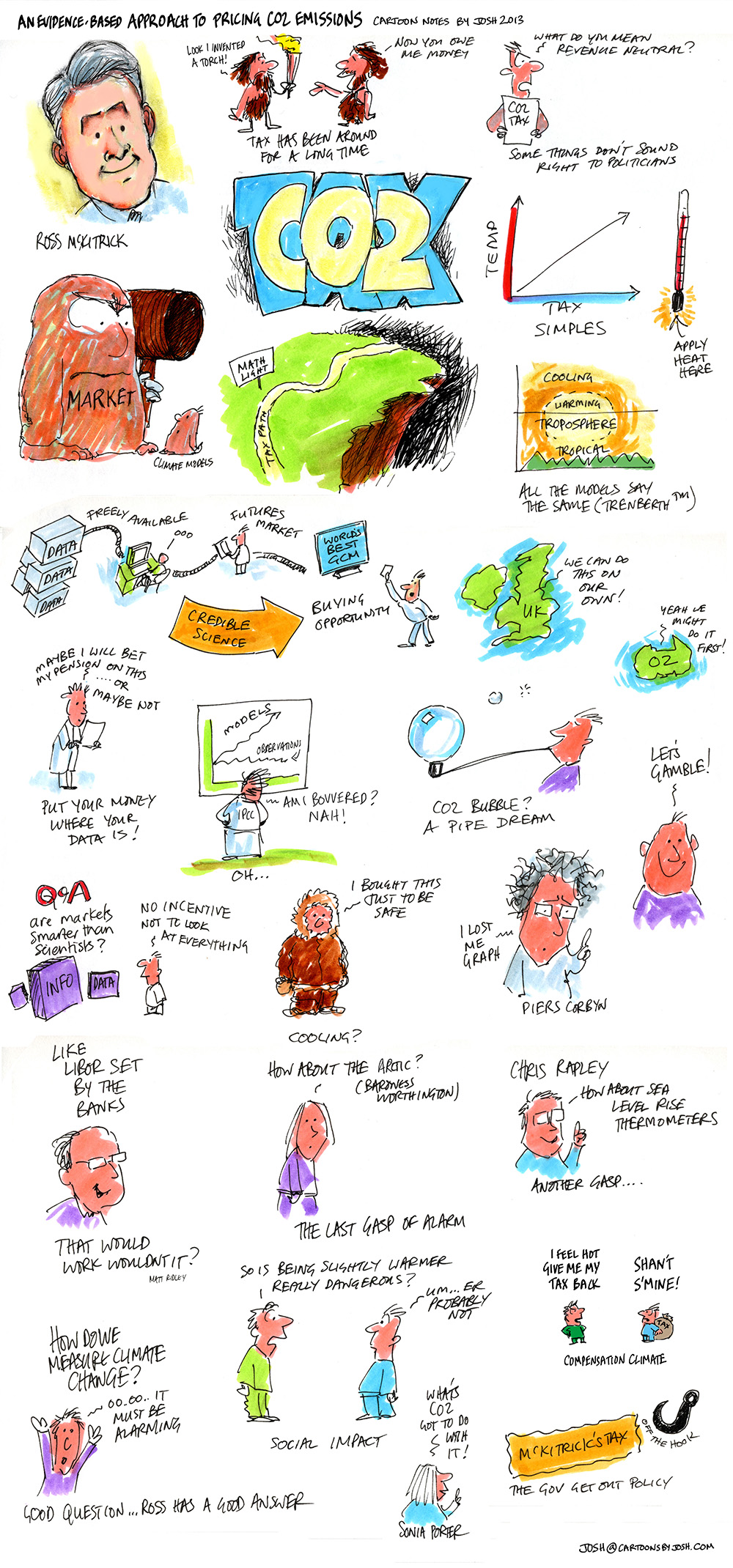
Evidence? What is this ‘evidence’ you speak of?
Evidence that man’s CO2 emissions are causing some warming
Or evidence that man’s CO2 portion of CO2 warming is causing some sort of problem?
I respect McKitrick, but no to this proposal as is. The only way I could stomach such a deal would be if the carbon emitters were paid a subsidy if the temps drop below the baseline. Then that would be an issue I would have a problem with.
Mosher, are you without principle on the 4th of July? Give me liberty or give me death. Does that mean anything to you? Principle and honor will make you sleep well and will prevail. Grow a set.
Richard– at a 17% consumption tax, that would equate to about $2 trillion/yr in tax revenues; about equal to government spending back in 1992.
$2 trillion would equate to about 13% of GDP. The US curently generates about $2.4 trillion In total tax revenues and spends about $3.7 trillion, with the balance printed and borrowed–hence the over $6 trillion increase in US national debt just under BHO…
It’s gotten completely insane and will not last much longer before the national debt/money printing collapses the US economy.
I think folks are missing the point here. McKitrick has devised a carbon tax methodology that is calling out the alarmists. Telling them to put there money where there mouth is and basing adjustments on objective data. This is not a concession to the alarmists, this is a bona fide in your face challenge.
A great idea by Ross McKittrick. The models have been wrong about the tropical troposphere. It hasn’t been behaving as the models say it should. If it were to suddenly get considerably warmer, that MIGHT start validating the models. If it continues NOT to warm, then the models are wrong.
So, yes — as Greg says — put your money where your mouth is.
I like it, this proposal is a Tarbaby. Linking tax rates to the imaginary hot spot of the teams computer models, is a truly cruel dig.
As others have noted, this proposal of a carbon tax, is actually a droll gotcha.
A tax imposed under McKitricks proposal would end up costing the government. I like the sarcasm implicit in proposing negative taxes.
Hey McKittrick, how about this … NO!
You should come down here to the States and run for office because you would make a fine (R)epublicrat. You’d fit right in as another surrender monkey. A Carbon Tax and Carbon Trading all in one shot? Are you nuts?
I got a better idea. How about a pseudo-Science Tax instead. It would be pegged to the accuracy of the endless bloviating by leftist AGW kooks. Every single time they ring the alarm bell and are inevitably proven wrong they will be required to cough up a fine equaling 100% of the wasted taxpayer funds plus an equal sum in punitive damages. We can start with monetizing the entire warmilist. This will likely result in enough revenue to take a big bite out of our astronomical national debt.
Stuff it Mosher, you predictable jack@ss. Appealing to the patented ploy of the ‘lesser of two evils’ in order to get your tax hike like so many American politicians do all so well. How transparent you both are, as the AGW hoax is unraveling and just awaiting a final co-operative nudge from mother nature herself to kill it completely, you two come along and try to skip right to the end of the story and conveniently step right over the remains of AGW alarmism littering the floor.
Readers should note the irony of pressing for big taxes on our Independence Day, which celebrates was a hard fought battle to get away from unilateral taxes. I don’t expect McKittrick to understand this point but this American called Steve Mosher should. That is, unless he is in the tank with all the other leftist bureaucrats, which is pretty obvious by now. Libertarian my @ss. You talkin ’bout the Queen again, English Bob? 🙂
How so? Is it like an April Fools gag?
An old article on Betting on climate change:
http://www.realclimate.org/index.php?p=161
With many comments. I figured someone had thought this up before. There are tried and true Weather related futures markets for crops. They transfer risk. I’d say they are an example of a zero sum game. Also I’d say it is an example of pure market efficiency. Cargill for example, can place huge bets. I suppose some Utilities smooth their resource cost flucuations as well. From Annan, “…the price in a free market should accurately reflect the aggregated information that is available.” So, can we aggregate all the information available and if we can, will it have any value? I know it’s not the Scientific Method. It doesn’t have 100% accuracy at all times. And it does look a bit like a Consensus, but a Consensus of money which may be better. Another attribute is what it would not be. Not an arbitrary tax, fee, or assessment.
If the models are revised will the futures contracts be retroactively repriced? Oh yeah no room for any insider trading here.
Maybe some of you have not read the original T3 tax proposal from Prof McKitrick in 2007, as a prelude.
http://www.rossmckitrick.com/uploads/4/8/0/8/4808045/t3tax.vv-online.pdf
Some are assuming that Ross wants to admit to CO2 being THE source of climate change to which tax is linked. Not so. CO2 is but a transient example and the tax is linked to temperature changes (from whatever source) affecting a portion of the atmospheric temperature measured by satellite reception of microwave emissions, as has been done since 1978.
I’ve been enthusiastic about this approach from my first reading. It has the effect of making people put their money where their actions are, rather than where their beliefs are. It has an obvious capacity to alter belief.
The only downside I can see is that the mention of a new taxation design encourages tax inventors to a new rush to invent even more taxes. (Like, I was not smart enough to create a T3 tax so I’ll design a new F35 tax instead).
Chad Wozniak says:
July 4, 2013 at 4:58 pm
“The real irony here is that, unlike the sheeple following him down the garden path, der Fuehrer knows full well that AGW is false, but he’s not going to let go of it because it’s his primary pretext for creating the totalitarian state he has set out to impose on America. Hitler and Goebbels would have been proud, and Stalin maybe even prouder.”
The Germans or the Russians didn’t have the second amendment. I think you give him too much credit, he’s not that smart. He is a socialist that makes him stupid by birth.
Steven Mosher says:
July 4, 2013 at 1:38 pm
go ahead fight this tax. you’ll get regulations instead.
#######################
I think you’re correct. Here in Nova Scotia, under Government direction, the power company has invested heavily in wind power. Our rates are increasing at about double inflation, albeit with the “assurance” that it will pay off in the long run. Anyone in a State with a “Green” government should welcome this proposal. Don’t be penny wise and pound foolish.
Oh dear. No. No. No. Wrong on too many levels. I smell something not quite right. I expected better than this.
I hear Steve McIntyre has accepted an office job with Michael Mann.
The good Professor is starting with the conclusion.
Geoff Sherrington : So you’re OK with a tax on temperature? Based on the last 15 years of relatively constant global temperature, that wouldn’t raise more than a few bob.
The only small problem with this is: who is going to guarantee the integrity of the data over time? you believe the people who collect the data?
Ragnaar says: July 4, 2013 at 7:06 pm
“……There are tried and true Weather related futures markets for crops. They transfer risk. I’d say they are an example of a zero sum game. Also I’d say it is an example of pure market efficiency. Cargill for example, can place huge bets….”
Once upon a time, such futures markets actually made sense. If someone was running a biscuit factory he could lock in his price of raw material (to an extent, there were grain futures, but no wheat flour futures) up to a year and half ahead. The farmer was happy, because he could also lock in his price that far ahead. Neither knew if the upcoming year would be a drought or a glut, but both were happy they would likely be in a position to make some predictable profit from their business.
Then along came the commodity traders. One would put up a contract to sell wheat he did not have, and another would agree to that contract to buy wheat he did not want. Coming up towards the due date all the trader contracts would cancel out as they reversed their positions with a profit or a loss, and at the end, some physical deliveries would get made, between the real farmers and grain traders. This was probably a good thing, adding more liquidity. And Ragnaar is correct, it is a zero sum game, except, very importantly, minus commissions.
But then every man and his dog got into commodity trading, including the huge financial houses with their masses of computer traders. The money sloshes in and out like the tide, and although eventually the price is anchored somewhat by the physical trades, it is equally likely the futures trades are affecting the physical price. Behind it all is a huge non-productive business of commissions and accumulated trading profits, which lands primarily in the hands of big business.
On top of this we have all sorts of obscure ‘instruments’ supposedly devised ot allow hedging, but in reality adding to an opaque casino business.
Carbon trading would be a worse rendition of the above, except with absolutely no evidence whatsoever of the regulatory pressure of some sort of a real physical value.
Now note about 50 percent of the world’s business market capital is in some 150 multinational companies, Note that three quarters of those 150 companies belong to the financial sector.
These are the people who are the keenest for a carbon trading scheme.
And I think it is quite likely they are not doing it to save the world.
http://www.paecon.net/PAEReview/issue64/HelbingKirman64.pdf
what is this nonsense about tax making the warmists put their money where there mouth is?
it’s MY money they want put where their mouth is.
it’s Your money they want to get their bloated lips around.
mckittrick’s plan is for us to be sucked dry – there is no other possible outcome.
IT’S A COOKBOOK!
Absurd idea and a transparent attempt to get the Camel’s nose (adopt carbon tax) under the tent.
When it gets colder government subsidizes the use of “fossil fuel” based energy
When the climate stay the same there is no tax or subsidizing on the use of “fossil fuel” based energy.
When it gets warmer you are taxed.
That means even more political motivated adjusting of the data?
Folks, ease off on Ross McKitrick.. He is the other M in the hacked/ released emails attacking Him and Steve McIntyre when they challenged the hockey stick. And, the GWPF is definitely not a warmest/ alarmist group.
I believe what he is trying to do is challenge the warmest team with their own dogma. If the warming meme proves to not be true then no taxes. Some politicians in many countries would charge blindly forward with a carbon tax without exception. This idea puts the ball in their court and is hard for them to challenge.
However, I have to agree with the danger of corrupt enforcement.
In that regard it seems that all organizations, without oversight, try to assume too much power and become corrupt. In the States, the EPA, which was created during the Reagan administration began as a
valuable and trustworthy organization. Now, it wants to go deeper into the dark side.
McKitrick forgot to factor in hype, the life blood of climate warming.
DarrylB says:
July 4, 2013 at 8:39 pm: Shame on you. Richard Nixon caused the EPA to be formed. Ronald Reagan never would have instituted such a sham organization.
The world has been warming at a rate of half a degree per century for about 300 years. With all due respect, Ross McKitrick is proposing imposing a tax on me which will go up if the temperature continues its 300 year slow climb … and I’m supposed to think this is a good idea?
Ross’s comment on this is:
This part is too good:
No, it doesn’t make sense to tax warming, that’s barking mad. Ross wants to tax warming because it costs money somehow? Cold costs money. Look at the little ice age, and the damage it caused.
I’m supposed to be impressed because if it cools the tax goes down? What part of “any tax on energy hurts the poor” is hard to understand?
This is just some bogus insurance scheme to protect us from the evils of warming. Look, Ross, if you want insurance buy your own, but don’t tax the planet to protect us from warming. I assure you I don’t want such insurance, as warming is generally beneficial.
Next, anyone who calculates the “marginal damage of CO2” and makes NO EFFORT to calculate the “marginal benefits of CO2” gets no slack from me. That is intellectually lazy and absolutely unacceptable.
Next, Ross says that:
That’s hilarious. The earth has been warming, in fits and starts, for 300 years. Ross is claiming that we can find something that has not been warming for 300 years to use as our gauge … say what? You can’t just assume a stationary process, there’s no evidence for that at all.
Then we have this one:
I don’t care how lunatic their policies might be or how costly they might be, that doesn’t make a slightly less loony alternative acceptable. I’m ashamed to even see this pathetic argument. The cost of alternative policies does not make your policy cost-effective.
Finally, the ugly reality of taxes on energy, as I have pointed out many times, is that they are the most regressive taxes on the planet. They hit the poor the hardest, and their is no relief like with income taxes, no minimum level. The poorer you are, the more the McKitrick Tax will screw you.
I hate to say this, because Ross is the McKitrick of M&M who has done so much for real science. But truly, Ross, this is industrial strength stupidity. I don’t want to be in the same room with this idea.
w.