
UPDATE: New table added below.
While searching for something else, I came across this entertaining collection of grand predictive failures related to resources and climate change, along with some of the biggest predictive failures of Paul Ehrlich. I thought it worth sharing.
Exhaustion of Resources
“Indeed it is certain, it is clear to see, that the earth itself is currently more cultivated and developed than in earlier times. Now all places are accessible, all are documented, all are full of business. The most charming farms obliterate empty places, ploughed fields vanquish forests, herds drive out wild beasts, sandy places are planted with crops, stones are fixed, swamps drained, and there are such great cities where formerly hardly a hut… everywhere there is a dwelling, everywhere a multitude, everywhere a government, everywhere there is life. The greatest evidence of the large number of people: we are burdensome to the world, the resources are scarcely adequate to us; and our needs straiten us and complaints are everywhere while already nature does not sustain us.”
- In 1865, Stanley Jevons (one of the most recognized 19th century economists) predicted that England would run out of coal by 1900, and that England’s factories would grind to a standstill.
- In 1885, the US Geological Survey announced that there was “little or no chance” of oil being discovered in California.
- In 1891, it said the same thing about Kansas and Texas. (See Osterfeld, David. Prosperity Versus Planning : How Government Stifles Economic Growth. New York : Oxford University Press, 1992.)
- In 1939 the US Department of the Interior said that American oil supplies would last only another 13 years.
- 1944 federal government review predicted that by now the US would have exhausted its reserves of 21 of 41 commodities it examined. Among them were tin, nickel, zinc, lead and manganese.
- In 1949 the Secretary of the Interior announced that the end of US oil was in sight.
Claim: In 1952 the US President’s Materials Policy Commission concluded that by the mid-1970s copper production in the US could not exceed 800,000 tons and that lead production would be at most 300,000 tons per year.
Data: But copper production in 1973 was 1.6 million tons, and by 1974 lead production had reached 614,000 tons – 100% higher than predicted.
Claims: In 1968, Paul R. Ehrlich wrote The Population Bomb and declared that the battle to feed humanity had been lost and that there would be a major food shortage in the US. “In the 1970s … hundreds of millions are going to starve to death,” and by the 1980s most of the world’s important resources would be depleted. He forecast that 65 million Americans would die of starvation between 1980-1989 and that by 1999, the US population would decline to 22.6 million. The problems in the US would be relatively minor compared to those in the rest of the world. (Ehrlich, Paul R. The Population Bomb. New York, Ballantine Books, 1968.) New Scientist magazine underscored his speech in an editorial titled “In Praise of Prophets.”
Claim: “By the year 2000 the United Kingdom will be simply a small group of impoverished islands, inhabited by some 70 million hungry people … If I were a gambler, I would take even money that England will not exist in the year 2000.” Paul Ehrlich, Speech at British Institute For Biology, September 1971.
Claim: Ehrlich wrote in 1968, “I have yet to meet anyone familiar with the situation who thinks India will be self-sufficient in food by 1971, if ever.”
Data: Yet in a only few years India was exporting food and significantly changed its food production capacity. Ehrlich must have noted this because in the 1971 version of his book this comment is deleted (Julian Simon, The Ultimate Resource, Princeton: Princeton Univesity Press, 1981, p. 64).
The Limits to Growth (1972) – projected the world would run out of gold by 1981, mercury and silver by 1985, tin by 1987, zinc by 1990, petroleum by 1992, and copper, lead and natural gas by 1993. It also stated that the world had only 33-49 years of aluminum resources left, which means we should run out sometime between 2005-2021. (See Donella Meadows et al., The Limits to Growth: A Report for the Club of Rome’s Project on the Predicament of Mankind. New York: New American Library, 1972.
Claim: In 1974, the US Geological Survey announced “at 1974 technology and 1974 price” the US had only a 10-year supply of natural gas.
Data: The American Gas Association said that gas supplies were sufficient for the next 1,000-2,500 years. (Julian Simon, Population Matters. New Jersey: Transaction Publications, 1990): p. 90.
Population and Poverty
In the mid 1970s the US government sponsored a travelling exhibit for schoolchildren titled, “Population: The Problem is Us.” (Jacqueline Kasun, The War Against Population, San Francisco: CA, Ignatius, 1988, p. 21.)
In 1973, Supreme Court Justice Potter Stewart’s vote in Roe v. Wade was influenced by this idea, according to Bob Woodward and Scott Armstrong: “As Stewart saw it, abortion was becoming one reasonable solution to population control” (quoted in Newsweek of September 14, 1987, p. 33.).
In 1989, when the US Supreme Court was hearing the Webster case, Justice Sandra Day O’Connor brought the idea of overpopulation into a hypothetical question she asked of Charles Fried, former solicitor-general, “Do you think that the state has the right to, if in a future century we had a serious overpopulation problem, has a right to require women to have abortions after so many children?”
World Bank president Barber Conable calls for population control because “poverty and rapid population growth reinforce each other” (Washington Post, July 16, 1990, p. A13)
Prince Philip advises us that “It must be obvious by now that further population growth in any country is undesirable” (Washington Post, May 8, 1990, p. A26)
37 Senators wrote President Bush in support of funding for population control (Washington Post, April 1, 1990, p. H1)
The Trilateral Commission and the American Assembly call for reduction in population growth (U. S. News and World Report, May 7, 1990)
Newsweek‘s year-ending cover story concluded that “Foremost of the new realities is the world’s population problem” (December 25, 1990, p.44)
The president of NOW warns that continued population growth would be a “catastrophe” (Nat Hentoff in the Washington Post, July 29, 1989, p. A17)
Ted Turner (Atlanta Journal Constitution, Wed. Dec. 2, 1998) in an address to the Society of Environmental Journalists in Chattanooga – blamed Christianity for overpopulation and environmental degradation, and argued that the people who disagree with him are “dummies.” He stated in part, “The Judeo-Christian religion says man was given dominion over everything, and his salvation was that he was to go out and increase and multiply. Well, we have done that … to the point where in Calcutta, it’s a hellhole. So it’s not an environmentally friendly religion.”
Ellen Goodman laments “People Pollution” (Washington Post, March 3, 1990, p. A25)
Herblock cartoon shows that the U. S. neglecting the “world population explosion” (Washington Post, July 19, 1990, p. A22)
Hobart Rowen likens population growth to “the pond weed [which] grows in huge leaps” (Washington Post, April 1, 1990, p. H8).
A Newsweek “My Turn” suggests giving every teen-age girl a check for up to $1200 each year that she does not have a baby “in order to stop the relentless increase of humanity” (Noel Perrin. “A Nonbearing Account”, April 2, 1990, p. 9).
Climate Change
Claim Jan. 1970: “By 1985, air pollution will have reduced the amount of sunlight reaching earth by one half.” Life Magazine, January 1970. Life Magazine also noted that some people disagree, “but scientists have solid experimental and historical evidence to support each of the predictions.”
Data: Air quality has actually improved since 1970. Studies find that sunlight reaching the Earth fell by somewhere between 3 and 5 percent over the period in question.
Claim April 1970: “If present trends continue, the world will be … eleven degrees colder by the year 2000. This is about twice what it would take to put us in an ice age.” Kenneth E.F. Watt, in Earth Day, 1970.
Data: According to NASA, global temperature has increased by about 1 degree Fahrenheit since 1970.

Claim 1970: “In ten years all important animal life in the sea will be extinct. Large areas of coastline will have to be evacuated because of the stench of dead fish.” Paul Ehrlich, speech during Earth Day, 1970.
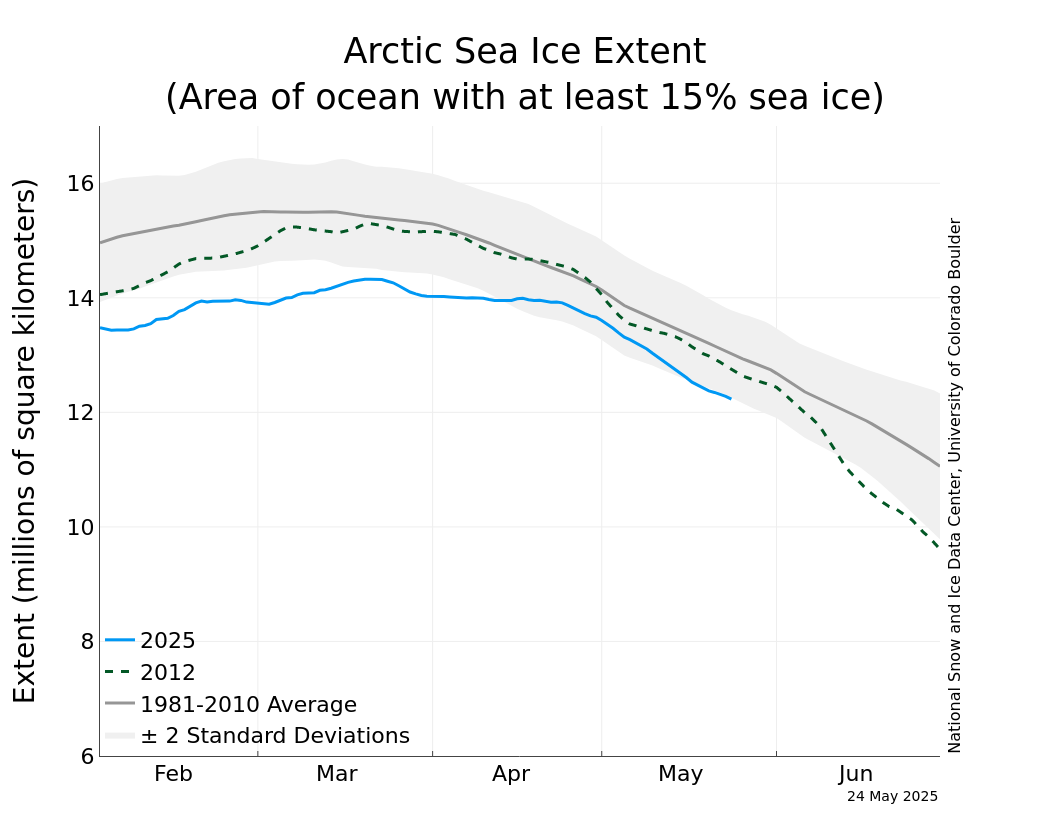
Claim 1972: “Artic specialist Bernt Balchen says a general warming trend over the North Pole is melting the polar ice cap and may produce an ice-free Arctic Ocean by the year 2000.” Christian Science Monitor, June 8, 1972.
Data: Ice coverage has fallen, though as of last month, the Arctic Ocean had 3.82 million square miles of ice cover — an area larger than the continental United States — according to The National Snow and Ice Data Center.
Claims 1974: “… when metereologists take an average of temperatures around the globe they find the atmosphere has been growing gradually cooler for the past three decades. The trend shows no indication of reversing. Climatological Cassandras are becoming increasingly apprehensive, for the weather aberrations they are studying may be the harbinger of another ice age. Telltale signs are everywhere–from the unexpected persistence and thickness of pack ice int eh waters around Iceland to the southward migration of a warmth-loving creature like the armadillo from the Midwest. When Climatologist George J. Kukla of Columbia University’s Lamont-Doherty Geological Observatory and his wife Helena analyzed satellite weather data fro the Northern Hemisphere, they found that the area of ice and snow cover had suddenly increased by 12% in 1971 and the increase has persisted ever since. Areas of Baffin Island in the Canadia Arctic, for example, were once totally free of any snow in summer; now they are covered year round.”
Later in the article, “Whatever the cause of the cooling trend, its effects could be extremely serious, if not catastrophic. Scientists figure that only a 1% decrease in the amount of sunlight hitting the earth’s surface could tip teh climatic balance, and cool the planet enough to send it sliding down the road to another ice age within only a few hundred years.”
Source: “Another Ice Age,” Time Magazine, June 24, 1974.
Claim 1989: “Using computer models, researchers concluded that global warming would raise average annual temperatures nationwide two degrees by 2010.” Associated Press, May 15, 1989.
Data: According to NASA, global temperature has increased by about 0.7 degrees Fahrenheit since 1989. And U.S. temperature has increased even less over the same period.

Claims: “Britain’s winter ends tomorrow with further indications of a striking environmental change: snow is starting to disappear from our lives.”
“Sledges, snowmen, snowballs and … are all a rapidly diminishing part of Britain’s culture, as warmer winters–which scientists are attributing to global climate change–produce not only fewer white Christmases, but fewer white Januaries and Februaries.”
“London’s last substantial snowfall was in February 1991.” “Global warming, the heating of the atmosphere by increased amounts of industrial gases, is now accepted as a reality by the international community.”
According to Dr. David Viner, a senior research scientist at the climatic research unit (CRU) of the University of East Anglia, within a few years “children just aren’t going to know what snow is” and winter snowfall will be “a very rare and exciting event.” Interviewed by the UK Independent, March 20, 2000.
“David Parker, at the Hadley Centre for Climate Prediction and Research in Berkshire, says ultimately, British children could have only virtual experience of snow.”
See “Snowfalls are now just a thing of the past.” The Independent. March 20, 2000.
Data: “Coldest December Since records began as temperatures plummet to minus 10 C bringing travel chaos across Britain.” Mailonline. Dec. 18, 2010.
Claim: “[By] 1995, the greenhouse effect would be desolating the heartlands of North America and Eurasia with horrific drought, causing crop failures and food riots … [By 1996] The Platte River of Nebraska would be dry, while a continent-wide black blizzard of prairie topsoil will stop traffic on interstates, strip paint from houses and shut down computers.” Michel Oppenheimer and Robert H. Boyle, Dead Heat, St. Martin’s Press, 1990. Oppenheimer is the Albert G. Milbank Professor of Geosciences and International Affairs in the Woodrow Wilson School and the Department of Geosciences at Princeton University. He is the Director of the Program in Science, Technology, and Environmental Policy at the Wilson School. He was formerly a senior scientist with the Environmental Defense Fund, the largest non-governmental organization in the U.S. that examines problems and solutions to greenhouse gases.
Data: When asked about these old predictions Oppenheimer stated, “On the whole I would stand by these predictions — not predictions, sorry, scenarios — as having at least in a general way actually come true,” he said. “There’s been extensive drought, devastating drought, in significant parts of the world. The fraction of the world that’s in drought has increased over that period.”
However, that claim is not obviously true. Data from NASA’s Goddard Space Flight Center show that precipitation — rain and snow — has increased slightly over the century.
—
How could scientists have made such off-base claims? Dr. Paul Ehrlich, author of “The Population Bomb” and president of Stanford University’s Center for Conservation Biology, told FoxNews.com that ideas about climate science changed a great deal in the the ’70s and ’80s.
Ehrlich told FoxNews.com that the consequences of future warming could be dire.
=============================================================
Source: University of Georgia, Terry College of Business. Economics 2200, Economic Development of the US, David B. Mustard
http://www.terry.uga.edu/~mustard/courses/e2200/pop.htm
UPDATE: reader Dennis Wingo writes in with this table:
Great article. I went into this myself in my book “Moonrush“, I took all of the predictions for the depletion of resources from the book and marked in red the deadlines that had already passed. All of the predictions failed.

Discover more from Watts Up With That?
Subscribe to get the latest posts sent to your email.
I suggest a law in which every scientist who makes a public prediction of doom has to place £50,000 (or other suitable sum based upon ability to pay) into a deposit account. If the prediction turns out to be wrong, they lose the deposit.
Oh yes, and apply it retrospectively to these death-worshiping shysters.
At least we can be comforted by the knowledge made a lot of money peddling fantasy predictions.
Clearly a tradition proudly followed by climate scientists today.
Ah… but at least: “The bomb will never go off. I speak as an expert in explosives.”
Admiral William Leahy , US Atomic Bomb Project
Some one should write to Ted Turner and inform him that Calcutta has very few Christians, which makes his example patently stupid.
I’m normally a fan, but knocking Limits to Growth for saying that it “projected the world would run out of gold by 1981, mercury and silver by 1985, tin by 1987, zinc by 1990, petroleum by 1992, and copper, lead and natural gas by 1993” is simply false. For a hard-nosed look at what LTG actually said, I recommend the late Matt Simmons review here (Simmons was a very successful investment banker specialising in the oil industry). Anyone who thinks we’re not running up against some resource limits needs to have an alternative, and preferably plausible, explanation for why the tripling of oil prices over the last decade has seen no significant increase in the production of oil.
Sat at home in NE Englnad watching the snow coming down on the 4 inches that is already on the ground, with a temperature of zero celsius. I am making the most of it as according to the “experts” I am not likely to see this again!
I remember being told by my chemistry teacher that the C grade I needed at A’ level to get into university was unattainable, and I would be lucky to get a pass. I did get the C grade and did go to university!
Don’t scientists ever make predictions that are positive, or is modern science all about pessimism?
Which environmental group produced the following quote?
The outstanding generahzations of my world tour are what may be summed up as the “six overs”; these “six overs” are, in the genetic order of cause and effect
Over-destruction of natural resources, now actually world-wide;
Over-mechanization, in the substitution of the machine for animal and human labor, rapidly becoming world-wide;
Over-construction of warehouses, ships, railroads, wharves and other means of trans- port, replacing primitive transportation;
Over-production both of the food and of the mechanical wants of mankind, chiefly during the post-war speculative period;
Over-confidence in future demand and supply, resulting in the too rapid extension of natural resources both in food and in mechanical equipment;
Over-population beyond the land areas, or the capacity of the natural and scientific resources of the world, with consequent permanent unemployment of the least fitted.
Answer:
http://ia700402.us.archive.org/2/items/decadeofprogress00inte/decadeofprogress00inte.pdf
“A Decade of Progress in Eugenics”, 1934 (proceeds of the 3rd International Eugenics Congress, 1932) p30 – 31.
http://en.wikipedia.org/wiki/International_Eugenics_Conference
As that famous philosopher Yogi Berra is quoted as saying “Predictions are difficult, especially about the future.” Human beings have a habit of making predictions that subsequently come back to haunt them:
“There is no reason anyone would want a computer in their home.” Ken Olson, president, chairman and founder of Digital Equipment Corp., 1977
“I think there is a world market for maybe five computers.” Thomas Watson, chairman of IBM, 1943
“Everything that can be invented has been invented.” Charles H. Duell, Commissioner, U.S. Office of Patents, 1899.
“Heavier-than-air flying machines are impossible.” Lord Kelvin, president, Royal Society, 1895.
Any real prediction needs to be based on measurements and thorough information. So take the prediction
“In 1865, Stanley Jevons (one of the most recognized 19th century economists) predicted that England would run out of coal by 1900, and that England’s factories would grind to a standstill.”
It would be better worded (given it’s an economist making a prediction) to say the following
“In order to meet the English need for coal in 1900 the following reserves (X) and rate of production (Y) need to be identified and achieved.
If Jevons was in a situation where a thorough survey for coal reserves had been carried out then it would be reasonable to predict as follows.
“There are insufficient coal reserves available in surveyed areas to meet England’s need for coal in 1900”.
If one then considers climate change predictions, it is much harder than Jevons’s conundrum to formulate a sensible prediction because of the large number of interacting variables in a chaotic system. One attempt to make predictions sound sensible is the use of statistical confidence statements but that is a false veneer of reasonableness. No amount of using Monte Carlo type methods on models that are physically wrong will create a good prediction anyway, Bayseian methods will be no better than guesses, and that is just for the climate part. Trying to predict regional change is going to be even more difficult and the consequent affect on say global agricultural production even harder.
The saving grace is that any climate change happens slowly compared to societal change and hence adaptation can move at that pace if needed.
You forgot the one about London disappearing under a mountain of Horse poo from Horse drawn carriages made in the 1800’s, the automotive car came to the rescue 😉
Ah,if only one of those “predictions” had come true…..it will “shut down computers”
A
Met Office scientists predicting future temperatures could do well to re-quote numbers from the past:
http://www.vukcevic.talktalk.net/CET1690-1960.htm
Sam Norton
January 19, 2013 at 2:03 am
… Anyone who thinks we’re not running up against some resource limits needs to have an alternative, and preferably plausible, explanation for why the tripling of oil prices over the last decade has seen no significant increase in the production of oil.
The price of oil has not tripled, the value of the America dollar has plummeted. Simply making something worth more in dollars has no stimulus effect if the value of the dollar has dropped. As Ron Paul once said, the value of oil in terms of gold or silver has not risen, it has dropped in price – it is only when comparing the price of oil to rapidly inflating currencies like the US dollar that it looks like a steep rise in price is occurring.
Sam Norton (@Elizaphanian) says:
Excuse me?
Oil production matches demand.
What, you think we store it somewhere?
And, gee, oil is continually being found, except in areas where searching for oil has been blocked. There are a lot of oil reserves that are off limits for production. And as an ALBERTA resident, I see a dramatic increase in production up north.
Look… a lot of “resource limits” are simply the result of the easiest deposits being exhausted. These doomsaying alarmist warnings about running out of things at a certain time make perfect sense to the people making them, but they assume that nothing else will change. Resources, raw materials, etc will be located and used, or exploited, as the need arises. The planet is a HUGE place.
And the most common error is projecting the past into the future. No one can forsee future changes in direction.
WOLF!!!!!
Hi Anthony, you ask, “How could scientists have made such off-base claims?”.
The answer as you well know is “Because they can”, at no cost to themselves and even, probably, some gain.
But if we’re honest the fault lies ultimately with ourselves – we love to read of doom and prophecies and so the MSM gives us what we want.
Add to that the public’s wish for self-flagellation and constant battle to increase their “caring” credentials we have a potent mix – currently. We are then surprised when our politicians react to that (they want to remain in power after all) and curry favour with the most vociferous.
We have lived in “good times” too long, concentrating on things of very little value. As long as we have had the latest gadgets, holidays abroad and bigger houses we have paid scant attention to what has been going on in the engine room. In doing so we have allowed democracy to wither away (certainly in the UK).
I believe one huge benefit the banking crisis has brought is a large dose of reality and therefore the need for pragmatism. With the help of blogs like this we can now see there are other ways of looking at issues and see others who are asking the same questions as oneself. A great help when deciding to question the orthodoxy. I genuinely believe the worm is turning and will gather pace when the real pain starts to be felt – we ain’t seen nothing yet.
The actual issue is, do we have politicians who have the sense and foresight to see through the noise and crap and come up with sensible choices? If not then the public needs to do something about it.
Thanks for all you do.
I find it astonishing that there can be such amazing errors in these predictions and yet when someone voices a sceptical opinion of climate science today they are demonised.
It would seem that some famous/notorious climate scientists are destined to relive history with their current crop of predictions.
Here’s a radical thought – if someone has a competing theory that explains the climate conditions we are OBSERVING today, the rest of the scientific community listens and judges that theory on its scientific merits rather than condemning that person as an anti-scientific denier.
Oh really Mr. Watts!
Are you trying to suggest to your audience with this piece that we (humans) can go on with business as usual for an unlimited amount of time on a planet that has a limited amount of space and resources?
Claim: “By the year 2000 the United Kingdom will be simply a small group of impoverished islands, inhabited by some 70 million hungry people … If I were a gambler, I would take even money that England will not exist in the year 2000.” Paul Ehrlich, Speech at British Institute For Biology, September 1971.
~~~~~~~~~~~~
Well he was pretty close on that one. The UK is now just a region of the EU, unable to grasp control of it’s own affairs from the bureaucrats in Brussels. O’bama should mind his own bloody business when it comes to the UK choosing to get out of the mess that the EU has become.
I don’t know if they know what it is or not but they are making a snowman in the field opposite as I write.
Yep, the UK is again buried in that thing from the past.
I might point out that John Cook of Skeptical (Non)Science dedicates his book “Head in the sand” about global warming alarmism, to Paul Ehrlich, as one who ‘first alerted the world’ to various impending doom and gloom. It shows that, according to John Cook, it isn’t whether something turns out to be true or not as to whether it has value, but whether it conforms to an anti-industrial mantra.
And the Academy’s Lifetime Achievement Award for making consistently alarmist but spectacularly wrong predictions goes to …
Paul Ehrlich.
Another large part of the increase in oil prices has been the demand for oil related financial instruments . In 1995 there were 400,000 open interest contracts to the recent peak of 1,600,000.
http://www.wtrg.com/oil_graphs/NYMEX_Open_Interest.gif